


The war, which broke out in April 2023 between the Sudanese Armed Forces (SAF) and the paramilitary Rapid Support Forces (RSF), devastated civilian infrastructure, destroyed basic services and triggered one of the world’s largest displacement crises.
A nutritional survey conducted this month in the town of Um Baru in Sudan’s North Darfur state – one of the areas worst affected by fighting – found that more than half of children under the age of five are suffering from acute malnutrition.
These are among the highest rates ever recorded in a standardized emergency assessment, the United Nations Children’s Fund (UNICEF) said, warning that without urgent and unhindered humanitarian access, children are at immediate risk of death from preventable causes.
The survey examined nearly 500 children and found acute malnutrition rates of 53 percent, more than three times the World Health Organization’s emergency threshold. Eighteen percent of the children suffered from severe acute malnutrition, a life-threatening illness that can kill within weeks if left untreated.
“When severe acute malnutrition reaches this level, time becomes the most critical factor,» said Catherine Russell, Executive Director of UNICEF. “The children of Um Baru are fighting for their lives and need immediate help.»
El Fasher’s movements fuel the crisis
North Darfur has become the epicenter of Sudan’s food crisis following intensifying fighting in and around El Fasher, the state capital and last major government stronghold in the region, which fell in October after more than 500 days of siege.
Many families currently sheltered in Um Baru are newly displaced people, having fled El Fasher and its surrounding areas since October.
UNICEF said many displaced children have not been able to benefit from routine vaccinations, particularly against measles, making them very vulnerable to the disease.. The survey also recorded crude emergency mortality rates, highlighting the deadly convergence of hunger, disease and lack of basic services.
Although vital supplies such as ready-to-use therapeutic foods have been prepositioned, UNICEF stressed that nutritional treatment alone is insufficient. Holistic health and nutrition services are urgently needed given the scale of the emergency, the agency said.
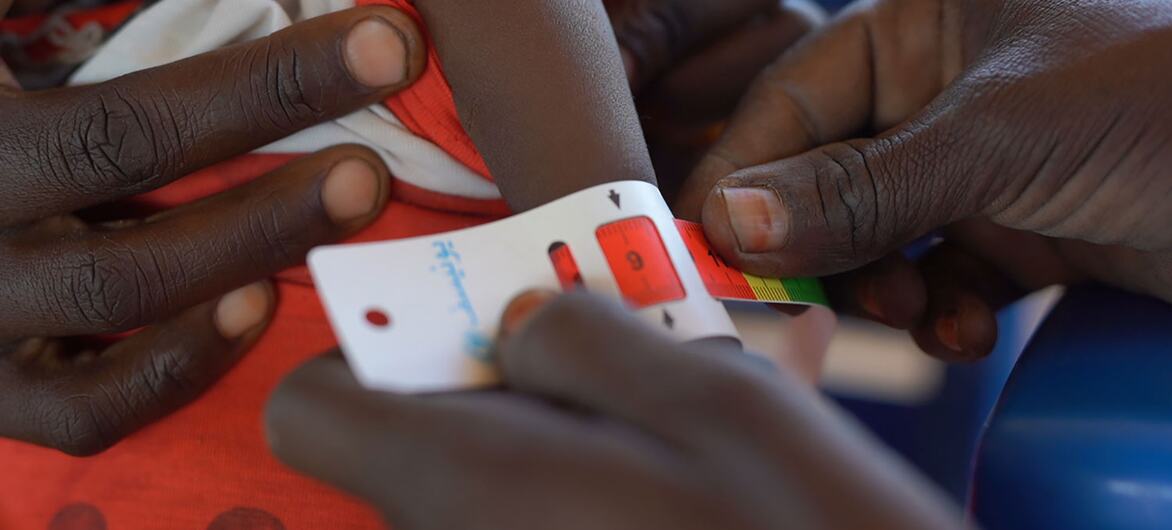
A child is screened for malnutrition at a UNICEF-supported nutrition center in North Darfur, Sudan, December 2025. The color red signifies severe acute malnutrition (SAM).
Access remains severely restricted
Humanitarian access remains one of the biggest obstacles.
On December 26, after lengthy negotiations, a UN team conducted its first security assessment in El Fasher since the siege began, spending several hours visiting the Saudi hospital and speaking with residents trapped in the city.
UN staff reported a severe lack of basic supplies and services.
Humanitarian convoys carrying food and medical aid have been prevented from entering El Fasher for months, forcing hundreds of thousands of civilians to flee while those who remain face extreme deprivation.
Refugee flows to Chad continue
As conditions deteriorate, movement outside Sudan’s borders is accelerating.
The Office of the United Nations High Commissioner for Refugees (UNHCR) reported that nearly 19,400 Sudanese refugees have crossed the border into eastern Chad since attacks intensified around El Fasher in late October.
Women and children make up 87 percent of new arrivalsMany arrive at the border exhausted and traumatized after fleeing violence, sexual abuse and extortion. Since the end of October, more than 2,700 unaccompanied or separated children and more than 1,100 people with disabilities have been registered.
Despite insecurity and movement restrictions along main roads, an average of around 250 refugees per day have entered Chad in recent weeks. UNHCR warned that cross-border movements expected to continue as fighting, economic collapse and protection risks intensify.
A recent security incident at the Tiné border post – where a Sudanese army drone struck a position held by Chadian troops – briefly forced the suspension of humanitarian activities, highlighting the unstable conditions under which aid is delivered.
Originally published at Almouwatin.com