


The essential elements for survival in the town invaded by paramilitary fighters in October were “completely erased”UN humanitarian workers warned on Friday.
“What little is known at this time about the current conditions in El Fasher is indeed beyond horrific,” said Ross Smith, director of emergency preparedness and response at the World Food Program (PAM). “We know that between 70 and 100,000 people could be stuck inside the city itself.”
Fighters from the paramilitary Rapid Support Forces, at war with the Sudanese army since April 2023, invaded El Fasher – the regional capital of North Darfur – in October, after a 500-day siege.
The ordeal was reducing people to eating peanut shells and animal food, the U.N. human rights office warned at the time, while satellite images showed bloodstains from massacres of civilians and executions based on ethnicity.
Access agreement
Guaranteeing access for humanitarian teams remains an urgent priority, humanitarian agencies insist, amid network outages that have largely cut off communication with those remaining in El Fasher.
Testimonies from survivors “describe the city as a crime scene with massacres, burned bodies, abandoned markets,” Smith said.
“We are asking and we continue to ask for unhindered access to El Fasher to urgently respond to those who remain stuck in the city,” stressed the WFP official.
“I understand from yesterday’s discussions that we have an agreement in principle with the Rapid Support Forces on a set of minimum conditions for entering the city; so we anticipate being able to do that very soon, to do some initial assessments and reconnaissance. After more than a year and a half of siege, the essential elements for survival have been completely wiped out.”
Desert town becomes ‘huge’ displaced persons camp
Mr Smith noted that those who managed to flee El Fasher risked their lives along roads “littered with mines” and unexploded ordnance.
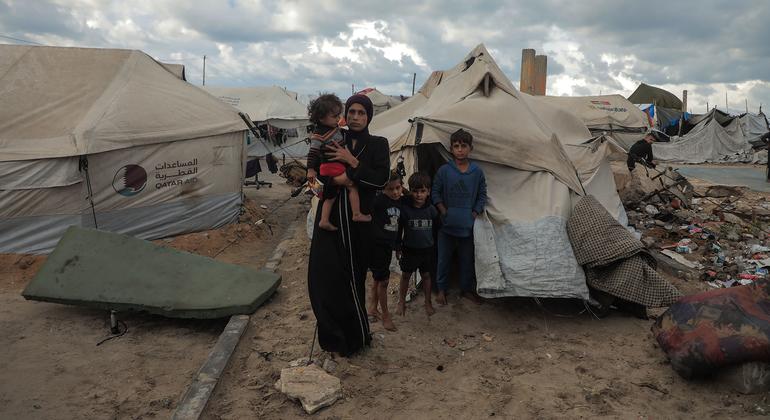
Many have found refuge in Tawila – until recently a small desert town but now “a sprawling, massive displacement camp” for more than 650,000 people, equivalent to the size of Luxembourg. Others sought refuge in Ad Dabbah in the Northern State.
As humanitarian teams and UN partners continue to push for access to all those in need, WFP-supported convoys are “now on their way to Tawila, with enough room for 700,000 people for the next month”, Smith said.
“These are families who have endured many months of starvation and mass atrocities and are now living in overcrowded conditions with very limited support. There is not enough shelter for people, many are living in makeshift structures: structures made of grass, straw, etc. Cholera and epidemics are widespread.”
12 million people displaced
Sudan has the world’s largest displacement crisis, with more than 12 million people uprooted inside and outside the country.
Meanwhile, a worrying situation update from the United Nations refugee agency, UNHCRconfirmed on Friday that the security situation in neighboring Kordofan has further deteriorated since December 1.
After a week of heavy fighting, the RSF reportedly took control of a Sudanese armed forces base in Babanusa, West Kordofan.
In Southern Kordofan, “civilians remain trapped in besieged towns such as Kadugli and Dilling, and while women, children and the elderly find ways to escape, men and youth are often left behind due to the specific high risks they face along escape routes, such as detention by armed groups due to their suspected affiliation with parties to the conflict,” UNHCR said.
The latest data shows more than 40,000 people displaced from North Kordofan since November 18. “UNHCR, through its partners on the ground, is responding to the urgent needs of displaced people, but access remains difficult and resources are extremely low,” the statement said.
Originally published at Almouwatin.com