

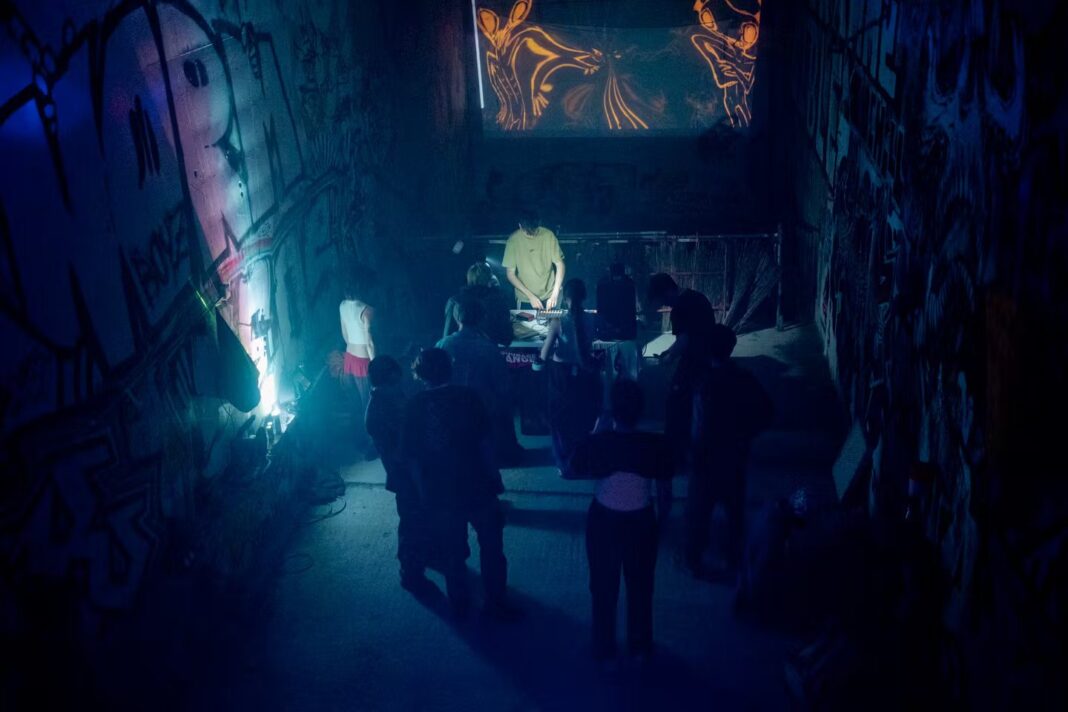

Citing the nuisance caused to local residents, particularly farmers, the National Assembly adopted, on Thursday April 9, a reinforced arsenal of sanctions against free parties, to the great dismay of left-wing groups and actors in the community, who denounce a security offensive against counter-culture models.
The bill, defended by MP (Maine-et-Loire, Horizons) Laetitia Saint-Paul during a day reserved for her group, was adopted at first reading by 78 votes to 67, with the support of the government camp and the far right. The text will now have to go to the Senate.
Denying any desire to “stigmatize a culture and the music that relates to it”, Laetitia Saint-Paul called for “ensuring that no event organization (…) frees itself from our common rules. »
In a dissonant Hemicycle, the debates pitted MPs denouncing the damage caused by these illegal techno gatherings, particularly for farmers’ fields, to those defending “a way of approaching the party in a non-commercial manner”, in the words of MP (Loire-Atlantique, La France insoumise) Andy Kerbrat. “Prefectural authorizations” are not given, he said, accusing the State of organizing “the illegality of free parties”.
The adopted text provides for a penalty of up to six months in prison and a fine of 30,000 euros against “contributing directly or indirectly to the preparation, implementation or smooth running” of an undeclared or prohibited free party.
“Authoritarianism”
A broad definition, necessary given the difficulty of identifying the organizers, according to Laetitia Saint-Paul. Who made a concession: people “intervening exclusively within the framework of risk reduction actions” cannot be considered as contributing to the organization. An LFI amendment was added to the list of people helping to install “a resting place” or “a catering truck”.
Also read the report (2025) | Article reserved for our subscribers Free parties, “extremely political” self-managed evenings, far from institutionalized clubs
In addition to the mandatory confiscation of equipment, the text creates a fine of 1,500 euros for simple participants (up to 3,000 euros in the event of a repeat offense). Currently, organizers face a fine of 1,500 euros, but there is no specific offense penalizing participation. “Insufficiently dissuasive” sanctions, for the Minister for the Interior Marie-Pierre Vedrenne, for whom France thus attracts revelers from countries with less flexible legislation.
Newsletter
” Policy “
Every week, “Le Monde” analyzes current political issues for you
Register
Free parties, which advocate free access or free donation, are often held over several days in fields or abandoned places, and are characterized by their illegality. Unlike rave parties, which now designate declared parties, with ticketing. Many free parties take place without incident, but nuisances (noise, degraded terrain, etc.) and slippage (excess of drugs) are blamed on these parties, which also mobilize emergency services and law enforcement. In 2025, in Aude, one of them caused clashes between farmers and “teufeurs”.
Also read the column (2025) | Article reserved for our subscribers Alexandre Grondeau, academic: “Rave parties are a citizen and collaborative response from part of the youth to a worrying social reality”
“10,000 squatters are transforming our countryside into giant latrines. And it’s a cultural expression,” quipped Eric Michoux (Saône-et-Loire, Union of Rights for the Republic), criticizing “vandalism.”
On the contrary, the signatories of a column in Télérama, including the Technopol association for the defense of electronic music, retort that a “policy which criminalizes and so violently represses free partying” is “not security” but “authoritarianism”. “Pushing the party even further underground aggravates exactly what we claim to be fighting,” they argue. Participants no longer call for help. »
The threshold requiring a declaration to the prefecture lowered
The question of the number of participants from which a free party is considered illegal also worries the community a lot. The text lowers the threshold above which a declaration to the prefecture must be made to 250 participants (compared to 500 currently). However, these events bring together an average of 300 people, according to Laetitia Saint-Paul.
But below 500 people, “there are very few problems”, underlined Paul Christophle (Drôme, Socialist Party). Above all, “sanctioning simple participants is a dangerous legal shift,” he added.
Read also | Article reserved for our subscribers Laurent Nuñez draws his Ripost law, a catalog of measures to create a double “shock of authority and efficiency”
The minister recalled that the government had planned to “go even further” with its Ripost bill, which must be examined in the Senate in May. This provides for a penalty of up to two years in prison and a fine of 30,000 euros for the organization of these events. An offense of participation would also be created, punishable by a fine of up to 300 euros.
It is difficult to assess the annual number of free parties, which are essentially off the radar: between a few hundred according to the gendarmerie and a few thousand according to the associations.
Originally published at Almouwatin.com