Security Council LIVE: Ambassadors meet as West Bank tensions rise, Gaza plan stalls
UN Warns West Bank Violence Is Eroding Peace Prospects
Security Council hears that settlement expansion, settler attacks and unfinished Gaza peace measures are putting renewed pressure on the two-state solution
The United Nations has warned that developments in the occupied West Bank and the stalled implementation of the Gaza peace plan are placing an already fragile political process under growing strain. At a Security Council meeting on 28 September, UN officials reported unprecedented levels of settler violence, thousands of new settlement units moving through Israeli planning procedures and continuing civilian deaths in Gaza despite the October 2025 ceasefire. Israel told the Council that Palestinian attacks and the continued presence of Hamas remain central obstacles to peace and insisted that violence by both Israelis and Palestinians should be condemned.
Two fronts of the same crisis
The meeting came almost a decade after the adoption of UN Security Council Resolution 2334, which states that Israeli settlements in the Palestinian territory occupied since 1967, including East Jerusalem, have “no legal validity” and calls on Israel to cease settlement activity.
Presenting the Secretary-General’s thirty-ninth report on the resolution, acting UN Special Coordinator for the Middle East Peace Process Ramiz Alakbarov said settlement activity had continued “at high levels”.
According to the UN briefing to the Security Council, Israeli planning authorities advanced or approved nearly 4,570 housing units in Area C of the West Bank during the reporting period from 13 June to 18 September, together with another 3,515 units in East Jerusalem.
Israel’s Housing Ministry also published tenders for almost 2,240 homes in Area C, including 1,234 units in the E1 area close to Jerusalem.
The E1 project has become one of the central international concerns surrounding settlement expansion. UN officials say development there would further separate East Jerusalem from the rest of the West Bank and weaken territorial continuity between its northern and southern parts.
France, Germany, Italy, the Netherlands, Norway and the United Kingdom issued a joint statement opposing the E1 project in August, arguing that it would undermine the territorial basis of a future Palestinian state.
Settler violence reaches unprecedented levels
The UN also reported a sharp rise in violence involving Israeli settlers.
During the latest reporting period, the organization documented 630 settler attacks resulting in casualties, property damage or both. Eleven Palestinians were killed, 430 were injured and 343 people were displaced across 17 communities, according to Alakbarov.
Three Palestinian communities were completely depopulated during that period following sustained settler violence. The UN says 49 communities have now been fully displaced under similar circumstances since January 2023.
Looking at 2026 as a whole, UN News reported more than 1,600 settler attacks, an average of 6.7 incidents per day compared with five per day in 2025. More than 4,300 Palestinians have been displaced during the year, according to figures cited by the UN.
Alakbarov condemned attacks against civilians regardless of the perpetrator. He called on Israeli authorities to protect Palestinians from settler attacks while also stating that Palestinian attacks against Israelis “must also cease” and that perpetrators on all sides should be held accountable.
Israel disputes the UN’s framing
Israel challenged much of the political interpretation presented during the meeting.
Addressing the Council, Israel’s representative said the country condemns violence in the West Bank — referred to by Israel as Judea and Samaria — whether committed by Palestinians or Israelis.
But Israel rejected the argument that Israeli communities in the territory are the fundamental barrier to peace. Its representative said the larger obstacle was the absence of a Palestinian partner committed to peace and focused extensively on attacks against Israelis, the activities of Hamas and alleged Iranian support for armed Palestinian groups.
Israel also called for Hamas to be disarmed and accused the Palestinian Authority of failing to carry out sufficient reforms and of continuing policies that Israel says incentivise attacks against Israelis.
The United States similarly told the Council that the complete disarmament and demobilisation of Hamas was essential to implementing the Gaza plan. At the same time, Washington said it opposed Israeli annexation of the West Bank and described stability there as important both for Israeli security and for progress in Gaza.
Gaza ceasefire has not become a durable peace
The situation in Gaza provided the second focus of the Security Council meeting.
The ceasefire that took effect in October 2025 ended large-scale hostilities and led to the return of the remaining Israeli hostages and their remains. However, the later stages of the political and security framework have not been fully implemented.
The Security Council endorsed the US-backed Comprehensive Plan to End the Gaza Conflict through Resolution 2803 in November 2025. The resolution called for the plan to be implemented in its entirety and supported transitional arrangements, including the Board of Peace and an International Stabilization Force.
Nearly a year after the ceasefire, major elements remain unresolved.
Hamas and other Palestinian factions announced on 30 July that they had accepted a 15-point roadmap that included commitments concerning demilitarisation and Israeli withdrawal. Israeli Prime Minister Benjamin Netanyahu said on 9 August that Israel did not accept that roadmap.
Eight days later, Israel and the Board of Peace announced two working groups: one dealing with disarmament and demilitarisation and another addressing water, sanitation and public health.
The central issues — Hamas’ disarmament and a complete Israeli withdrawal — have therefore yet to move into full implementation.
Civilians remain exposed
Meanwhile, violence has continued.
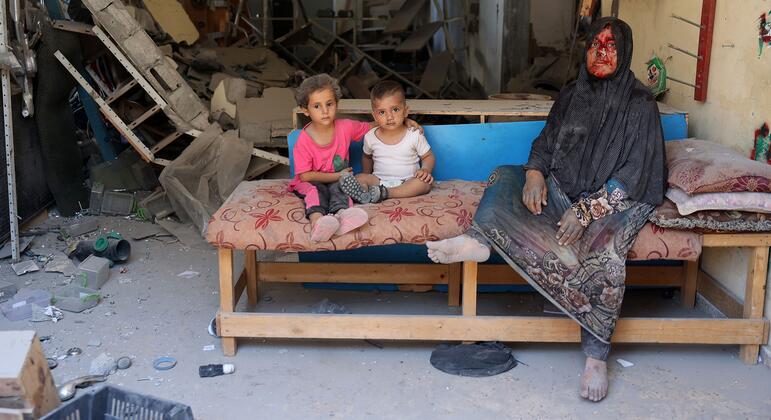
The UN briefing said that Israeli military operations and airstrikes continued during the reporting period. Citing Gaza health authorities, it reported that at least 1,386 Palestinians had been killed since the October 2025 ceasefire, including more than 300 children and 130 women. Israeli sources reported no Israeli fatalities in Gaza during the latest reporting period, although several Israeli soldiers were injured.
The wider humanitarian situation remains severe. The latest UN assessment of Gaza and the West Bank says much of Gaza’s basic infrastructure remains damaged and that reconstruction has yet to reach the scale required.
Water, sanitation, healthcare, housing and electricity remain major concerns. Around two-thirds of Gaza is inaccessible or subject to severe access restrictions, according to the UN report prepared for the Ad Hoc Liaison Committee.
UN News reported that some 94 per cent of Gaza’s population requires shelter assistance.
European governments increase pressure over settlements
The Security Council debate is also increasingly connected to European policy.
On 8 September, the foreign ministers of Canada, Denmark, Finland, France, Iceland, Ireland, Norway, Poland, Portugal, Spain, Sweden and the United Kingdom issued a joint declaration on the two-state solution.
The governments said they intended either to introduce national restrictions on trade with Israeli settlements, support restrictions at European level, or actively consider such measures.
The declaration also recognised Israel’s security concerns, condemned the Hamas attacks of 7 October 2023 and reaffirmed support for two states living alongside each other in peace and security.
The UN briefing noted that several European governments have already moved towards differentiating economically between Israel and settlements in occupied territory, reflecting the requirement contained in Resolution 2334 for states to distinguish between Israel and territories occupied since 1967.
A narrowing political horizon
The Security Council discussion showed that significant areas of disagreement remain over responsibility for the continued conflict.
Israel argues that Palestinian militancy, Hamas’ continued armed presence and failures of Palestinian governance remain fundamental security obstacles. UN officials and several Council members focused heavily on settlement expansion, settler violence, displacement and measures weakening the Palestinian Authority.
Yet there was also considerable overlap around several immediate issues: Hamas must relinquish its military role under the Gaza plan; violence against civilians must stop; Palestinian governing institutions require reform and stability; and the ceasefire must be turned into a functioning political process.
For the UN, the concern is that events on the ground are moving faster than diplomacy.
With the tenth anniversary of Resolution 2334 approaching in December, Alakbarov warned that continued settlement expansion, violence and displacement are steadily reducing the physical and political space in which a negotiated two-state settlement could eventually be implemented.