Latvia Heads to Polls Under Tight Security
A fragmented contest and foreign-interference concerns place coalition arithmetic at the centre of Saturday’s election
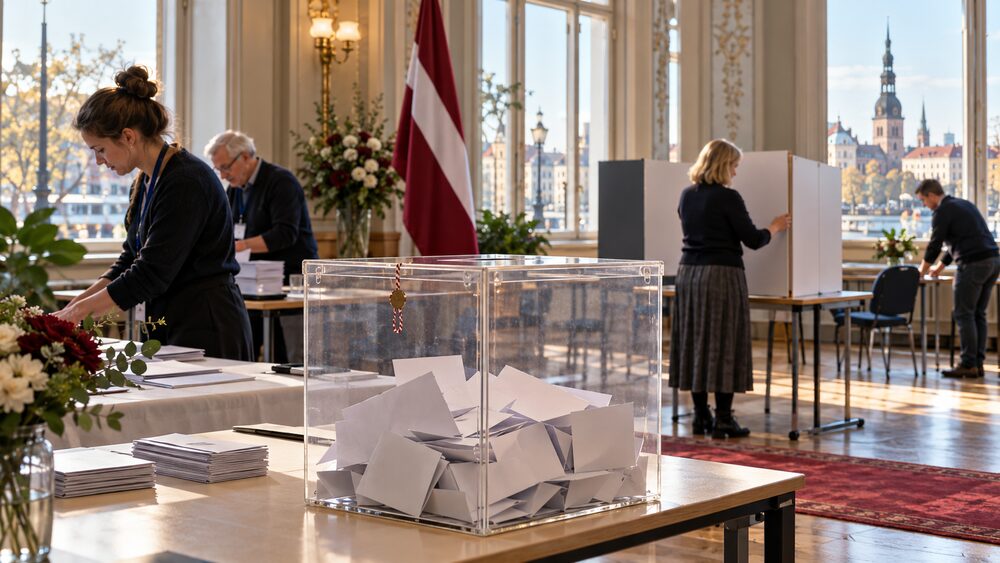
Latvians will elect a new parliament on Saturday after a campaign shaped by living costs, national security and increasingly contested political messages aimed at the country’s Russian-speaking population. Authorities have strengthened safeguards against disinformation and possible provocations, although they say no systematic foreign operation supporting a particular party has been detected.
Polling stations will open from 08:00 to 20:00 local time on 3 October. The final period for depositing ballots in advance runs from noon until 15:00 on Friday. Latvian citizens may vote at any polling station in the country, while 88 stations have been established abroad.
The election will determine all 100 seats in the Saeima, Latvia’s unicameral parliament. Parties must receive at least 5% of the national vote to enter parliament, making small movements around the threshold potentially decisive for the next governing coalition.
A close and fragmented contest
The latest publicly reported SKDS survey placed Prime Minister Andris Kulbergs’s United List first with 14.4% support among all respondents. Sovereign Power/Young Latvians Alliance followed on 9.4%, narrowly ahead of Latvia First on 9.2%.
The Progressives and National Alliance also remained above 5% among all respondents, while New Unity stood below that mark. Once the calculation was restricted to voters who had chosen a party, however, the September SKDS poll indicated that seven lists could enter parliament.
The survey was conducted between 4 and 16 September among 2,035 Latvian citizens. Its findings provide a snapshot rather than a result, particularly in a contest where several parties remain close to the threshold and some voters may decide only after the formal campaign ends.
The arithmetic means that finishing first may not be enough to control the government. The number of parties entering the Saeima will determine how widely the leading groups must negotiate and whether the next coalition can bridge disagreements over economic policy, language, security and relations with Latvia’s eastern neighbours.
Authorities distinguish risk from evidence
Latvia’s proximity to Russia and Belarus has placed election security under intense scrutiny. The country has faced disinformation, pressure along its border with Belarus and wider concerns about sabotage, cyber incidents and airspace violations.
The Latvian State Security Service has introduced enhanced monitoring alongside the police and other public institutions. It has warned that Russia could intensify disinformation against candidates who oppose Moscow’s war against Ukraine. The service is also monitoring possible vote buying, anonymous campaigning, deepfakes and artificially generated political material.
Crucially, its latest assessment draws a distinction between potential threats and confirmed interference. The security service said it had not identified significant and systematic attempts by Russia or another hostile state to influence the result in favour of a specific party or candidate. It said individual instances of election-related disinformation were still being assessed.
Campaigning is prohibited on election day and the day before it. Officials have asked residents to report unlawful political advertising, intimidation, offers of payment for votes and suspected manipulated media. That appeal places part of the protective effort in the hands of voters, journalists and civil society, while requiring the authorities to avoid presenting every disputed political message as foreign interference.
Security and social concerns intersect
Economic management has remained central to the campaign. Parties have debated family support, public services, the difficulties facing the national airline airBaltic and delays affecting Rail Baltica. Security, however, runs through many of those arguments, from defence expenditure and energy resilience to the economic consequences of breaking longstanding commercial ties with Russia.
The campaign has also exposed divisions over language and political representation. Several parties are competing for Russian-speaking voters, some of whom say their social and cultural concerns receive insufficient attention from mainstream parties. Those concerns should not be conflated with support for Kremlin policy, even as investigators scrutinise networks spreading demonstrably false or threatening material.
Pressure on Latvia’s border with Belarus has already brought the country’s security choices into a broader European debate over Schengen, migration and fundamental rights. As The European Times previously reported, Riga’s response must reconcile legitimate security concerns with legal safeguards and humane treatment.
Provisional election results are expected after polling stations close, with counting continuing into Sunday. The formal result will answer which parties have entered parliament. Negotiations in the days that follow will determine whether Latvia emerges with a stable government capable of addressing both external pressure and the domestic grievances that shaped the campaign.