


Reducing pollution, in line with the EU Zero Pollution action plan, could improve mental health across Europe, according to an EEA briefing published today. The publication covers the links between air pollution, noise and chemical pollution to mental health issues, as well as opportunities for action – including the positive effects of nature-based solutions on mental wellbeing.
A significant correlation between exposure to pollution (especially air, noise and chemicals) and mental health issues is emerging in scientific studies, even though more research is needed to establish a clear causality link, reveals the EEA briefing ‘Pollution and mental health: current scientific evidence’. Mental health disorders originate from a multitude of factors (genetics, social and economic determinants, psychological, lifestyle, etc.) some of them not yet completely understood. Pollution is increasingly being examined as one such contributing factor.
Europe has been experiencing a significant increase in the prevalence and incidence of mental health disorders in the past 25 years. Mental health disorders accounted for the sixth largest burden of disease in the EU in 2023, and represented the eighth most common cause of death.
A few examples covered by the briefing, where pollution is correlated with mental health issues:
Air pollution:
- outdoor air pollution during critical stages of brain development — for example in utero, childhood and early adolescence — is associated with structural and functional brain changes.
- long-term exposure to poor air quality (mainly PM2.5 and NO2) is linked to an increased prevalence or risk of new onset depression
- short-term peaks of exposure are associated with worsening schizophrenia symptoms;
Fig. 1 Links between air pollution and mental health disorders.
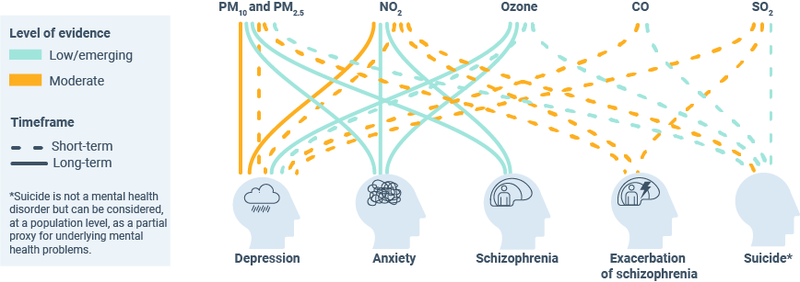
Notes: abbreviations: PM2.5 = particulate matter with a diameter under 2.5 micrometres; PM10 = particulate matter with a diameter under 10 micrometres; NO2 = nitrogen dioxide; SO2 = sulphur dioxide; CO = carbon monoxide. Source: comprehensive review of the literature, with a particular focus on systematic reviews and meta-analyses carried out by the European Topic Centre on Human Health and the Environment (ETC HE, 2026).
Environmental noise:
- an increase in road-traffic noise is correlated with a small increase in the risk of depression (3%) and anxiety (2%);
- exposure to environmental noise is associated with a higher prevalence of behavioural issues in children; this in turn affects their mental well-being;
- there is a significant 2.2% increase in suicide rates per 10dB increase in railway noise.
- a meta-analysis found a 12% increase in depression risk per 10dB Lden increase in aircraft noise.
Fig. 2 Links between environmental noise pollution and mental health issues
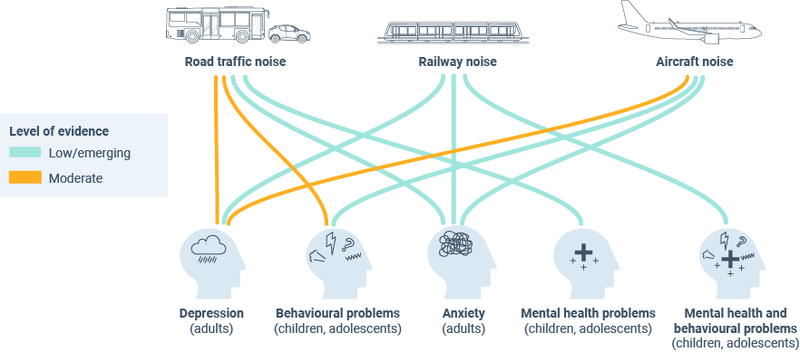
Source: ETC HE, 2026.
Chemicals:
- prenatal or childhood exposure to Pb is associated with both depression and schizophrenia;
- exposure to second hand smoke is consistently linked to depression and schizophrenia, especially in vulnerable groups like children and pregnant women;
- studies found an association between prenatal BPA exposure and depression as well as anxiety in childhood.
Fig. 3 Links between chemical pollution and mental health issues.
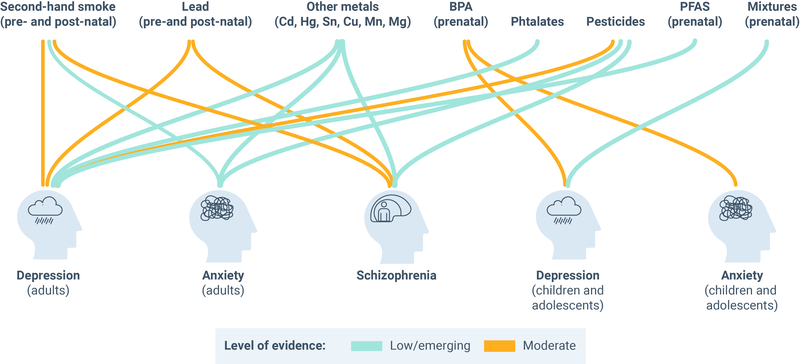
Notes: Abbreviations: SHS = second-hand smoke; Cd = cadmium; Hg = mercury; Sn = tin; Cu = copper; Mn = manganese; Mg = magnesium; BPA = bisphenol A; PFAS = per- and polyfluoroalkyl substances.
Sources: ETC HE, 2024, 2026.
Opportunities for action
While further research is needed to clarify causality, the existing evidence strengthens the case for full implementation of EU legislation and further reductions in pollution exposure.
The findings reinforce the relevance of the One Health approach, which recognises the interconnectedness of human, animal and environmental health. That doesn’t apply only to reducing pollution. Nature-based solutions can, in fact, be used to promote mental health, physical activity and social cohesion through access to green and blue spaces (activities on water or around water). Nature-based therapeutic approaches have been developed in recent decades: gardening, green exercise, forest-bathing have been shown to have some beneficial effects on mental health.
Delivering on the objectives of the EU Zero Pollution Action Plan, by reducing pollution and expanding access to nature could contribute to improved mental wellbeing for millions of Europeans.
Related content can be found here: Climate change impacts on mental health in Europe; Impact of air pollution on mental health (signal).