

On the front page of the press this Friday, May 1, 2026: a Prime Minister in difficulty, hybrid wars and a history of familiarity.
The +: Receive the France 24 Press Review every morning on your iPhone or any other mobile. And also always on your PC by becoming a fan on Facebook…
Anger does not subside in the United Kingdom after the anti-Semitic knife attack in a Jewish neighborhood of London. The Guardian looks at Prime Minister Keir Starmer’s reaction with a trip in support of the targeted Jewish community.
The Daily Telegraph gives us another, more critical view of this visit and shows us photos of hostile demonstrators. According to them, Labor is responsible for this attack. The Daily Mail wonders, for its part, why the suspect was able to move freely, when he had already been arrested in 2008 for stabbing a police officer.
For the New York Times, these anti-Semitic attacks in the United Kingdom, France or the Netherlands could be a form of “hybrid war”. The often young authors are recruited against a promise of money on social networks by an Islamic group, Hayi. According to the daily, Iran could be behind the latter. The goal: to establish fear in Western societies.
Ukraine, laboratory of the Russian defense industry
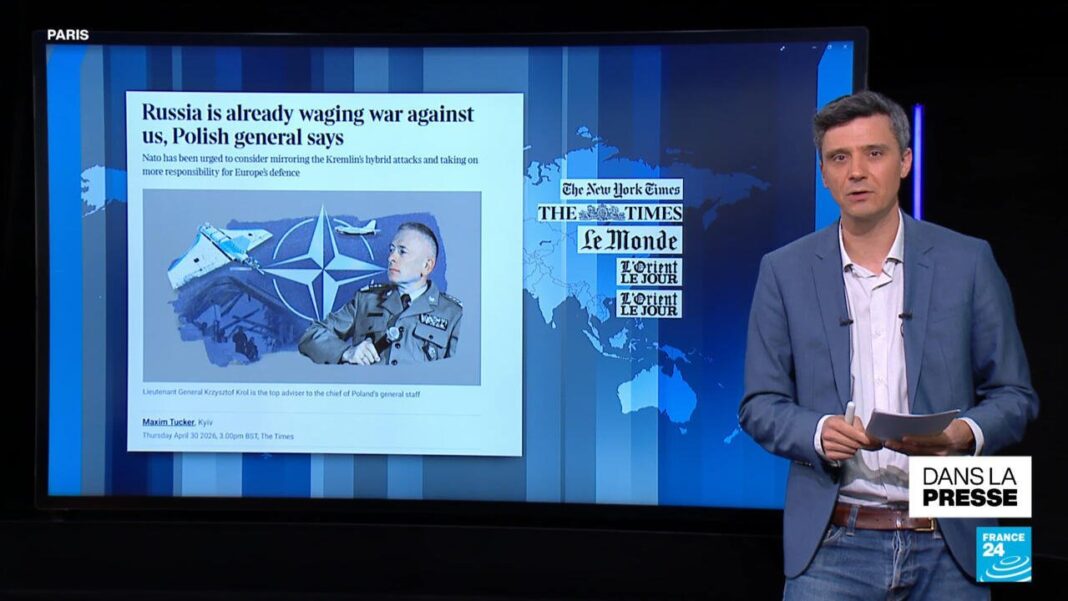
Hybrid warfare is also a method used by Russia in Poland, writes The Times. Sabotage of the railway network, drone flights, hacker attacks on energy networks… Russia is on the offensive, worries a Polish general. He calls on NATO to take urgent measures.
Le Monde explains to us that Ukraine has become a laboratory for the defense industry. kyiv now produces millions of drones per year. 4 million and 2025 and 7 planned for this year. An expertise that Ukraine skillfully exports in return for support in other areas. Today, drones, Le Monde tells us, are responsible for 80% of deaths and injuries on both camps. Drones are also used, L’Orient-le-Jour tells us, by Hezbollah against the Israeli army in southern Lebanon.
Finally, Le Temps offers us on May 1st, a short history of familiarity in business. More and more people use informal terms in the Swiss professional environment, indicates the daily, as in Latin or Anglo-Saxon countries. So behind the amusing side of this article, there is a real question: does using informal terms in the professional environment improve working conditions?… Not really, time tells us, it doesn’t change anything.
Find the Press Review every morning on France 24 (Monday to Friday, at 7:20 a.m. and 9:20 a.m. Paris time). Also follow the Revue des Hebdos every weekend in multicast.
Originally published at Almouwatin.com