
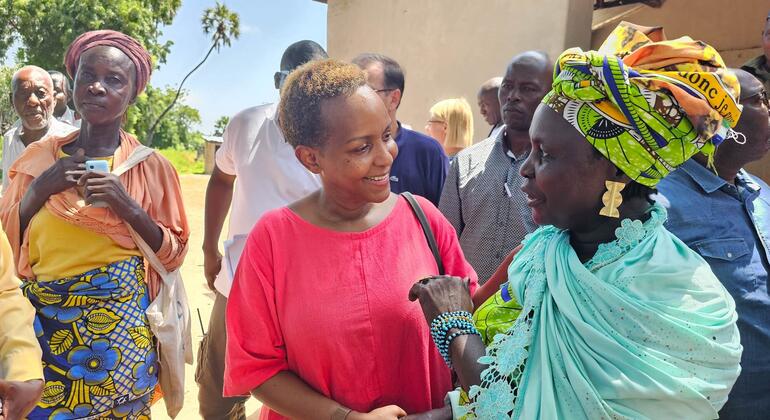

“It has been the privilege of a lifetime to serve humanity,” said Joyce Msuya, who spent the past four years as the Assistant Secretary-General and Deputy Emergency Relief Coordinator in the UN Office for the Coordination of Humanitarian Affairs (OCHA).
In an exclusive interview with UN News, she highlighted the critical role played by humanitarians in a “collapsing” world and the challenge of advocating before a divided Security Council for safe access to civilians in the Gaza Strip.
Ms. Msuya, who is from Tanzania, was also inspired by her interactions with young people over the years – even when they asked “uncomfortable” questions about the UN’s response in conflict situations.
She encouraged them to lend support to the world body and the principle of multilateralism which are so under threat.
“What has kept me grounded is to always think about the internally displaced people, the persons we are trying to serve,” she said. “And that is a very noble cause – a gift of service to humanity that I hope especially the young generation will aspire to do.”
This interview has been edited for clarity and length
Joyce Msuya: Three things come to my mind as I’ve had a bit of time to reflect. One is the privilege I’ve had to serve humanity in this role. I joined OCHA six days before the Ukraine war started in February 2022 and even then, I thought gosh, the world was collapsing. So, just being in this role and seeing three major wars – Ukraine, Gaza, and then more recently, Iran – has been quite a humbling experience, but also very motivating to see the power and the contribution that the United Nations and the humanitarian community at large, including NGOs, can play.
The second is being in this role as someone from the Global South. I didn’t know what that meant as a platform, and that has been incredibly, a gift of service for me personally, and I really hope that has opened doors and will open doors for others.
Lastly, is just seeing the investments that funding partners are putting in, but also the suffering of people in all the countries where I’ve travelled. I used to take some things for granted and now I have a very deep appreciation of what suffering really means for people.
UN News: You have visited 30 countries, probably more. Is there a particular story or encounter that has remained in your mind?
Joyce Msuyua: I remember visiting an internally displaced camp in the northern part of Yemen. I met a woman, a mother of four, who was in her thirties.
She told me that she had never had a stable life. She’s been moving from one place to another because of the war. But what struck me was how kind and giving she was, despite the incredible pain that I could not imagine as a mother that she went through.
In talking to her, I realised her own aspirations for her children were very similar to my own aspirations for my own children – peace, education and stability. For me, that was the lesson, that we as human beings have more in common than in difference. And I’ve always carried that and will always carry that message with me as I exit this particular role.
Joyce Msuya (right) UN Deputy Emergency Relief Coordinator, briefs the Security Council meeting on the Middle East.
UN News: You have also briefed the United Nations Security Council more than 40 times, an average of almost once every month. Which briefing was the most difficult for you, and why?
Joyce Msuya: The Security Council is an absolute central body for the United Nations. When I joined OCHA, it was a Monday, and then the following day I was asked to brief the Security Council on Syria, my first briefing. I remember pinching myself sitting in that chamber thinking, ‘Wow, what a privilege, what an honour.’
I would say probably the most difficult part of my briefings to the Security Council were around the humanitarian crisis in Gaza.
We were advocating for operational humanitarian space in the context where there was a global fracture of the big powers. And whenever I was in the chamber to advocate for humanitarian work and to report on the progress, I carried the perspectives of humanitarians who had lost their lives while trying to save others; OCHA staff who were still sacrificing a lot, especially national staff.
Some of them I knew through the interactions who had lost family members, children separated from their families, and yet they showed up every single day to serve others.
I think third is the lack of respect for international humanitarian law. Even though we advocated – and the Secretary-General, the Emergency Relief Coordinator and the whole sector were very clear, but really to see the impunity that came with that.
What gave me hope was the whole multilateral [system] supporting humanitarian work, speaking up even when it was tough to do so.
UN News: Records also show that you held nearly 20 meetings with students in different countries. What is one message or insight from those students that has stayed with you and that you believe the international community should hear?
Joyce Msuya: I always strive to engage with students. I find their thinking, their curiosity and their questions very refreshing, very difficult, and very uncomfortable because they are not tainted by some of the organisational stuff that older people have.
I overprepared when I met with the students because I felt you just don’t know what question they have.
I remember being in Tokyo at a university and some of the students were saying ‘Why should we believe in the United Nations whilst you said ‘x’ in this war, and you stayed quiet on another?’ For me, it was an opportunity to engage in a very open and candid way with the young generation.
Second for me was to unpack the journey of being an international civil servant. There were lots of questions, including from girls, about how did I get to where I am and how do I stay grounded, and some very personal questions, for example, on family.
So, using my platform to inspire the younger generation – to join in with multilateralism – to support the United Nations.
And the third is I’ve learned that because of technology, young people are more connected than we thought. Whether I’m speaking in Tokyo or in Mozambique or in Kenya, there’s some commonality, common threads, thanks to social media, to news, et cetera, which is good and bad: good because they get a lot of information from social media and the networks, but also bad as sometimes there is misinformation and disinformation.
Our role is to help them filter what is reality, what is not, using data and evidence.
UN Assistant Secretary-General for Humanitarian Affairs Joyce Msuya sitting with Al Naser School students inside a tent during her visit to Al Sumya IDP Camp in Marib, Yemen.
UN News: Finally, what is your personal message to the world?
Joyce Msuya: I would say three personal messages, and one is also inspired by the Secretary-General.
The United Nations has an important role to play, so please support multilateralism – get engaged, be informed. This is your body as much as it is for us who are serving.
I always say – including to the critics – think about if the United Nations was not there, what would happen, whether it’s in Gaza, in the humanitarian sector, the Democratic Republic of the Congo, Sudan, Yemen, Syria, on and on. The power of multilateralism as our collective organization is key.
Second, let’s not forget what service is, especially in the humanitarian sector. What has kept me grounded is to always think about the internally displaced people, the people we are trying to serve. And that is a very noble cause – a gift of service to humanity that I hope especially the young generation will aspire to do.
And lastly, deepest thanks to every person, every government, every community, the whole sector, strangers whom I’ve met who have prayed for me, who have supported me. It has been the privilege of a lifetime to serve humanity.