Bavaria’s New Dialogue Promise Comes With a Difficult Question
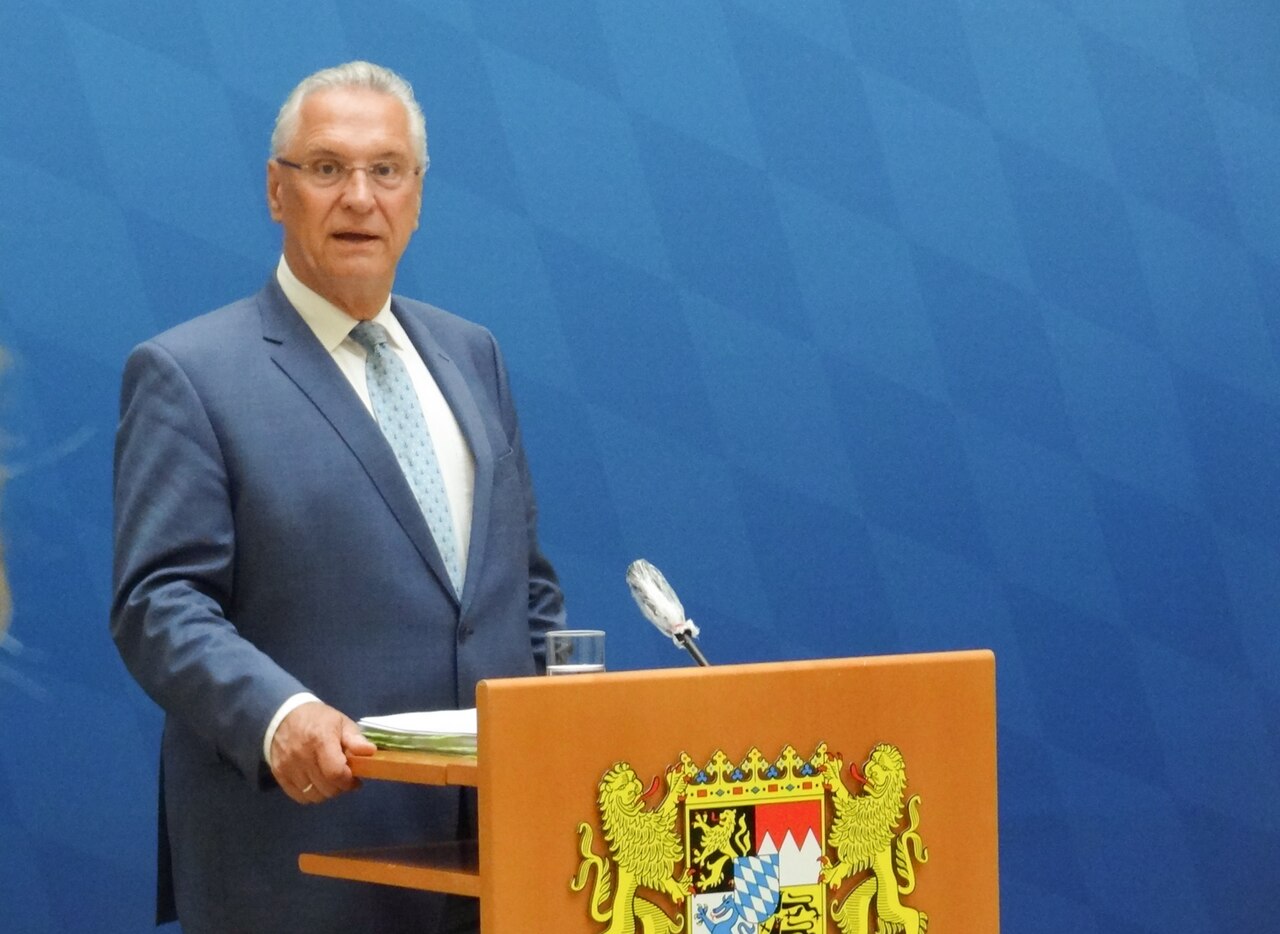
When Bavaria’s Interior Minister Joachim Herrmann presented the new declaration of the “Religion and Integration Dialogue Forum,” the image was carefully composed: religious leaders and state representatives standing together against hatred, incitement and discrimination.
The message was timely. Germany, like much of Europe, is facing sharper social tensions, rising antisemitism, anti-Muslim hostility, online radicalization, disinformation and public debate increasingly shaped by identity conflict. In that climate, a state-backed call for interreligious dialogue is not meaningless. It can matter.
The Bavarian Interior Ministry described the forum as a platform for dialogue among religious communities, universities, institutions, public administration and politics. Herrmann said the forum should support democracy, integration and social cohesion, and he praised the declaration as a common stand against hatred, incitement and discrimination. The Bavarian Interior Ministry’s press release says the forum was created at Herrmann’s initiative and first met in autumn 2025.
The declaration itself uses strong language. It says religions have a key role to play in peaceful coexistence on the basis of Germany’s Basic Law and the Bavarian Constitution. It speaks of human dignity, solidarity, integration and reconciliation. It commits the signatories to remain in constructive exchange even in difficult times and around controversial positions. It promises to oppose antisemitism, anti-Muslim hostility, racism, discrimination, extremist ideologies, religious fundamentalism, hatred and incitement.
Taken at face value, this is a welcome statement. But precisely because the words are good, they invite a harder question: is this a genuine change of political culture, a polished exercise in reputational repair, or a response to the growing international exposure of Germany’s own record on freedom of religion or belief?
That question is not hostile to dialogue. It is the condition for taking dialogue seriously.
The credibility of a declaration against discrimination is not measured only by how warmly the state speaks with religious communities already accepted in public life. It is measured by how the state treats groups that are controversial, unfamiliar, stigmatized or politically inconvenient. Dialogue is easy when everyone around the table already enjoys public respectability. It becomes meaningful only when it reaches those who have long been spoken about rather than spoken with.
This is where Bavaria’s new initiative becomes more than an interfaith ceremony. It becomes a test of institutional memory.
For decades, Germany has not only warned against extremism. It has also developed administrative habits around suspicion: classifications, declarations, public warnings, procurement clauses, educational materials, employment-related checks and loyalty-style forms. Some of these measures were aimed at genuine threats. Others have raised serious questions about neutrality, proportionality and freedom of religion or belief.
The problem is not that a democratic state investigates danger. It must. The problem begins when suspicion becomes detached from concrete conduct and attaches itself instead to identity, affiliation or belief.
One of the clearest examples is the long treatment of Scientologists in Germany. This is not because Scientology is an easy case. It is precisely because it is not. Scientology remains controversial in Germany, and public authorities have long treated it through a security lens. But constitutional rights do not exist only for communities that are broadly understood or widely accepted.
For nearly thirty years, Scientology was subjected to domestic-intelligence scrutiny. Over time, that security framing did not remain confined to intelligence reports. It helped shape wider administrative and social practice.
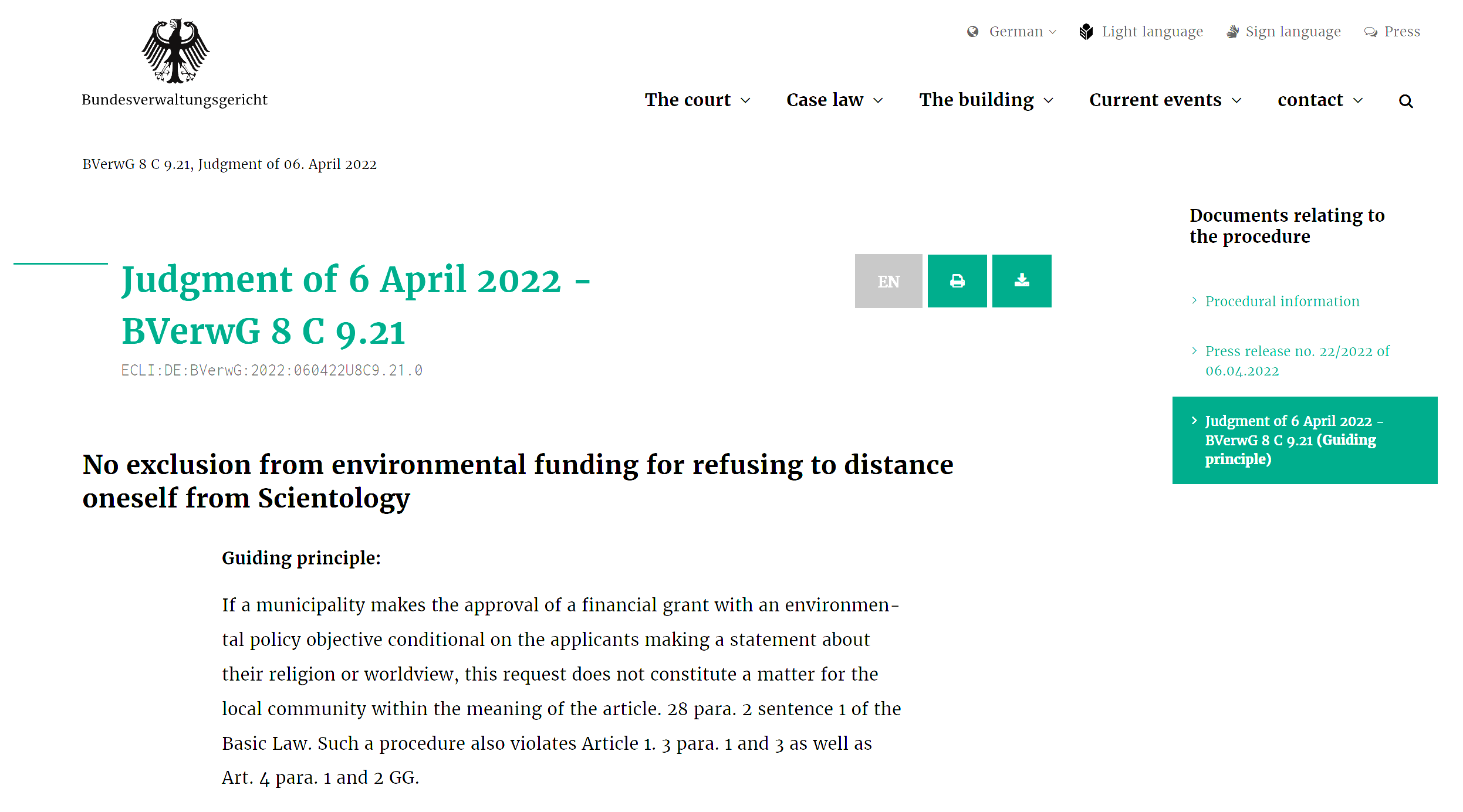
So-called “protective declarations,” often described as “sect filters,” required people, companies or applicants to distance themselves from Scientology or from the teachings of L. Ron Hubbard in order to receive public benefits, contracts or opportunities. In 2022, the Federal Administrative Court described one such Munich declaration: a subsidy applicant was asked to state that she did not apply or disseminate Scientology teachings and did not attend Scientology courses or seminars. The Federal Administrative Court held that Munich could not make an environmental Pedelec subsidy dependent on such a declaration, because the requirement interfered with freedom of religion and worldview and had no proper connection to the environmental purpose of the subsidy.
That ruling mattered because it exposed the logic of the problem. Clean air does not require a religious loyalty test. A person’s eligibility for an environmental subsidy should depend on the subsidy’s purpose, not on whether the applicant signs a declaration about belief, worldview or religious distance.
The same concern has appeared in employment and professional settings. In March 2026, the Bavarian Higher Administrative Court intervened in a case involving a publicly appointed translator whose appointment had been withdrawn after her Scientology membership became known. A summary by the Bavarian State Attorney’s Office states that the reliability of a court translator does not fail merely because of full-time membership in Scientology; it further notes that reliability is not a matter of attitude alone and should not be based solely on faith, political opinion or worldview.
This is the democratic weakness exposed by the courts: suspicion, once institutionalized, can survive long after its factual basis has weakened. It enters forms. It enters funding rules. It enters public procurement. It enters personnel decisions. It enters educational material. Eventually, it begins to look normal.
That is why the role of Bavaria’s Interior Ministry deserves particular scrutiny.
The same minister now presenting a declaration against religious discrimination has also promoted state prevention material warning young people against Scientology. Bavaria’s domestic intelligence office lists Scientology as one theme in its youth-oriented video series, “10 Tipps, wie du dich nicht verarschen lässt” — “10 tips on how not to get fooled.” The official page says the videos are designed to explain extremist strategies to young people and lists Scientology alongside right-wing extremists, Salafists, autonomous left-wing extremists, haters and online trolls. The Bavarian domestic intelligence office’s video page describes the series in precisely those prevention terms.
The Scientology section goes further. It says the film aims to show how Scientology allegedly seeks to draw in young people and gives users tips to avoid falling “into the clutches of Scientologists.” That official wording remains on the Bavarian domestic intelligence website. That is not neutral language. It is the language of warning, suspicion and social avoidance.
In 2020, Herrmann himself presented the brochure “Das System Scientology” and the short film “10 Tipps wie Du Dich nicht verarschen lässt – diesmal von Scientologen.” In his speech, he described both as “important awareness formats” and said the “subtle danger” posed by Scientology could be forgotten amid other threats such as right-wing extremist murder attacks, international Islamist terrorism and growing left-wing extremist violence. The speech is published by the Bavarian Interior Ministry.
The point is not that the state must remain silent about groups it considers problematic. The point is that there is a difference between factual public information and state messaging that encourages young people to see members of a particular religious minority as people to avoid. When the state speaks to school-age audiences, its words carry special weight. It can inform, or it can mark a group socially.
This is where international criticism becomes relevant.
In 2019, two United Nations Special Rapporteurs wrote to Germany about alleged discriminatory measures against Scientologists. Their communication, AL DEU 2/2019, concerned the continued use of Schutzerklärungen in grants and employment. The UN experts said the declarations required applicants to state that they did not use, teach, disseminate or support methods and technology associated with L. Ron Hubbard, and they expressed concern that such measures could prevent access to grants and employment opportunities on the basis of religion or belief.
The UN experts also warned that individuals identifying as Scientologists should not have to endure undue scrutiny or disclose their beliefs unless a legitimate and substantiated reason is provided, with the burden of proof falling on the state. They further warned that measures reinforcing negative stereotypes could conflict with state neutrality, tolerance and equal treatment of religious groups.
In 2023, The European Times published an article titled “Germany: Bavaria and the return of religious cleansing in the EU”. Its language is severe and openly critical; it should be read as advocacy journalism, not as a neutral court finding. But its relevance lies in showing how Bavaria’s practices have been framed abroad: not merely as a domestic dispute about Scientology, but as a European freedom-of-religion problem involving employment, public contracts and access to ordinary civic opportunities.
The article described “sect filters” as declarations used in employment and public procurement, and claimed they affected not only sensitive positions but ordinary jobs and services such as gardeners, trainers, engineers, interpreters, printers, IT experts and suppliers. It also criticized the Bavarian anti-Scientology video as stigmatizing and dehumanizing.
One does not have to adopt every phrase of that article to see why it matters. It shows that Bavaria’s record has become part of an international narrative. The question is no longer only what Bavaria says about religious freedom at home. It is also how Bavaria explains the gap between its new public language of dialogue and its older administrative practice of exclusion.
The timing of the new dialogue declaration therefore cannot be ignored. In 2026, the Federal Office for the Protection of the Constitution ended Scientology’s treatment as a separate nationwide phenomenon area, the Bavarian services have continued the undue surveillance. Legal Tribune Online reported the decision as a significant reclassification after decades of federal observation.
That leaves a deeper question unanswered. If the threat was serious enough to justify decades of public suspicion, millions of tax payers money, youth-warning material, professional consequences and loyalty-style declarations, what concrete danger was finally proven? And if the danger was not proven in the way the public had been led to believe, which seems to be the case (as no evidences nor criminal charges have ever been raised or proven in court) who repairs the damage caused by the suspicion?
This is why Herrmann’s new language deserves both acknowledgment and doubt.
It may be sincere. Bavaria, like every democratic society, needs interreligious dialogue. The state is right to oppose antisemitism, anti-Muslim hostility, racism and religious intolerance. It is right to say that religious communities can contribute to cohesion and peace. The photograph of religious leaders sitting together is not worthless.
But a photograph can also serve another purpose. It can attempt to clean the public face of an institution without changing the institution, as a public relations strategy. It can present tolerance as a public image while older practices remain untouched (as it seems by the Bavarian decision to continue their local surveillance). It can answer international criticism with symbolic inclusion while avoiding the more uncomfortable work of reviewing exclusionary rules.
The difference between sincerity and image-management will be visible only in what happens next.
If Bavaria’s declaration is real, it should lead to a review of every remaining form, funding condition, procurement clause, employment practice and educational material that treats controversial religious affiliation as a proxy for unreliability. Public authorities should ask whether any remaining “sect filter” practice has a concrete, lawful and proportionate connection to the task at hand. They should stop allowing intelligence language to substitute for individual evidence. And they should ensure that state-produced youth materials inform without ridiculing, dehumanizing or socially marking a minority like the Scientologists.
None of this requires Bavaria to endorse Scientology. That is the false choice that has poisoned the discussion for too long. A democratic state may criticize providing it has evidences. It may regulate. It may investigate where proof justifies investigation. It may act where there is concrete danger. But it may not transform a controversial affiliation into a civil disability.
The sentence quoted by Imam Benjamin Idriz at the forum deserves to be taken seriously: those who end dialogue leave the field to the loudest and most radical. He was right. But that principle cannot stop with the communities already invited to the official table. It must also reach those whom the state has historically treated as objects of suspicion.
Bavaria’s declaration may become a turning point. Or it may become a well-lit public-relations gesture by a state that has not yet confronted its own record. The difference will not be found in the photograph from the press conference. It will be found in forms withdrawn, clauses removed, videos reviewed, and citizens judged by conduct rather than label.
A declaration can improve an image. Only policy can repair a record.