
Scientology Volunteers Bring Human Rights Education to Madrid Streets Amid Housing Debate
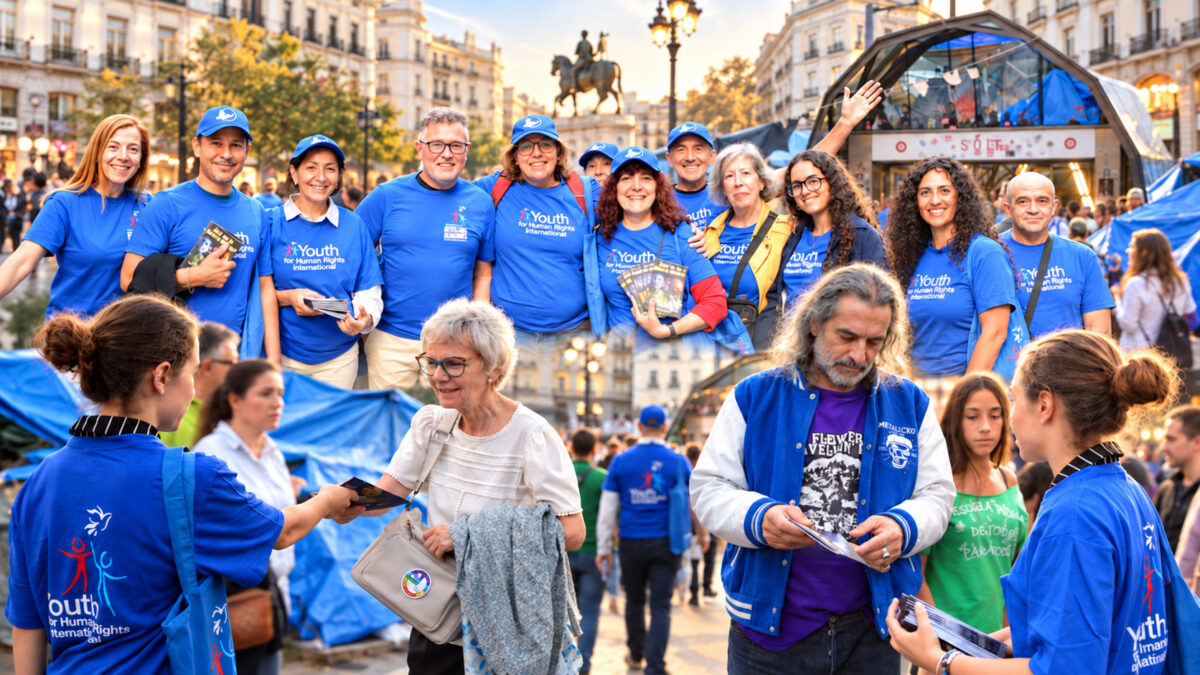
KINGNEWSWIRE // PRESS RELEASE // Volunteers from the Church of Scientology, Youth for Human Rights and Fundación MEJORA distribute educational materials on the Universal Declaration of Human Rights as Spain’s capital faces renewed debate over housing, civic participation and fundamental freedoms.
MADRID, Spain — 19 October 2026 — Volunteers associated with the Church of Scientology of Madrid, Youth for Human Rights and Fundación MEJORA, a Spanish foundation holding Special Consultative Status with the United Nations Economic and Social Council (ECOSOC), have been taking human rights education directly to the streets of the Spanish capital, distributing informational booklets designed to help residents and visitors better understand the 30 articles of the United Nations Universal Declaration of Human Rights.
The initiative forms part of an international educational programme supported by the Church of Scientology, which uses printed materials, audiovisual resources and community outreach to explain fundamental rights in accessible language.
The activity comes at a particularly relevant moment for Madrid, where public debate over housing, evictions and social protections has intensified following weeks of demonstrations and an ongoing protest encampment in Puerta del Sol, one of the city’s best-known public squares.
Although the human rights education initiative is independent of the housing protests, both are taking place against a backdrop of heightened public attention to fundamental rights, civic participation and the responsibilities of democratic institutions.
Bringing the Universal Declaration into Everyday Life
The volunteers are distributing What Are Human Rights?, an educational booklet presenting the 30 articles of the Universal Declaration of Human Rights, adopted by the United Nations General Assembly on 10 December 1948.
The publication explains rights such as equality before the law, freedom of expression, freedom of thought and religion, peaceful assembly, education, and access to an adequate standard of living.
Rather than focusing on a particular political issue, the educational campaign seeks to improve general awareness of the principles contained in the Declaration and their relevance to everyday situations.
The programme is internationally led by Youth for Human Rights International and United for Human Rights, two educational initiatives supported by the Church of Scientology that provide resources for schools, community organisations, volunteers and individuals interested in human rights education.
Their materials include printed booklets, teaching guides, the documentary The Story of Human Rights, and a series of 30 short public service announcements illustrating individual articles of the Declaration through situations intended to be understandable across different cultures and age groups.
The emphasis on accessible educational materials reflects a broader challenge in human rights education: making internationally recognised principles understandable outside specialist legal and institutional settings.
Madrid’s Housing Protests Bring Social Rights into Focus
The distribution campaign coincides with an unusually visible debate over housing rights in Spain.
Since 26 September, demonstrators have maintained an encampment in Madrid’s Puerta del Sol, a central square known internationally for its role in major civic mobilisations, including Spain’s 2011 protest movement.
The protest has drawn attention to rising housing costs, access to affordable accommodation, eviction procedures and the responsibilities of public authorities. It has also prompted political and legal debate over the continued presence of demonstrators in one of Madrid’s principal public spaces.
These developments provide a contemporary illustration of several principles contained in the Universal Declaration.
Article 25 recognises the right of everyone to a standard of living adequate for their health and well-being, including housing, food, clothing, medical care and necessary social services.
Articles 19 and 20 address freedom of expression and peaceful assembly, while Article 1 establishes the principle that all human beings are born free and equal in dignity and rights.
The Declaration itself is not a binding international treaty, but its principles have influenced subsequent international human rights agreements and constitutional frameworks, including those developed across Europe.
The Scientology-supported educational campaign has as its main purpose to make the underlying human rights principles more widely understood, regardless of individual political positions.
Human Rights Education and European Civic Values
Across Europe, the protection of fundamental rights is embedded in institutions and legal frameworks such as the European Convention on Human Rights and the European Union’s Charter of Fundamental Rights.
While these instruments differ in scope and legal application, they share principles with the Universal Declaration, particularly regarding human dignity, equality, fundamental freedoms and protection against discrimination.
For civil society organisations engaged in public education, explaining these principles in accessible terms represents one way of contributing to informed civic participation.
Ivan Arjona, representative of the Church of Scientology to the European Union, OSCE, Council of Europe and United Nations, connected the Madrid initiative with the wider European commitment to human rights.
“Europe’s commitment to human dignity, fundamental freedoms and the rule of law cannot depend solely on institutions or legal texts. It also depends on citizens knowing their rights and respecting those of others. At times of intense public debate, human rights education helps provide a common foundation for civic participation, peaceful disagreement and mutual respect. Making these principles understandable and accessible is a practical contribution that volunteers can make to democratic life.”
The Madrid campaign follows this educational approach by placing information directly in the hands of members of the public, rather than limiting awareness activities to conferences, classrooms or formal events.
An International Programme with Local Participation
Youth for Human Rights International was established in 2001 by educator Dr. Mary Shuttleworth, who grew up in South Africa during apartheid and became involved in educational efforts to increase awareness of fundamental freedoms.
The initiative subsequently developed into an international programme, with educational materials designed for use in a variety of cultural and community settings.
The Church of Scientology has supported the production and distribution of these resources, drawing on the interest in human rights expressed by Scientology founder L. Ron Hubbard.
In a 1969 essay, Hubbard referred to the Universal Declaration of Human Rights and argued for its implementation as a means of protecting individual freedoms and improving relations between governments and citizens.
That emphasis became part of the Church’s subsequent support for humanitarian and educational initiatives, including campaigns addressing human rights awareness, drug prevention and community betterment.
In Spain, the Church of Scientology has maintained a presence since the 1960s and opened its first church in 1980.
Through its Madrid congregation and associated volunteers in numerous other Spanish cities, the Church continues to support community-based educational activities, including the distribution of human rights materials.
The current initiative illustrates how an internationally developed educational programme can be applied at local level, reaching people in ordinary public spaces at a time when questions of dignity, social rights and democratic participation are prominent in public discussion.
About the Church of Scientology in Europe
Founded by L. Ron Hubbard, the Church of Scientology has churches, missions, affiliated groups and members throughout the European continent. Its communities support educational, preventive and humanitarian initiatives addressing human rights awareness, drug prevention, moral education and community betterment. Legal recognition of Scientology as a bona fide religion, and in certain jurisdictions as a charitable or public-benefit religious organisation, has developed through judicial and administrative decisions in several European countries. Its programmes emphasise education, prevention and voluntary participation in initiatives intended to benefit local communities.