Scientology Volunteer Ministers Bring Practical Training and Bosnian Cultural Traditions Together in Sarajevo
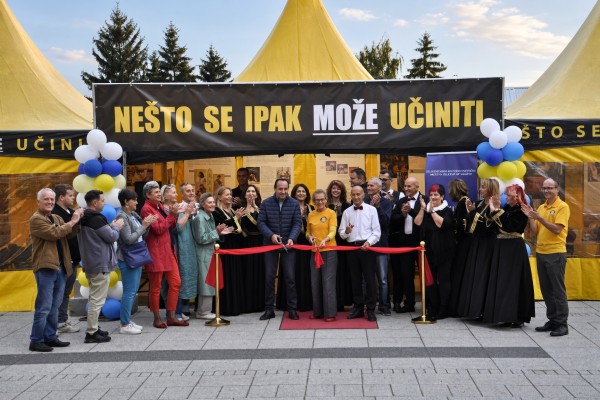
KINGNEWSWIRE // PRESS RELEASE // SARAJEVO, Bosnia and Herzegovina — 29 October 2026 — When rain and falling temperatures forced the opening ceremony of the first Scientology Volunteer Ministers exhibition in Sarajevo indoors, singers in traditional Bosnian dress performed sevdalinka among displays devoted to communication, family relationships and other everyday concerns. The three-day event brought local residents together for free workshops and practical demonstrations, concluding the European Goodwill Tour’s latest visit to Bosnia and Herzegovina.
The exhibition’s distinctive yellow tent, installed in a central square, served as a temporary venue for visitors to explore educational materials, speak with volunteers and learn techniques intended to help people address personal and interpersonal difficulties. It was the tour’s first public exhibition in the Bosnian capital, following five weeks of activities in Mostar earlier in the year.
Bosnian Cultural Heritage at the Opening
The ceremony had originally been scheduled for 5:30 p.m. outdoors, but a sudden change in weather brought guests and performers inside the tent. A local ensemble, wearing traditional Bosnian clothing and accompanied by accordion music, performed two sets of sevdalinka songs and an encore, concluding with pieces dedicated to Sarajevo and Bosnia and Herzegovina.
Sevdalinka, a traditional form of urban folk singing associated with Bosnia’s cultural history, has been transmitted across generations through family and community performances. Its songs frequently explore love, longing and human relationships. In December 2024, UNESCO inscribed sevdalinka on its Representative List of the Intangible Cultural Heritage of Humanity, recognising its cultural significance and its role in connecting communities.
Between performances, Juraj Duna, coordinator of the Scientology Volunteer Ministers European Goodwill Tour, welcomed visitors and introduced the programme’s history. He recalled its previous humanitarian activities in Bosnia and Herzegovina, particularly the assistance provided following the severe floods of 2014.
A Volunteer Minister who had participated in earlier regional activities then joined two local guests to cut the ceremonial ribbon. Visitors subsequently explored the exhibition and attended the first demonstrations.
Visitors Take Part in Practical Seminars
The exhibition presented 19 subjects drawn from The Scientology Handbook, covering communication, study, marriage, raising children, workplace challenges, personal relationships and approaches to resolving difficulties.
The educational materials form part of the Scientology Volunteer Ministers programme, established in the mid-1970s by Scientology founder L. Ron Hubbard. Supported by the Church of Scientology, the initiative provides training in practical and spiritual assistance, both through community exhibitions and during humanitarian emergencies.
In Sarajevo, visitors could watch short instructional films, observe demonstrations and practise selected techniques under the guidance of experienced volunteers.
Some of the most requested sessions concerned Scientology assists, spiritual practices intended to offer comfort and support in circumstances involving stress, tension or discomfort. These practices are part of Scientology’s religious approach to personal assistance and are not medical treatments.
Participants were shown how the techniques are performed before practising them with one another.
“What stood out in Sarajevo was how quickly people moved from watching to doing,” Duna said.
The emphasis on participation distinguished the exhibition from a conventional information display. Visitors were able to discuss their questions directly with volunteers and experience elements of the programme rather than simply reading about them.
The educational sessions were open to the public, regardless of religious affiliation, with participation voluntary.
A Humanitarian Relationship Dating Back to 2014
For the Volunteer Ministers, Bosnia and Herzegovina was not unfamiliar territory.
In May 2014, exceptional rainfall caused extensive flooding and landslides across the country, damaging homes, agricultural land, businesses and public infrastructure. According to the World Bank, approximately one million people were directly affected, with economic damage and losses estimated at $2.8 billion.
Scientology Volunteer Ministers joined relief operations in affected communities, helping residents clear damaged properties and recover belongings and equipment.
One documented intervention took place in Kopanica, where a family farm had been submerged by floodwaters. Volunteers assisted with clearing the property, removing spoiled animal feed and cleaning agricultural buildings so the family could begin restoring its livelihood.
The operation was described in a July 2014 report issued by the Church of Scientology, reflecting the programme’s participation in recovery efforts alongside the wider emergency response.
The 2026 visit focused on a different form of assistance: education for everyday situations rather than immediate disaster relief.
The European Goodwill Tour arrived in Bosnia and Herzegovina on 6 June, spending five weeks in Mostar before proceeding to Sarajevo. Its travelling exhibition gave residents an opportunity to become familiar with subjects taught through the Volunteer Ministers programme, with seminars adapted to participants’ interests.
This dual emphasis on community education and emergency assistance has also been visible elsewhere in Europe. Earlier in September, Scientology Volunteer Ministers held a similar exhibition in Bologna, Italy, where accounts of volunteers assisting communities after floods and earthquakes accompanied public workshops.
The programme’s motto, “Something can be done about it,” reflects Hubbard’s emphasis on an individual’s capacity to take constructive action when confronted with difficulties.
Civic Responsibility and Community Life in Europe
Sarajevo’s history gives particular resonance to activities involving people from different religious and cultural backgrounds. Long associated with Muslim, Orthodox Christian, Catholic and Jewish communities, the city has experienced both traditions of coexistence and the consequences of conflict.
Ivan Arjona, representative of the Church of Scientology to the European Union, OSCE, Council of Europe and United Nations, connected the initiative to the principles of human dignity and civic responsibility.
“Sarajevo’s history and cultural traditions remind us that helping others begins with respect for the people and communities around us,” Arjona said. “Across Europe, human rights, freedom of religion or belief and civic responsibility provide a common foundation for people of different convictions to contribute to society. Voluntary service is one practical way of expressing those values, through assistance freely offered and relationships built on mutual respect.”
The presence of religiously inspired humanitarian organisations in public life is part of Europe’s wider tradition of voluntary association, in which faith communities, secular organisations and individual citizens contribute to local welfare and social initiatives.
For the Church of Scientology, the Volunteer Ministers programme represents one aspect of its broader community activities, alongside educational initiatives addressing human rights awareness, drug prevention and ethical conduct.
Local Interest Continues Beyond the Exhibition
Following the three-day programme, the Volunteer Ministers delivered an additional lecture and workshop on The Cause of Suppression, one of the subjects presented in the exhibition, for members of a local cultural association.
The organisers subsequently received a request to repeat the presentation for a larger audience in Sarajevo.
The European Goodwill Tour concluded its activities in Bosnia and Herzegovina on 8 October before continuing its regional itinerary.
About the Church of Scientology in Europe
The Church of Scientology, founded by L. Ron Hubbard, maintains churches, missions, affiliated groups and communities throughout the European continent. Its members and associated organisations participate in initiatives addressing education, human rights awareness, drug prevention, humanitarian assistance and community betterment. Recognition of Scientology as a bona fide religion, including charitable and public-benefit recognition in various jurisdictions, has developed across Europe through differing national legal frameworks and continues to evolve. Through its religious and social programmes, the Church of Scientology maintains a commitment to education, prevention, voluntary service and constructive participation in European civil society.