Future of Europe – The presidents of the EU institutions pledged to act on citizens’ ideas for EU change after receiving the final report of the Conference on the Future of Europe.
The document, including 49 proposals with more than 300 measures adopted by the Conference plenary on 30 April, was presented at a closing event for the Conference on 9 May – Europe Day – in Strasbourg.
Speaking at the ceremony, Roberta Metsola, President of the European Parliament; Ursula von der Leyen, President of the European Commission; and French president Emmanuel Macron, representing the Council, acknowledged that some of the most ambitious proposals would require changes to the EU treaties.
“We are once again at a defining moment of European integration and no suggestion for change should be off limits. Whatever process is required in order for us to get there should be embraced,” said Metsola.
MEPs already called for the procedure for treaty change to be triggered in a resolution adopted on 4 May. The process might require forming a convention bringing together representatives of the European Parliament, Council and the Commission as well as national parliaments to propose treaty change.
“There is a gap between what people expect and what Europe is able to deliver at the moment. That is why we need a convention as the next step. There are issues that simply cannot wait,” Metsola added.
The way forward
Macron, whose country currently holds the rotating presidency of the Council, said reforming the treaties would allow the EU to “move forward towards more simplicity” and would “provide legitimacy to the democratic control” launched by the Conference.
He spoke in favour of taking decisions by qualified majority rather than unanimity in Council: “We know the way to go: to continue to generalise qualified majority voting in our decisions for our main public policies.”
Commission President von der Leyen pledged to work on new proposals based on the citizens’ recommendations and to present them in September, when she delivers her annual State of the European Union address.
“There is already a lot we can do without delay and that also goes for those recommendations, which will need us to take new action,” she said, stressing that many measures proposed by citizens can already be implemented within the current treaties.
Speakers at the event called for finding ways to directly involve citizens in EU decision-making in a permanent manner.
“It is my firm belief that, beyond elections, we need to institutionalise direct citizens’ participation as an antidote to division in society,” said Conference co-chair Guy Verhofstadt.
Ukraine
The urgency to reform the EU has become even more evident with the Russian war against Ukraine, the presidents of the EU institutions said.
The world now is “more dangerous” and “Europe’s role has changed”, said Metsola. “The future of Europe is tied to the future of Ukraine. The threat we face is real. And the cost of failure is momentous,” she added.
People’s recommendations
The Conference’s final report comes following a year of meetings and grassroots events across the EU, in which hundreds and thousands of people took part. The report is based on ideas submitted on the Conference’s website and recommendations by European and national citizens’ panels.
Proposals include calls for giving the European Parliament a right of legislative initiative, removing unanimity in the Council on foreign policy, establishing a right to health care for all EU citizen, a shift in energy production towards renewables, and improving education on environmental issues, digital technologies, soft skills and EU values.
“When I’m 65, in 2070, I would like to tell my grandchildren that many of the positive changes in Europe emerged from this unique exercise,” said 16-year-old Camille Girard, from France, one of the youngest participants in the Conference.
Every workday, New Jersey construction worker Bud Smith has a coffee break and a lunch break. That leaves him 15- to 30-minute intervals to type up the ideas swirling around in his head.
That’s how Smith, 40, came to write his novel “Teenager,” (Vintage Books) a Bonnie and Clyde-esque teenage love story — which he wrote on his iPhone, mostly while sitting in his work truck, a Chevy Silverado 2500. (“Even at the end of the day when everyone is in line to get out of the parking lot, I sit a little longer and write,” he said.)
The first drafts of all his stories have been born through this process. “Generally, I’ll just use the best tool I have at hand — my phone — because I’m always trying to work on something. It’s all about using everything you have.”
The Jersey City resident has worked in heavy construction since his early 20s, but writing is his lifelong passion.
“I come from a family where everyone has some sort of art project. My parents are blue-collar people too, but they were always working on something in the evenings, even just arts and crafts,” he told The Post. “I just followed the same path and took up writing little punk rock things.”
Author Bud Smith uses his iPhone to write his books.
In his upcoming novel, he follows Kody and Tella on their journey across the United States, escaping abusive home lives in pursuit of a warped American Dream. It’s a witty story of teenage love and self-discovery, accompanied by original illustrations by his wife, Rae Buleri.
“Working together on the book was amazing. It was like a home arts and crafts project,” he reflected. “We got to work on it during the pandemic, and it just got us through the worst days of it.”
“There just weren’t any other books like this out there,” Smith said. “I like when a book balances a dark subject matter with levity — something that’s moving but really harrowing at the same time.”
Smith is also the author of novels “Double Bird” and “Dust Bunny City.” “Teenager” is his first book to be picked up by a major publisher, and he’s eager to see how it’s received.
Meanwhile, his construction coworkers are cheering him on: “I’ve known some of these guys for 15 years, and they’ve always known me as a writer. Now they’re all excited to see where this book goes.”
Lithuanian Prime Minister met with Deputy Prime Minister of Ukraine Olha Stefanishyna
LITHUANIA, May 27 – On 27 May, Prime Minister Ingrida Šimonytė received Deputy Prime Minister for European and Euro-Atlantic integration Olha Stefanishyna in the Government Office. During the meeting, the following topics were discussed: the situation in Ukraine, its humanitarian needs, the EU support as well as bilateral Lithuanian support, plans for rebuilding Ukraine, the EU and NATO response to the Russian war against Ukraine, and Ukraine’s aspirations for the EU candidate status.
‘Lithuania is doing its utmost to support and will keep on supporting Ukraine and its people, who are boldly defending not only their freedom and democratic values from Russian aggression but also that of our own, we will ensure safe conditions for Ukrainians who found refuge in Lithuania and will contribute to Ukraine’s rebuilding’, said Ingrida Šimonytė.
Prime Minister noted that in the EU and NATO formats, Lithuania is encouraging its partners to stay united, ensure long-term support for Ukraine, while pressuring Russia and Belarus via the EU sanctions, limiting Russia’s possibilities to wage war, and reducing our dependency on Russia’s energy resources.
According to Prime Minister, Ukraine’s ability to complete enormous EU questionnaires in record time while fighting the war only proves that Ukraine is committed to directing the country towards Europe. Lithuania, in return, is doing its best for the EU to respond as soon as possible by granting Ukraine the EU candidate status.
‘Already in 2013, the people of Ukraine firmly decided that they belong to the European Union and today they are sacrificing their lives for Ukrainian freedom and its future in Europe. It is time for the European Union to show that our talk of the open door to Ukraine is not mere words and grant Ukraine the EU candidate status in the European Council in June’, said Prime Minister.
The moon’s Orientale Basin as seen by NASA’s Lunar Reconnaissance Orbiter. Credit: NASA GSFC
Billions of years ago, a series of volcanic eruptions raged on the moon, blanketing hundreds of thousands of square miles of the orb’s surface in hot lava. Over the eons, that lava created the dark blotches, or maria, that give the face of the moon its distinctive appearance today.
Now, new research from the University of Colorado Boulder (CU Boulder) suggests that volcanoes may have left another lasting impact on the lunar surface: sheets of ice that dot the moon’s poles and, in some places, could measure dozens or even hundreds of feet thick.
“We envision it as a frost on the moon that built up over time,” said Andrew Wilcoski, lead author of the new study and a graduate student in the Department of Astrophysical and Planetary Sciences (APS) and the Laboratory for Atmospheric and Space Physics (LASP) at CU Boulder.
He and his colleagues published their findings this month in The Planetary Science Journal.
Scientists believe that the moon’s snakelike Schroeter’s Valley was created by lava flowing over the surface. Credit: NASA Johnson
The researchers drew on computer simulations, or models, to try to recreate conditions on the moon long before complex life arose on Earth. They discovered that ancient moon volcanoes spewed out huge amounts of water vapor, which then settled onto the surface—forming stores of ice that may still be hiding in lunar craters. If any humans had been alive at the time, they may even have seen a sliver of that frost near the border between day and night on the moon’s surface.
It’s a potential bounty for future moon explorers who will need water to drink and process into rocket fuel, said study co-author Paul Hayne.
“It’s possible that 5 or 10 meters below the surface, you have big sheets of ice,” said Hayne, assistant professor in APS and LASP.
Temporary atmospheres
The new study adds to a growing body of evidence that suggests that the moon may be awash in a lot more water than scientists once believed. In a 2020 study, Hayne and his colleagues estimated that nearly 6,000 square miles of the lunar surface could be capable of trapping and hanging onto ice—mostly near the moon’s north and south poles. Where all that water came from in the first place is unclear.
“There are a lot of potential sources at the moment,” Hayne said.
Volcanoes could be a big one. The planetary scientist explained that from 2 to 4 billion years ago, the moon was a chaotic place. Tens of thousands of volcanoes erupted across its surface during this period, generating huge rivers and lakes of lava, not unlike the features you might see in Hawaii today—only much more immense.
A depiction of what frost may have looked like forming on the moon’s surface billions of years ago. Credit: Paul Hayne
“They dwarf almost all of the eruptions on Earth,” Hayne said.
Recent research from scientists at the Lunar and Planetary Institute in Houston shows that these volcanoes likely also ejected towering clouds made up of mostly carbon monoxide and water vapor. These clouds then swirled around the moon, potentially creating thin and short-lived atmospheres.
That got Hayne and Wilcoski wondering: Could that same atmosphere have left ice on the lunar surface, a bit like frost forming on the ground after a chilly fall night?
Forever ice
To find out, the duo alongside Margaret Landis, a research associate at LASP, set out to try to put themselves onto the surface of the moon billions of years ago.
The team used estimates that, at its peak, the moon experienced one eruption every 22,000 years, on average. The researchers then tracked how volcanic gases may have swirled around the moon, escaping into space over time. And, they discovered, conditions may have gotten icy. According to the group’s estimates, roughly 41% of the water from volcanoes may have condensed onto the moon as ice.
“The atmospheres escaped over about 1,000 years, so there was plenty of time for ice to form,” Wilcoski said.
There may have been so much ice on the moon, in fact, that you could, conceivably, have spotted the sheen of frost and thick, polar ice caps from Earth. The group calculated that about 18 quadrillion pounds of volcanic water could have condensed as ice during that period. That’s more water than currently sits in Lake Michigan. And the research hints that much of that lunar water may still be present today.
Those space ice cubes, however, won’t necessarily be easy to find. Most of that ice has likely accumulated near the moon’s poles and may be buried under several feet of lunar dust, or regolith.
One more reason, Hayne said, for people or robots to head back and start digging.
“We really need to drill down and look for it,” he said.
Reference: “Polar Ice Accumulation from Volcanically Induced Transient Atmospheres on the Moon” by Andrew X. Wilcoski, Paul O. Hayne and Margaret E. Landis, 3 May 2022, The Planetary Science Journal. DOI: 10.3847/PSJ/ac649c
Inside Japan’s Large Helical Device (LHD) stellarator, built to test plasma fusion confinement. Credit: Justin Ruckman
New insights into understanding turbulence in fusion plasmas.
In order to achieve fusion in a power plant, it is necessary to stably confine a plasma of more thn 100 million degrees Celsius in a magnetic field and maintain it for a long time.
A research group led by Assistant Professor Naoki Kenmochi, Professor Katsumi Ida, and Associate Professor Tokihiko Tokuzawa of the National Institute for Fusion Science (NIFS), National Institutes of Natural Sciences (NINS), Japan, using measuring instruments developed independently and with the cooperation of Professor Daniel J. den Hartog of the University of Wisconsin, USA, discovered for the first time in the world that turbulence moves faster than heat when heat escapes in plasmas in the Large Helical Device (LHD). One characteristic of this turbulence makes it possible to predict changes in plasma temperature, and it is expected that observation of turbulence will lead to the development of a method for real-time control of plasma temperature in the future.
In high-temperature plasma confined by the magnetic field, “turbulence,” which is a flow with vortexes of various sizes, is generated. This turbulence causes the plasma to be disturbed, and the heat from the confined plasma flows outward, resulting in a drop in plasma temperature. To solve this problem, it is necessary to understand the characteristics of heat and turbulence in plasma. However, the turbulence in plasmas is so complex that we have not yet achieved a full understanding of it. In particular, how the generated turbulence moves in the plasma is not well understood, because it requires instruments that can measure the time evolution of minute turbulence with high sensitivity and extremely high spatiotemporal resolution.
A “barrier” can form in the plasma, which acts to block the transport of heat from the center outward. The barrier makes a strong pressure gradient in the plasma and generates turbulence. Assistant Professor Kenmochi and his research group have developed a method to break this barrier by devising a magnetic field structure. This method allows us to focus on the heat and turbulence that flow vigorously as the barriers break, and to study their relationship in detail. Then, using electromagnetic waves of various wavelengths, we measured the changing temperature and heat flow of electrons and millimeter-sized fine turbulence with the world’s highest level of accuracy. Previously, heat and turbulence had been known to move almost simultaneously at a speed of 5,000 kilometers per hour (3,100 miles per hour), about the speed of an airplane, but this experiment led to the world’s first discovery of turbulence moving ahead of heat at a speed of 40,000 kilometers per hour (25,000 miles per hour). The speed of this turbulence is close to that of a rocket.
Assistant Professor Naoki Kenmochi said, “This research has dramatically advanced our understanding of turbulence in fusion plasmas. The new characteristic of turbulence, that it moves much faster than heat in a plasma, indicates that we may be able to predict plasma temperature changes by observing predictive turbulence. In the future, based on this, we expect to develop methods to control plasma temperatures in real-time.”
Reference: “Preceding propagation of turbulence pulses at avalanche events in a magnetically confined plasma” by N. Kenmochi, K. Ida, T. Tokuzawa, R. Yasuhara, H. Funaba, H. Uehara, D. J. Den Hartog, I. Yamada, M. Yoshinuma, Y. Takemura and H. Igami, 16 May 2022, Scientific Reports. DOI: 10.1038/s41598-022-10499-z
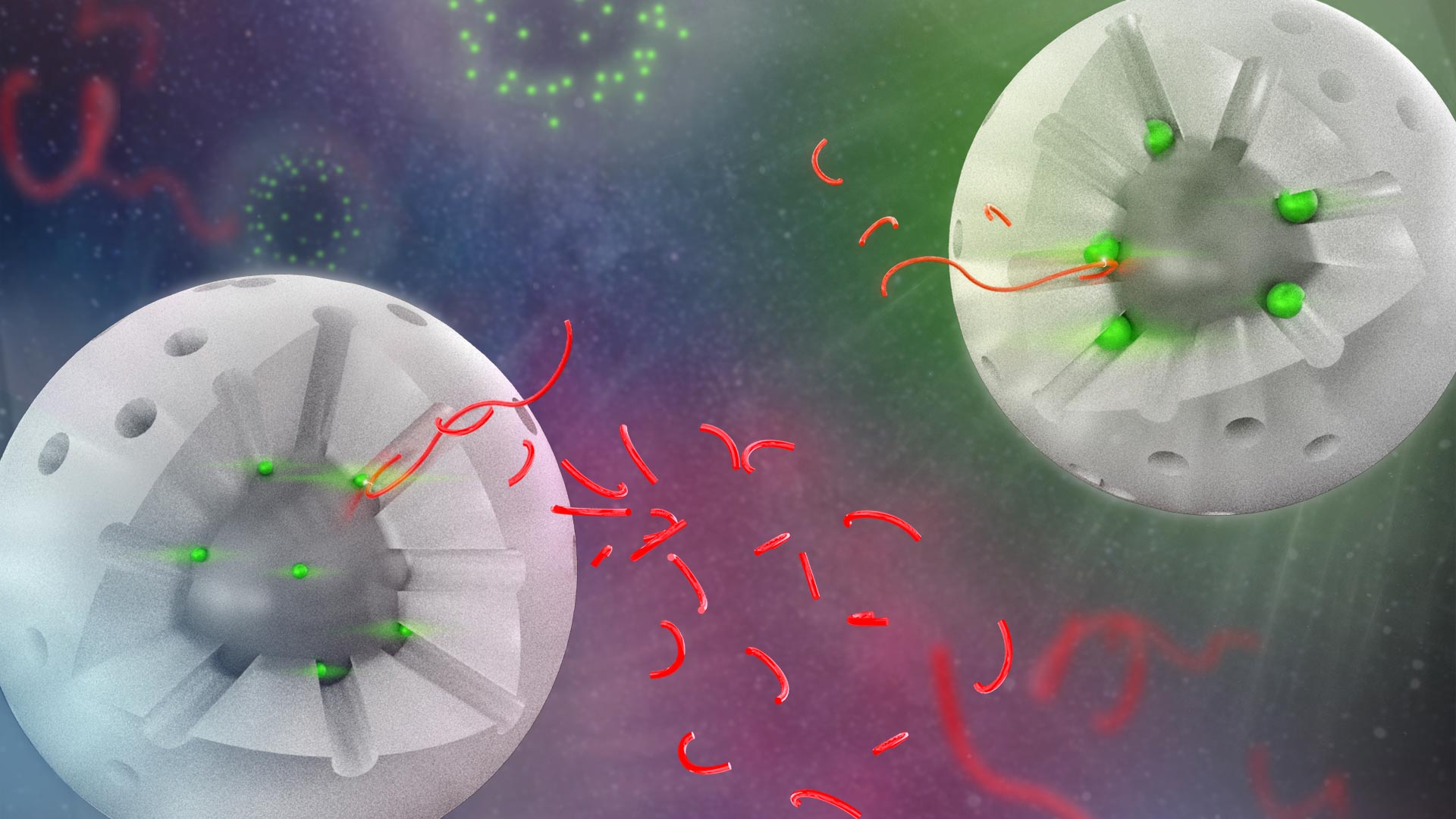
Visual of two variations of the catalyst, with a segment of the shell removed to show the interior. The white sphere represents the silica shell, the holes are the pores. The bright green spheres represent the catalytic sites, the ones on the left are much smaller than the ones on the right. The longer red strings represent the polymer chains, and the shorter strings are products after catalysis. All shorter strings are similar in size, representing the consistent selectivity across catalyst variations. Additionally, there are more smaller chains produced by the smaller catalyst sites because the reaction occurs more quickly. Credit: Image courtesy of Argonne National Laboratory, U.S. Department of Energy
Plastic upcycling technologies are being advanced by a recently developed catalyst for breaking down plastics. A team of scientists lead by Ames Laboratory scientists discovered the first processive inorganic catalyst in 2020 to deconstruct polyolefin plastics into molecules that can be used to create more valuable products. The team has now developed and validated a strategy to speed up the transformation without sacrificing desirable products.
The catalyst was originally designed by Wenyu Huang, a scientist at Ames Laboratory. It consists of platinum particles supported on a solid silica core and surrounded by a silica shell with uniform pores that provide access to catalytic sites. The total amount of platinum needed is quite small, which is important because of platinum’s high cost and limited supply. During deconstruction experiments, the long polymer chains thread into the pores and contact the catalytic sites, and then the chains are broken into smaller-sized pieces that are no longer plastic material (see image above for more details).
According to Aaron Sadow, a scientist at Ames Lab and director of the Institute for Cooperative Upcycling of Plastics (iCOUP), the team crafted three variations of the catalyst. Each variation had identically sized cores and porous shells, but varying diameters of platinum particles, from 1.7 to 2.9 to 5.0 nm.
The researchers hypothesized that the differences in platinum particle size would affect the lengths of the product chains, so large platinum particles would make longer chains and small ones would make shorter chains. However, the team discovered that the lengths of the product chains were the same size for all three catalysts.
“In the literature, the selectivity for carbon-carbon bond cleavage reactions usually varies with the size of the platinum nanoparticles. By placing platinum at the bottom of the pores, we saw something quite unique,” said Sadow.
Instead, the rate at which the chains were broken into smaller molecules was different for the three catalysts. The larger platinum particles reacted with the long polymer chain more slowly while the smaller ones reacted more quickly. This increased rate could result from the higher percentage of edge and corner platinum sites on the surfaces of the smaller nanoparticles. These sites are more active in cleaving the polymer chain than the platinum located in the faces of the particles.
According to Sadow, the results are important because they show that activity can be adjusted independently from the selectivity in these reactions. “Now, we are confident that we can make a more active catalyst that would chew up the polymer even faster, while using catalyst structural parameters to dial in specific product chain lengths,” he said.
Huang explained that this type of larger molecule reactivity in porous catalysts in general are not widely studied. So, the research is important for understanding the fundamental science as well as how it performs for upcycling plastics.
“We really need to further understand the system because we’re still learning new things every day. We are exploring other parameters that we can tune to further increase the production rate and shift the product distribution,” said Huang. “So there are a lot of new things in our list waiting for us to discover.”
Reference: “Size-Controlled Nanoparticles Embedded in a Mesoporous Architecture Leading to Efficient and Selective Hydrogenolysis of Polyolefins” by Xun Wu, Akalanka Tennakoon, Ryan Yappert, Michaela Esveld, Magali S. Ferrandon, Ryan A. Hackler, Anne M. LaPointe, Andreas Heyden, Massimiliano Delferro, Baron Peters, Aaron D. Sadow and Wenyu Huang, 23 February 2022, Journal of the American Chemical Society. DOI: 10.1021/jacs.1c11694
The research was conducted by the Institute for Cooperative Upcycling of Plastics (iCOUP), led by Ames Laboratory. iCOUP is an Energy Frontier Research Center consisting of scientists from Ames Laboratory, Argonne National Laboratory, UC Santa Barbara, University of South Carolina, Cornell University, Northwestern University, and the University of Illinois Urbana-Champaign.
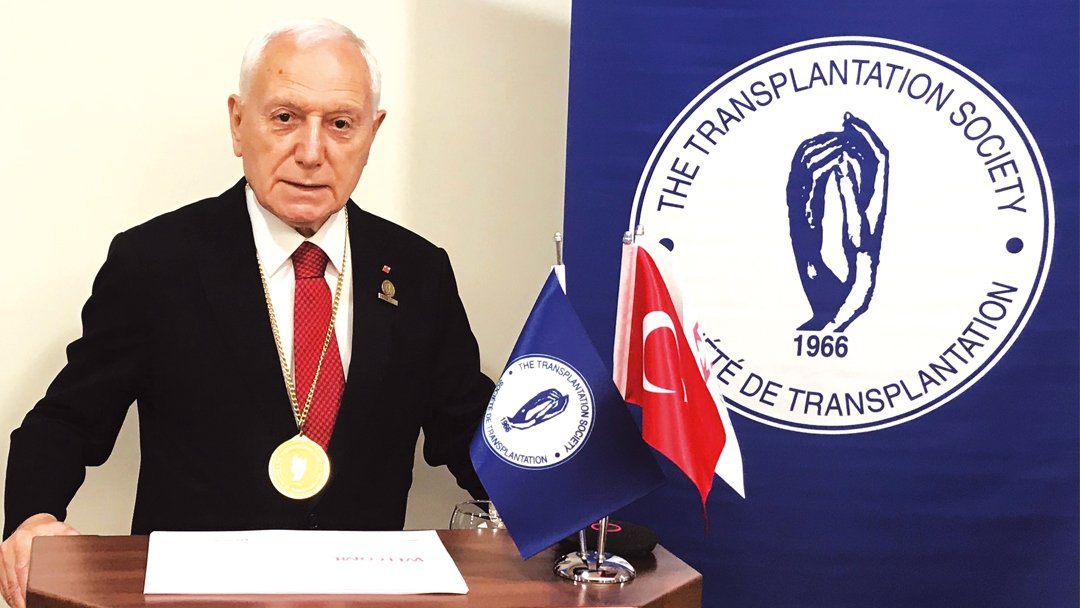
Professor Haberal during the ceremony at which he handed over the presidency of the Turkish Transplantation Society.
Credit: Personal archive of Prof. Haberal
The Severe Hypothermia Treatment Centre in Krakow, Poland, and Professor Mehmet Haberal of Başkent University in Ankara, Turkey, have today been presented with WHO-supported awards recognizing their long-term and outstanding contribution to global public health.
Professor Haberal received the Ihsan Doğramacı Family Health Foundation Prize, while the Severe Hypothermia Treatment Centre received the Dr Lee Jong-wook Memorial Prize for Public Health, jointly with Dr Prakit Vathesatogkit from Thailand for his work in tobacco control.
Pioneering surgery
Professor Haberal has provided innovative work in the fields of general surgery, organ transplantation and burn treatment in his native Turkey and other countries around the world. His distinguished career has included his leadership of a team that performed Turkey’s first kidney transplant.
WHO Regional Director for Europe, Dr Hans Henri P. Kluge, commended Professor Haberal, adding that WHO “looks forward to pursuing its successful collaboration with pioneers like you, especially with a view to strengthening national capacities in organ transplantation and burn treatment ”.
The Ihsan Doğramacı Family Health Foundation Prize is presented following consultation between WHO and the Foundation. The Foundation, established in 1980 to promote and raise the standard of family health, is named in honour of Professor Doğramacı, a paediatrician and child health specialist who was among the signatories of the WHO Constitution at the International Health Conference held in New York in 1946.
Treating hypothermia
The Dr Lee Jong-wook Memorial Prize is awarded to individuals, institutions, or governmental or nongovernmental organizations who have made an outstanding contribution to public health.
Named in honour of the late Dr Lee, a former WHO Director-General, the award is decided by a panel based on nominees presented by WHO Member States.
The Severe Hypothermia Treatment Centre has adopted a holistic approach to the treatment of severe hypothermia, which has contributed to understanding and treatment world-wide. In addition, the work of the Centre has increased social awareness about the risk of hypothermia – especially for people living in situations of homelessness or poverty.
On a recent visit to Poland, Dr Kluge spoke with personnel at the Severe Hypothermia Treatment Centre and recounted the extraordinary story of a 2-year-old child who, thanks to the Centre’s breakthrough techniques, was saved following a case of severe hypothermia after being exposed to subfreezing temperatures.
Dr Kluge thanked the staff of the Centre for their work, adding: “Friends, this is a true miracle – blending medicine, science and technology with compassion and care.
“Quite possibly, this institution, created less than a decade ago, is the only one of its kind worldwide. By dedicating its services to an issue that is far too often neglected globally, the Severe Hypothermia Treatment Centre has proven itself worthy of Dr Lee’s – and WHO’s – vision of health for all.”
With delegates from Member States, non-governmental organizations, and universities attending, as well as entrepreneurs looking for ways to sustainably develop the “Blue Economy”, there are hopes that this event, taking place in the Portuguese city of Lisbon between 27 June and 1 July, will mark a new era for the Ocean.
1. It’s time to focus on solutions
The first Conference, in 2017, was seen as a game changer in alerting the world to the Ocean’s problems. According to Peter Thomson, the UN Secretary-General’s Special Envoy for the Ocean, Lisbon “is going to be about providing solutions to those problems”.
The event is designed to provide a space for the international community to push for the adoption of innovative, science-based solutions for the sustainable management of the oceans, including combating water acidification, pollution, illegal fishing and loss of habitats and biodiversity.
This year’s conference will also determine the level of ambition for the United Nations Decade of Ocean Science for Sustainable Development (2021-2030). The Decade will be a major theme in the conference, and will be the subject of several important events, laying out the vision of a healthier, more sustainable Ocean.
The UN has set 10 ocean-related targets to be achieved over this decade, as part of the 2030 Agenda for Sustainable Development, the Organisation’s blueprint for a fairer future for people and the planet. They include action to prevent and reducing pollution and acidification, protecting ecosystems, regulating fisheries, and increasing scientific knowledge. At the conference, interactive dialogues will focus on how to address many of these issues.
The role of youth will be at the fore in Lisbon, with young entrepreneurs, working on innovative, science-based solutions to critical problems, an important part of the dialogue.
From 24 through 26 June, they will participate in the Youth and Innovation Forum, a platform aimed at helping young entrepreneurs and innovators to scale up their initiatives, projects and ideas, by providing professional training, and matchmaking with mentors, investors, the private sector, and government officials.
The forum will also include an “Innovathon,” where teams of five participants will work together to create and propose new ocean solutions.
2. The stakes are high
The Ocean provides us all with oxygen, food, and livelihoods. It nurtures unimaginable biodiversity, and directly supports human well-being, through food and energy resources.
Besides being a life source, the ocean stabilizes the climate and stores carbon, acting as a giant sink for greenhouse gases.
According to UN data, around 680 million people live in low-lying coastal zones, rising to around one billion by 2050.
Plus, latest analysis estimates that 40 million people will be employed by ocean-based industries by the end of this decade.
3. Spotlight on Kenya and Portugal
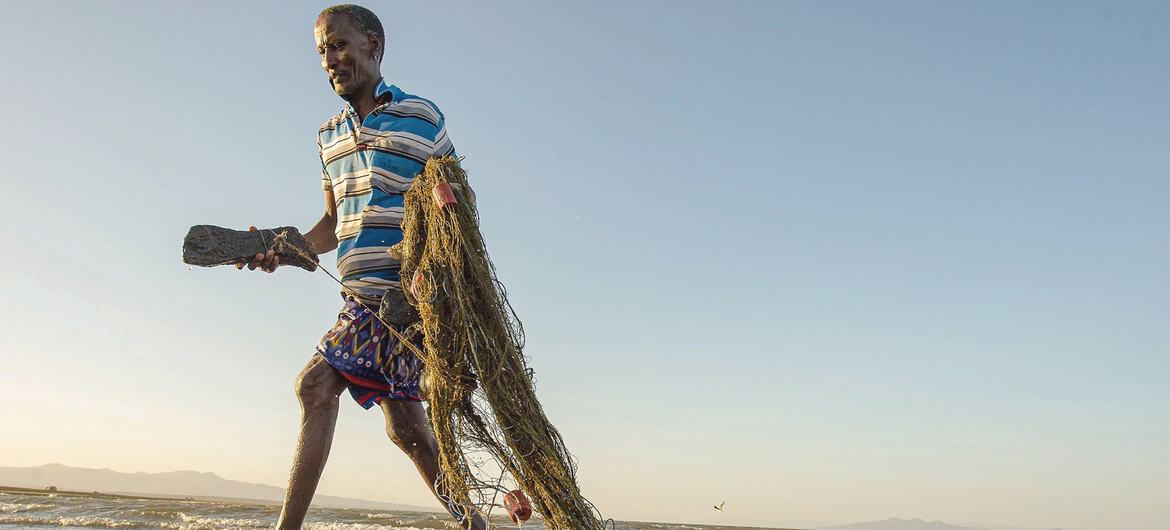
Although the Conference is taking place in Portugal, it is being co-hosted by Kenya, where 65 per cent of the coastal population lives in rural areas, engaging primarily in fisheries, agriculture, and mining for their livelihoods.
For Bernadette Loloju, a resident of Samburu County, Kenya, the ocean is important for her country’s people because it allows them to get many of the goods they need. “The ocean contains many living organisms including fish. It also gives us food. When we go to Mombasa city, we enjoy the beach and swim, adding to our happiness”.
Nzambi Matee, UN Environment Programme (UNEP) Young Champion of the Earth winner, shares the same vision. Nzambi lives in Nairobi, Kenya, and is the founder of Gjenge Makers, which produces sustainable low-cost construction materials made of recycled plastic waste.
Ms. Matee takes plastic waste from the ocean, fished by fishermen, and converts it into paving bricks – “my work of recycling plastic waste from the ocean has enabled me to employ over 113 youth and women, whom together have produced 300,000 bricks. I get my livelihood from the ocean, and therefore the ocean is life to me”, she said.
The passion for the ocean is shared with Portugal, the largest coastal European Union Member State with some four million kilometers of continuous coastline, and as such, a country that plays a central role in the Atlantic basin.
“Our expectations for the UN Oceans Conference are that it will be a conference about action and not just about commitment”, says Catarina Grilo, Director of Conservation and Policy at Associação Natureza Portugal (ANP), a non-governmental organization working in line with the World Wildlife Fund (WWF). ANP runs several projects in the areas of marine protection, sustainable fisheries, and ocean conservancy.
“The previous conference in New York was a really good moment to raise awareness about the role of the oceans for humanity’s well-being. At the time we had a lot of voluntary commitments from Member States and non-state organizations, but now it’s time to move from words to actions”.
4. The ocean and the global climate are intrinsically linked
The ocean and global climate heavily influence one another in many ways. As the climate crisis continues to pose an existential threat, there are some key metrics scientists are watching closely.
The ocean absorbs around 23 per cent of CO2 generated by human activity, and when it does, chemical reactions take place, acidifying the seawater. That puts marine environments at risk and, the more acidic the water becomes, the less CO2 it is able to absorb.
Samuel Collins, a project manager at the Oceano Azul Foundation, in Lisbon, believes that the conference will serve as a bridge to COP27, due to take place in Sharm El-Sheikh, Egypt this November.
“The ocean is fundamentally integral to climate. It houses 94 per cent of the living space on the planet. I could reel off statistics that shock us all.”, says the 27-year-old Scot.
“The reason why the products that we buy in the shop are so cheap is because shipping transports 90 per cent of the goods in our homes, so there are many reasons why we are connected to the ocean, whether you’re a landlocked country or not. There’s no living organism on earth that is unaffected by the Ocean”.
We asked some experts – including Catarina Grilo and biologist Nuno Barros at ANP, as well as Sam Collins at Oceano Azul Foundation – what citizens can do to promote a sustainable blue economy, while waiting for decision-makers and world leaders to move into action. Here are some ideas that you can incorporate to your daily lives:
If you eat fish, diversify your diet in terms of seafood consumption, do not always eat the same species. Also avoid consuming top predators and make sure what you eat is coming from responsible sources.
Prevent plastic pollution: with 80 per cent of marine pollution being originated on land, do your part to stop pollution reaching the sea. You can help by using reusable products, avoid consuming disposable products, and also making sure that you are placing your waste in the appropriate bins.
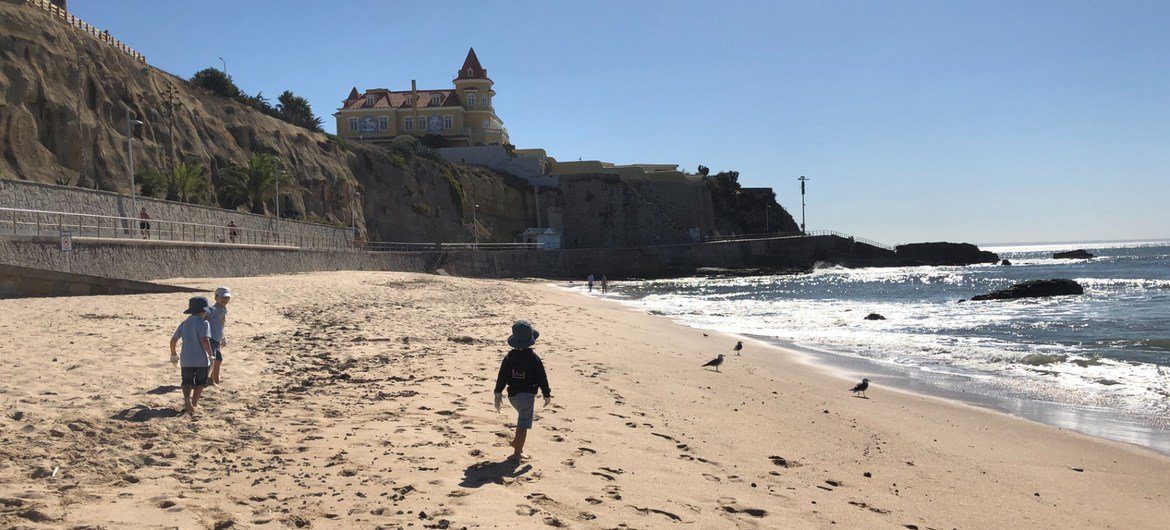
UN News/Teresa Salema – Beach clean-up at Praia da Poça, a popular little beach at the start of the Estoril – Cascais coast, in Portugal.
Pick up trash from the beach, and do not litter. But also think that any step you can take to reduce your environmental footprint will help the ocean in an indirect way.
Continue to advocate for solutions, whether that’s on the streets, writing letters to decision-makers, signing petitions, or supporting campaigns that aim to influence decision makers, at the national level or at a global level.
UN News will be in Lisbon to cover the Ocean Conference, so you can expect news stories, interviews, and features with experts, youth, and UN voices.
Look out for the latest updates on our page, and also onTwitter.
In a remote area, a mix of geophysical methods identifies magma transfer below the seafloor as the cause.
Even off the coast of Antarctica, volcanoes can be found. A sequence of more than 85,000 earthquakes was recorded in 2020 at the Orca submarine volcano, which has been inactive for a long time, a swarm quake that reached proportions not previously observed for this region. The fact that such events can be studied and described in remarkable detail even in such remote, and therefore poorly instrumented areas, is now shown by the study of an international team published in the journal Communications Earth and Environment.
Researchers from Germany, Italy, Poland, and the United States were involved in the study, which was led by Simone Cesca of the German Research Centre for Geosciences (GFZ) Potsdam. They were able to combine seismological, geodetic, and remote sensing techniques to determine how the rapid transfer of magma from the Earth’s mantle near the crust-mantle boundary to almost the surface caused the swarm quake.
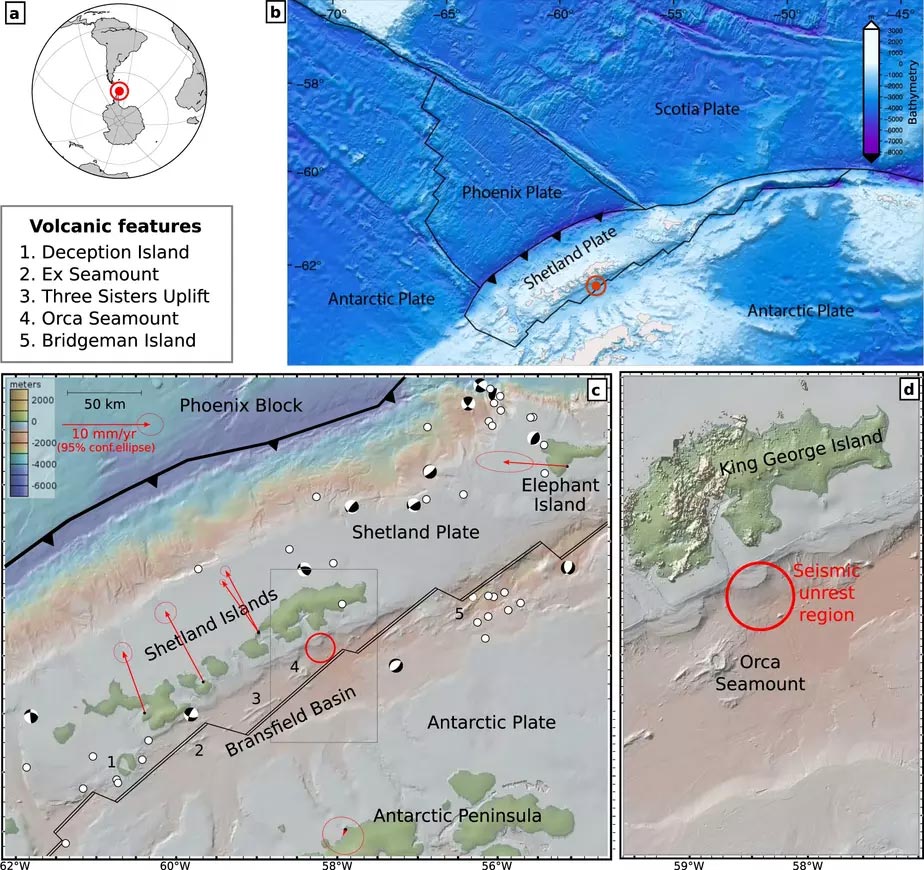
The Orca volcano between the tip of South America and Antarctica
Swarm quakes mainly occur in volcanically active regions. The movement of fluids in the Earth’s crust is therefore suspected as the cause. Orca seamount is a large submarine shield volcano with a height of about 900 meters above the seafloor and a base diameter of about 11 kilometers. It is located in the Bransfield Strait, an ocean channel between the Antarctic Peninsula and the South Shetland Islands, southwest of the southern tip of Argentina.
Illustration of the seismically active zone off Antactica. Credit: Cesca et al. 2022; nature Commun Earth Environ 3, 89 (2022); doi.org/10.1038/s43247-022-00418-5 (CC BY 4.0)
“In the past, seismicity in this region was moderate. However, in August 2020, an intense seismic swarm began there, with more than 85,000 earthquakes within half a year. It represents the largest seismic unrest ever recorded there,” reports Simone Cesca, a scientist in GFZ’s Section 2.1 Earthquake and Volcano Physics and lead author of the now published study. At the same time as the swarm, a lateral ground displacement of more than ten centimeters and a small uplift of about one centimeter was recorded on neighboring King George Island.
Challenges of research in a remote area
Cesca studied these events with colleagues from the National Institute of Oceanography and Applied Geophysics — OGS and the University of Bologna (Italy), the Polish Academy of Sciences, Leibniz University Hannover, the German Aerospace Centre (DLR) and the University of Potsdam. The challenge was that there are few conventional seismological instruments in the remote area, namely only two seismic and two GNSS stations (ground stations of the Global Navigation Satellite System which measure ground displacement). In order to reconstruct the chronology and development of the unrest and to determine its cause, the team therefore additionally analyzed data from farther seismic stations and data from InSAR satellites, which use radar interferometry to measure ground displacements. An important step was the modeling of the events with a number of geophysical methods in order to interpret the data correctly.
Reconstructing the seismic events
The researchers backdated the start of the unrest to 10 August 2020 and extend the original global seismic catalog, containing only 128 earthquakes, to more than 85,000 events. The swarm peaked with two large earthquakes on 2 October (Mw 5.9) and 6 November (Mw 6.0) 2020 before subsiding. By February 2021, seismic activity had decreased significantly.
The scientists identify a magma intrusion, the migration of a larger volume of magma, as the main cause of the swarm quake, because seismic processes alone cannot explain the observed strong surface deformation on King George Island. The presence of a volumetric magma intrusion can be confirmed independently on the basis of geodetic data.
Starting from its origin, seismicity first migrated upward and then laterally: deeper, clustered earthquakes are interpreted as the response to vertical magma propagation from a reservoir in the upper mantle or at the crust-mantle boundary, while shallower, crustal earthquakes extend NE-SW triggered on top of the laterally growing magma dike, which reaches a length of about 20 kilometers.
The seismicity decreased abruptly by mid-November, after about three months of sustained activity, in correspondence to the occurrence of the largest earthquakes of the series, with a magnitude Mw 6.0. The end of the swarm can be explained by the loss of pressure in the magma dike, accompanying the slip of a large fault, and could mark the timing of a seafloor eruption which, however, could not yet be confirmed by other data.
By modeling GNSS and InSAR data, the scientists estimated that the volume of the Bransfield magmatic intrusion is in the range 0.26-0.56 km³. That makes this episode also the largest magmatic unrest ever geophysically monitored in Antarctica.
Conclusion
Simone Cesca concludes: “Our study represents a new successful investigation of a seismo-volcanic unrest at a remote location on Earth, where the combined application of seismology, geodesy, and remote sensing techniques are used to understand earthquake processes and magma transport in poorly instrumented areas. This is one of the few cases where we can use geophysical tools to observe intrusion of magma from the upper mantle or crust-mantle boundary into the shallow crust — a rapid transfer of magma from the mantle to almost the surface that takes only a few days.”
Reference: “Massive earthquake swarm driven by magmatic intrusion at the Bransfield Strait, Antarctica” by Simone Cesca, Monica Sugan, Łukasz Rudzinski, Sanaz Vajedian, Peter Niemz, Simon Plank, Gesa Petersen, Zhiguo Deng, Eleonora Rivalta, Alessandro Vuan, Milton Percy Plasencia Linares, Sebastian Heimann and Torsten Dahm, 11 April 2022, Communications Earth & Environment. DOI: 10.1038/s43247-022-00418-5
Neonatal abstinence syndrome: UNODC and experts discuss support for mothers and infants exposed prenatally to synthetic drugs
Vienna (Austria), 27 May 2022 – The reach of the opioid crisis has extended to the youngest and most vulnerable, affecting pregnant women and their infants who are prenatally exposed to synthetic drugs.
Some international guidance exists for managing substance use disorders in pregnant women. However, to ensure the best outcomes for children exposed in utero to synthetic drugs, we need comprehensive guidance for immediate, short and long term multi-disciplinary responses and care.
To explore the impact on infant children of prenatal exposure to synthetic drugs, in particular synthetic opioids, the United Nations Office on Drugs and Crime (UNODC) held a technical consultation online with 43 clinicians and academic experts from 14 countries and six specialized UN agencies.
Held on 1-3 February 2022, the consultation discussed the health, social, educational and legal needs of infants born with neonatal exposure to synthetic opioids. Participants identified gaps in the guidance available to health professionals for addressing the needs of infants with neonatal abstinence syndrome and recommended multi-disciplinary actions to address these gaps.
Addressing the meeting, Mr. Alexandre Bilodeau, Deputy Permanent Representative of Canada to the International Organizations in Vienna, said: “Infants experiencing withdrawal from opioid exposure can surely be counted among the most vulnerable members of our society. Canada fully recognizes the critical importance of addressing this issue and its multiple public health consequences. Canada is very proud to support the UNODC Synthetic Drug Strategy and UNODC’s work on neonatal abstinence syndrome,” he added.
A further awareness-raising gathering on this issue was held at a side-event to the 65th Session of the Commission on Narcotic Drugs on 17 March 2022. The event included a powerful address from one panellist, Ms. Lauren Dicair, a psychotherapist and clinical social worker working with the adult children of people who have used drugs.
Ms. Dicair brought to the table her own lived experience of being born with neonatal abstinence syndrome. She explained how, as an adult, she is still suffering from the consequences: “decades of complex trauma and grief” as well as a “bizarre array of physical symptoms” resulting from her early drug exposure. She called for funding for large-scale research on the lifelong psychological and physical effects of neonatal abstinence syndrome, as well as for public education to help reduce stigma.
The keynote speaker, Ms. Carol Anne Chenard, Director of Health Canada’s Office of Controlled Substances, stressed the need for comprehensive international guidance and multidisciplinary responses to respond to this issue.