Sunday, September 20, 2026
Home Blog Page 1072

Webb Space Telescope Will Study Formation, Composition, Clouds of Distant Worlds

Webb Space Telescope Will Study Formation, Composition, Clouds of Distant Worlds

NASA’s James Webb Space Telescope is a true technological marvel. The largest and most complex space telescope ever built, Webb is able to gather light that has been traveling for 13.5 billion years, almost since the beginning of the universe. In effect, Webb is a time machine, allowing us to peer at the first galaxies to form after the Big Bang. Because it gathers infrared light, sees right through the giant clouds of dust that block the view of most other telescopes. Webb is 100 times more powerful than the Hubble Space Telescope. Most notably, with its 21-foot-wide (6.5-meter-wide) set of segmented mirrors, Webb is powerful enough to search for water vapor in the atmospheres of planets orbiting other stars. It will open a new window on these exoplanets, observing them in wavelengths of light at which they have never been seen before and helping us gain new insights about their nature. Webb will help us understand how galaxies evolve over billions of years into grand spirals, like our own Milky Way, search for signs of habitability on distant planets, and penetrate into the hearts of dust-shrouded stellar nurseries. The observatory launched from South America on Christmas Day 2021. Credit: NASA/JPL-Caltech

The journey of commissioning the Webb telescope continues this week with the successful cooling of the Mid-InfraRed Instrument (MIRI), through the critical ‘pinch point,’ down to its final operating temperature of less than 7 kelvins (-447 degrees Fahrenheit, or -266 degrees Celsius). This was a precondition to completing the seventh and final stage of the mirror alignment process.  The next steps include initial check-outs of MIRI and continue on to the final stages of multi-instrument, multi-field alignment with all four science instruments.

Last week we shared the cool science on star and planet formation planned for Webb. Today, we get into details on how Webb will study planets around other stars, which are known as extrasolar planets, or exoplanets. Knicole Colón, Webb’s deputy project scientist for exoplanet science, takes us into the discovery space of exploring new worlds beyond our solar system. Dr. Colón brings a unique perspective as she is also the project scientist for the Transiting Exoplanet Survey Satellite (TESS), a mission that has found many exoplanet targets that Webb will observe.

This illustration shows an exoplanet orbiting its much brighter star. With its onboard coronagraphs, Webb will allow scientists to view exoplanets at infrared wavelengths they’ve never seen them in before. Credit: NASA, ESA, and G. Bacon (STScI)

“Over the last 30 years, astronomers have discovered over 5,000 extrasolar planets. These discoveries have revealed that exoplanets span a vast range of masses, sizes, and temperatures and orbit all types of stars, leading to extraordinarily diverse worlds.

“With its powerful spectroscopic and imaging capabilities across a wide infrared wavelength range, Webb is poised to revolutionize our knowledge of the composition of these worlds and of planet-forming disks. From small, potentially rocky exoplanets up to giant, gaseous ones, Webb will observe these worlds with the transit technique. Direct imaging techniques will be used to study young, giant exoplanets along with the environments in which planets form and evolve around stars, known as protoplanetary disks and debris disks.

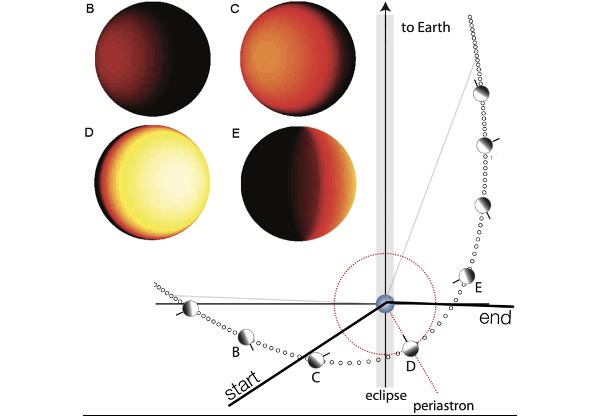
“One specific exoplanet observation that will be done with Webb involves collecting observations over the course of a planet’s orbit to enable measurements of the atmospheric composition and dynamics. I am involved in a program to observe the gas giant HD 80606 b as part of Webb’s first year of observations. Because the orbit of HD 80606 b is extremely eccentric (non-circular) and long (111 days), the amount of energy received by the planet from its star ranges from approximately 1 to 950 times what Earth receives from the Sun! This results in extreme temperature variations, which are predicted to cause clouds to rapidly form and dissipate in the planet’s atmosphere on very short timescales. Our science team will probe these predicted cloud dynamics in real-time over the course of a continuous ~18 hour observation of HD 80606 b as it passes behind its star, using the NIRSpec instrument on Webb to measure thermal light from the planet’s atmosphere.

The orbital configuration of HD 80606 b is shown along with expected temperature variations as viewed from Earth and Webb at several orbital phases. The planned “start” and “end” of the ~18 hour stretch of Webb observations are indicated. Credit: adapted from de Wit et al. 2016; courtesy of James Sikora

“Beyond gas giants, a number of Webb’s exoplanet targets in its first year of observations are small and orbit stars that are smaller and cooler than the Sun, known as M dwarfs. While exoplanet discovery began around 30 years ago, many of these small exoplanets around M dwarfs were just discovered in the last few years by surveys like TESS. Webb observations will start to reveal the diversity of atmospheres that exist on these small planets by searching for evidence of molecules like water, carbon dioxide, and methane in their atmospheres. Because M dwarfs are typically much more active than the Sun and have energetic stellar flares that could potentially strip the atmospheres off of these planets, Webb observations may even reveal that some of these small planets have no atmosphere at all.

This artist’s illustration shows three small planets discovered by TESS around an M dwarf star called L 98-59. Planets c and d are just 1.4 and 1.6 times larger than Earth and will be observed in Webb’s first year of science. Credits: NASA’s Goddard Space Flight Center

“With TESS and other surveys continuing to discover additional planets in our galaxy at a regular pace and Webb preparing to study the atmospheres of many of these newly discovered worlds, our exoplanet adventures are in many ways just beginning.”

– Knicole Colón, Webb’s deputy project scientist for exoplanet science, NASA’s Goddard Space Flight Center

Stefanie Milam, Webb deputy project scientist for planetary science, NASA Goddard

Jonathan Gardner, Webb deputy senior project scientist, NASA Goddard

Umuamua – an asteroid, comet or spaceship

0

A Harvard professor claims that an alien civilization has “deposited small probes” on our planet

“Umuamua, the mysterious asteroid that passes through our solar system, is very likely to be a spaceship that aliens have launched to receive signals from their sensors located on Earth,” said Professor Avi Loeb of Harvard University. Science.

According to Avi Loeb, an ancient alien civilization has long installed sensors all over planet Earth to study life here, and the Umuamua rock is simply a “receiver” that takes measurements from their sensors.

“Umuamua’s overall behavior indicates that it is an artificial object on a targeted mission to the Sun to collect data from a habitable region near Earth. It can even be assumed that it is extracting data from probes that have already been sprinkled on Earth. in that case, “Umuamua’s thin, flat shape could be that of a receiver,” the professor said.

The asteroid’s predecessor may have been an alien spacecraft that deposited small probes in Earth’s atmosphere without being noticed because it visited Earth before the Pan-STARRS system began operations.

Loeb came to his “thesis” by examining a large number of phenomena of inexplicable things in the sky. These “things,” called unexplained celestial phenomena (NNFs), are either drones from Russia and China, as is commonly believed, or aliens associated with the Umuamua stone.

Since Umuamua entered our solar system in 2017, the rock has been the subject of debate. Whether it is part of an asteroid or a comet is not known, but it is known to rotate and even accelerate as it moves through space. This movement leads Loeb to conclude that its wider flat surfaces may contain equipment that can pick up signals from any hidden sensors or probes.

Initially, Umuamua was considered a comet and was named C / 2017 U1 (PAN-STARRS), and was later re-categorized as an asteroid named A / 2017 U1. It was last identified as a hyperbolic asteroid of interstellar origin. Oumuamua in Hawaiian means “ambassador from afar, first come.” Judging by the trajectory of approach, Umuamua most likely comes from Vega, the constellation Lyra. Umuamua is the first interstellar object discovered by man. The cigar-shaped asteroid is 400 meters long and about 30 meters in diameter.

“Instead of just wondering about possible scenarios, we need to gather more accurate scientific data and clarify the nature of the NNF,” Loeb wrote in SciAm magazine.

He proposes to deploy state-of-the-art cameras on broadband telescopes that observe the sky in different places to solve the NSF mystery once and for all.

“The sky is not classified. It’s just government sensors,” Loeb said, adding that it was time for scientists, not the US government, to explain the phenomenon.

As noted in my recent book, Aliens, I do not rely on science fiction stories, as the plot lines often violate the laws of physics. But we must be open to the possibility that science will one day reveal a reality that was once considered fiction, “he concluded.

Beyond Labels & Exclusion: Multifaith Roundtable Explores Paths to Understanding

0
Beyond Labels & Exclusion: Multifaith Roundtable Explores Paths to Understanding

Who are you? What do you believe? Can we still work together, despite our differences?

These are questions often asked of faith leaders and clergy, and the last is generally answered with a smiling “of course!”.

But the proof is in the doing. Can the history of conflict and even bloodshed amongst religions be reversed? Can the suspicions and bigotry which, in some cases, have persisted for centuries be set aside in favour of a unified push toward forming a better, more peaceful, more welcoming world?

A constellation of diverse religious leaders, scholars, and activists convened in a virtual roundtable this past weekend sponsored by the Institute for Religious Tolerance, Peace and Justice to attack these thorny questions as well as lay the groundwork for mutual cooperation. Founder of the Institute, scholar, author and lecturer Dr Arik Greenberg, set the tone and the theme of the forum at the outset: “The interfaith movement is at a crossroads,” he said, and it is time to go beyond “just breaking bread and sharing hugs. Now is the time to take the next step.” Dr Greenberg challenged the keynote speakers and panellists to answer the question: how do we remain faithful to our own traditions while being tolerant of others?

“This room isn’t a room of just Jews, Christians, Muslims, Hindus. It’s a room of inclusivity.”

The first keynote speaker, author and theologian Dr. SimonMary Asese Aihiokhai, used the scriptures and parables of various faiths in his address to answer the question, “How can we reimagine identity issues that can be more inclusive?” Dr Aihiokhai stressed that the instant we begin to use labels of identity for ourselves and God we are practicing exclusion. “This room isn’t a room of just Jews, Christians, Muslims, Hindus. It’s a room of inclusivity,” Dr. Aihiokhai said, “Some of us want to be the police officers of God, and that is wrong.” He explained that conflict is impossible among faiths when we all acknowledge a common God of diversity: “Our God is a God of differences, not exclusion.”

Responding and commenting on Dr. Aihiokhai’s remarks, was a panel composed of a diverse group in itself: national award-winning LGBTQ+ and social justice activist Mr. Justin Hager, J.D.; Assistant Professor of African American Thought and Practice in the Theological Studies Department of Loyola Marymount University, Dr. Kim R. Harris; Adjunct Professor and doctoral candidate at the University of Denver, Prof. Marji Karish; Born Again Christian from the Ventura County Interfaith Community, Mr. Keith Salvas; and human rights activist and Executive Director of Boat People SOS (BPSOS), Dr. Thang Nguyen Dinh.Top left to right: Ms. Sharon Angel, Mr. Keith Salvas, Mr. Justin Hager. Bottom left to right: Ms. Marji Karish, Dr. Kim Harris and Dr. Thang Nguyen Dinh

Top left to right: Ms Sharon Angel, Mr Keith Salvas, Mr Justin Hager. Bottom left to right: Ms Marji Karish, Dr Kim Harris and Dr Thang Nguyen Dinh

Each panellist expressed his or her unique perspective and experience in their comments. Mr Hager stressed that his presence at the forum was not as a person of faith, though he was raised in a family and community of faith who were shocked by his coming out. He said, “I think it is absolutely wonderful to have events like this… one of the things we don’t see enough of is these things within our faiths,” adding, “I don’t need to be right—just recognize me as a human being.”

Dr Harris, who identifies as a Black Catholic, spoke from her own experience of being outside the “template” of what is thought of as the American Black religious experience. “People can’t imagine that we are Catholic or Jewish or Muslim or Buddhist. And some of that is from other African Americans, who can’t imagine that is what we are. So part of the engagement is being able to see within our own communities that there is an internal diversity that is there… there is a hospitality, an engagement that needs to happen.”

Conversing is inclusive, converting is exclusive.

Professor Karish shared her experience of being part of the largest interfaith event in Denver, the annual “langar-in-the-park.” Langar is a Sikh tradition wherein a free Indian meal is served and shared by a community regardless of who they are, thus unifying diverse race, religion, gender, sexual orientation, and class identities. Professor Karish said, “We served 10,000 meals every year across the community until the pandemic put everything on hold, and we will be starting up again in the fall.” She has set up a course at the University of Denver (DU) that will culminate in a “[email protected] DU.” Professor Karish added, “I’m very grateful for being able to bring non-Western traditions focused on unity and community into a space where people may not have been familiar with the tradition in the past, but are now embracing the equity it represents.”

Mr. Salvas, in his turn, said: “When we talk about reimagining identity there is so much to do.” He shared a historic retrospective of diverse faiths coming together and working as a team. In the 1920s, Charles Evans Hughes, a Catholic, Ben Cardozo, a Jew, and social reformer Jane Addams toured, giving town hall talks about interfaith. The three became known as the “Tolerance Trio” and together brought about the formation of the National Conference of Christians and Jews (NCCJ), which is now known as the American Conference on Diversity. Our multifaith forums and seminars are an outgrowth of those early and effective efforts a century ago to foster cooperation and understanding among faiths.

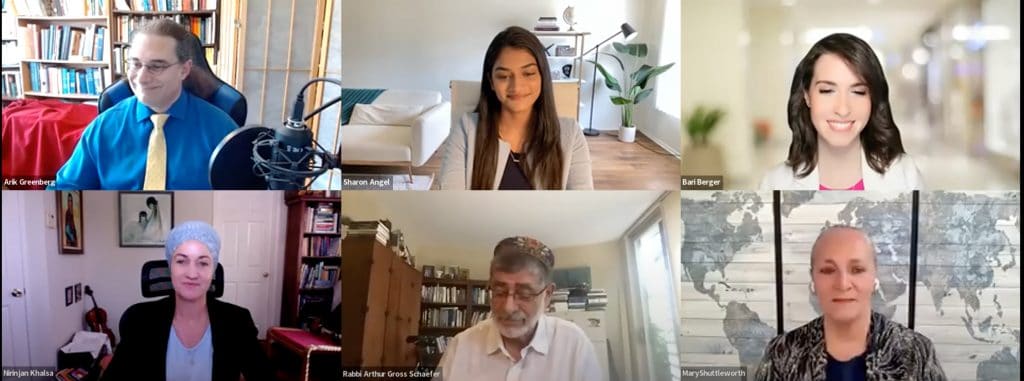
Dr. Thang Nguyen Dinh, a refugee and escapee of communist Vietnam, brought his own unique story to the table. “Refugees face many barriers,” he said, citing language, housing, and economic hardships, “but they also have strengths.” Dr. Dinh outlined the paradoxical situation of the refugee community, a demographic composed of resilient individuals who are patriotic and appreciate their new freedoms, but who at the same time are often disconnected from their own religious and ethnic communities due to barriers of language, economics and social divides.Top left to right: Dr. Arik Greenberg, Ms. Sharon Angel, Ms. Bari Berger. Bottom left to right: Dr. Nirinjan Khalsa, Rabbi Arthur Gross-Schaefer, Dr. Mary Shuttleworth

Top left to right: Dr. Arik Greenberg, Ms. Sharon Angel, Ms. Bari Berger. Bottom left to right: Dr. Nirinjan Khalsa, Rabbi Arthur Gross-Schaefer, Dr. Mary Shuttleworth

The other thorny question posed by Dr. Greenberg: “How do we engage in conversation that deals with hard and often divisive topics in a manner that is respectful, constructive, and promotes a deep understanding of each other’s worldview?” Tackled by the second keynote speaker, East African Muslim Interfaith teacher and preacher Sheikh Aziz Nathoo, said that his toolkit consists of two words: respectful dialogue. Visiting the same well as the first keynote speaker, Dr. Aihiokhai, Sheikh Nathoo also used scripture and parables to support his points. Taking a cue from the Holy Quran, he said, “We are instructed to compete with each other, but compete in good deeds.” He encouraged all to attend the festivals and ceremonies of other faiths—“breaking bread leads to breaking dread”—to make friends and to “ensure you are conversing rather than converting. Conversing is inclusive, converting is exclusive.” Sheik Nathoo urged us to unite with others and create a tsunami of religious tolerance. He concluded: “Every one of us is an ambassador and all our actions have a resounding effect,” before quoting the 13th-century Persian poet, Rumi: “You are not a drop in the ocean. You are the entire ocean contained in a single drop.”

“How do we see each other? Through the lens of curiosity, of wonder, or of exclusion?”

On the second panel, responding to Sheikh Nathoo’s insights, were President of United for Human Rights International, Dr. Mary Shuttleworth; Senior Instructor of Theological Studies and Clinical Professor of Jain and Sikh Studies at Loyola Marymount University (LMU), Dr. Nirinjan Khalsa-Baker; Professor of Business Law, Ethics, and Sustainability at LMU, Rabbi Arthur Gross-Schaefer; Director of STAND League, Scientologists Taking Action Against Discrimination, Ms. Bari Berger; and roundtable moderator, author, TV show host, entrepreneur, humanitarian and motivational speaker, Ms. Sharon Angel.

Once again, the panelists drew on their own backgrounds and experiences in responding to Sheik Nathoo. Dr. Shuttleworth cited her upbringing in apartheid South Africa and related how, in searching for respect and common ground, she discovered the United Nations Universal Declaration of Human Rights—specifically Article 18 on freedom of thought and religion. Dr. Shuttleworth also emphasized Article 29, wherein everyone has a responsibility to their community to see that others are aware of these rights as well. “So to me as an educator, it is important to teach our children what are the common grounds. The Universal Declaration of Human Rights is a good solid stepping stone.” https://www.youtube.com/embed/WZEQIvo8nMQ?start=673wmode=transparent&rel=0&autohide=1&showinfo=0&enablejsapi=1

Dr. Khalsa-Baker touched on the Sikh concept that we are all one, and part of the Divine Light. “How do we see each other?” she asked. “Through the lens of curiosity, of wonder, or of exclusion?” Dr. Khalsa-Baker said that we need to transcend our own emotions so that we can listen with respect and humility to open up a space of grace. “What does it take?” she added. “A lot of courage, support, and resources from others.”

Rabbi Arthur Gross-Schaefer commented, “We are not the chosen—we all are. Who is my enemy? An enemy is someone whose story I have not heard.” Like Sheik Nathoo, he quoted the poet Rumi: “Out beyond ideas of rightdoing or wrongdoing, there is a field. I will meet you there,” to illustrate that despite our differences—or possibly because of them—we of different beliefs must find common ground. Rabbi Gross-Schaefer added that a lot of people don’t hear God speak to them, “A lot of people walk past the burning bush. In the spiritual tradition, you have to search for God and then God will speak to you. But it also comes from listening to others.”

“Time to start doing the hard work.”

Ms. Berger pointed out that much of what brings different faiths together is the similar problems they face. She said, “We should be investing our energies in discovering the things we passionately agree about, and figuring out how we can use that agreement to better the world. And one thing I believe I can safely say we all agree on is that our religious freedom is important to us and we want the right to practice our faith freely and with dignity.”

Roundtable moderator and panelist, Ms. Sharon Angel commented, “When we come from generations of a particular religion it is sometimes hard to understand other faiths.” She spoke of the necessity of a healthy bit of “holy envy” in order to respect the other person, their beliefs, and to live a better life sustaining our own beliefs. Ms. Angel also spoke about the power and importance of story-telling to deconstruct what otherwise may be a difficult and complex subject. When you are drawn closer to God, “you are drawn closer to unity, justice, and peace for yourself and for others,” she said.

If the roundtable participants represent a sample size of the larger tapestry of diversity among religions, the desire to get along, understand, and cooperate is more than present.

What comes next, is, in Dr. Greenberg’s words, “Time to start doing the hard work.”

30,000 Ukrainians returning home every day, say relief agencies

0
30,000 Ukrainians returning home every day, say relief agencies
More than 870,000 people who fled abroad since the Russian invasion on 24 February, have now returned to Ukraine, UN humanitarians said in their latest emergency update, amid concerns about deteriorating food security inside the country.

Citing the State Border Guard Service, UN aid coordination office, OCHA, said that 30,000 people are crossing back into Ukraine every day.

Capture décran 2022 04 15 à 18.02.52 30,000 Ukrainians returning home every day, say relief agencies

The recent returnees reportedly include women with children and older persons, compared to mostly men at the beginning of the escalation.

Relief delivery challenge

This significant figure suggests that migration back to Ukraine might continue increasing, potentially creating new challenges for the humanitarian response as people will need support to reintegrate into their communities or find suitable host communities if returning to their homes is no longer viable,” OCHA said in a statement.

Of the 12 million people in need in Ukraine, humanitarians have reached 2.1 million of them, and the UN’s $1.1 billion flash appeal for Ukraine is now 64 per cent funded.

War rages in east and south

Fighting is concentrated in the eastern and southern oblasts – or regions – of Ukraine, causing damage and civilian casualties and driving humanitarian needs. OCHA also reported rockets strikes in central and northern Ukraine, before citing Ukraine’s State Emergency Service (SESU), which said that 300,000 km2 – or almost half of Ukraine – requires demining.

Relief workers killed

In its latest emergency update, OCHA also reported that two humanitarian workers and five of their relatives have been killed in eastern Dontesk oblast.

They were sheltering at the Caritas Mariupol office when the building was reportedly hit by rounds fired from a tank, probably on 15 March, although the information only became available recently, as the city had been cut off for weeks.

In a statement, the UN Emergency Relief Coordinator, Martin Griffiths, said he was “deeply saddened” by news of the deaths.

“Both aid workers dedicated their lives to the service of others through their work for Caritas. On behalf of the United Nations and the humanitarian community, I send our heartfelt condolences to their families and colleagues, and to those of the other civilians who were killed.

This deeply tragic and unacceptable event is just one example of this war’s horrific consequences for civilians, including aid workers“, the UN relief chief added.

“Tens of thousands of civilians in Mariupol — which has been an epicentre of horror since the conflict began — and in other locations around Ukraine have now endured 50 days of violence and shelling. More than 1,932 civilians have died since 24 February, including more than 150 children. This must stop.”

Meanwhile, the Food and Agriculture Organization (FAO) warned that there are “immediate food insecurity issues” in nearly three in 10 oblasts – with a further 11 per cent of oblasts (that are partially exposed to fighting) expecting shortages within two months.

Farming support

Rural and isolated communities have been worst-hit by food insecurity, FAO said, as it announced support for farmers to plant their fields, save their livestock and produce food.

Urgent cash support is also planned for the most vulnerable families, including those headed by women, the elderly and those with disabilities.

Meanwhile, OCHA also noted that Russia reported that more than 783,000 people – including nearly 150,000 children – have crossed into Russia from Ukraine since 24 February.

Latest data from the UN refugee agency, UNHCR, indicates that more than 4.7 million people have fled Ukraine since the war began. Another seven million are internally displaced.

UNAIDS warns of ‘wave of deaths’

The war in Ukraine has resulted in the destruction and disruption of health services and logistical supply chains that hundreds of thousands of people living with and affected by HIV, depend on for survival, the UN agency committed to ending AIDS said in a press release on Wednesday.

Some 250,000 Ukrainians are living with HIV, and lack of access to antiretroviral therapy and prevention services would mean a wave of deaths and risks a resurgence of Ukraine’s AIDS pandemic, said UNAIDS.

The community-led networks which are vital to maintaining life-saving services need an urgent upscaling of international support.”  

More than 40 health facilities that offered HIV treatment, prevention and care services before the war, are now closed and there are various levels of service disruption at other sites.

The World Health Organization (WHO) has this week verified more than 100 attacks on health facilities in Ukraine, while supply routes within the country have been thrown into disarray.

An initial delivery of more than 18 million doses of life-saving antiretroviral medicine procured by the United States President’s Emergency Plan for AIDS Relief (PEPFAR), that arrived in Lviv last week, is now being distributed in partnership with the Ukrainian health ministry, and 100% Life, the largest organization of people living with HIV in Ukraine.

“If they can be delivered to those in need, the medicines are sufficient to cover a six-month supply for all people living with HIV on first-line treatment”, said UNAIDS.

The Global Fund to Fight AIDS, Tuberculosis and Malaria, is also providing emergency funding to ensure the continuity of life-saving HIV and tuberculosis services. 

Civil society organizations are mounting “a heroic effort”, said UNAIDS, to deliver vital medical supplies and HIV services to people living with and affected by HIV, including to vulnerable populations.

They are reaching people in extraordinary challenging locations, despite the huge obstacles. But the civil society organizations on which this delivery and care system depends need further international support to be able to continue their work.”

Investigating a book of the dead in ‘The Unwritten Book’

0
Investigating a book of the dead in ‘The Unwritten Book’
Efi Chalikopoulou for The Boston Globe
book Investigating a book of the dead in ‘The Unwritten Book’
 

Author of the brilliant short story collection “The Dark Dark” (2017) and the wonderfully odd and moving novel “Mr. Splitfoot” (2016), Samantha Hunt is one of our most interesting and bold writers. Now she has published her first work of nonfiction, “The Unwritten Book.” It’s a characteristically wild effort that defies genre distinctions, flits from the profound to the mundane with fierce intelligence and searching restlessness, and at its best, delves deep into the recesses of the human heart with courageous abandon.

Hunt’s fiction has always been obsessed with ghosts and haunting, darkness and the uncanny; in this newspaper, I once referred to Hunt as “an aficionado of the liminal.” “The Unwritten Book” is if anything even more consumed with the transitional, with mortality and immortality, the spectral and the mysterious, than her fiction has been. Because this time, it’s personal. “The Unwritten Book” is Hunt’s idiosyncratic version of a grief memoir, an alternately crazed and cool musing on grief, literature, and her late father’s identity as both a man and an aspiring writer. 

The Unwritten Book referred to in the title isn’t actually unwritten, just unfinished; it’s a partially complete manuscript by her father that she finds in his desk only days after he dies at 71 of lung and colon cancer. But the phrase also refers to paths snuffed out, experiences aborted, stories never shared. There “was much more he should have seen in life,” Hunt laments. She is “unhinged” by her father’s dying, “distraught by the loss of stories he hadn’t yet told” her.

The book’s subtitle is “An Investigation,” and Hunt appears as a kind of gothic Nancy Drew, “a daughter/detective trying to interrogate her dead dad.” “The dead leave clues,” she writes, “and life is a puzzle of trying to read and understand these mysterious hints before the game is over.” Hunt astutely parses her father’s words even as she refuses to reduce them to simple explanations, deftly teases out the relationships between his fiction and his life while allowing for mystery to remain, annotates and elaborates and expatiates with charm, wit, and an insistence on her father’s fundamental unknowability.

Intermittently, and covering somewhat less than half of “The Unwritten Book”’s total pages, Hunt presents two texts side by side: the chapters of her father’s book on the right, her annotations of these pages on the left. Printing her annotations in tiny font was a mistake — not only because it strains the eyes but also because it diminishes Hunt’s insightful, hilarious, eloquent words in relation to the relatively hackneyed prose of her father. With typical Hunt humor, she acknowledges that her father’s book may not entrance us: “Apologies if this is boring you,” she says. Hunt herself never bores us; her father’s book unfortunately does.

But in the annotations and the chapters or sections without her father’s book, other vibrant characters emerge: Hunt’s daughters, with whom she shares a passion for the boy band One Direction, her editor, her long-suffering mother, her husband, and her five siblings, a “gang of Hunts” who “saved each other” as they navigated their father’s alcoholism, “detectives, alert to the slightest changes in scent, demeanor, and language.”

Hunt’s mind is capacious and supple; her musings cover everything from the films of Werner Herzog and Tobe Hooper to the fiction of W.G. Sebald, William Faulkner, and Toni Morrison to the music of Nick Cave, Gillian Welch, and Patti Smith. Watching her link wildly disparate topics is part of the fun. Referring to her mother’s “drawerful of nail polishes beside a toy turtle beside a pink pillow beside an expired jar of my dad’s cancer drugs beside a golden statuette of the Virgin,” Hunt declares: “I make it make sense. I plot these points and create a chalk line around the ghost, all that’s missing.” But at times, this book could have benefited from a clearer chalk line; some readers will feel lost, confused by its jumble of styles, approaches, and stories

At one point, Hunt wonders: “perhaps this is a self-help book I’m writing, a wellness manual that urges us to live closer to our dead.” If this is the case, it is literature that emerges as the best medicine and reading as the most salubrious activity. Reading and books have always enabled Hunt to commune with the dead, connect across boundaries of space and time with other voices, transcend human limitation and loss. “I carry each book I’ve ever read with me, just as I carry my dead — those things that aren’t really there, those things that shape everything I am,” she insists. “In books we can find our ways back to the worlds we thought were lost, the world of childhood, the world of the dead.” “The Unwritten Book” ponders and enacts this art of losing with an intoxicating blend of humor and pathos.


THE UNWRITTEN BOOK: An Investigation

By Samantha Hunt

Samantha Hunt is the author of the story collection The Dark Dark and the novels Mr. SplitfootThe Invention of Everything Else, and The Seas. Hunt is the recipient of a Guggenheim Fellowship, the Bard Fiction Prize, the National Book Foundation’s 5 Under 35 prize, and the St. Francis College Literary Prize, and she was a finalist for the Orange Prize and the PEN/Faulkner Award. She lives in upstate New York.

FSG, 384 pages, $28

Scientists Prove Diamond Rains on Uranus and Neptune

0
clear crystal stone
Photo by Gigi

Uranus and Neptune: The universe is full of surprises. Gas giants in the solar system were even more amazing than previously thought.

Usually the attention of the scientific community is focused on the giant Jupiter with myriad moons and Saturn with its legendary rings.

And two other gas giants on the outskirts of the solar system are deprived of attention. Their name is not immediately remembered even by excellent students.

It is generally accepted that Uranus and Neptune are not particularly remarkable against the background of their fellow giants. And the name “ice giants” sounds somehow not as intriguing as “gas giants”, right?

Read also:

However, a number of new studies by American scientists can seriously affect this long-established alignment.

The fact is that scientists have proven a long-standing hypothesis that the weather on ice giants can be simply fantastic. For example, on Uranus and Neptune it sometimes rains … from diamonds.

An experiment by a group of American scientists showed that the hypothesis of strange atmospheric phenomena on Neptune and Uranus may be correct.

The diamond rain hypothesis was put forward many decades ago. Perhaps the first to suggest that such conditions may exist on some planets was the British science fiction writer Arthur C. Clarke.

In subsequent years, the hypothesis acquired formulas and various theoretical justifications. Its essence is that on some planets supposedly high temperature and high pressure lead to the division of hydrocarbon elements into components. In particular, carbon is compressed, turning into diamonds, which literally sink into the depths of the planet. After all, gas giants do not have a solid surface.

However, there has been no confirmation of these theoretical calculations so far.

Now scientists from the American national laboratory SLAC have conducted an experiment that speaks of the validity of the hypothesis.

The scientists used a laser to make precise measurements, and found that carbon does turn into crystal diamonds.

The results of the study were published in the authoritative journal Nature.

Rain of diamonds

The atmospheres of Neptune and Uranus are composed predominantly of hydrogen and helium with a small amount of methane.

Below the layers of the atmosphere there is a layer of a very dense and highly heated liquid, surrounding the core of the planet. This layer consists of water, methane and ammonia.

Mental Health in UK: Maudsley Hospital – protests target brain-damaging electric shock (ECT)

0
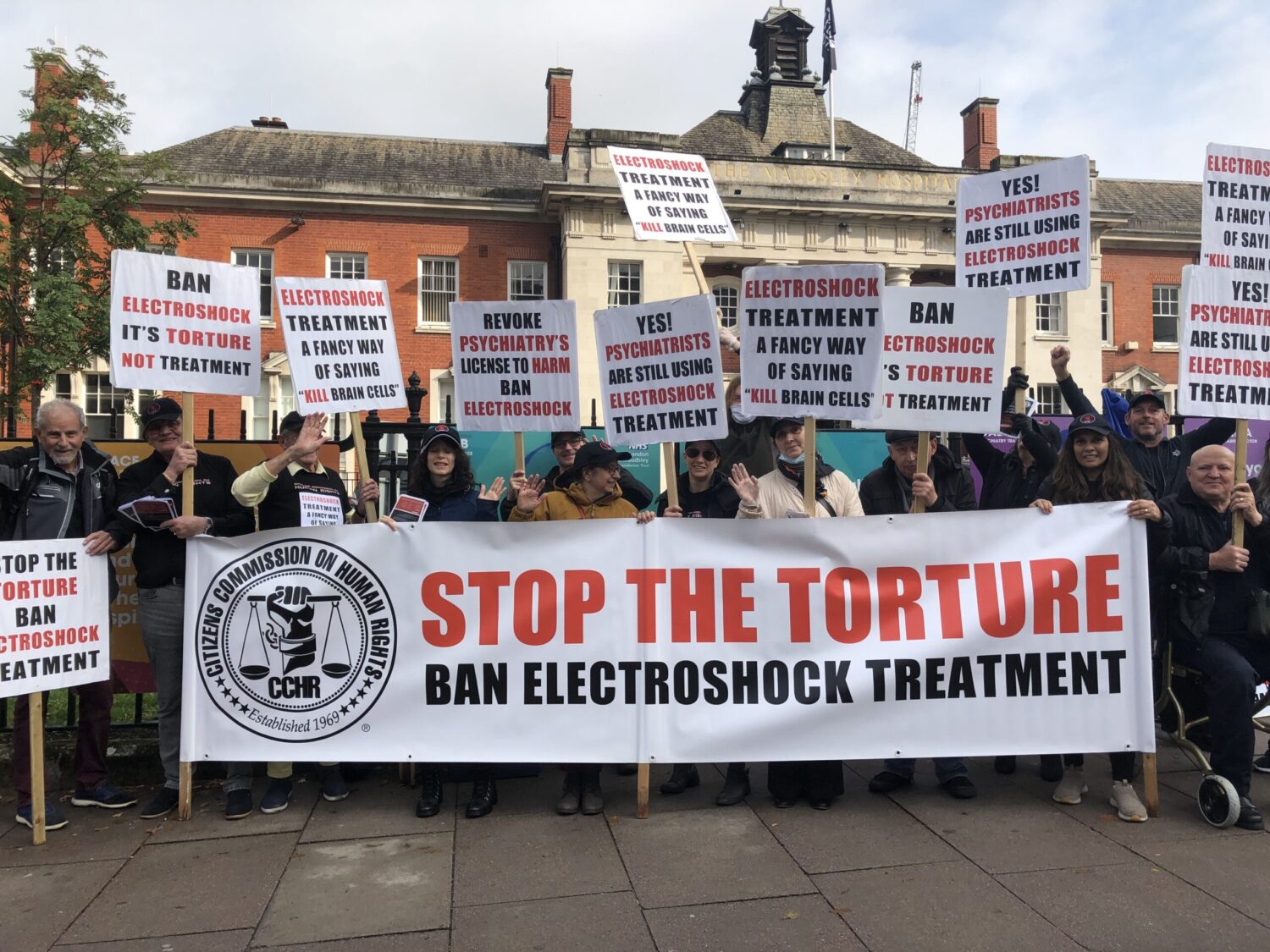
CCHR volunteers protesting against ECT usage

The controversial electroconvulsive therapy ( ECT ) is the target of a series of protests taking place outside of the Maudsley Hospital at Denmark Hill in the UK as it is “brain-damaging”.

The next protest, which is taking place outside of the hospital on Saturday 23 April at 11:00 am, aims to draw attention to the damage being inflicted as a result of ECT. The Citizens Commission on Human Rights (CCHR), a group originally created by psychiatrist Thomas Szasz and the Scientologists, is organising the protest and targets the use of “an ECT device being used at the Maudsley which was the subject of a 2018 US lawsuit. The outcome of that lawsuit saw the manufacturer place a warning on its website linking the device with permanent brain damage“.

According to figures obtained under the Freedom of Information Act by CCHR, the use of electroshock spiked in 2017/2018 when the number of treatments rose sharply to 952. In 2019/2020, the number of treatments more than halved to 437.

Despite warnings about the dangers of applying high-voltage electricity to the brain, there are psychiatrists using ECT who consistently deny causing brain damage. They claim “the procedure is new and improved”, and that it’s safer. But Brian Daniels, the national spokesperson for CCHR in the UK, says that “any improvements in the procedure are not for the benefit of the patient“.

Daniels told The European Times that “In modern ECT, anaesthetics and paralysing agents which prevent the patient writhing and screaming can make the shock procedure appear less barbaric but that’s for the benefit of the person watching”. According to the report, the anaesthesia and paralysing drugs raise the seizure threshold “requiring more electricity to induce a convulsion“.

Today, there are psychiatrists who routinely assault the brain with far more electricity than was previously required to induce a seizure. The result is a grand mal seizure and brain damage, which can be permanent.” Daniels stated in CCHR’s report.

“”In modern ECT, anaesthetics and paralysing agents which prevent the patient writhing and screaming can make the shock procedure appear less barbaric but that’s for the benefit of the person watching

Brian Daniels, Representive of CCHR in the UK

This NGO, whose international branch has been praised by UN authorities will protest outside of the main entrance of the Maudsley facility.

CCHR was co-founded as an independent mental health watchdog in 1969.

Bulgaria: Discrimination against Roma children in the adoption process is a obstacle to deinstitutionalization

0
Romani people (Roma or "Gypsies") make up around 3% of the population of Romania. These images were shot inside one Roma village while working with Ovidiu Rom, a non-profit organization based in Bucharest who's mission is to mobilize public and private resources to ensure quality early education is available to Romania's poorest children. Image by "Shea Winter Roggio"/©SheaWinterPhotography

The know-how center for alternative care for children, NBU, shared an article about the ways in which the topic of deinstitutionalization is related to that of the situation of the Roma ethnic group. Symptoms of this relationship are the high share of Roma children placed in residential services and the high share of parents from Roma families with whom abandonment prevention specialists work. Although there are no official statistics on the predominant presence of Roma children in the services, many of the social workers interviewed by the NHC were adamant about this fact.

What maintains the high number of Roma children and families in residential services?

This is a question of the system’s ability to meet the specific needs of Roma families. The question is also about the ability of our society to integrate and support this extremely vulnerable social group. The deepening marginalization and impoverishment of the Roma are problems imposed on the child protection system. However, it does not have the necessary resources, support and training.

What is the key mechanism for the problems?

The NHC study showed that one of the key and at the same time invisible mechanisms for reproducing these problems is the numerous discriminatory practices that permeate the child protection system, the workplace, the health and education system and are part of the everyday life of the Roma ethnic group. . They lead to the systematic social exclusion of children and parents of Roma origin. According to one of the co-researchers of the NHC of Roma origin – “the first, the main thing is discrimination in our country.”

What do Roma children and parents share?

Quotes from the interviews were selected, which illustrate the extent and ways of spreading discriminatory practices that support the problems in the social sphere.

• Employees in the children’s rights system discriminate. Apart from violating children’s rights, this is also a barrier to integration, for which trust between professionals and clients is the basis.

At home they did not stop insulting us – “dirty gypsies”, “dirty gypsies”, “abandoned gypsy”. What if we are gypsies, we are people… That’s why I ran away from home, but they brought me back and I started to be afraid. I’m scared all the time, I’m shaking and that’s why I’m taking medication, I can’t stay calm. A 16-year-old Roma woman

• Discrimination against Roma children in the adoption process is one of the main obstacles to deinstitutionalization.

The problem is that Roma children are unwanted for adoption. If we break this barrier and start adopting our children here, we will largely solve the problem of institutionalization. The other day we had another case – they don’t want it because – a very nice child, wonderful, but very mulberry. Even I have heard the phrase “A Vietnamese, a Negro, but not a Gypsy.” A representative of the children’s rights system

Parents have reported numerous cases of discrimination at school, in the workplace, in public places such as hospitals and restaurants.

• The school discriminates.

At school I had a lot of problems with young people because I was the only one there who was blacker. Because there were only girls and a lot of boys came to school. Threats, insults, shouted “Hey, gypsy, we’ll make you soap. What are you doing here at this school? Lots of harassment, they had to get me out of the other entrance. And they had to move me to another school. Father of one child

• The workplace discriminates

One of the things is discrimination, for example, a factory does not accept Roma. There was such an ad on the internet a year or so ago. I worked with this company and I even talked to the boss – why not have Roma in the factory? They hate them… I can’t assimilate it. There is no such thing abroad. Father of two children

• “Wherever we go – discrimination”

Wherever we go, whether in a store or in a restaurant, the attitude is as if we are the last hole in the kaval, the biggest miserable people… They don’t pay any attention to us, they behave badly, they don’t respond with a good tone, they raise their voice. Sometimes, when we go to a restaurant, they serve us, they try to be kind, kind, but it is visible – the eyes and the face betray everything. Young Roma

• For a large part of the Roma, emigration abroad is the only way out of the discriminatory and humiliating attitude, of poverty and unemployment.

And I can safely say that in Germany, or in any other country – be it Greece, the Netherlands, Spain, etc. the attitude is very warm, the concern is very great. It doesn’t matter to them that you are not from their country. They are ready to help you in any way they can. A Roma woman living mainly abroad

What is the real solution?

Existing “solutions” doom Roma families to painful divisions between parents and children, which can jeopardize children’s development and well-being. In this way, the children’s rights system faces the effects of discrimination and needs support and resources to counter it. The scale, prevalence and, above all, the non-discrimination of discrimination against the Roma are such that they require not only the efforts of specialists, but also the development of public sensitivity and disapproval of everyday manifestations of discrimination.

Green Deal: EU announces €1 billion worth of commitments to protect the ocean

0
protect the ocean woman in brown jacket standing on green grass field near body of water during daytime
Photo by Boxed Water Is Better

Yesterday, at the Our Ocean Conference (OOC) in Palau, the EU has renewed its pledges towards international Ocean governance. Presenting a list of 44 commitments for the 2020-2022 period for an amount of almost €1 billion, the EU has brought forward its most important commitments ever offered during an Our Ocean Conference, in terms of value.

The Our Ocean Conference is a key moment for countries across the world, civil society, and industry to commit to concrete and significant actions to protect the ocean. The theme of 2022 edition is ‘Our Ocean, Our People, Our Prosperity’, and it draws global partners to identify solutions to sustainably manage marine resources, increase the ocean’s resilience to climate change and safeguard its health for generations to come.

Commissioner for Environment, Oceans and Fisheries, Virginijus Sinkevičius, said: “The sum the EU is committing today is significant, but not as significant as the role that the ocean plays for our very existence. It provides us clean air, regulates the climate, hosts a large part of biodiversity on Earth and is key for our economy. The ocean is bringing all these benefits to us and we need to protect it. Our future depends upon it.”

At the Our Ocean Conference, the EU has taken commitments covering all the themes of this international event: marine protected areas; tackling marine pollution; confronting the ocean-climate crisis; creating sustainable blue economies; advancing sustainable small-scale fisheries and aquaculture; and achieving a safe, just and secure ocean. The EU has also developed a commitment tracking tool to allow citizens to follow the progress of the implementation of the commitments.

The EU is conscious of the challenges facing the ocean and has put a strong focus this year for protecting and restoring it, for example by contributing to initiatives such as the One Ocean Summit (in February, Brest) and the forthcoming UN Ocean Conference (in June-July, Lisbon). The EU is also currently updating its International Ocean Governance Agenda to take into account in a comprehensive way ocean challenges and recent developments, but also opportunities presented by the European Green Deal.

The EU remains fully engaged in the Our Ocean process, and stands ready to assume its responsibility in relation to international ocean governance as a firm supporter of multilateralism. 

Examples of flagship commitments

Almost €500 million over the period 2021-2023 will go to research, development and innovation in seed funding (i.e. funding to start a business) for the Horizon Mission ‘Restore our Ocean and Waters by 2030′. The ‘Mission Ocean’ will address the ocean and waters as one and play a key role in achieving climate neutrality and restoring nature. It will help achieve the EU objectives of protecting 30% of the Member States’ sea area as well as restore marine eco-systems, prevent and eliminate pollution by reducing plastic litter at sea, nutrient losses and use of chemical pesticides, and help the further development of a sustainable and circular blue economy.

The EU has also announced a contribution of €55 million over two years to strengthen marine environmental monitoring and monitoring of climate change, through its satellite monitoring programme, Copernicus, and in particular the WEkEO service that allows the international research community to access in one place all products describing the past, present and future of the earth system together with online tools for environmental science on cloud computing facilities.

Background

Originally launched in 2014, the Our Ocean Conference took place in the US in 2014 and 2016. Chile hosted it in 2015, the EU in 2017 (in Malta), Indonesia in 2018 and Norway in 2019. Throughout the six previous conferences, participants have made more than 1,400 commitments worth approximately $91.4 billion and protected at least five million square miles of ocean. This 7th edition, co-convened by President Surangel Whipps Jr. of Palau and the US Special Presidential Envoy for Climate John Kerry, is all the more important as it will help draw attention to one of the most ocean-dependent and climate change-prone regions.

UNHCR ‘firmly’ opposing UK-Rwanda offshore migration processing deal

0
UNHCR ‘firmly’ opposing UK-Rwanda offshore migration processing deal

A deal reportedly made by the United Kingdom to send some migrants for processing and relocation to the Central African nation of Rwanda, are at odds with States’ responsibility to take care of those in need of protection, the UN refugee agency, UNHCR, said on Thursday.

In an initial response, UNHCR spelled out that it was not a party to negotiations that have taken place between London and Kigali, which it is understood were part of an economic development partnership.

According to news reports, UK Prime Minister Boris Johnson, has said the scheme costing around $160 million, would “save countless lives” from human trafficking, and the often treacherous water crossing between southern England and the French coast, known as the English Channel.

UNHCR remains firmly opposed to arrangements that seek to transfer refugees and asylum seekers to third countries in the absence of sufficient safeguards and standards,” said UNHCR’s Assistant High Commissioner for Protection, Gillian Triggs, describing the arrangements as shifting asylum responsibilities and evading international obligations that are “contrary to the letter and spirit of the Refugee Convention.”

Stand in solidarity

UNHCR urged both countries to re-think the scheme, warning that instead of deterring refugees from perilous journeys, the externalization arrangements would only magnify risks, causing refugees to seek alternative routes, and exacerbate pressures on frontline States migrants are seeking to pass through.

While Rwanda has for decades generously provided a safe haven to refugees fleeing conflict and persecution, the majority live in camps with limited access to economic opportunities.

UNHCR underscored that wealthier nations must show solidarity in supporting Rwanda and the refugees it already hosts, and not the other way around.

People fleeing war, conflict and persecution deserve compassion and empathy,” underscored Ms. Triggs. “They should not be traded like commodities and transferred abroad for processing”.

UNHCR said in its statement that the UK has an obligation to ensure access for asylum seekers – integrating those deemed to be refugees and safely returning to their country of origin, people with no legal basis to stay.

However, Britain is instead adopting arrangements that abdicate responsibility to others, thus threatening the international refugee protection regime that has stood the test of time and saved millions of lives over the decades.

Manage sanctuary

The UK has often supported UNHCR, providing important contributions that help protect refugees and support countries in conflicts, including Ukraine, the agency noted.

However, financial support abroad for certain refugee crises cannot replace the responsibility of States and the obligation to receive asylum seekers and protect refugees on their own territory – irrespective of race, nationality and mode of arrival, the UN agency stressed.

While UNHCR recognizes the challenges posed by forced displacement, it maintained that developed countries host only a fraction of the world’s refugees and have the capacity to manage asylum claims in a humane, fair and efficient manner.

No externalizing asylum

In the past, UNHCR has also spoken out against Australia’s migrant offshore processing policy, which involved redirecting people on the move to Nauru, a Pacific island, thousands of kilometres away.

UNHCR has made it clear it does not support the externalization of asylum by countries, including measures taken to transfer asylum-seekers and refugees to other nations, with insufficient safeguards to protect their rights, or where this leads to the shifting rather than the sharing of responsibilities to protect them.