
Andrej Karpathy received early access to Google’s newest AI model on November 17, one day before its public
When Google’s Gemini 3 Time-Traveled to 2025 and Lost Its Mind
From silence to strength: Women leaders speak out in South Sudan

She knows what it’s like to be silenced.
Born into a family that didn’t believe in educating girls, she had to stay home while her brothers went to school. Only when she moved to Khartoum with her uncle did she get a chance to study, though not for long.
“I was forced into marriage at 14,” Awrelia said. “Even before then, some relatives scolded me just for going to school. I fought to finish primary school, but I couldn’t go any further.”
Even so, she never gave up on the value of education – especially for her daughters. “I hope they grow up to be responsible and successful women leaders. Something has to change for girls.”
Awrelia at home in Wau.
Widowed mother of eight
In South Sudan, where conflict and deeply entrenched gender norms have shaped life for generations, change comes slowly – yet women like Awrelia are leading it with courage and determination.
A widowed mother of eight, she has spent years raising her children alone, often under difficult and uncertain conditions.
“Their father died when they were very young. My eldest was still in primary school,” Awrelia recounts. “I’ve been raising them alone ever since.”
In her daily life, Awrelia constantly navigates complex family dynamics, scarcity, and stigma, but she keeps going. “People expect us to endure silently. Even when women try to seek help, no one responds.”
In public spaces, the challenges are even greater. Speaking ahead of the International Day for the Elimination of Violence Against Women marked annually on 25 November, Awrelia described how women are often dismissed or ignored. “They say we’re just women, as if our voices don’t matter,” she said. “I kept quiet for years because I was afraid to speak up.”
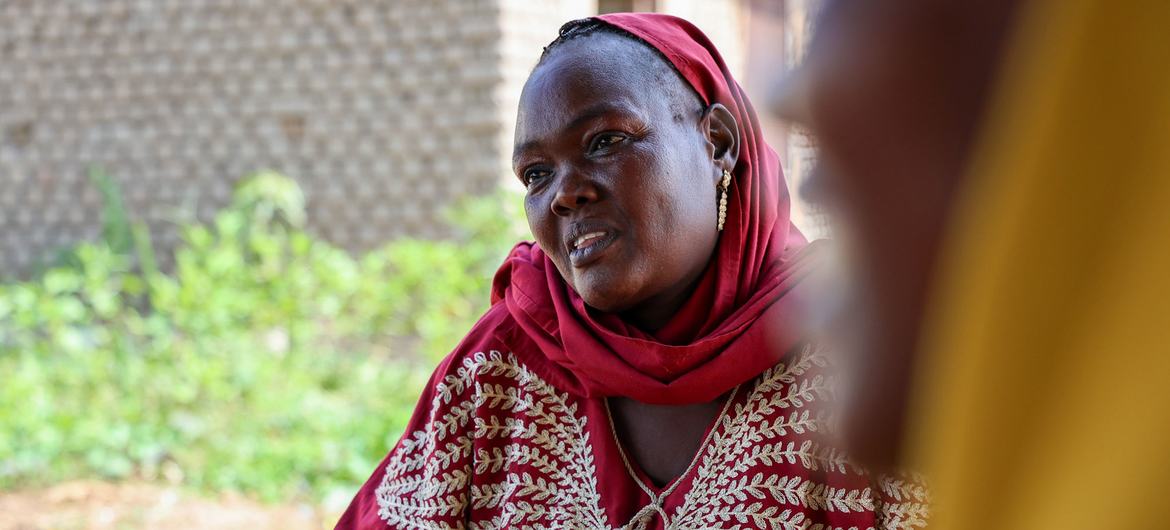
Nearly 1,400 women across South Sudan have benefitted from leadership training.
Transformative training
But even before she spoke out, Awrelia was leading in her own way – fighting for her children’s education and holding her family together. That strength deepened when she joined a women’s leadership training organized by the International Organization for Migration (IOM) in Wau.
The training is included in IOM’s gender-transformative recovery programme – part of a broader, locally led effort to strengthen women’s leadership and ensure their participation in community decisions.
Across South Sudan, women’s groups and grassroots movements have long been laying the groundwork for change. The five-day course builds on that momentum, offering women a safe space to reflect, learn, and grow together.
I learned that being a leader means treating others fairly and solving problems with patience. The training gave me courage to stand up for myself. Now I know I can lead.
“I learned that being a leader means treating others fairly and solving problems with patience,” she said. “The training gave me courage to stand up for myself. Now I know I can lead.”
Back in her community, she put her new confidence into action. Her local women’s group had nearly collapsed, but she brought it back together. Now they meet regularly to support one another and share their challenges.
Though they lack funding for income-generating activities like sewing or catering, the group offers something equally powerful: solidarity.
Women run households
In many displacement-affected areas of South Sudan, women head up to 80 per cent of households.
In Wau, Bentiu, Malakal, and other areas where IOM runs the programme, more women are stepping forward. Those who once stayed silent now speak up at meetings, support survivors of violence, and build networks to share experiences and grow together.
Awrelia has noticed a change in how she is perceived. “People recognize me now,” she said. “During a meeting with chiefs and women leaders, they mentioned my name and honoured me in front of everyone. It made me feel proud. The women I lead respect me, and I respect them.”
From homes to community halls, women like Awrelia are finding their voices and reshaping what the future can look like – for their daughters, their families, and their country.
G20 Johannesburg Leaders’ Declaration

G20 leaders met in Johannesburg, South Africa, on 22-23 November 2025 and agreed on a joint declaration.
Remarks by President António Costa at G20 Session I: "Inclusive and sustainable economic growth – leaving no one behind"
President António Costa attended the G20 summit in Johannesburg. He spoke at Session I: “Inclusive and sustainable economic growth – leaving no one behind”, on 22 November 2025.
‘Leave no one behind’: as wealth gap widens, UN calls for new industrial deal for the world’s poorest

“First we have to end the war. Then we have to restart the factories,” says Basher Abdullah, advisor to Sudan’s Minister of Industry and Trade.
Like many of the world’s poorest countries, Sudan’s attempts to develop its economy are severely hampered by the conflict. Yet even in the midst of a brutal civil war, the UN continues to offer support and pave the way for development.
First, we must end the war. Then, the factories will have to be restarted.
The fighting appears far from the vast King Abdul Aziz Conference Center in the Saudi capital, where government ministers gathered Saturday for a family photo to mark the Eleventh Conference. Least Developed Countries Ministerial Meeting.
Hailing from Asia, Africa and the Caribbean, the ministers have one thing in common: they each represent one of the world’s poorest and most vulnerable nations, officially designated by the UN as a least developed country (LDC).
Family photo at the 11th LDC Ministerial Conference, Riyadh (November 2025)
“Yes to global solidarity”
“We need a decisive change of direction,” said Gerd Müller, CEO of UNIDOin his opening speech to the assembled ministers, reminding them that industrialization is “essential to achieve the set objectives”. Sustainable Development Goals (the 17 global goals adopted by all UN member states in 2015 as part of the 2030 Agenda for sustainable development) and strengthen resilience in the face of crises.
“We must say yes to global solidarity, say yes to multilateralism, say yes to prevent the gap between rich and poor from widening even further,” added Mr. Müller.
He pointed out that 500 Nobel Prize winners and economists are calling on the world’s leading economies (the G20, currently meeting in South Africa) to act: these leading experts highlighted the fact that between 2000 and 2024, the richest percent of the world’s population increased their wealth by 41 percent, while the poorest half of the world’s population increased theirs by only 1 percent.
Müller stressed that the world’s least developed countries are particularly vulnerable to all kinds of economic shocks, from the climate crisis to tariffs and significant cuts in foreign aid and development support from richer countries.
“The losses,” he warned, “will be devastating in sectors such as textiles, leather, agribusiness and equipment – all vital to local livelihoods and economies.”
Building resilience through industry
UNIDO’s mission is to help countries overcome these shocks and, by industrializing, become more resilient and improve lives: in Bangladesh, UNIDO training programs have helped garment factories meet international standards, creating millions of jobs for women; and in Nepal, young people are learning coding and digital skills, bridging the digital divide.
Meanwhile, in Sudan, the agency supports agribusiness, targeting smallholders and entrepreneurs, and helping youth and women access finance, preparing the private sector for a period of peace and stability.
On Saturday, two major outcomes were achieved: guidelines to scale up UNIDO’s support – focused on the transfer of technology and know-how – were agreed, and ministers committed to modernizing the industry, finding the funds needed to achieve this and working more closely together, in line with the UN’s global goals.
The commitments made in Riyadh mark a decisive step towards ensuring that millions of people in the world’s most vulnerable countries can thrive in an interconnected global economy.
Conference results
The Eleventh LDC Ministerial Conference was convened by the United Nations Industrial Development Organization (UNIDO) in partnership with the Office of the United Nations High Representative for LDCs, Landlocked Developing Countries and Small Island Developing States (OHRLLS).
-
Ministerial declaration adopted – reaffirm the commitment to inclusive industrialization and resilience.
-
Approval of UNIDO operational strategy – roadmap to increase support to LDCs until 2031.
-
Strengthened partnerships – new commitments on financing, capacity building and technology transfer.
-
Agreed policy frameworks – youth empowerment, gender equality and climate adaptation highlighted as priorities.
Originally published at Almouwatin.com
UN outlines UN80 Initiative action plan, establishing a coordinated path for system-wide reforms

The plan does not introduce new proposals but sets out how the United Nations system intends to advance those already on the table: 87 actions, grouped into 31 work packages divided into 3 areas of work, ranging from peace operations and humanitarian response to technology, shared services and institutional mergers.
“Its objective is to provide structure, transparency and coherence as well as an operational framework to advance all aspects of the UN80 Initiative – and also to allow you to see how each element will move forward: who is responsible for what and on what timetable,” Ryder told Member States during an informal meeting of the General Assembly.
A plan to change the UN
The Action Plan is at the heart of the UN80 Initiative, a bold system-wide transformation to make the United Nations system work better – so that every dollar, decision and mandate delivers better results for people and the planet.
Launched in March 2025, and welcomed by the General Assembly in resolution 79/318The Initiative is not intended to redefine what the United Nations system does. The focus is on how it is structured, managed and coordinated: modernizing outdated arrangements, reducing bureaucracy, fragmentation and duplication, and enhancing impact.
The UN80 Initiative is progressing through three streams of work – all brought together in the Action Plan: proposals aimed at improving efficiency across the United Nations system, with initial proposals reflected in the revised estimates for the program budget proposed by the Secretariat for 2026; THE Report of the review of the execution of the mandatecurrently under study by the Member State-led committee Informal ad hoc working group; And “Shifting paradigms: United to deliver”, the Secretary-General’s report outlining potential structural and programmatic realignments.
The Action Plan brings these three streams of work under one roof, translating their recommendations into a clear structure that identifies responsibilities, deadlines and the intergovernmental bodies that will consider the proposals.
“If we maintain the momentum and approach this initiative in the right spirit, the coming months could be a time of real transformation,” Ryder told member states.
From three reports to 31 work packages
Concretely, the Action Plan is a road map. It takes the dense architecture of the UN80 Initiative and breaks it down into work packages, ranging from discrete technical changes to large-scale system changes.
Some of the biggest programs focus on what senior officials call the “big tickets” for a more cohesive United Nations system. On the peace and security side, this means new models for peace operations, including how tasks and resources are delegated to entities best placed to carry them out. In the humanitarian field, he is advancing the New Humanitarian Compact to simplify emergency response plans, integrate supply chains and expand common services so that every dollar can do more.
Another group of work focuses on how the UN development system is configured, including a “reset” of regional capacities and a reconfiguration of UN country teams that better combine expertise and cost-effectiveness.
The plan will also advance assessments of possible mergers between UNDP and UNOPS, and UNFPA And UN Womenand the way forward for UNAIDS.
Crucially, the Action Plan places emphasis on bringing together all the “operational tools” that underpin the daily work of the United Nations system: common data; shared technology platforms; unified services for supply chains and all other back-office functions; and a simpler approach to training and research.
Steering committee and working group at the center
A new Steering Committee, chaired monthly by the Secretary-General, will provide strategic direction and coherence among leaders across the United Nations system.
Within it, the UN80 working group, chaired by Mr Ryder, will meet weekly to coordinate implementation, monitor deadlines and prepare recommendations for consideration by the steering committee.
“As a basic principle, all actions will be undertaken in accordance with applicable rules and procedures, as set out in the Charter, as well as decisions, resolutions and established practices of relevant intergovernmental bodies,” recalled Mr. Ryder.
He noted that the Action Plan contains proposals under three different decision-making scenarios. The first scenario concerns proposals that fall under the authority of the Secretary-General. The second concerns proposals that require additional work, including potential mergers outlined in the Work Stream 3 report. The third scenario concerns proposals involving financial considerations related to the program budget and the peacekeeping operations budget and are submitted to the General Assembly for consideration and approval in accordance with standard procedures.
Not a cure for cash shortage – but part of the answer
This plan is being implemented at a time when the United Nations system continues to face severe funding cuts, with system resources estimated to fall by 25% (from $66 billion to $50 billion) in 2026 compared to 2024.
The Secretary-General has made it clear that the UN80 Initiative is not a solution to the financial crisis of the United Nations system but a commitment to protecting maximum impact, including in the most vulnerable contexts.
A public dashboard for a complex redesign
To help make sense of a reform that affects almost every aspect of the United Nations system, the Secretariat has launched an interactive site Dashboard of UN80 Initiative actions.
The online platform allows users to see, at a glance, each work package, its objectives and leadership, and its links to the three core reports. The dashboard will be expanded with a timeline and milestones and updated regularly as work progresses.
For an initiative whose success will ultimately be measured not by new documents but by its real-world impact, the Action Plan represents a turning point: moving from conception to a phase where progress, gaps and results will be tracked in one place.
Originally published at Almouwatin.com
Russian Spy Ship is Very Interested in Europe’s Critical Undersea Cables
Russian willingness to organize and conduct sabotage operations in Europe is quite shocking. The West pledges to remain
UN denounces ‘truly horrible’ massacres in DRC

The UN described it as one of the most horrific attacks in a new wave of violence by the Allied Democratic Forces (ADF), an armed extremist rebel group.
Four wards housing patients were burned during the assault in Byambwe, an isolated community about 60 kilometers west of Lubero in the restive North Kivu province that has been gripped by fighting between a plethora of armed groups and national security forces for years.
Coordinated murders
The Byambwe killings were part of a series of coordinated attacks carried out between November 13 and 19 in several localities in Lubero territory.
According to information collected on the ground by United Nations human rights staff from MONUSCO peacekeeping mission, a total of 89 civilians were killed, including at least 20 women and an unknown number of children.
Other areas affected by violence include Mabiango, Tunarudi, Sambalysa, Thucha and Butsili, where abuses range from kidnappings and looting of medical supplies to burning of houses and destruction of property.
UN spokesperson Stéphane Dujarric said during Friday’s briefing in New York that “As we dug deeper and sent people out there, the information we received was truly horrific..”
The UN offered its condolences to the affected families and communities, stressing that attacks against civilians, particularly against medical facilities, can constitute war crimes and serious violations of international humanitarian law.
Solidarity with the victims
“We express our solidarity with all those affected,” Mr Dujarric said. “Violence against civilians, including targeting of medical facilities, may constitute war crimes.”
MONUSCO said it remains fully committed to help the Congolese authorities protect civilians, prevent further human rights violations and fight impunity.
The stabilization mission urged national authorities to quickly open independent and credible investigations to identify those responsible for the massacres and bring them to justice.
He also renewed his call on armed groups operating in the region to lay down their arms unconditionally.
Mr. Dujarric said that “too often,” massacres like those reported in Lubero “occur far from the eyes of journalists, far from the eyes of the international community.”
He appealed regional powers to cooperate and armed groups to disarm, “so that those responsible for these crimes which go beyond words” [can] be brought to justice.”
Who are the ADF?
The Allied Democratic Forces are an armed group of Ugandan origin that has operated in eastern DRC for decades.
Known for its brutal attacks on civilians, the ADF has pledged allegiance to the Islamic State and is considered one of the deadliest non-state armed organizations in the region.
Originally published at Almouwatin.com
