A remark in Vienna could reopen one of Slovakia’s longest-running religious-freedom disputes.
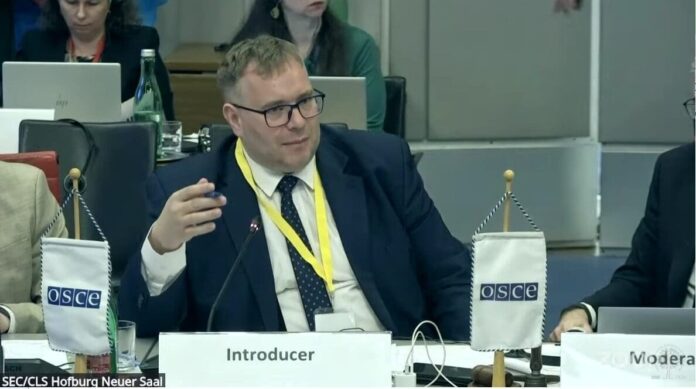
Slovakia’s long-running dispute over how the state recognizes religion resurfaced on Tuesday at the OSCE ODIHR meeting in Vienna, where Public Defender of Rights Róbert Dobrovodský indicated that he intends to challenge the country’s requirement that a religious community gather 50,000 adult adherents before it can register officially. The remark, made during discussion on judicial review and accountability in lawmaking, matters because the ombudsman’s office has already spent years arguing that the threshold is excessive, discriminatory and out of line with what a democratic society should require.
The intervention came during the second day of the OSCE ODIHR Supplementary Human Dimension Meeting on “Lawmaking for Democratic Resilience”, a gathering that has focused on how democratic systems can be weakened not only by openly unlawful acts, but also by laws passed without fair safeguards, meaningful scrutiny or effective remedies. As The European Times reported earlier from the same Vienna meeting, Tuesday’s final working session was devoted precisely to the question of what happens when courts or constitutional review bodies become the last line of defence.
A threshold that has shaped religious freedom for years
Under Slovakia’s current legal framework, a group seeking recognition as a religious community must submit declarations from at least 50,000 adult citizens who permanently reside in the country. In practice, that threshold is far more than a symbolic formality. Groups that cannot meet it may still organize in other legal forms, such as civic associations, but they do not gain the status of a recognized religious community and therefore lose access to a series of rights and public functions that recognized churches enjoy.
That includes the ability to operate fully as a religious body before the state, to establish religious schools, to obtain public subsidies, and to provide officially recognized spiritual services in places such as prisons or public hospitals. Critics have long argued that this creates a two-tier system: historic churches remain protected, while newer or smaller communities are left in a legally inferior position even when they are peaceful, organized and socially established.
The asymmetry is striking. Many of Slovakia’s already registered churches would not themselves meet the present threshold if they were applying for the first time today. They remain protected because they were registered before the stricter rules took effect. That has turned the registration system into a barrier not simply against abuse, but against entry.
Why the ombudsman’s office says the law is unconstitutional
The legal case against the threshold has been building for some time. In a 2022 statement, the Slovak ombudsman’s office said the registration requirement was disproportionate, discriminatory and not necessary in a democratic society. The office argued that the rule prevents smaller churches and religious societies from acquiring legal personality as religious communities and creates a range of practical obstacles, from property and employment issues to limits on their institutional religious life.
Dobrovodský’s 2024 annual report went further. It said the progressive tightening of registration rules in 2007 and again in 2017 had left only a handful of the largest churches capable of meeting the current standard. The report argued that this may violate constitutional protections for freedom of religious manifestation and church self-government, and could also conflict with the state’s duty of religious neutrality.
The office has also rejected one of the standard political justifications for the threshold: that it is needed to prevent speculative registrations by groups seeking access to public money. That concern, the report argued, can be addressed in less restrictive ways through ordinary administrative scrutiny rather than by setting the bar so high that smaller communities are effectively locked out from the start.
Politics stalled. A court case may be next.
Legislative solutions have so far gone nowhere. In 2024, the Ministry of Culture did not produce the reform the ombudsman’s office had urged, and later rejected a renewed request to bring the law into line with the constitution. Parliament also failed in March 2024 to pass a bill that would have created a lower-status registration category for smaller religious groups. Even that compromise was criticized, because it would still have left such communities in a second-class position.
There have been other missed openings. According to the 2023 international religious-freedom reporting on Slovakia, President Zuzana Čaputová agreed that the registration requirements were “unreasonably high,” but she declined to ask the Constitutional Court to review them, saying she expected the court would not reverse its earlier approach. That left reformers in an awkward position: broad recognition that the law is too restrictive, but no institution yet willing to force the constitutional question directly.
That is why Dobrovodský’s signal in Vienna is important. If he now follows through, the issue may move from political debate into constitutional litigation. And the legal question would be difficult to avoid: can a state credibly claim to protect freedom of religion for all while maintaining a registration rule that only a few of the country’s largest religious bodies could satisfy?
Examples from elsewhere in Europe
Comparative examples from elsewhere in Europe help show why Slovakia’s system has drawn so much criticism. Democratic states do regulate how religious communities acquire legal status, but many do so through registration models that focus on statutes, continuity, governance or social presence, not by requiring tens of thousands of citizen signatures before a community can even enter the system. That does not mean all European models are identical or free of hierarchy. It does mean Slovakia’s threshold stands out as unusually hard to satisfy for newer or smaller faith communities.
Spain offers a layered system rather than a numerical barrier. Religious groups do not need to register in order to practice their faith, but registration in the state’s Registry of Religious Entities gives them legal benefits such as the ability to buy, rent and sell property and act as a legal entity in civil proceedings. Spanish law links legal personality to registration, but not to a fixed membership threshold. Beyond basic registration, some communities may later obtain notorio arraigo status — roughly meaning deep social roots — which can open the way to broader cooperation agreements with the state. In practice, Spain’s model is not perfectly equal, because some communities enjoy more privileges than others, but it is still far less exclusionary than a system that demands 50,000 signatures before recognition is even possible.
Portugal also uses a differentiated model, but again without a mass-signature requirement. Portuguese law provides for the registration of religious legal persons and then distinguishes churches or religious communities considered radicadas no País — rooted in the country — with that qualification assessed by the competent government member in light of the number of believers and the history of the community’s existence in Portugal, after hearing the Religious Freedom Commission. That rooted status matters because it unlocks additional recognition, including civil effects for religious marriages celebrated before ministers of communities recognized as rooted in the country. The Portuguese model therefore still evaluates stability and social presence, but it does so through institutional assessment and duration, not through a headline numerical petition threshold.
Sweden, by contrast, illustrates an administrative registration model. Kammarkollegiet, the Swedish Legal, Financial and Administrative Services Agency, registers religious communities that are organized for religious activity, have statutes stating that purpose, and have a governing board or equivalent body. The register records basic institutional information such as the community’s name, address, statutes and contact person. A community that wants its marriages to have civil validity must then apply separately for that right, and individual officiants must be authorized as well. The Swedish system is therefore structured and supervised, but it is built around organization and legal compliance, not around proving that a faith already commands tens of thousands of signatures.
Seen together, these examples do not prove that Europe has a single ideal model for religious recognition. They do show, however, that states have many ways to regulate legal status without setting the entry bar so high that smaller communities are effectively excluded from recognition altogether. That is precisely why Slovakia’s 50,000-signature rule has become such a sensitive test of whether formal freedom of religion is matched by equal access to the law in practice.
More than a Slovak dispute
The significance goes beyond Slovakia. Across Europe, debates over freedom of religion often focus on headline controversies, discrimination cases or symbolic political fights. But legal recognition rules matter too. They shape whether communities can exist in public life as communities, not merely as tolerated private associations. They also test whether neutrality means equal freedom under the law or simply the preservation of inherited privilege.
That made Vienna an appropriate place for the issue to surface. A meeting about democratic resilience and judicial accountability is exactly where such a question belongs. When lawmakers fail to correct a rights problem, and when ministries decline to act, the last remaining test is often whether constitutional review still works as a real safeguard rather than a theoretical one.
For Slovakia, that moment may now be approaching.

 يمكن لملاحظة في فيينا أن تعيد فتح أحد أطول نزاعات الحرية الدينية في سلوفاكيا. عاد النزاع الطويل الأمد في سلوفاكيا حول كيفية Remove the water from the water الديمقراطية وحقوق الإنسان التابع لمنظمة الأمن والتعاون في أوروبا في فيينا، حيث أشار المدافع العام عن الحقوق روبرت دوبروفودسكي إلى أنه يعتزم […]

 The crisis in the Middle East has entered its third week, with fighting continuing across the region and humanitarian needs increasing. Oil prices continue to hover above $100 a barrel, while shipping disruptions and temporary flight suspensions affect travel and […]