Monday, March 30, 2026
Home Blog Page 160

Haiti is subject to a UN arms embargo: so why are 500,000 illegal weapons circulating?

0

Haiti faces an acute security crisis as rival gangs fight for control of the capital, Port-au-Prince, and surrounding areas, while terrorizing local communities through extortion, sexual violence, kidnapping for ransom and murder.

UN member states agreed to impose an arms embargo on Haiti in 2022 – so what went wrong? Here are five things you need to know.

How many weapons are there in Haiti?

Haiti does not manufacture firearms or ammunition, but according to the latest figures According to information published by the Office of the United Nations High Commissioner for Human Rights, it is estimated that between 270,000 and 500,000 illegal weapons are in circulation.

They are not only in the hands of the many murderous gangs that control most of the capital, they are also common among the growing number of “justice” vigilante groups trying to protect people and property in Port-au-Prince’s troubled neighborhoods.

The impact of so many weapons in a metropolitan area of ​​approximately 2.6 million people is devastating. According to the UN, in 2024 alone, more than 5,600 people have been killed due to gang-related activities.

In early December 2024, in just five days, at least 207 people were killed by gangs controlling the Quai Jérémie district of the capital.

Thousands of people have been killed in Haiti because of gang warfare.

Human rights violations and abuses documented by the UN include massacres, kidnappings for ransom, rape and sexual exploitation, destruction of property and severe restrictions on access to essential services, particularly health care and education.

What firearms are in circulation?

It is difficult to accurately estimate the number of illegal firearms in the hands of gangs and vigilante groups, but there is evidence that more sophisticated and lethal weapons are being used.

Haitian authorities have had limited success in stopping the flow of weapons. A shipment of weapons purchased in Miami in the United States and intercepted in the Dominican Republic in February 2025 included a Barret M82 heavy semi-automatic rifle, sniper rifles, an Uzi submachine gun and more than 36,000 rounds of ammunition.

A man is being treated for serious burns in hospital after gangs attacked and started a fire at the petrol station where he worked.

What does the embargo say?

The arms embargo as well as travel bans and freezing of individuals’ assets were authorized by the UN. Security Council in October 2022.

Specifically targeting gangs and individuals deemed responsible for threatening the peace and security of Haiti, it calls on UN member states to prohibit the supply, sale or transfer of weapons and related materiel of all types, including technical assistance, training and financial support related to military activities.

He recognizes that the situation in Haiti constitutes a threat to regional peace.

How to circumvent the embargo?

Well-established trafficking routes from the United States, primarily from Miami – but also from New York via the Dominican Republic – continue to be exploited, often due to weak customs controls and corruption.

Some shipments are intercepted by American authorities before reaching Haiti.

Weapons seized by American law enforcement and destined for Haiti are on display.

There is also evidence of weapons being shipped from Venezuela and other South American countries.

Weapons are frequently concealed in mixed shipments or declared as humanitarian or commercial goods to evade inspection.

There are also growing concerns that assault rifles originally registered to private security companies operating in Haiti will end up in the hands of gang members.

What needs to be done to ensure compliance with the embargo and what help is the UN providing?

The United Nations Office on Drugs and Crime (UNODC) who works on trafficking issues, said ensuring compliance requires a “comprehensive and coordinated approach at national, regional and international levels.”

© UNICEF/Ralph Tedy Erol

This means equipping Haitian customs, port and border control authorities with the technical capacity to detect, interdict and investigate illicit arms shipments. Currently, there is not even a single large format scanner in all of Haiti that can effectively identify the contents of a shipping container or truck.

Given that most weapons enter Haiti by sea, it is essential to improve maritime and port security – including inspections – as well as work more effectively with law enforcement authorities in countries of origin.

Providing more resources along the porous border with the Dominican Republic, which shares the island of Hispaniola with Haiti, would help end illicit trafficking through unofficial crossings.

The UN is helping coordinate Haiti and other countries in the region to ensure compliance and providing technical assistance to strengthen arms tracing, customs controls and financial investigations.

“The fight against corruption and illicit financial flows also remains essential to respecting the embargo,” UNODC said.

Since Haiti does not manufacture weapons or ammunition, simply cutting off the supply of bullets would end the gangs’ ability to fight and terrorize communities.

Originally published at Almouwatin.com

Media advisory – Transport, Telecommunications and Energy Council (Energy) of 20 October 2025

0
Media advisory – Transport, Telecommunications and Energy Council (Energy) of 20 October 2025

Main agenda items, approximate timing, public sessions and press opportunities.

Source link

Financial crisis forces deep cuts to UN peacekeeping missions

0

The crisis, which UN peacekeeping chief Jean-Pierre Lacroix called “more intimidating than ever,» follows the partial non-payment of assessed contributions – the mandatory contributions that member states pay to fund UN operations in some of the world’s most unstable regions – which are operating at a level well below the approved budget for 2025-26.

He echoed those warnings this week in a speech to defense officials and diplomats at a peacekeeping conference in New Delhi, saying: “Unfortunately, we have no other option.” »

Our peacekeepers, your peacekeepers, protect people – they mean the difference between life and death for hundreds of thousands of civilians.» he said.

Massive cuts in the field

The UN Secretary-General has asked all missions to identify spending reductions equal to 15 percent of their annual budgets, a move that will result in an approximately 25 percent reduction in uniformed and civilian personnel due to the tight schedule.

These reductions will affect all major areas of peacekeeping work – from patrols and protection functions to logistics, air operations and civil support functions.

The Department of Peace Operations (DPO) warned that fewer peacekeepers on the ground will mean fewer patrols to monitor ceasefires, fewer safe zones for civilians and less support for humanitarian relief in places like the Democratic Republic of the Congo, South Sudan, the Central African Republic, Lebanon and the Golan Heights.

Call for solidarity

Mr. Lacroix urged all member states to pay their contributions “in full and on time” and called for collective advocacy to counter what he described as “campaigns that spread misinformation and disinformation about peacekeeping operations.”

We need your understanding and support, but we also need to work together to remedy this situation.» he said.

UN Secretary-General António Guterresin his own remarks to troop- and police-contributing countries last week, echoed that call, emphasizing the importance of peacekeeping missions.

But without predictable, adequate and timely funding, peacekeeping cannot achieve its objectives. Security Council mandates.

UN peacekeepers on patrol in rural South Sudan.

A budget under pressure

The General Assembly in July approved a $5.38 billion peacekeeping budget for 2025-2026 – down slightly from $5.6 billion the previous year – covering missions and global support centers in Entebbe, Uganda, and Brindisi, Italy.

However, budget execution depends on the contributions actually received.

Peacekeeping represents less than 0.5% of global military spending, estimated at $2.4 trillion in 2023, but it remains one of the UN’s most crucial and visible tools for maintaining international peace and security.

Some wonder why peacekeeping missions are still necessary,» Colin Stewart, the former head of the United Nations Peacekeeping Force in Cyprus (UNFICYP) said UN News shortly before retiring from the Organization.

The answer is simple: it is peaceful because the missions have done their job. Without this, distrust between the parties could easily degenerate into confrontation.”

A pivotal moment

Since 1948, more than two million member state peacekeepers have worked in some of the world’s most hostile environments, contributing to the implementation of ceasefires and the space for political dialogue and peace processes. More than 4,400 peacekeepers have lost their lives in the quest for lasting peace.

As the UN celebrates its 80th anniversary, Mr. Lacroix said the Organization finds itself at “a pivotal moment” and must adapt peace operations to new global realities.

“The challenges ahead are real,” he warned, “but so is our ability to meet them – if we stay united in their goals, pragmatic in their actions and unwavering in their commitment to peace.»

Originally published at Almouwatin.com

EU eyes budget leverage to push pension reform

0
EU eyes budget leverage to push pension reform

The European Commission is weighing whether to give its country-specific recommendations real bite by linking parts of the next seven-year EU budget to pension reform progress. With Europe’s aging population squeezing public finances and underdeveloped supplementary pensions, Brussels sees “reform-for-funds” as a way to nudge capitals to act—yet clashes in Belgium and France’s pause on its own reform show just how politically explosive pensions remain.

Demographics make delay costly

Europe is getting older and its traditional pay-as-you-go systems are strained by fewer workers supporting more retirees. The EU’s audit watchdog recently concluded that efforts to build up second- and third-pillar pensions have fallen short, leaving many countries heavily reliant on state schemes. A Financial Times summary of the findings noted that the flagship pan-European personal pension (PEPP) has attracted only a few thousand users and roughly €11.5 million in savings since 2022—far from its aspirations.

From guidance to leverage

Under the Commission’s proposal for the 2028–2034 Multiannual Financial Framework, Brussels wants a more flexible, results-driven budget. Think-tank assessments suggest this could generalise the post-pandemic “reform-for-funds” blueprint across programmes—using financial incentives to unlock investment when reforms are delivered. The European Policy Centre argues the next MFF is likely to extend this approach, while Bruegel highlights the political battle ahead over scope and ambition.

For pensions, the Commission’s push would stop short of dictating retirement ages. Instead, it would lean on budget conditionality to encourage auto-enrolment into private savings, stronger occupational schemes, and measures that broaden coverage—steps many member states have struggled to implement. Advocates say auto-enrolment could both boost retirement adequacy and channel long-term savings into Europe’s capital markets.

Political peril is real

Recent events underscore the risks. On 14 October, a national strike paralysed Belgium as unions protested austerity and pension changes, with police using tear gas amid clashes in Brussels—Reuters and AP reported widespread travel disruption and arrests. Context matters: Belgium has legislated a rise in the statutory retirement age to 66 in 2025 and 67 by 2030, a timetable that has become a lightning rod for anger. Our own coverage captured the day’s scenes in Brussels (The European Times).

In France, newly appointed Prime Minister Sébastien Lecornu has moved to suspend the 2023 reform that raised the legal retirement age from 62 to 64, a step aimed at stabilising a fragile parliamentary arithmetic. EU executive vice-president Valdis Dombrovskis acknowledged the pause will be costly but said France plans offsetting measures to keep fiscal plans on track, according to Reuters. Le Monde breaks down how the suspension would work in practice.

How conditionality might work

Legally, pension design is a national competence. But the Commission can still use milestone-based disbursements—as it did under the Recovery and Resilience Facility (RRF)—to encourage “soft” reforms like coverage expansion, auto-enrolment, or incentives for later retirement. Parliamentary briefing notes on the new MFF emphasise the scale and direction of the next budget and the likelihood of more performance-linked funding (European Parliament Research Service). The Commission has also been convening a “reality check” on retirement savings to spread best practices across the bloc.

The roadblocks: bureaucracy and buy-in

Not all capitals are convinced. Governments struggled with the paperwork burden of the RRF’s milestone system, leaving funds on the table in some cases. Critics warn that expanding conditionality could slow delivery and inflame sovereignty disputes just as the EU faces costly transitions and enlargement pressures (see analyses by Hertie Center and CAN Europe).

What to watch

  • Scope of conditionality: Whether pensions become an explicit priority within the MFF negotiations.
  • Design over diktat: Emphasis on auto-enrolment, occupational coverage and adequacy—rather than headline retirement ages.
  • Social consent: Whether governments can build coalitions for reform amid unrest like the recent Belgian strike.
  • Capital markets link: Momentum for turning pension savings into productive investment as part of a revived Capital Markets Union (see policy signals).

Brussels is preparing to use money to move policy. Tying slices of EU funding to credible pension fixes could help shore up sustainability and adequacy—but only if it avoids one-size-fits-all ultimatums and secures domestic buy-in. The demographic clock is ticking; the politics remain unforgiving.

Source link

Piero Cipollone: Stablecoins and monetary sovereignty

0
Piero Cipollone: Stablecoins and monetary sovereignty

Piero Cipollone: Stablecoins and monetary sovereignty

Source link

Gaza: UN pushes to scale up aid delivery

0
Gaza: UN pushes to scale up aid delivery

On Thursday, UN Emergency Relief Coordinator Tom Fletcher made his way to Rafah on the southern Gaza border, from the Egyptian capital Cairo, describing the main Rafah crossing as a “vital lifeline for food, medicine, tents and other lifesaving aid.”

He told BBC Radio 4 that the role of the “collective international community” was essential for aid delivery, adding that he was in very close touch with the White House “who are determined that we are allowed to deliver at scale.”

The UN agency that supports Palestine refugees, UNRWA, reported that it has sufficient food supplies outside Gaza to sustain the population for three months, but said Israeli authorities are still blocking its entry despite the Israel-Hamas ceasefire.

© UNICEF/Mohammed Nateel

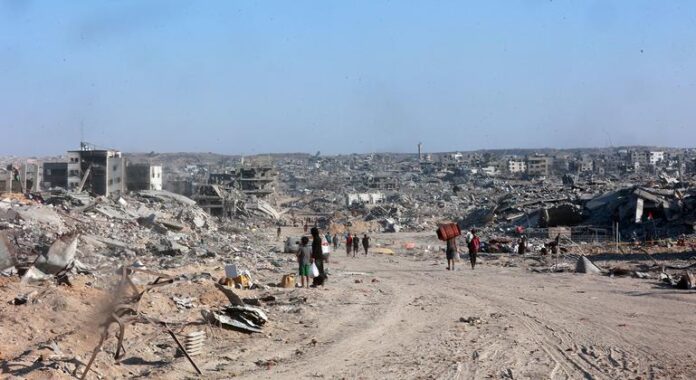
Displaced Palestinians travel along the coastal road back to northern Gaza.

UNRWA still the ‘backbone’

UNRWA spokesperson Adnan Abu Hasna told UN News that with its unparalleled aid distribution network, the agency must be the “backbone” of the enhanced relief effort, and if Israel continues to exclude them it would mean “a loss of people’s trust.”

We see absolutely no justification for Israel not allowing this massive amount of aid – which cost tens of millions of dollars – into the country.”

He said there are still around 12,000 staff working inside Gaza, including some 8,000 teachers who are working to allow 640,000 students to resume their studies following two years of lost education.

UNRWA has also played a key role providing psychological support in the form of around 800,000 consultations. Ninety per cent of UNRWA facilities have been destroyed, 370 colleagues have been killed in Gaza: “The only thing that has changed for us is our inability to distribute food, even though we have the logistical capabilities,” he said.

Meanwhile, the UN Children’s Fund (UNICEF) stated that it has over 1,300 truckloads of life-saving supplies ready to move, emphasising that humanitarian needs remain immense.

Still in limbo

UNICEF spokesperson Tess Ingram, speaking on the ground in a social media post on Thursday, described the ongoing challenges faced by relief teams as they await access to deliver critical assistance.

“Nine out of 10 homes in the Gaza Strip have been damaged or destroyed,” she said. “What that means is families across the Gaza strip are coming back to the likes of this, a skeleton of a city, a shell of a building, and trying to make sense of how they move forward.”

UN aid coordination office OCHA said supplies from Egypt still need to take a long detour to the Kerem Shalom crossing for Israeli checks, pending the opening of the Rafah crossing to aid.

Relief chief Fletcher stressed the need for all the crossings to be open to allow for a massive scale-up in aid.

“The humanitarian community cannot deliver at the scale necessary without international NGO presence and engagement,” said UN Spokesperson Stéphane Dujarric, briefing journalists in New York on Thursday.

“Currently, the Israeli authorities do not issue visas for a number of international NGOs and do not authorize many of them to send supplies into Gaza.”

Mr. Dujarric pointed to some specific improvements in UN aid delivery: “On Tuesday alone, 21 of our partners distributed nearly 960,000 meals through 175 kitchens. Bakeries that we support produced over 100,000 two-kilogramme bread bundles. UNICEF distributed more than one million baby diapers.”

Lifesaving medical supplies

The World Health Organization (WHO) has been able to deliver three truckloads of surgical and other essential medical supplies to the central pharmacy in Gaza City which will be transferred to Al-Shifa Hospital, serving the needs of around 10,000 people.

WHO has also deployed an international emergency medical team to boost orthopaedic surgery and trauma care in Gaza.

UN teams have also finished clearing main roads leading to the Erez and Zikim crossings in the shattered areas of northern Gaza in anticipation of their potential re-opening.

Source link

Gaza peace plan ‘at precarious moment’ as killings continue on both sides

0

In a statement on Wednesday, Emergency Relief Coordinator Tom Fletcher said that two days after world leaders gathered in Sharm el-Sheikh to endorse the US-led peace initiative, “this is a moment of great but precarious hope.”

“It is also clear from the public response to the progress, that Palestinians, Israelis and people across the region want this peace to take hold,” Mr. Fletcher said.

“So, we must not fail to see through in full the implementation of the agreements made.

He said UN humanitarian operations had finally begun to scale up “after months of frustration and blockages,” with some food, medicine, fuel, water, cooking gas and tents delivered to those in need.

Renewed setbacks

However, he warned that renewed setbacks now threatened to undermine that fragile progress.

“We are now tested to see whether we can ensure that these do not prevent the progress on which President [Donald] Trump, the UN Secretary-General and so many leaders have insisted,” he said.

Mr. Fletcher called on Hamas to “make strenuous efforts to return all the bodies of deceased hostages, urgently,” and voiced concern over “evidence of violence against civilians in Gaza.

He also pressed Israel to allow “the massive surge of humanitarian aid – thousands of trucks a week – on which so many lives depend.” Additional border crossings must be opened, he said, and remaining logistical barriers lifted to ensure aid flows freely.

“Facilitation of aid is a legal obligation,” Mr. Fletcher stressed. “We will not accept any interference with our aid distribution.

Summary executions in Gaza

His appeal came as the UN human rights office (OHCHR) reported new allegations of serious abuses in Gaza, including summary executions and unlawful killings of civilians.

Armed clashes between Hamas-affiliated groups and rival factions have intensified since 10 October, OHCHR said in a news release.

On 13 October, video footage released by the Sahm Unit, reportedly linked to Gaza’s Interior Ministry, showed the public execution of eight blindfolded and handcuffed men who were alleged members of a Gaza City-based family militia.

OHCHR added that said such acts “amount to a war crime,” and reminded Hamas that they “must prevent and repress any violation or abuse committed by its members.”

Meanwhile, Israeli forces were reported to have opened fire on Palestinians attempting to return to their homes in eastern Gaza City on 14 October, killing three. OHCHR said it had recorded 15 Palestinian deaths in similar incidents since 10 October.

The situation in Gaza remains precarious and uncertain,” said Ajith Sunghay, head of OHCHR in the Occupied Palestinian Territory.

“It is imperative to ensure that the ceasefire holds and progresses to recovery and the full realisation of Palestinians’ right to self-determination,” he added.

Source link

Six EU-Funded Projects Receive the 2025 RegioStars Awards in Brussels

0
Six EU-Funded Projects Receive the 2025 RegioStars Awards in Brussels

The RegioStars awards have become Europe’s label of excellence for EU-funded projects that demonstrate the impact and inclusiveness of regional development.

This year’s finalists include initiatives ranging from carbon loss reduction in peatlands across the Atlantic Area to the deployment of electric shared cabin taxis on train tracks in Germany, a Lithuanian virtual library for those with print disabilities, and a modern ecological shopping centre in Belgium.

The notable AGEO project, focusing on geohazard risk management in the Atlantic region, garnered two awards, including the Public Choice Award with about 2,000 votes.

The 2025 REGIOSTARS Award Winners:

  • A Competitive and Smart Europe
  • This project leverages satellite radar imagery to create precise and reliable monitoring of crop growth through mineral fertilisation maps, enhancing precision farming practices.

  • A Green Europe
  • AGEO brings together scientists, local communities, and governments to address geohazards in the Atlantic region through citizen science, Earth observation, and innovative risk management tools. It demonstrates how to empower local communities to engage in early warning systems and climate challenges. 

  • A Connected Europe
  • A gyro-stabilized monorail cabin system providing an individual, autonomous, and “on demand” solution – serving as a flexible, socially responsible, and sustainable feeder to public transport.  as an on-demand, flexible solution to enhance mobility.

  • A Social and Inclusive Europe
  • Providing free psychosocial support post-childbirth to ensure women’s well-being, connecting health and social services for comprehensive care for post-partum distress.

  • A Europe Closer to Citizens
  • A dedicated shared space with a vision for a prosperous, more peaceful and cohesive future for women and their families from Protestant and Catholic communities across the region and beyond. 

  • Public Choice Award
  •  Background: Organised by the European Commission since 2008, the RegioStars Awards celebrate Cohesion policy’s supported projects showing the impact and inclusiveness of regional development with solutions to common challenges across EU regions. A jury consisting of experts from all over Europe selected 25 outstanding finalists across five key areas, each representing a priority for the EU’s regional policy. Those shortlisted were invited to present their final pitch before a jury during the 2025 European Week of Regions and Cities, taking place in Brussels from 13 to 15 October. 


    Source link

    Six EU-Funded Projects Receive the 2025 RegioStars Awards in Brussels

    0
    Six EU-Funded Projects Receive the 2025 RegioStars Awards in Brussels

    The RegioStars awards have become Europe’s label of excellence for EU-funded projects that demonstrate the impact and inclusiveness of regional development.

    This year’s finalists include initiatives ranging from carbon loss reduction in peatlands across the Atlantic Area to the deployment of electric shared cabin taxis on train tracks in Germany, a Lithuanian virtual library for those with print disabilities, and a modern ecological shopping centre in Belgium.

    The notable AGEO project, focusing on geohazard risk management in the Atlantic region, garnered two awards, including the Public Choice Award with about 2,000 votes.

    The 2025 REGIOSTARS Award Winners:

  • A Competitive and Smart Europe
  • This project leverages satellite radar imagery to create precise and reliable monitoring of crop growth through mineral fertilisation maps, enhancing precision farming practices.

  • A Green Europe
  • AGEO brings together scientists, local communities, and governments to address geohazards in the Atlantic region through citizen science, Earth observation, and innovative risk management tools. It demonstrates how to empower local communities to engage in early warning systems and climate challenges. 

  • A Connected Europe
  • A gyro-stabilized monorail cabin system providing an individual, autonomous, and “on demand” solution – serving as a flexible, socially responsible, and sustainable feeder to public transport.  as an on-demand, flexible solution to enhance mobility.

  • A Social and Inclusive Europe
  • Providing free psychosocial support post-childbirth to ensure women’s well-being, connecting health and social services for comprehensive care for post-partum distress.

  • A Europe Closer to Citizens
  • A dedicated shared space with a vision for a prosperous, more peaceful and cohesive future for women and their families from Protestant and Catholic communities across the region and beyond. 

  • Public Choice Award
  •  Background: Organised by the European Commission since 2008, the RegioStars Awards celebrate Cohesion policy’s supported projects showing the impact and inclusiveness of regional development with solutions to common challenges across EU regions. A jury consisting of experts from all over Europe selected 25 outstanding finalists across five key areas, each representing a priority for the EU’s regional policy. Those shortlisted were invited to present their final pitch before a jury during the 2025 European Week of Regions and Cities, taking place in Brussels from 13 to 15 October. 


    Source link

    How your canteen can be more sustainable

    0
    How your canteen can be more sustainable

    A new EU report outlines sustainable criteria for how schools, hospitals, or public institutions buy, source and manage food and drinks. It promotes healthier and more sustainable food options, whether prepared and served in the canteen, or in vending machines.

    Source link

    Source link