
Intel wants back in the game. The company revealed Tuesday it’s preparing a new data center AI chip
Intel Bets Big on Energy-Smart AI Chip for 2026 Launch
Vice-President Vigliotti highlights EIB support for agricultural development at FAO World Food Forum and unveils new financing for Sub-Saharan Africa’s private sector

- EIB Vice-President Vigliotti underlines the bank’s global support for sustainable and resilient food systems, with a focus on developing countries
- EIB lends $110 million to ETC Group to modernize processing plants, storage and transport infrastructure across Sub-Saharan Africa
- The investment will strengthen agricultural competitiveness, climate resilience, and livelihoods for smallholders
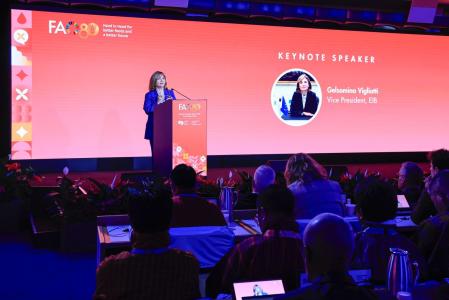
At the World Food Forum in Rome, coinciding with the 80th anniversary of the Food and Agriculture Organization of the United Nations (FAO), European Investment Bank (EIB) Vice-President Gelsomina Vigliotti reaffirmed during her keynote speech the bank’s commitment to strengthening agriculture worldwide, with a particular focus on low- and middle-income countries (LMICs).
“Agriculture is at the heart of global development,” said EIB Vice-President Gelsomina Vigliotti. “The way we produce, distribute, and finance food will determine not only food security but also climate resilience, economic growth, and the livelihoods of millions of people. The EIB plays a key role to support this transformation.”
Since 1965, when the EIB approved its first loan to support agriculture outside Europe, the Bank has financed more than 3,000 agricultural projects beyond the EU, for a total of over €85 billion — with more than 80% of this volume committed in the past decade, reflecting the Bank’s growing focus on agricultural development and food security.
This approach is reinforced through close cooperation with Rome-based UN agencies – FAO, IFAD, and WFP. Joint projects blend financial capacity with technical expertise, ensuring impact even in fragile and low-capacity contexts. For example, a landmark €500 million loan to IFAD, is already scaling rural development and food security in over 70 countries across geographies, with a focus on Sub-Saharan Africa. Moreover, at the Financing for Development (FfD4) summit in Seville in July, the EIB also deepened its collaboration with FAO and WFP through new Memorandum of Understanding.
EIB lends $110 million to ETC Group (ETG) to strengthen agricultural development across Sub-Saharan Africa.
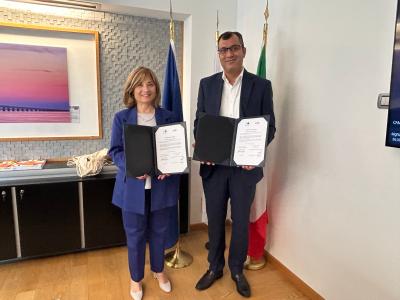
On the margins of the World Food Forum, Vice-President Vigliotti signed a major financing agreement with ETG, one of Africa’s leading agribusiness supply chain players. The $110 million loan will support modernisation of processing plants of commodities such as cashew and soy, as well as essential, storage, and transport infrastructure in Sub-Saharan Africa, including in Mozambique, Malawi, Benin, Zambia, Tanzania, and Uganda. The project also supports ETG’s Farmer Extension Services (FES) program that is in line with its long-standing commitment towards promoting sustainable agriculture. These include training and technical assistance programs to support technology and knowledge transfer to smallholder farmers, as well as community-based initiatives to help farmers improve yields and adopt sustainable practices.
The initiative stands as one of the largest EIB Global financing operations for the private sector in Africa in recent years and reflects the bank’s ambition to build long-term partnerships that boost competitiveness, foster climate resilience, and improve livelihoods across the continent.
“This partnership with ETG shows how targeted private-sector engagement, supported by EIB Global, can deliver real change,” added EIB Vice-President Gelsomina Vigliotti. “By unlocking sustainable investment, we are helping smallholder farmers and rural communities build a more resilient future.”
Paul van Spaendonk, ETG Chief Treasury Officer, welcomed the new agreement: “This significant financing will accelerate our efforts to enhance agricultural competitiveness and food security across Sub-Saharan Africa. With this facility, we can drive impactful projects of varying sizes under a single umbrella, reaching more communities, more quickly.”
Background information
About EIB Global
The European Investment Bank (ElB) is the long-term lending institution of the European Union, owned by its Member States. It finances investments that contribute to EU policy objectives.
EIB Global is the EIB Group’s specialised arm devoted to increasing the impact of international partnerships and development finance, and a key partner of Global Gateway. EIB Global aims to support €100 billion of investment by the end of 2027 — around one-third of the overall target of this EU initiative. Within Team Europe, EIB Global fosters strong, focused partnerships alongside fellow development finance institutions and civil society. EIB Global brings the EIB Group closer to people, companies and institutions through offices across the world. High-quality, up-to-date photos of the organisation’s headquarters for media use are available here.
About ETG
ETG has developed into a global player with a presence in more than 45 countries, spanning 6 continents. The Group has a diverse portfolio of expertise across various industries, encompassing agricultural inputs, chemicals, logistics, processing, food and food ingredients, energy, metals, technology and supply chain optimization. Over 9 000 employees contribute every day to achieve its vision and purpose, and live its values of Respect, Integrity, Pursuit of Excellence, Leadership and Meritocracy. ETG’s verticals are structured in a manner to emphasize focus and optimize strategic growth opportunities. ETG adapts and grows responsibly as a diversified enterprise, creating a sustainable future for all its stakeholders.
Vice-President Vigliotti highlights EIB support for agricultural development at FAO World Food Forum and unveils new financing for Sub-Saharan Africa’s private sector
©EIB
Download original
Vice-President Vigliotti highlights EIB support for agricultural development at FAO World Food Forum and unveils new financing for Sub-Saharan Africa’s private sector
©EIB
Download original
Mysterious gamma-ray explosion unlike any discovered before
Astronomers have detected an explosion of gamma rays that repeated several times over the course of a day, Source link
Israel restricts aid to Gaza, says Hamas must do more to return dead hostages

Israel’s military body that coordinates with the U.N. and other international organizations, COGAT, said in a statement that starting Wednesday it would allow only 300 of the previously agreed 600 humanitarian trucks from the U.N. and other NGOs to enter the Gaza Strip, effectively ending the flow of commercial goods.
COGAT added that no fuel or gas supplies will be allowed into the enclave except when linked to humanitarian needs.
At a press briefing on Tuesday, Olga Cherevko, spokesperson in Gaza for the United Nations aid coordination office, OCHAsaid the agency would continue to encourage both sides to adhere to the agreements outlined in the ceasefire agreement.
“We very much hope that the bodies of the hostages will be handed over and that the ceasefire will continue to be implemented.“, she said.
OCHA is currently implementing a 60-day surge plan, as thousands of tons of humanitarian aid and supplies entered Gaza for the first time in months in recent days.
Help intensifies
“Since the ceasefire plan came into force, the UN and our humanitarian partners have been able to move more freely in areas of Gaza from which Israeli forces have withdrawn, without coordination with Israeli authorities“, said UN deputy spokesperson Farhan Haq at the press conference. daily press briefing in New York.
He listed a number of aid advances, including the installation of a solar panel for a desalination unit, new telecommunications equipment to improve connectivity, the transfer of life-saving medicines from the World Food Program (PAM), and other developments.
He stressed that more could be done: more crossing points must be opened, infrastructure must be restored and security guarantees for convoys must be provided.
Landmine risk
Mr. Haq shared an update from United Nations Mine Action Service (UNMAS), referring to the serious risks faced by displaced people and aid workers from unexploded ordnance, such as landmines, in the devastated Gaza Strip.
Since October last year, UNMAS has disposed of 550 explosive munitions, but only in areas it has been able to access. Explosive Ordnance Disposal (EOD) officers assess the situation and provide advice to mitigate the risk.
“The ceasefire ended the fighting, but it did not end the crisis“, said Ms. Cherevko.
Unexploded ordnance is just one of many challenges facing the post-conflict period, alongside displacement, destroyed infrastructure, collapse of basic services, and more.
“Scaling up the response is not just about logistics and increasing the number of trucks. It is also about restoring humanity and dignity to a broken population,” she added.
Originally published at Almouwatin.com
Humanitarians call for greater support amid immense needs

The $45.3 billion needed for vital activities throughout 2025 has been only 21 percent funded in Septemberwith nearly $9.6 billion received, the UN aid coordination office OCHA said Tuesday.
This represents “a staggering decrease of more than 40 percent compared to the same period last year.”
Closure of health facilities and reduction of food aid
OCHA highlighted that funding gaps have devastating consequences for millions of people around the world who are left without health care, food and education.
“In Afghanistanmore than 420 health facilities have closed this year, forcing three million people to be left without intensive care,” the agency said.
In SomaliaFood aid cuts now mean only 350,000 people will receive aid in November, down from more than a million in August, while half a million Rohingya refugee children in Bangladesh have lost access to education.
Support saves lives
The UN and its humanitarian partners are doing everything they can to reach as many vulnerable people as possible with the limited funding available, OCHA said.
In June, the agency launched ahyper-prioritized global attractiveness in the broader framework of 2025 Global humanitarian overview which required $29 million to meet the most urgent needs of 114 million people.
“We have been forced into triage of human survival», Tom Fletcher, UN Humanitarian Affairs and Emergencies Coordinator. said at the time.
“Too many people will not receive the support they need, but we will save as many lives as possible with the resources given to us. »
OCHA called on donors to increase their investments in humanitarian assistance, saying that “at a time of immense global needs, increased support is essential to save lives.”
Originally published at Almouwatin.com
Gaza: $70 billion needed to rebuild shattered enclave, says UN
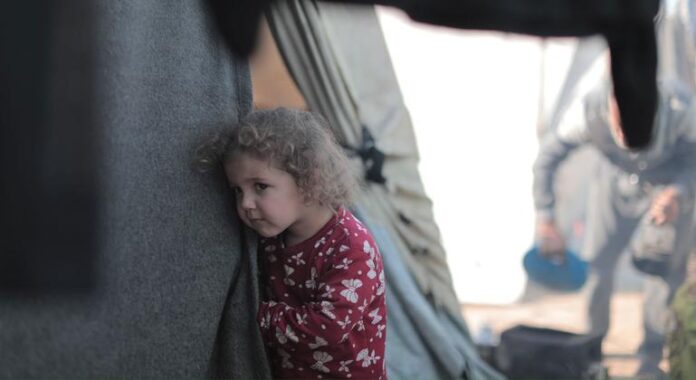
At just 41 kilometres long (25.4 miles) and two to five kilometres wide (1.2 to 3.1 miles), few places in the Gaza Strip had been left unscathed by the constant Israeli bombardment before the latest ceasefire came into effect haltingly last Friday.
According to the UN Development Programme Special Representative for the Palestinians, Jaco Cilliers, destruction across the enclave “is now in the region of 84 per cent. In certain parts of Gaza, like in Gaza City, it’s even up to 92 per cent.”
$20 billion needed now
Speaking from Jerusalem, the UNDP’s Mr. Cilliers highlighted the findings of the latest Interim Rapid Damage and Needs Assessment (IRDNA) on Gaza by the UN, the European Union and the World Bank, which estimated the damage at $70 billion.
To kickstart the massive operation, some $20 billion will be required in the next three years alone, he told journalists in Geneva.
The UN development agency is present in Gaza alongside humanitarian partners to provide immediate support to the enclave’s 2.1 million people.
This includes providing clean water, emergency employment, medical supplies, solid waste removal and making homes and public spaces safe by clearing rubble potentially hiding unexploded ordnance or the many thousands of missing Palestinians.
“We’ve already removed about 81,000 tonnes. That is about…3,100 truckloads,” Mr. Cilliers explained. “The majority of the debris removal is to provide access to humanitarian actors so that they can provide the much-needed aid and support to the people in Gaza. But we also help with hospitals and other social services that need to be cleared of debris.”
The UNDP official pointed to “very good indications” from potential donors in support of reconstruction from Arab States, but also from European nations and the United States “which has also indicated that they are going to be coming in supporting some of the early recovery efforts”.
Immediate aid essential
Important as reconstruction is for Gaza’s long-term future, UN humanitarians once again clamoured for the Israeli authorities to open all access points into Gaza, after the remaining 20 living Israeli hostages were freed on Monday and Palestinian prisoners were released from Israel.
The development followed the signing of a ceasefire deal between Hamas and Israel signed on Monday evening in Sharm El-Sheikh by US President Donald Trump, and the leaders of Egypt, Qatar and Turkïye.
Earlier on Monday, UN Secretary-General António Guterres welcomed the release of all living hostages from Gaza, two years since they were among some 250 taken during Hamas-led terror attacks in Israel on 7 October 2023.
Gaza City testimony
Speaking to UN News from Gaza, UN Children’s Fund (UNICEF) aid worker Tess Ingram described the story of one family displaced five times by the war:
“I met a family today, Mustafa and Syeda and their children, and they told me that they were among the lucky ones because while Mustafa was pulling rubble out from the building, that is their home, at least he said, we have a home.”
The family was relieved on Monday at the appearance of a water truck, Ms. Imgram told us: “But they live in fear that truck might not turn up today or tomorrow. She also can’t get the medicine she needs and her sons had to walk a really long way today just to buy the basics that she needed to make some bread.
“Families need absolutely everything right now. We need the hundreds of trucks a day that were promised to get into the Gaza Strip.”
Hostage remains
On Tuesday, the focus shifted to the transfer from Gaza of all deceased hostages, an extremely difficult process overseen by the International Committee of the Red Cross (ICRC). It remains unclear how many deceased hostages will be transferred by Hamas.
“When it comes to the living hostages or Palestinian detainees – and believe me that’s a big issue for us – we actually don’t know, we know that we have to be ready,” said ICRC spokesperson Christian Cardon, adding that the complex search is getting underway today.
In the meantime, needs in Gaza remain enormous and “fluid”, aid teams report, with more than 300,000 Palestinians heading north to Gaza City since Friday, as the ceasefire agreement seemed to hold.
“The enthusiasm that came from the international community, from people on the ground that this was the beginning of the end of all the suffering and things would change rapidly, is just not being reflected on the ground, day in and day out. We are not getting enough aid in,” said UN Children’s Fund (UNICEF) spokesperson Ricardo Pires.
The Israeli authorities have agreed to allow 190,000 tonnes of relief supplies into Gaza and UN agencies and their partners are scaling up operations rapidly, but a far greater amount is needed overall, humanitarian agencies including the UN aid office, OCHA, have said repeatedly.
“Of course, we are advocating with everyone, and we were there in Sharm El- Sheikh yesterday as well, with 22 heads of state of government, who we are asking to help us push all buttons you can to get this up and running as soon as possible,” said OCHA spokesperson Jens Laerke.
Aid hub carnage
Aid teams continue to insist that there needs to be a move away from handing out lifesaving supplies from remote areas including non-UN aid hubs that are difficult to reach and where hundreds of Palestinians have been shot or injured.
“Most of the actors – ICRC included – were not able to organize sufficient distribution of aid inside Gaza,” said Mr. Cardon. “And what we’ve seen instead, it’s people coming back from distribution sites being wounded, if not killed, in many instances…It’s about aid coming to the people and not any more people going to the aid.”
Polish Innovation Goes Global: 12 Scale-ups Join the First EIT Regional Innovation Booster

The European Institute of Innovation and Technology (EIT) has announced the 12 finalists selected for the first-ever EIT Regional Innovation Booster (RIB) pre-pilot in Poland – a new initiative designed to accelerate the internationalisation of promising scale-ups from the region.
The programme builds on the collaboration formalised in May through a Memorandum of Understanding between the EIT and the Polish Ministry of Economic Development and Technology. This partnership marked the launch of the EIT RIB pilot in Poland – a joint effort to strengthen national innovation capacity, reduce regional disparities, and help high-potential Polish scale-ups expand into European and global markets.
A Highly Competitive Selection
The pre-pilot has attracted over 80 high-quality applications from Polish scale-ups operating at Technology Readiness Level 7 (TRL7), meaning their solutions have already been validated in operational environments. With only 12 seats available, competition was intense – nearly seven applicants for every place. This outstanding interest demonstrates both the maturity of the Polish innovation ecosystem and the strong appeal of the EIT’s tailored support for international growth.
The number and quality of applications prove that Poland’s innovation scene is ready for global expansion. The EIT Regional Innovation Booster is designed to open those doors — connecting local deep-tech talent with Europe’s innovation powerhouses.
Marta Kaczmarek, Director of the EIT Community Strategic Regional Innovations Cluster
The Selected Scale-ups
The 12 selected scale-ups represent the diversity, excellence, and international potential of the Polish innovation landscape. Their solutions address key challenges across health, energy, food, mobility, and digital transformation, embodying the EIT’s mission to drive positive change through innovation.
List of selected start-ups:
-
WindTAK Sp. z o.o, delivers professional solutions in wind engineering, focusing on areas related to the operation of turbines and the improvement of their energy efficiency.
-
NanoSci sp. z o.o, specialises in innovative nanotechnology for air and surface purification using UV light and titanium dioxide.
-
Unicorn VR World, focuses on immersive virtual-reality therapy and neuro-educational tools, offering apps that support neurodevelopment, rehabilitation, and special-needs education.
-
MIGAM S.A., bridges communication gaps for Deaf customers by offering video remote interpreting, translations into sign language, and ongoing R&D aimed at automating sign‑language translation.
-
SEEDiA, develops smart urban furniture solutions that enhance public spaces through solar-powered technology and connectivity.
-
Bio Ice Cream Dots Sp. z o.o., produces healthy, organic, sugar-free ice cream dots enriched with fiber, probiotics, and plant-based proteins.
-
WIDMO, offers innovative solutions for subsurface imaging, enabling industries such as mining, construction and environmental monitoring.
-
My OVU, is an ovulation thermometer with a mobile app that enables women to monitor their fertility at home, supporting natural conception or contraception.
-
EcoBean Sp. z o.o.,is a circular bioeconomy startup and certified B Corp that upcycles coffee waste into high-value ingredients.
-
Intelligent Hives Sp. z o.o. develops start monitoring systems that use sensor and cloud analytics to support sustainable beekeeping and protect biodiversity.
-
Zolak, provides an artificial intelligence and augmented reality platform for furniture retailers to create immersive 3D showrooms and configurators.
-
WeavAir Sp. z o.o, offers a digital platform using sensors and AI to monitor emissions and optimize energy in infrastructure projects.
Insights from the Applications
The data from the pre-pilot paints an inspiring picture of ambition and diversity among Polish scale-ups:
International ambitions:
- 32% plan to expand to Germany
- 28% target the Nordic countries
Sectoral distribution across EIT Knowledge and Innovation Communities (KICs):
- EIT Climate-KIC – 14%
- EIT Urban Mobility – 7%
- EIT Manufacturing – 5%
- EIT RawMaterials – 4%
An impressive 87% of participating start-ups feature female leadership, reflecting the inclusive and forward-looking nature of Poland’s innovation community.
What’s Next: The Programme Journey Ahead
The EIT Regional Innovation Booster officially launches on 15 October 2025 with a Kick-off Meeting that brings together all selected scale-ups, mentors, and organisers. From there, the journey continues through a series of intensive activities aimed at transforming strategic visions into actionable internationalisation roadmaps.
A Launchpad for International Success
This inaugural edition of the EIT Regional Innovation Booster, part of the broader EIT Regional Innovation Scheme (EIT RIS), sets the stage for future expansion across other RIS countries, enabling more local innovators to reach global markets.
The “clean revolution is unstoppable”, but will it come too late?

In recent years, one bright spot among the gloomy climate predictions has come from the International Renewable Energy Agency (IRENA) – an intergovernmental body based in Abu Dhabi – which has consistently highlighted the falling costs and increasing efficiency of clean energy sources, such as solar and wind.
On Tuesday, IRENA launched its latest progress reportwho reiterated the impressive rise in renewable energy – 2024 saw a record 582 gigawatts of renewable energy capacity addition – but warned that this is still far from the annual increase needed to wean us off the fossil fuels that accelerate global warming.
“The clean energy revolution is unstoppable,” Mr. Guterres said in response to the study.
“Renewable energy is deployed faster and more cheaply than fossil fuels, boosting growth, jobs and affordable energy.. But the window for keeping the 1.5°C limit within reach is quickly closing. We must scale up, scale up and accelerate the just energy transition – for everyone, everywhere.
Indonesia is modernizing its electricity network.
Still off track
At the UN COP28 climate conference, governments committed to producing 11.2 terawatts of energy from renewable sources by 2030.
So while the 2024 figure is impressive, it is still far from the 1,122 GW of capacity that needs to be added each year, if this target is to be reached on time.
The report calls on the world’s richest countries to take the lead in moving away from polluting energy sources such as coal and oil and increase their share of renewable energy to around 20 percent of global capacity by the end of the decade.
A major increase in investment for the transition is urgently needed, the report says, to finance the modernization of electricity grids, supply chains and the manufacturing of clean technologies for solar, wind, batteries and hydrogen.
Originally published at Almouwatin.com
Ukraine: Senior humanitarian official strongly condemns Russian attack on UN humanitarian convoy

The UN humanitarian coordinator in the country, Matthias Schmale, strongly condemned the attack.
“Today, an inter-agency convoy of four humanitarian trucks, clearly identified as belonging to the UN, carrying aid, was attacked by the Armed Forces of the Russian Federation while delivering aid to the town of Bilozerka, Kherson region,” he said. a declaration.
“Intensive artillery fire”
Aid workers from the United Nations Office for the Coordination of Humanitarian Affairs (OCHA) and the World Health Organization (WHO) were on a mission to a community that had not received help for months.
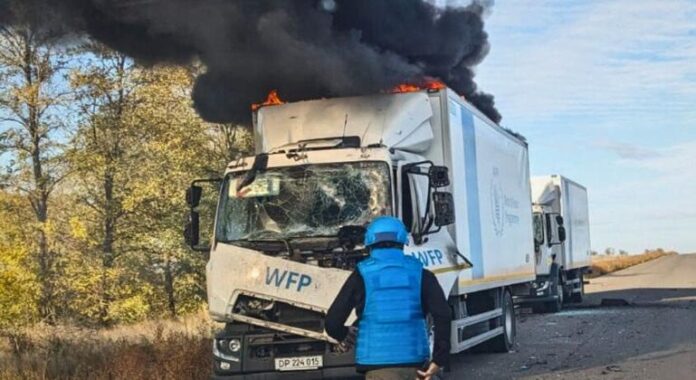
“When aid workers were on site, intensive artillery fire began, then during unloading.two clearly marked trucks from the World Food Program (PAM) were targeted by first-person view drones,” he said.
“Fortunately, the aid workers were not injured, but two trucks were damaged and set on fire. »
Not a target
The convoy was carrying hygiene kits, medicines and shelter materials, Andrea de Domenico, Ukraine’s senior OCHA official, said in a video posted on social media.
It showed one of the WFP trucks damaged on the side of a road, with flames and black smoke billowing from the top.
“It is extremely important to (remind) all parties that humanitarian aid must be facilitated and humanitarians must be protected,” he said.
Mr. Schmale noted that “Deliberately targeting humanitarian workers and humanitarian resources is a flagrant violation of international humanitarian law and could constitute a war crime..”
He added that “the Kherson region has also seen an increase in drone attacks, injuring civilians,” which must stop.
“All measures must be taken to protect civilians and humanitarian workers. International humanitarian law must be respected,” he said.
UN human rights monitors recently reported that at least 214 civilians were killed and nearly 1,000 injured in Ukraine in September.
Nearly 70 percent of casualties occurred near the front line, with particularly high numbers in the Donetsk and Kherson regions.
Originally published at Almouwatin.com
Ukraine: Top humanitarian strongly condemns Russian attack on UN aid convoy
The UN Humanitarian Coordinator in the country, Matthias Schmale, strongly condemned the attack.
“Today, an inter-agency convoy of four humanitarian trucks, clearly marked as belonging to the UN, carrying aid, came under attack by the Armed Forces of the Russian Federation when delivering aid to Bilozerka Town in the Kherson Region,” he said in a statement.
‘Intensive artillery fire’
Aid workers from the UN Office for the Coordination of Humanitarian Affairs (OCHA) and the World Health Organization (WHO) were on a mission to a community that had not received assistance for months.
“When the aid workers were on site, intensive artillery fire started, and later, during offloading, two clearly marked trucks of the World Food Programme (WFP) were targeted by first-person-view drones,” he said.
“Fortunately, the humanitarian workers were not injured, but two trucks were damaged and set on fire.”
Not a target
The convoy was carrying hygiene kits, medicines and shelter materials, OCHA’s top Ukraine official Andrea de Domenico said in a video posted on social media.
It showed one of the damaged WFP trucks at the side of a road, with flames and black smoke billowing from the top.
“It is super important to (remind) all the parties that humanitarian assistance needs to be facilitated and humanitarians need to be protected,” he said.
Mr. Schmale noted that “deliberately targeting humanitarians and humanitarian assets is a gross violation of international humanitarian law and might amount to a war crime.”
He added that “the Kherson Region has also seen an increase in drone attacks, harming civilians”, which must stop.
“All measures should be taken to protect civilians and humanitarian workers. International humanitarian law must be respected,” he said.
UN human rights monitors recently reported that at least 214 civilians were killed and almost 1,000 injured in Ukraine during September.
Nearly 70 per cent of casualties occurred near the frontline, with notably high numbers reported in the Donetsk and Kherson regions.
