Tuesday, March 31, 2026
Home Blog Page 187

The world fails the hungry children in Gaza, warn the aid teams

0

In total, 150 children have perished by acute malnutrition in the Gaza Strip since the start of the war, according to the latest figures from the Palestinian health authorities.

Announcing Jana’s death in an online video message, Unicef Communication director Tess Ingram explained that she had been treated at the hospital twice for the condition and recovered each time to waste on September 17, in the midst of continuous Israeli aid restrictions.

“” The world has failed Jana so many times, she failed her on food, twice“Insisted Ms. Ingram. »»A little girl forced to endure so much pain because of the deliberate decisions that have been made to restrict the entrance to food in the Gaza Strip. “”

Mme Ingram explain that UNICEF originally evacuated Jana (In the above photo) for treatment in the south of Gaza over a year ago and that she had recovered. “I remember holding his fragile little hand and helping him in the ambulance,” she recalls.

Hunted

Once Jana was better and released from the hospital for the first time earlier this year, she and her mother, Nesma, returned to Northern Gaza during the ceasefire to be with their family.

But the help of the aid allowed hunger to return, claiming the life of Jana’s sister, two years old, Jouri, in August. At the time, Ms. Ingram warned that Jana was “barely hung” in a Gaza City hospital where she received treatment.

She Also pointed out that the health system broken by the Gaza War was unable to give the child the care she needed. “” His last hope, the medical evacuation of the Gaza Strip, failed it. No country has intervened and could come out Jana“Said the UNICEF worker.

The young people of Gazan who suffer from moderate and severe acute malnutrition receive ready to use therapeutic foods (RUTF) in the last remaining hospitals of the enclave, including at the Friends of the patient Society in Gaza City where Jana was treated.

No hospital capacity

There are only days, the United Nations World Health Organization (WHO)) warned That four other hospitals had been forced to close in the north of the enclave torn by the war this month only.

Through Gaza, there are only 14 hospitals left, said the United Nations Health Agency, while humanitarian workers have repeatedly warned that they are overwhelmed by trauma and fighting to cope.

“Children are punished”

UNICEF insisted that the story of Jana and Jouri was a “devastating reminder that the life of children in Gaza is in danger, not only by air strikes, but also by living conditions”.

He also pointed out that Gaza’s malnutrition crisis has reached catastrophic levels with the entire population of children under the age of five – more than 320,000 children – at risk of acute malnutrition.

In July, 13,000 children were seriously suffering from malnutrition, “the highest monthly figure ever recorded” and representing more than 500% since the start of the year, UNICEF said.

“This war must end now. Aid should be allowed to enter the Gaza strip, including food and nutritional supplies. Humanitarian workers must be allowed to do their job, “said Ms. Ingram.

“The children of Gaza are punished by these decisions and that kills them.”

How medical evacuations occur

The medical evacuations (Medevacs) of the coordinated band by who follow a strict protocol in seven stages, from the initial reference of the patient by a doctor to the evacuation of the United Nations Health Agency, on the basis of a list subject to the host countries which is then approved by the Israeli authorities.

The latest Omevac data indicates that 7,841 patients were helped to leave Gaza since the war broke out on October 7, 2023, after the terrorist attacks led by Hamas against Israel. More than 5,330 of these patients were children. About 15,600 patients still need medical evacuation from Gaza.

On September 29, which supported the evacuation of 14 patients and 38 companions from Gaza to Jordan and 15 patients and 65 companions in Italy, a field hospital led by the UN partner La Palestinien Red Crescent Society on the Al-Mawasi coastal road.

“Patients, companions and caregivers will start from here with ambulances, buses and escorters from who they pass safely through the combat areas at Kerem Shalom,” said Dr. Athanasios Gargavanis, who traumed surgery and the head of Gaza.

He explained that from Kerem Shalom, the Palestinians would leave the strip before being transported to Ramon airport in southern Israel, then in the host countries.

“This is only the tip of the iceberg,” said Dr. Gargavanis. “Many other Medevac missions are necessary, and many other receiving countries are necessary. The World Health Organization is committed to supporting such missions. ”

Who continues to call for the restoration of medical references to the West Bank and East Jerusalem and for more countries to accept patients.

Originally published at Almouwatin.com

Projects across Europe win prizes for innovative and sustainable designs

0
Projects across Europe win prizes for innovative and sustainable designs

The New European Bauhaus prizes 2025 has awarded 22 winners from around Europe for their skill in fusing sustainability, inclusion and aesthetics in their designs. Winning projects include Pollino in Hungary, which transforms urban signage into habitats for pollinators, and Portugal’s Edible School. Source link

Source

Source link

Projects across Europe win prizes for innovative and sustainable designs

0
Projects across Europe win prizes for innovative and sustainable designs

The New European Bauhaus prizes 2025 has awarded 22 winners from around Europe for their skill in fusing sustainability, inclusion and aesthetics in their designs. Winning projects include Pollino in Hungary, which transforms urban signage into habitats for pollinators, and Portugal’s Edible School.

Source link

Online Justice Warns of Smarter Phishing Scams as Attack Methods Evolve

0

Phishing scams have been around for decades, but their latest evolution is catching even the most cautious users Source link

Source

Source link

Online Justice Warns of Smarter Phishing Scams as Attack Methods Evolve

0


Phishing scams have been around for decades, but their latest evolution is catching even the most cautious users

Source link

From crisis to community cure: A Haitian mother fights back against cholera

0
From crisis to community cure: A Haitian mother fights back against cholera

When her 11-year-old daughter, Noel-Dina, was struck by fever and unbearable abdominal pain, Oriata didn’t hesitate.

She immediately took her child to the nearest hospital. “She couldn’t walk anymore because she was so weak. I had to carry her on my back. I was terribly worried and thought I was going to lose her,” said Oriata, her eyes filled with tears.

That day, Noel-Dina was diagnosed with cholera.

Oriata (centre) participates in a community campaign against cholera.

Like many children in their rural neighborhood of Grand-Goâve west of the Haitian capital Port-au-Prince, she lived without access to basic sanitation facilities. “We had no choice but to use the outdoors as our toilet. That’s how the disease entered our lives,” Oriata explained.

Cholera spread

Cholera has recently been spreading in Haiti. So far this year, more than 3,100 suspected cholera cases have been reported nationwide.

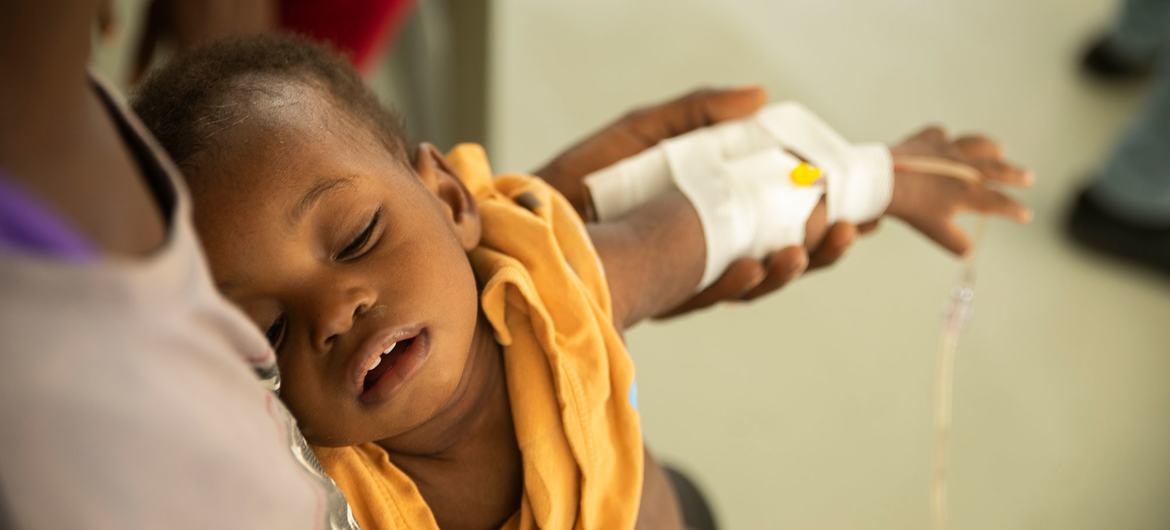
A young child is treated for cholera at a hospital in Port-au-Prince, Haiti.

A young child is treated for cholera at a hospital in Port-au-Prince, Haiti.

Between 2125 September alone, 40 suspected cases and three deaths were reported in Pétion-Ville, a busy suburb with many schools – a worrying development with the new academic year set to begin.

Young adults, who typically move around a lot, account for most of the cases, fuelling concerns of the disease spreading.

UN Spokesperson Stéphane Dujarric said that the UN humanitarian coordination office, OCHA, was working “together with authorities and our partners to ensure there is rigorous case monitoring and that health workers are rapidly mobilised to reduce the risk of the further spread of cholera.”

Community action

Eleven-year-old Noel-Dina survived thanks to timely medical care.

Her painful experience was a turning point as thanks to awareness campaigns in their area, her mother, Oriata, learned that the lack of latrines was one of the main reasons for the spread of cholera and other waterborne diseases.

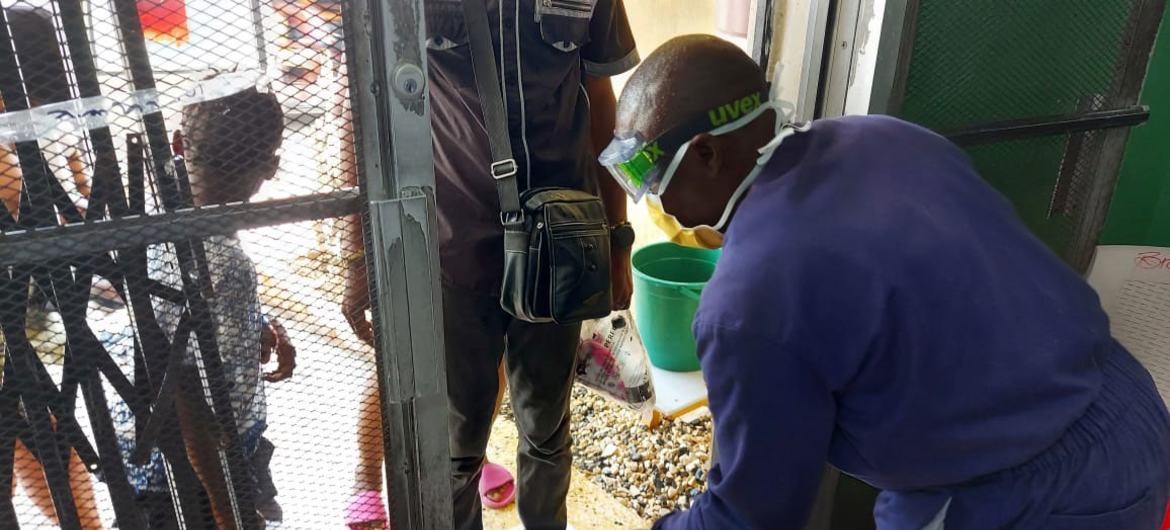
A health worker carries out sanitation procedures as people enter a cholera facility in Haiti.

UNOCHA/Christian Cricboom

A health worker carries out sanitation procedures as people enter a cholera facility in Haiti.

Without waiting for outside help, she began digging a pit in her yard.

“I didn’t have many resources, but I knew I had to do something, not just for my daughter, but for all the children in the neighborhood,” she explained.

Oriata didn’t stop there. After seeing her daughter gradually regain strength, she became involved in awareness-raising activities in her community, going from house to house, to encourage other families to take action.

Her commitment sparked a wave of solidarity.

“When someone started digging a pit and couldn’t continue, we would get together to help them and we did this house by house until it became a movement,” she recalled.

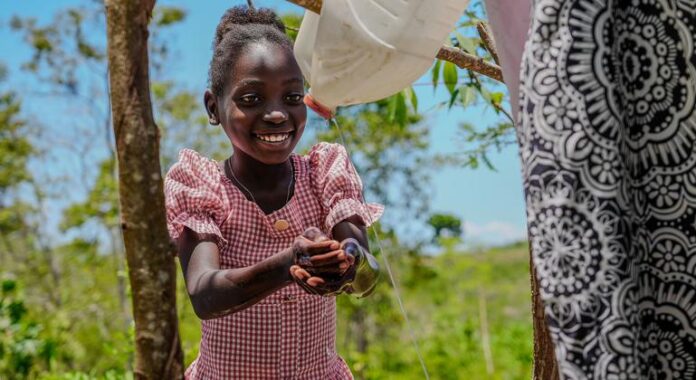
This mutual support transformed their neighbourhood. Latrines became the norm and hygiene practices such as systematic hand washing were adopted by everyone.

“Today, when you walk through here, you no longer smell any bad odours because no one relieves themselves outside anymore,” she said.

Full of dreams

Sitting on her bed, her maths notebooks open in front of her, Noel-Dina smiles shyly. She dreams of becoming a nurse. Every day, she helps her mother at home and washes her hands thoroughly after using the toilet, actions that have become automatic.

“Before, I had to go outside. Now we have a latrine at home, and I’m glad my mum built it. She did it for me and for everyone,” she said.

Other communities are also taking action with support from the UN Children’s Fund, UNICEF, and the local authorities.

Nearly 3,000 households now have access to safe and hygienic latrinesand 30 hygiene clubs, 22 in schools and 8 in health centres, have been created to encourage good practices among children, teachers, and medical staff.

“Before, there were bacteria everywhere, and children often got sick. Now, even when a child has a fever, it’s no longer because of dirt. They are healthier and happier,” said Oriata. 

Source link

Promoting online safety during European Cybersecurity Month

0
Promoting online safety during European Cybersecurity Month

The EU’s annual campaign promoting cybersecurity among EU citizens and organisations kicks off today and will run throughout October. It brings together hundreds of partners in a series of conferences, workshops, trainings, webinars, presentations to raise awareness and share good practices.

Source link

The UN air service that flies where no one else can

0
The UN air service that flies where no one else can

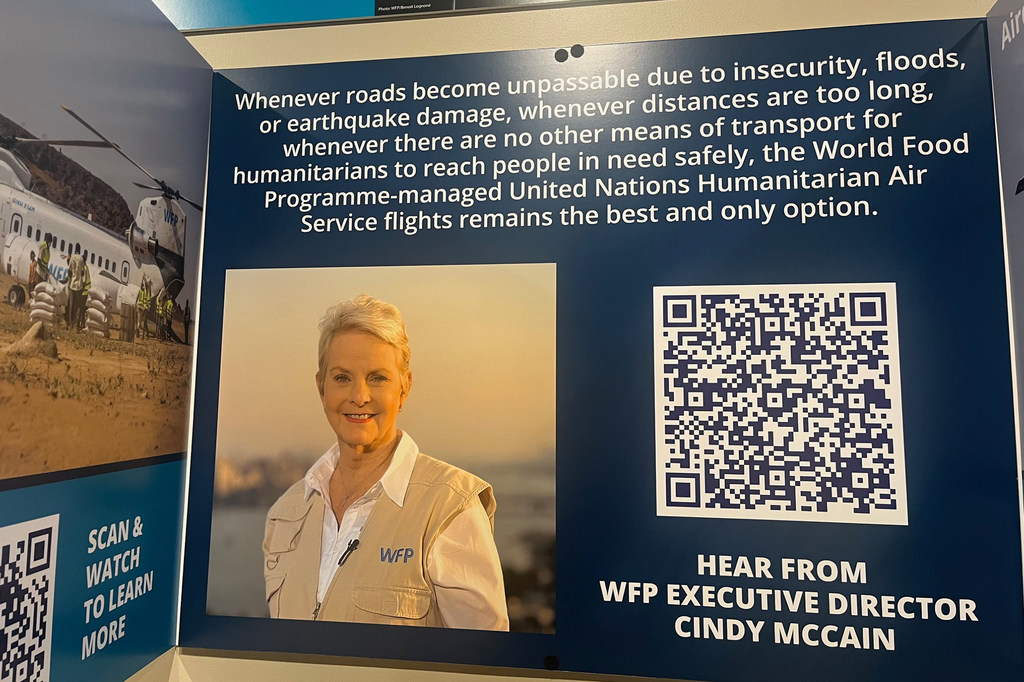
“I just watched how it was a central driver for humanitarian agencies from all over – not just the UN agencies – and it was the only organisation that could do that,” said Mr. Stroumboulopoulos, an actor, media interviewer and producer, who also now serves as an Ambassador for the Word Food Programme (WFP), which runs the lifesaving service.

UNHAS Cessna 208 Caravan fleet is one of the most used aircraft present in its operations.

For two decades, UNHAS has been providing the vital air links which allow various UN agencies to deliver humanitarian workers and assistance to hard-to-reach regions.

From the COVID pandemic – when commercial flights shut down – to the earthquake in Haiti in 2010, the service has keep going under some of the most challenging circumstances imaginable.

But with less funding available, UNHAS flights and the vital resources they transport, are in danger of stalling in mid-air.

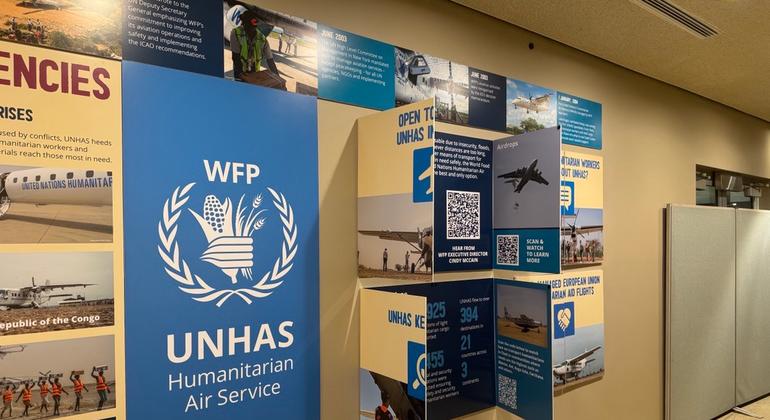
“What we are trying to do here is to get political support from Member States to let them know that we have a promise of leaving no one behind, and it’s very important that we keep funding for UNHAS.” said Hedley Tah, head of external relations for the service at a pop-up UNHAS exhibit during high-level week in New York.

A most efficient system

Identifying and correcting inefficiencies is one of the aims of the UN80 Initiative, the UN’s systemwide reform plan rolled out by Secretary-General António Guterres earlier this year.

UNHAS is an example of a system that is already lean and efficient, according to Mr. Tah, given that it is a centralised service is used by over 600 UN organisations, relieving them of having the set up or pay for their own.

“We are able to do that for the entire humanitarian community,” he said. “We are able to allow other organisations to focus more on their programmatic mandates while we run the supply chain for them, making sure that gains are made in terms of efficiencies.”

He noted that 70 per cent of costs associated with humanitarian aid come from supply chains — which involves flights and distribution.

“A small percentage of cost savings with a supply chain can result into hundreds of millions of dollars in savings,” and this is where UNHAS comes into play.

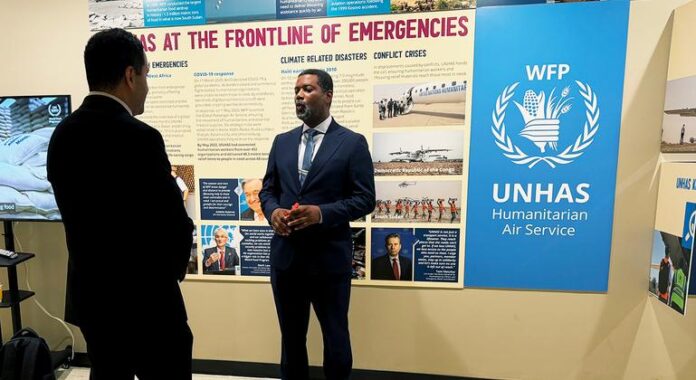
UN Humanitarian Air Service (UNHAS) pop-up exhibit at the UN Headquarters during the General Assembly's high-level week.

UN Humanitarian Air Service (UNHAS) pop-up exhibit at the UN Headquarters during the General Assembly’s high-level week.

‘Doing more with less’

Compared to last year, UNHAS now has 50 per cent less funding to do its work.

“That affects our response to the humanitarian community,” said Mr. Tah. “But nonetheless, we are now doing more with less.”

To continue operating effectively despite funding challenges, the service has reduced the number of aircraft and renegotiated its contracts. While flights are grounded to some destinations, they still reach 21 countries.

According to last year’s WFP UNHAS Annual Review, the aviation service strategy through 2028 includes improvements in fleet readiness, emergency deployment mechanisms and digital booking systems.

“The kind of expertise required to be able to pull off what UNHAS does is unparalleled,” said Mr. Stromboulopoulos, who flew with the service in Syria last year.

“I can’t imagine the level of heartache and pain and loss of life, loss and dignity, loss and hope that comes if you don’t have something like UNHAS.”

UN Humanitarian Air Service (UNHAS) pop-up exhibit at the UN Headquarters during the General Assembly's high-level week.

What makes the flights special?

  • In the past decade, more than 3.8 million humanitarian workers have flown with UNHAS, bringing hope and life-saving aid to communities at need.
  • In 2024, alone, thousands of metric tons of cargo were transported across 21 countries, the annual report says.
  • A small and versatile jet, the Cessna 208 Caravan, is one of the most frequently used aircraft. The plane has the ability to take off and land on short and unpaved runways – great for regions that lack roads and airport infrastructure.
  • This sturdy aircraft can withstand high temperatures thanks to its powerful turboprop engine, which consumes less fuel than traditional jet engines.
  • The plane carries up to 12 aid workers per flight. Other aircraft in use by UNHAS include the Airbus Super Puma H215 helicopter and the De Havilland Canada Dash-8 plane.

Source link

Press remarks by President António Costa at the press conference following the meeting with the Mayors for Housing Alliance

0
Press remarks by President António Costa at the press conference following the meeting with the Mayors for Housing Alliance

European Council President António Costa met with the Mayors for Housing Alliance in Brussels, followed by a press conference. 

Source link

Taliban internet blackout leaves Afghans in limbo while needs surge

0
Taliban internet blackout leaves Afghans in limbo while needs surge

The United Nations Assistance Mission in Afghanistan (UNAMA) called on Taliban leaders to immediately and fully restore Internet and telecommunications services.

“As of yesterday, 1700 hours, we were informed that the telecommunications and fibreoptic connectivity in Afghanistan is going to be suspended until further notice,” said the top UN official in the country, Indrika Ratwatte, via a patchy satellite video link from Kabul.

The rest of the country is completely cut off right now, by and large,” he explained, adding that connectivity has been lost with aid teams in the “deep field” who are delivering assistance to survivors of last month’s quake in eastern Afghanistan.

“We don’t have connectivity with them,” he stressed, highlighting needs among families originally from hillside villages who now live in crowded informal settlements on the valley floor in Kunar province.

In one community, Mr. Ratwatte met one woman who had lost 11 members of her family. “The trauma is quite immense,” he said.

More than 43 million people in Afghanistan are now believed to be offline, after the Taliban began cutting communications cables several weeks ago, reportedly to tackle “vice” and immorality in the light of their strict interpretation of Sharia law.

The work of UN humanitarians has been also set back by the de facto authorities’ ban on women nationals on staff from entering its premises, earlier this month.

Total shutdown

In addition to impacting the work of the UN and partner organizations, the internet shutdown has affected health programmes, banking services and financial services, UN humanitarian coordinator Mr. Ratwatte stressed.

“At a community level, I would imagine that for normal business transactions, for banking, for cash transfers, for remittances that come from abroad, which are critical for these communities, that’s been cut off,” he explained.

One month since the 6.0 magnitude quake struck eastern regions of Afghanistan, remote communities are still struggling to recover. The disaster killed around 2,000 people and injured 3,600, damaging 8,500 homes.

“The winter is not anymore on the way, it’s upon us,” Mr. Ratwatte warned, stressing the need to insulate shelters for displaced people and provide warm clothing amid plummeting temperatures.

Waiver discussions

Discussions are underway with the de facto authorities in Kabul to seek a waiver to provide “critical connectivity” with aid teams, but the situation has complicated an already “dire” situation in Afghanistan.

“This is another crisis on top of the existing crisis…the impact is going to be on the lives of people,” Mr. Ratwatte stressed.

He highlighted how the development would also impact critical medical services, supply chains and vaccinations. “Assistance that keeps the basic essential services functioning in the country is going to be impacted”, the UN aid coordinator continued, noting that connectivity with the rest of the world had also been impacted.

“Flights have been cancelled, international flights are not coming in today,” he said.

Source link