Wednesday, April 1, 2026
Home Blog Page 188

The United Nations Security Council approves a new “deletion force” for Haiti in the midst of the violence of the gangs in a spiral

0

The resolution-checked by Panama and the United States, and supported by dozens of countries in the region and beyond-was adopted by a vote of 12 in favor, with three abstentions of China, Pakistan and Russia.

Under a 12 -month first term, the GSF will work closely with the Haitian national police (HNP) and the Haitian armed forces to carry out intelligence operations to neutralize gangs, ensure the security of critical infrastructure and support humanitarian access.

The force of 5,550 people will also protect vulnerable groups, will support the reintegration of veterans and will help strengthen Haitian institutions.

The multinational security support mission (MSS), authorized by the Security advice In October 2023, faced chronic under-funding, insufficient staff and a limited operational capacity, which makes gangs difficult which now control large parts of the capital, Port-au-Prince.

Although the MSS has enabled HNP to find access to certain areas and infrastructure, it has struggled to correspond to the scale of the crisis. Kenya, which directed the MSS, also supported the new mechanism.

Haiti faces nearly 1.3 million people displaced internally, by increasing kidnappings, generalized sexual violence and gangs which control large areas of the capital.

Haiti is not alone

Presentation of the text to the council, the ambassador Eloy Alfaro de Alba de Panama underlined the urgency of international support.

“Since last year, this council has asked the Secretary-General to present recommendations to combat the multidimensional crisis in Haiti … Haiti faces an unprecedented multidimensional crisis that requires our decisive attention,” he said.

He urged all the members of the Security Council to support the initiative, declaring that this “would send a clear message to Haiti – you are not alone”.

United Nations Support Office in Haiti

The resolution also tasks to the Secretary General to establish a United Nations support office in Haiti (UNSEH) to provide logistical and operational support to the GSF, HNP and Haitian armed forces, including rations, medical care, transport, strategic communications and the rotation of troops.

The UNSEH will also support the organization of the Secure Haiti project of the American States and will ensure compliance with international standards of human rights.

A force against gangs

The United States, sponsor of the resolution, underlined the magnitude of the new mission.

Ambassador Mike Waltz said that the MSS mission did not have the scale, scope and resources necessary to lead the gang combat and restore a security basis in Haiti.

“Today’s vote makes this right. With this vote to transform the MSS mission into the new force of abolition of gangs, a mission five times the size of its predecessor and with a reinforced mandate to attack the gangs, “he noted.

“The international community shares the burden and lives up to its promise to help Haiti turn the trend. It offers Haiti the possibility of assuming responsibility for its own security. ”

Haitian government ultimately responsible

The Council stressed that the Government of Haiti retains “main responsibility” for national security and governance reform, including the fight against corruption, illegal arms flows and recruitment of children by gangs.

The GSF is intended to support the Haitian authorities while creating conditions so that the country is gradually taking responsibility for security.

A decisive turning point

The decision to transform the MSS mission into GSF marked “a decisive turning point” in one of the most serious challenges in Haiti’s already turbulent history, said the country’s ambassador after the vote.

Although the multinational security support mission was “precious support and a strong international solidarity signal”, ambassador Pierre Ericq Pierre stressed: “But reality on the ground reminded us that the scale and sophistication of the threat by far exceed the mandate initially granted to this mission.”

As the Security Council has granted a stronger, more offensive and more operational mandate, “this gives the international community the means to respond to the gravity of the situation in Haiti,” he added.

Broadcast of the Security Council meeting.

Originally published at Almouwatin.com

UN air service that flies where no one else can

0

“I just saw how it was a central engine for humanitarian agencies everywhere – not just the United Nations agencies – and it was the only organization that could do so,” said Stroumboulopoulos, actor, interviewer and producer of the media, which also serves as an ambassador for the Word Food Program (Wfp), which manages the rescue service.

The fleet of UNHAS Cessna 208 caravans is one of the most used planes present in its operations.

For two decades, UNHAS has provided vital air links that allow various United Nations agencies to deliver humanitarian workers and assistance to difficult to access regions.

From the cocovid pandemic – when commercial flights stop – towards the earthquake in Haiti in 2010, the service continues in some of the most difficult circumstances imaginable.

But with less funds available, the UNHAS flights and the vital resources they carry, may calculate in the air.

“What we are trying to do here is to obtain political support from the Member States to let them know that we have the promise to leave no one behind, and it is very important that we continue to finance for the United. “Said Hedley Tah, head of external relations for the service during a Pop-Up Unhas exhibition during the high-level week in New York.

One most effective system

Identify and correct ineffectiveness is one of the objectives of the UN80 Initiativethe United Nations system reform plan deployed by Secretary General António Guterres Earlier this year.

Unhas is an example of an already meager and effective system, according to Mr. Tah, since it is a centralized service is used by more than 600 United Nations, relieving them to have set up or pay for their own.

“We are able to do so for the whole humanitarian community,” he said. “We are able to allow other organizations to focus more on their programmatic mandates while we execute the supply chain for them, ensuring that gains are made in terms of efficiency.”

He noted that 70% of the costs associated with humanitarian aid come from supply chains – which involve flights and distribution.

“A small percentage of cost savings with a supply chain can lead to hundreds of millions of dollars in savings”, and this is where the abseaux come into play.

Pop-up Humanitarian Air Service (UNHAS) exhibition at the United Nations headquarters during the high-level week of the General Assembly.

‘Do more with less’

Compared to last year, Unhas now holds 50% less funding to do his job.

“This affects our response to the humanitarian community,” said Tah. “But nevertheless, we are now doing more with less. »»

To continue to operate effectively despite the financing challenges, the service has reduced the number of planes and renegotiated its contracts. Although thefts are anchored towards certain destinations, they still reach 21 countries.

According to the WFP last year Annual review of the UnhasThe aeronautical service strategy until 2028 includes improvements in preparation for the fleet, emergency deployment mechanisms and digital booking systems.

“The type of expertise required to be able to achieve what Unhas does is unprecedented,” said Stromboulopoulos, who stole with service in Syria last year.

“I cannot imagine the level of sorrow and pain and loss of life of life, loss and dignity, loss and hope that it comes if you do not have something as united. »»

What makes flights special?

  • Over the past decade, more than 3.8 million humanitarian workers have stolen with Unhas, bringing hope and vital aid to communities if necessary.
  • In 2024, only thousands of metrics of freight were transported in 21 countries, the annual report said.
  • A small and versatile jet, the Cessna 208 caravan, is one of the most frequently used planes. The plane has the capacity to take off and land on short and not paved tracks – ideal for regions that lack airport roads and infrastructure.
  • This robust plane can withstand high temperatures thanks to its powerful turboprop engine, which consumes less fuel than traditional jet engines.
  • The plane carries up to 12 humanitarian workers per flight. The other planes used by the UNIS include the Airbus Super Puma H215 helicopter and the Havilland Canada Dash-8 plane.

Originally published at Almouwatin.com

Good Rohingya in Myanmar, a “test for humanity”

0

At the heart of the urgency are Muslims Rohingyas, denied Burmese citizenship, driven from their homes and forced camps or exile.

More than a million now live as a refugee in Bangladesh, while countless others remain moved or trapped – alongside other minorities – within Myanmar under conditions of the UN leaders described as “disastrous” and “unsustainable”.

The conference at the UN headquarters in New York brought together senior United Nations, heads of state and governments, to galvanize the action alongside Rohingya activists.

Briefings and reports have exposed daily realities since the February 2021 military blow: Forced recruitment, sexual violence, air strikes, famine and mass movement.

Humanitarian agencies warn that the resources are exhausted, leaving refugees poorly fed and pushing more people to make dangerous sea trips.

Conditions within the Myanmar Rakhine State – ancestral house of the Rohingyas – have been described as the worst for decades, with civilians captured between the forces of the junta and the ethnic armed groups.

The president of the general assembly Annalena Baerbock (on the podium and on the screens) deals with the high -level conference of the general assembly on the situation of Rohingyas Muslims and other minorities in Myanmar.

“Human rights are trampled on”

The secretary general, in a statement Read by his chief of staff Courtenay Catéray, said The crisis “trampled on human rights, the dignity and security of millions and threatens regional stability. »»

He urged three immediate steps: protect civilians in accordance with international law, guarantee humanitarian access and invigorate investments to facilitate pressure on refugees and reception communities.

“” The solution to this crisis finally lies in Myanmar,“The message highlighted, calling for the end of the persecution and recognition that”Rohingyas belong – as full citizens.“”

A crisis “which should make us shame”

The president of the Baerbock assembly underlined the extent of the suffering.

“” More than five million Rohingyas men, women and children share a version of this story, ” She saidNoting that 800,000 children remain outside the school in the bangladesh bazaar camp alone.

Humanitarian funding is extremely short, the 2025 response plan, only 12% funded.

“” It should make us shame,She said, urging states to stimulate aid and pursue a political solution that would allow safe, voluntary and lasting return.

Rohingya refugees are going through a muddy field in southern Bangladesh, while fires burn remotely. (File photography)

Request for responsibility

For Rohingya activists, the conference was not another moment of awareness but a request for justice.

Wai Wai Nu, founder of Myanmar Women’s Peace Network, told delegates that atrocities did not end in 2017, when more than 750,000 men, women and children Rohingyas fled the violence described as “Example of ethnic cleaning manualAt present, the High Commissioner of Human Rights at the UN, Zeid Ra’ad Al Hussein.

“It has worsened,” she said, pointing to murders, forced conscription, sexual violence and a famine inflicted by the military and ethnic groups of Myanmar fighting the junta.

“” Without action, the Rohingya exodus will continue until there is no Rohingya left in Myanmar,She warned, urging cross -border humanitarian corridors, sanctions and targeted proceedings for crimes of atrocity.

‘A test for humanity’

Rofik Husson, founder of Arakan Youth Peace Network, offered his own testimony of travel and violence, recalling how the junta forced men and boys rohingyas in service, often as human shields. In just one week, he said, at least 400 were killed.

He described village burns and drone strikes, including one May 2024 massacre This moved 200,000 people in one day.

“” To put an end to the insecurity crisis for the Rohingya community is a test for this assembly and a test for humanity itself,He told the delegates, calling for an international supervised area in northern Rakhine.

Unsplash / Gayatri Malhotra

A demonstration against the military coup of Myanmar takes place in Washington, DC, United States. (Photography 2021)

No way agreed to peace

Adding a wider objective, the special envoy Julie Bishop stressed that the multifaceted myanmar crisis is inseparable from the political agitation triggered by the 2021 coup.

Combining it in place and the spread of armed conflicts, she warned that the elections later scheduled for this year would feed new violence rather than giving legitimacy.

“” There is no way agreed to peace,She said, warning that the international condemnation of the junta has reflected while abuses persist.

Fragile hope

Despite the dark accounts, the speakers have stressed that the solutions remain possible if the political will can be summoned.

Ms. Baerbock closed her remarks by noting: “The Rohingya people have survived eight years of difficulties, travel and uncertainty. Their resilience is extraordinary. Our answer must match it.“”

For Rohingya activists, the message was just as clear: statements are no longer enough.

“” Justice is not optional … It is the only deterrence, the only way to peace,Ms. Nu said.

Originally published at Almouwatin.com

Youth to UN: ‘Listen to us. Invest in us. Partner with us’

0
Youth to UN: ‘Listen to us. Invest in us. Partner with us’

“Youth participation is not just about bringing young people to meetings,” General Assembly President Annalena Baerbock said on Thursday.

It’s about truly integrating their lived experience and their expertise to shape policy outcomes.”

Prioritising rights and aspirations

Ms. Baerbock was speaking at an event to commemorate the 30th anniversary of the World Programme of Action for Youth.

The framework covers 15 priority areas, including education, employment, hunger and poverty; health and the environment; globalisation, information and communication technologies; armed conflict and intergenerational issues.

It shows that action for young people cuts across every issue and that they are drivers of change.

Members of the Sustainable Ocean Alliance, a youth-led non-profit in Tanzania.

Leading the way

At roughly 1.2 billion, today’s youth generation – people aged 15-24 – is arguably the largest in history. 

Youth are at the forefront on climate action, digital innovation, building local solutions, and championing human rights, said Guy Ryder, UN Under-Secretary-General for Policy, who spoke on behalf of the Secretary-General.

“Yet too often, they are shut out of decisions, decisions that shape their lives and face barriers to education, to decent work, to health services, and political participation,” he said.

“At the same time, violence, instability, and shrinking civic space silence youth voices and place obstacles in the way of their meaningful contributions.”

Paying the price

The commemoration was held to mark progress since the landmark framework but also to address unfinished business. 

As the head of the UN’s Youth Office stated, the international community “must confront the sobering reality that millions of young people continue to be left behind.”

Felipe Paullier said they are the ones “paying the highest price” when it comes to the climate crisis, digital disruptions, and growing threats to peace. 

“The reality is that conflict-related deaths have soared to the highest level since the adoption of the World Programme of Action for Youth,” he said.

“This mean millions of young lives lost, displaced, or forever affected. From Gaza to Ukraine, from Haiti to the DRC (Democratic Republic of the Congo), to Sudan and so many other places in crisis, young people are being robbed of their education, their safety, and their future.”

Voices of a generation

Prior to the event, more than 75,000 young people in 182 countries shared their challenges and hopes through a “foresight activity” coordinated by his office.

The insights will help to guide action, but this generation’s impact is already being felt across the world.

Young people are not waiting for tomorrow to become leaders; they are today’s leaders,” said Ms. Baerbock, who recalled that the recent historic ruling by the International Court of Justice (ICJ) on States’ obligations to address climate change was sparked by a group of students in the Pacific.

‘Partner with us’

For Amina Alidi, a youth advocate with the UN in Malawi, the event was “more than a commemoration” but “a call to action.”

“Young people remain steadfast in our optimism and determination to build a better future,” she said.  

What we ask of the United Nations and its Member States is simple but urgent:  Listen to us.  Invest in us, and most important of all, partner with us.”

James Casserly from Ireland, an advocate for young people with disabilities, advised global leaders on what youth participation really means.

It is where people who have the power listen to us and take action because actions speak louder than words,” he said.

“It is more than a box-ticking exercise. It is when we get to make our own decisions, and not just have other people make decisions on our behalf. As we always say, nothing about us without us.” 

Source link

Live security advice: Ambassadors authorize the new force for the abolition of gangs for Haiti

0

The United Nations Security Council has supported a resolution authorizing the transition from the Kenyan support mission to Haiti into a new force for the abolition of gangs, in close cooperation with the Haitian authorities. American ambassador Michael Waltz said he was offering a new hope for the future of the country as a “key first step” to remedy the humanitarian and security crisis. Follow the meeting live below; UN application users should click here for the cover.

Source link

Originally published at Almouwatin.com

Blackout on the Taliban Internet leaves Afghans in limbo when it takes a power

0

The United Nations assistance mission in Afghanistan (Unama)) called The Taliban direct internet and telecommunications services immediately and entirely entirely.

“Yesterday, 1700 hours, we were informed that telecommunications and fiberoptic connectivity in Afghanistan will be suspended until further notice“Said the senior United Nations officials in the country, Indrika Ratwatte, via an unequal satellite video link from Kabul.

“” The rest of the country is completely cut at the moment, overall“, He explained, adding that connectivity has been lost with aid teams in the” deep field “which provides help to the survivors of the earthquake last month in eastern Afghanistan.

“We have no connectivity with them,” he said, highlighting the needs among families from the villages on the hillside that now live in informal overcrowded colonies on the bottom of the valley in the province of Kunar.

In a community, Mr. Ratwatte met a woman who had lost 11 members of his family. “The trauma is quite immense,” he said.

It is believed that more than 43 million people in Afghanistan are offline, after the Taliban began to cut the communication cables several weeks ago, which would have addressed “vice” and immorality in the light of their strict interpretation of Sharia law.

The work of UN humanitarian workers has also been fell by the de facto authorities’ Prohibit staff from the staff To enter its premises earlier this month.

Total judgment

In addition to having an impact on UN work and partner organizations, the Internet closure has affected health programs, banking services and financial services, said Ratwatte, UN coordinator.

“At community level, I imagine that For normal commercial transactions, for the bank, for cash transfers, for funding from funds from abroad, which are essential for these communities, which have been cut“He said.

A month since the magnitude 6.0 earthquake struck the eastern regions of Afghanistan, the distant communities are still struggling to recover. The disaster killed around 2,000 people and injured 3,600, damaging 8,500 houses.

“Winter is no longer on the way, it is on us,” warned Mr. Ratwatte, stressing the need to isolate shelters for displaced people and provide warm clothes in the middle of falling temperatures.

Derogation discussions

Discussions are underway with the de facto authorities of Kabul to request a derogation to provide “critical connectivity” with the aid teams, but the situation has complicated an already “disastrous” situation in Afghanistan.

“This is another crisis in addition to the existing crisis … The impact will be on the lives of people”, Mr. Ratwatte underlined.

He stressed how development would also have an impact on critical medical services, supply chains and vaccinations. “The assistance that maintains the basic essential services operating in the country will be affected,” continued the United Nations aid coordinator, noting that connectivity with the rest of the world had also been affected.

“Flights have been canceled, international flights do not arrive today,” he said.

Originally published at Almouwatin.com

Dr Congo: Peace always elusive despite the “progress we see on paper”, says a UN official

0

” There is differences between the progress we see on paper and reality that we observe on the ground which continues to be ruined with violence“Said Bintou Keita, presenting the last report.

She underlined the progress since the signing of the Washington Agreement between the DRC and Rwanda on June 27, including the signing of a declaration of principle between the Congolese government and the rebel group AFC / M23 in Doha the following month.

The DRC has long accused Rwanda of supporting M23 and the developments came following a deadly offensive in the eastern provinces of northern Kivu and southern Kivu, launched at the end of last year, the rebels capturing cities and villages, including the provincial capitals Goma and Bukavu.

Montage of civilian deaths

” However, Peace was slow to feel on the ground“She said.

Since June, Monusco recorded some 1,087 civilians killed during violence in Ituri and northern Kivu, “and this toll increases day by day.”

Ms. Keita recalled that in February, the Council “had sent a clear message to all parties” by adopting Resolution 2773 (2025), which called for an immediate and unconditional cessation of hostilities.

Resolution “largely not implemented”

“Eight months later, the main provisions of resolution 277 remain largely without supporting.

Since taking Goma, they “have replaced formal institutions with alternative structures” and formed more than 7,000 new recruits.

“Monusco has received many requests for personal protection in the territories controlled by AFC / M23. In the territory of Rutshuru, July was the deadliest month since the resurgence of the group at the end of November 2021, “she added.

“This underlines the Persistent gap between the decisions of this council and the realities on the ground. “”

The displaced families of the Bulengo camp on the outskirts of Goma are faced with a terrible and uncertain future while the authorities of the M23 request to dismantle their makeshift shelters.

Other groups remain active

But “violence is not the field of a single armed group” because the Allied Democratic Forces (ADF) continued the attacks in northern Kivu and Ituri, linked to the terrorist group linked to the ISIL Islamist in the region. He has executed some 300 civilians in the last three months.

Meanwhile, the clashes between the militia of the Convention for the Popular Revolution (CRP) and the Congolese army, the FARDC, added to the toll. The attacks of the Cooperative for the Development of Congo (CODECO) also continue.

She also discussed the situation in the province of southern Kivu, even if it is no longer covered by the operational mandate of Monusco, where serious abuses and violations are committed by the armed groups Wazalendo and Allied.

Mission faces restrictions

Ms. Keita said that the difficult environment restricted Monusco’s ability to achieve her mandate, especially in Goma and other areas under AFC / M23 control.

“” Fuel and food supplies are delayed. Many rotations of troops are always blocked. Exhausted contingents remain in place for several months. The electricity and water cuts paralyze the bases and the survival systems. Goma Airport is still closed, “she said.

Humanitarians are also faced with obstacles such as roadblocks, the narrowing of access and attacks, thus affecting the delivery of aid.

Protect civilians, promote security

“” Despite this complex framework, Monusco continues to protect civilians as far as possible“, And his bases” shelter communities under an imminent threat, “she said.

On September 16, at least 600 women, the girls and the men’s boys took refuge in trenches at the Drodro base, the province of Ituri, during the clashes between Codeco and the Zaire group.

“Beyond these immediate responses, the wider presence of Monusco also offers communities a greater sense of security,” she added.

Millions that are hungry

Keita said that the humanitarian response plan for the DRC is funded at just over 15%, compared to 41% at the same period last year.

“The withdrawal of certain main donors has led to a collapse of financing“She said.

“Consequently, more than 27.7 million people face food insecurity, including 5.7 million in Ituri and in northern Kivu. In some places, the aid was suspended. Fewer people will receive help. For others, their rations will be reduced. “

In addition, maternal mortality increases and the gap between vital needs and available resources increases.

“The many shortcomings that I have described today negatively affect the population,” she told ambassadors, warning that ” If we cannot fill these shortcomings, millions of civilians will continue to pay the price. “”

Originally published at Almouwatin.com

Hoping in Gaza: The health crisis deepens as families burn plastic for fuel

0

Um Muhammad al-Masri, moved from the northern city of Beit Hanoun, never lets go of its asthma inhaler. She says she would die without that. The smoke fills her tent, where she directed a primitive oven fed by garbage.

“I was prescribed medication, but I couldn’t afford it, so UNRWA [the UN agency for Palestine refugees] gave me this inhaler, ”she said UN news corresponding in the enclave.

“When I have the impression of suffocating, my children shout and rush to the hospital.”

Um Mohammed Al-Masri, moved by Beit Hanoun south of the strip, working in a clay oven to cook bread and cooking food for displaced people to support his family.

‘What should I do?’

The inhaler is supposed to last more than two weeks, but it must use it so often that it must obtain a new one every three days. “What should I do?” She asks.

“I have sons and daughters to take care of. I can’t afford to stop using the oven. I am pregnant and I spend the whole day sitting in front of the smoke. »»

Aisha al-Ra’i already has several children and is pregnant again. She also has to keep her burning oven every day despite chronic disease.

His daughters help him collect plastic and cardboard remains for fuel early in the morning. Her injured children and her husband help her light up the fire.

“We pray that this test is raised from us so that we can return to our lives,” she said in tears. We hope that the living conditions will improve and that people will understand our suffering. “”

Aisha al-ra’i, moved by Gaza City south of the band

‘We work because we have to eat’

“I work as a baker with my husband Abu Mohammed,” explains Um Muhammad Abu Zuaitter. “We have been working in this profession for a year and a half, and that made us both serious health problems. I have blood pressure, diabetes, disk hernia, and I need a inhaler. »»

Um Mohammed says she suffered a stroke during the last Ramadan, but she cannot stop working.

“We work because we have to eat. We have young children in our tent who need to go to aid distribution points every day. My sons were injured twice. We have two older daughters who have hearing loss. We pray to God to give us health. »»

Dr. Khalil al-Daqran, spokesperson for the Ministry of Health in Gaza, says that the use of plastics in clay ovens causes the spread of pneumonia and asthma.

“While Israel continues to keep the passages closed and prevent the entry of fuel and gas cooking, the women of the Gaza strip used the use of waste and plastic to cook food and prepare bread in clay ovens.

“This led to the emission of toxic smoke and smoke, causing the spread of respiratory diseases among the population, posing a serious risk of public health in the Gaza Strip. »»

Hospitals unable to provide treatment

Dr. al-Daqran adds that Gaza hospitals are unable to provide health services to these patients due to the shortage of basic medicines and supplies.

“This situation requires urgent intervention by the international community and international organizations to put pressure on Israel to allow the entry of essential drugs, medical supplies, fuel and food. »»

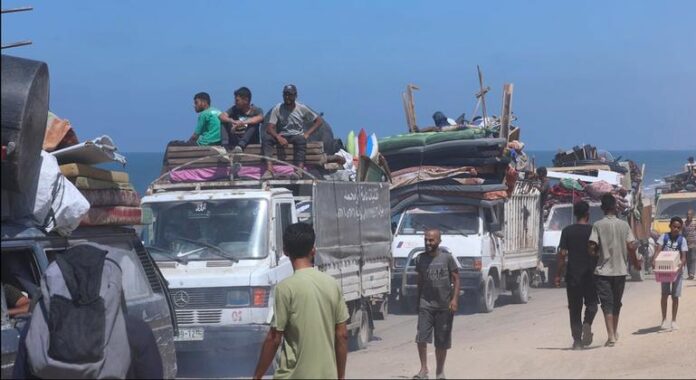
Gaza attends an worsening of the humanitarian crisis as fighting continues, forcing hundreds of thousands of people displaced to count on rudimentary means of survival.

The UN is ready to provide more essential help – but too many obstacles remain to allow necessary scale supplies.

Originally published at Almouwatin.com

Gaza: UN rights office deplores deadly strikes on Palestinians gathering firewood

0
Gaza: UN rights office deplores deadly strikes on Palestinians gathering firewood

OHCHR in the Occupied Palestinian Territory expressed dismay that “the Israeli military is destroying Gaza City, forcing Palestinians to flee and then killing them when they seek shelter in Middle Gaza, especially in and around An Nuseirat Camp.” 

Amid the ongoing displacement and influx of internally displaced persons (IDPs), Israel intensified strikes on the northwestern part of Middle Gaza governorate, covering An Nuseirat and Az Zawaida areas.

Tents, homes and a busy market hit

Officials recorded at least 12 incidents there during the past five days which killed at least 89 Palestinians, most of whom appeared to be civilians – including many women and children. 

The incidents included strikes on IDP tents, homes and a crowded market in An Nuseirat Camp where at least 17 Palestinians were reportedly killed.

“In addition, the Israeli military has reportedly launched airstrikes from Unmanned Aerial Vehicles (UAVs), artillery shelling, and live gunfire against those gathering firewood, especially in northern Middle Gaza, causing dozens of casualties,” the statement continued. 

Between 1 August and 23 September, OHCHR recorded 14 such attacks which killed 21 Palestinians including at least one child

The Office recalled that “Israel has completely blocked the entry of cooking gas since 2 March 2025, forcing people to rely on wood, mostly derived from flammable debris from destroyed buildings and broken furniture, as the only available source of fuel for cooking.”

Civilians under attack

OHCHR emphasised that Israel is obliged to distinguish between civilians and combatants and to refrain from directing attacks against civilians.

“The strikes which kill many Palestinians, including children and women, as well as the use of live ammunition against Palestinians collecting firewood, appear to amount to attacks directed at civilians, demonstrably not directly participating in hostilities,” the office said. 

Supporting the hungry

Separately, the UN aid coordination office, OCHA, said that shelling and air strikes have continued across the Strip, with high-rise buildings reportedly hit in areas around Gaza City including Ar Rimal, Beach camp, and Tal al Hawa.

Teams are working to bring in aid to support bakeries and community kitchens.  On Sunday, partners prepared and delivered some 658,000 meals across the enclave

However, access to northern Gaza is especially complicated. Daily meals were reduced from 170,000 in mid-September to about 50,000 as aid partners relocated and scaled up their operations in the central and southern parts of the enclave.

“Humanitarian partners report that this week, about 50 communal ovens in Gaza City are operational, helping some 2,700 families bake their dough for free,” OCHA said.

The agency reminded that the UN and partners have not been allowed to bring any food aid from Zikim crossing into northern Gaza for more than two weeks.

Although many remain in Gaza City and the north, others continue to flee southwards with 6,900 such displacements recorded on Sunday through four monitoring points. 

Overall, almost 453,000 displacements were recorded across Gaza since mid-August, with the majority originating from Gaza City. 

Source link

Gaza: UN rights office deplores deadly strikes on Palestinians gathering firewood

0
Gaza: UN rights office deplores deadly strikes on Palestinians gathering firewood

OHCHR in the Occupied Palestinian Territory expressed dismay that “the Israeli military is destroying Gaza City, forcing Palestinians to flee and then killing them when they seek shelter in Middle Gaza, especially in and around An Nuseirat Camp.” 

Amid the ongoing displacement and influx of internally displaced persons (IDPs), Israel intensified strikes on the northwestern part of Middle Gaza governorate, covering An Nuseirat and Az Zawaida areas.

Tents, homes and a busy market hit

Officials recorded at least 12 incidents there during the past five days which killed at least 89 Palestinians, most of whom appeared to be civilians – including many women and children. 

The incidents included strikes on IDP tents, homes and a crowded market in An Nuseirat Camp where at least 17 Palestinians were reportedly killed.

“In addition, the Israeli military has reportedly launched airstrikes from Unmanned Aerial Vehicles (UAVs), artillery shelling, and live gunfire against those gathering firewood, especially in northern Middle Gaza, causing dozens of casualties,” the statement continued. 

Between 1 August and 23 September, OHCHR recorded 14 such attacks which killed 21 Palestinians including at least one child

The Office recalled that “Israel has completely blocked the entry of cooking gas since 2 March 2025, forcing people to rely on wood, mostly derived from flammable debris from destroyed buildings and broken furniture, as the only available source of fuel for cooking.”

Civilians under attack

OHCHR emphasised that Israel is obliged to distinguish between civilians and combatants and to refrain from directing attacks against civilians.

“The strikes which kill many Palestinians, including children and women, as well as the use of live ammunition against Palestinians collecting firewood, appear to amount to attacks directed at civilians, demonstrably not directly participating in hostilities,” the office said. 

Supporting the hungry

Separately, the UN aid coordination office, OCHA, said that shelling and air strikes have continued across the Strip, with high-rise buildings reportedly hit in areas around Gaza City including Ar Rimal, Beach camp, and Tal al Hawa.

Teams are working to bring in aid to support bakeries and community kitchens.  On Sunday, partners prepared and delivered some 658,000 meals across the enclave

However, access to northern Gaza is especially complicated. Daily meals were reduced from 170,000 in mid-September to about 50,000 as aid partners relocated and scaled up their operations in the central and southern parts of the enclave.

“Humanitarian partners report that this week, about 50 communal ovens in Gaza City are operational, helping some 2,700 families bake their dough for free,” OCHA said.

The agency reminded that the UN and partners have not been allowed to bring any food aid from Zikim crossing into northern Gaza for more than two weeks.

Although many remain in Gaza City and the north, others continue to flee southwards with 6,900 such displacements recorded on Sunday through four monitoring points. 

Overall, almost 453,000 displacements were recorded across Gaza since mid-August, with the majority originating from Gaza City. 

Source link