

On 23 September 2025, European Council President António Costa was in New York at the United Nations Security Council on Ukraine, as part of the 80th United Nations General Assembly. In his speech, he emphasised the European Union’s unwavering support for Ukraine and the pursuit of peace as a top priority.
High-level week opens with celebration of women’s empowerment

During the landmark 1995 event in the Chinese capital, countries came together and adopted the Beijing Declaration – a blueprint document for advancing women’s rights (read our explainer, here).
At the high-level celebratory event on Monday, countries, civil society organizations, and representatives from academia and the private sector discussed how to accelerate its implementation.
“For so many of us here in this room, we hold positions that when we ourselves were young, seemed unattainable, but are now almost normal for the next generation,” said Annalena Baerbock, referring to the notion that “women’s rights are human rights,” – the rallying cry from First Lady Hillary Clinton 30 years ago in Beijing.
Most ambitious commitment
UN Secretary General António Guterres described the declaration as “the most ambitious global political commitment on women’s rights ever achieved,” adding that it has helped advance legal protection, political participation and education for women worldwide.
Executive Director of gender-equality agency UN Women Sima Bahous remarked that girls are far more likely to finish school today, than at any other time in history.
The number of women in parliament has almost doubled and nearly 100 discriminatory laws have been reversed around the world in the past five years alone.
“Every step forward proved the same truth: gender equality works,” Ms. Bahous said. “But progress has not been fast enough.”
‘No more promises’
A new report from UN Women released earlier this month found that none of the gender equality Sustainable Development Goals are on track. Furthermore, 676 million women and girls now live under the shadow of deadly conflict – the highest recorded since the 1990s.
Cecilia Suárez, UN Global Advocate for the UN Spotlight Initiative, a groundbreaking programme designed to end violence against women and girls, said it had shown “it is possible to make positive and concrete results in this fight.”
“What is required is leadership from those who have gathered here. Leadership that fosters reforms,” she added.
Speaking about the many women around the world who continue to experience injustice, human rights activist and Yazidi survivor of ISIL terrorist sex traffickers, Nadia Murad, called on the international community to fund women’s organisations on the frontlines, guarantee women’s participation in peace and security, and hold perpetrators accountable.
“The next generation of women and girls deserve to inherit no more promises but the reality of justice, equality and dignity,” said Ms. Murad.
Check out a recording below of Celia Suárez at the UNGA80 SDG Media Zone on Monday, talking about the Spotlight Initiative and her role as Global Advocate since 2020.
The security crisis of Haiti ‘is like the sword of Damocles above us: Minister of Foreign Affairs

The country of the Caribbean remains in the grip of an in -depth multidimensional crisis affecting political, security, human rights and humanitarian spheres, with implications for the region.
The armed gangs control large expanses of the territory, more than six million people have an urgent need for help, and 1.4 million fled their house, mainly women and children. Murders and abductions are crawling, while cases of sexual and sexual violence have increased considerably.
Ordinary people affected
The meeting was summoned under the UN Economic and social council (Ecosoc) of which the ad hoc advisory group in Haiti is chaired by the ambassador Bob Rae of Canada.
He announced the latest violence when eight children were killed that day in a drone strike in the Citi Soleil district of the capital, Port-au-Prince.
“We must understand that this is not a problem of theory,” he said. “This is a problem that affects people’s daily life.”
Discussions took place like the Security advice Prepares to resume the debate on a proposal from the Secretary General to establish a new United Nations support office in Haiti.
Duploi in million dollars in Canada
He would provide logistical and operational support for the multinational security support mission led by Kenyan (MSS) who is already on the ground in support of the national police in their efforts to fight against gangs and create a secure environment conducive to the holding of the elections.
At the meeting, the Canadian Minister of Foreign Affairs Anita Anand announced that her country was ready to promise additional $ 40 million to the MSS and its successor mission.
“We are clearly attached to its success, and we are counting on other partners to also improve their support, because the resolution currently offers an increase in size, financing, staff and equipment,” she said.
Canada will also contribute an additional $ 20 million to help improve maritime security in the Caribbean, she added.
Priorities and progress
The situation in Haiti “is like the sword of damocles above us,” said the Minister of Foreign Affairs of the country Jean-Victor Harvel Jean-Baptiste, recalling words on Monday he declared to the CARICOM regional block.
He described the priorities, including the need to “restore social peace so that the people can vote in security” and to support the government in the implementation of development, economic and social programs to resolve the violence of gangs.
“Despite these security challenges, there has been progress,” he said. “We have shown that we can effectively use your help. We now need more support to conclude this effort. ”
Also critical stability
In a video message, the UN deputy secretary general Amina Mohammed Stressed that if security support is essential, “it is not enough to break the crisis cycle”. Haiti is confronted.
“Stability will only come when security is equaled by a political process, credible elections and an economic recovery,” she said.
“This means daring funding, mixing donors’ support with investments to mobilize large -scale resources and place them where they count the most: in the hands of the Haitian people.”
The new Special Representative of the United Nations for Haiti, Carlos Massieu Ruiz, has expressed hope that the Security Council will act urgently on the proposals of the Secretary General.
He urged countries to take advantage of this opportunity and reaffirm commitment to Haiti.
“The path to follow requires a political will, a vision, but above all the resolution,” he said. “Together, we can help Haiti and Haitian society, the Haitian authorities, to turn the trend and to embark on a recovery of peace and inclusive development.”
Originally published at Almouwatin.com
Guterres warns against the loss of “fragile” diplomatic impetus on Ukraine

The president of Ukraine, Volodymyr Zelenskyy, was seated in the emblematic room after his arrival to participate in the UN high -level week, the secretary general watched in February when the council had marked the third anniversary of the large -scale invasion of Russia.
Since then, there has been an “intense” diplomatic commitment but also an “intensification of fights” in Ukraine and, sometimes, in Russia, noted Mr. Guterres.
Houses, schools, hospitals and shelters continue to be bombed in Ukraine, while critical civil infrastructures are in the process of destroying.
According to Mr. Guterres, the last months have experienced some of the highest victims with more than 14,000 civilians killed and more than 36,000 injured.
He added that civilians inside Russia are “increasingly affected”.
“Let me be clear: attacks on civilians and civil infrastructure is prohibited under international law,” he said. “They must stop now.”
“Painfully slow” progress towards peace
Guterres congratulated the efforts of the United States and other people seeking to facilitate diplomatic solutions to the conflict and welcomed direct talks between Ukraine and Russia in Istanbul.
However, progress in the realization of a ceasefire and a lasting peace regulation remain “painfully slow”.
“” We cannot afford to lose the current diplomatic momentum, as fragile as possible“, He said.
He reiterated his call to a “complete and lasting ceasefire” in accordance with Charter of the United Nations and international law.
“The United Nations undertake to fully support all the significant efforts to put an end to this war – and to build a future of dignity, security and peace for all.”
A resident near the ruins of a residential building in kyiv, looking at the emergency teams looking for survivors after a missile strike in the early hours of the morning on August 28.
“Be the strength that acts together”
In his speech, President Zelenskyy deplored that the UN “loses its influence” and called for real security guarantees.
He said that with Great Britain, France and 40 more nations in what he called the coalition of willingly: “We build a new security architecture. We count on the United States of America as fixed. ”
He urged the United States, China, Great Britain and France to “be the force that acts together”.
“What we need now is a strong push to force Russia to peace.”
President Volodymyr Zelenskyy addresses the United Nations Security Council meeting on peacekeeping and security in Ukraine.
‘Bring to this war’ end ‘
US Secretary of State Marco Rubio has urged Security advice Members and people involved in the conflict “put an end to this war before becoming something that will last three or four years, will lead to more destruction – both economic and at the same time, loss of life, loss of goods, loss of future”.
He said that if no path to peace appears in the short term, the United States “will take the necessary measures to impose costs for continuous assault”.
US Secretary of State Marco A. Rubio tackles the meeting of the Security Council on the Maintenance of Peace and Security of Ukraine.
‘Do not give up negotiations’
Speaking for Russia, the first assistant permanent representative Dmitry Polyanskiy said that Reunion – which he described as another “shameful episode on the hypocrisy market” – generates “no added value to the establishment of peace in Ukraine”.
Addressing the Member States, he declared that Russia is expecting their support for a “realistic, long -term and lasting peace” adding that Moscow “abandons any negotiation”.
Originally published at Almouwatin.com
Failure of the end of the Gaza War undermining the credibility of the world, warns the UN chief

The high -level meeting to which foreign ministers and senior officials took place in the midst of the intensification of Israel’s military operations to tear off the full control of Gaza City, growing famine and growing international recognition of the Palestinian state.
“” The Israeli military assault in the city of Gaza aggravates an already catastrophic humanitarian crisis,“Said Mr. Guterres.
“Innumerable Palestinian civilians and the remaining hostages are trapped under a relentless bombardment and deprived of food, water, electricity and medicine. Famine is a reality. “
Respect international law
He repeated his calls for an immediate and permanent ceasefire, the unconditional release of all hostages and without hindrance.
“” UN resolutions continue to be ignored. International humanitarian law violated. Impunity prevails. And our collective credibility is undermined,He warned.
He also reiterated his call to an immediate permanent ceasefire, the unconditional release of all hostages; And unhindered humanitarian access to all those who need it through the band.
Deepening of instability
The secretary general declared that the conflict spreads beyond Gaza in the West Bank and in the region in the broad sense, citing the Israeli strike on Qatar earlier this month as “not only a violation of Qatar’s sovereignty and territorial integrity” but also a threat to “the norms and the very mechanisms on which we support conflicts ”.
“” The efforts to conclude a release contract of ceasefire and hostage-led by Qatar, Egypt and the United States-suffered a hard blow on September 9,He said.
Preserve the two -state solution
Turning to the political horizon, Mr. Guterres warned that the two -state solution is eroding in the midst of “the expansion of incessant settlement. De facto annexation. Forced displacement, ”he said.
“If it is implemented, the recent approval by Israel of the construction of colonies in the E1 region broke the occupied West Bank-destroying the territorial contiguity of a Palestinian State,” he noted.
He called the Israeli colonies “a blatant violation of international law” and urged more international support to stabilize the Palestinian authority, which, according to him, faces an “existential crisis” under fiscal and political pressure.
‘A glow of hope’
However, he underlined a “glimmer of hope” in the resumption of the international conference on the two -state solution, co -chaired by France and Saudi Arabia.
Recognition of the Palestinian State by additional countries, including France and the United Kingdom, he said, has shown a momentum that must be seized.
“” A fair and lasting peace will never be built by more violence,“Mr. Guterres concluded. He demands a collective commitment – to diplomacy, international law, to the dignity of all. “”
Originally published at Almouwatin.com
Sudan war: Lifesaving cholera vaccination campaign begins in Darfur
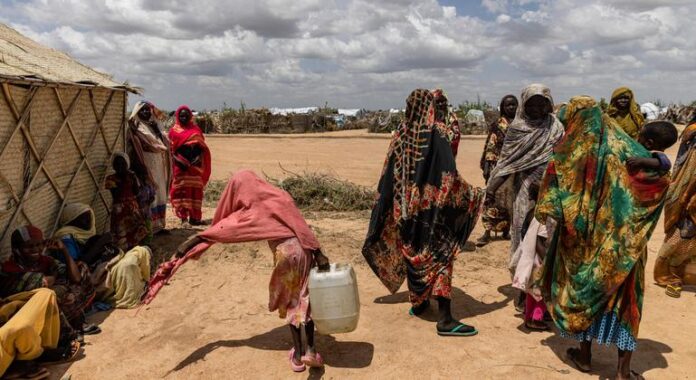
The World Health Organization (WHO)’s Deputy Representative to the country Hala Khudari reported on Tuesday that the outbreak, which started in July 2024 in Kassala, has spread to all 18 states of the country.
More than 113,600 cases have been registered so far and over 3,000 deaths – a “concerning case fatality rate” of 2.7 per cent.
Speaking from Port Sudan, she said that the past year saw surges in White Nile and Khartoum among other states, resulting from the impact of the conflict and increased population movement. This critical situation has been compounded by severely limited basic services such as water, food and health, caused by ongoing heavy fighting between the Sudanese army and the paramilitary Rapid Support Forces.
Cholera is an acute intestinal infection that spreads through bacteria-contaminated food and water. According to WHO, it can kill within hours when not treated, and case fatality rates above one per cent indicate “serious gaps in case management and delayed access to care”.
Conditions ripe for disease
The resurgence of cholera in Sudan has been fuelled by heavy rains and flooding, overcrowding and lack of access to clean water in displacement sites and within communities.
In the Darfur region, where cholera has been spreading since May, the number of cases continues to increase amid “severe access constraints” which are impeding the response, including inaccessible roads due to the rainy season, Ms. Khudari said. As of two days ago 12,739 cases and 358 deaths were reported in more than half of all the localities of the five Darfur states.
In certain localities in West Darfur, the case fatality rate has been as high as 11.8 per cent, she said.
Ms. Khudari explained that WHO and partners have been working to control the outbreak with a vaccination campaign in the worst-hit communities. It began last Sunday “after weeks of preparations to overcome access, transport and logistical challenges”.
The campaign aims to protect 1.86 million people in six priority localities of the Darfurs.
The WHO representative said that the “biggest challenge” in launching the campaign was to “actually get the vaccines there”. She described the difficulties in delivering the life-saving immunizations and supporting supplies via “long routes” to Nyala in South Darfur state earlier this month, amid ongoing security concerns.
El Fasher survivors
Preparations are ongoing to launch the campaign by the end of September in Tawila in North Darfur State, which hosts more than 575,000 internally displaced people, most of whom have fled from the besieged city of El Fasher.
The vaccines are being deployed in Sudan with the support of the UN Children’s Fund (UNICEF), whose spokesperson Ricardo Pires raised the alarm over the severe risks of cholera for children.
Children under five have been “disproportionately affected”, he told reporters, and so far at least 380 have died.
Access to life-saving treatment for cholera in Sudan is limited as the almost two-and-a-half-year-old violent conflict has devastated the health system.
The outbreak comes at a time when “more than 70 per cent of hospitals in conflict-affected areas are non-operational, with health centres being damaged or destroyed during the conflict, lacking supplies and even staff, as well as facilities being often used as shelter,” Mr. Pires stressed.
The UNICEF spokesperson also underscored the impact of “relentless” attacks on the country’s power and water infrastructure which have off cut millions of people including many children from safe and clean water, forcing families to collect water from unsafe and contaminated sources.
Live security advice: a fragile diplomatic momentum on Ukraine must continue, Guterres exhort

The UN Secretary General told the Security Council on Tuesday that it was important not to lose the “fragile diplomatic dynamic” between Ukraine and Russia – and international mediators – during the end of the war. He informed the ambassadors during consecutive meetings where the call to a ceasefire in Gaza, he declared that the war “day after” stops there, must be anchored in international law, rejecting any “ethnic cleaning” of the Palestinians. OUR Live meetings cover is below; UN News Application users can Click here.
Originally published at Almouwatin.com
World News in Brief: Gaza and Nicaragua human rights update, WHO hypertension alert and alarm over US autism claim

The damaged facilities include nine schools and two health centres sheltering more than 11,000 people. At least five displaced people were injured and UNRWA’s field office also sustained damage.
The agency says that its operations in Gaza City – where Israeli air and ground attacks have intensified – have been sharply reduced after its only functioning health centre north of central Gaza was forced to close.
The UN humanitarian office, OCHA, has also reported a surge in displacement in recent weeks, along with almost 28,000 cases of acute malnutrition among children under-five recorded in July and August.
In the occupied West Bank, UNRWA says that Israeli forces have introduced more restrictions on Palestinian movement by installing new road gates.
Israel ‘intent’ to permanently control Gaza
Meanwhile, a new report from the UN Human Rights Council-mandated investigative body on Palestine says that Israel has demonstrated a “clear and consistent intent” to establish permanent control over the Gaza Strip.
The Commission investigated developments relating to land and housing in all areas of the Occupied Palestinian Territory and in Israel.
It finds in relation to Gaza that Israeli authorities “extensively and systematically demolished civilian infrastructure in the corridors and buffer zone and continuously enlarged areas under their control reaching 75 percent of the Gaza Strip by July 2025.”
Actions undertaken to expand the buffer zone and establish corridors have substantially reduced the territory available for Palestinians, with significant implications for their ability to exercise their right to self-determination.
WHO responds to claims on paracetamol and vaccines
The World Health Organization, WHO, has responded to remarks made on Monday by President Donald Trump in Washington, suggesting that paracetamol use in pregnancy may cause autism.
Spokesperson Tarik Jasarevic said that while some observational studies had raised questions, many others found no such link, and the evidence overall remains inconsistent. If there were a strong connection, he said, it would have been seen consistently across multiple studies.
Caution during pregnancy
Mr. Jasarevic stressed that medicines in pregnancy should always be used cautiously and under medical supervision, particularly in the first trimester.
Speaking in Geneva in response to journalists’ questions, the WHO spokesperson also rejected suggestions that routine childhood vaccines cause autism, noting that WHO’s immunization schedules are based on decades of evidence and have saved more than 150 million lives over the past 50 years.
Uncontrolled high blood pressure puts more than a billion at risk
Staying with the WHO, more than 1.4 billion people worldwide live with hypertension, yet only one in five have the condition under control.
The new WHO report on chronic high blood pressure – launched during the 80th UN General Assembly at an event co-hosted with Bloomberg Philanthropies and Resolve to Save Lives – highlights that uncontrolled hypertension is a leading driver of heart attacks, strokes, kidney disease and dementia, killing over 10 million people each year.
Over 1,000 lives lost per hour
“Every hour, more than 1,000 lives are lost to strokes and heart attacks from high blood pressure – and most of these deaths are preventable,” said WHO chief Tedros Adhanom Ghebreyesus. “Countries have the tools to change this narrative. With political will and investment, millions of lives can be saved.”
The report shows that only 28 per cent of low-income countries have consistent access to all WHO-recommended hypertension medicines, compared to 93 per cent of high-income nations. In 99 countries, control rates remain below 20 per cent.
Despite these gaps, progress is possible. Bangladesh, the Philippines and South Korea have shown how integrating hypertension care into universal health coverage can sharply increase treatment and survival rates.
Nicaragua: UN experts warn of escalating repression beyond borders
The Nicaraguan Government is extending its repression of critics far beyond its own borders, UN independent rights experts told journalists in Geneva on Tuesday, as they presented a new report to the Human Rights Council.
The Group of Human Rights Experts on Nicaragua said that opponents in exile are being stripped of their nationality, denied passports and targeted through digital surveillance, property confiscation and threats to relatives still inside the country.
“Their entire life is systematically dismantled, beginning with their uprooting and erosion of legal identity, cascading into economic collapse, social isolation, and pervasive surveillance,” said chairperson Jan-Michael Simon.
‘Cynical and calculated’
He added that the misuse of international systems, including false Interpol alerts, was part of a “cynical and calculated” strategy to avoid accountability while silencing dissent.
Panel member Reed Brody highlighted the June killing of retired army major and government critic Roberto Samcam in Costa Rica, noting that “even beyond borders, opponents of the Government don’t feel safe.”
While investigations are continuing and no official link has been made, he said the attack underscored the climate of fear facing exiled Nicaraguans.
Fellow rights investigator Ariela Peralta raised the alarm about a resurgence of enforced disappearances inside the country, with dozens of detainees held incommunicado and two recent deaths in custody. “When people are detained in secret and die in State custody, State responsibility is incurred under international law,” she said.
The independent body of experts urged States to consider bringing a case before the International Court of Justice (ICJ) and to step up protection for Nicaraguans exiled abroad.
President Trump criticizes the UN, NATO and the “hoax” of the climate

“What is the purpose of the United Nations?” He asked, adding: “All they seem to do is write a really strongly written letter and never follow this letter. These are empty words and empty words do not solve war. ”
He noted that some had suggested receiving the Nobel Peace Prize, adding that “the real price will be to save millions of lives”.
On Iran, which he described as “the number one number one sponsor”, Trump said that his enrichment capacities had been “completely demolished” and that his administration had ended a 12 -day war.
Warning of “strict prices” to Russia
Regarding Ukraine, the American president said that he had thought that it would be “the easiest” the conflict to be resolved because of his relationship with Russian President Vladimir Putin. Instead, he said, the war dragged on for three years, “killing five to seven thousand young people a week”.
Trump also accused countries of hypocrisy of the North Atlantic Treaty Organization (NATO) of hypocrisy for buying oil and gas in Moscow “when they fight Russia”.
Its proposed solution is the punitive prices: “If Russia does not end the war, the United States will impose very strict prices which would end the war very quickly, but Europeans must also adopt them.”
In Gaza, he urged the immediate action to release all hostages and warned that the unilateral recognition of a Palestinian state would represent “a reward for Hamas for its horrible atrocities”.
“But instead of giving in to Hamas, such as ransom request, those who want peace should be united with a single message-release the hostages now,” he said.
The American president also criticized the UN on the renovation of his headquarters in New York which began in 2008, saying that he had proposed to rebuild him for $ 500 million, but the organization had chosen a different entrepreneur, spending “between two and four billion dollars and had not even obtained the marble floors that I promised them. »»
In migration, he said that in 2024, the UN spent “$ 372 million in cash to support 624,000 migrants to go to the United States to infiltrate our southern border”.
He added: “The UN is supposed to stop the invasion, not promote them. »»
Trump also attacked climatic policies and renewable energies, declaring that “windmills are pathetic” and calls the carbon footprint “a hoax”.
He argued: “If you do not get away from the green energy scam, your country will fail”, this “energy and open immigration destroy Europe” and that “China now produces more CO2 than all other developed nations in the world”.
Originally published at Almouwatin.com
SECURITY COUNCIL LIVE: Ambassadors return to Middle East crisis amid diplomatic impasse
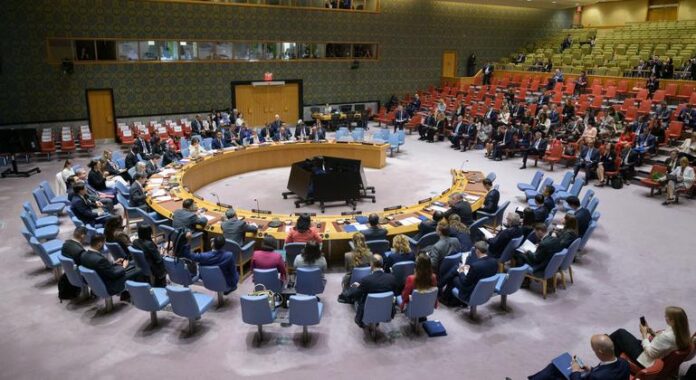
A high-level briefing in the UN Security Council on the Middle East crisis has just got underway with Gaza the expected focus amid Israel’s ongoing offensive to wrest full control of Gaza City from Hamas – and stalled diplomacy in New York, following the sixth use of its veto in the chamber by the United States last week since the Gaza war erupted in September 2023. Follow live meetings coverage below – UN News app users can click here.
