Tuesday, April 7, 2026
Home Blog Page 211

Gaza Live: US VETOS Resolution of the UN Security Council requiring without restrictions

0

The United States has opposed a draft resolution to the Security Council published Thursday by its 10 non-permanent members demanding an immediate, unconditional and permanent cease-fire in Gaza-and the immediate release of all hostages. In the context of the increase in famine, he also demanded the lifting of the Israeli restrictions for help, calling for the power of occupation to ensure a safe and unhindered distribution to all needs. Information applications users can follow our live Meetings coverage by go here.

Originally published at Almouwatin.com

Security Council: US votes against resolution on Gaza ceasefire

0
Security Council: US votes against resolution on Gaza ceasefire

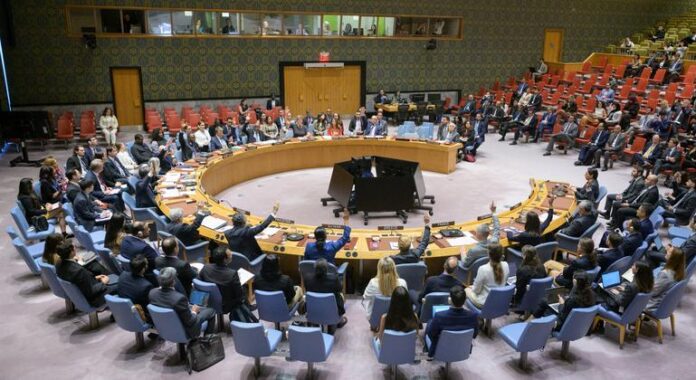
The negative vote was cast as the 15-member Council held its 10,000th meeting against the backdrop of famine spreading in the besieged enclave and an ongoing Israeli offensive to take full control of Gaza City.

The resolution also demanded the release of all hostages held by Hamas and for Israel to lift all restrictions on the entry of humanitarian aid and ensure that it is safely distributed to the population – in particular by UN agencies and partners.

‘No surprise’: US representative

The US is one of five permanent Council members who possess the right to veto.

Speaking prior to the vote, representative Morgan Ortagus stated that Washington’s opposition to the resolution “will come as no surprise” as it fails to condemn Hamas or recognize Israel’s right to defend itself.

The text also “wrongly legitimizes the false narratives benefiting Hamas, which have sadly found currency in this Council,” she said.

“This resolution also refuses to acknowledge and seeks to return to a failed system that has allowed Hamas to enrich and strengthen itself at the expense of civilians in need.”

‘Clear message’ sent

The draft was put forward by the Council’s 10 non-permanent members: Algeria, Denmark, Greece, Guyana, Pakistan, Panama, Republic of Korea, Sierra Leone, Slovenia and Somalia.

“Even though this resolution was not adopted today at this 10,000th meeting of the Council, 14 members of this Council have sent a clear message,” said Danish Ambassador Christina Markus Lassen.

“We want to see an immediate and lasting ceasefire, the immediate and unconditional release of all hostages, and the urgent lifting of all restrictions on humanitarian aid.  We will continue to work for this for however many Council meetings it may take.” 

The Gaza war erupted on 7 October 2023 after Hamas and other Palestinian militant groups attacked Israel, killing roughly 1,200 people and taking 250 hostages, with 48 still in captivity.

The Security Council first met on the crisis the following day, behind closed doors.  Since then, the US has vetoed four other resolutions calling for a ceasefire, most recently in June.

More than 65,000 Palestinians have been killed since hostilities began, according to the Gaza health authorities.

A landmark occasion

South Korea holds the rotating Security Council presidency for the month of September.

At the outset of the meeting, representative Sangjin Kim noted that the 10,000 number was both “large and significant, like the challenges that remain before us on this Council’s agenda.”  

He said that “137 Member States have worked on the Council, often in concert”, over this period. 

“Let us bear this in mind as we continue to strive to fulfill the Security Council’s vital mandate.” 

Maintaining peace and security

The Security Council is one of the six main organs of the UN, alongside the General Assembly, the Secretariat, the Economic and Social Council (ECOSOC), the Trusteeship Council, and the International Court of Justice (ICJ).

The Council has primary responsibility for the maintenance of international peace and security and takes action through resolutions and decisions. It also establishes peacekeeping missions and can enact sanctions. 

The five permanent members – China, France, Russia, the United Kingdom and the United States – have the right to veto any resolution and all have exercised this power at some time.

Permanent members were granted the right to veto because of their key roles in the establishment of the UN 80 years ago, with Russia taking over the seat held by the Union of Soviet Socialist Republics (USSR) in 1990.

The 10 non-permanent members are elected by the General Assembly, which comprises all 193 UN Member States, and serve for two-years periods. 

Source link

Paris Agreement: EU submits statement of intent to the UNFCCC on the post-2030 NDC

0
Paris Agreement: EU submits statement of intent to the UNFCCC on the post-2030 NDC

Today, the Council approved the EU’s statement of intent on its post-2030 NDC, outlining its intention to submit an NDC ahead of COP30.

Source link

The UN welcomes the first convictions of Colombia under transitional justice measures as a “crucial step”

0

“” After decades of atrocity to atrocity, these convictions represent a fundamental step in the fight against impunity in Colombia and by realizing the rights of the victims to the truth and the justice, ” he said.

The Special Jurisdiction for Peace (SJP), established under the 2016 peace agreement between the government and the FARC rebels, the Revolutionary Armed Forces in Colombia, published convictions based on restorative justice on Tuesday.

Seven former FARC leaders were found guilty of war crimes and crimes against humanity linked to more than 20,000 kidnappings, torture, sexual violence and imposed disappearances.

The court allows defendants to refuse their crimes or to recognize them by a “reconnaissance”.

The seven chose the latter, committing to participating in restorative activities, including humanitarian demining, to help in search of missing persons and to contribute to commemoration projects.

These measures aim to amplify the truth, guarantee responsibility and provide reparation to the victims.

The “recognition route” also means that instead of serving childcare sentences in prison, they are faced with restrictions on their movement.

Ball in the Government Court

“” It is now up to the government to take measures so that the legal, budgetary, security and administrative conditions are in place to guarantee that the following sanctions are actually applied and that the responsibility is fully integrated into the system,“Said Mr. Türk.

UN Secretary General António Guterres also praised the decisions, noting that they represent a key step forward.

In a statement Emitted by his spokesperson, the UN chief stressed that the sentences should be fully implemented and that the Colombian authorities ensure that all the conditions are in place for compliance.

“” The United Nations, including through the United Nations verification mission [in the country]It remains firmly determined to support Colombia in its pursuit of peace, justice and sustainable reconciliation,Said Stéphane Dujarric.

First historical step

SJP decisions only mark the first step in a broader responsibility process. Later this week, the court should pronounce its first convictions for former members of the security forces.

These decisions deal with serious violations of human rights, in particular “murders and forced disappearances of civilians by state agents, falsely presented as victims resulting from the fight”, according to the United Nations Human Rights Office, Ohchr.

A long road to come

While the convictions have been welcomed as an important step, UN officials have care that challenges remain.

Armed conflicts continue to affect certain parts of the country and human rights violations – including the murders of rights defenders, recruiting children by armed groups and disproportionate impacts on minorities – remain an urgent concern.

“” The implementation of peace agreements is rarely a fluid or simple process; This often requires dedicated years of effort,“Said Mr. Türk.

“These convictions highlight the progress made, but also the importance of continuing to prioritize the implementation of the 2016 peace agreement to prevent new violations and suffering.”

United Nations Support

Ohchr supported the creation of the SJP and continues to provide technical assistance to its surveys, ensuring that the rights and participation of the victims remain at the heart of the justice process.

Originally published at Almouwatin.com

The UN must evolve to “stay strong” for the next 80 years: President of the General Assembly

0

Speak before the start of High level weekAnnalena Baerbock stressed the importance of The Charter of the United Nationsthe founding document of the organization, and the need for reform and greater inclusiveness.

“Our task is to assure us that the UN is strong for the next 80 years”, it said.

Reform to remain relevant

Ms. Baerbock underlined the theme of her presidency, “better together”, which “reflects the reality that No single nation, whatever its size, power or wealth, can face the challenges without borders that we are facing alone. “”

She recalled that the UN had been established during what was perhaps one of the darkest moments in human history, which led to the Charter-“The northern star which guides our work and reminds us of what we want to do together. »»

But after 80 years of a changing world, it is time to “adapt and evolve for a nations of the United Nations which will lead us over the next eight decades to show eight billion people why this organization still counts”.

This is also essential “to respond to calls desperate for peace in Ukraine, Gaza, Sudan and Haiti”, and a significant action to combat climate change, inequalities and rapid technological progress.

This year, the emphasis must be placed on the progress of the UN80 The agenda of the reform, she said, guiding the selection of the next secretary general and guaranteeing the implementation of the Pact for the future Adopted by the Member States last September.

Enter the day

In this regard, The general debate Next week-the annual gathering of world leaders in the emblematic hall of the General Assembly-is an opportunity to demonstrate the role of the UN as a dialogue platform. Some 150 heads of state and government, as well as thousands of delegates, should attend.

Ms. Baerbock is committed to “to use all occasions to underline the importance of this moment in history to reaffirm our commitment to the Charter of the United Nations and the principles it represents. »»

She described the key possibilities during the high -level week, such as the meeting To commemorate the UN 80th anniversary. It gives “a chance to think about the achievements and the role of the UN and to reintegrate the principles of the Charter-our life insurance”.

Support for the two -state solution

She also underlined the resumption of The high -level international conference On Palestine and the two -state solution with Israel.

“” It is a chance to deal with reality that the Israeli-Palestinian conflict cannot be resolved by an endless war, continuous occupation and terror“She said.

“The only way to ensure that Israelis and Palestinians can live in sustainable peace, security and dignity is the two -state solution.”

Women, young people and minorities

Meetings are also planned to mark 30 years from both The Fourth World Conference on Women And The global action program for young peopleWhile another will focus on Non -transmitted and mental health diseases.

The General Assembly will also hold a high -level conference to approach the crisis to which Rohingyas Muslims and other minorities in Myanmar “support the most vulnerable and draw attention to conflicts and human rights abuses which are too often forgotten”.

Finally, the annual gathering to commemorate International day for the total elimination of nuclear weapons “Gains renewed of importance in a year when conflicts and tensions are at a highest critical point.”

“A moment of makeup or rupture”

Ms. Baerbock noted that the international community was “not short of challenges or problems”, but it is time to transform commitment into collective action.

“” We are at a crossroads – a moment to do or rupture for the United Nations and multilateralism as a whole – but it is precisely when we have to work harder“She said.

“Our ancestors had humility and grace to put aside their differences and work together in 1945; We need this same conviction of principle today. ”

The President of the Assembly called for “will and ambition to transform the promise into action, commitments into progress and hope in reality”.

Originally published at Almouwatin.com

Syria: Statement by the Spokesperson on the roadmap agreed by Syria, Jordan and the US on Suwayda

0
Paris Agreement: EU submits statement of intent to the UNFCCC on the post-2030 NDC

Syria: Statement by the Spokesperson on the roadmap agreed by Syria, Jordan and the US on Suwayda

Source link

UN presses ahead with mission for a better world despite global headwinds

0
UN presses ahead with mission for a better world despite global headwinds

The Secretary-General’s annual report, released on Thursday ahead of the 80th session of the UN General Assembly’s yearly high-level session, offers a sobering yet resolute account of the Organization’s efforts in the face of mounting challenges.

Mr. Guterres highlighted the resilience of UN personnel, committed to delivering hope and help to those in need despite operating under difficult circumstances.  “The present report demonstrates that despite enormously trying times – indeed, precisely because of them – we can and must keep pushing for the better world that we know is within reach,” he said.

Together with partners, the UN coordinated a $50 billion appeal for the humanitarian needs of 198 million people. “In 2024, the United Nations helped to mobilize $25 billion of the $50 billion funding target, enabling life-saving humanitarian assistance to reach 116 million people in urgent need across 77 countries and territories.”

This enabled life-saving programmes in the Horn of Africa, the Occupied Palestinian Territory, Sudan, Ukraine, Yemen and regions affected by natural disasters like earthquakes in Vanuatu, drought in Southern and Eastern Africa and floods in South-East Asia.

At the same time, UN operations in 2024 came at a heartbreaking human cost. It was the deadliest year on record for UN staff and humanitarian workers, with 373 aid workers killed. The vast majority of those casualties were personnel from the UN Relief and Works Agency for Palestine Refugees in the Near East (UNRWA), working in Gaza under extreme and dangerous conditions.

In launching the report, the Secretary-General paid tribute to their sacrifice, reaffirming the UN’s unwavering commitment to standing with the world’s most vulnerable.

© UNRWA/Mohammed Hinnawi

Children find shade and take part in recreational activities organized by UN personnel in front of destroyed buildings in the Gaza Strip.

Peace and security core to UN’s mission

Diplomacy for peace remained core to the Organization’s work amid escalating global challenges to peace and security. Despite rising threats, the UN’s diplomatic efforts continued to protect hundreds of thousands of civilians daily and advance peace processes.

During the political transition in Syria, the UN engaged stakeholders in line with Security Council resolution 2254 – which in 2015 endorsed a road map for a peace process in the country – to de-escalate violence protect civilians and prevent regional spillover. 

Meanwhile, in the Occupied Palestinian Territory, including East Jerusalem, Gaza and the West Bank and the broader region, the UN closely engaged all parties to end violence, enhance humanitarian access and sustain assistance to affected populations.

In Lebanon the UN supported de-escalation and a resumption of a cessation of hostilities in line with our mandate under Security Council resolution 1701, enabling people to return to their homes on both sides of the Blue Line.

The UN also facilitated peace talks, supported state-building efforts and helped to protect civilians globally, including in the Sudan. The Organization’s efforts to help promote a peaceful coexistence in Abyei, saw a decline in intercommunal violence.

The Peacebuilding Fund allocated over $116 million to support national peace plans in 32 countries and territories, with a focus on gender equality. Partnerships with regional organizations, like the African Union, further bolstered conflict prevention.

A renewed vision for the future

The 2024 Summit of the Future marked a historic turning point for multilateralism. World leaders adopted the Pact for the Future, a landmark agreement to revitalize international cooperation and deliver solutions for people and planet.

The Pact calls for stronger diplomacy and conflict prevention, reforms to the global financial system, urgent climate action, and accelerated progress on the Sustainable Development Goals (SDGs). It also commits to more representative and effective global governance, including reforms to the Security Council and greater voice for developing countries.

The Global Digital Compact and the Declaration on Future Generations were adopted as annexes to the Pact, underscoring its breadth and ambition. The Compact advances a vision for a safe, open and inclusive digital future, committing Member States to close digital divides, promote universal digital public infrastructure, and strengthen governance of data and artificial intelligence.

The Declaration, meanwhile, represents the first global agreement to systematically account for the rights and interests of tomorrow’s citizens in today’s decisions, embedding foresight in policymaking and paving the way for long-term, sustainable action.

Together, these outcomes form the foundation of a generational renewal of multilateralism. As Secretary-General Guterres underscored: “By addressing the pressing issues of our time, the United Nations is paving the way for a more equitable and sustainable future, ensuring that digital technologies are harnessed for the benefit of all humanity.

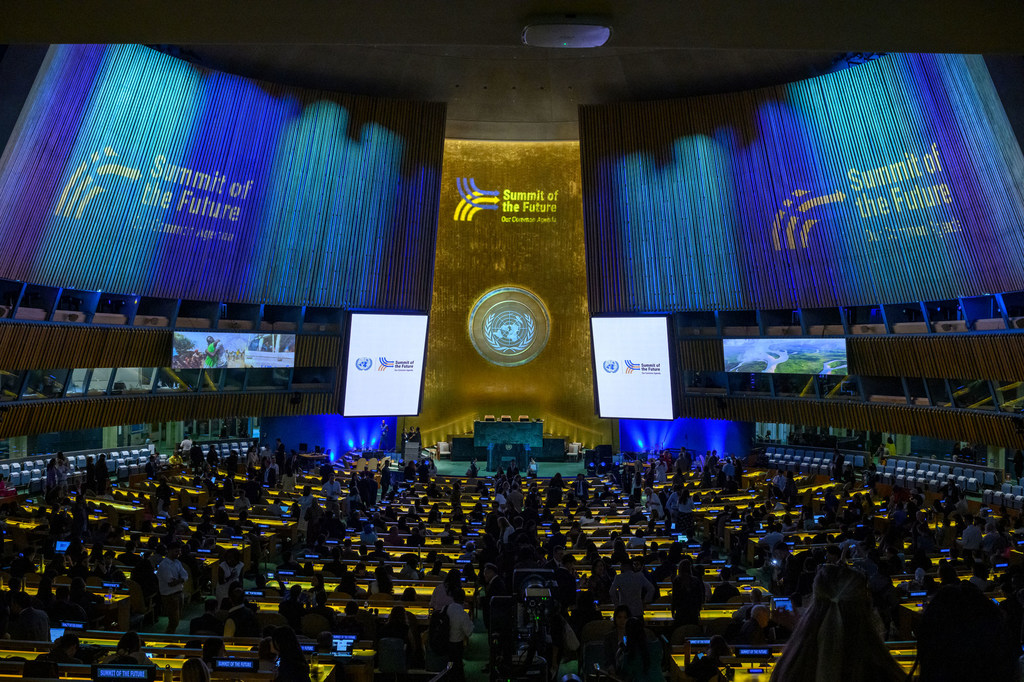
Participants gather for the opening of the Summit of the Future, with Youth Lead for the Future as the opening Action Day theme.

Participants gather for the opening of the Summit of the Future, with Youth Lead for the Future as the opening Action Day theme.

Human rights and sustainable development

The United Nations continues to be guided by the vision that human rights are a driving force for solutions to the many global challenges we face, and are the foundation for peace, justice and sustainable development. In 2024, the Organization advanced initiatives to eliminate violence against women and girls, empower rural and marginalized communities, and ensure women’s participation in peace and constitutional processes.

Human rights were also woven into responses to conflict, migration, climate change and digital governance, helping to strengthen protection, accountability and inclusion across the Organization’s work.

At the same time, sustainable development and climate action remained central. The UN supported 170 countries in implementing their nationally determined contributions to reduce emissions and provided targeted assistance for low-carbon transitions in developing States.

The Organization also pressed for reforms to the global financial system to close the widening SDG financing gap, ensuring that the most vulnerable countries have a fair chance to deliver on the promise of the 2030 Agenda.

A commitment to staff is a commitment to humanity

The Secretary-General highlighted the commitment of UN personnel working under extraordinary risk. He voiced alarm at the erosion of humanitarian norms, condemning deliberate attacks on civilians, hospitals, schools and aid workers, which undermine international law and the values of the UN Charter.

Despite record dangers, staff carried forward their mission with courage and resilience.

“The present report demonstrates that despite enormously trying times – indeed, precisely because of them – we can and must keep pushing for the better world that we know is within reach. We will renew our efforts to achieve peace, foster sustainable development and defend and uphold human rights, for all of humanity,” said Mr. Guterres.

Together, these strands embody the spirit of an Organization striving not only to confront today’s crises but to uphold rights, deliver development, and serve people everywhere with integrity and compassion.


Source link

The UN pushes with mission for a better world despite the world -contrary winds

0

The Secretary General’s annual report, published Thursday before the 80th session of the high -level annual session of the United Nations General Assembly, offers a sober but resolved account of the organization’s efforts in the face of mounting challenges.

Mr. Guterres underlined the resilience of the UN staff, committed to providing hope and helping those who need it despite the functioning in difficult circumstances. “This report shows that Despite extremely trying moments – in fact, precisely because of them – we can and must continue to push for the world better than we know at hand“He said.

With partners, the UN coordinated a call of $ 50 billion for the humanitarian needs of 198 million people. “In 2024, the United Nations helped to mobilize $ 25 billion from the funding target of $ 50 billion, allowing humanitarian assistance that saves lives to reach 116 million people in urgent needs in 77 countries and territories.”

This saved backup programs in the Horn of Africa, the Occupied Palestinian territory,, Sudan,, Ukraine,, Yemen and regions affected by natural disasters such as earthquakes in Vanuatu,, drought in South Africa and East And Floods in Southeast Asia.

At the same time, UN operations in 2024 have reached a heartbreaking human cost. It was the The deadliest year ever registered for United Nations personnel and humanitarian workersWith 373 humanitarian workers killed. The vast majority of these victims were staff of the United Nations Rescue and Work Agency for Palestinian Refugees in the Middle East (UNRWA), working in Gaza Under extreme and dangerous conditions.

By launching the report, the secretary general paid tribute to his sacrifice, reaffirming the unwavering commitment of the UN to stand with the most vulnerable in the world.

© Unrwa / Mohammed Hinnawi

Children find the shadow and participate in recreational activities organized by UN staff in front of the buildings destroyed in the Gaza Strip.

Peace and security of the UN mission

Peace diplomacy has remained at the heart of the work of the organization in the midst of climbing world challenges to peace and security. Despite growing threats, UN diplomatic efforts have continued to protect hundreds of thousands of civilians daily and to advance peace processes.

During the political transition in SyriaThe UN has engaged the stakeholders online with Security advice Resolution 2254 – which in 2015 approved a roadmap for a peace process In the country – to defuse violence, protect civilians and prevent regional overflows.

Meanwhile, in the occupied Palestinian territory, notably Jerusalem-Est, Gaza and the West Bank and the wider region, the parties of all the parties have been closely engaged to end violence, improve humanitarian access and maintain aid to the affected populations.

In Lebanon, the UN supported de -escalation and a resumption of a cessation of hostilities in accordance with our mandate under the Security Council Resolution 1701allowing people to return home on both sides of the blue line.

The UN also facilitated peace talks, supported the efforts to build the state and contributed to protect civilians on a global scale, including Sudan. The organization’s efforts to help promote peaceful coexistence in Abyei experienced a drop in inter -municipal violence.

The Peace Construction Fund allocated more than $ 116 million to support national peace plans in 32 countries and territories, emphasizing gender equality. Partnerships with regional organizations, such as the African Union, have further strengthened conflict prevention.

A renewed vision for the future

2024 Future summit marked a historic turning point for multilateralism. World leaders have adopted the Pact for the futureA historic agreement to revitalize international cooperation and provide solutions for people and the planet.

The Pact calls for stronger diplomacy and conflict prevention, global financial system reforms, urgent climate action and accelerated progress on the Sustainable development objectives (ODD). It also undertakes to a more representative and effective global governance, including the reforms of the Security Council and a greater voice for developing countries.

THE Global Digital Compact and the declaration on future generations have been adopted as annexes to the pactemphasizing its magnitude and ambition. The compact advances a vision of a safe, open and inclusive digital future, by initiating member states to close digital divisions, to promote universal digital public infrastructure and to strengthen data governance and artificial intelligence.

The declaration, on the other hand, represents the first global agreement to systematically explain the rights and interests of the citizens of tomorrow in today’s decisions, integrating providents in the development of policies and paving the way for long -term sustainable action.

Together, these results constitute the foundation of a generational renewal of multilateralism. As the Secretary General Guterres pointed out: “By attacking the urgent problems of our time, the United Nations paves the way for a more equitable and lasting future, ensuring that digital technologies are exploited for the benefit of all humanity.“”

Participants meet for the opening of the summit of the future, with young people for the future as theme of the opening day of action.

Human rights and sustainable development

The United Nations continue to be guided by the vision that human rights are an engine of solutions with many global challenges that we face and are the foundation of peace, justice and sustainable development. In 2024, the organization has advanced initiatives to eliminate violence against women and girls, empowering rural and marginalized communities and ensuring women’s participation in peace and constitutional processes.

Human rights have also been woven in the responses to conflicts, migration, climate change and digital governance, helping to strengthen protection, responsibility and inclusion through the work of the organization.

At the same time, sustainable development and climate action remained central. The UN has supported 170 countries in the implementation of their contributions determined to reduce emissions and provided targeted assistance for low carbon transitions in developing states.

The organization also put pressure on global financial system reforms to close the Expanding the ODD financing gapensuring that the most vulnerable countries have a fair chance of keeping the promise of 2030 agenda.

A commitment to staff is a commitment to humanity

The secretary general underlined the commitment of the UN staff working in extraordinary risk. He expressed his alarm to the erosion of humanitarian standards, condemning deliberate attacks on civilians, hospitals, schools and humanitarian workers, which undermines international law and the values ​​of the Charter of the United Nations.

Despite record dangers, the staff continued their mission with courage and resilience.

“This report shows that despite the extremely trying moments – indeed, precisely because of them – we can and must continue to put pressure on the world better than we know at hand. We will renew our efforts to achieve peace, promote sustainable development and defend and maintain human rights, for all humanitySaid Mr. Guterres.

Together, these strands embody the minds of an organization which endeavors not only to face the crises of today, but to maintain the rights, to provide development and to serve people everywhere with integrity and compassion.
Originally published at Almouwatin.com

UN hails Colombia’s first convictions under transitional justice measures as ‘crucial milestone’

0
UN hails Colombia’s first convictions under transitional justice measures as ‘crucial milestone’

After decades of atrocity upon atrocity, these convictions represent a fundamental step in the fight against impunity in Colombia and in fulfilling the rights of victims to truth and justice,” he said.

The Special Jurisdiction for Peace (SJP), established under the 2016 Peace Agreement between the Government and FARC rebels, the Revolutionary Armed Forces of Colombia, issued the sentences based on restorative justice on Tuesday.

Seven former FARC leaders were convicted of war crimes and crimes against humanity linked to more than 20,000 kidnappings, torture, sexual violence and enforced disappearances.

The tribunal allows defendants to either deny their crimes or acknowledge them through a “recognition route.”

All seven chose the latter, committing to participate in restorative activities including humanitarian demining, assisting in the search for missing persons and contributing to memorialization projects.

These measures aim to amplify truth-telling, ensure accountability, and provide redress to victims.

The “recognition route” also means that instead of serving custodial sentences in prison, they face restrictions on their movement.

Ball in the Government’s court

It is now up to the Government to take action so the legal, budgetary, security and administrative conditions are in place to ensure that the ensuing penalties are effectively enforced and that accountability is fully embedded in the system,” said Mr. Türk.

UN Secretary-General António Guterres also welcomed the rulings, noting that they represent a key step forward.

In a statement issued by his Spokesperson, the UN chief emphasised that the sentences should be fully implemented and that Colombian authorities ensure all conditions are in place for compliance.

The United Nations, including through the UN Verification Mission [in the country], remains firmly committed to supporting Colombia in its pursuit of lasting peace, justice and reconciliation,” said Stéphane Dujarric.

Landmark first step

The SJP rulings mark only the first stage of a broader accountability process. Later this week, the court is expected to issue its first sentences for former members of the security forces.

These rulings address serious human rights violations, including “murders and enforced disappearances of civilians by state agents, falsely presented as casualties resulting from combat,” according to the UN human rights office, OHCHR.

A long road ahead

While the convictions were hailed as a milestone, UN officials caution that challenges remain.

Armed conflicts continue to affect parts of the country, and human rights violations – including killings of rights defenders, child recruitment by armed groups, and disproportionate impacts on minorities – remain a pressing concern.

Implementing peace accords is rarely a smooth or straightforward process; it often requires years of dedicated effort,” Mr. Türk said.

“These convictions highlight the progress made, but also the importance of continuing to prioritize the implementation of the 2016 Peace Accord to prevent further violations and suffering.”

UN support

OHCHR supported the creation of the SJP and continues to provide technical assistance for its investigations, ensuring that victims’ rights and participation remain central to the justice process.

Source link

Why Developing Discipline in Play Builds a Stronger Path to Victory

0


Sports betting feels exciting; a quick win makes anyone feel like a genius. The dream is to use

Source link