
A key milestone in the pursuit of fusion energy is achieving a high “triple product,” an important metric
ORNL’s pellet injector enables world record performance in W7-X
Israel: Commission proposes to suspend trade concessions and sanction officials

The Commission presented a proposal to suspend certain trade-related provisions of the EU-Israel Association Agreement, and to sanction extremist ministers and violent settlers. It also proposed to further sanction Hamas.
Thirsty and starving, Gazans face ‘inhumane’ evacuation
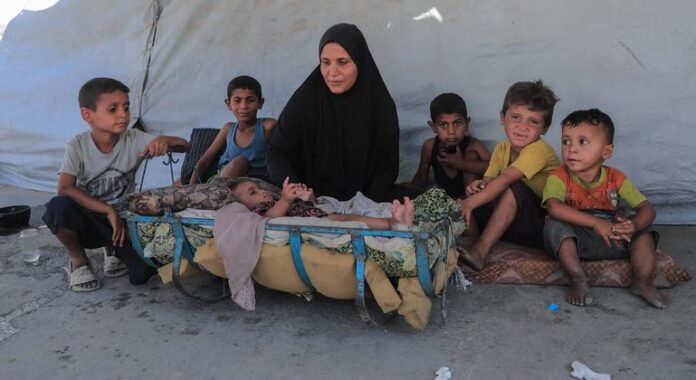
The development followed reports that the Israeli military has stepped up its ground offensive in Gaza City, ordering residents to leave the area.
Speaking from the south of the enclave, UNICEF’s Tess Ingram described the forced mass displacement of families as a “deadly threat for the most vulnerable”.
“It is inhumane to expect nearly half a million children battered and traumatized by over 700 days of unrelenting conflict to flee one hellscape to end up in another,” she insisted.
150,000 go south in a month
According to the UN’s humanitarian affairs coordination office, OCHA, over the past few days, partners monitoring the movement of people in Gaza counted almost 70,000 displacements heading south, and about 150,000 over the past month. The only available route, Al Rashid Road, was “very busy” when Ms. Ingram was there on Monday, she said.
The UNICEF spokesperson described meeting a mother who had walked for more than six hours from Gaza City to the South with her five children, “all dirty, thirsty and starving”, two of them with no shoes.
They are being pushed along with tens of thousands of others to “a so-called humanitarian zone” encompassing Al-Mawasi and surrounding areas, she said.
Sea of despair
Ms. Ingram described their destination as “a sea of makeshift tents, human despair” and services which are “insufficient” to support the hundreds of thousands already living there.
Child malnutrition in Gaza is “spiralling”, Ms. Ingram continued, pointing out that according to UNICEF estimates, some 26,000 children in the enclave currently require treatment for acute malnutrition – more than 10,000 in Gaza City alone.
Famine was confirmed late last month in Gaza City by UN-backed food insecurity experts.
Feeding centres closed
UNICEF’s Ms. Ingram said that owing to evacuation orders and military escalation more nutrition centres in Gaza City have been forced to shut this week, “cutting off children from a third of the remaining treatment sites that can save their lives”.
While humanitarians remain on site and continue responding to the crisis, “it is becoming harder with every bombardment and every denial”, she stressed.
According to OCHA, last Sunday out of 17 missions that humanitarian teams coordinated with the Israeli authorities, only four were facilitated, while seven missions were denied and others were impeded on the ground or had to be cancelled.
Ms. Ingram spoke of the dilemma desperate Gazans face: “stay in danger or flee to a place that they also know is dangerous.” She recalled that Al-Mawasi came under attack some two weeks ago, when eight children were killed while lining up for water; the youngest victim was three years old.
More to follow…
Spain and Germany recognised with Europol’s ‘Criminal Analyst of the Year Award 2025’
Criminal analysts from Germany and Spain have been named winners of Europol’s ‘Criminal Analyst of the Year Award 2025’, recognising outstanding work in both strategic and operational analysis.
Government corruption fuels human rights crisis in South Sudan, independent panel finds

Based on two years of independent investigations and analysis, the report reveals how oil and non-oil revenues are siphoned off through opaque schemes and politically connected contracts. Meanwhile, millions of South Sudanese are denied basic services.
“Our report tells the story of the plundering of a nation: corruption is not incidental, it is the engine of South Sudan’s decline,” said Yasmin Sooka, Chair of the Commission.
“It is driving hunger, collapsing health systems, and causing preventable deaths, as well as fuelling deadly armed conflict over resources.”
Diversion of funds
Upon gaining independence in 2011, South Sudan emerged from decades of brutal civil war with Sudan, carrying a legacy of divisive conflict, state repression and poverty.
Fourteen years after independence, ruling elites still struggle for control over natural resources.
The report found that the Sudanese government’s oil inflows alone have exceeded $25.2 billion since 2011, but hardly any money goes to essential services. Due to systemic corruption, the education, public health and justice systems are in crisis.
“The diversions are not abstract budget failures – they translate into preventable deaths, widespread malnutrition, and mass exclusion from education,” said Commissioner Carlos Castresana Fernández.
“Three-quarters of child deaths are preventable — yet funds go to patronage and private pockets, not medicine or clean water and sanitation.”
Multiple corruption schemes
The ‘Oil for Roads’ programme is just one of the corruption schemes described in the report. The programme intended to build infrastructure but failed to deliver promised roads. An estimated $2.2 billion has been channeled into political patronage networks through the off-budget scheme.
The report also details schemes by Crawford Capital, a politically-connected company, in non-oil revenue collections, where little of the taxes reach government budgets even as illegal levies on humanitarian actors obstruct critical food aid operations.
A need for change
A 2018 peace agreement promised structural change and an improvement of public financial management, but the reform has not been adequately funded or implemented.
Prioritizing the implementation of certain reforms under the agreement is one of the many recommendations that the report lays out for South Sudan. The 54 recommendations are aimed at helping the country fulfil the population’s basic needs, strengthen accountability, and end impunity.
“When public revenue becomes private fortune, peace cannot hold. For the transition to survive, accountability for economic crimes and an investment in human rights are indispensable,” said Ms. Sooka.
The Commission on Human Rights in South Sudan was established by the UN Human Rights Council in March 2016. The three Commissioners are not UN staff and do not receive payment for their work.
“ The needs are enormous ”: Pakistan is reduced by floods while millions of people have left homeless

More than six million people have been affected since unusually heavy monsoon rains began at the end of June, with almost 1,000 lost lives, including 250 children.
About 2.5 million people have been moved, numerous shelters in camps managed by the government or in host families which are already stretched at their limit.
“” On the ground, we only see the tip of the iceberg,»Carlos Geha, head of the United Nations Coordination Office (Ochha) In Pakistan, Islamabad told the UN News.
He added that many inappropriate families have not yet returned home and could find their houses and their livelihoods destroyed when the water levels are finally retreating.
Pakistan’s Breadbasket underwater
Exacerbating the Flood of Mousson, the river floods flooded large parts of the Punjab province – the Pakistani food basket – where more than 4.7 million people were affected after India has released water from the dams upstream, leading to rivers that burst their banks.
The Indian authorities had informed Pakistan before the Liberation, which was launched by massive rains which made rivers over northern rivers.
In Khyber Pakhtunkhwa, 1.6 million people were affected, while the sudden floods triggered by the overflows of the glacial lakes have devastated parts of the Gilgit-Baltistan, cutting entire valleys. The Sindh province remains on high alert for potential “super floods”.
“The government has done a great job evacuating 2.5 million people, which we have not seen in 2022,” said Mr. Geha, recalling the devastating floods that killed more than 1,700 people and caused around 40 billion dollars in economic losses.
“But when the water levels reach 25 feet, swallowing whole villages, there are only few people can do. »»
Aerial view showing the devastation caused by the jhang district floods in Punjab – the most populous province in Pakistan.
Disappeared cultures, lost infrastructure
The National Disaster Management Authority (NDMA) reports that more than 8,400 houses, 239 bridges and almost 700 kilometers of roads have been damaged or destroyed.
More than 2.2 million hectares of cultivated land – largely in Punjab – are underwater, destroying harvests and pushing the prices of foodstuffs. The prices of wheat flour alone increased by 25% in the first week of September.
“” These are agricultural families who feed the nation,“Mr. Geha said. Now their land is overwhelmed, their animals have gone and they find themselves nothing. “”
Under tensioning efforts
The UN and its partners find it difficult to match the extent of the disaster. OCHA published $ 5 million from the UN Central emergency intervention fund (Deer), with an additional $ 1.5 million channeled to local NGOs.
Unicef,, Wfp And other agencies are safe water trucks, the supply of health supplies and nutrition and set up temporary learning centers for children.
However, humanitarian workers warn that it is far from sufficient. Many communities remain cut by collapsed bridges and submerged roads, food and drugs reaching them only by boat or by helicopter.
Diseases of water origin like malaria and dengue are already increasing, with fears of cholera outbreaks in the coming weeks.
“Immediate needs are food, health care, refuge, water and sanitation,” said Geha. ” But The next phase will be even more difficult – to help millions of people get back on their feet after losing everything.“”
A member of UNICEF staff distributes hygiene kits and water purification tablets to flood families affected in the District of Jhang, Punjab.
A call for solidarity
Pakistan has endured repeated climatic disasters in recent years, from records in 2022 to heat and drought waves. Humanitarian workers warn that each shock pushes families who are already vulnerable further in poverty.
“This is not the fault of Pakistan – it is one of the countries most exposed to climate change,” said Geha.
“” The international community must be held with Pakistan not only in an emergency, but also to rebuild resilience and restore long -term livelihoods.“”
Originally published at Almouwatin.com
‘The needs are huge’: Pakistan reels from floods as millions left homeless
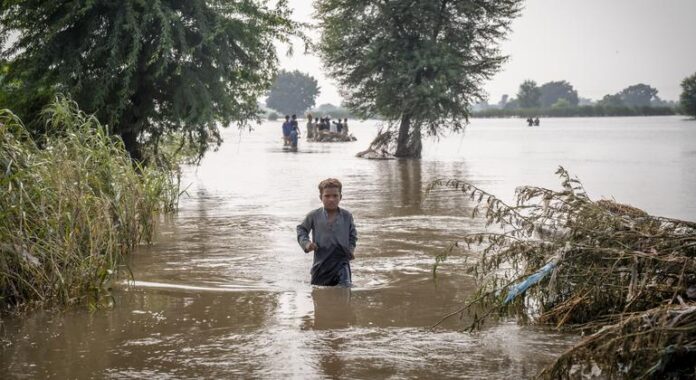
More than six million people have been affected since the unusually heavy monsoon rains began in late June, with nearly 1,000 lives lost – 250 of them children.
Around 2.5 million people have been displaced, many sheltering in Government-run camps or with host families who are already stretched to their limit.
“From the field, we are only seeing the tip of the iceberg,” Carlos Geha, head of the UN aid coordination office (OCHA) in Pakistan told UN News from Islamabad.
He added that many displaced families have yet to return home and may find their houses and livelihoods wiped out when water levels finally recede.
Pakistan’s breadbasket underwater
Exacerbating the monsoon deluge, riverine flooding has inundated large parts of Punjab province – Pakistan’s food basket – where over 4.7 million people have been impacted after India released water from upstream dams, leading to rivers bursting their banks.
Indian authorities had informed Pakistan ahead of the release, which was triggered by massive rains that caused rivers in northern India to overflow.
In Khyber Pakhtunkhwa, 1.6 million people have been affected, while flash floods triggered by glacial lake overflows have devastated parts of Gilgit-Baltistan, cutting off entire valleys. Sindh province remains on high alert for potential “super floods.”
“The Government has done a tremendous job evacuating 2.5 million people, something we did not see in 2022,” said Mr. Geha, recalling the devastating floods that killed over 1,700 people and caused an estimated $40 billion in economic losses.
“But when water levels reach 25 feet, swallowing whole villages, there is little anyone can do.”
Aerial view showing the devastation caused by the floods in Jhang District in Punjab – Pakistan’s most populous province.
Crops gone, infrastructure lost
The National Disaster Management Authority (NDMA) reports that more than 8,400 houses, 239 bridges and nearly 700 kilometres of roads have been damaged or destroyed.
Over 2.2 million hectares of cropland – much of it in Punjab – lie under water, wiping out harvests and pushing food prices higher. Wheat flour prices alone rose 25 percent in the first week of September.
“These are farming families who feed the nation,” Mr. Geha said. “Now their land is submerged, their animals are gone, and they are left with nothing.”
Relief efforts under strain
The UN and its partners are struggling to match the scale of the disaster. OCHA has released $5 million from the UN’s Central Emergency Response Fund (CERF), with an additional $1.5 million channeled to local NGOs.
UNICEF, WFP and other agencies are trucking safe water, providing health and nutrition supplies, and setting up temporary learning centers for children.
Yet aid workers warn that this is far from enough. Many communities remain cut off by collapsed bridges and submerged roads, with food and medicines reaching them only by boat or helicopter.
Waterborne diseases such as malaria and dengue are already on the rise, with fears of cholera outbreaks in the weeks ahead.
“The immediate needs are food, healthcare, shelter, water and sanitation,” said Mr. Geha. “But the next phase will be even more difficult – helping millions of people stand back on their feet after losing everything.”
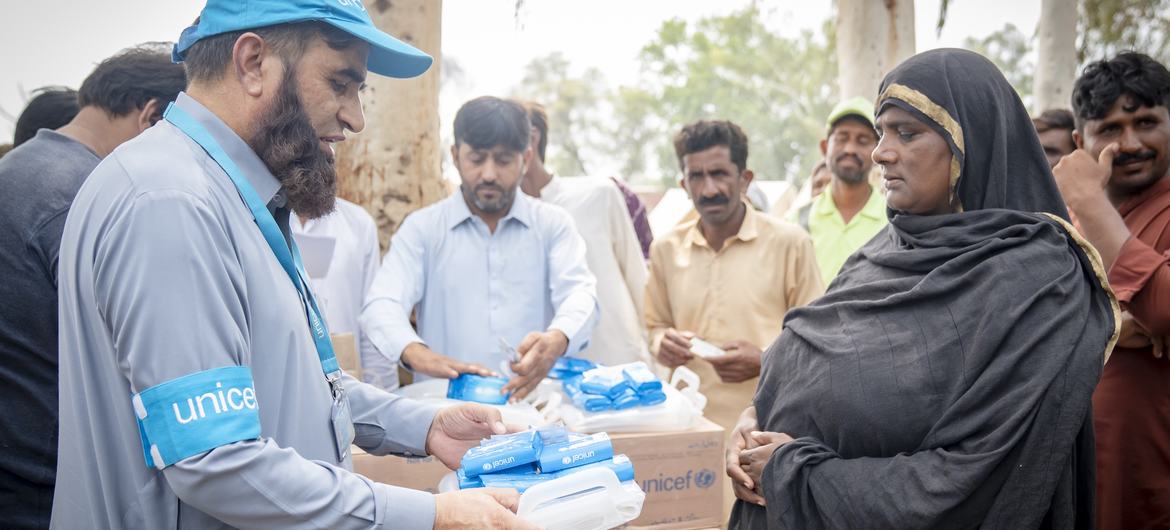
A UNICEF staff member distributes hygiene kits and water purification tablets to flood affected families in Jhang district, Punjab.
A call for solidarity
Pakistan has endured repeated climate disasters in recent years, from the record-breaking 2022 floods to heatwaves and drought. Humanitarians warn that each shock pushes already vulnerable families further into poverty.
“This is not Pakistan’s fault – it is one of the countries most exposed to climate change,” Mr. Geha emphasised.
“The international community must stand with Pakistan not just in this emergency, but in helping to rebuild resilience and restore livelihoods for the long term.”
Venezuelan migrants stimulate economic gains in equator but face persistent vulnerabilities

“” The evidence is clear: when migrants have access to rights and opportunities, they considerably contribute to the companies that house them,“Said Kristina Mejo, the head of the agency in Ecuador.
The Venezuelans currently have around 441,000 in Ecuador, households paying nearly $ 47 million in taxes per year.
Their contributions have been activated by public policies that have rationalized the documentation processes, expanded access to formal jobs, social security and financial services and recognized academic diplomas.
These steps have strengthened productivity while helping to integrate migrants into the system.
Barriers and inequalities
However, despite these gains, significant challenges remain.
Most Venezuelans are young – more than 70% are between 18 and 39 – but about two -thirds operate in the informal sector. Only 30% is used in their field of expertise.
Women, in particular, face even more steep obstacles: almost 70% work informally and many earn below the minimum wage.
Migration and sending of funds in the world
The study comes while sending global funds – money returned to his house by migrant workers – continue to increase.
IomThe 2024 global migration report shows that transfers from $ 128 billion in 2000 to 831 billion dollars in 2022, highlighting the growing economic weight of migration.
High income countries, led by the United States, are the main sources. In 2022, the United States alone sent $ 79 billion abroad, supporting families and strengthening global financial ties.
Similarly, migrants to Saudi Arabia returned $ 39.4 billion, followed by those in Switzerland ($ 31.9 billion) and Germany (25.6 billion dollars).
India, Mexico, China, the Philippines and Egypt were (in decreasing order) the five main recipient countries of funds, with India well above the others.
Interior funds to India exceeded $ 111 billion, the first country to reach and even exceed $ 100 billion.
Originally published at Almouwatin.com
Heal the ozone layer: “guided by science, united in action”
The last century, scientists confirmed the alarming reality of significant depletion in the ozone layer – an invisible gas shield that surrounds the earth and protects it from the UV rays of the sun.
The collection of substances depleting ozone included CFC, or chlorofluorocarbons, which in the mid -1980s were commonly found in everyday products such as air conditioners, refrigerators and aerosol cans.
Science has led to global action. Realizing that harmful UV radiation led into the atmosphere through what was potentially a damaged ozone layer, the countries were committed under the Vienna Convention in 1985, to do what was necessary for the protection of the people and the planet.
“” The Vienna Convention and its Montreal Protocol have become a benchmark for multilateral success“Said the UN secretary general António Guterres in a message for World Ozone Day this year.
“Today, the ozone layer heals,” he said.
What is the Vienna Convention?
Forty years ago, the countries met to take the first step in protecting the ozone layer, “guided by science, united in action,” continued the UN chief.
THE Vienna Convention For the protection of the ozone layer, adopted and signed by 28 countries on March 22, 1985, formalizes universal cooperation on the protection of the fragile layer of ozone.
It is the first treaty to be signed by all countries of the world and the precursor of the Montreal Protocol.
The objective of the Montreal Protocol is to monitor the world’s production and consumption of substances that exhaust the ozone layer – and ultimately eliminate them.
Multilateralism at its best
In a video messageInger Andersen, Executive Director of the United Nations Environment Program (Dive), stressed that through action under conventions, “exhausting ozone substances have now been practically eradicated and the hole in the ozone layer is closed.”
After scientists sounded the alarm, countries, nations and businesses met and took measures for the planet.
” It is multilateralism to its very, better“, She added.
The Montreal Protocol progresses well in developed and developing countries with most elimination hours – the time given for each country to gradually stop the production of harmful substances – adhered or even exceeded.
“” This achievement reminds us that when the nations take into account the warnings of science, progress is possible“Said Mr. Guterres.
Following online, the Kigali amendment
In his message, Mr. Guterres urged governments to ratify and implement the Kigali amendment to the Montreal Protocol, which undertakes to reduce or reduce hydrofluorocarbons (HFC), greenhouse gases used mainly in cooling technologies.
“The implementation of the Kigali amendment could avoid up to 0.5 degrees Celsius of warming by the end of the century,” he said. “Combined with energy -efficient cooling, we could double these gains. »»
As indicated in the Paris AgreementCountries have agreed to try to limit the increase in global temperature to 1.5 degrees Celsius.
“On this World Ozone Day, recommend preserving our ozone layer and protecting people and the planet for future generations,” said the UN chief.
Originally published at Almouwatin.com
Before the week of the General Assembly with high issues, Guterres urges world leaders to “become serious – and to deliver”

Speaking on Tuesday at a press conference at the United Nations headquarters in New York, he warned that global divisions, conflicts and crises have left the very principle of international cooperation to its most fragile point in decades.
“Some call it the diplomacy World Cup,” said Guterres.
” But It is not a question of scoring points – it must be a question of solving problems. There is too much at stake.“”
Drifting in unexplored waters
The United Nations has described a world drifting in “turbulent and unexplored waters”, listing the widening of geopolitical divisions, climate climate change, gap technologies and the increase in inequalities, such as challenges that require urgent solutions.
“” International cooperation is handed under the invisible pressure of our life,He said.
Nearly 150 heads of state and government are expected in New York next week, alongside thousands of civil servants and diplomats.
Mr. Guterres said that he would personally hold more than 150 bilateral meetings, pressing managers “to speak directly, to fold the divisions, reduce risks, find solutions”.
The key themes of the chef’s UN
The secretary general underlined peace, climate, responsible innovation, gender equality, development of development and UN reform as central themes of the week.
He called for urgent stages to end wars in Gaza, Ukraine, Sudan and beyond, and reiterated the need for “just and lasting peace in the Middle East on the basis of a two-state solution”.
On the climate, he urged countries to advance stronger national plans to maintain global warming below the 1.5 ° C threshold envisaged in the 2015 benchmark Paris Agreement On climate change – which seems more and more out of reach.
He also announced the launch of a global dialogue on AI governance to ensure that technology is developing with advantages to humanity “at the center”.
More “posture and promises”
The week will also feature a very first biennial summit bringing together international financial institutions and world leaders to advance commitments on the financing of Sustainable development objectives (ODD) – which are seriously off track – as well as the commemorations of the 30th anniversary of the Beijing historical conference on gender equality.
“” The list is long because the needs are excellent,“Said Mr. Guterres, adding that current world crises do not ask for” posture and promises “but that leadership that is committed to making concrete progress.
He concluded with a frank call: “The United Nations is the place. Next week is the time. Managers must become serious – and deliver.“”
Originally published at Almouwatin.com
