Thursday, April 9, 2026
Home Blog Page 229

The Head of the Rights of the United Nations denounces the “glorification of violence” and the attack on the rule of law

0

“No one is safe when human rights are attacked,” said Türk Human Rights CouncilWarning that the The rules of war “are shredded”.

“Some states become an extension of the personal power of their manager,” he insisted.

In his customary speech at the top of the United Nations Forum at the start of a new session in Geneva, the High Commissioner for Human Rights died that “pro-war propaganda is everywhere”, from military parades to “rampant rhetorical” of leaders.

“Unfortunately, there are no peace parades or ministries of peaceHe said, while calling on countries to remain firmly against the growing “erosion” of international law.

The High Commissioner also defended the importance of held behind multilateral agreements such as “the foundation of peace, our world order and our daily life, from global Internet trade rules to our fundamental rights”.

Risk World Order

Today, the governments “do not take into account, lack respect and disengagement” of the World Order based on the rules which was established after 1945 to prevent another world war, insisted the head of the rights of the United Nations, in a call to responsibility.

The danger is that when states ignore the violations of the law, “They become standardized”, Mr. Türk said. “When states apply the law inconsistently, they undermine the legal order everywhere. It is time for states to wake up and act. »»

Condemning the continuous illegal detention of United Nations staff in Yemen as a “direct attack on the United Nations system”, Türk also called the withdrawal of the United States “from the Paris Agreement And global bodies, including this council … deeply regrettable “, noting that other states are following the plunge.

The High Commissioner also warned of the negative consequences of the decision of Estonia, Finland, Latvia, Lithuania and Poland to leave the Ottowa Treaty on Land Mines, while identifying the “new trend of unsubscribe” 2030 agenda For sustainable development, which all countries had accepted a decade ago.

The Human Rights Council meets in three sessions scheduled each year in the UN Geneva.

A A TO Z of rights concerns

As usual at the beginning of the council sessions, the High Commissioner underlined the concerns of concern in the world, of Afghanistan-where “the erasure” of women and girls of public life “is almost complete”-in Haiti who “plunges more deeply into anarchy; Nigeria, who sees a resurgence of Boko Haram extremism; and Syria – whose transition to peace remains “fragile”.

In Ukraine, following the biggest conflict drone assault, Russia’s large -scale invasion “has become even more deadly”.

In Sudan, El Fasher besieged is under constant bombing and the risk of new atrocities remains, said Türk, while in Myanmar, four years since the military coup, people have been taken in “a heartbreaking calamity of human rights”.

Turning to the eastern Democratic Republic of Congo, the “overwhelming evidence” indicate that all the parties to the conflict have continued, while Gaza is now a “civil”, in the middle of the “massage” of Israel of Palestinian civilians.

Where are the steps to stop the Gaza genocide?

“” We fail the inhabitants of Gaza … Where are the decisive stages to prevent the genocide? »» He asked. “Why don’t countries do more to avoid crimes of atrocity?” They must stop the flow towards Israel of weapons which risk violating the laws of war. ”

Continuing his Overview Situations from worrying countries in addition to thematic issues, Mr. Türk argued that the progress sought by his office, OhchrTo protect the rights of uud and other Muslim minorities in China, has not yet materialized. “

In West Africa, on the other hand, restrictions on LGBTQ + persons develop in certain countries considering the crime of consensual homosexual relations, said the high-commissioner, as well as the rights of migrants and refugees are increasingly raped.

Asylum alert

“Iran and Pakistan have forcibly returned millions of Afghans to their country and India has also expelled groups of Rohingya Muslims by land and sea,” he insisted.

Likewise, Germany, Greece, Hungary and other European countries “have also sought to limit the right to request asylum,” insisted Mr. Türk. He took note of the concerns about the reported agreement of the United States with El Salvador, South Sudan, Eswatini, Rwanda and others, to expel nationals from third countries and underlined Kuwait’s decision to revoke citizenship for thousands of people in recent years, “leaving many stateless persons.”

School call

In the imminent national elections across Africa, Türk also cited serious concerns concerning survey preparations in Cameroon, Côte d’Ivoire, Guinea, Guinea Bissau, Malawi, Tanzania and Uganda.

“In many of these countries, the authorities resort to harassment, exclusion or detention of opposition leaders; Restrictions on media freedom; prohibit peaceful demonstrations; And repression against human rights defenders, “he said.

The head of the Rights of the United Nations also urged the Ethiopian authorities to guarantee free, fair and inclusive conditions, in the midst of concerns about the arbitrary detentions of journalists.

As part of the UN efforts to improve and promote human rights everywhere, Mr. Türk has urged all countries to do more so that “every child – whether it is a future farmer, a digital worker, a doctor or a merchant” understands that human rights “are our unique right”.

He added: “The vast majority of people around the world cry for human rights and freedoms …No one is safe when human rights are attacked. The abuses committed against a group are still part of a broader oppression scheme and lead to the broader erosion of fundamental freedoms ”.

Originally published at Almouwatin.com

Delivery Route Planning Software: Transforming Logistics Efficiency

0


In today’s fast-moving digital economy, logistics operations are under tremendous pressure to deliver faster, smarter, and at lower

Source link

Press remarks by President António Costa following the meeting with Prime Minister of Finland, Petteri Orpo

0
Press remarks by President António Costa following the meeting with Prime Minister of Finland, Petteri Orpo

Press remarks by President António Costa following the meeting with Prime Minister of Finland, Petteri Orpo

Source link

Window to prevent famine spreading in Gaza is ‘closing fast’, UN warns

0
Window to prevent famine spreading in Gaza is ‘closing fast’, UN warns

Tom Fletcher’s statement amid what he described as “a massive military offensive” by Israeli forces against Palestinians in Gaza City, and the failure of ceasefire negotiations with Hamas militants.

By the end of September famine will likely have spread into Deir al Balah and Khan Younis, he said, unless there is a huge influx of humanitarian aid: “Death, destruction, starvation and displacement of Palestinian civilians are the result of choices that defy international law and ignore the international community.”

The horror can be stopped, he continued, if aid is allowed in at scale.

Mr. Fletcher called again for an immediate ceasefire, the protection of civilians, the release of all hostages held inside Gaza by Hamas and other militants and the release of arbitrarily detained Palestinians.

He also insisted on the implementation of the International Court of Justice’s (ICJ) provisional measures which call for prevention of genocidal acts and the immediate and effective delivery of urgent basic services to Gaza’s civilian population.

No money, nowhere to go

Ahead of a second airstrike on a Gaza City high rise apartment block on Saturday in as many days which Israeli forces claimed was being used by Hamas – which the militant group denied – Israel reportedly dropped leaflets warning residents to relocate to the south.

UN News’s correspondent spoke to families trying to survive in the city amid Israel’s ongoing offensive, who are facing an impossible choice over staying or fleeing.

Abu Amer Al-Sharif, A Palestinian in Gaza City.

Abu Amer al-Sharif said, “we are at a loss,” sitting in front of what remains of his house in the city that used to be home to over one million people.

They had salvaged some belongings – but moving again seemed a daunting task.

“You know the financial burden, including transportation costs and rent for new housing. There are no salaries from the authorities and people have no income. Families are required to pay thousands of dollars for the places they move to, in addition to transportation costs. On top of that, our property is damaged,” Abu Amer said.

‘I live on the rubble’

In the same neighborhood, Hossam Madi stands amid the rubble of his home, breaking up furniture to sell as firewood.

We don’t have enough money to move to the southern Gaza Strip,” he said bluntly.

Hossam Madi, a resident of Sheikh Radwan in northern Gaza City removes some of his belongings from his destroyed home.

Hossam Madi, a resident of Sheikh Radwan in northern Gaza City removes some of his belongings from his destroyed home.

“I break wood to sell it to buy a kilo of flour for breakfast or lunch. We have nothing. Look at our house, look what happened to it. I am living on the rubble, and now I will take my things and move to western Gaza.”

Saqr Abu Sultan said he wasn’t sure where they were headed, loading his family’s belongings onto a three-wheeled cart in preparation for leaving the Sheikh Radwan neighborhood.

The situation is chaotic now. We’re trying to evacuate, but we don’t know where to go, despite the constant talk of safe areas,” he said.

Abu Amer Al-Sharif and his family in Gaza City remove their belongings and household items from their home, preparing for yet another displacement..

Abu Amer Al-Sharif and his family in Gaza City remove their belongings and household items from their home, preparing for yet another displacement..

Source link

UN provides urgent support after ‘massive’ Russian attack across Ukraine

0
SECURITY COUNCIL LIVE: Push for peace in Ukraine could rapidly fade if large-scale Russian attacks continue

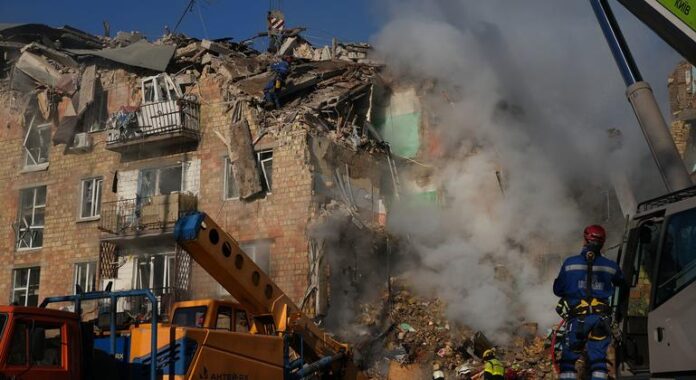
More than 800 drones were launched in waves designed to overwhelm Ukrainian air defences, according to news reports, and a Government building was hit in the capital Kyiv for the first time.

Ukrainian authorities reported that four had been killed, with 44 injured. Air-raid sirens continued for 11 hours straight across the capital and although a majority were shot down more than 50 drones and nine missiles hit their targets.

“Yet again, attacks impacted homes, a government building, a kindergarten and other civilian infrastructure in Kyiv and Chernihiv, Kharkiv, Kremenchuk, Kryvyi Rih, Odesa, Sumy region, Zaporizhzhia – leaving behind loss, destruction and grief,” said UN Humanitarian Coordinator for Ukraine, Matthias Schmale, in a post on social media.

The top aid official said that together with authorities, the UN and humanitarian partners had mobilised to provide urgent support to civilians and civilian areas where damage was sustained.

Civilians should never be a target

“Civilians and civilian infrastructure are protected under international humanitarian law – they are not a target,” he continued.

The UN Children’s Fund, UNICEF, said that the news of a baby being killed along with their young mother in an attack on an apartment building in Kyiv was “devastating”. At least one other child was injured during the attacks on Sumy.

“Ukraine endured another terrifying night of attacks that impacted multiple cities. More young lives brutally cut short,” the agency tweeted.

The attacks came following weeks of high profile diplomacy from Western allies of the Ukrainian Government to broker a lasting peace deal between Kyiv and Moscow.

President Volodymyr Zelenskyy said in a social media post following the attacks that “such killings now, when real diplomacy could have already begun long ago, are a deliberate crime and a prolongation of the war.”

Source link

Local leaders feed the climatic ambitions of Indonesia

0

The national climate strategy of Indonesia aims to make net-zero emissions by 2060. A key element of this strategy is to absorb 140 million tonnes of CO₂, equivalent to removing 30 million out of the road.

Riau’s contribution to this objective is essential.

The province has historically faced some of the highest levels of deforestation and land degradation, largely due to the drainage of peat bogs, fires and the rapid conversion of land use in agriculture.

Green for Riau

Launched earlier this year, the Green for Riau initiative transforms the implementation of forest climatic solutions to these challenges.

“Economic and climatic objectives can coexist a lot,” said Abdul Wahid, governor of Riau. “This is what our program is talking about. We are proud to show the way by showing that local action can provide world results. ”

The new initiative, a collaboration between the Government of Indonesia, the United Nations environmental program (Dive) and the organization of food and agriculture (Fao), with the support of the United Kingdom, already finds local solutions to global problems.

Indonesia is home to large tropical forests.

Local leadership is essential

Local leadership is essential to carry out the Sustainable development objectives (ODD). While national governments adopt legislation and set up the political framework, the implementation of these policies is the responsibility of local authorities who lead the transition to a green economy.

Almost half of the seven million riau residents live in rural areas, many of whom depend on the forests for their livelihoods. The initiative supports these communities through sustainable agroforestry, ecotourism and unleashed forest products, ensuring that conservation efforts go hand in hand with economic development.

“By aligning provincial action on the national climatic objectives, Riau shows how sustainable development objectives can be achieved from zero,” said Gita Sabharwal, resident coordinator of the UN for Indonesia, when she returned from Riau last month. “This shows how local leadership can stimulate the national and global impact.”

Reduction of emission discounts

At the heart of the transformation is the REDD +mechanism, which means reducing the emissions of deforestation and the degradation of forests.

The mechanism supports and rewards the measurable discounts of emissions. Riau, with almost five million hectares of peat bogs rich in carbon, is about to become the first province of Indonesia to access Redd + Finance.

The approach also consists in marrying technology with consent and customary knowledge. International organizations calculate carbon credits using artificial intelligence tools (AI), satellite imaging, field verification and carbon forecasts, in accordance with Global Redd +directives.

The meeting of generations of local wisdom

Beyond forest surveillance, AI can generate robust data necessary to unlock climate financing, supporting emissions monitoring, verification and sharing of benefits.

You cannot fully depend on the AI ​​for environmental decision -making; He must take into account traditional practices developed from the observation of nature for generations

However, the effectiveness of these new technologies, in particular in environmental decision -making, depends on the knowledge included as a starter.

To be transformers, AI systems must be designed to respect, integrate and learn customary knowledge systems.

“You cannot fully depend on the AI ​​for environmental decision -making,” said Datuk H. Marjohan Yusuf, president of the council of the Coutumier Malaysi de Riau Institute.

“He must take into account Adat, Or local wisdom, traditional practices have developed and learned from nature observation for generations. »»

During the launch of Green for Riau, customary communities signed a joint declaration, aligning national legal frameworks and policies which recognize and strengthen the rights and roles of customary communities in matters of forest protection.

This commitment will guide the development of guarantees and the distribution of advantages in accordance with the information system for social guarantees of Indonesia in accordance with national and international standards.

“This project not only protects forests; It also empowers communities, ”said Marlene Nilsson, assistant director of the UNEP in Asia-Pacific. “Riau leadership is a model to manage climate action while supporting livelihoods and biodiversity.”

Green Riau is a joint effort with Indonesia, local leaders and United Nations agencies to protect forests and advance climatic objectives.

Inclusive climate financing model

With the support of the United Nations and the participation of the community, new diagrams under REDD + offer incentives to local populations to safeguard rather than exploit forests. This also strengthens the governance of land use and implements financial executives to attract public and private investments in forests.

The advantages go beyond carbon. Riau is home to emblematic and threatened species such as the Orang-Outan Sumatra, the Tiger and the Elephant. The protection of these habitats saves biodiversity and improves climate resilience.

The initiative pilots payments based on REDD + results at the provincial level, providing an evolutionary model for inclusive and high integrity forest financing. This will be done thanks to the facilitation by REDD of mutual recognition agreements between the government and the international carbon credits programs.

The forest transition could unlock millions

These efforts could unlock hundreds of millions of dollars a year in carbon financing and develop an investment pipeline, creating a sustainable financing flow for conservation and development.

“Riau becomes the first Indonesian province to adopt global standards for sustainable forest management,” said Sabharwal. “This daring step will unlock high integrity, results -based payments and show how global standards can result in sustainable and inclusive growth.”

During the Redd + 2025 investment round table in London, global investors expressed a strong interest in supporting the riau forest transition, said Ms. Nilsson, providing an example for other jurisdictions in Indonesia and beyond.

“The interest of funders indicates that climatic solutions anchored in local leadership and customary knowledge is not only, but viable,” she said.

Originally published at Almouwatin.com
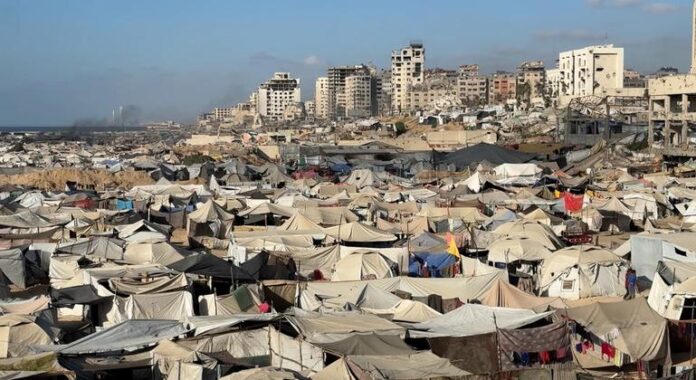
The window to prevent the propagation of famine in Gaza is “ firm quickly ”, warns the UN

0

Tom Fletcher’s statement in the midst of what he described as “a massive military offensive” by Israeli forces against the Palestinians of Gaza City, and the failure of cease-fire negotiations with Hamas activists.

At the end of September, famine will probably have spread to Deir Al Balah and Khan Younis, he said, unless there is a huge influx of humanitarian aid: “Death, destruction, famine and displacement of Palestinian civilians are the result of choice that challenge international law and ignore the international community. “”

Horror can be stopped, he continued, if the aid is authorized on a large scale.

Mr. Fletcher again called for an immediate cease-fire, the protection of civilians, the release of all the hostages held inside Gaza by Hamas and other activists and the release of arbitrarily detained Palestinians.

He also insisted on the implementation of International Court of Justice‘s (Icj)) Provisional measures that call for the prevention of genocidal acts and the immediate and effective service of urgent basic services to the civilian population of Gaza.

No money, nowhere where to go

Before a second air strike on a building of Gaza City high -rise apartments on Saturday in as many days which, according to Israeli forces, were used by Hamas – which the militant group denied – Israel would have dropped leaflets warning residents to move to the South.

UN news The correspondent spoke to families trying to survive in the city in the middle of the current offensive of Israel, which faces an impossible choice to stay or flee.

Abu Amer Al-Sharif, a Palestinian in Gaza City.

Abu Amer Al-Sharif said: “We are lost”, seated in front of what remains of his house in the city which housed more than a million people.

They had recovered certain personal effects – but to move again seemed an intimidating task.

“You know the financial burden, including transport costs and rent for new housing. There is no salary by the authorities and people have no income. Families have to pay thousands of dollars for places they move, in addition to transport costs. In addition to that, our goods are damaged, “said Abu Amer.

‘I live on the rubble’

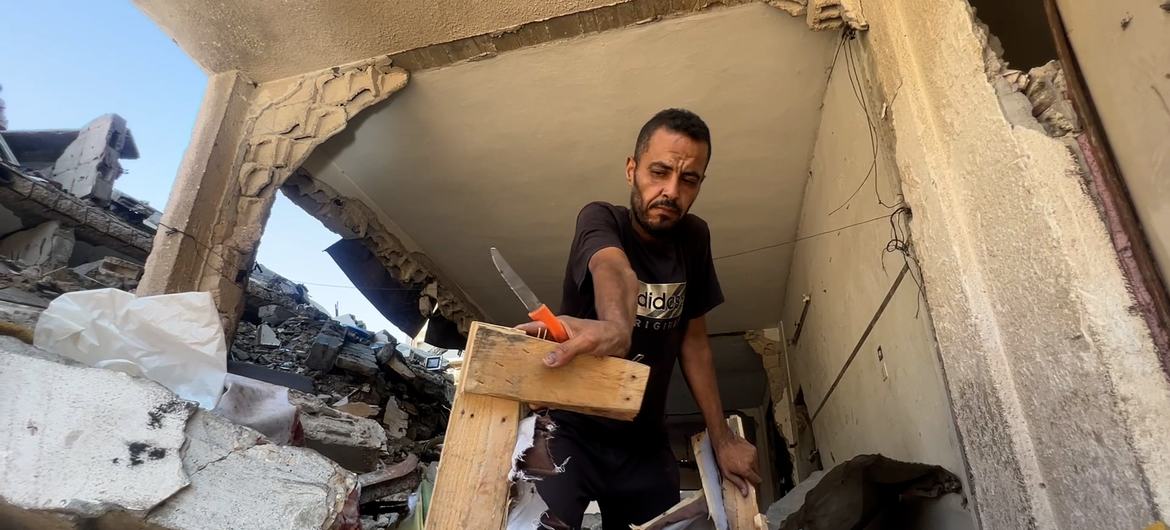
In the same district, Hossam Madi is held in the middle of the rubble of his house, breaking furniture to sell in firewood.

“” We don’t have enough money to move to the South Gaza Strip“He said bluntly.

Hospals Madi, a resident of Sheikh Radwan, northern Gaza City, removes some of his personal effects from his destroyed house.

“I break wood to sell it to buy a kilo of flour for breakfast or lunch. We have nothing. Look at our house, look at what happened to him. I live on the rubble, and now I will take my things and move to Western Gaza. »»

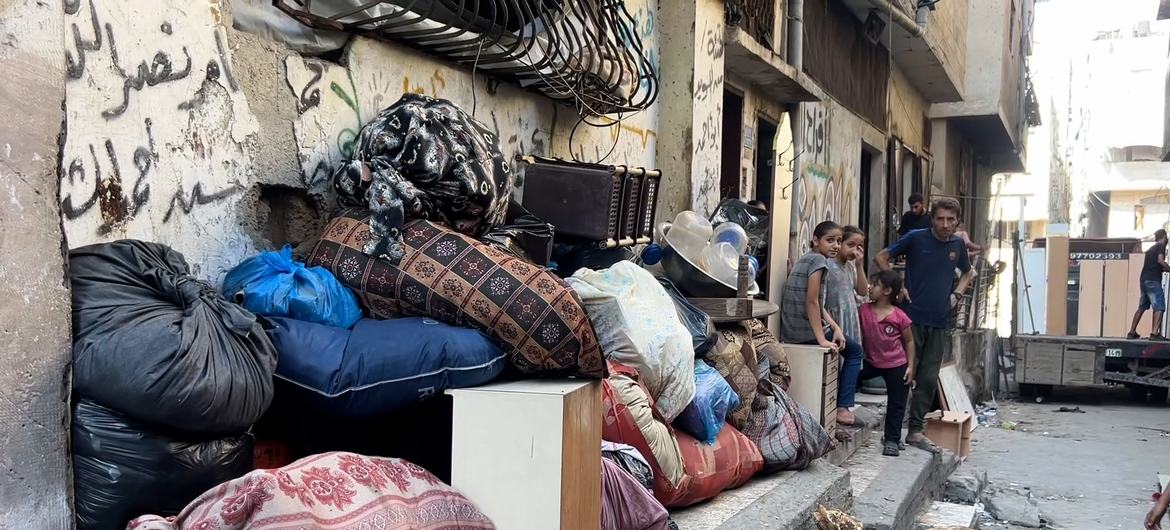
Saqr Abu Sultan said he was not sure where they were heading, loading his family’s affairs on a three -wheeled cart in preparation to leave the Sheikh Radwan district.

“” The situation is chaotic now. We try to evacuate, but we do not know where to go, despite the constant speech of the safe areas“He said.

Abu Amer Al-Sharif and his family from Gaza City withdraw their household belongings and articles from their house, preparing for another trip.

Originally published at Almouwatin.com
The UN is a “remarkable example” of Papua Nouvelle-Guinée while it concludes a historical journey

0

Flanked by the Prime Minister of the country, James Marape, Mr. Guterres echoes comments He delivered Wednesday during a speech in the National Parliament, in which he described the Papua New Guinea as “champions of multilateralism and international solutions”.

The secretary general noted that, in a world where “we see democratic values ​​called into question”, the country – where 800 languages ​​are spoken – retains a preference to solve problems peacefully through dialogue.

Ryan Hawk / Woodland Park Zoo

The tropical forest of Papua-Nouvelle-Guinea (file)

Time for climate justice …

The climate crisis was raised on the agenda throughout the visit, Mr. Guterres leaving the capital to visit a region of the tropical forest and discuss the problems caused by the evolution of the climate with the representatives of civil society.

Addressing the media at Port Moresby, the UN chief expressed his gratitude and solidarity with the Papua New Guinea, for how they take up an existential challenge and not of their own manufacture.

“Papua New Guinea does not contribute to climate change,” he said. “Papua New Guinea has a record for negative emissions, due to a huge carbon well: the admirable forests of this country and the ocean.”

He said it was time for the international community to recognize that countries like Papua New Guinea deserve climate justice and support to strengthen resilience against “the devastating impact of climate change”.

The conservationist Papuan Alfred Masul is replanting mangroves to strengthen resilience against climate change (file)

… and economic justice

The country’s ability to adapt to the increasingly volatile climate and to develop its economy is also hampered, said Mr. Guterres, by his designation as an intermediate income country – which means that he does not have access to the types of concessional funding, such as subsidies, low interest loans and debt relief, which are available for low -income nations.

This, he said, is “an injustice that must be corrected”.

According to the secretary general, part of the question is the obsolete nature of international financial architecture (a recurring theme during his mandate). The institutions created over 75 years ago must be reformed “so that developing countries like Papua New Guinea have a much stronger voice and much stronger influence in the way decisions are taken,” he said, “and much higher access to resources that are essential for the development of the country”.

Originally published at Almouwatin.com
Global Human Rights Sanctions Regime: Council imposes sanctions on two individuals over abuses in detention centres in Crimea

0
Press remarks by President António Costa following the meeting with Prime Minister of Finland, Petteri Orpo

The Council imposed additional restrictive measures against two persons under the European Union’s Global Human Rights Sanctions Regime, in relation to abuses that occurred in detention centres in Crimea.

Source link

Will offshore wind energy affect ocean productivity?

0

A major new campaign is underway off the northeast coast of Scotland this summer to see if the Source link

Source

Source link