Sunday, May 3, 2026
Home Blog Page 428

Roxana Mînzatu, European Commission Executive Vice-President for Social Rights and Skills, Quality Jobs and Preparedness, visits the ECCC on Europe Day

0
Roxana Mînzatu, European Commission Executive Vice-President for Social Rights and Skills, Quality Jobs and Preparedness, visits the ECCC on Europe Day

Today, when we celebrate Europe Day, the Executive Vice-President for Social Rights and Skills, Quality Jobs and Preparedness, Ms. Roxana Mînzatu visited the ECCC premises in Bucharest, Romania.

During her visit, Executive Vice-President Mînzatu met the ECCC staff and found out more about the activities and mandate of the Centre as engine for the implementation of Europe’s strategy in research, innovation, and industrial policy in the area of cybersecurity. Discussions focused also on the Centre’s role in supporting cyber skills identified as a priority in the ECCC Strategic Agenda, including through the activity of the ECCC Governing Board Working Group on Cyber Skills. 

The visit of Executive Vice-President Mînzatu followed a debate organized by the Romanian Presidency that brought together students and teenagers from Romanian Universities and High Schools to discuss the significance of the European Union for Romania, in which both the Executive Vice-President and ECCC Executive Director Mr. Luca Tagliaretti took part.

Executive Vice-President Ms. Roxana Mînzatu highlighted “The ECCC is at the heart of Europe’s cybersecurity resilience—securing AI, scaling quantum readiness, and providing cyber skills at a time when they are needed most. Its work strengthens not just Romania, but the entire Eastern flank of our Union. We stand fully committed to its mission.”

ECCC Executive Director Mr. Luca Tagliaretti said: “It is a privilege to receive the visit of the EVP Roxana Mînzatu at the ECCC on this special day for Europe and discuss how we can contribute to her important and challenging mandate to close the skill gap in Europe. The ECCC is ready to support cybersecurity skills and competences, promoting also STEM education and women in cyber.”

Contact for media:  communicationeccc [dot] europa [dot] eu (communication[at]eccc[dot]europa[dot]eu)

Source link

Cardinal Jozef De Kesel’s Journey in Faith and Dialogue

0
Cardinal Jozef De Kesel’s Journey in Faith and Dialogue

Born on a humid June morning in 1947 in the Belgian city of Ghent, Jozef De Kesel was the sixth of eleven children in a family whose roots intertwined faith and service. His father, a modest civil servant, and his mother, a devoted homemaker, fostered in him an early curiosity about the tapestry of human belief. By age eighteen, he had already answered what he later described as “an inner summons,” entering the diocesan seminary of Saint-Paul in Ghent to study philosophy and theology.

After three formative years at the Catholic University of Leuven, De Kesel carried his questions to Rome’s Pontifical Gregorian University. There he immersed himself in Scripture and patristic studies, and in 1977 completed a doctorate with a dissertation on Rudolf Bultmann’s existential hermeneutics, exploring how modern readers might encounter the New Testament’s message without reducing it to mere myth.

It was during those Roman years that he adopted his episcopal motto, Vobiscum Christianus—“With you, a Christian”—a succinct articulation of his belief that the essence of Christianity is presence and solidarity with every person, regardless of background or belief.

Ordained to the priesthood on August 26, 1972, by his uncle, Bishop Leo-Karel De Kesel of Ghent, he returned home with youthful zeal. His first assignments combined parish work with teaching catechesis to young adults, experiences that convinced him that effective ministry required both doctrinal clarity and genuine personal encounter.

Soon the classroom beckoned. From 1980 to 1996, De Kesel taught fundamental and dogmatic theology at the Major Seminary of Ghent, later serving as dean of the Higher Institute of Religious Sciences. Students recall his lectures for weaving rigorous scholarship with an abiding respect for questions that resisted easy answers, cultivating in him a conviction that faith must be both critical and compassionate.

On March 20, 2002, Pope John Paul II appointed him Titular Bishop of Bulna and auxiliary of the Archdiocese of Mechelen-Brussels. Consecrated on May 26 by Cardinal Godfried Danneels, he assumed oversight of liturgy and catechesis in one of Europe’s most religiously diverse capitals, learning firsthand the challenges of shepherding both urban parishes and immigrant communities.

In Brussels he represented Belgium on the Commission of the Bishops’ Conferences of the European Community, engaging in discussions on religious freedom, migration policy and the role of faith in public life. These early assignments sharpened his resolve to make dialogue not a sideline but a cornerstone of his ministry.

In 2010 he was named Bishop of Bruges and installed on July 10, where he balanced diocesan governance with a deepening concern for ecumenism. He launched programs bringing Catholic, Protestant and Orthodox youth together for summer camps, convinced that lifelong friendships forged across confessional lines could reshape Belgium’s communal bonds.

In a November 14, 2016 interview with ZENIT, he drew a crucial distinction between secular culture and secularism. He warned that secularism—an ideology intent on sidelining religion—must be resisted, even as secular culture offers a neutral arena where “no tradition claims cultural supremacy.” “The Church must not ‘conquer,’” he said, “but only be present, meeting others without ulterior motives”.

Five years later, on November 6, 2015, Pope Francis tapped him to succeed André-Joseph Léonard as Archbishop of Mechelen-Brussels. Installed before King Philippe on December 12, De Kesel inherited an archdiocese grappling with secularization, migration flows and periodic sectarian tensions, but his appointment signaled a pastoral style both conversational and theologically grounded.

Within weeks of his installation, his fellow bishops elected him president of the Belgian Episcopal Conference, a post he assumed on January 26, 2016, giving him national responsibility for coordinating the Church’s response to shared challenges, from refugee integration to secularism’s rise.

Pope Francis elevated him to the College of Cardinals on November 19, 2016, recognizing him as a trusted interlocutor in Rome and further amplifying his voice on global Church issues . Three years later, on November 11, 2019, Francis named him a member of the Pontifical Council for Culture, entrusting him with dialogue between the Church and contemporary cultures, including other faith traditions.

Very early in his archiepiscopal ministry, on February 1, 2016, the Community of Sant’Egidio brought more than thirty religious and political leaders to Brussels’s Hotel Le Plaza for an Interfaith Harmony Breakfast. Confronting terrorism, migration and youth disengagement, De Kesel urged attendees to reject nihilism and instead “build bridges of understanding,” insisting that faith could flourish only when it met—rather than shunned—difference.

Just nine months later, on December 1, 2016, he joined Jewish and Christian leaders at the sixth annual “Juifs et Chrétiens, engageons-nous !” conference in Brussels’s Great Synagogue. Reflecting on Nostra Aetate’s fiftieth anniversary, he highlighted the shared patrimony of Abraham and called for ever-deeper memory work to heal historical wounds ﹣ a vision warmly received by participants.

Within the Vatican, Pope Francis tapped him for even broader horizons by naming him a member of the Pontifical Council for Culture in November 2019. That dicastery, charged with engaging contemporary cultures and world religions, reflects De Kesel’s lifelong project: to bridge conviction and curiosity, to honor truth while embracing dialogue. His voice there has championed initiatives on art and faith, migration and ecology—fields where secular and sacred concerns inevitably intersect.

In July 2019, New Europe asked him about the Church’s place in modern Europe. He stressed that “it is a pluralistic society, a secular society, where there are also other beliefs,” and insisted that Catholics must work “in solidarity with all who strive for a more just and fraternal society,” defending freedom of religion while “keeping our convictions”.

Perhaps most surprising to many was his willingness to step inside the Church of Scientology’s Brussels center. On February 5, 2020, as the Church of Scientology in Belgium celebrated its forty-sixth anniversary on Boulevard Waterloo, he sent a formal blessing: “I express the hope that your solidarity and help activities in our common home will be successful. May you continue to foster interreligious dialogue, with respect for diversity and otherness in the richness of the encounter.” Four years later, in November 2024, he returned in person to deliver the keynote address “Compassion as a Moral Imperative” at the “Celebration of Kindness and Peace at the Churches of Scientology for Europe” conference, declaring that “faith must serve as a bridge, not a barrier,” and calling all traditions to unite in empathy and understanding.

His partners in dialogue have included Buddhist legal scholar Ines Wouters, who spoke of how interfaith experiences safeguard freedoms and how “transforming yourself may transform the world,” and Swami Bhairavananda Sarasvati, who reminded that intercultural exchange is the only path to lasting peace. Their testimonials, offered in the wake of De Kesel’s addresses, testify to his capacity not merely to convene but to inspire genuine solidarity across creeds.

His interfaith encounters have spanned continents. In June 2024, a Belgian delegation he led under the Ferdinand Verbiest Foundation visited mainland China. From Beijing to Inner Mongolia, he and his companions met Chinese Catholic bishops, seminarians and scholars to “consolidate mutual visits and strengthen cultural exchanges and ecclesial cooperation,” embodying his belief that patient, respectful engagement can flourish even under complex political conditions.

In June 2023, Pope Francis accepted his resignation as Archbishop of Mechelen-Brussels, marking the close of an administrative chapter but not of his vocation. As Cardinal De Kesel, he remains an active presence in episcopal gatherings and scholarly symposia, ever articulate on the need for solidarity amid diversity. Through these gatherings—Sant’Egidio breakfasts, synagogue dialogues, Vatican appointments, blessings to unexpected hosts—Cardinal De Kesel has shown that conviction and conversation need not be adversaries. For him, peace is always, at its heart, personal: the fruit of countless moments of listening before speaking, of solidarity before proselytism.

As he watches a new generation in Belgium navigate religious diversity and secular pressures, he offers a simple counsel: remember history’s lessons, cultivate the spirit, and remain committed to solidarity. In his world, faith is neither barrier nor club but a bridge of compassion—each encounter an opportunity to affirm that the human family is at its best when it listens before it speaks, embraces before it excludes, and seeks unity not in erasure but in empathy.

Source link

Celebrating 75th anniversary of Schuman Declaration

0

This Europe Day marks 75 years since the signing of the Schuman Declaration that laid the foundation of the European Union as we know it today. On 9 May 1950, French Foreign Minister Robert Schuman announced the creation of a European Coal and Steel Community. Discover more. Source link

Source link

Port Sudan: Aid officials call for greater protection as drone attacks continue

0
Port Sudan: Aid officials call for greater protection as drone attacks continue

The escalation is occurring as war grinds on between the Sudanese Armed Forces (SAF) and the paramilitary Rapid Support Forces (RSF), who appear to be targeting airports in each other’s areas of control.

“Very concerned by ongoing drone strikes on Port Sudan,” UN Emergency Relief Coordinator Tom Fletcher tweeted on Wednesday. 

“International humanitarian law must be respected. Constant care must be taken to spare civilians and civilian infrastructure.”

Suffering will worsen

The latest strikes in Port Sudan took place early on Tuesday morning, reportedly targeting the international airport and other infrastructure, including a fuel storage facility and a power transformer. 

The UN Resident and Humanitarian Coordinator in Sudan, Clementine Nkweta-Salami, issued a statement that day, saying the attacks “will deepen humanitarian suffering and needs, as well as exacerbate the already severe access and logistical challenges that humanitarian actors face in the delivery of urgently needed aid to the rest of the country.” 

She underlined that the airport is a “lifeline for humanitarian operations” as it is the primary entry point for aid personnel, medical supplies and other life-saving relief. 

“Moreover, the availability of fuel in Port Sudan is critical to the dispatch of humanitarian supplies to areas across Sudan in dire need of assistance,” she added.

She stressed that damage to critical infrastructure could also disrupt supply chains and increase the price of basic goods, thus worsening what is already the world’s largest humanitarian crisis.

Displacement and aid suspension

Drone attacks have also affected Kassala and River Nile states, according to the UN humanitarian affairs office OCHA.

Earlier this week, strikes near the airport in Kassala displaced about 2,900 people and led to the temporary suspension or relocation of some aid activities.

Meanwhile, River Nile state is still facing a power blackout following a drone strike on the transformer station in Atbara on 25 April. The outage is contributing to growing fuel and bread shortages and long lines at gas stations and bakeries.

Cease hostilities now

Ms. Nkweta-Salami noted that since January, attacks on infrastructure across Sudan, such as power stations, water sub-stations, and oil refineries, have caused widespread electricity outages and disrupted access to essential services, including safe drinking water, healthcare and food supplies. 

These are serious violations of international humanitarian law and “reflect a consistent failure to comply with the principles of distinction, proportionality and precaution,” she said. 

“Every measure must be taken to spare civilians and civilian objects,” she said. “Once again, I call on all those involved in this conflict to cease hostilities.”

Source link

Celebrating 75th anniversary of Schuman Declaration

0
Celebrating 75th anniversary of Schuman Declaration

This Europe Day marks 75 years since the signing of the Schuman Declaration that laid the foundation of the European Union as we know it today. On 9 May 1950, French Foreign Minister Robert Schuman announced the creation of a European Coal and Steel Community. Discover more.

Source link

World News in Brief: South Sudan urged to avoid slide to war, Türk calls on EU not to weaken landmark law, Ukraine and Mali updates

0
World News in Brief: South Sudan urged to avoid slide to war, Türk calls on EU not to weaken landmark law, Ukraine and Mali updates

The Quartet is calling on the country’s leaders to end hostilities and return to dialogue to fully implement the 2018 peace agreement known as the Revitalized Agreement on the Resolution of the Conflict in the Republic of South Sudan (R-ARCSS).

South Sudan, the world’s youngest nation, gained independence in 2011 but soon descended into a brutal civil war. A 2018 peace agreement has held together but now threatens to fully unwind between the president and his vice presidential rival.

Regional pressure

In recent weeks, the Quartet has observed air and ground attacks that have led to loss of life, the destruction of homes, and the displacement of civilians. Humanitarian facilities have also been targeted, while hate speech and ethnic tensions are on the rise.

The Quartet welcomed a recent joint visit by the African Union and IGAD to South Sudan as a sign of regional support for peace. It also called on all sides to cooperate with ceasefire monitors investigating recent violence.

South Sudan’s leaders must commit to inclusive dialogue, the release of political detainees, and renewed efforts to carry out the peace deal, the Quartet stressed.

A return to war would betray the people’s hope for peace and stability, they warned. Only a political solution can ensure free and fair elections at the end of the current transitional period.

UN rights chief urges EU not to weaken landmark corporate responsibility law

UN human rights chief Volker Türk has called on the European Union to protect a key law that holds large companies accountable for human rights and environmental harm.

The EU’s Corporate Sustainability Due Diligence Directive (CSDDD), adopted last year, requires businesses to identify and address any negative impact their activities may have on people or the planet.

But changes now being discussed in Brussels as part of a broader reform package could weaken the law, Mr. Türk warned on Wednesday.

“The CSDDD, by far the most ambitious business and human rights regulatory initiative anywhere in the world, has rightly been welcomed by companies, policy makers, civil society, and national human rights institutions alike,” he said.

“A large number of businesses have already taken steps to ensure they comply with it.”

Detailed review

UN human rights office, OHCHR, has published a detailed review of the EU proposal, pointing to ways it could undermine this groundbreaking directive.

Mr. Türk urged lawmakers to keep the law in line with global standards, such as the UN Guiding Principles on Business and Human Rights.

“While some streamlining… could be advantageous, it would be counterproductive to water down its alignment with international standards,” he said.

April deadliest month for civilians in Ukraine since September

April was the deadliest month for civilians in Ukraine since September 2024, with at least 209 people killed and 1,146 injured, the UN Human Rights Monitoring Mission in Ukraine (HRMMU) reported on Wednesday.

In its monthly update, the Mission said that 97 per cent of casualties occurred in areas controlled by Ukraine, with nearly half caused by missile and loitering munitions attacks by Russian forces.

“Kryvyi Rih, Sumy, Dnipro, Zaporizhzhia, Kyiv, and Kharkiv all endured devastating attacks,” said Danielle Bell, Head of HRMMU. “The sharp rise in casualties was mainly due to the intensified use of ballistic missiles in major cities.”

Among the deadliest incidents:

  • On 4 April, a missile strike on Kryvyi Rih killed 20 civilians and injured 63.
  • On Palm Sunday (13 April), two missiles hit Sumy, killing at least 31 and injuring 105.
  • A 24 April attack on Kyiv killed 11 and injured 81.

Children were especially affected. At least 19 were killed and 78 injured in April – the highest monthly total since June 2022.

The wave of attacks continued into May, with cities including Kharkiv, Odesa and Kyiv again coming under fire.

UN experts raise alarm over Mali’s suspension of political parties

Independent UN human rights experts have strongly criticised Mali’s military authorities for suspending all political parties and activities, calling the move a clear violation of basic rights.

© MINUSMA/Harandane Dicko

A detention centre in Bamako, Mali. (file)

The decision, announced on 7 May via state television, halts political activity “until further notice.” The junta, which took power following coups in 2020 and 2021, said the suspension was necessary to maintain public order.

The three UN Human Rights Council-appointed experts described it as a direct violation of human rights and called for the order’s immediate repeal.

They also called on the National Transitional Council to strike down a bill introduced on 30 April, which repealed legislation governing how political parties operate.

“If passed into law, the 30 April bill will place Mali in contravention of its human rights obligations, notably on freedoms of association and expression,” the experts stressed.”

Protests

In response to the 30 April bill, opposition parties organised a pro-democracy rally in the capital Bamako on 3 May which drew hundreds of demonstrators. The parties reportedly demanded a timeline to end military rule and a return to constitutional order.

Another protest is planned for Friday to oppose the decree against political parties.

The experts said Malian authorities must work to counteract “the current climate of suppression of the civic space”.

“The right to peacefully assembly is essential to the health of a vibrant political community,” the experts said. “The Malian Transitional authorities must scrupulously respect it and abstain from acts of intimidation and repression that risk the physical integrity and the rights of demonstrators.”

Special Rapporteurs and Independent Experts are appointed by the Geneva-based Human Rights Council. They serve in their individual capacity, independent of the UN system and national governments. They are not UN staff and draw no salary

Source link

Port Sudan: No let-up in drone attacks as UN chief urges peace

0
Port Sudan: No let-up in drone attacks as UN chief urges peace

The UN chief warned that any further escalation of the conflict could result in massive civilian casualties and worsen the already catastrophic humanitarian situation across the country.

The expansion of the conflict into an area that has served as a place of refuge for a large number of displaced people is alarming,” he said in a statement issued by his Spokesperson’s office.

Mr. Guterres’s appeal follows days of drone strikes on key infrastructure in Port Sudan that have opened a new front in the fighting between forces of the military government and heavily armed paramilitaries.

The city is a main entry point for relief supplies, hosting airports and direct access to the Red Sea. It is also a shelter for hundreds of thousands of displaced people and the seat of government after generals lost control of the capital Khartoum to the Rapid Support Forces (RSF).

Aid flights suspended

In response to the drone attacks, flights of the UN Humanitarian Air Service (UNHAS) to and from Port Sudan have been suspended since 4 May.

The UN World Food Programme (WFP) which manages the airline said that operations will resume as soon as conditions allow. For the moment, amid reported gun and weapons fire overnight, the insecurity has impacted the movement of aid workers into Sudan and across the country.

A country in flux

Drone strikes have also been reported elsewhere in Sudan, including the states of Kassala and River Nile. In Kassala, strikes near the airport displaced about 2,900 people and led to the temporary suspension or relocation of some aid activities, according to the UN aid coordination office, OCHA.

As of Wednesday evening, River Nile State was still without power following a drone strike on the transformer station in Atbara on 25 April. The outage has contributed to growing fuel and bread shortages and long queues at petrol stations and bakeries.

The situation remains dire across Sudan, the UN chief continued, citing intense attacks on critical infrastructure since January that have hampered people’s access to essential services and left them without food, clean water, healthcare and electricity.

“All parties to the conflict must comply with their obligations under international humanitarian law,” Mr. Guterres insisted. “They must not direct attacks against civilians and civilian objects; must take all feasible precautions to avoid, and in any event to minimize, incidental civilian casualties; and must allow and facilitate rapid and unimpeded passage of humanitarian relief for civilians in need.”

Sudan’s war stems from the breakdown in the transition to civilian rule following the overthrow in April 2019 of Omar al-Bashir, who had been president for 30 years.

Mr. Guterres decried a “lack of political will” by the warring parties to engage in constructive dialogue as they pursued their military goals.

“Dialogue is the only way to achieve the peace that the people of Sudan demand,” the Secretary-General insisted.

A hunger catastrophe

The turmoil caused by relentless heavy fighting across Sudan has reportedly killed more than 18,800 civilians and injured tens of thousands more. UN aid agencies say that the country’s people are in the grip of the largest hunger catastrophe on the planet.

Today, more than half of Sudan’s population – 30.4 million people – need humanitarian assistance, including more than 15 million children. They lack access to food, water, shelter, electricity, education and healthcare, aid veterans have warned repeatedly.

“Across Sudan, 25 million people face acute hunger,” WFP spokesperson Leni Kinzli told UN News. “And people are displaced across the country, nearly 13 million people forced from their homes. We are seeing waves of displacement in North Darfur, where around 450,000 people have fled horrific levels of violence.

Reaching those in need

Despite the dangers, UN agencies and partners are doing everything they can to reach the most vulnerable uprooted by intensifying attacks on government-controlled El Fasher town and Zamzam displacement camp.

“We’ve distributed assistance food assistance and emergency food packages to 335,000 people who recently fled that violence in and around El Fasher,” Ms. Kinzli explained. “We are also ramping up assistance in Khartoum, aiming to support one million people across the coming month.”

Distributions are ongoing in Jabalia, in the South of Khartoum, which is one of the risk of famine areas, as well as the central Khartoum neighbourhood of Burri, “where we finally reached the centre of the city…just last week”, the WFP officer noted.

To reach 21 million people in desperate need this year the UN needs $4.2 billion which is only seven per cent funded.

And over the next six months, WFP requires around $700 million to ramp up assistance and expand assistance to seven million people per month. 

Source link

UN rights body rules Guatemala failed displaced Mayan Peoples

0
UN rights body rules Guatemala failed displaced Mayan Peoples

The landmark decision, announced on Thursday, also considered the harm caused to succeeding generations.

Forced displacement is permanent in nature until the victims benefit from a safe and dignified return to their place of habitual residence or are voluntarily resettled elsewhere,” said Committee member Hélène Tigroudja.

Conflict, displacement and violations

The Committee found that the 269 members of the K’iche’, Ixil and Kaqchikel Mayan Indigenous Peoples were violently uprooted from their traditional lands and forced to seek refuge in the capital, Guatemala City, in violation of the International Covenant on Civil and Political Rights (ICCPR).

They were forcibly displaced during “scorched earth” operations amid internal armed conflict in the 1980s.

Mayan leaders approached the Committee in 2021, claiming their rights under the UN treaty were violated.

Although they had reached a settlement with the Government and agreed on several reparation measures under the 2011 National Compensation Programme – which foresaw, in particular, the resettlement and construction of alternative housing – it was never implemented.

‘Stripped of cultural identity’

The UN Committee’s decision noted that while in the capital city, Mayans were also forced to conceal and ultimately change their identities, representing another violation.

The uprooting of the victims from their natural environment and lands had a deep, devastating, and lasting impact as they were irremediably stripped of their cultural identity,” Ms. Tigroudja said. 

“They had to abandon their cultural practices, stop wearing their traditional clothing and stop speaking their language, which also constitutes an irreparable loss for their children and grandchildren,” she added.

Transgenerational trauma

In a new approach, the Committee considered that the State violated not only the rights of those who were forcibly displaced but also the rights of third-generation children born in displacement, thus transmitting the trauma of being uprooted. 

“Indigenous Peoples’ rights are, by definition, intergenerational.  Transmission is a key condition for the continuity of Indigenous Peoples’ existence and cultures,” Ms. Tigroudja said.

The Committee also highlighted that the forced displacement and accompanying violence resulted in the victims having to leave behind the buried bodies of their relatives. 

Burial rites disrupted

Moreover, they were unable to perform funeral rituals for family members who died or were executed or forcibly disappeared during the conflict, in violation of their right not to be subjected to torture and inhumane treatment. 

In Mayan culture, not performing funeral rites is considered a moral transgression which can lead to spiritually caused illnesses that can manifest as physical diseases and can affect the entire lineage,” Ms. Tigroudja explained. 

“These are not only performative ceremonies and rituals but an integral part of the physical, moral and spiritual integrity of members of the communities as well as of the communities as a whole,” she added.

Action by authorities

The Committee requested Guatemala to search for and hand over the remains of the disappeared family members so that funeral rituals can be carried out in accordance with cultural requirements. 

The Government is also urged to undertake other measures, including providing victims, their children and grandchildren with the necessary medical, psychological and/or psychiatric treatment; and publicly acknowledging responsibility.

About the Committee

The Human Rights Committee comprises 18 independent experts who monitor implementation of the International Covenant on Civil and Political Rights (ICCPR).

More than 170 States are party to the UN treaty. Committee members are elected by States parties and serve in their personal capacity. They are not UN staff and do not receive payment for their work. 

Source link

Pope Leo XIV, Cardinal Robert Prevost Becomes Second American Pope, Signaling a Middle Path for the Catholic Church

0
Pope Leo XIV, Cardinal Robert Prevost Becomes Second American Pope, Signaling a Middle Path for the Catholic Church

In a historic decision, Cardinal Robert Francis Prevost of Chicago has been elected pope, becoming the first US American (2nd American after Pope Francis) to lead the Roman Catholic Church. The announcement, reported by Newsweek on Thursday, marks a pivotal moment for a global Church facing deep internal divides and an uncertain post-Francis era.

A Historic Election Amid Internal Tensions

The 69-year-old cardinal, who spent much of his clerical career in Peru and speaks fluent Spanish and Italian, emerged as a leading candidate during the secretive conclave following the death of Pope Francis. His election reflects both a break from tradition and a carefully calibrated choice by the College of Cardinals during a period of theological and institutional reflection.

According to Newsweek, Prevost’s selection comes as cardinals wrestle with whether to continue the more inclusive, pastoral approach championed by Pope Francis or return to a stricter, doctrine-centered leadership style. Prevost appears to stand somewhere in between but still close enough to Francisco.

“He represents the dignified middle of the road,” said Rev. Michele Falcone of the Order of St. Augustine, speaking to The New York Times on May 2. That middle-ground stance may have been a key factor in his rise to the papacy.

Who Is Pope Leone XIV?

Ordained in 1982, Prevost’s path to the papacy was shaped by decades of service outside the United States. He earned a doctorate in canon law in Rome at the Pontifical College of St. Thomas Aquinas and spent over 20 years in Peru, where he served as Bishop of Chiclayo from 2015 to 2023. He eventually became a naturalized Peruvian citizen.

In 2023, Pope Francis appointed him to lead the Dicastery for Bishops, a powerful Vatican body that oversees episcopal appointments worldwide, as reported by the Associated Press. The role placed him at the heart of the Church’s global leadership apparatus and expanded his influence among Vatican insiders.

But Prevost’s vision of leadership remains grounded in humility. In a 2024 interview with Vatican News, he remarked: “The bishop is not supposed to be a little prince sitting in his kingdom,” but should instead “be close to the people he serves, to walk with them, to suffer with them,” according to The New York Times.

A Pope Bridging Worlds

Born in the south suburbs of Chicago and raised in the parish of St. Mary of the Assumption near Dolton, Illinois, Prevost’s American upbringing contrasts with his extensive international experience. That dual identity — Midwestern roots and deep immersion in Latin America — has made him a figure capable of bridging diverse cultures within the global Church.

“It was pretty apparent back then that was going to be his route,” John Doughney, a former classmate from St. Mary’s, told the Chicago Sun-Times. “Some of us had considered it. It was kind of a fantasy for most young men. For him, I think it was a true calling.”

Daniel Rober, a professor and chair of Catholic studies at Sacred Heart University, told Newsweek that Prevost may have been seen as a more practical and less politically entrenched alternative to other leading candidates, such as Cardinal Pietro Parolin. Rober noted that Prevost’s administrative strengths, paired with his outsider status from the Vatican bureaucracy, might have appealed to cardinals seeking both competence and reform.

Navigating a Global Crossroads

Prevost’s election occurs at a time of theological and geopolitical complexity. The Catholic Church is confronting pressing issues, from declining attendance in the West to political unrest in the Global South, and from internal debates on LGBTQ+ inclusion to questions about clerical accountability.

Observers say Cardinal Robert could signal continuity with Francis’ social justice orientation while adopting a more centrist doctrinal tone. His election may also reshape the Church’s global political optics, highlighting the growing influence of the Americas in Catholic life and leadership.

While reactions from other global religious leaders and political figures are still emerging, the consensus from early commentary is clear: this is a historic and symbolic break with centuries of Eurocentric papal succession.

Looking Ahead

With his papacy only just beginning, questions remain about how Pope Leo XIV will balance competing factions within the Church and address mounting global challenges. Yet in his long service record, modest public profile, and dedication to pastoral care, the new pope appears poised to continue — and possibly recalibrate — the legacy of his predecessor.

His journey from suburban Illinois to the throne of St. Peter marks not only a personal milestone but a potentially transformative chapter for the Catholic Church itself.

Source link

UNRWA condemns ‘storming’ of schools in East Jerusalem

0
UNRWA condemns ‘storming’ of schools in East Jerusalem

According to the agency, heavily armed personnel entered the schools in Shu’fat refugee camp on Thursday while classes were in session, forcing more than 550 Palestinian girls and boys – some as young as six – out of their classrooms.

One UNRWA staff member was detained, and all of the agency-run schools in East Jerusalem were subsequently evacuated as a precaution.

‘Assault on children’

This is an assault on children. An assault on education,” UNRWA Commissioner-General Philippe Lazzarini said in a statement.

Storming schools and forcing them shut is a blatant disregard of international law.

He added that by enforcing the closure orders issued against UNRWA schools in April, Israeli authorities are denying Palestinian children their basic right to learn.

These schools are inviolable premises of the United Nations. UNRWA schools must continue to be open to safeguard an entire generation of children,” Mr. Lazzarini said.

Immediate risk

Roland Friedrich, Director for UNRWA Affairs in the West Bank, warned the Palestine refugee children are at an “immediate risk” of losing their access to education.

“Israel’s actions today are a grave violation of its obligations as a UN Member State under international law,” he said in a social media post.

He called on the international community to uphold UNRWA’s mandate and humanitarian space in the West Bank.

Gaza: Water, sanitation crisis deepens

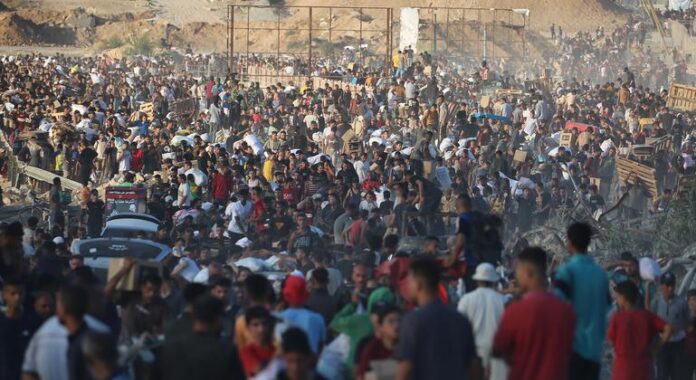
Meanwhile, the humanitarian crisis in Gaza continues unabated, with more than three-quarters of households reporting reduced access to water, ten weeks into Israel’s aid blockade.

A survey conducted by humanitarians in April found that 90 per cent of families faced critical water shortages, often having to choose between basic hygiene and cooking. They also reported an increase in reliance on private vendors for drinking water – with public infrastructure in ruins.

Fuel shortages and limited access to repair equipment, have further complicated the situation. The southern Gaza desalination plant remains offline due to a severed power line, while key water pipes damaged earlier this year have yet to be repaired.

Overflowing waste and rodent infestation

The UN aid coordination office, OCHA, also reported widespread sanitation issues, including a lack of functioning latrines, soap shortages and sewage overflows in hard-hit areas like Jabalia and Nazla.

Overcrowded shelters are facing rodent and insect infestations, further raising fears of disease outbreaks amid strained medical services, OCHA said, warning of a looming public health disaster if the crisis continues unchecked.

Source link