
The Commission has opened investigations against 4 large pornographic platforms for suspected breaches of its digital services rules. EU countries are also taking action against smaller pornographic platforms. This will reinforce the EU’s effort to protect minors from harmful content online. Source link
EU opens investigations to protect minors from pornographic content

The Commission has opened investigations against 4 large pornographic platforms for suspected breaches of its digital services rules. EU countries are also taking action against smaller pornographic platforms. This will reinforce the EU’s effort to protect minors from harmful content online.
EU provides €280 million to help with flood recovery in Austria, Czechia, Poland, Slovakia, Bosnia and Herzegovina and Moldova

The EU has allocated €280 million to help with flood recovery in 4 Central European countries, Bosnia and Herzegovina and Moldova, following severe floods there in autumn 2024. The funds will finance all aspects of disaster recovery including temporary accommodation for affected populations. Source link
EU provides €280 million to help with flood recovery in Austria, Czechia, Poland, Slovakia, Bosnia and Herzegovina and Moldova
The EU has allocated €280 million to help with flood recovery in 4 Central European countries, Bosnia and Herzegovina and Moldova, following severe floods there in autumn 2024. The funds will finance all aspects of disaster recovery including temporary accommodation for affected populations.
EU Launches Landmark €150 Billion Defence Initiative to Bolster Security and Deterrence
In a historic move aimed at strengthening Europe’s strategic autonomy and defence readiness, the Council of the European Union today adopted the Security Action for Europe (SAFE) instrument — a €150 billion financial programme designed to boost joint procurement and investment in the European defence industry.
The new initiative, which enters into force on 29 May 2025, marks the first large-scale coordinated EU effort to address urgent capability gaps, enhance production capacity and ensure rapid availability of critical defence equipment across member states.
“This is not only a success of the presidency, but of the EU as a whole,” said Adam Szłapka , Polish Minister for the European Union. “This unprecedented instrument will boost our defence capabilities and support our defence industry. The more we invest in our security and defence, the better we deter those who wish us harm.”
A New Era of Joint Investment
SAFE is structured around long-maturity loans that will be disbursed to interested EU member states based on national investment plans. The funds are intended to finance large-scale investments in the European Defence Technological and Industrial Base (EDTIB) , with a focus on priority areas identified by the European Council on 6 March 2025.
These include:
- Ammunition and missiles; artillery systems; ground combat capabilities
- Cybersecurity and military mobility
- Air and missile defence systems; maritime capabilities
- Drones and counter-drone systems
- Strategic enablers such as airlift, refuelling, surveillance and space assets
To promote efficiency and interoperability, SAFE encourages common procurement projects involving at least two participating countries. However, given current geopolitical pressures, single-member-state procurements will also be permitted for a limited time.
Opening Up to Partners
A notable feature of SAFE is its openness to third countries. Ukraine and EEA-EFTA nations will be treated on equal footing with EU members, able to participate in joint procurements and supply their domestic industries. Additionally, candidate countries, potential candidates and partners with Security and Defence Agreements — including the United Kingdom — may join procurement efforts.
The regulation also allows for bilateral or multilateral agreements with third states to tailor eligibility conditions where necessary.
Eligibility and Oversight
To qualify for funding, defence products must meet strict criteria. Category 2 systems — including advanced air defences, drones and strategic enablers — require contractors to maintain control over design decisions. Furthermore, non-EU/EEA/Ukraine components cannot exceed 35% of the total product cost.
The European Commission has emphasized that while SAFE promotes European sovereignty, it does not preclude transatlantic cooperation. On the contrary, the initiative aims to strengthen complementarity with NATO and ensure reciprocal access to cutting-edge technologies with trusted allies.
Part of a Larger Strategy
SAFE forms the first pillar of the European Commission’s broader ReArm Europe Plan / Readiness 2030 , which seeks to mobilize over €800 billion in total defence spending through multiple channels:
- Activating the Stability and Growth Pact’s national escape clause
- Making cohesion funds more flexible for defence use
- Engaging the European Investment Bank
- Leveraging private capital
The adoption of SAFE follows the European Council’s March 2025 conclusions calling for increased sovereignty, reduced strategic dependencies and faster response times in equipping European forces.
With geopolitical tensions at their highest in decades, the EU is now taking concrete steps to ensure it can act swiftly and collectively when security is at stake.
As the ink dries on this landmark regulation, all eyes will turn to implementation — and whether Europe can deliver on its promise to become a credible, unified actor in global security.
The Commission welcomes the agreement in the Council on the Security for Action for Europe (SAFE) instrument. The Commission will raise up to €150 billion on the capital markets, providing financial levers to EU countries to ramp up investments in key defence areas.
EU adopts €150 billion defence loan instrument
The Commission welcomes the agreement in the Council on the Security for Action for Europe (SAFE) instrument. The Commission will raise up to €150 billion on the capital markets, providing financial levers to EU countries to ramp up investments in key defence areas.
Gaza: UN agencies calls for aid ‘surge’ as Israeli distribution plan begins
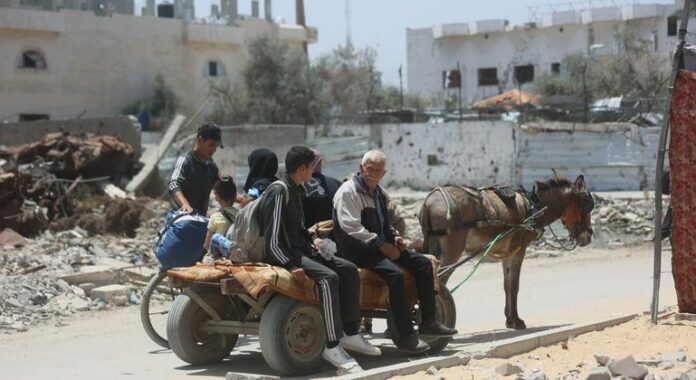
After nearly three months of complete blockade by Israel, a “vastly insufficient” amount of aid was finally allowed into the war-ravaged enclave in the last week, insisted Jens Laerke, spokesperson for the UN aid coordination office, OCHA.
“We have not stopped operating,” he said, referring to staff still inside Gaza, who are tasked with liaising with the Israeli authorities to retrieve supplies allowed into Gaza from Israel, via the Kerem Shalom crossing.
Mr. Laerke insisted that the UN is not participating in the Israeli aid plan known as the Gaza Humanitarian Fund: “It is a distraction from what is actually needed, which is a reopening of all the crossings into Gaza, a secure environment within Gaza and faster facilitation of permissions and final approvals of all the emergency supplies that we have just outside the border; [aid] needs to get in.”
The veteran humanitarian stressed the ongoing dangers and obstacles that have prevented aid teams from picking up and dispatching lifesaving supplies via the UN’s existing delivery network in Gaza.
“We are not always able to collect what is being dropped off on the other side because of the insecure routes that are being assigned to us by the Israeli authorities to use,” he told journalists in Geneva.
‘Cherry-picking’ warning
All types of aid must be allowed through and not “cherry-picked”, Mr. Laerke stressed: “The bottom line again is that we are talking about a vastly insufficient amount of aid that eventually enters Gaza at the moment. That’s why we need [the] opening of more crossings, we need all types of aid – not that aid that is cherry-picked by the Israeli side that we are allowed to get in.”
In an update, the UN World Food Programme (WFP) said that as of Monday, 294 trucks have reached Kerem Shalom from Port Ashdod. On Tuesday, media reports indicated that protesters attempted to block lorries loaded with aid from leaving the Israeli port.
“While desperately needed aid is finally trickling into Gaza, the pace is far too slow to meet the overwhelming needs,” WFP said. “Gaza families are at a breaking point, amid intensified fighting, waves of evacuation orders and population displacement.”
Crossing the line
The UN agency noted that it has “more than 130,000 metric tonnes of food in the pipeline as well as a functioning delivery network ready to provide assistance. An immediate surge in daily aid trucks and unrestricted access to safely collect and distribute food inside Gaza are critical before it is too late.”
The UN agency for Palestinian refugees, UNRWA, meanwhile, explained that “no supplies whatsoever” prepared by the agency have reached Gaza since the Israeli siege began on 2 March.
This is despite UNRWA having readied more than 3,000 trucks carrying food and medicines in Jordan and Egypt which will perish soon.
“We have clinics, we have pharmacies that the agency runs and there we normally would distribute medicines against chronic diseases…but also basic medicines, things like paracetamol and then childhood diseases and these are the medicines that we’re running out of,” said Juliette Touma, UNRWA Director of Communications.
Evidence call to Israel
The development comes as UNRWA Commissioner-General Philippe Lazzarini urged the Israeli Government to provide proof to back up its unsubstantiated allegations that the UN agency’s staff were involved in the Hamas-led terror attacks in Israel that sparked the war in October 2023.
Investigations carried out internally by the UN last year found sufficient evidence that nine active UNRWA staff had been involved.
A separate independent probe commissioned by the UN Secretary-General found that the agency’s rules, mechanisms and procedures were the most “elaborate” within the UN, reflecting the complex and sensitive demands associated with working in the Occupied Palestinian Territories.
“It’s been over 20 months of these claims coming our way, harming the agency’s reputation of course, but more importantly, putting the lives of our staff, especially those working in the Occupied Palestinian Territory, at risk,” said Ms. Touma.
Despite numerous requests by UNRWA to the Israeli Government for evidence to substantiate “numerous accusations”, no evidence has been shared to back up the claims against the agency and its personnel, Ms. Touma continued.

Media advisory – European Union Military Committee

DISCLAIMER: Information and opinions reproduced in the articles are the ones of those stating them and it is their own responsibility. Publication in The European Times does not automatically means endorsement of the view, but the right to express it.
DISCLAIMER TRANSLATIONS: All articles in this site are published in English. The translated versions are done through an automated process known as neural translations. If in doubt, always refer to the original article. Thank you for understanding.
UN warns of ‘catastrophic’ human rights crisis in Myanmar as violence and economic collapse deepen

Published ahead of the Human Rights Council’s upcoming session, the report highlighted the worsening situation since the military coup in 2021, which derailed Myanmar’s democratic transition and ignited widespread armed resistance.
In the years since, military forces have targeted civilian populations with airstrikes, artillery bombardments and other forms of violence, while anti-military armed groups have gained ground, particularly in Rakhine state.
“The country has endured an increasingly catastrophic human rights crisis marked by unabated violence and atrocities that have affected every single aspect of life,” said UN High Commissioner for Human Rights Volker Türk.
Grim toll
The report documents a grim toll: military operations killed more civilians in 2024 than in any previous year since the coup.
In Rakhine, the Arakan Army seized control of most of the state, displacing tens of thousands, while Rohingya civilians were caught between warring factions, facing killings, torture, arbitrary arrests and widespread destruction of villages.
Some Rohingya armed groups have also been drawn into the conflict, according to reports.
Economic crisis deepening
The escalating violence has had a cascading effect on Myanmar’s economy, worsening already dire humanitarian conditions.
Myanmar’s economy has lost an estimated $93.9 billion since the coup, with the gross domestic product (GDP) not expected to recover to pre-pandemic levels before 2028.
Inflation has surged, the kyat has lost 40 per cent of its value, and over half the population now lives below the poverty line, facing food insecurity and soaring prices.
The March earthquakes further exacerbated the crisis, leaving thousands more displaced, homeless and without basic services.
Military control of revenue
Meanwhile, the military continues to control key revenue sources, including the central bank and state-owned enterprises, particularly in the extractive sector.
While targeted international sanctions slowed some revenue streams, the junta has maintained its financial lifelines through forced currency conversion, import restrictions, and a crackdown on informal money transfers.
Myanmar has also become the world’s largest producer of opium and synthetic drugs, with transnational criminal networks thriving under military rule.
Multifaceted approach needed
The report urged a multifaceted response to the crisis, including urgent humanitarian support, cross-border aid for displaced populations and increased political engagement with Myanmar’s democratic forces and emerging governance structures.
It also emphasised the need for accountability through international justice mechanisms, including a referral of the situation to the International Criminal Court (ICC).
The report also identified key “constituents for change” in the country’s future – women, youth, ethnic minorities, civil society and pro-democracy actors – and highlighted the work of communities who have established local institutions and forms of governance, often with increased participation from women.
Buildings lie in ruins in Mandalay region, in central Myanmar, following the devastating 7.7 magnitude earthquake that struk in March.
Hopes for a peaceful future
The report underscored the importance of planning for the day-after, ensuring human rights are central to a future Myanmar – from rebuilding systems to restoring fundamental freedoms.
“There are strong, resourceful and principled individuals and groups rallying and creating the conditions for an inclusive and democratic future,” High Commissioner Türk said. “They are a shining example of hope for a peaceful future.”
The report will be formally presented to the UN Human Rights Council in Geneva on 1 July.
