Monday, September 28, 2026
Home Blog Page 508

RAW MATERIALS SUMMIT | EIT

0

Join the “Race to 2030” at the 7th EIT RawMaterials Summit

Global shifts, from geopolitical tensions to climate challenges, redefine Europe’s economic landscape. Critical raw materials (CRMs) are no longer just an industry concern–they are essential to Europe’s competitiveness, strategic autonomy, and green transition.

With 80–100% import dependency on many CRMs, the European Competitiveness Compass highlights the urgent need to secure supply chains, diversify partnerships, and accelerate a circular economy. Action is needed now to drive industrial innovation and resilience.

Join over 1,000 participants, including industry leaders, innovators, and policymakers in Brussels, 13–15 May 2025, to connect, collaborate, and address the most pressing topics for our sector, including:

  • Funding innovation to drive breakthrough research and industrial adoption
  • Unlocking circular economies and Europe’s resource potential
  • Training the workforce needed for a net-zero industrial future
  • Building partnerships that drive meaningful progress and shared benefits

Agenda

Register Here

Source link

RAW MATERIALS SUMMIT | EIT

0
RAW MATERIALS SUMMIT | EIT

Join the “Race to 2030” at the 7th EIT RawMaterials Summit Global shifts, from geopolitical tensions to climate challenges, redefine Europe’s economic landscape. Critical raw materials (CRMs) are no longer just an industry concern–they are essential to Europe’s competitiveness, strategic autonomy, and green transition. With 80–100% import dependency on many CRMs, the European Competitiveness Compass […]

Source link

UNFPA calls on US to reconsider ban on future funding

0
UNFPA calls on US to reconsider ban on future funding

In a statement, UNFPA said the move – which invokes a 1985 legal provision known as the Kemp-Kasten Amendment – is based on “unfounded claims” about the agency’s work in China. These allegations, it noted, have “long been disproven”, including by the US Government itself.

The Kemp-Kasten amendment states that no funds can go to any organization or programme which support any “coercive abortion or involuntary sterilization,” as determined by the US president.

The funding cut now in effect is in addition to termination notices already issued for more than 40 existing humanitarian projects, representing roughly $335 million in support.

Impact on the most vulnerable

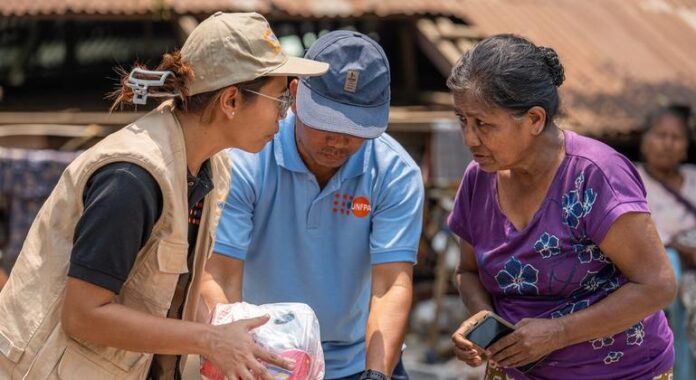
UNFPA – formally the UN Population Fund – said the loss of US support will significantly undermine efforts to prevent maternal deaths, especially in conflict-affected and crisis-hit regions.

“It will cut essential support for millions of people living in humanitarian crises and for midwives preventing mothers from dying in childbirth – work that is a ‘best-buy’ in development, a cost-effective investment that generates positive returns over generations,” the agency stated.

The US, a founding and long-standing partner, has over the decades helped strengthen global health systems and save countless lives, UNFPA said.

“Over the past four years alone, with the US Government’s life-saving investments, we prevented more than 17,000 maternal deaths, nine million unintended pregnancies and nearly three million unsafe abortions by expanding access to voluntary family planning,” the agency added.

Call to reconsider

UNFPA urged Washington to reconsider its position and “reclaim its position as a leader in global public health, saving millions of lives.”

“Funding UNFPA – the only United Nations agency dedicated to reproductive health and rights – is the surest way of reducing the risk of coercive practices around the world,” the agency said.

It also emphasised its continued commitment to dialogue with the US Government through the UNFPA Executive Board, where the United States has been an active member for over 50 years.

The agency also vowed to continue to work tirelessly under its mandate to uphold the health, safety, and dignity of women and girls worldwide.

Source link

EIT Food and SkyHive launch the G4F Skills Platform

0

EIT Food, in partnership with SkyHive by Cornerstone and a consortium of leading partners from the EU-funded GEEK4Food project, has launched the G4F Skills Platform. 

The platform aims to connect learners, workers, employers, educators, and soon policymakers, offering tools and resources to help drive sustainability and innovation within the food industry.

AI-Powered Learning for Career Development

Leveraging technology from SkyHive by Cornerstone, the G4F Skills Platform empowers individuals and organizations to stay ahead of industry trends and enhance their skills. By focusing on continuous learning, the platform supports the development of a more skilled workforce that can meet the evolving demands of the agri-food sector.

Powered by SkyHive by Cornerstone, the platform offers a dynamic, AI-driven experience that helps individuals at all stages of their careers whether upskilling, reskilling, or transitioning to track and develop their skills and discover new career and learning opportunities. Users can access tailored learning paths, identify skill gaps, and receive personalized insights to future-proof their career paths in the evolving agri-food sector.

The agri-food sector requires a specific set of skills and knowledge that are vital to retain, retrain and continually upskill not only for the industry, but the greater population who benefit from their work. Leveraging SkyHive by Cornerstone’s technology will allow individuals, employers, educators and policymakers the benefit of identifying gaps, closing these gaps with the necessary training and making critical talent projection decisions to meet the needs of the sector

Mohan Reddy, VP of Engineering, SkyHive by Cornerstone

The platform equally benefits employers, educators, and policymakers as the agri-food sector shifts from a role-based to a skills-based labor market. Automation, AI, and data-driven agriculture are transforming food production, and the rising demand for sustainability calls for expertise in areas like environmental management and sustainable farming. Meanwhile, younger workers increasingly expect more flexible, dynamic roles across various areas of expertise.

For employers, this shift means the need to identify the precise skills required for emerging roles in food systems, enabling them to match talent with the right opportunities. For education providers, it requires a rethinking of curricula and training programs to ensure that they are equipping learners with the skills the industry urgently needs.

Policymakers will soon be able to access real-time data on agri-food skills and labor market trends in Europe, empowering them to shape evidence-based policies that address the sector’s evolving workforce needs and drive long-term sustainability.

The G4F Skills Platform facilitates this transition by offering tools that help learners, workers, employers, educators, and policymakers understand the skills landscape, allowing them to align talent development, educational offerings, and policies with the evolving needs of the sector.

The platform is now live and available to users across Europe, offering a set of real-time tools for upskilling, reskilling, and career development, with continuous adaptability powered by AI technology.

The agri-food system stands at a critical crossroads, where urgent change is imperative. Climate change, a growing population, and the strain on planetary boundaries have intensified environmental, social, and economic pressures, demanding action from both the public and private sectors. Addressing the skills gap and reskilling the workforce is paramount. We must leverage technological innovations to equip learners with the skills needed for real transformation towards more sustainable models. The Geek4Food project introduces the G4F Skills Platform, offering flexibility and a wealth of training opportunities to support the educational progression of professionals, students, and educators, while enhancing the value of each individual’s skills portfolio

Maarten van der Kamp, Director of Education, EIT Food

About GEEK4Food

The GEEK4Food project, co-funded by the European Union under the Erasmus+ programme, is designed to address critical challenges in the agri-food sector, with a focus on sustainability, innovation, and skills development through higher education. The project brings together a diverse consortium of universities, consultancy agencies – including those specialising in futures literacy – technology providers focused on AI-driven workforce development, and innovation-focused organisations dedicated to transforming the food sector. All partners share the belief that specialised, skills-oriented education is crucial for driving improvements and creating a more sustainable, innovative agri-food system. The G4F Skills Platform is one of the key tools in this effort, offering an AI-powered solution for upskilling and reskilling across the sector.


Source link

EIT Food and SkyHive launch the G4F Skills Platform

0
RAW MATERIALS SUMMIT | EIT

EIT Food, in partnership with SkyHive by Cornerstone and a consortium of leading partners from the EU-funded GEEK4Food project, has launched the G4F Skills Platform. 

The platform aims to connect learners, workers, employers, educators, and soon policymakers, offering tools and resources to help drive sustainability and innovation within the food industry.

AI-Powered Learning for Career Development

Leveraging technology from SkyHive by Cornerstone, the G4F Skills Platform empowers individuals and organizations to stay ahead of industry trends and enhance their skills. By focusing on continuous learning, the platform supports the development of a more skilled workforce that can meet the evolving demands of the agri-food sector.

Powered by SkyHive by Cornerstone, the platform offers a dynamic, AI-driven experience that helps individuals at all stages of their careers whether upskilling, reskilling, or transitioning to track and develop their skills and discover new career and learning opportunities. Users can access tailored learning paths, identify skill gaps, and receive personalized insights to future-proof their career paths in the evolving agri-food sector.

The agri-food sector requires a specific set of skills and knowledge that are vital to retain, retrain and continually upskill not only for the industry, but the greater population who benefit from their work. Leveraging SkyHive by Cornerstone’s technology will allow individuals, employers, educators and policymakers the benefit of identifying gaps, closing these gaps with the necessary training and making critical talent projection decisions to meet the needs of the sector

Mohan Reddy, VP of Engineering, SkyHive by Cornerstone

The platform equally benefits employers, educators, and policymakers as the agri-food sector shifts from a role-based to a skills-based labor market. Automation, AI, and data-driven agriculture are transforming food production, and the rising demand for sustainability calls for expertise in areas like environmental management and sustainable farming. Meanwhile, younger workers increasingly expect more flexible, dynamic roles across various areas of expertise.

For employers, this shift means the need to identify the precise skills required for emerging roles in food systems, enabling them to match talent with the right opportunities. For education providers, it requires a rethinking of curricula and training programs to ensure that they are equipping learners with the skills the industry urgently needs.

Policymakers will soon be able to access real-time data on agri-food skills and labor market trends in Europe, empowering them to shape evidence-based policies that address the sector’s evolving workforce needs and drive long-term sustainability.

The G4F Skills Platform facilitates this transition by offering tools that help learners, workers, employers, educators, and policymakers understand the skills landscape, allowing them to align talent development, educational offerings, and policies with the evolving needs of the sector.

The platform is now live and available to users across Europe, offering a set of real-time tools for upskilling, reskilling, and career development, with continuous adaptability powered by AI technology.

The agri-food system stands at a critical crossroads, where urgent change is imperative. Climate change, a growing population, and the strain on planetary boundaries have intensified environmental, social, and economic pressures, demanding action from both the public and private sectors. Addressing the skills gap and reskilling the workforce is paramount. We must leverage technological innovations to equip learners with the skills needed for real transformation towards more sustainable models. The Geek4Food project introduces the G4F Skills Platform, offering flexibility and a wealth of training opportunities to support the educational progression of professionals, students, and educators, while enhancing the value of each individual’s skills portfolio

Maarten van der Kamp, Director of Education, EIT Food

About GEEK4Food

The GEEK4Food project, co-funded by the European Union under the Erasmus+ programme, is designed to address critical challenges in the agri-food sector, with a focus on sustainability, innovation, and skills development through higher education. The project brings together a diverse consortium of universities, consultancy agencies – including those specialising in futures literacy – technology providers focused on AI-driven workforce development, and innovation-focused organisations dedicated to transforming the food sector. All partners share the belief that specialised, skills-oriented education is crucial for driving improvements and creating a more sustainable, innovative agri-food system. The G4F Skills Platform is one of the key tools in this effort, offering an AI-powered solution for upskilling and reskilling across the sector.


Source link

The Quiet Architecture of Freedom

0
The Quiet Architecture of Freedom

There is a certain quietness to Eric Roux’s manner, a deliberate attentiveness that draws the listener closer. It is not the quietness of hesitation, but the steady cadence of someone who has spent his life arranging words with care — words that, over time, have built an architecture of bridges between faiths, between traditions, between ways of belonging in the world. The language of freedom, of dialogue, of religious rights, is spoken by many. But few speak it as Eric Roux does, with the quiet force of conviction backed by decades of advocacy.

In the landscape of interfaith dialogue, where noise often trumps nuance, Roux has become, almost without theatrics, one of Europe’s steadfast architects of religious freedom. In an age when declarations are made in capital letters and outrage is broadcast in real time, his work has moved with the patience of stone masons, laying one invisible brick after another, creating spaces where belief, in all its unwieldy plurality, can be quietly honored. His work is not about flashy gestures or grand speeches. It is about steady commitment, deliberate actions, and a conviction that true change takes root when nurtured carefully and without fanfare.

Roux was born in France, in a generation that had begun to mistrust grand narratives but still yearned, perhaps unknowingly, for a kind of sacred coherence. In his youth, he sought answers across the spiritual spectrum, wandering, as he would later describe it, not lost but hungry. His explorations led him eventually to the Church of Scientology, where he found both a personal spiritual path and an organizational framework through which to act in the world. By 1993, he had been ordained as a minister, having chosen to take up the mantle of leadership within his faith community.

But it was not enough to belong to a faith; belonging had to be made meaningful in society. And society — with its often uneasy relationship to minority religions — would not make that easy. France, despite its proud commitment to liberté, égalité, fraternité, harbored a peculiar suspicion toward non-traditional religious movements. Roux saw early on how prejudice, masked as secular rigor, could suffocate the delicate freedoms of conscience and worship. Over time, he recognized that his faith was not just a personal matter; it was a matter of public interest and human rights.

By the early 2000s, Roux had begun to dedicate himself beyond his own community, co-founding the European Interreligious Forum for Religious Freedom (EIFRF), a platform meant not to promote one religion, but to defend the right of every person to believe — or not — without state interference. The EIFRF’s mission was clear: to create a space where diverse voices could be heard, where individuals of all faiths could come together to affirm their right to worship without fear of repression. Roux’s work became increasingly vital in a time when governments were beginning to impose “sect filters,” listing certain religious movements as cults in an attempt to regulate or suppress them.

His involvement with the EIFRF marked a crucial turning point in his life. Eric Roux’s advocacy was no longer limited to his own faith community but expanded to encompass the wider issue of religious freedom. The organization sought to unite like-minded individuals, regardless of faith, to raise awareness about the importance of religious liberty and to combat the growing discrimination against religious minorities. His role at EIFRF was one of legal expertise and diplomatic finesse, attending conferences, speaking at the United Nations, the European Parliament, and the OSCE, where he would insist, patiently but persistently, that freedom of religion or belief was not a privilege for the favored, but a right for all.

At these gatherings, Roux was rarely the loudest voice. He did not grandstand or moralize. Instead, he would build slow arguments, brick by brick, invoking not only human rights conventions but the ancient wisdom that freedom must be defended in silence as much as in spectacle. His speeches were often met not with thunderous applause but with quiet reflection. His listeners, even if they didn’t fully agree, could not help but acknowledge the depth of his commitment to what he believed was an unassailable right: the freedom to believe.

In 2013, Roux found a new home for his expanding vision within the United Religions Initiative (URI), a global grassroots network committed to interfaith cooperation and peacebuilding. Through EIFRF, he became one of URI’s “Cooperation Circles,” contributing a European voice to a global mosaic. The Cooperation Circles, groups that span the globe, serve as the heart of URI’s efforts to build interfaith relationships and tackle pressing global issues such as poverty, violence, and environmental degradation. Over time, his commitment deepened. In 2022, he was elected as a Global Council Trustee for Europe, and in September 2024, Roux rose to Chair of URI’s Global Council — the first European in that position, but perhaps more importantly, a quiet reaffirmation of URI’s belief that leadership need not shout to be heard. It was a significant moment in Roux’s life, a recognition of his quiet but persistent efforts to protect the rights of religious minorities and to foster interfaith cooperation.

At the URI headquarters in San Francisco, where the board gathered after his election, Roux delivered a brief, characteristically restrained acceptance address. There, he remarked that there is no singular faith that owns peace or holds all the truth — only people gathered in goodwill across their differences. The room did not erupt into the raucous cheers one might expect; instead, there was a slow standing, a solemn recognition. His was a leadership of quiet dignity, grounded not in the pursuit of power but in the service of others, in the effort to create a world where religious difference is not a reason for conflict but an opportunity for understanding.

If there is a throughline in Roux’s life, it is this insistence on the humble fact of difference — that to believe differently is not a threat but a promise: the promise that humanity, in its endless variation, can still find a shared ground. In practice, this means navigating not only between religions, but within them: between Orthodox and Reform, Sunni and Shia, Theravāda and Mahāyāna, conservative and progressive, those who cling and those who reform. Roux has been involved in dialogue between a wide array of faiths, from the Catholic Church to Buddhist communities to Orthodox Jews, understanding that the strength of a pluralistic society depends on the ability to see and respect the differences of others.

Eric Roux has always been someone who listens deeply, even when those around him might not fully grasp the weight of their own words. There is a thoughtfulness to his approach that leaves room for all perspectives to be heard. It is not that he believes every viewpoint is equally valid, but that the act of listening — especially to those one disagrees with — is itself a form of respect and a necessary precondition for any kind of meaningful dialogue. Whether working on religious freedom legislation in Europe or engaging with the international interfaith community, Eric Roux’s work is always marked by this careful, thoughtful listening. It is this quality that has earned him the respect of colleagues and adversaries alike.

There are, inevitably, moments of discouragement. Roux has been the target of smear campaigns by those who view religious diversity not as a strength but a dilution of the “true faith.” He has witnessed how governments, even in democratic Europe, quietly institutionalize suspicion against minority religions through so-called “sect filters” and blacklists. Each setback could have pushed him into cynicism or retreat. Instead, he has responded with an almost monastic discipline of engagement: another conference, another dialogue, another letter drafted carefully and sent out into a bureaucracy that may or may not read it. His resilience has been a hallmark of his leadership, his refusal to be cowed by hostility or indifference. It is this quiet resilience that has helped keep the flame of religious freedom alight in Europe, where challenges to this fundamental right often appear in the guise of law or state policy.

In private conversations, Eric Roux sometimes speaks about hope not as a feeling but as a practice — a daily, deliberate act, like laying another stone in a cathedral he knows he may never see completed. His faith, though personal, seems to have shaped him toward a broader fidelity: not to a doctrine, but to the very possibility of shared humanity. His is not a hope born of naive optimism but one grounded in a deeply held belief that, through sustained effort, human beings can build a better world together. This belief has driven his activism, his advocacy, and his daily work.

Outside of his formal roles, Roux has remained a prolific advocate. He has published articles on religious freedom, spoken at global interfaith summits, contributed to roundtables at the United Nations. His written work, while less known to the general public, reveals a thinker deeply invested in the paradoxes of modern pluralism: how to honor freedom without succumbing to relativism, how to defend minority rights without alienating majority traditions. His approach is never simplistic; rather, he understands that the work of interfaith dialogue is deeply complex, requiring patience, understanding, and the ability to confront uncomfortable truths.

Today, even as he leads one of the world’s largest grassroots interfaith organizations, Roux remains strikingly unassuming. In public events, he tends to dress simply, to defer to others on panels, to redirect praise. His presence is less that of a general rallying troops than of a gardener tending many different seeds, knowing some will grow, some will not, and that the garden is never finished anyway. His work is the quiet, constant tending of that garden, ensuring that the seeds of understanding, cooperation, and peace have every opportunity to take root and flourish.

To walk with Eric Roux through a conference hall — whether in Brussels or New York or Nairobi — is to witness a quiet choreography of handshakes, nods, whispered greetings. He moves calmly, with deliberation, yet never seems out of place. There is a sense, among those who know him, that Roux does not aspire to lead faith communities into a single unified voice, but rather to preserve the polyphony — each voice distinct, each voice essential. His leadership is not about homogenizing belief but about fostering a space where diversity can be celebrated and protected.

It is a difficult thing, in a noisy and suspicious world, to hold onto this vision. Yet, brick by brick, handshake by handshake, Eric Roux continues to build it: the quiet architecture of freedom, a structure light enough to shelter many beliefs, strong enough to endure the winds of fear.

And like all true architects, he seems content to let the work speak for itself.

Source link

World News in Brief: ‘Massive’ needs in Sudan, DR Congo aid shortfall, support for Congolese refugees and Angola cholera relief

0
World News in Brief: ‘Massive’ needs in Sudan, DR Congo aid shortfall, support for Congolese refugees and Angola cholera relief

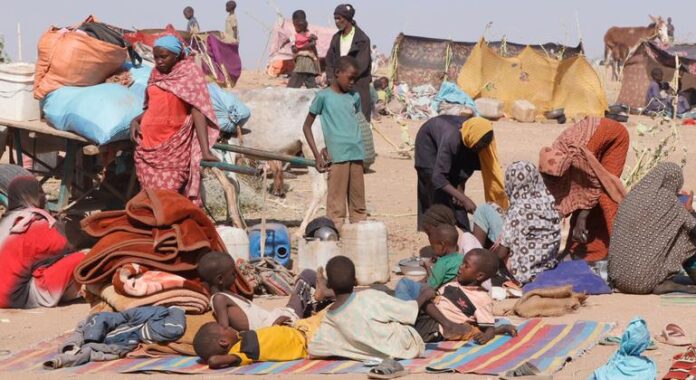
The UN estimates that in the past few weeks, over 330,000 people have fled into Tawila after the Rapid Support Forces (RSF) launched violent attacks in the Zamzam and Abu Shouk displacement camps and in El Fasher, the regional capital. 

Over 100,000 people also remain trapped in El Fasher. 

‘Massive’ humanitarian needs

Since the beginning of the civil war in Sudan in April 2023, over 18,000 civilians have been killed and over 13 million have been forced from their homes. 

According to UN estimates, over 30.4 million Sudanese are in desperate need of humanitarian aid. 

The World Food Programme (WFP) has provided food assistance to over 300,000 people from the Zamzam displacement camp. Yet, UN Humanitarian Affairs Coordinator Tom Fletcher noted on Thursday that needs remain “massive” in the region. 

“Our humanitarian colleagues also underscore the urgent need for stepped-up, flexible funding to sustain and expand life-saving support for people in need in North Darfur and elsewhere in Sudan,” said UN Deputy Spokesperson Farhan Haq, briefing reporters on Friday. 

However, with ongoing drone strikes in Port Sudan, the main entry point for humanitarian supplies, and increasing violence in North Darfur, providing life-saving assistance has become increasingly difficult. 

“We call once again on all parties to facilitate safe, unhindered and sustained access to the area, via all necessary routes,” Mr. Haq said. 

© UNICEF/Jospin Benekire

A displaced family sit in front of their makeshift shelter in Goma, North Kivu province, DR Congo.

DR Congo: Dire impact of funding cuts amidst cholera outbreak   

Funding shortfalls have forced the humanitarian community to re-prioritise its response plan to alleviate the crisis in the Democratic Republic of the Congo (DRC), the UN aid coordination office OCHA said on Friday. 

Nearly seven million people have already been forcibly displaced by violence since advances by M23 rebels earlier this year.

While the 2025 UN humanitarian plan aims to provide life-saving interventions to 11 million people across the DRC at a cost of $2.5 billion, only $233 million has been received so far. 

Despite escalating needs in the wake of the crisis in the east of the country, “that’s only half the amount we had secured by this time last year,” Farhan Haq told journalists in New York.

Congolese health authorities are facing shortages of medical supplies as the DRC is now facing a cholera outbreak in six provinces.

OCHA is calling for greater protection of civilians in conflict-affected areas, and more support to prevent the collapse of essential services and address the root causes of the crisis.

UN fund allocates over $4 million to support Congolese refugees, Angola cholera outbreak

Two new allocations from the UN Central Emergency Response Fund (CERF) will support Congolese refugees in Uganda and efforts to combat a deadly cholera outbreak in Angola. 

UN Emergency Relief Coordinator Tom Fletcher released the funding on Friday.

More than 60,000 people have fled violence in the Democratic Republic of the Congo (DRC) for neighbouring Uganda since January.

The first allocation, for $2.5 million, will allow the UN and partners to provide life-saving assistance to over 40,000 refugees, including clean drinking water, food, healthcare and nutrition support.

The $1.8 million CERF contribution in Angola will support the urgent response to the country’s worst cholera outbreak in two decades.

Since the beginning of the year, the outbreak has spread to 17 out of 21 provinces, with more than 18,000 cases and 586 deaths reported as of 7 May. 

The funding will go towards scaling up the response and helping to prevent further spread of the disease. 

Source link

CorPower Ocean: Revolutionizing Wave Energy for a Sustainable Future

0
CorPower Ocean: Revolutionizing Wave Energy for a Sustainable Future

The global push for renewable energy sources has brought significant innovations in harnessing natural resources.

Among renewable sources, wave energy stands out as a clean and abundant resource with immense potential. One of the pioneering companies in this field is CorPower Ocean, an EIT InnoEnergy-backed start-up that is redefining wave energy conversion with cutting-edge technology. 

The Birth of CorPower Ocean 

Founded in 2009 by Dr. Stig Lundbäck, CorPower Ocean is a swedish start-up operating in Europe. Iinspired by an unconventional source, Dr. Lundbäck, a medical expert with three decades of experience in high-efficiency pumping systems, applied his knowledge to the development of wave energy technology. His vision materialized in the form of a unique buoy that oscillates in resonance with sea waves, maximizing energy extraction and conversion. CorPower Ocean is currently working on two main projects in Portugal and Ireland.

The Role of EIT InnoEnergy 

EIT InnoEnergy has been instrumental in CorPower Ocean’s growth, helping assemble a skilled team with expertise in energy generation, system design, manufacturing, and engineering. Additionally, EIT InnoEnergy has provided market insights, networking opportunities, and financial support, enabling CorPower Ocean to transform its groundbreaking technology into viable renewable energy applications. 

Innovative Technology: A Game-Changer in Wave Energy 

At the core of CorPower Ocean’s Wave Energy Converter (WEC) lies a sophisticated control system equipped with advanced algorithms. This system optimizes the device’s response to incoming waves, ensuring optimal energy capture. Working in tandem with a high-performance power take-off (PTO) system, the technology efficiently converts the mechanical energy generated by the oscillating buoy into electrical energy. 

The PTO system is designed to be both robust and reliable, ensuring consistent performance in the unpredictable ocean environment. Moreover, its compact and modular structure allows for easy maintenance and replacement, reducing maintenance costs and downtime. 

Significant Funding and Expansion Plans

CorPower Ocean’s groundbreaking technology has attracted considerable financial backing. Recently, the company was selected by the European Innovation Council (EIC) Accelerator programme to receive up to EUR 17.5M in grants and equity funding. This support will be pivotal in accelerating the commercialization of its wave energy technology, optimizing manufacturing processes, and deploying its first commercial wave farm projects across Europe. 

This milestone follows CorPower Ocean’s successful EUR 32M Series B1 funding round  in October 2024, reinforcing its leadership in the wave energy sector. These funds will further solidify its position as a frontrunner in developing sustainable energy solutions. 

A Vision for a Sustainable Future 

CorPower Ocean’s innovative approach to wave energy conversion has the potential to revolutionize the renewable energy landscape. By leveraging advanced control systems, robust engineering, and strategic financial backing, the company is well on its way to making wave energy a mainstream contributor to global sustainability efforts. With continued support and advancements, CorPower Ocean is poised to play a crucial role in the transition towards a cleaner and more sustainable energy future. 

EIT recently launched a call for proposal for a new Knowledge and Innovation Community on Water, Marine and Maritime sectors and ecosystems to tackle water scarcity, droughts, floods, and marine and freshwater degradation. Find out more here 

Source link

‘She cries in her sleep’: Deeper crisis looms beneath devastation from Myanmar quake

0
‘She cries in her sleep’: Deeper crisis looms beneath devastation from Myanmar quake

“I hate earthquakes. Earthquakes took my mother and my aunt away,” five-year-old Khin Yadanar told the UN Children’s Fund (UNICEF), after both her mother and aunt were killed when a brick wall collapsed on them.

Around 6.5 million children were already in need of humanitarian assistance before the earthquake, which compounded existing vulnerabilities resulting from the brutal civil war between multiple armed opposition groups and the military junta which seized power in a February 2021 coup.

Families now face a further threat from flooding and landslides with the arrival of the monsoon season.

Midwives are lifelines

As health services collapsed after the earthquake, “women, especially pregnant mothers, were severely impacted,” said Yu Yu, a midwife in Mandalay, speaking to the UN’s reproductive health agency, UNFPA.

Amidst the chaos, midwives have emerged as frontline heroes. Undeterred by aftershocks and confronting both physical obstacles and emotional challenges, midwives provided hope and life-saving support.

Yu Yu notably recalls the case of one of her patients who suddenly became stranded, unable to reach any medical facilities as she went into labour following the quake.

Without hesitation, Yu Yu rushed to her side: “When I reached her, she was exhausted, overwhelmed by fear and financial insecurity following the earthquake,” she recalled.

On that day, Yu Yu saved both mother and child, as the baby’s umbilical cord had wrapped itself around the infant’s neck.

UNFPA has deployed mobile clinics to ensure that women and girls continue to receive essential healthcare and protection services.

A 10-year-old boy with his parrot on his shoulder at a temporary camp set up in the aftermath of devastating earthquake that struck Myanmar.

Deep trauma

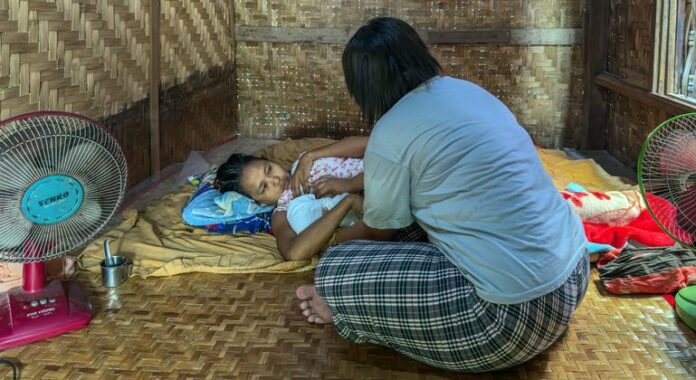
“She cries in her sleep, and I worry something inside her has broken,” said Thida, mother of eight-year-old Thiri, speaking to UNICEF.

Beneath the visible devastation of the earthquake lies a deeper crisis: the profound psychological trauma that young survivors carry.

“I was so scared. My heart was beating so fast – and all I could think about was my parrots and cats at home,” said Thurein Oo, a ten-year-old boy who was praying at a mosque when the tremor struck.

Across earthquake-affected areas, parents are witnessing similar signs of distress in their children – sudden anxiety, emotional withdrawal, and sleepless nights, say UN aid workers.

In response to this growing mental health crisis, UNICEF and its partners have mobilised to provide critical psychological support to affected communities.

Setting up child-friendly spaces, UNICEF aims to promote psychosocial wellbeing, build resilience, and restore a sense of normalcy to children’s routines. Through various activities such as drawing, children learn to cope with their trauma.

“I coloured a picture of my mother,” said Khin, who lost her mother in the quake. “I feel better when I draw.”

Although the physical rebuilding of homes and infrastructure will likely take years, the emotional and psychological toll the earthquake has had on children cannot be left untreated.

“I like coming here,” said Thurein, referring to one of these spaces. “I feel safe, and I made a new friend who also lost his home,” he added.

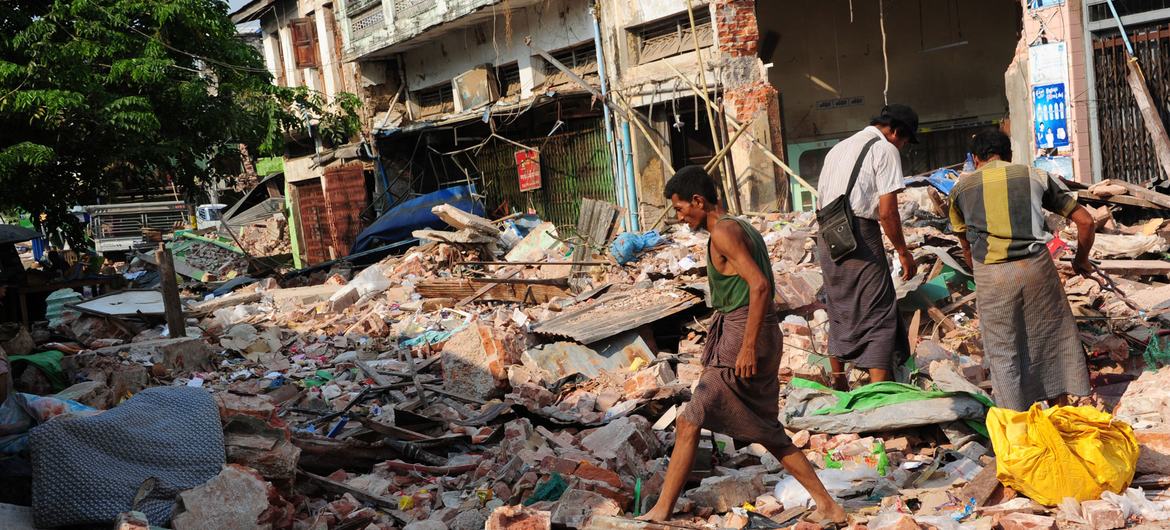
Earthquake survivors survey the ruins of their homes in Pyinmana, Myanmar following the earthquake there.

Earthquake survivors survey the ruins of their homes in Pyinmana, Myanmar following the earthquake there.

Proactive planning

While earthquakes are among the deadliest natural hazards, it is the collapse of buildings that causes the most devastating effects. As such, proactive disaster risk reduction – such as making structures earthquake-resistant – is essential to reducing deaths and economic losses.

Focusing on risk-sensitive urban development, UN-Habitat and the UN office for disaster risk reduction (UNDRR) are also working across Myanmar to mitigate the risks future earthquakes could pose.

While little can be done to prevent natural hazards such as earthquakes from occurring, much can be done to mitigate their effects.

As rebuilding efforts are underway, the UN is dedicated to “ensuring that each step we take makes the rebuilt areas stronger and more resilient than before,” said Anacláudia Rossbach, Executive Director of UN-Habitat.

Source link

President Costa travelling to the Western Balkans to reaffirm EU’s commitment to the region and co-host the EPC summit

0
President Costa travelling to the Western Balkans to reaffirm EU’s commitment to the region and co-host the EPC summit

During the week of 12 May 2025, European Council President António Costa will travel to the Western Balkans to meet with the political leadership and co-host the sixth European Political Community Summit in Tirana.

Source link