Monday, September 28, 2026
Home Blog Page 528

Gaza aid crisis deepens as border closure stretches into 50th day

0
Gaza aid crisis deepens as border closure stretches into 50th day

The UN relief coordination office, OCHA, said on Tuesday that this marks the longest period without aid or commercial supplies entering the Strip since the conflict began in October 2023.

“Right now, it is probably the worst humanitarian situation ever seen throughout the war in Gaza,” OCHA spokesperson Jens Laerke told journalists at a briefing in Geneva.

Over 2.1 million Gazans are facing acute shortages of food, medicine, fuel, and clean water.

However, humanitarian supplies are stockpiled just across the border, including nearly 3,000 trucks of life-saving aid prepared by the Palestine refugee agency (UNRWA), which Israeli authorities are refusing to allow in.

Deliberate, man-made suffering

“Hunger is spreading and deepening – deliberate and man-made,” UNRWA Commissioner-General Philippe Lazzarini said in a statement.

“Gaza has become a land of desperation…humanitarian aid is being used as a bargaining chip and a weapon of war.”

The agency warned supplies inside Gaza are nearly all gone, with food stocks running dangerously low and only 250 food parcels left.

Flour has run out. Bakeries are shutting down, hospitals are collapsing without fuel or medicine, and essential items have soared in price.

“Two million people – a majority of women and children – are undergoing collective punishment,” Mr. Lazzarini said.

“The siege must be lifted, supplies must flow in, the hostages must be released, the ceasefire must resume.”

Aid effort continues

Despite these conditions, UNRWA continues to operate on the ground, providing water, collecting solid waste, and running vital health services.

Eight health centres and 39 medical points are still providing around 15,000 consultations daily. A blood donation drive to support local hospitals in urgent need of transfusions is also underway.

Source link

EDPB annual report 2024: protecting personal data in a changing landscape

0
EDPB annual report 2024: protecting personal data in a changing landscape

Brussels, 23 April – The European Data Protection Board (EDPB) has published its 2024 Annual Report. The report provides an overview of the EDPB work carried out in 2024 and reflects on important milestones, such as the adoption of the 2024-2027 strategy, the increase in Art. 64(2) consistency opinions and the continued efforts to provide guidance and legal advice.
EDPB Chair Anu Talus said: “As I look back on the work carried out over the past year, I am proud to present our achievements. In 2024, we reaffirmed our commitment to safeguarding individuals’ fundamental rights to privacy and data protection in a fast-changing digital landscape.
We adopted a new strategy and continued to play a central role in providing guidance and ensuring a consistent application of the General Data Protection Regulation (GDPR) across Europe. To support understanding and implementation of data protection rights and duties, we expanded our outreach activities by devoting special attention to businesses and non-expert individuals. In addition, we acquired new roles in the framework of the new digital legislations.”

A new EDPB strategy
The EDPB strategy 2024-2027 outlines key priorities and actions to strengthen and modernise data protection across Europe, ensure consistent enforcement of the GDPR, and address emerging challenges, including cross-regulatory cooperation. The strategy also helps strengthen the EDPB’s global presence by engaging with global partners and representing the EU data protection model in key international fora.
 
EDPB’s central role in providing guidance and legal advice
The number of consistency opinions adopted under Art. 64(2) GDPR significantly increased. In 2024, the Board adopted eight Art. 64 (2) GDPR opinions, including on ‘Consent or Pay’ models used by large online platforms, the use of facial recognition at airports, and the use of personal data to train AI models. These opinions address a matter of general application and ensure consistency prior to enforcement.
The EDPB actively participated in legislative discussions by issuing statements highlighting data protection considerations and impacts. For example, the Board adopted statements on the draft procedural regulation for GDPR enforcement, and on the DPAs role in the AI Act framework.
The EDPB has also expanded its general guidance to help organisations achieve and maintain GDPR compliance. To this end, the Board adopted four new guidelines in 2024, such as the guidelines on legitimate interest and on data transfers to third country authorities.
 
Proactive engagement with stakeholders
In 2024, the EDPB continued to engage with stakeholders to foster open dialogue and mutual understanding between regulators, industry representatives, civil society organisations, and academic institutions.  To collect relevant insights from organisations that have expertise on data protection-related topics, the Board launched public consultations on its adopted guidelines and organised two stakeholder events, related to the upcoming guidelines on “Consent or Pay” models and to the preparation of the Opinion on AI models.
 
Contributing to cross-regulatory cooperation
New digital legislations, including the Digital Markets Act (DMA), the Digital Services Act (DSA), the AI Act, the Data Governance Act (DGA) and the Data Act, build on GDPR. To ensure consistency of application between the GDPR and these acts, the EDPB actively contributed to cross-regulatory cooperation by engaging with European and international partners, including the EU AI Office and the high-level group on the DMA.
 
Making the GDPR understandable and practical for all
Finally, the EDPB continued its efforts to provide information on the GDPR to a broader and non-expert audience by presenting it in a clear and non-technical language. To this end, the EDPB made the Data Protection Guide for Small Business available in 18 languages. In addition, the Board has launched a series of summaries of EDPB guidelines to help non-expert individuals and organisations identify in an easier way the most important points to consider.  

Source link

Eurogroup President Paschal Donohoe will represent the Eurogroup at the Spring Meetings of the IMF and World Bank Group in Washington, DC

0
Eurogroup President Paschal Donohoe will represent the Eurogroup at the Spring Meetings of the IMF and World Bank Group in Washington, DC

President of the Eurogroup, Paschal Donohoe, is travelling to Washington D.C. to attend the Spring meetings of the International Monetary Fund (IMF) and the World bank Group. Source link

Source link

Gaza: Destruction of vital lifting gear halts search for thousands buried under rubble

0
Gaza: Destruction of vital lifting gear halts search for thousands buried under rubble

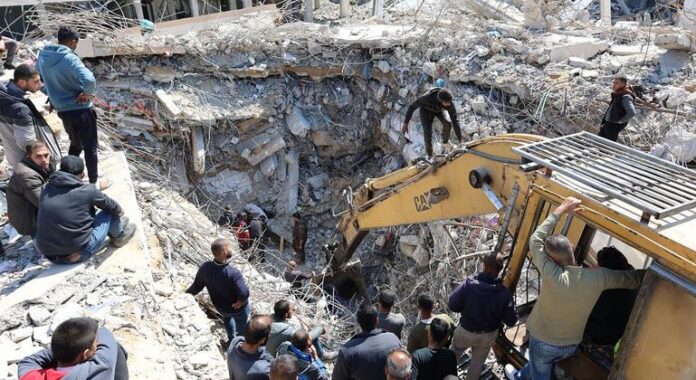
The destruction of key heavy machinery on Tuesday following reported Israeli airstrikes has brought rescue and recovery efforts to a standstill, making it even harder to reach the estimated 11,000 bodies still trapped under the debris.

According to local authorities, the strikes put a halt to all solid waste and debris removal operations, UN Spokesperson Stéphane Dujarric told journalists at a briefing in New York.

Until recently, bulldozers and other excavation equipment had been used in painstaking efforts to recover bodies from the wreckage.

One bulldozer operated by Atif Nasr – who before the war worked building and repairing roads – had become vital in the grim task of extracting the remains of loved ones from the rubble.

He was interviewed by a UN News correspondent in Gaza before the strike but now his grim but vital work has come to a standstill after his vehicle was destroyed.

Destroyed heavy equipment, including bulldozers.

Months trapped in rubble

The Dahdouh family managed to recover the remains of their son, Omar, from the ruins of their home, almost a year after he was killed in an airstrike which levelled their seven-story building.

Standing at the site, Omar’s brother, Moayad, shared the family’s ordeal.

“His body remained trapped under the rubble for nearly a year. After the war, we tried to retrieve him, but with the building so large and with no heavy machinery available, it was impossible.

“We searched everywhere for a bulldozer to reach the ground floor – where Omar had been – but during the war, Israeli forces destroyed or burned all the bulldozers or excavators that could have helped us.”

A decent burial

In southern Gaza’s Khan Younis, the Dajani family continues to live in what’s left of their destroyed home, where the bodies of three of their children remain buried.

Their father Ali remembers the time they died with a heavy heart.

“We fled to the beach area during the bombings. When we returned, the house was gone – and our children were still under the debris. We are forced to live here, but this is not life. It is unbearable,” he told our correspondent.

“We have no clean water, no food. We are lost. All we ask is to recover our children’s bodies. To bury the dead is sacred. That is all we want.”

Just days ago, Mr. Dajani spoke as diggers worked nearby to clear away the debris. That effort, too, has come to a halt for now.

A mounting humanitarian crisis

The UN estimates that approximately 92 per cent of all residential buildings in Gaza – around 436,000 homes – have been damaged or destroyed since the start of the conflict.

The resulting debris amounts to nearly 50 million tonnes – an overwhelming quantity of rubble that would take decades to remove under current conditions.

Humanitarian organizations warn that the delay in debris removal and body recovery is not only deepening psychological trauma across Gaza but also threatens to become a public health and environmental catastrophe.

Source link

Media Advisory: High Representative Kaja Kallas travels to Moldova

0
EDPB annual report 2024: protecting personal data in a changing landscape

Media Advisory: High Representative Kaja Kallas travels to Moldova

Source link

Media Advisory: High Representative Kaja Kallas travels to Moldova

0
Eurogroup President Paschal Donohoe will represent the Eurogroup at the Spring Meetings of the IMF and World Bank Group in Washington, DC

Media Advisory: High Representative Kaja Kallas travels to Moldova Source link

Source link

Media Advisory: High Representative Kaja Kallas travels to Azerbaijan

0
EDPB annual report 2024: protecting personal data in a changing landscape

Media Advisory: High Representative Kaja Kallas travels to Azerbaijan

Source link

Media Advisory: High Representative Kaja Kallas travels to Azerbaijan

0
Eurogroup President Paschal Donohoe will represent the Eurogroup at the Spring Meetings of the IMF and World Bank Group in Washington, DC

Media Advisory: High Representative Kaja Kallas travels to Azerbaijan Source link

Source link

Hunger stalks Ethiopia as UN aid agency halts support amid funding cuts

0
Hunger stalks Ethiopia as UN aid agency halts support amid funding cuts

In total, 3.6 million of the “most vulnerable” people in Ethiopia stand to lose WFP food and nutrition assistance unless funding arrives urgently, warned Zlatan Milisic, the UN agency’s Country Director.

“Over 10 million people in Ethiopia are acutely food insecure. This includes three million people displaced by conflict and extreme weather. Malnutrition rates are alarmingly high,” he told journalists in Geneva via video-link.

Child wasting scare

More than four million pregnant women, breastfeeding women and young children need treatment for malnutrition in Ethiopia. In Somali, Oromia, Afar and Tigray regions, child wasting has passed the 15 per cent emergency threshold.

WFP had planned to reach two million mothers and children with lifesaving nutrition assistance in 2025 but it has been forced to cut costs after receiving only half of last year’s funding.

“What is particularly important now is that our nutritious foods are running out,” Mr. Milisic explained. “So, we are stopping that programme unless something comes really fast and we are looking and we are hopeful, but nothing has come yet.”

Ration cuts the norm

In the first three months of the year, WFP provided food and nutrition support to more than three million people. This included 740,000 children and pregnant and breastfeeding women suffering from malnutrition.

In common with other humanitarian crises impacted by funding cuts, the UN agency has reduced food rations to reach the most vulnerable communities. For the past 18 months this has meant giving 60 per cent rations to most of the 800,000 refugees WFP serves and 80 per cent rations to “displaced and food-insecure – some severely food-insecure – Ethiopians for the past nine months”, Mr. Milisic continued.

Citing access challenges for humanitarians in Amhara region where there ongoing conflict is reported, the WFP official noted that aid operations had been disrupted, threatening relief supplies for more than 500,000 people. “Car hijacking, threats and theft are on the rise and pose serious risks to staff safety and impact the delivery of lifesaving assistance,” he continued.

Hostile environment

Media reports indicate that fighting is also continuing in Oromia region and tensions are rising in Tigray, where civil war killed an estimated 500,000 people from 2020 to 2022 as the Tigray People’s Liberation Front (TPFL) fought the federal army.

Despite the challenging funding and security situation, WFP continues to provide daily school meals to 470,000 children every month. This includes 70,000 children from refugee communities – with conflict-affected and food-insecure areas the focus of relief efforts in northern Ethiopia.

WFP also helps communities to prepare and protect their livelihoods in drought-prone Oromia, Somali and Southern regions, targeting over 200,000 people with early warning messages and cash transfers.

The agency requires $222 million between now and September to maintain its operations and to reach its target of 7.2 million people this year.

“We have the teams, the logistics, the capacities in place, partners, our staff; what we lack are the resources to act and the scale that this situation demands,” Mr. Milisic said.

Source link

#ForOurPlanet is bigger and bolder than ever before!

0
#ForOurPlanet is bigger and bolder than ever before!

It’s the global campaign everyone is talking about. Fresh from its successes in 2022 and 2024, #ForOurPlanet is back for a third season starting on April 22 with a brand new focus on circular economy: beyond recycling.  

Running through to European Green Week 3-4 June, the campaign calls on ‘all interested organisations’ — including UN agencies, embassies, ministries, non-profits and companies — to take action for our planet. 

The organisers of the 2025 #ForOurPlanet campaign promise taking action has never been easier. From cooking with leftovers to composting coffee grounds, from pop-up libraries to local repair cafes, there are dozens of ways that families, communities and businesses can get involved.  

For inspiration, look no further than LIFE Turn to e-circular, a 5-year €2.2 million project which closed last year. With its slogan ‘I’m still useful’ LIFE Turn to e-circular set itself a big challenge: to persuade consumers — especially families and young people — to cut down on the mountains of WEEE (waste electric and electronic equipment) dumped in the EU each year.  

Among other initiatives, the project set up 60 ‘reuse corners’ across Slovenia where people could take small electrical items for repair by experts. The team also toured the country in a mobile repair van giving new life to worn-out appliances, and set up a Facebook group to exchange opinions and share tips and guidelines for servicing. 

‘Computers, mobile phones, consumer electronics and small white goods were the most popular items for repair, but most of the items brought in were less than 5 years old.’ says Emil Šehić, Director of ZEOS, the Slovenian non-profit which ran the project. ‘A circular economy must go beyond simple reuse. We have to ask ourselves about why we buy things, about servicing and sharing. Products must be made to be useful for as long as possible.’ 

Also featuring in this year’s #ForOurPlanet campaign is C-MARTLife, a 7-year LIFE project to reduce, recycle and reuse plastic waste in the Flanders region of Belgium. Already the team have cut marine plastic litter by 75% and expect to see completely litter-free beaches by 2027. ‘Today’s waste products are tomorrow’s raw materials,’ says project coordinator Els Herremans. ‘We’re training circular ambassadors to spread the word — education and awareness among leaders and communities drives change!’  

#ForOurPlanet launches today, on Earth Day, April 22. For updates on activities in your area or ideas about how to get involved, visit the campaign website or email EU-FOR-OUR-PLANETec [dot] europa [dot] eu (EU-FOR-OUR-PLANET[at]ec[dot]europa[dot]eu). 

Source link