Monday, March 23, 2026
Home Blog Page 63

General Assembly approves UN regular budget of $3.45 billion for 2026

0

The budget – approved Tuesday by the 193 members of the General Assembly – authorizes $3.45 billion for the coming year, covering the Organization’s three main pillars of work: peace and security, sustainable development and human rights.

The budget largely reflects the Secretary-General’s proposed reduction of 15 percent in financial resources and almost 19 percent in staffing levels.

The regular budget funds the core activities of the UN, including political affairs, international justice and law, regional development cooperation, human rights, humanitarian affairs and public information.

It is separate from the budget for UN peacekeeping operations, which operates on a budget cycle from July 1 to June 30, while the regular budget follows the calendar year.

Consensus after intense negotiations

Addressing delegates as the Fifth Committee – the Assembly’s principal administrative and budgetary body – concluded negotiations, UN Comptroller Chandramouli Ramanathan praised the Committee for leading a complex and compressed process to its timely conclusion.

“It has been a year of challenges,” he said, noting that the Secretariat had been tasked with assembling a comprehensive budget in less than six weeks, producing hundreds of tables and answering thousands of questions from oversight bodies and Member States.

He stressed that, despite often difficult negotiations, the Committee had once again reached an agreement by consensus, characteristic of the budget process. “This is something remarkable that should not be underestimated,” he told delegates.

The challenges ahead

Looking ahead, the Comptroller warned that adoption of the budget marks the beginning – not the end – of a demanding implementation phase.

By January 1, 2026, he said, 2,900 positions will be eliminated, while more than 1,000 staff departures have already been finalized, which will require careful management to ensure that affected staff continue to receive their salaries and benefits during the transition.

Mr Ramanathan also welcomed what he described as a record level of potential advances from Member States for the 2026 budget and called for continued prompt payment of assessed contributions.

Originally published at Almouwatin.com

Afghanistan will remain a major crisis in 2026, warn the UN and its partners

0

Years of conflict, compounded by worsening food insecurity, recurring natural disasters, the impacts of climate change and mass returns of displaced people, have left around 45 percent of the population – or some 21.9 million people – in need of humanitarian assistance next year.

Among them, 17.5 million people – more than three-quarters of whom are women and children – received priority support as part of the coordinated response.

Basic nutrition and hygiene

Food security and sanitation remain among the most urgent needs.

THE Humanitarian needs and response plan in Afghanistan projects that during the 2025-2026 lean season, more than a third of the Afghan population will face crisis level or worse food insecurity, as defined by the Integrated Food Security Classification (IPC).

This means that many households will only be able to meet their minimum food needs by depleting their essential livelihoods – a sharp deterioration from the previous year.

The current drought has also led to the loss of almost 80 percent of rainfed wheat crops in several regions, leaving many families without food stocks for the winter.

Sanitary conditions are equally dire: an estimated 25 percent of households relied on unimproved water sources this year, while 37 percent lacked soap for basic hygiene.

The response will prioritize water, sanitation and hygiene needs in areas most affected by drought, cholera outbreaks, disasters and large-scale returns.

Returning home in case of crisis

Afghanistan faces one of the largest and fastest growing returnee displacement crises in the world, with an estimated five million people returning to the country this year.

More than 2.6 million Afghans have returned from Iran and Pakistan, largely due to tougher migration policies and deteriorating protection conditions.

Many returned to districts already struggling with poverty, food insecurity, drought and limited access to basic services, further straining local capacities.

More help for less

In 2026, humanitarian partners aim to reach more people with fewer resources.

The $1.71 billion required represents a 29 percent reduction from the resources needed in 2025. Still, it aims to be about 4 percent higher than last year’s target.

These changes were “driven by more precise prioritization, notable efficiency gains and a strategic move away from costly and less sustainable interventions,” notes the response plan.

Originally published at Almouwatin.com

Sexual violence against children is ‘entrenched, systemic and widespread’ in Democratic Republic of Congo, UNICEF warns

0

This surge comes against the backdrop of an escalating conflict in eastern DRC, where renewed fighting has triggered mass displacement, eroded protection systems and worsened an already grave humanitarian crisis – putting children at increased risk of abuse, exploitation and lasting trauma.

UNICEF has called repeatedly for an immediate cessation of hostilities and unhindered humanitarian access, emphasizing that conflict-driven displacement and poverty fuel violence against children across the country.

“Hidden scars”

THE report,The hidden scars of conflict and silence, documents cases in every province, highlighting that the crisis extends far beyond the active front lines. The highest figures are recorded in the conflict-affected eastern provinces – notably North Kivu, South Kivu and Ituri – where insecurity, displacement and weak protection services leave children extremely vulnerable.

Significant figures are also reported in Kinshasa and the Kasai regions, where poverty, food insecurity and school dropout rates increase exposure to exploitation, early marriage and abuse.

National figures compiled by child protection and gender-based violence providers show that more than 35,000 cases of sexual violence against children were recorded in the first nine months of 2025 alone. In 2024, almost 45,000 cases were documented – almost three times more than in 2022 – representing almost 40% of all cases of sexual violence reported in the country.

UNICEF warns that the real toll is likely much higher, as fear, stigma, insecurity and limited access to services prevent many survivors from reporting abuse.

Resilience must shape the response

The report centers survivors’ testimonies and data, emphasizing that each statistic represents a child whose life has been profoundly altered by violence.

Survivors describe shame, isolation and fractured self-esteem, while also expressing their determination to regain dignity and hope. Their testimonies, collected by social workers in several provinces, illustrate both the scale of the crisis and the resilience of those affected – a resilience that UNICEF says must shape the response.

“Social workers describe mothers walking for hours to clinics with daughters who can no longer walk after being assaulted” said Catherine Russell, Executive Director of UNICEF. “Families say fear of stigma and retaliation often prevents them from reporting abuse. Stories like these are repeated across provinces, revealing a deep-rooted crisis fueled by insecurity, inequality and weak support systems.”

Adolescent girls account for the largest and fastest share of reported cases, although boys are also victims of sexual violence and remain significantly underrepresented due to stigma and underreporting. Children with disabilities face increased risks as physical, social and communication barriers increase vulnerability and restrict access to care and justice.

Children express themselves

The scale of the crisis is increasingly reflected in the words of children.

“My role is not in armed conflict,” wrote a child from the DRC in a message to world leaders across the Prove It Matters campaignled by the Office of the Special Representative of the Secretary-General for Children and armed conflict.

As 2025 draws to a close, UN Special Representative Vanessa Frazier warned that children in the DRC and other conflict contexts face extreme levels of abuse throughout the year.

She pointed out that 2024 was already the worst year on record since the mandate was created almost 30 years ago, warning that such harm must not become the new normal. In her statement, she cited the DRC, alongside Gaza, Haiti, Myanmar, Nigeria, Somalia, Sudan and Ukraine, as contexts where children continued to experience “appalling levels of grave violations in 2025.”

“We cannot change 2025”

“We cannot change the year 2025, but we can act and be resolute to change the situation for children affected by armed conflict in 2026,” Ms. Frazier said.

She called on leaders to listen to children, respect international law, end violations, release children associated with armed groups and strengthen funding for child protection, justice and long-term recovery.

Funding cuts add to risk

Although UNICEF and its partners expanded their assistance between 2022 and 2024 – reaching more than 24,200 children in the worst-affected provinces last year – insecurity and global budget cuts have forced many safe spaces, mobile clinics and community protection programs to scale back or close.

By mid-2025, only 23 percent of gender-based violence interventions were funded, compared to 48 percent in 2022, putting hundreds of thousands of children at risk of losing essential services, including an estimated 300,000 children in conflict zones in the east.

“A protected child is a secure future,” another conflict-affected child told world leaders as part of the Prove It Matters campaign.


Originally published at Almouwatin.com

Sudan: UN warns of unprecedented child hunger in Darfur as fighting fuels refugee exodus

0

Sudan: UN warns of unprecedented child hunger in Darfur as fighting fuels refugee exodus

Source link

Sudan: UN warns of unprecedented child hunger in Darfur as fighting fuels refugee exodus

0

The war, which broke out in April 2023 between the Sudanese Armed Forces (SAF) and the paramilitary Rapid Support Forces (RSF), devastated civilian infrastructure, destroyed basic services and triggered one of the world’s largest displacement crises.

A nutritional survey conducted this month in the town of Um Baru in Sudan’s North Darfur state – one of the areas worst affected by fighting – found that more than half of children under the age of five are suffering from acute malnutrition.

These are among the highest rates ever recorded in a standardized emergency assessment, the United Nations Children’s Fund (UNICEF) said, warning that without urgent and unhindered humanitarian access, children are at immediate risk of death from preventable causes.

The survey examined nearly 500 children and found acute malnutrition rates of 53 percent, more than three times the World Health Organization’s emergency threshold. Eighteen percent of the children suffered from severe acute malnutrition, a life-threatening illness that can kill within weeks if left untreated.

When severe acute malnutrition reaches this level, time becomes the most critical factor,» said Catherine Russell, Executive Director of UNICEF. “The children of Um Baru are fighting for their lives and need immediate help.»

El Fasher’s movements fuel the crisis

North Darfur has become the epicenter of Sudan’s food crisis following intensifying fighting in and around El Fasher, the state capital and last major government stronghold in the region, which fell in October after more than 500 days of siege.

Many families currently sheltered in Um Baru are newly displaced people, having fled El Fasher and its surrounding areas since October.

UNICEF said many displaced children have not been able to benefit from routine vaccinations, particularly against measles, making them very vulnerable to the disease.. The survey also recorded crude emergency mortality rates, highlighting the deadly convergence of hunger, disease and lack of basic services.

Although vital supplies such as ready-to-use therapeutic foods have been prepositioned, UNICEF stressed that nutritional treatment alone is insufficient. Holistic health and nutrition services are urgently needed given the scale of the emergency, the agency said.

Sudan: UN warns of unprecedented child hunger in Darfur as fighting fuels refugee exodus

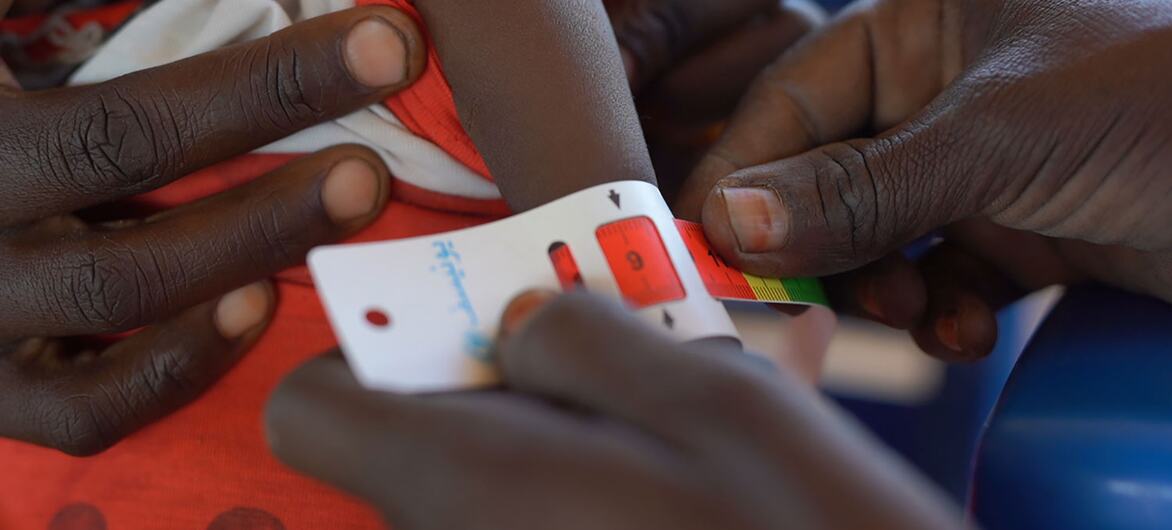
A child is screened for malnutrition at a UNICEF-supported nutrition center in North Darfur, Sudan, December 2025. The color red signifies severe acute malnutrition (SAM).

Access remains severely restricted

Humanitarian access remains one of the biggest obstacles.

On December 26, after lengthy negotiations, a UN team conducted its first security assessment in El Fasher since the siege began, spending several hours visiting the Saudi hospital and speaking with residents trapped in the city.

UN staff reported a severe lack of basic supplies and services.

Humanitarian convoys carrying food and medical aid have been prevented from entering El Fasher for months, forcing hundreds of thousands of civilians to flee while those who remain face extreme deprivation.

Refugee flows to Chad continue

As conditions deteriorate, movement outside Sudan’s borders is accelerating.

The Office of the United Nations High Commissioner for Refugees (UNHCR) reported that nearly 19,400 Sudanese refugees have crossed the border into eastern Chad since attacks intensified around El Fasher in late October.

Women and children make up 87 percent of new arrivalsMany arrive at the border exhausted and traumatized after fleeing violence, sexual abuse and extortion. Since the end of October, more than 2,700 unaccompanied or separated children and more than 1,100 people with disabilities have been registered.

Despite insecurity and movement restrictions along main roads, an average of around 250 refugees per day have entered Chad in recent weeks. UNHCR warned that cross-border movements expected to continue as fighting, economic collapse and protection risks intensify.

A recent security incident at the Tiné border post – where a Sudanese army drone struck a position held by Chadian troops – briefly forced the suspension of humanitarian activities, highlighting the unstable conditions under which aid is delivered.

Originally published at Almouwatin.com

LIVE: General Assembly decides on UN budget for 2026

0

Follow our live coverage as the General Assembly and its Fifth Committee meet today to finalize negotiations and vote on the United Nations regular budget for 2026. The Fifth Committee is responsible for administrative and budgetary matters, including the finances and personnel of the Organization. UN News app users can Click here and goes here for all our in-depth meeting coverage.

Originally published at Almouwatin.com

High blood pressure in adolescence a silent risk of atherosclerosis later

0
High blood pressure in adolescence a silent risk of atherosclerosis later

A blood pressure as low as 120/80 mm Hg in adolescence can be linked to a higher risk of atherosclerosis in middle age, according to a study led from Linköping University. The findings indicate that high blood pressure early in life plays an important role in the development of coronary artery disease.

Blood pressure – illustrative photo. Image credit: Pixabay (Free Pixabay license)

“High blood pressure is the largest modifiable risk factor for cardiovascular disease, which in turn is the largest single cause of death globally,” says Pontus Henriksson, senior associate professor of nutritional physiology, who led the study together with Karin Rådholm, senior associate professor of general medicine, both at Linköping University.

Efforts to prevent and treat high blood pressure, also called hypertension, are currently primarily focused on adult individuals. But a new Swedish study corroborates the idea that blood pressure can begin to impact health early in life.

In their study, the researchers used advanced CT scans, so-called CT coronary artery scans, to examine the coronary arteries supplying blood to the heart. These scans were performed on around 15,000 men aged 50 to 64 years in the large national population study SCAPIS. The method provides high-resolution images of the size of atherosclerosis plaques in the blood vessels, and what they contain, which affects how risky they are.

Just over 10,200 of these men had taken the military conscription tests when they were about 18 years old. At that time, taking these tests was mandatory in Sweden for men, which means that the data is representative of Swedish men of that age. The researchers examined whether there was a correlation between the blood pressure men had at the age of 18 and the health of their coronary arteries nearly 40 years later.

Clearly increased risk

Blood pressure is the force that occurs when the blood is pressed against the walls of the vessels. When the heart pumps blood, the pressure is higher. This is known as systolic pressure or upper pressure. When the heart relaxes and fills with blood for the next heartbeat, the pressure is lower and is called diastolic pressure or lower pressure. Blood pressure measurements state both numbers, in millimetres of mercury, mm Hg. A blood pressure below 140/90 mm Hg is considered normal according to Swedish guidelines.

“The most important thing we see is that those who had a systolic pressure of 140 or a diastolic pressure of 90 or more were at a clearly increased risk of coronary artery atherosclerosis later in life. But the risk increased already at 120/80 mm Hg,” says Karin Rådholm, who is also a General Practitioner at Vårdcentralen Kärna in Region Östergötland.

Some recent international recommendations have lowered the limit value for what counts as elevated blood pressure to 120/80 mm Hg. Lower limit values mean that more people are at risk than before.

In the present study, the researchers found that the higher the blood pressure at the time of the military conscription tests, the higher the risk of atherosclerosis in middle age, with an increased risk already at a blood pressure of 120/80 mm Hg. In their analyses, the researchers have taken into account other factors that affect the risk of cardiovascular disease.

“The study shows that the development of atherosclerosis begins early. The health care system needs to treat high blood pressure in young people more actively. The problem is that high blood pressure rarely causes symptoms. It’s not something you can feel, so if you don’t measure your blood pressure, you can have hypertension without knowing it,” says Karin Rådholm.

Risk factors more common today

Some of the factors increasing the risk of high blood pressure, such as overweight and poor fitness, are more common among young people today than when the study participants were young 40 years ago.

“In just one to two generations, the proportion of young people with obesity has increased significantly while fitness has decreased. So, these results are highly relevant for those who are young today,” says Pontus Henriksson.

Since only men were included in the study, it is not possible to draw conclusions about women’s risk for disease.

The study was funded by, among others, the Heart-Lung Foundation, the Knut and Alice Wallenberg Foundation, the Swedish Research Council, Vinnova and the Joanna Cocozza Foundation for Children’s Medical Research. Several other researchers from Linköping University also participated in the work on the study: Ángel Herraiz-Adillo, Hampus Eriksson, Carl Johan Östgren and Oskar Lundgren.

Article: Blood Pressure in Adolescence and Atherosclerosis in Middle Age: A population-based cohort study, Ángel Herraiz-Adillo, Hampus Eriksson, Viktor H. Ahlqvist et al, (2025), JAMA Cardiology , published online on 19 November 2025, doi: https://doi.org/10.1001/jamacardio.2025.4271

Written by Karin Söderlund Leifler

Source: Linköping University

Source link

High blood pressure in adolescence a silent risk of atherosclerosis later

0
High blood pressure in adolescence a silent risk of atherosclerosis later


A blood pressure as low as 120/80 mm Hg in adolescence can be linked to a higher risk of atherosclerosis in middle age, according to a study led from Linköping University. The findings indicate that high blood pressure early in life plays an important role in the development of coronary artery disease.

High blood pressure in adolescence a silent risk of atherosclerosis later

Blood pressure – illustrative photo. Image credit: Pixabay (Free Pixabay license)

“High blood pressure is the largest modifiable risk factor for cardiovascular disease, which in turn is the largest single cause of death globally,” says Pontus Henriksson, senior associate professor of nutritional physiology, who led the study together with Karin Rådholm, senior associate professor of general medicine, both at Linköping University.

Efforts to prevent and treat high blood pressure, also called hypertension, are currently primarily focused on adult individuals. But a new Swedish study corroborates the idea that blood pressure can begin to impact health early in life.

In their study, the researchers used advanced CT scans, so-called CT coronary artery scans, to examine the coronary arteries supplying blood to the heart. These scans were performed on around 15,000 men aged 50 to 64 years in the large national population study SCAPIS. The method provides high-resolution images of the size of atherosclerosis plaques in the blood vessels, and what they contain, which affects how risky they are.

Just over 10,200 of these men had taken the military conscription tests when they were about 18 years old. At that time, taking these tests was mandatory in Sweden for men, which means that the data is representative of Swedish men of that age. The researchers examined whether there was a correlation between the blood pressure men had at the age of 18 and the health of their coronary arteries nearly 40 years later.

Clearly increased risk

Blood pressure is the force that occurs when the blood is pressed against the walls of the vessels. When the heart pumps blood, the pressure is higher. This is known as systolic pressure or upper pressure. When the heart relaxes and fills with blood for the next heartbeat, the pressure is lower and is called diastolic pressure or lower pressure. Blood pressure measurements state both numbers, in millimetres of mercury, mm Hg. A blood pressure below 140/90 mm Hg is considered normal according to Swedish guidelines.

“The most important thing we see is that those who had a systolic pressure of 140 or a diastolic pressure of 90 or more were at a clearly increased risk of coronary artery atherosclerosis later in life. But the risk increased already at 120/80 mm Hg,” says Karin Rådholm, who is also a General Practitioner at Vårdcentralen Kärna in Region Östergötland.

Some recent international recommendations have lowered the limit value for what counts as elevated blood pressure to 120/80 mm Hg. Lower limit values mean that more people are at risk than before.

In the present study, the researchers found that the higher the blood pressure at the time of the military conscription tests, the higher the risk of atherosclerosis in middle age, with an increased risk already at a blood pressure of 120/80 mm Hg. In their analyses, the researchers have taken into account other factors that affect the risk of cardiovascular disease.

“The study shows that the development of atherosclerosis begins early. The health care system needs to treat high blood pressure in young people more actively. The problem is that high blood pressure rarely causes symptoms. It’s not something you can feel, so if you don’t measure your blood pressure, you can have hypertension without knowing it,” says Karin Rådholm.

Risk factors more common today

Some of the factors increasing the risk of high blood pressure, such as overweight and poor fitness, are more common among young people today than when the study participants were young 40 years ago.

“In just one to two generations, the proportion of young people with obesity has increased significantly while fitness has decreased. So, these results are highly relevant for those who are young today,” says Pontus Henriksson.

Since only men were included in the study, it is not possible to draw conclusions about women’s risk for disease.

The study was funded by, among others, the Heart-Lung Foundation, the Knut and Alice Wallenberg Foundation, the Swedish Research Council, Vinnova and the Joanna Cocozza Foundation for Children’s Medical Research. Several other researchers from Linköping University also participated in the work on the study: Ángel Herraiz-Adillo, Hampus Eriksson, Carl Johan Östgren and Oskar Lundgren.

Article: Blood Pressure in Adolescence and Atherosclerosis in Middle Age: A population-based cohort study, Ángel Herraiz-Adillo, Hampus Eriksson, Viktor H. Ahlqvist et al, (2025), JAMA Cardiology , published online on 19 November 2025, doi: https://doi.org/10.1001/jamacardio.2025.4271

Written by Karin Söderlund Leifler

Source: Linköping University


Source link

UN, US sign $2 billion humanitarian funding agreement for 17 crisis-hit countries

0
UN, US sign $2 billion humanitarian funding agreement for 17 crisis-hit countries

Speaking at the signing in Geneva, UN Emergency Relief Coordinator Tom Fletcher paid tribute to humanitarian workers operating under increasingly difficult conditions, describing the past year as “a very, very tough year for everyone engaged in humanitarian action.”

Despite the challenges, he said the agreement, known as a memorandum of understanding or MOU, offered grounds for optimism.

“Millions, millions more will get that support that they so badly need,” Mr. Fletcher said, adding that the funding would help save tens of millions of lives in the year ahead.

The agreement covers 17 crisis-affected countries: Guatemala, Honduras, El Salvador, Ukraine, Haiti, Nigeria, Ethiopia, South Sudan, Mozambique, Myanmar, the Democratic Republic of the Congo (DRC), Sudan, Bangladesh, Syria, Uganda, Kenya and Chad, as well as the UN Central Emergency Response Fund (CERF).

Saving lives

Mr. Fletcher said the true impact of this “landmark agreement” would be its impact on the ground. “A number that really matters…is that millions of lives will be saved,” he said.

He noted that the funding supports the UN’s 2026 plan to reach 87 million people with emergency assistance. That plan, he said, has been “hyper-prioritized” to reduce duplication, streamline bureaucracy and maximize efficiency across the humanitarian system.

The agreement is a major vote of confidence in the ‘Humanitarian Reset’ – which Mr. Fletcher had announced in March 2025 – to deliver aid faster, smarter and closer to people who need it most.

Accountability

Reform and accountability featured prominently in his remarks.

Mr. Fletcher emphasized that donors expect results, saying accountability mechanisms would ensure that “every dollar we spend” is tracked to confirm that it is saving lives. He also underlined that the agreement does not imply alignment on all issues but reflects a shared focus on urgent life-saving priorities.

He also highlighted the link between humanitarian action and diplomacy, calling for 2026 to be “a year of diplomacy and peacemaking.” Ending conflicts, he said, remains the most effective way to reduce humanitarian need.

“This lifesaving announcement is not the end of the process,” Mr. Fletcher concluded. “It is the beginning.”

Source link

Gaza hit by heavy rains as humanitarian response continues

0

Heavy seasonal downpours are worsening an already dire humanitarian situation, as torrential rains cause war-damaged buildings to collapse, flood tents and soak people’s belongings, OCHA said.

To respond quickly to flood warnings, a coordinated system of UN agencies and non-governmental organizations is distributing tents, tarpaulins, warm clothing, blankets and dignity kits across Gaza.

The UN and its partners are also mobilizing heavy equipment to remove overflowing sewage – which poses serious health risks – away from residential areas. OCHA warned that these conditions increased the risk of hypothermia, particularly in babies, as well as illnesses linked to sewage flooding.

Separately, humanitarian teams are helping hundreds of newly displaced people from the At Tufah neighborhood in Gaza City, where ongoing military operations have forced many residents to flee.

People who remain or have returned to the As Sanafour neighborhood in At Tufah – often due to a lack of space elsewhere – report significant difficulties accessing water, food and basic services.

Rescue operations continue

Other relief operations under the UN-coordinated humanitarian ceasefire plan continue.

Between December 23 and 26, partners working in water, sanitation and hygiene distributed tens of thousands of dignity kits, hygiene kits and shampoo bottles across Gaza, reaching some 150,000 people in need, according to OCHA.

As of Sunday, partners fighting food insecurity had reached more than a million people – about half of Gaza’s population – through 60 distribution points with December’s monthly general food aid.

At the same time, humanitarian partners distributed veterinary kits and animal feed to more than 2,000 families with livestock between December 9 and 26, helping to support local production and reduce dependence on aid.

Originally published at Almouwatin.com