In an update from Ukraine, the UN’s top aid official there, Assistant Secretary-General Matthias Schmale, reports that half the population in Kherson city, about 30,000 or more residents, have been without electricity for several days.
It’s not the only city without power, he told UN News on Wednesday, while on mission to southern Ukraine:
“The big challenge is how do you support people if electricity is cut off for several days, more than a week, let’s say, in a row, like is currently the case in Odesa,” he said.
“The authorities are fairly confident that they can deal with a couple of hours or even a couple of days in a row. but more than a week will be very challenging.”
The Humanitarian Coordinator said that one solution to the energy crisis was to ensure that schools and health centres are provided with generators and enough fuel, “so that people can gather there, if there is a crisis and if needed for several days in a row”.
Mr. Schmale was in the frontline city of Kherson on Wednesday, which lies directly across the Dnipro River from land occupied by Russian invaders in southern Ukraine.
While there, he met civilians at a UN humanitarian hub who had come seeking aid. One woman who is a power plant worker said she was very afraid of being targeted while on the job.
Matthias Schmale, UN Resident and Humanitarian Coordinator in Ukraine, on a fact-finding mission to Kherson.
‘Almost everything has been destroyed’
She said there were five houses left on her street where people still live and “almost everything has been destroyed.”
“I don’t even think about it. My home, my dogs, my cats. The neighbours left after their houses were hit. They left their dog for a week. They have been gone for three years now.”
A woman from Kherson who lives near the so-called red zone. She came to the UN’s humanitarian hub in search of critical aid.
Another woman who Humanitarian Coordinator Schmale met said she was from there Kherson Island district and was living without gas for heat or cooking. Her mother died in hospital 10 days ago due to a landmine accident.
Six months before that, her husband died while using public transportation in Mykolaiv, during a drone attack.
She started crying while remembering all the people she had lost, and fears that it may not be possible for her to return home.
‘I prefer to smile rather than cry’
“Kherson used to be a very industrial city, but not anymore,” said another pensioner. When she was young, she worked on building weather instruments for ships.
Mr. Schmale complimented her on her great sense of humour in the face of adversity. “I prefer to smile rather than cry. I’ve already had a lot of time to cry,” she replied.
“I just want to go back home and die there,” she added poignantly.
This elderly woman was born and has lived all her life in Kherson.
Speaking to the media outside the council chambers in New York, he highlighted the simmering tensions across Yemen and “spectacular new developments» in its eastern governorates which “increase the pressure”.
Since 2014, Yemeni government forces, backed by a Saudi-led military coalition, have been fighting Iran-backed Houthi rebels controlling the capital, Sanaa.
This month, forces affiliated with a separatist group called the Southern Transitional Council (STC) advanced toward two resource-rich governorates, Hadramawt and al-Mahra.
“As I said to Security Council, unilateral actions will not pave the way to peace», the general secretary said. “They deepen divisions. Strengthen positions. And increase the risk of broader escalation and further fragmentation.”
He warned that a full resumption of hostilities could have serious consequences for regional security.
“I urge all parties to exercise maximum restraint, ease tensions and resolve disputes through dialogue“, he said.
“This includes regional stakeholders, whose constructive engagement and coordination in support of UN mediation efforts are essential to securing collective security interests. »
A political solution is needed
The Secretary-General stressed that Yemen’s sovereignty and territorial integrity must be preserved.
He stressed the need for a “negotiated and lasting political settlement” that takes into account the aspirations of the entire population of the country and puts an end to the conflict.
The fighting has left thousands dead and triggered one of the world’s worst humanitarian crises. Nearly half the population – 19.5 million people – are in need of humanitarian assistance and almost five million people have been forced to flee their homes.
UN efforts to support the Yemeni people face enormous challenges, particularly in Houthi-controlled areas where “the operational environment has become untenable.”
Press briefing by the Secretary-General.
Release detained staff
The Secretary-General strongly condemned the continued arbitrary detention of 59 personnel of the United Nations and its partners, as well as staff of NGOs, civil society organizations and diplomatic missions, and called for their immediate and unconditional release.
The Houthis de facto Authorities recently referred three UN staff members to a special criminal court. They were charged in connection with the exercise of their official functions at the UN. He said the dismissal should be overturned and all charges should be dropped.
“The continued detention of our colleagues constitutes a profound injustice to all those who have dedicated their lives to helping the people of Yemen,” he said.
“The UN and its partners must never be targeted, arrested or detained while carrying out their official duties. We must be allowed to carry out our work without interference.”
Commitment to peace
The Secretary-General confirmed the UN’s commitment to providing life-saving assistance to millions of people across Yemen despite the challenges.
Since January, more than 5.3 million people have received food, nutrition, water and health assistance, and “with adequate funding and operational space, we can do much more.”
He recalled that the Yemeni parties were already close to peace, during the 2022 truce and agreed commitments in 2023. Although “subsequent developments have seriously complicated the situation”, the path to peace is possible and the UN remains committed to these efforts.
He called on all parties to engage constructively with the UN Special Envoy for Yemen, to “prioritize dialogue over violence and to avoid any unilateral action that could worsen this fragile situation,” adding that “the Yemeni people demand and deserve peace.”
The rules on the admissibility of an action for infringement of the copyright in a collective work must ensure that the right to effective judicial protection is observed, by not making the procedure provided for unnecessarily complicated or costly
DISCLAIMER: Information and opinions reproduced in the articles are the ones of those stating them and it is their own responsibility. Publication in The European Times does not automatically means endorsement of the view, but the right to express it.
DISCLAIMER TRANSLATIONS: All articles in this site are published in English. The translated versions are done through an automated process known as neural translations. If in doubt, always refer to the original article. Thank you for understanding.
Texas Attorney General Ken Paxton filed lawsuits against Samsung, LG, Sony, Hisense, and TCL yesterday, claiming their smart TVs secretly monitor viewers through software that captures screen images twice per second.
Watching smart TV – artistic impression. Image credit: Jonas Leupe via Unsplash, free license
Key takeaways:
ACR software captures television screenshots every 500 milliseconds and transmits viewing habits to manufacturers
Companies face fines up to $10,000 per violation, or $250,000 when affecting seniors
Opting out requires navigating through 15+ menu clicks across multiple settings screens
The legal action targets Automated Content Recognition technology that collects viewing data without proper user permission.
The attorney general’s office describes ACR as an “uninvited, invisible digital invader” that monitors everything displayed on screen—from streaming content to gaming consoles and Blu-ray players. This harvested information builds consumer profiles that manufacturers sell to advertisers for profit.
“Companies, especially those connected to the Chinese Communist Party, have no business illegally recording Americans’ devices inside their own homes,” Paxton stated. “This conduct is invasive, deceptive, and unlawful.”
The lawsuits accuse manufacturers of violating the Texas Deceptive Trade Practices Act through inadequate disclosure and deceptive consent practices. According to court filings, these televisions function as “a mass surveillance system sitting in millions of American living rooms” rather than simple entertainment devices.
During initial television setup, Samsung presents consumers with a single prominent button labeled “I Agree to all” after displaying four separate policy notices. Actually disabling the tracking requires locating and adjusting settings buried across different menu sections—a process involving at least 15 clicks through non-intuitive paths.
The complaint against Samsung details this maze: users must navigate Settings, Additional Settings, General Privacy, Terms & Privacy, Viewing Information Services, then finally select “Disable.” Additional toggles exist for Interest-Based Ads, Ad Personalization, and Privacy Choices scattered throughout the interface.
Texas argues this creates meaningless consent because privacy options “are scattered across four or more separate menus.” Meanwhile, manufacturers offer one-click enrollment during startup.
“Most consumers do not know, nor have any reason to suspect, that Samsung Smart TVs are capturing in real-time the audio and visuals displayed on the screen and using the information to profile them for advertisers,” the Samsung lawsuit states.
The attorney general contends that personalized content and targeted advertising don’t justify this data collection. Manufacturers demonstrate an “insatiable appetite for consumer data far exceeds what is reasonably necessary,” with the “invasive data harvesting” serving only to boost advertisement revenue rather than meeting genuine consumer needs.
Special attention targets Hisense and TCL due to their Chinese ownership. The Hisense complaint specifically alleges the company fails to disclose that Chinese law requires transferring collected consumer data to the People’s Republic of China upon government request.
Both Chinese manufacturer lawsuits claim the Communist Party could exploit ACR data “to influence or compromise public figures in Texas, including judges, elected officials, and law enforcement, and for corporate espionage by surveilling those employed in critical infrastructure.”
Paxton’s press release emphasized concerns about “China’s National Security Law, which gives its government the capability to get its hands on US consumer data.” The lawsuits describe Hisense and TCL televisions as “effectively Chinese-sponsored surveillance devices, recording the viewing habits of Texans at every turn.”
The Center for Digital Democracy raised similar concerns in a report last year, noting that “viewer surveillance is now built directly into the television set, making manufacturers central players in data collection, monitoring, and digital marketing.”
That organization found ACR systems bundled into new televisions during initial setup without fully explaining “its extensive role in monitoring and sharing viewer actions.” Consequently, most consumers remain unaware of the risks involved when activating these features.
Texas seeks restraining orders to halt collection, sharing, and selling of ACR data during litigation. The state also pursues monetary damages, with penalties potentially reaching $10,000 per violation—escalating to $250,000 when violations affect residents aged 65 or older.
Sony, LG, and Hisense responded to media inquiries by declining comment on pending litigation. Samsung and TCL have not yet issued statements.
The complaints expose sensitive information at risk, including passwords, bank details, and other personal data visible on television screens. ACR technology captures whatever appears on display, regardless of whether content comes from streaming services, cable television, or connected devices.
Privacy advocates have warned about smart TV tracking for years. Recent guides explaining how to escape smart TV advertisements and monitoring demonstrate growing consumer awareness of these practices.
These lawsuits arrive as television manufacturers increasingly rely on advertising revenue and data sales to supplement hardware profits. Industry observers note that modern televisions often sell at thin margins, with companies recouping costs through post-purchase data monetization.
The legal action spans multiple Texas district courts, with each complaint seeking both injunctive relief and substantial financial penalties. Court proceedings will determine whether manufacturers adequately informed consumers about surveillance capabilities and obtained legitimate consent for data collection.
Giving an update at the daily midday press briefing, UN deputy spokesperson Farhan Haq told correspondents that the “peacekeepers” were killed and nine others injured on Saturday when UNISFAThe Washington logistics base was the target of what the mission described as a “horrific drone attack.”
We do not yet know at this stage who led this strike, he added.
The ceremony in Abyei marked the official farewell of the fallen peacekeepers, whose remains will now be returned to Bangladesh.
UNISFA said their “sacrifice for peace will never be forgotten”, adding that the entire mission mourned alongside the families of the deceased and the government and people of Bangladesh.
The nine injured were evacuated from Kadugli to Abyei on the day of the attack and are being treated at the UNISFA hospital.
The mission said its top priority was to provide all necessary and appropriate medical care to the injured.
UNISFA strongly condemned this attack, extending its deepest condolences to the families of the victims and the Bangladeshi authorities, while wishing a speedy and full recovery to the injured.
New protective measures
UNISFA added that it had taken all necessary measures to protect its personnel and facilities, including the strengthening of protective measures at the Kadugli logistics base, and would continue to carefully assess the situation.
The Acting Head of Mission and Force Commander, Major General Robert Yaw-Afframvisited Kadugli on Monday.
UNISFA also reiterated the Secretary-General’s message book this weekend, emphasizing that attacks targeting peacekeepers may constitute war crimes under international law and that those responsible must be held accountable.
The mission was created in 2011 and his mandaterecently extended for one year, includes strengthening the capacity of the Abyei Police Service in the disputed and oil-rich region, monitoring and verifying the redeployment of forces from the region, facilitating the delivery of humanitarian aid and protecting civilians.
Nearly 4,000 soldiers and police are on duty, alongside civilian personnel.
The European Commission has presented a new set of measures to support the automotive sector in moving towards clean mobility. The European automotive sector has been key to Europe’s economy for decades, employing millions of people and driving technological innovation. Today, it is at a critical turning point, challenged by rapid technological changes and […]
The European Commission has presented a new set of measures to support the automotive sector in moving towards clean mobility. The European automotive sector has been key to Europe’s economy for decades, employing millions of people and driving technological innovation. Today, it is at a critical turning point, challenged by rapid technological changes and […]
The European Commission has presented a new set of measures to support the automotive sector in moving towards clean mobility.
The European automotive sector has been key to Europe’s economy for decades, employing millions of people and driving technological innovation. Today, it is at a critical turning point, challenged by rapid technological changes and increasing competition. To address these challenges, the new measures set out ambitious and pragmatic rules for the industry and EU countries to adapt to clean mobility and a low-carbon economy, while ensuring the competitiveness of the industry.
Key proposals include
revision of the CO2 standards for cars, vans, and heavy-duty vehicles to help manufacturers meet their 2035 targets
greening corporate fleets to accelerate the uptake of zero- and low-emission vehicles
battery booster strategy with €1.8 billion for a fully EU-made battery value chain
automotive omnibus to ease administrative burdens, cut costs and introduce a new vehicle category of ‘small affordable cars’
revised car labelling rules for consumers to have complete information about the cars’ emissions, empowering them to make more informed choices when buying a car
The proposals build on the automotive action plan and strategic dialogue on the future of the automotive industry. The dialogue, launched in January 2025, brings together industry representatives, social partners, EU countries, regions, and civil society. So far, three dialogue meetings have taken place, providing a platform to discuss the challenges and opportunities the sector faces.
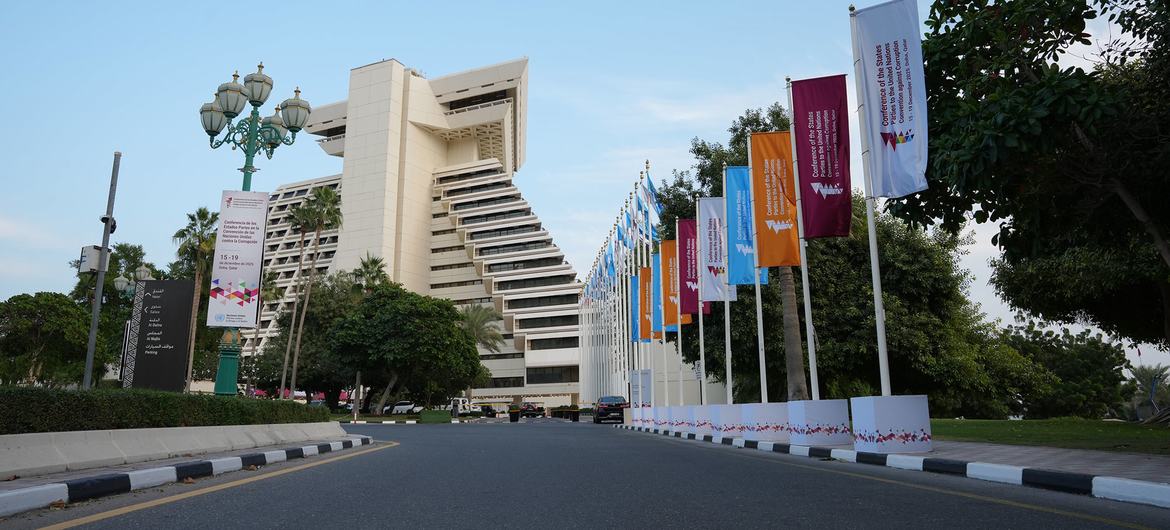
Heads of state, civil society and private sector leaders will discuss the most pressing issues related to corruption and how to combat it at a meeting UN conference against corruption (COSP11) this week in Doha, Qatar.
Taking place from December 15-19 this year, COSP is the world’s largest international gathering dedicated to the fight against corruption and economic crime.
This session, entitled Shaping the integrity of tomorrowwill address the role of AI and new technologies in meeting the realities of today’s complex crime patterns.
The links between corruption and financial and organized crime will also be discussed, as well as steps countries can take to improve the transparency of their public financial systems and efforts to combat corruption in the private sector.
Technology can help or harm
“Rapid advances in technology provide corrupt actors with new tools to hide assets, falsify documents, and move between jurisdictions.“, warned John Brandolino, acting executive director of the United Nations Office on Drugs and Crime (UNODC).
However, he acknowledged that technology can also be a “transformative” force against corruption, notably by facilitating investigations.
“Governments must strive to reap the benefits of revolutionary solutions“, said Mr. Brandolino, adding that these technological solutions must respect human rights and close the loopholes that allow criminals to misuse digital tools.
Why COSP is important
Corruption deprives people of their basic needs such as education, healthcare, clean water and infrastructure.
The conference aims to translate international commitments into action by assessing how countries implement the anti-corruption treaty and strengthening cross-border cooperation.
The decisions of the COSP have led to real changes, notably the creation of a peer review system which helped 146 countries improve their anti-corruption laws and policies.
“Shaping the integrity of tomorrow is about protecting people from exploitation through crime and corruption,” said Mr. Brandolino. “And it’s also about safeguarding our common aspirations for the future. »
Location of the eleventh session of the Conference of States Parties to the United Nations Convention against Corruption taking place in Doha, Qatar.