The State Duma, the lower house of the Russian parliament, has passed a bill banning foreigners from using the services of Russian surrogate mothers, Reuters reported. Under the new legislation, a child born to a surrogate mother in Russia will automatically receive Russian citizenship.
Married couples in which one spouse is a Russian citizen will be able to use the services of surrogate mothers in the future. Paid surrogacy is legal in Russia, but the practice has been criticized by religious organizations, who say it amounts to the commercialization of childbearing.
The Chairman of the State Duma, Vyacheslav Volodin, stated that the new legislation aims to protect Russian children.
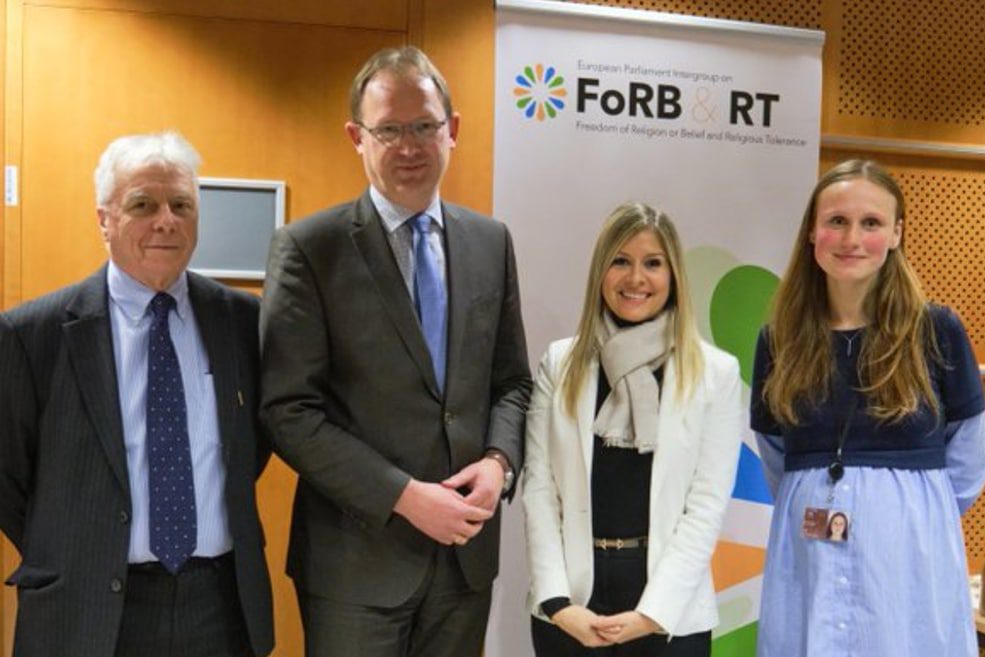
European Parliament: MEP Bert-Jan Ruissen, Rachel Bayani and Anastasia Hartman on the right, a deported Baha’i on the left
In the shadow of the Football World Cup in Qatar, voices of non-Muslims have been heard and listened to at the European Parliament at a conference organized on 6 December by Dutch MEP Bert-Jan Ruissen under the title “Qatar: Addressing the limitations of religious freedom for Bahá’ís and Christians.”
This initiative of MEP Bert-Jan Ruissen, a member of the EP Intergroup on Freedom of Religion or Belief, was a followup of the resolution of the European Parliament on the “Situation of human rights in the context of the FIFA football world cup in Qatar” adopted on 24 November last plenary session. On that occasion, the Parliament called “on the Qatari authorities to ensure respect for the human rights of all persons attending the 2022 World Cup, including international guests and those living in the country, including for their freedom of religion and belief.”
During the conference, the situation of the Baha’is was addressed by Rachel Bayani from the office of the Baha’i International Community in Brussels. Here is a large excerpt of her intervention:
“Baha’is have lived in Qatar for almost 80 years. They are a very diverse community with members of Qatari citizenship or from other nationalities. They all consider Qatar their home.
Nevertheless, the community has suffered instances of discrimination and human rights violations over many decades. The cumulative effect of these acts has now become untenable because they threaten the very viability of the community. Over the decades, and more intensely in recent years, Baháʼís in Qatar have approached the Qatari authorities directly and with an open hand to seek remedy in areas where the State falls short of its obligations. Although various assurances and promises have periodically been given, they have not materialised.
More and more Baháʼís have been forced to leave the country. The human rights violations they suffer are of various types, ranging from surveillance, the harassment of school children and students, the bulldozing of a Baha’i cemetery, violations in the employment sector and the sudden termination of work contracts, the non-recognition of personal status or marriage laws, the impossibility of family reunification, the refusal of a residency permit or the blacklisting for ‘security’ reasons because of their religious affiliation.
In some cases, Baháʼís resident in the country for generations are simply instructed to leave with no explanation whatsoever, are deported or have been refused permission to re-enter the country. Baha’i leadership positions are targeted with for instance the Chair of the National Assembly of the Baha’i of Qatar who is a Qatari national having recently been presented with a court ruling sentencing him in absentia to a period of imprisonment and a fine, and this clearly because of his religion.
In the employment sector, Baháʼís are systematically denied ‘certificates of good conduct’ needed for employment. This is a clearance to be obtained from state security. Baha’is are being refused these certificates though they have not committed any crime or misdemeanour. There is no transparency to the clearance process nor any right or means of appeal. Because employment is the key to residency, many families have lost their residency, and ultimately had to leave the country.
These problems, characterised as incidental by the authorities, and even presumed to be so by the Baháʼís themselves, gradually took the form of a pattern that was impossible to ignore or explain away.
The Baha’i community being invisibly and noiselessly suffocated
The Baha’i community knows all too well what it looks like when a country wants to extinguish an entire community. We have the example of Iran and how it systematically carries out its effort to slowly suffocate a community economically, socially and intellectually. One of the characteristics of that strategy is to proceed in a very calculated manner with the purpose to evade international attention.
The Baha’i community in Qatar counts in the low hundreds today. If it were not for the discrimination and the fact that many were forced to leave the country, the Baha’i community would today be much larger. So it is the survival of the community that is at stake.
His Highness Sheikh Tamim Bin Hamad Al Thani, the Emir of Qatar, said during his address to the United Nations General Assembly some weeks ago that the State of Qatar wanted to celebrate our common humanity, no matter how diverse our religions and nationalities may be. The Baha’i International Community welcomes these noble sentiments. And we thank His Highness for sharing them with the world. We look forward to a time when these words become reality with respect to the Baha’i community living in Qatar.”
And MEP Bert-Jan Ruissen concluded by saying “I call on Qatar to uphold therights of the Baha’i communityand to ensure that Baha’is areno longer expelled from thecountry or forced to leave.”
QATAR“I was expelled for life from Qatar because I was a Baha’i”
A Baha’i deported in 2015 denied entry in the country to attend the Football World Cup in November 2022
QATAR – In the shadow of the Football World Cup, a forgotten issue: the situation of the Baha’is
During the conference organized on 6 December by Dutch MEP Bert-Jan Ruissen under the title “Qatar: Addressing the limitations of religious freedom for Bahá’ís and Christians,“ a Baha’i (*) testified about his deportation from the country in 2015:
“My wife and I moved to Qatar from Kuwait in 1979. My wife, who was brought up in Qatar, wanted to be back where her family lived and had been serving the community since moving there in the early 50s.
I started teaching English language in a national oil and gas company. Later on, I moved to other jobs, all involved with training and development of Qatari nationals. I lived there very happily for 35 years until I was expelled in May 2015.
Our three children all went to government schools and are fluent in Arabic. Although they studied in British universities, they all chose to return to Qatar where they had been raised and where their friends were.
We were all well integrated but despite this, I was ordered to leave in May 2015. No official reason was ever presented to me for such a decision but I believe it was due to my activities as a Baha’i.
Freedom of expression and proselytism
Indeed, we, as Baha’is, do not hide or deny our religion and share with anyone interested, the principles and teachings of our faith. Our activities are mainly educational, aimed at a process of spiritual and moral education that builds capacity to serve the community and thus work for the betterment of the world. Our activities are very transparent and open to anyone, regardless of race, religion and nationality, who wants to benefit from them.
My understanding is that such activities have been misinterpreted by the authorities as proselytism, which is forbidden by law in Qatar.
In the Baha’i faith, imposing one’s belief on others, using any form of intimidation or offering material inducements to conversion is forbidden. However, everybody is welcome to join in Baha’i activities and the community if they wish.
When a Baha’i shares his or her belief with another person, the act is not an attempt to convince or otherwise prove a particular point. It is the expression of the sincere desire to engage in meaningful conversation about fundamental issues of existence, to seek the truth, to remove misconceptions and to foster unity. Baha’u’llah tells us that “The well-being of mankind, its peace and security are attainable unless and until its unity is firmly established.”
How my deportation was planned behind the scenes
In September 2013, my employers applied for the renewal of my resident permit which was due to expire in November. I was told that they had been unable to complete the renewal due to “problems with the system.” My employers continued regular followup but each time was told to “wait.”
In March 2014, my employers had to terminate my work contract as the administrative issue had been left without any solution. I contacted the British Embassy but they told they were unable to assist. I approached a lawyer who told me that law firms had been instructed not to take on cases related to security.
In April 2014, the Ministry of Interior told me that my departure was being treated as deportation under instruction from the State Security with no reason given. I appealed the decision and approached the National Human Rights Committee. I reported to the Immigration Department every week for several months as I was told.
In March 2015, The Immigration Department informed me that there would be no written response to my appeal and the security authorities had considered my presence was “not in the interest of the state.”
I was expelled on 24 May 2015. My wife remained in Qatar with our children to take care of her own elderly parents.
Banned from Qatar for life
It is important to mention that when I lived in Qatar, other Baha’is were expelled from the country and many of our youth were denied employment opportunities. These young people, many of whom were born and raised in Qatar and knew no other home, had no other choice but to leave. Some, who subsequently attempted to return, were denied entry and were blacklisted.
In December 2015 and August 2016, I applied for a visitor visa through Qatar Airways but both applications were rejected because they had not been approved by the security authorities.
On 17 November 2016, I was denied entry in the country when transiting at Hamad International Airport.
In September 2022, my daughter approached the British Embassy asking them to request, on compassionate grounds, a visit for me as my wife had been diagnosed with cancer. The application was denied.
In October 2022, as Qatar had openly declared that all were welcome to attend the World Cup, I applied for a Hayya card which required to enter the country and attend the football matches. My application was twice rejected.
(*) HRWF withholds his name for security reasons for his family.
ImageImage copyright: Iwona Krzysztofek, Well with Nature /EEA
Today, the European Commission is publishing its first Zero Pollution Monitoring and Outlook report setting pathways to cleaner air, water and soil. The Commission report, together with the European Environment Agency’s monitoring assessment, shows that EU policies have contributed to reducing air pollution as well as pollution from pesticides. However, in other areas such as harmful noise, nutrient pollution or municipal waste generation, problems persist. The results show that overall much stronger action is necessary if the EU is to achieve 2030 zero pollution targets, by adopting new anti-pollution laws and better implementing existing ones.
Progress towards 2030 targets but pollution levels still too high
The progress towards the six ‘zero pollution’ targets is mixed. Pollution is decreasing from pesticides, antimicrobials and marine litter. Not much progress has been made for pollution from noise, nutrients and waste. On the other hand, the overall high rates of compliance with the EU drinking and bathing water pollution standards (>99% and >93% respectively) are encouraging. For 2030, we can achieve most of the targets if additional efforts are made.
However, current pollution levels are still far too high: over 10% ofpremature deaths in the EU each year are still related to environmental pollution. This is mainly due to air pollution, but also to noise pollution and exposure to chemicals, which is likely to be underestimated. The pollution similarly damages biodiversity.There are significant differences between Member States, with premature deaths levels around 5-6% in the North and 12-14% in the South and East of Europe.
The Commission has by now delivered or advanced on all 33 of the announced actions in the Zero Pollution Action Plan of 2021. In order for them to have an impact, the Commission report calls for the swift agreement and adoption of the legislative proposals to reduce harmful pollution, and the improved implementation of the existing ones at local, national and cross-border level. Notably, it finds that if the EU implements all relevant measures proposed by the Commission, the number of premature deaths due to air pollution would fall by up to 66% in 2030 compared to 2005, with benefits of clean air measures outweighing costs and leading to overall GDP gains. The report also points to the importance of promoting global initiatives and supporting third countries in their efforts towards reducing pollution.
Executive Vice-President for the European Green Deal Frans Timmermans said:
“Once again the evidence presented today shows us that the benefits of acting for clean air, water and soil are far greater than the investment. This is also what citizens want, as more than 80% are worried about the health and environmental problems caused by pollution”.
Commissioner for the Environment, Oceans and Fisheries Virginijus Sinkevičius said:
“Today we are presenting compelling evidence about the results of ambitious action to reduce pollution. The reports show that the EU’s zero pollution ambition is realistic and possible, but only if we speed up adoption of legislative proposals linked to pollution, and step up implementation of the existing EU pollution laws. I also hope that today’s reports will help convince our global partners to agree on equally ambitious targets in the context of the upcoming COP15 negotiations on biodiversity”.
Executive Director of the European Environment Agency HansBruyninckx added:
The EEA’s first zero pollution monitoring report shows that Europe is making progress in reducing and preventing pollution in key areas, such as air, bathing water and drinking water, and is using less hazardous pesticides. But, to deliver on our 2050 vision, we need progress in reducing excess nutrients in the environment and the health impacts of noise and chemicals, and identifying emerging issues earlier.
EEA monitoring assessment shows mixed picture
Good progress in reducing the health impacts of air pollution has been achieved, with a 45% fall in premature deaths since 2005. If this past trend continues, the EU will be on track to meet the target of a 55% reduction.
The area of land negatively affected by air pollution has fallen by 12% since 2005. If this past trend continues, the EU will not meet the target of a 25% reduction.
Little progress has been made in reducing nutrient losses since the 2012-2015 baseline. Based on the limited progress to date, the EU is not on track to achieve the 50% reduction target.
The use and risk of pesticides has fallen by 14% since the baseline period of 2015-2017, while the use of more hazardous pesticides has fallen by 26%. Based on this recent trend, the EU is on track to meet its target of cutting the use and risk of pesticides, and the use of the more hazardous pesticides, by 50%.
Sales of veterinary antimicrobials have fallen by 18% since 2018. If this past trend continues, the EU will be on track to meet the target of a 50% reduction.
There was no significant reduction in the share of people impacted by transport noise between 2012 and 2017. With no indications of noise levels having declined significantly since then, the EU is unlikely to meet the target of reducing the share of people chronically disturbed by transport noise by 30%.
Provisional analysis suggests that the amount of plastic litter at sea has fallen in recent years. While this is encouraging, consistent and comprehensive EU-wide data is needed to assess progress towards the targets of reducing plastic litter at sea by 50% and reducing releases of microplastics into the environment by 30%.
Total waste generation has slowly increased between 2010 and 2018, with a sharp drop in 2020 related to the pandemic. Residual municipal waste (waste that is not recycled or reused) generation has been stable since 2016. If these waste streams do not decline significantly in coming years, the EU will not meet the targets of significantly reducing total waste generation and of reducing residual municipal waste by 50%.
Pollution is the largest environmental cause of multiple mental and physical diseases, and of premature deaths, especially among children, people with certain medical conditions and the elderly. Pollution is also one of the five main threats to biodiversity.
The monitoring and outlook assessment serves as a baseline for future reviews of progress the EEA will conduct, the next being scheduled for 2024, to support the European Commission and Member States in delivering the targets. It will also inform future policies designed to support the zero pollution ambition — to reduce pollution to the extent that it no longer presents a risk to human health and the environment by 2050.
Image Image copyright: Micheile dot com on Unsplash
Alarming degradation of biodiversity has prompted initiatives for financial investments in nature both globally and in Europe. Besides strengthening biodiversity, such investments can have other important benefits, such as supporting climate action, food security, and improving quality of life in cities. European Environment Agency’s (EEA) new briefing highlights that better data, impact analysis and coordination mechanisms are needed to make nature financing effective.
The EEA briefing ‘Financing nature as a solution’ draws attention to the conditions of effective financing of nature-based solutions. The briefing contributes to bridging the gap between analysis on the state of nature in Europe and development of effective biodiversity finance.
To support environmental policy, there is a clear need to considerably increase public and private investments in protecting and restoring nature. However, these investments are challenged by several barriers, such as lack of sufficient data and standardised impact metrics.
According to the EEA briefing, key improvements would create more favourable conditions for effective nature finance. First, biodiversity data needs strengthening to allow for measuring impacts of investments. Moreover, nature and financial data need to be integrated spatially to allow for effective targeting of interventions, such as nature restoration.
Also, there is a need for standardised models about the environmental impacts of different business activities. The EEA briefing notes that while some activities are clearly destructive at local scale, others can create a variety of lower pressures, and some can have mixed impacts or different impacts on different scales.
Finally, protecting and restoring biodiversity requires different types of finance from different actors. Innovative and differentiated mechanisms and finance instruments are therefore needed to attract a broad range of partners, the EEA briefing says.
The findings of this EEA briefing ‘Financing nature as a solution’ will be discussed at a joint online event with the European Investment Bank at Biodiversity Conference of the Parties COP15 on 14 December 2022. More information is available on the event and registration page.
While emissions of methane across the European Union have decreased over past years, the overall reduction in emissions needs to accelerate to meet 2030 and 2050 EU climate objectives. Increased global efforts to reduce methane emissions would also be needed to mitigate global warming in the short term, according to a European Environment Agency (EEA) briefing on trends and drivers of methane emissions published today.
The briefing also includes a methane emissions visualisation tool where users can see country CH4 emissions as reported in their greenhouse gas inventories.
According to the latest available official data, emissions of CH4 is down by 36% in the EU in 2020 compared with 1990 levels, furthering a 30-year downward trend.
The largest reductions in emissions occurred in energy supply, which includes energy industries and fugitive (leaked or uncaptured emissions) (-65%), waste (-37%) and agriculture (-21%).
Overall, reductions in methane emissions have been significant and reflect:
a decrease in agricultural livestock numbers and increased efficiency in the agricultural sector;
lower levels of coal mining and post-mining activities;
improved oil and gas pipeline networks;
less waste disposal on land, and
an increase in recycling, composting, landfill gas recovery, and waste incineration with energy recovery.
The observed emission reductions have contributed not only to climate change mitigation but also to better air quality, because of synergies in the reduction of greenhouse gases and air pollutants.
Still, despite the progress, methane concentrations are increasing rapidly and reductions need to be stepped up across all sectors. Methane is substantially stronger at trapping heat than carbon dioxide (CO2) and also has an average shorter lifetime than CO2.
Reducing CH4 emissions globally is a low hanging fruit for the current generation, using existing practices and technologies. Policies aimed at CH4 emission reductions will deliver faster benefits from the climate mitigation perspective in the short term. Reducing CH4 emissions will also lead to lower ozone formation and local air pollution, which would bring health-related benefits thanks to cleaner air.
Continued reductions in other greenhouse gases (GHG) are also essential to achieving the long-term climate goals. The EEA briefing notes the EU has put in place overarching and sector-specific policies to reduce GHG emissions, including methane emissions representing 12% of total EU emissions in 2020 — half of which are from agriculture.
As countries implement EU and national legislation, GHG emissions will decrease further. However, to help achieve the EU’s 2030 and 2050 climate objectives, the EU needs to reduce emissions more rapidly, including via policies and measures aimed at reducing methane emissions.
The EEA briefing also notes several policy options and technologies are available to reduce emissions and improve not only the climate and environment but also energy security. For example, landfill gas recovery from waste or biogas produced from agricultural manure can be used to produce electricity and heat in the energy sector.
Preventing and addressing leaks from oil and natural gas systems remain a challenge and have become urgent especially in wake of the recent leaks due to explosions in the two Nord Stream natural gas pipelines in the Baltic Sea.
International frameworks and initiatives are also key to reducing methane emissions and mitigating climate change globally. Ambitious EU policies alone will not be sufficient to ensure that we do not exceed the 1.5°C global rise in temperature goal, as the EU accounts for 7% of global greenhouse gas emissions and for less than 5% of global CH4 emissions.
While emissions of methane across the European Union have decreased over past years, the overall reduction in emissions needs to accelerate to meet 2030 and 2050 EU climate objectives. Increased global efforts to reduce methane emissions would also be needed to mitigate global warming in the short term, according to a European Environment Agency (EEA) briefing on trends and drivers of methane emissions published today.
The briefing also includes a methane emissions visualisation tool where users can see country CH4 emissions as reported in their greenhouse gas inventories.
According to the latest available official data, emissions of CH4 is down by 36% in the EU in 2020 compared with 1990 levels, furthering a 30-year downward trend.
The largest reductions in emissions occurred in energy supply, which includes energy industries and fugitive (leaked or uncaptured emissions) (-65%), waste (-37%) and agriculture (-21%).
Overall, reductions in methane emissions have been significant and reflect:
a decrease in agricultural livestock numbers and increased efficiency in the agricultural sector;
lower levels of coal mining and post-mining activities;
improved oil and gas pipeline networks;
less waste disposal on land, and
an increase in recycling, composting, landfill gas recovery, and waste incineration with energy recovery.
The observed emission reductions have contributed not only to climate change mitigation but also to better air quality, because of synergies in the reduction of greenhouse gases and air pollutants.
Still, despite the progress, methane concentrations are increasing rapidly and reductions need to be stepped up across all sectors. Methane is substantially stronger at trapping heat than carbon dioxide (CO2) and also has an average shorter lifetime than CO2.
Reducing CH4 emissions globally is a low hanging fruit for the current generation, using existing practices and technologies. Policies aimed at CH4 emission reductions will deliver faster benefits from the climate mitigation perspective in the short term. Reducing CH4 emissions will also lead to lower ozone formation and local air pollution, which would bring health-related benefits thanks to cleaner air.
Continued reductions in other greenhouse gases (GHG) are also essential to achieving the long-term climate goals. The EEA briefing notes the EU has put in place overarching and sector-specific policies to reduce GHG emissions, including methane emissions representing 12% of total EU emissions in 2020 — half of which are from agriculture.
As countries implement EU and national legislation, GHG emissions will decrease further. However, to help achieve the EU’s 2030 and 2050 climate objectives, the EU needs to reduce emissions more rapidly, including via policies and measures aimed at reducing methane emissions.
The EEA briefing also notes several policy options and technologies are available to reduce emissions and improve not only the climate and environment but also energy security. For example, landfill gas recovery from waste or biogas produced from agricultural manure can be used to produce electricity and heat in the energy sector.
Preventing and addressing leaks from oil and natural gas systems remain a challenge and have become urgent especially in wake of the recent leaks due to explosions in the two Nord Stream natural gas pipelines in the Baltic Sea.
International frameworks and initiatives are also key to reducing methane emissions and mitigating climate change globally. Ambitious EU policies alone will not be sufficient to ensure that we do not exceed the 1.5°C global rise in temperature goal, as the EU accounts for 7% of global greenhouse gas emissions and for less than 5% of global CH4 emissions.
HRWF (28.11.2022) – On 24 November, the website of the Verkhovna Rada of Ukraine published the text of draft law No. 8221 banning the activities of the Russian Orthodox Church represented on the territory of Ukraine by the Ukrainian Orthodox Church (UOC).
The bill outlaws the activity of any religious organizations or institutions, which are part or in any way accountable to the Russian Orthodox Church “in canonical, organizational and other issues,” the European Solidarity Party said on Telegram.
The party said that the bill aimed at preventing threats to the national security of Ukraine and providing order, and described “the liberation of Ukraine from the Russian Orthodox Church as yet another step towards independent Ukraine.”
The authors of draft law No. 8221 “On ensuring the strengthening of national security in the sphere of freedom of conscience and activities of religious organizations” propose a ban on the activities of
the Russian Orthodox Church,
religious organizations (associations) that are directly or as constituent parts of another religious organization (association) included in the structure (are part of) the Russian Orthodox Church,
religious centers (management), who are part of or recognize (declare) in any form subordination in canonical, organizational, and other matters to the Russian Orthodox Church.
It is assumed that all transactions related to the use of property (renting, hiring, leasing, etc.), the validity period of which has not expired, concluded between residents of Ukraine and the relevant foreign religious organization, as well as with legal entities, the owner, participant, shareholder of which it is, they are terminated prematurely.
The peculiarities of the naming of religious organizations are established, in particular, the possibility for a religious organization to use the word “Orthodox” in its name (both full and abbreviated), in the name, only if this religious organization is subordinate in canonical and organizational matters to Orthodox Church of Ukraine.
Alexey Goncharenko, a Ukrainian Verkhovnaya Rada deputy from the European Solidarity Party, has asked Prime Minister Denis Shmygal to deprive the Ukrainian Orthodox Church/ Moscow Patriarchate of the right to rent the Kyiv Lavra of the Caves and the Pochayev Lavra.
If this law is adopted, the famous monasteries Kyiv-Pechersk, Holy Assumption Pochaiv and Sviatohirsk Lavra would become the property of the Orthodox Church of Ukraine (OCU), founded in 2018 under President Poroshenko and affiliated with the Patriarchate of Constantinople.
The European Environment Agency’s (EEA) assessments have shown that Europe and world face unprecedented environment and climate challenges that require ambitious policy responses, such as the European Green Deal. Published today, EEA Signals 2022 looks at Europe’s commitments for sustainability and energy system from the perspective multiple, interconnected crises.
Europe is recovering from the COVID-19 pandemic, faced with a war in Ukraine and committed to ambitious goals of the European Green Deal for protecting the climate, nature and people’s health. ‘EEA Signals 2022 – Staying on course for a sustainable Europe’ provides a snapshot of the Agency’s assessment and data that are linked to this context and making Europe’s energy system more secure and sustainable.
The ‘EEA Signals’ is a based on a series of short articles based on previously published EEA data, information, and expert interviews.
EEA Signals 2022 editorial and articles look at the state of play in the energy sector, moving towards more renewables, saving energy and links with the transport sector. Jorge Cabrita, research manager at Eurofound, discusses the concept of ‘just transition’ and tells about Eurofound’s work towards that goal. Eva Mayerhofer, lead biodiversity and environment specialist at the European Investment Bank, Andreas Barkman, and EEA’s lead expert on sustainable finance, tell about the challenges and opportunities in accelerating Europe’s green transition through sustainable financing.
Building a sustainable energy system for Europe requires time, and the decisions that we take now will define our options for decades to come. This is especially true for expensive energy infrastructure. Given the current circumstances, Europe needs to react quickly but also in the right direction to avoid lock-ins on solutions that are not compatible with what we want to hand over to future generations.
Hans Bruyninckx, EEA Executive Director (See Editorial)
The ‘EEA Signals’ is an annual, easy-to-read web publication, that looks at key issues related to the environment and climate. Recent EEA Signals reports have looked at nature (2021) pollution (2020), soil (2019) and water(2018).
Malaga. Spain. During the investigation period, more than 30 tonnes of cocaine have been seized in various European ports and it is estimated that this macro criminal organisation was behind a third of the total cocaine market in Europe.
6 high-value targets (HVTs) have been arrested simultaneously in Dubai, considered to be the “drug lords” who have been based in the emirate for years.
In Spain, under the name of OPERATION FAUKAS, searches and arrests have been carried out in the provinces of Malaga, Madrid and Barcelona.
The Guardia Civil, within the framework of the international police operation called DESERT LIGHT, coordinated by EUROPOL and in which police agencies from the Netherlands, France, Belgium and Dubai have also participated, has managed to dismantle a super cartel that controlled a large part of the cocaine market in Europe.
This macro criminal organisation had established its base in these countries, coinciding with the location of the most important European ports considered to be the main gateway for the entry of narcotics into the European continent.
From the city-emirate of Dubai, the leaders of this mega-cartel, known as the “Drug Lords” to the participants in this operation, controlled and directed the criminal activities of the different cells, under the conviction of being in a sanctuary where they felt untouchable and which in turn allowed them to maintain a high standard of living.
In the course of the investigation, more than 30 tonnes of cocaine have been seized, with the intention of flooding Europe with this drug, which, according to EUROPOL estimates, could account for a third of the total market, making the cartel a real whale in the world of global drug trafficking.
Between 8 and 19 November, raids or joint actions were carried out simultaneously in several European countries and Dubai with the aim of dismantling the logistical structure, represented by the criminal groups responsible for bringing the drugs into each country, as well as to break up the organisation, in the figure of these “drug lords” based in the emirate.
As a result of these actions, 49 people have been arrested in Spain, France, Belgium, the Netherlands and Dubai, 7 of whom are considered High-Value Targets (HVT), according to the EUROPOL agency, with the participation of police agencies from the USA (DEA), the United Kingdom (NCA) and Bulgaria.
#OperationFAUKAS in Spain
As far as Spain is concerned, the Guardia Civil has named this investigation Operation FAUKAS, and it has been carried out by the Central Anti-Drugs Group of the Central Operational Unit (UCO), with simultaneous actions having been carried out in Malaga, Madrid and Barcelona on the 8th of this month. These have resulted in the arrest of 15 people, including 3 HTVs for EUROPOL, 2 of them in Dubai and another in Malaga, all in more than 21 searches of homes and companies related to this criminal organisation.
Operation FAUKAS began with the seizure, by the Guardia Civil, of a container in the Port of Valencia in March 2020, through which they intended to introduce 698 kg of cocaine, without any arrest or responsibility at that time.
This led to an extensive exchange of information, under the auspices of EUROPOL, with numerous police agencies in other countries, which bore fruit in the identification of the persons responsible for the introduction of the container, as well as its “contamination” at source, in Panama.
In this way, during the course of the investigation, it became clear how a criminal organisation had been established in Spain that was introducing containers with cocaine inside through the Ports of Barcelona, Valencia and Algeciras, and which in turn had set up a complex corporate network of real estate investments in the Costa del Sol area with the aim of laundering the profits obtained from drug trafficking.
Roles of the organisation in Spain
It has been possible to identify the leader of this organisation, a British citizen linked to the Costa del Sol who had to leave Spain due to a kidnapping attempt against him, moving to Dubai, from where he continued to direct and coordinate the criminal activities of the organisation while maintaining contacts and drug trafficking business with the rest of the “Drug Lords” based in this city-emirate.
In the same way, the Guardia Civil managed to identify the supplier of the drugs at source, who turned out to be a Panamanian citizen also based in Dubai, who was responsible for bringing the drugs into the Port of Manzanillo (Panama) and who also maintained contacts with the rest of the drug barons in the emirate.
This criminal organisation based in Spain had two clearly differentiated structures, one in charge of extracting the drugs in commercial seaports and the other responsible for money laundering through Real Estate companies.
The first one would be located between the provinces of Barcelona and Malaga, having a direct influence on the Port of Barcelona and being made up of two Bulgarian nationals, one of them considered as HVT for EUROPOL, and three Spanish nationals, one of them being a worker in the port of Barcelona, responsible for the entry and exit of vehicles.
The other part would be made up of people of great trust of the leader of the criminal organisation, located on the Costa del Sol, the nerve centre of their financial activities, from where they would have acquired movable and immovable property and shares worth some 24 million euros, thus integrating them into the legal economic circuit.
During the searches, elements were found that link the suspects to the criminal activity, as well as more than 500,000 € in cash, 3 handguns with ammunition and luxury items including high-end vehicles, some of them with prices close to 300,000 €.
“There will be no safe place for drug lords”.
With this operation, a historic milestone has been reached in the fight against global drug trafficking and the action carried out in Dubai is unprecedented, culminating in the simultaneous arrest of 6 HVTs who were taking refuge in this emirate with the conviction of feeling safe from possible police action.
For months, the Guardia Civil has been working jointly and in coordination with the Dubai Police, within the framework of Operation FAUKAS, holding regular meetings in Spain and Dubai with the main officials of the Dubai authorities. This has strengthened the bond between the two police forces, which has enabled successful police actions to be carried out in recent months.
This international effort by all the agencies involved sends a strong message to criminal organisations that no place will be safe for those who try to evade justice.
On November 22 the Holy Synod of the Patriarchate of Alexandria met under the chairmanship of Patriarch Theodore II in the Patriarchal Monastery “St. George” in Old Cairo and discussed the problems in church life arising from the non-canonical entry of the Moscow Patriarchate into the jurisdiction of the Alexandrian Church in Africa.
The Patriarch drew attention to the symbolism of convening this meeting of Holy Synod precisely in this sacred place, where many of his illustrious predecessors who defended the unity and rights of the Patriarchal See of Alexandria are buried.
The Patriarch informed the bishops about everything that has been done this year from January until now in all areas of his pontifical ministry.
Subsequently the Holy Synod considered in detail and in depth the issue of the non-canonical entry of the Russian Church into the spiritual and pastoral jurisdiction of the Patriarchate of Alexandria on the African continent, carried out and coordinated by Metropolitan Leonid (Gorbachev), called “Patriarchal Exarch for Africa” of the Patriarch of Moscow.
After discussion the Holy Synod proceeded to depose the former Klinsk Metropolitan Leonidas from his episcopal rank due to his canonical violations, including: invading the jurisdiction of the ancient Patriarchate of Alexandria, distributing antiminsi, holy ointment, bribing local clerics, including excommunicated ones, creating a church division and factions, ethnophiletism, etc. The Holy of the Church of Alexandria also condemned the “new ecclesiastical and political theories” of the pastoral care of the “Russian world” on all continents on the basis of nationality.
Finally, after the prolonged ignoring and silence by the Moscow Patriarch Kirill of the written protests sent to him by the Patriarch of Alexandria requesting him to withdraw his “exarchical” bodies from Africa, the Holy Synod of the Patriarchate of Alexandria decided to stop mentioning the name of the Patriarch of Moscow in its liturgical diptychs for an unspecified time.
Until now, only the Moscow Patriarchate unilaterally decided to stop the mention of all prelates who recognized the autocephalous Orthodox Church in Ukraine, while these churches, for their part, continued to mention the Moscow Patriarch during divine services as a sign that they are not the ones who violate the Eucharist unity of the Church. The Patriarchate of Alexandria became the first church to stop the liturgical mention of the Patriarch of Moscow.