“At a tragic time like this, the space for discussion and debate on issues of major public interest and concern is more important than ever,” he said.
“The people of Hong Kong understandably want answers and accountability, so that the hundreds of victims are properly compensated and to avoid such a tragedy occurring again.”.
Mr. Türk noted that the authorities appointed an independent review committee and initiated criminal and anti-corruption investigations into the fire – but have so far stopped short of appointing a commission of inquiry with full investigative powers.
They have also offered support packages for affected residents and announced measures to remove hazardous materials from building sites and review fire-safety regulations.
Calls for an inquiry
“I am deeply concerned by reports that the territory’s draconian security laws are being applied against individuals who have called publicly for a transparent and independent inquiry, a review of construction oversight, government accountability, and support for affected residents, among other things,” he said.
“I urge the authorities to drop these cases against those seeking accountability.”
The UN rights chief stressed that several provisions and practices under the 2020 National Security Law and the 2024 Safeguarding National Security Ordinance do not comply with international human rights law, particularly the principles of legality, necessity and proportionality governing permissible restrictions on rights.
Erosion of human rights
“The cumulative impacts of these laws reflect a systemic erosion in enjoyment of human rights, including the fundamental freedoms of expression, peaceful assembly and association in what was once a vibrant hub for civil society, vigorous debate on public policy, and independent media in the region,” he said.
The High Commissioner also expressed concerns about electoral changes which have reduced the proportion of directly elected District Council seats to less than 20 per cent of its full membership.
“The compelled dissolution of major political parties has effectively eliminated organized political opposition,” he said.
“Political pluralism fosters diversity and equality, while also providing essential checks and balances needed for democratic accountability of the public authorities.”
Mr. Türk insisted that “there is an opportunity to restore meaningful civic space in Hong Kong, by rolling back these measures that restrict political participation and suppress dissent.”
A new offensive from Congo River Alliance/March 23 Movement (AFC/M23) relaunched large-scale hostilities in South Kivu, just days after the signing of international agreements aimed at defusing the conflict.
The renewed fighting has caused civilian casualties, destroyed infrastructure and driven hundreds of thousands of people from their homes, according to United Nations officials and humanitarian groups.
The UN and the Security Council have repeatedly described the Tutsi-majority M23 militia as being supported by Rwanda – a claim Kigali has repeatedly denied.
US Ambassador Mike Waltz told the Council on Friday that after bringing together Rwanda and the DRC in Washington to sign an agreement peace agreement Just last week, the government was “incredibly disappointed” by the actions taken in recent days by Kigali to support the M23 rebels that it fully controls.
Jean-Pierre Lacroix, head of UN peace operations, warned that the offensive has revived “the specter of a regional outbreak with incalculable consequences”, saying that the territorial expansion of the AFC/M23 and the weakening of the authority of the DRC government in eastern areas threaten national unity, sovereignty and territorial integrity.
He said recent diplomatic breakthroughs – including Washington Accords signed on December 4 between the DRC and Rwanda, and the Doha framework agreement in November between the DRC and the AFC/M23 – had raised real hope of de-escalation.
But persistent ceasefire violations and renewed fighting now risk destroying this progress.
“The growing gap between political commitments and their effective implementation on the ground undermines the credibility of peace processes and fuels the feeling of abandonment felt by civilians.“, declared Mr. Lacroix.
MONUSCO/Didier Vignon Dossou-Gba
MONUSCO soldiers on patrol near Bunia, the provincial capital of Ituri, eastern DR Congo.
MONUSCO, an essential lifeline
As violence escalates, the U.N. peacekeeping mission MONUSCO remains a central – and increasingly tense – pillar of the protection of civilians in eastern DRC, just days before the Security Council decides on the renewal of its mandate.
Mr. Lacroix told Council members that MONUSCO continues to provide direct physical protection to approximately 100,000 displaced people living near its basesparticularly in North Kivu and Ituri, through daily patrols, early warning systems and close engagement with communities.
He said the mission has adopted a more preventative posture, focusing on deterrence, rapid response and sustained presence around displacement sites where armed groups operate in close proximity.
Constrained operations
He warned, however, that MONUSCO’s capacity to fulfill its mandate is increasingly limited. AFC/M23 restrictions on freedom of movement, fuel supplies, water and electricity – as well as the continued closure of Goma airport – limit mobility, delay rotations and hinder humanitarian access.
At the same time, funding shortages and reductions in uniformed and civilian personnel, linked to the broader UN liquidity crisis, are affecting the mission’s rapid response capacity and operational reach.
Mr. Lacroix emphasized MONUSCO’s role in protecting civilians and supporting de-escalation remains essential, warning that “diplomatic progress must now translate into real improvements on the ground.”
Dr. Javid Abdelmoneim of Médecins Sans Frontières briefs the Security Council on the health and humanitarian situation in the eastern Democratic Republic of the Congo.
The health system is collapsing
The humanitarian toll is increasing. Hospitals and clinics in North and South Kivu are struggling to cope with a constant influx of injured civilians amid acute shortages of staff, medicines and equipment.
Dr Javid Abdelmoneim, emergency physician and international president of Médecins Sans Frontières (MSF), said: Health systems in eastern DRC are “collapsing” under the combined impact of violence, mass displacement and diminishing humanitarian access..
“MSF teams continue to witness staggering levels of violence, displacement and deprivation,” he said. “This crisis is not going away.”
Sexual violence and epidemics
Sexual violence remains widespread and systematic, particularly affecting women and girls.
Dr Abdelmoneim said nearly 28,000 survivors sought care in MSF-supported facilities in eastern DRC in the first six months of the year alone, an average of more than 150 people per day. Many arrived too late to benefit from preventive treatment, while others were never able to receive care.
At the same time, infectious diseases spread rapidly. Cholera cases have exceeded 38,000 this year, and deaths have more than doubled from last year. Measles continues to spread and malaria epidemics develop amid limited diagnostic and treatment capacity.
Broadcast of the Security Council meeting.
DR Congo seeks solutions in good faith
The Democratic Republic of Congo condemned what it described as a new offensive by the Rwanda Defense Forces-M23 launched shortly after the signing of the Washington agreement, saying it violated its commitments and worsened an already serious humanitarian situation.
Foreign Minister Thérèse Kayikwamba Wagner said Kinshasa had continued its diplomacy in good faith through processes led by the United States, Qatar and Africa, but warned that continued attacks, attacks on civilians and cross-border risks threatened regional stability.
She urged the Security Council to implement resolution 2773 (2025), strengthen MONUSCO’s mandate and impose consequences for continued violations, stressing that lasting peace requires accountability.
Rwanda alleges persecution in South Kivu
Rwanda rejected the accusations and said MONUSCO’s renewed mandate should strengthen the Washington Peace Agreement and the Doha Framework through strict impartiality and support for the implementation of the ceasefire.
Ambassador Karoli Martin Ngoga said progress depended on the political will of all parties and expressed concerns over what he described as persecution of the Banyamulenge community in South Kivu, citing displacement, killings and blockades imposed by Congolese forces and allied militias.
He called for a political solution and reaffirmed Kigali’s stated commitment to promoting lasting peace through the Washington process.
Burundi condemns the capture of Uvira
Ambassador Zéphyrin Maniratanga of Burundi condemned the capture of Uvira by M23 fighters supported by the Rwandan Defense Forces, calling it a violation of Resolution 2773 and warning of serious civilian suffering and mass displacement to his country.
He said cross-border artillery and drone strikes had hit Burundian territory, threatening sovereignty and regional stability.
He called for the full implementation of Washington’s commitments, strengthened civil protection and emergency humanitarian aid for refugees, while reaffirming his willingness to support peace efforts and defend its territorial integrity within the framework of the United Nations Charter.
Around 100 hectares of Palestinian land were reportedly confiscated to make way for the new route.
This would mark a new step towards progressive fragmentation of the West Bankwarned the head of OHCHRUN Office in the Occupied Palestinian Territory, Ajith Sunghay.
“We are alarmed to learn that Israel has started building a new barrier and a new road in the heart of the Jordan Valley,” he said Friday.
“This is the most fertile land in the West Bank and the road will likely separate Palestinian communities from each other and Palestinian farmers in Tubas from the…land they own on the other side of the planned barrier.” »
Mr. Sunghay argued that the move would consolidate Israel’s annexation of the West Bank and remove all sources of income for Palestinians.
He also noted that Jenin, Tulkarem and Nur Shams camps emptied and after almost a year, residents were not allowed to return.
This raises concerns about forced transfers which are prohibited under international law, the UN human rights chief said, before expressing concern over warnings to continue bulldozing Palestinian camps.
The General Assembly on Friday gave “firm support” to a decision of the International Court of Justice (ICJ) which claims that the United Nations agency serving Palestinian refugees (UNRWA) infiltrated by Hamas militants in Gaza, lack substance.
This is what the head of UNRWA, Philippe Lazzarini, says, tweeted this The resolution, supported by 139 states, also rejected allegations that the main aid provider in the Gaza Strip was not a neutral organization.
“This vote is an important sign of support for UNRWA from the overwhelming majority of the international community.. As the ICJ has emphasized, UNRWA is the key humanitarian actor in the Occupied Palestinian Territory and everything must be done to facilitate our work, not to hinder or prevent it.
Nineteen countries abstained and 12 voted against. The United States, Argentina, Bolivia and Hungary were among those who joined Israel in opposition.
U.N. deputy spokesperson Farhan Haq told reporters at the daily briefing that the U.N. Secretary-General António Guterres was “encouraged by the enormous support” given to UNRWA by Member States.
Winter storms worsen humanitarian crisis
Heavy rains in the Gaza Strip flooded more displacement sites, collapsed damaged buildings in Jabalya and Gaza City and caused further casualties, including children.
Humanitarian agencies warn that overflowing drainage systems and contaminated water sources increase the risk of waterborne disease outbreaks.
“Immediate and sustainable entry of essential spare parts and machinery must be facilitated», aid coordination office, OCHApointed out, emphasizing that waste collection and safe disposal are now severely limited.
As temperatures drop, families without access to gas or electricity struggle to stay warm and repeatedly move in search of higher, safer ground.
Shortage of tents
Humanitarian partners are distributing winter clothing, tarpaulins and tents, but an estimated 1.3 million people still need urgent shelter assistance.
Since the ceasefire two months ago, fewer than 50,000 tents have entered Gaza to accommodate around 270,000 people. Thousands of pallets of shelter materials were rejected and many NGOs were prevented from operating.
Restrictions on the entry of aid must be lifted, OCHA said, including the ban on UNRWA, which stores supplies for more than a million people outside Gaza.
In the West Bank, more than 1,000 Palestinians have been displaced this year in Area C and East Jerusalem, largely due to demolitions lacking Israeli permits that are almost impossible to obtain.
OCHA continues to record an average of five Israeli settler attacks per day, with serious humanitarian consequences. The UN calls for increased protection of Palestinians and an end to illegal demolitions and settler violence.
The Assembly is the highest decision-making body in the world for environmental issues.
More than 6,000 people – representing 186 countries – took part in the week-long gathering held at the headquarters of the United Nations Environment Program (UNEP).
UNEA-7 resolutions cover issues such as the sound management of minerals and materials critical to the transition to clean energy, international cooperation to combat wildfires, and better protection of coral reefs and glaciers.
The ministerial declaration highlights the commitment to bold actions that lead to sustainable solutions, such as promoting local and national zero waste initiatives.
He also called for implementing obligations arising from multilateral environmental agreements and frameworks, as well as promoting equitable and inclusive participation in all efforts.
Rise above differences
In her concluding remarksUNEP Executive Director Inger Andersen recalled that participants came to Nairobi to show the determination and solidarity needed to address the environmental challenges that threaten to undermine economies and societies.
“You did it,” she said. “The beacon of environmental multilateralism that rises today above the fog of geopolitical differences shines a little brighter. »
She noted that the assembly had also approved the UNEP projectMedium-term strategy(MTS) for the next four years.
Support the United Nations environment agency
While Member States also gave new mandates to UNEP, in addition to existing ones, she urged countries to make their full contribution so that UNEP can deliver “results and impact”.
“You will now return to the world outside the negotiating rooms. A world in which – let us not forget in the midst of our euphoria – people are dying, homes and livelihoods are being destroyed, economies are being damaged and inequalities are widening because action on environmental challenges has not been fast or strong enough,” Ms Andersen said.
“Yes, you have lit the beacon and better illuminated the path forward. But now, together, we must quickly get on this path to deliver on our collective promise to deliver real solutions for a resilient planet and people.”
The Paris Agreement celebrates its 10th anniversary
Friday also marked the tenth anniversary of the adoption of the Paris Agreement on climate change which Ms. Andersen also highlighted in her remarks.
This historic treaty, signed by 194 countries and the European Union, aims to limit the increase in global temperature to 1.5 degrees Celsius above pre-industrial levels.
UN Secretary-General António Guterres used the anniversary to call for more climate action.
“Ten years ago, the world found the courage to embrace Paris Agreement– a pillar of hope for humanity,”he said in a tweet.
“Today, we must find courage. The climate crisis is one of the defining challenges of our time. Together, we can – and we must – build a livable future for all.”
Speaking from the shattered enclave, UNICEF Communication Manager Tess Ingram said that at least 165 children are reported to have died “painful, preventable deaths” related to malnutrition during the war between Hamas fighters and Israel.
A lesser-known scourge is acute hunger among pregnant and breastfeeding women and “the devastating domino effect” of this lack of a healthy diet on thousands of newborns.
“In Gaza’s hospitals I have met several newborns who weighed less than one kilogramme, their tiny chests heaving with the effort of staying alive,” Ms. Ingram said.
Speaking to journalists in Geneva via video link, she explained that low birthweight infants are about 20 times more likely to die than infants of normal weight.
The UNICEF spokesperson pointed out that before the war in 2022, an average of 250 babies per month, or about five per cent, were born weighing less than 2.5 kilograms at birth according to the Gaza Ministry of Health.
In the first half of 2025, even with fewer births, that proportion rose to 10 per cent of all births, or about 300 babies per month, surging to 460 per month in the three months before the ceasefire.
That amounts to 15 a day – almost double the pre-war average.
“Low birthweight is generally caused by poor maternal nutrition, increased maternal stress and limited antenatal care,” Ms. Ingram explained.
“In Gaza, we witness all three, and the response to them is not moving fast enough, nor at the scale required.”
Reality of war
The UNICEF spokesperson added that in October alone, 8,300 pregnant and breastfeeding women were admitted for treatment for acute malnutrition, “in a place where there was no discernible malnutrition among this group before October 2023”.
“This pattern is a grave warning and it will likely result in low birthweight babies being born in the Gaza Strip for months to come,” she said, adding, “This is not over.”
The UN has responded to this dire situation by replacing incubators, ventilators and other life-saving equipment destroyed in the conflict.
UNICEF has also provided supplements to tens of thousands of pregnant and breastfeeding women to prevent malnutrition, screening young children for acute malnutrition and enrolling them in treatment.
But to improve the response, more aid urgently needs to enter the Gaza Strip.
The UN Office for the Coordination of Humanitarian Affairs (OCHA) said on Monday that “persistent impediments” to reach the most vulnerable with aid include insecurity, customs clearance challenges, delays and denials of cargo at the crossings. Aid teams also highlight that limited routes are provided for transporting humanitarian supplies within the Strip.
Rafah call
Opening the Rafah crossing in southern Gaza could help to increase the flow of humanitarian trucks and bring down the numbers of children with malnutrition, UNICEF’s Ms. Ingram explained.
“We really need to see all types of aid come in, particularly nutritious food through commercial routes as well,” she added, stressing that local markets need to be restocked with more commercial goods so that prices can drop and items such as fruit and vegetables, meat and dairy, can become affordable for families.
The UNICEF spokesperson insisted that the two-month-old ceasefire “should offer families safety, not more loss”, recalling that more than 70 children have been killed since it began on 10 October.
“Generations of families, including those being born now into this ceasefire, have been forever altered by what was inflicted upon them,” Ms. Ingram said, stressing that she sees and hears the generational impacts of the conflict on mothers and infants “almost every day in hospitals, in nutrition clinics, in family tents”.
“It is less visible than the blood and injury, but it is ubiquitous,” she said.
Ms. Ingram insisted that the “domino effect from mother to child” – the impact of malnutrition, stress and displacement on pregnant women and their babies – should have and could have been prevented.
“No child should be scarred by war before they have taken their first breath,” she said, pointing to the “brutal reality” of the conflict and the “Israeli aid restrictions, which depleted hospitals and starved and stressed mothers.”
“So much suffering could have been prevented if international humanitarian law had been respected,” she concluded.
Briefing the Security Council, Georgette Gagnon, Deputy Special Representative of the Secretary-General for Afghanistan, and Tom Fletcher, the UN Emergency Relief Coordinator, said nearly half the population will need protection and humanitarian assistance in 2026.
Women and girls remain “systematically excluded” from almost all aspects of public life, Ms. Gagnon said, as the ban on secondary and higher education for girls has now entered its fourth year, depriving the country of future doctors, teachers and leaders.
“Media freedom is increasingly restricted. Journalists face intimidation, detention and censorship, reducing the space for public debate and public participation,” she added.
Afghans – both women and men – also face daily intrusions under the de facto authorities’ law on the “propagation of virtue and prevention of vice,” she added, describing a pattern of systematic interference in private life.
At the same time, humanitarian needs are surging. Mr. Fletcher said that nearly 22 million people will need assistance next year, with Afghanistan now ranking among the world’s largest humanitarian crises.
“For the first time in four years, the number of people facing hunger has gone up,” he warned. Some 17.4 million Afghans are now food insecure, while massive funding cuts have left the response “stretched to breaking point.”
More than 300 nutrition delivery points have closed, leaving 1.1 million children without lifesaving nutrition, while 1.7 million face the risk of death without treatment. The health system is also buckling: 422 health facilities were closed in 2025, cutting three million people off from lifesaving care.
The year 2025 has seen a marked increase in refugee returnees to Afghanistan. Pictured here, a scene at the Islam Qala border crossing between Afghanistan and Iran.
Refugees returning to hardship
Adding to the strain, Afghanistan has seen record refugee returns, with over 2.6 million Afghans returning in 2025 alone, bringing the two-year total to more than four million. Most arrive with few possessions and are absorbed into already impoverished communities.
“Women and children made up 60 per cent of all returns this year,” Mr. Fletcher noted – returning to a country where women are barred from education, work and, in some cases, healthcare.
Economic pressures are worsening despite modest growth. While GDP is expected to rise by 4.5 per cent, per capita income will fall by about four per cent due to population growth, according to World Bank figures cited by Ms. Gagnon.
Rural livelihoods have also been devastated by the third year of the opium cultivation ban. Although welcomed internationally, UN agencies report a 48 per cent drop in rural incomes, with more support needed for alternative livelihoods.
Aid delivery crippled
While security conditions appear calmer than in past decades, tensions with Pakistan are rising amid cross-border exchanges linked to militant activity. At the same time, the closure of key border posts for two months has hurt trade and civilian life on both sides.
Meanwhile, women’s participation in humanitarian work remains under direct assault. Since September, female national UN staff have been barred from accessing UN premises nationwide, a restriction Mr. Fletcher called “unacceptable” and warned was crippling aid delivery.
“There can be no effective humanitarian response without women,” he said. “Afghanistan needs them.”
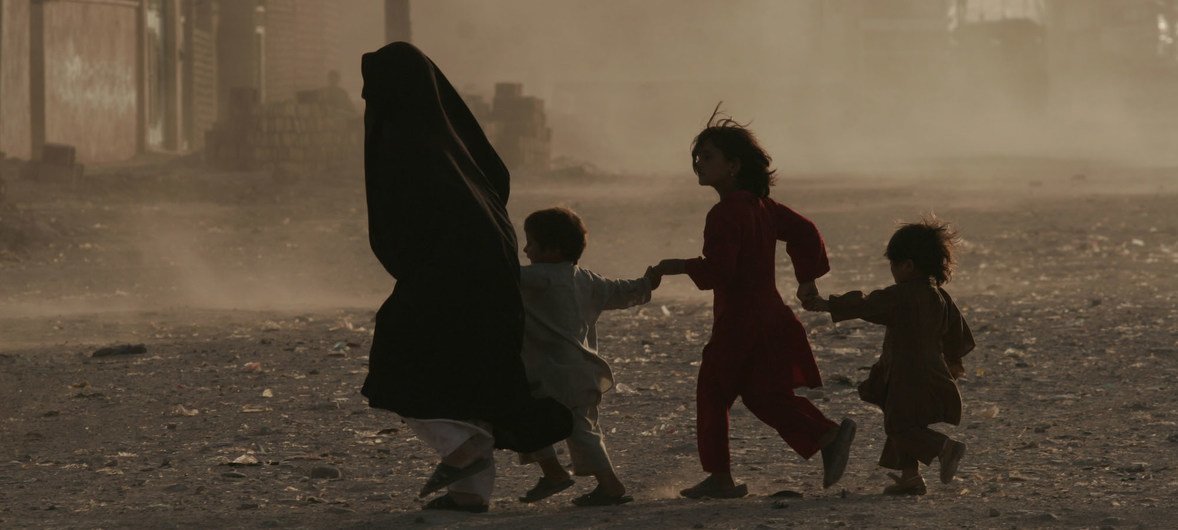
A family runs across a dusty street in Herat, Afghanistan.
Rights increasingly out of reach
The UN Assistance Mission in Afghanistan (UNAMA) also warned that rights in the country remain “out of reach for too many,” especially for women and girls. Involuntary returns are also placing journalists, former officials and civil society figures at heightened risk of reprisals.
“Human rights are not optional. They are the everyday essentials that sustain life,” Ms. Gagnon said in a separate UNAMA statement. “For Afghanistan, ensuring women and girls can learn, work, and participate fully is indispensable to recovery.”
Call for international support
Despite severe constraints, the UN continues to deliver aid. More than $40 million in emergency funding has been released in recent months to respond to earthquakes, drought and mass returns.
But Mr. Fletcher warned that underfunding is now costing lives.
“As we look to 2026, we risk a further contraction of lifesaving help at a time when food insecurity, health needs a strain on basic services and protection risks are all rising,” he said.
He stressed that without urgent attention of and support from the international community, the crisis would only worsen.
On December 14 and 15, the Saudi capital will host the Alliance congress 11th Global Forumbringing together governments, civil society, youth leaders, women peacebuilders and voices from the media.
The theme:
UNAOC: Two Decades of Dialogue for Humanity – Advancing a New Era of Mutual Respect and Understanding in a Multipolar World.
Across continents, intolerance and xenophobia are on the rise. Cultural and religious differences are used to justify violence and exclusion. Hate speech – particularly online – is increasing, reinforcing distrust and eroding social cohesion.
In this climate, UNAOC’s mission – to promote mutual respect and understanding across cultures and religions – has never been more urgent.
Why was UNAOC created?
The Alliance was born in the shadow of tragedy. After the September 11 attacks in the United States and subsequent bombings in Bali, Madrid, London and Istanbul, Spain and Turkey co-sponsored an initiative aimed at bridging divisions.
Launched in 2005 by Kofi Annan, then Secretary-General of the UN, UNAOC aimed to prevent conflicts based on identity and to make diversity a source of strength and not a pretext for violence.
What is the Alliance doing?
Guided by the motto “Many Cultures”. One Humanity’, UNAOC has become a leading United Nations platform for intercultural dialogue. Her work covers youth engagement, education, media literacy, migration and tackling hate speech.
From empowering women as mediators of peace to harnessing the unifying power of sport and art, the Alliance has launched projects that challenge stereotypes, prevent extremism and promote inclusion. Its alumni network now includes hundreds of peacebuilders making a difference around the world.
What is happening in Riyadh?
The Forum will include:
A high-level meeting of the Group of Friends of UNAOC, now 161 members strong.
The Youth Forum, highlighting alumni who have led change in their communities.
Thematic sessions on pressing issues: AI-driven misinformation, women on the frontlines of peace, migration and human dignity, and combating hate speech.
PLURAL+ Youth Video Festival, celebrating creative voices fighting xenophobia and promoting diversity.
What is the expected result?
The Forum is expected to adopt the Riyadh Declaration, opening the next chapter of the UNAOC. New partnerships and agreements for 2026 and beyond will be announced, as well as proposed recommendations feeding into the Alliance’s 2027-2031 Action Plan.
Twenty years later, UNAOC’s message is clear: dialogue is not a luxury: it is a lifeline for humanity in an increasingly fragmented world.
Here’s how to follow the Forum:
The UN media team will cover the Forum in Riyadh.
UN News will be in Riyadh to cover the meeting and provide stories and interviews.
Live and on-demand broadcasts will be available on WebTV.
Broadcast-quality video packages and stories will be available on UNifeed.
“We cannot forget Haiti“, said Lola Castro, speaking from the capital, Port-au-Prince, while also appealing to Jamaica, Cuba and the Dominican Republic.
More than 80 people were killed and around six million were affected by this Category 5 hurricane, one of the most intense ever recorded in the Atlantic.
The top humanitarian official placed particular emphasis on Haiti, which is already grappling with challenges such as gang violence, mainly in the capital, and food insecurity.
Around 5.7 million people – more than half the population – are hungry and 1.4 million people are displaced across the country.
Hurricane Melissa dumped heavy rains on southern Haiti, affecting 1.2 million people.
Ms. Castro came straight from the town of Petit-Goâve, where the river overflowed and “people had to escape from their homes in the middle of the night through rivers of mud.” Twenty-five residents died.
She met “women and men in total distress” who are trying to rebuild their lives after losing their loved ones, their homes, their livelihoods, their crops and their livestock.
PAMalongside other UN agencies, NGOs and government, were on the ground “from day one” providing food and then cash transfers, which allow people to make their own purchasing decisions.
The women told him they would use the cash transfers to buy food, soap and other immediate needs.
“We also spoke with a group of organized young people who are trying to help these communities restart their lives,” she continued.
“And what they ask is: “Please don’t forget us. Don’t forget us, because a month and a half (ago) we were all over the news, but now we need continued support.
Recovery and rehabilitation
The hurricane also caused catastrophic damage in western Jamaica and eastern Cuba, and WFP assisted more than 725,000 people in the four countries.
“We are now trying to really work on recovery and rehabilitation through a number of tools,” Ms. Castro said, such as school feeding programs and supporting government efforts to strengthen social protection by registering all those affected by the disaster.
“But what is very clear in Haiti and across the region is that we need to invest much more, as we have this time, in anticipatory action.”
Advance preparation is essential
WFP undertook extensive emergency preparedness work before the hurricane struck.
These measures included sending messages informing Haitians of the impending storm, affecting some 3.5 million people across the country, and distributing cash advances to more than 50,000 people. The teams present in Cuba also transported food aid from the east of the island to the west.
“But we need to do much more in this direction,” she said. “We also need to make sure our simulations and preparation mechanisms are ready. »
Strengthening community resilience
Ms. Castro cited examples such as microinsurance payments, which allow Haitian small farmers – who supply food used in WFP’s “locally produced” school meal programs – to continue producing.
“These are new mechanisms and tools that we need to do much more in the region, in the Caribbean, because we know that every year there will be hurricanes or earthquakes, like we saw last year in Cuba,” she said.
“We really need to redouble our efforts to build the resilience of these populations who are continuously affected so that food insecurity does not become a trend. but it is reduced, with communities working for themselves and building their own resilience.
WFP is seeking $83 million to help 1.3 million people affected by Hurricane Melissa in the Caribbean. and approximately half of the funding has been received.
The incident comes amid alarming new data from the United Nations reproductive health agency (UNFPA), showing a sharp increase in the risk of dying during pregnancy or childbirth in Ukraine, which is approaching its fourth year of conflict following Russia’s full-scale invasion.
“Our latest analysis shows a sharp deterioration of maternal health in Ukrainesaid Florence Bauer, UNFPA regional director.
Kherson remains one of Ukraine’s most vulnerable cities as it is located on the Dnipro River, directly opposite Russian-controlled territory.
Although Ukrainian forces retook the city in late 2022, it has since come under near-daily bombardment from positions just across the water.
Civilian sites, including hospitals, are frequently hit, leaving health workers with little warning and forcing essential services like maternity wards to operate underground.
“Safe childbirth must be protected even in times of war, and international humanitarian law is clear: health facilities, health workers and humanitarian access must never be targeted,” Ms. Bauer stressed.
Since 2022, more than 80 maternity and maternity wards have been damaged or destroyed, among the 2,763 care sites affected across the country, according to UNFPA.
All staff and patients who had been hiding in the agency-backed bunker during last week’s harrowing incident remained unharmed and a baby girl was safely delivered during the attack. However, “worrying” trends persist across the country.
Life-threatening complications
Analysis of UNFPA data for 2023 and 2024 indicates that despite a decrease in the number of births, a higher proportion of pregnancies in the country are now affected by serious medical complications.
Uterine ruptures, one of the deadliest emergencies, increased by more than 44 percent, while hypertensive disorders, such as high blood pressure, increased by 12 percent.
C-sections, or surgical deliveries, not only remain high but exceed levels recommended by the World Health Organization, as the organization says such unnecessary procedures can put the lives of women and their babies at risk.
The cesarean section rate in Kherson is currently 46 percent, according to UNFPA; WHO recommends not more than 15 percent (15 per 100 births).
Birth under bombing
With power outages, shortages of medical supplies and property damage now commonplace, humanitarian aid is often the only lifeline to keeping women and premature newborns alive.
With the support of UNFPA, the maternity ward of the perinatal center in the city of Kherson was rebuilt in a bunker.
UNFPA provides mobile incubators, sterile neonatal equipment and life-saving medicines to help premature babies breathe.
The special underground maternity hospitals of the Kherson City Perinatal Center and the Kharkiv Regional Perinatal Center are the first of their kind in Ukraine.
UNFPA is calling for $52 million to keep maternal health and protection services functioning in the country throughout the coming year.
It provides an update on renewable water availability, which refers to the amount of fresh water that is replenished each year in rivers and aquifers through precipitation.
The availability of renewable water per person has decreased by seven percent over the past decade, from 5,326 to 5,719 cubic meters (m3), according to the AQUASTAT 2025 water data overview.
Regions like North Africa, South Asia and West Asia have the lowest freshwater resources per capita, with Kuwait, United Arab Emirates, Qatar and Yemen ranking among the top countries with the lowest total renewable water.
Several regions have also seen increased freshwater withdrawals in recent years, adding to pressure on already stressed river basins and aquifers.
“North Africa saw the largest increasewith freshwater withdrawals up 16 percent,” the report said.
Most of the world’s withdrawals, almost 70 percent, came from surface water sources, while 23 percent came from groundwater.
Water for agriculture
Agriculture remains the largest water-consuming sector, accounting for about 72 percent of freshwater withdrawals worldwide. The industrial and service sectors followed with 15 percent and 13 percent respectively.
Sixty-six countries devoted more than 75 percent of their total freshwater withdrawal to agriculture.
For Afghanistan, Lao People’s Democratic Republic, Mali, Nepal, Somalia and Sudan the figure was 95 percent.
Change in availability and demand
The report also shows how water availability and demand change from region to region.
This includes North Africa, where per capita availability of fresh water remains among the lowest in the world, while withdrawals have increased by 16 percent over the past 10 years.
In West Asia – which the report says includes most of the Middle East – rapid population growth and agricultural demand are helping to increase pressure on limited supplies.
Irrigation and efficiency
The report also highlights large disparities in irrigation and water use efficiency on croplands.
“In parts of Latin America and Asia, irrigation supports a large part of agricultural production, while in sub-Saharan Africa, irrigated cropland represents only a small fraction of total cropland, reflecting persistent gaps in access to water infrastructure. » FAO said.
At the national level, Bahrain, Egypt, Saudi Arabia, Suriname and Uzbekistan reported the highest irrigation coverage. More than 90 percent of cultivated land in these countries is equipped with irrigation infrastructure.
In contrast, some 35 countries – mainly in sub-Saharan Africa – had less than 1 percent of cultivated land irrigated.