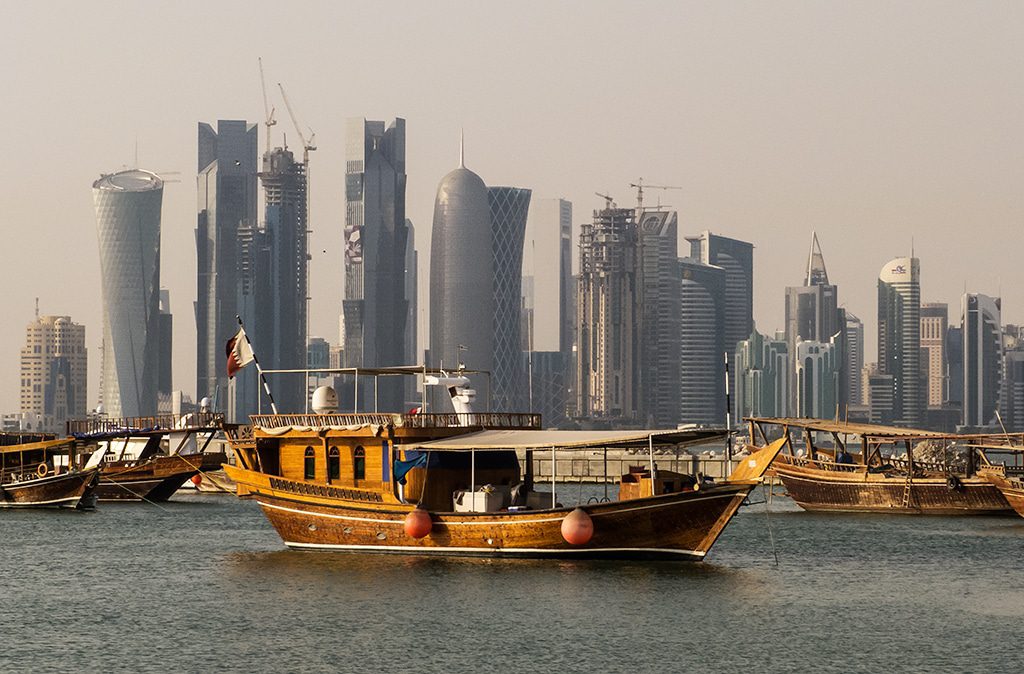
In a communication to The European Times, the Baha’i International Community(BIC) informed of being “extremely worried by developments in Qatar—where the government is apparently attempting to eradicate the Baha’i community“
The Baha’is have often and regularly voiced out their extreme concerns for the “discrimination, restrictions and human rights violations experienced by the Baha’is in Qatar over many decades”.
These violations, continue to say the BIC, include systematic attempts by Qatari authorities to blacklist and deport Baha’is from Qatar. Once blacklisted, Baha’is who have for decades been residents in Qatar are expelled from the country and are permanently refused reentry, even to visit. Residency permits of non-Qatari Baha’is have also been denied, or not renewed, despite their employers or sponsors supporting them to remain in the country.
What links all those who have been deported—who come from various professional and national backgrounds—has been their Baha’i belief. This bears a striking resemblance to types of persecution Baha’is have faced in Iran and Yemen.
Most of those facing blacklisting and deportation, say the BIC, were born and raised in Qatar and have known no other home, some coming from families whose lives there stretch back multiple generations, predating the independence of the state of Qatar itself.
Other reported incidents of discrimination relate to employment or education. In 2009, the Bahá’í cemetery in Doha was bulldozed and graves were exhumed and destroyed.
“We are deeply concerned that the ongoing and worsening discrimination against Baha’is in Qatar may lead to the eradication of the entire community” said to The European Times Rachel Bayani, Representative of the Baha’i International Community to the European Institutions.
A Qatar citizen and a Baha’i, Remy Rowhani, is to be jailed in Qatar on charges linked to his religious beliefs. A previous hearing had been held in his absence and his sentence was first issued on 29 April 2021. No evidence was presented at any time to substantiate the charges against Mr Rowhani, says the press statement of the Baha’is in Brussels.
“To secretly hold a trial in the defendant’s absence, without notifying him, and to then issue a prison sentence and fine in absentia, is against due process and betrays an official policy of discrimination against the Baha’is. This is a worrying escalation of the targeted and discriminatory treatment against Baha’is in Qatar.” added Ms. Bayani.
EP Plenary session - The massacre of Christians in Nigeria
MEP Hölvényi managed to bring to the plenary the atack against the St. Francis Catholic Church in Nigeria. A gunman had attacked worshippers in the Nigerian town of Owo during a mass on Pentecost Sunday.
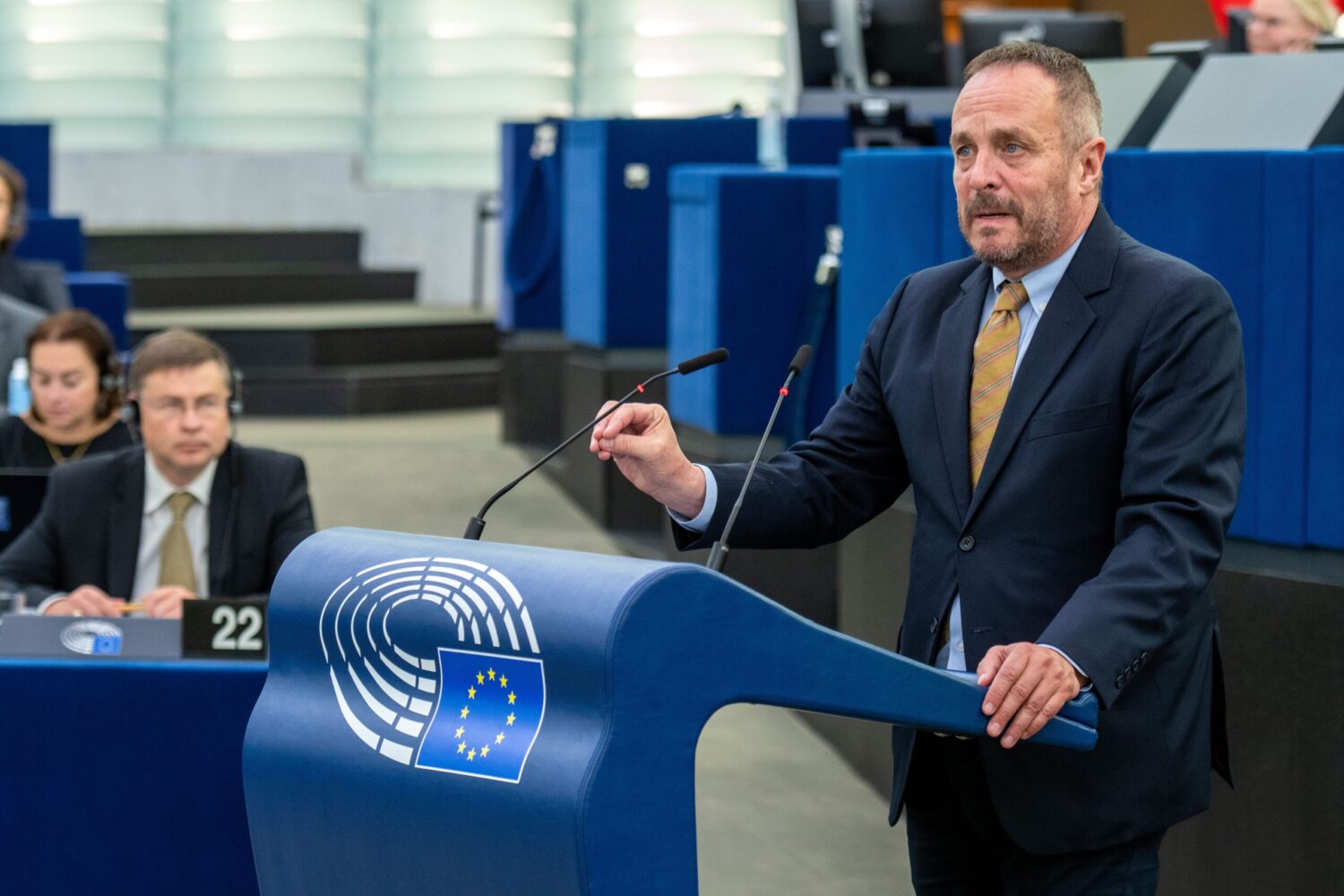
“We must do a lot to ensure that the European Parliament is finally able to take effective action against the increasing persecution of Christians after that many years,” emphasised Christian Democrat MEP György Hölvényi (KDNP) during Wednesday’s plenary debate on the Pentecost attack in Nigeria.
“First of all, we must declare that the attack was directed against Christian believers,” said MEP György Hölvényi, reacting to the tragedy in the Nigerian town of Owo, where gunmen ruthlessly killed at least 50 people, including several children, during a Mass on Pentecost Sunday.
Quoting Dr Réka Fodor, a Hungarian volunteer doctor working in Nigeria, the politician said that the Hospital in the local Catholic Archdiocese, the neighbouring federal state of Onitsha, had immediately offered fifty beds to treat the injured. Church institutions are also at the forefront of helping at a time when the social situation in Nigeria is deteriorating. The war in Ukraine has caused energy crisis and as a result, the gasoline prices doubled, and running basic health care has become a challenge.
Although the Nigerian central government has pledged to curb the terror, it is not showing results. “Moreover, the attack took place in a previously peaceful part of the country, which indicates the deterioration of the security situation and undermines our achievements in development policy,” the MEP said.
“We must all work to ensure that the EP is able to take action against open persecution of Christians. We must end the passive discrimination caused by indifference. We have a responsibility to those who are suffering because they themselves are asking us to stand up for them,” he underlined, citing the Nigerian Catholic Council’s cry for help: “We want the leaders to take urgent action against the perpetrators of evil deeds.”
The suspected traffickers are from Malawi, Ethiopia, Burundi, Rwanda, and DRC. So far, there have been five arrests and the cases are ongoing.
UNODC expert fears that “this is just the beginning.”
Lilongwe, (Malawi), May 2022 – The widespread exploitation of men, women, and children at a refugee camp in Malawi has been uncovered by the United Nations Office of Drugs and Crime (UNODC) and the Malawian Police Service.
The Dzaleka Refugee Camp, 41 kilometers from the Malawi capital Lilongwe, was established in 1994 and hosts 52,000 people from five different countries. New measures are now underway to dismantle human trafficking networks operating within the Dzaleka Refugee Camp, identify and rescue their victims, and bring those responsible to justice.
“The situation was much worse than we first envisaged,” says UNODC’s Maxwell Matewere, who initially visited the camp in October 2020, when he trained camp staff and law enforcement officers on how to detect and respond to trafficking cases.
“I even witnessed a kind of Sunday market, where people came to buy children who were then exploited in situations of forced labour and prostitution,” he adds.
UNODC coached and mentored 28 camp officials and law enforcement officers to help identify victims and investigate trafficking cases. These officials will in turn train other colleagues at police stations and border crossing posts.
Since the training and the implementation of new anti-trafficking procedures, over 90 victims of human trafficking have been identified and rescued.
The guidelines for the identification, rescue, and referral of victims were developed by UNODC, with the support of the UN Refugee Agency (UNHCR) and the International Organization for Migration (IOM).
Most of the victims rescued are men from Ethiopia, aged between 18 and 30. Several girls and women were also rescued, aged between 12 and 24 from Ethiopia, Burundi, and the Democratic Republic of Congo (DRC).
Some of the victims were assisted to return to their countries of origin, while others are being cared for in safe houses. Several victims, who were identified at border crossings, requested to be returned to the camp to seek asylum.
One 16-year-old girl from DRC was rescued from a situation of forced prostitution by an undercover police officer who had been trained by UNODC.
“I arrived at the camp in 2009 after leaving my home country due to conflict,” she says. “One evening in a nightclub inside the camp, I was approached by a man who told me he was identifying people who were being exploited.”
The girl, who was trafficked at the age of 10, explains that she initially did not believe or trust the officer, since she thought “all men were violent and looking for sex”.
“That evening, I had been beaten by one of my clients for refusing to have sex due to a cut that was bleeding. I was in pain, and it was visible. The officer was friendly, and he took me to a safe house.”
She is now attending a computer literacy class and hopes to return home: “In the future, I would like to be a teacher, and I want to be reunited with my brother who I have not seen for a long time,” she adds.
The new procedures contain clear guidelines for the transfer of victims to authorities where they can receive appropriate care. “Before our intervention, victims of human trafficking would have been placed in police cells or prisons, alongside criminals. Now they are referred to specially-equipped safe houses that we helped to prepare for the arrival of the victims,” says Matewere.
Various types of human trafficking have been identified in the Dzaleka Refugee Camp. Children are trafficked within and outside of the camp for farm labour and domestic work. Women and girls are exploited sexually inside Dzaleka and in Malawi or transported for the purpose of sexual exploitation to other countries in Southern Africa. Male refugees, meanwhile, are being subjected to forced labour inside the camp or on farms in Malawi and other countries in the region.
The camp is also being used as a hub for the processing of victims of human trafficking. Traffickers recruit victims in their home country under false pretenses and arrange for them to cross the border into Malawi and enter the camp.
After the recent, successful operations in the camp, which were based on intelligence information, the police now have more knowledge about the international nature of the trafficking network.
“There is evidence that victims are sourced in Ethiopia, DRC and Burundi by agents of the trafficking network offering work opportunities in South Africa, which is the economic powerhouse on the continent,” says Matewere. “At the camp, they are told they need to pay off the debts incurred from being smuggled into Malawi. They are exploited there or transported to other countries in the region for forced labour.”
However, according to the Malawian Police Service, efforts to convict human traffickers and migrant smugglers are being hampered because the people affected are too scared to testify in court.
“We do fear that this is just the beginning, and there are huge numbers of victims. Authorities strongly suspect there is a highly organized, international syndicate operating from within the camp,” says Matewere.
Awareness-raising material about human trafficking will be distributed soon in the camp and is expected to lead to more victims coming forward for assistance.
“All security agencies operating in the camp must be frequently reminded about their role to eradicate human trafficking through regular training,” says UNHCR’s Owen Nyasula, a field protection associate at UNHCR’s Malawi office.
“These agencies need to work closely with religious and community leaders, as well as local police forces, to stop this form of modern slavery,” he concludes.
Further information
Human trafficking and migrant smuggling are global and widespread crimes that use men, women and children for profit. The organized networks or individuals behind these lucrative crimes take advantage of people who are vulnerable, desperate or simply seeking a better life. UNODC strives for the eradication of these crimes through the dismantling of the criminal enterprises that trade in people and the conviction of the main perpetrators. Ultimately, our work safeguards people from the abuse, neglect, exploitation or even death that is associated with these crimes.
UN Voluntary Trust Fund for Victims of Human Trafficking: 20 new NGO projects selected for emergency grants under the sixth grant cycle
Vienna (Austria), 8 June 2022 – 20 projects proposed by specialized civil society organizations (CSO) from 17 countries have been selected under the United Nations Voluntary Trust Fund for Victims of Human Trafficking (UNVTF)’s sixth Call for Proposals (sub-grant programme one (SGP 1) dedicated for emergency aid grants). SGP 1 was introduced in 2019 to provide agile responses to victims of human trafficking in or fleeing from humanitarian and natural crises.
The selected projects represent a fair geographical distribution with enhanced visibility on Central Asia, as well as Latin American and Caribbean, which are the priority regions of SGP 1. A record number of applications were received as a result of collective outreach efforts of the Trust Fund, with colleagues disseminating the Call for Proposals in Spanish, Russian, English and French.
The UNVTF was established by the UN General Assembly within the UN Global Plan of Action to Combat Trafficking in Persons in 2010. It is managed by UNODC and advised by a Board of Experts appointed by the Secretary-General. The UNVTF awards multi-year grants of up to USD 60,000 to global CSOs that provide victim-centred comprehensive support and humanitarian aid to survivors of human trafficking in desperate need of help. With the latest 20 selected proposals, the Trust Fund has awarded over 6 million USD to more than 140 projects implemented by civil society partners, thereby directly supporting over 5,000 victims a year, most of which are women and girls.
Details of the newly selected projects, which provide shelter, medical and material support, repatriation service, and other emergency aid, are as follows:
N°
01
02
03
04
05
06
07
08
09
10
11
12
13
14
15
16
17
18
19
Organization
HAGAR AFGHANISTAN
SUSTAINABLE DEVELOPMENT ORGANIZATION FOR WOMEN (SDOFW)
RIGHTS JESSORE
LOVE FOUNDATION
FUNDACIÓN MUNASIM KULLAKITA
FOCUS DROITS ET ACCES (FDA)
GOOD SAMARITAN ASSOCIATION (GSA)
VOLTA REVIVAL FOUNDATION
ASSOCIATION FOR THE SOCIAL SUPPORT OF YOUTH (ARSIS)
RESCUE FOUNDATION
LIFE BLOOM SERVICES INTERNATIONAL (LBSI)
PUBLIC FOUNDATION “INSAN-LEILEK”
PUBLIC ASSOCIATION NUR JOL BER
FARAH SOCIAL FOUNDATION
ASOCIACIÓN NACIONAL CONTRA LA TRATA HUMANA EN LA SOCIEDAD (ANTHUS)
RED BINACIONAL DE CORAZONES AC (RBC)
GRASSROOT DEVELOPMENT SUPPORT AND RURAL ENLIGHTENMENT INITIATIVE (GDEV)
INSTITUTE FOR DEMOCRACY
TADAMUN SOCIAL SOCIETY (TASS)
Project focus
This project is to provide shelter for vulnerable and trafficked girls.
This project is to provide support to human trafficking victims among conflict and internally displaced person (IDP).
This project is to provide support to survivors and vulnerable migrants repatriated from abroad, who will be mainly women and girls.
This project is to provide support to women, including LGBTIQ+ community, who are survivors of trafficking in persons.
This project is to provide support to girls, adolescents, and young survivors of human trafficking by sexual exploitation.
This project is to provide support to woman and girl survivors living with disabilities or HIV/AIDS.
This project is to provide support to women migrant workers who were human trafficking survivors of forced labour.
This project is to provide support to children trafficked into force labour in the fishing communities.
This project is to provide support to human trafficking survivors among asylum seekers, refugees and/or migrants mostly from the Balkans, Asia and Africa.
This project is to provide support to young women and girls who were human trafficking survivors of commercial sexual exploitation.
This project is to provide support IDP who were trafficked for sexual exploitation and early marriage.
This project is to provide support to migrant women who have suffered from forced labour amid COVID-19 pandemic.
This project is to provide support to vulnerable migrant and survivors of human trafficking of forced labour and sexual exploitation.
This project is to provide support to women and girls survivors of human trafficking after Beirut port explosion
This project is to provide support to women, girls, adolescents, including LGBTIQ+ community, who are survivors of trafficking in persons.
This project is to provide aftercare shelter for minors who survived human trafficking.
This project is to provide support to COVID-19 based healthcare assistance for survivors of human trafficking.
This project is to provide support to direct psychological assistance to trafficking victims among ethnic minority women and girls.
This project is to identify and aid (shelter, medical care, food and clothes) young girls.
20
URBAN
This project is to provide support to survivors and highly vulnerable groups, in particular men and boys.
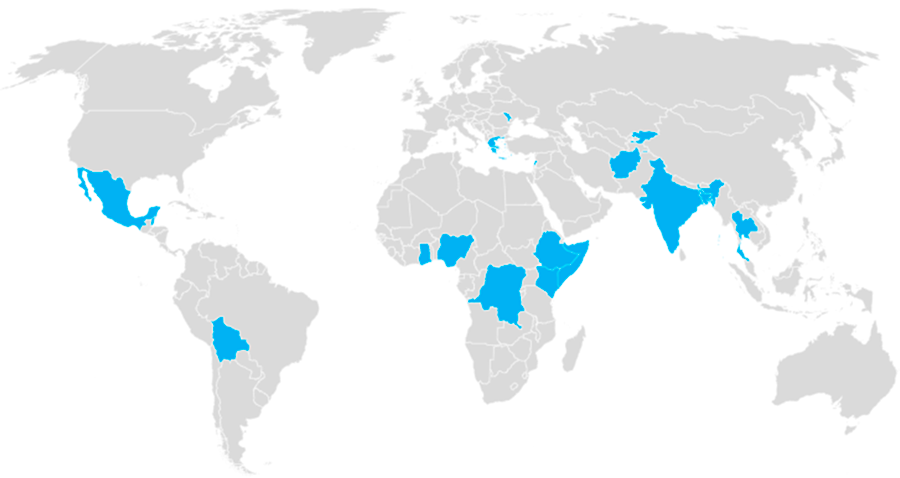
Implementation Map of the Selected Projects
This map is a visual reference of geographic information which does not imply the expression of any opinion whatsoever on the part of UNODC concerning the legal status of any country, territory or city or its authorities, or concerning the delimitation of its frontiers or boundaries.
After being blocked in the Council for a decade, EP and EU countries’ negotiators finally agreed on a bill to increase the presence of women on boards.
The provisional agreement reached on Tuesday night on the draft legislation aims to ensure gender parity on boards of publicly listed companies in the EU.
At least 40% of non-executive directors should be women
The so-called “Women on Boards” Directive aims to introduce transparent recruitment procedures in companies, so that at least 40% of non-executive director posts or 33% of all director posts are occupied by the under-represented sex. Thanks to Parliament, companies must comply with this target by 30 June 2026, compared to the Council’s proposal of 31 December 2027. In cases where candidates are equally qualified for a post, priority should go to the candidate of the under-represented sex.
MEPs insisted that merit must remain the key criterion in selection procedures, which should be transparent, as part of the agreement. Listed companies will be required to provide information to the competent authorities once a year about the gender representation on their boards and, if the objectives have not been met, how they plan to attain them. This information would be published on the company’s website in an easily accessible manner.
Small and medium-sized enterprises with fewer than 250 employees are excluded from the scope of the directive.
Penalties
The proposal includes effective, dissuasive and proportionate penalties for companies that fail to comply with open and transparent appointment procedures. Parliament succeeded in including examples of specific penalty measures, such as fines and companies having their selection of board directors annulled by a judicial body if they breach the national provisions adopted pursuant to the Directive.
Quotes by the rapporteurs
Evelyn Regner (S&D, AT), co-rapporteur, said: “Parliament has been asking for a Directive for more women on boards for over a decade. The Council was finally ready to come to the table 10 years after the Commission made its proposal. It was high time to have binding measures. More women on boards make companies more resilient, more innovative and will help to change top-down structures in the workplace. One of the main achievements is transparency. Selection processes have to be based on clear, predetermined criteria and with this agreement, only the best candidates will be selected, thereby improving the overall quality of boards.”
Lara Wolters (S&D, NL), co-rapporteur, added: “All data show that gender equality at the top of companies is not achieved by sheer luck. We also know that more diversity in boardrooms contributes to better decision-making and results. This quota can be a push in the right direction for more equality and diversity in companies.”
Press conference
The lead EP negotiators Evelyn Regner (S&D, AT) and Lara Wolters (S&D, NL) will answer journalists’ questions on the deal on Wednesday 8 May at 9.00 CEST in the Daphne Caruana Galizia room (WEISS N -1/201) in the European Parliament in Strasbourg. More details on how to follow the press conference are available here.
Next steps
Once Parliament and Council have formally approved the agreement, the Directive will enter into force 20 days after it has been published in the EU’s Official Journal. Member states would need to implement the directive two years after it has been adopted. Parliament succeeded in including an assessment on the scope of the directive at a later stage on whether non-listed companies should be included in the scope of directive.
Background
The European Commission first presented its proposal in 2012 and the European Parliament adopted its negotiation position back in 2013. The file was blocked in the Council for almost a decade, until Employment and Social Affairs ministers finally agreed on a position last March.
Today, only 30.6% of board members in the EU’s largest publicly listed companies are women, with significant differences among member states (from 45.3% in France to 8.5% in Cyprus).
In his address to MEPs on Wednesday, the Speaker of the Ukrainian Verkhovna Rada (parliament) Ruslan Stefanchuk called on the EU to endorse his country’s membership application.
Welcoming Mr Stefanchuk to the hemicycle in Strasbourg, Parliament’s President Roberta Metsola underscored Ukraine’s “fight for freedom, for democracy, for the values that bind us as Europeans, is our fight. What Ukraine has had to endure was unthinkable a few months ago, but your people have inspired the world.”
President Metsola added that the European Parliament will continue to actively support Ukraine’s efforts to be granted EU candidate status. “We know how important it is to send a clear signal that Ukraine’s place is within our European family. To tell everyone that Ukraine is Europe,” she said.
Mr Stefanchuk outlined how the initial Russian assault on Ukraine had shocked his country and the entire world, but that Ukrainians had quickly realised what they needed to do: unite against the aggressor.
Praising President Metsola for being one of the first European leaders to visit Ukraine following the outbreak of the war, he also thanked European countries for their response to the Russian aggression, for welcoming Ukrainian refugees, and for standing with the people of Ukraine in these dark times. At the same time, he raised the prospect of more action in the event of the war continuing, including further EU sanctions, even as they start to negatively impact European economies. “Because the price for defeat will be way bigger,” he said.
In addition, Mr Stefanchuk also expressed his deep wish for the European Union to strongly support his country’s desire to be granted EU candidate status. Ukraine and its people need this powerful message from Europe, he underlined, while pointing out that any other political signal would only benefit Russian President Vladimir Putin and his regime. He also thanked the European Parliament for its strong support for his country.
You can watch his address again here. (08.06.2022)
Zero waste: There’s no doubt that food loss and waste, has been undermining the sustainability of our food systems. In an effort to counter this, some small businesses around the world are putting the focus on new sustainable waste management practices.
UN News paid a visit to one such project recently, in the Portuguese capital, Lisbon, where the UN Ocean Conference, will take place, at the end of June.
Sancho Pancho was created by Russian Daria Demidenko, who moved to Portugal in 2015. Her ingenious business idea, involves turning leftover parts of fresh fish, into dog treats.
Ms. Demidenko, established her business by partnering with a Japanese restaurant and some of the fish markets in the Portuguese capital. She’s making use of the parts that don’t make it to the plate, and can’t be used when producing high end sushi and sashimi dishes.
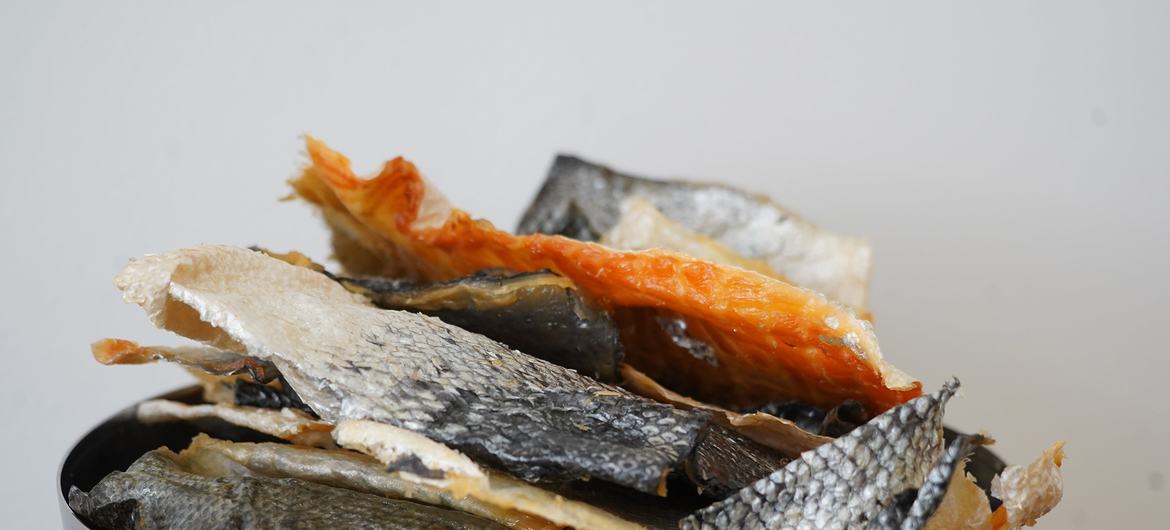
UN News/Leda Letra – Sancho Pancho, a small business that turns leftover parts of fresh fish, into dog treats, is based in Lisbon, Portugal.
Every day, pounds and pounds of fish heads, bones, and skins literally end up in the trash, but Ms. Demidenko has revolutionized the approach to such food waste, by partnering with Sekai Sushi Bar, a Japanese restaurant in the central neighborhood of Santos.
Each day, the restaurant receives around 10 kilos of salmon, tuna and white fish.
Sushi chef Sunil Basnet quickly cleans and prepares the fish, including such treats as a three-kilogram croaker caught right off the Portuguese coast.
The owner of Sekai, Edilson Neves, explained to UN News that, on average, 30 per cent of the fish cannot be used by the restaurant.
“The backbone, part of the tail, the edges, the sides, the part that connects with the stomach, some parts of the fish that are tougher, that have more fibers and skin too, we end up not using them. This 30 to 40 per cent that would go to waste, we end up reusing it through Sancho Pancho”.
Sancho Pancho, 30 to 40 per cent of fish that would go to waste, Sancho Pancho ends up reusing it.
Healthy snacks
The name of Ms. Demidenko’s business, alludes to the character Sancho Panza, from Miguel de Cervantes’ classic novel, Dom Quixote, and is also a personal tribute to one of her dogs, named Pancho.
She told UN News, about some of the special ingredients and dishes, she’s managed to come up with, making use of the scraps.
“These cookies are made with this type of white fish, which we first cook, and then crush, so the bones have a much smoother texture”, she told us, pointing to one of the dog treats.
“We crush it, mix it with flour and make the cookie. But there are also other types of waste, such as white fish or salmon skins, that you can dehydrate. This type of snack goes into the machine, stays for 20 hours at a temperature of 70˚C and then comes out drier, crispier, and we cut it into pieces and make it like little chips, flakes of salmon skin.”
Sancho Pancho, With leftover white fish, Daria produces dog treats enriched with sweet potatoes.
Scandinavian countries at the forefront
In addition to picking up leftovers at the Sekai restaurant, Daria has partnerships with other restaurants and fish markets in Lisbon.
She collects about 25 kilos of leftover fish a week. Her initiative has won praise from the Senior Fishery expert at the Food and Agriculture Organization of the United Nations (FAO), based in Rome, Márcio Castro de Souza.
“This initiative is very interesting and in fact we have seen, not only on an industrial scale, but also small examples of how to reduce fish waste.
“There are already several salmon producing industries in Scandinavian countries that have already reached the level of using 100 per cent of the whole fish. They don’t miss any. They make fillets, use their eyes to make fertilizer or to generate essential oils, so there is already a whole production focused on zero waste”, he explained.
Other initiatives around the world include using fish skin to make wearable products; using fish scales in the manufacturing of lipstick; and squid ink to color dishes like pasta.
Consumer awareness
Snacks made with salmon skin are rich in omega 3 fish oil, which is helpful to keeping the skin and fur of pets like dogs and cats, healthy.
In addition to reusing leftover fish, Daria’s brand produces cookies from leftover dehydrated rabbit and pork meat.
The creator of Sancho Pancho says she has already managed to raise customer awareness, of the problems caused by food waste.
“Some customers have told us that they are learning from us, and they are now going to fish markets and butchers here in Portugal and also taking some food waste home now themselves. They don’t make snacks for sale, but they manage to make some food for their dogs, cats, or for themselves.”
Goal 14 also involves sustainably managing marine life. Saving the Oceans and Protecting the Future is the motto of the UN Ocean Conference, which takes place in the Portuguese capital from June 27 through July 1.
In view of the discussion scheduled for today, Wednesday 8 June 2022, in the European Parliament under the title “Global threats to abortion rights: the possible overturn of abortion rights in the US by the Supreme Court”, the Secretary General of COMECE, Fr Manuel Barrios Prieto, has made the following declaration:
STRASBOURG, FRANCE – Plenary room of the European Parliament in Strasbourg. (Credit: Shutterstock)
We see with surprise that the European Parliament will discuss the impact of a leaked draft opinion of the US Supreme Court concerning abortion. This is an unacceptable interference in the democratic jurisdictional decisions of a sovereign state, a country that is also not a Member State of the EU. The adoption of a resolution by the European Parliament that endorses this interference will only discredit this institution.
In this regard, we would like to reiterate that, from a legal perspective, there is no recognized right to abortion in European or International Law. Therefore, no State can be obliged to legalize abortion, or to facilitate it, or be instrumental to perform it.
The EU should respect the legislative competences of its Member States and the principle of conferral whereby the Union shall act only within the limits of the competences conferred upon it by the Member States in the Treaties to attain the objectives set out therein (Article 5.2 of the Treaty of the European Union). As the Standing Committee of COMECE expressed in a statement in February 2022 the attempt to introduce a supposed right to abortion in the Charter of Fundamental Rights of the European Union would be a law “devoid of an ethical foundation and destined to be a cause of perpetual conflict among the citizens of the EU.”
We also note with high concern and regret the negation of the fundamental right to conscientious objection, which is an emanation of freedom of conscience, as declared by Article 10.1 of the Charter of Fundamental Rights of the European Union and recognised by the UN Human Rights Committee (case Jeong et al v. Republic of Korea, 27 April 2011). We are alarmed that the right of health institutions to refuse to provide certain services, including abortion, is weakened or, even, denied. As stated by the Parliamentary Assembly of the Council of Europe in its Resolution 1763 (2010) on the right to conscientious objection in lawful medical care “no person, hospital or institution shall be coerced, held liable or discriminated against in any manner because of a refusal to perform, accommodate, assist or submit to an abortion, the performance of a human miscarriage (…) or any act which could cause the death of a human fetus or embryo, for any reason.”
As the Standing Committee of COMECE highlighted: “We are aware of the tragedy and complexity of the situations in which mothers considering an abortion find themselves. Caring for women who are in a difficult or a conflict situation because of their pregnancy is a central part of the diaconal ministry of the Church and must also be a duty exercised by our societies. Women in distress should not be left alone, nor can the right to life of the unborn child be ignored. They both must receive all necessary help and assistance.”
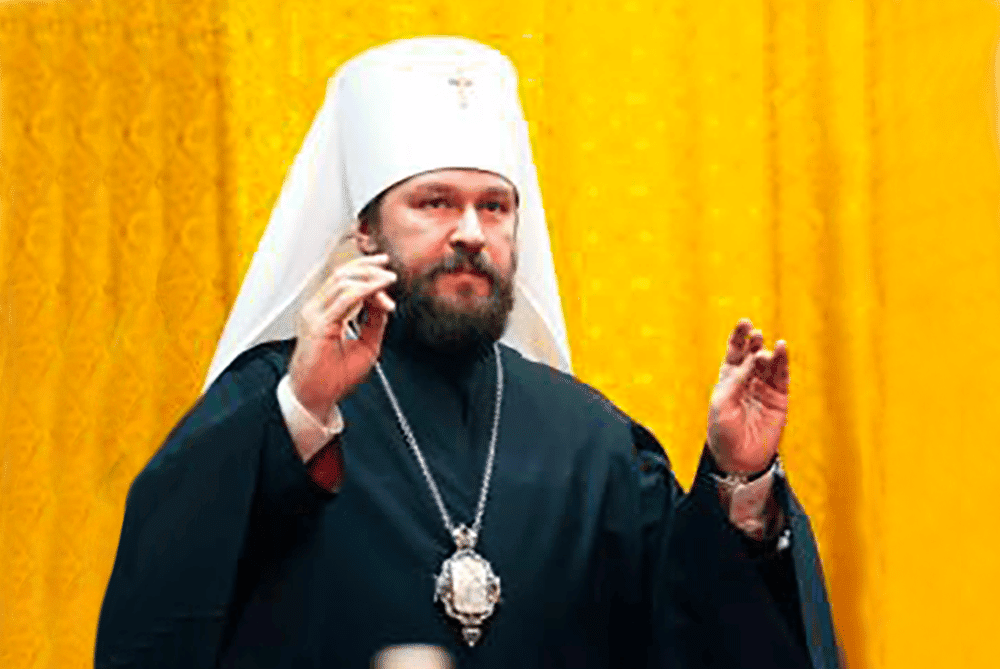
At the meeting of St. Synod of the Russian Orthodox Church (ROC) on June 7, 2022; the Bishop of Volokolamsk Hilarion (Alfeev) was relieved of all his duties so far: chairman of the Department of External Church Relations of the Moscow Patriarchate, permanent member of St. Synod of the ROC and Rector of the All-Church Postgraduate and Doctoral Studies “St. Cyril and Methodius ”(theological educational institution of the ROC for postgraduate qualification). He has now been appointed Metropolitan of Budapest and will head the Hungarian Diocese of the ROC.
The current Metropolitan of Budapest and Hungary. Mark was relieved of his post and thanked for his work.
The place of Mitr. Hilarion as Metropolitan of Volokolamsk, Chairman of the Department for External Church Relations of the Moscow Patriarchate and a permanent member of St. The Synod of the ROC is held by the Korsun Miter. Anthony, who temporarily retained his position as head of the Western European Exarchate and the overseas institutions of the Moscow Patriarchate. He will no longer be responsible for the Korsun diocese. Archbishop Nestor of Madrid and Lisbon is temporarily in charge of this.
Prof. Prot. Maxim Kozlov, who retains his previous positions and the post of chairman of the Training Committee of the ROC.
It is noteworthy that Mitr. Hilarion (Alfeev) was released without “expressing gratitude for the work done”, which in the bureaucratic language of the Moscow Patriarchate means that the change of position is penalty.
Mitr. Hilarion (Alfeev) headed the External Department of the Moscow Patriarchate for thirteen years, taking office in 2009, when he also became vicar of the newly elected Moscow Patriarch Kirill. Until then, he headed the Viennese-Austrian and Hungarian dioceses of the ROC.
He visited Hungary a few days ago, which was probably in connection with his new assignment.
Biographical information:
The new Volokolamsk Metropolitan Anthony (Sevryuk) has an impressive career biography, beginning as the personal secretary of the Smolensk Metropolitan and then Moscow Patriarch Kirill.
Born in 1984 in the town of Kalinin (after 1990 renamed Tver). First, the eighteen-year-old graduated with a gold medal from a lyceum in Tver, then studied at the St. Petersburg Theological Seminary, graduating with honors. His good knowledge of English gave him the reason to be sent to various inter-Orthodox and inter-Christian seminars and conferences. Due to good indicators he was admitted without entrance exams as a student at the St. Petersburg Theological Academy and at the same time appointed an associate of the external department of the ROC-MP, headed by the current patr. Cyril, then Metropolitan of Smolensk. Anton Sevryuk was appointed a lecturer at the Smolensk Theological Seminary. Since February 5, 2009 he has been the personal secretary of Patr. Cyril, and on March 5 he was tonsured a monk named Anthony. Shortly afterwards, he was ordained a hierodeacon, and the following year, 2010, he was ordained a hieromonk. Then he graduated with honors and SPDA. In March 2011 he was appointed clergyman of the Russian church “St. Nicholas ”in Rome, Italy, and on May 30 this year he served in the new Russian church of St. Ekaterina ”in the“ Eternal City ”(in place of Archbishop Filip (Vasiltsev), who came as a representative of the Ministry of Justice in Sofia-Bulgaria). In 2015, he was ordained Bishop of Bogorodsk and appointed Vicar of the Patriarch, while at the same time leading the foreign institutions of the Ministry of Justice and Russian Orthodox parishes in Italy. In April 2016 he was included in the delegation of the ROC for the All-Orthodox Council of Crete, but in early June this year the ROC refused to participate in this council. In the following years he was appointed to new and new positions: head of the Berlin diocese of the ROC, then of the Vienna-Budapest diocese. In 2018 he was promoted to archbishop with the title of Korsunsky (for Western European countries), and in 2019 he was already “Metropolitan of Korsunsky, Western European and patriarchal exarch for Western Europe.”
In 2019, Macedonia changed its name. The Balkan state became the Republic of Northern Macedonia after a long dispute with neighboring Greece. Turkey soon announced that its name would be spelled Turkie in English to avoid resemblance to the word ‘turkey’.
But these are far from the only countries that have changed their name. In fact, many nations have had their own identity crises and have usually changed their names since independence.
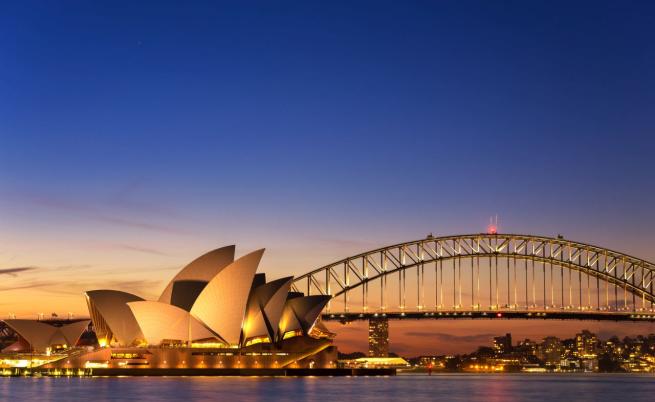
Australia
This distant country was once known as New Holland and New South Wales, but its current name was finally established in the early 19th century.
Jordan
This country was called the Emirate of Transjordan before it officially became the Hashemite Kingdom of Jordan in 1949.
Belarus
From 1920 to 1991, this country was known as Belarus (“White Russia”).
Belize
Belize was once called British Honduras.
Bolivia
Until 1825, this country was called Upper Peru.
Bangladesh
This South Asian country was called East Bengal and Assam, then East Bengal, East Pakistan, and now Bangladesh.
Ethiopia
Before 1974, the lands of Ethiopia were united with Eritrea to form Abyssinia.
Iraq
In 1932, the country gained full independence and was officially called Iraq. It was formerly called the British Mandate of Mesopotamia.
Lesotho
The enclaved state was once a colony of the British crown called Basutoland.
Mexico
Mexico was once part of the Viceroyalty of New Spain until the landmark change of its name in 1821 after the War of Independence.
Myanmar
The country of Southeast Asia was once called Burma and this name is still used in some countries.
Philippines
This country was once part of the Spanish East Indies. The country gained its independence in 1898 and was called the Philippines.
Singapore
Temasek is the early name of Singapore, which received its last in 1819.
Sri Lanka
Since the beginning of British colonial rule, this country has been known as Ceylon.
Suriname
This South American country was once known as Dutch Guiana.
Thailand
This country was known as Siam before it officially became Thailand in 1949.
Togo
Togo was once part of French Togoland, a colonial state of the League of Nations that existed from 1916 to 1960.
Zimbabwe
Zimbabwe is another country that has changed its name several times. Previous names include Southern Rhodesia, Rhodesia and Zimbabwe-Rhodesia.