Tuesday, March 24, 2026
Home Blog Page 90

New €3 customs duty on small parcels entering the EU

0
New €3 customs duty on small parcels entering the EU

The EU has agreed to apply a fixed customs duty of €3 on small parcels valued at less than €150 entering the EU from 1 July 2026. This temporary measure addresses the fact that small parcels currently enter the EU duty free, leading to unfair competition for EU sellers and health and safety risks.

Source link

Sudan war: Aid teams say deal struck to reach stricken El Fasher

0
Sudan war: Aid teams say deal struck to reach stricken El Fasher

The essentials for survival in the town which was overrun by paramilitary fighters in October have been “completely obliterated”, UN humanitarians warned on Friday.

“The little that’s known at the moment about the current conditions in El Fasher is indeed beyond horrific,” said Ross Smith, Director of Emergency Preparedness and Response for the World Food Programme (WFP). “We know that there’s anywhere between 70 and 100,000 people potentially remaining trapped inside the city itself.”

Paramilitary Rapid Support Forces fighters who have been at war with the Sudanese army since April 2023 overran El Fasher – the regional capital of North Darfur – in October, after a 500-day siege.

That ordeal reduced people to eating peanut shells and animal feed, the UN human rights office warned at the time, while satellite footage indicated bloodstains from mass killings of civilians and executions based on ethnicity.

Access agreement

Securing access for aid teams remains an urgent priority, humanitarian agencies insist, amid network blackouts that have largely cut off communication with those remaining inside El Fasher.

Testimonies from survivors “describe the city as a crime scene with mass killings, with burnt bodies, with abandoned markets”, Mr. Smith explained.

“We are calling for and we’ve continued to call for unimpeded access into El Fasher to urgently respond to those that remain trapped in the city,” the WFP official stressed.

“I understand from discussions yesterday that we have agreement in principle with the Rapid Support Forces for a set of minimum conditions to enter the city; so, we anticipate to be able to do that very soon, to do some initial assessments and reconnaissance. After more than a year and a half under siege, the essentials for survival have been completely obliterated.”

Desert town becomes ‘massive’ IDP camp

Mr. Smith noted that those who have managed to flee El Fasher have risked their lives along roads “littered with mines” and unexploded ordnance.

Many have reached shelter in Tawila – until recently a small desert town but which is now “a sprawling, massive displacement settlement” for more than 650,000 people, which is equivalent to the size of Luxembourg. Others have sought safety in Ad Dabbah in Northern State.

As UN aid teams and partners continue to push for access to all those in need, WFP-supported convoys are “en route to Tawila now, with enough for 700,000 people for the next month”, Mr. Smith said.

“These are families that have endured famine for many months on end and mass atrocities and are now living in overcrowded conditions with very limited support. There’s not enough shelter for people, many are staying in very makeshift structures: grass, straw structures, et cetera. Cholera and disease outbreak is widespread.”

12 million people displaced

Sudan is the world’s largest displacement crisis with more than 12 million people uprooted inside and outside the country.

Meanwhile, a worrying update from the UN refugee agency, UNHCR, on Friday confirmed that the security situation in nearby Kordofan has deteriorated further since 1 December.

After a week of heavy fighting, the RSF reportedly seized control of a Sudanese Armed Forces base in Babanusa, West Kordofan.

In South Kordofan, “civilians remain trapped in besieged cities such as Kadugli and Dilling, and as women, children, and the elderly find ways to escape, men and youth are often left behind due to specific high risks they face along flight routes such as detention by armed groups for perceived affiliation with parties to the conflict,” UNHCR said.

Latest data points to more than 40,000 people displaced from North Kordofan since 18 November. “UNHCR, through partners on the ground, is responding to the urgent needs of those displaced, but access remains challenging, and resources are critically low,” it said.

Source link

Why Businesses Should Audit Their Website Every Year

0
Why Businesses Should Audit Their Website Every Year


Your website is often the first impression potential customers have of your business. It is your digital storefront, your 24/7 salesperson, and a critical hub for information. Just like a physical store needs regular cleaning and maintenance, your website also requires ongoing attention to perform its best. 

Image credit: Freepik, free license

Many businesses build a website and then forget about it, expecting it to continuously deliver results without further effort. This is a common mistake. Neglecting your online presence can lead to missed opportunities and a slow decline in performance.

What is a Website Audit?

A website audit is a detailed analysis of your entire website. It covers a wide range of factors that influence its performance, usability, and effectiveness. This process involves looking at technical aspects, content quality, user experience, and how well it ranks in search engines. It is like taking a comprehensive inventory of your digital asset.

The goal of an audit is to identify weaknesses, discover opportunities for growth, and ensure your website is aligned with your business objectives. It helps you understand if your website is truly serving its purpose. Without a clear understanding of its current state, it is very difficult to make informed decisions about its future development. A good audit provides a roadmap for improvement.

Why Annual Audits Are Not Optional, But Essential

The online world changes at a rapid pace. Search engine algorithms are updated constantly, user expectations evolve, and technology advances quickly. A website that performed excellently two years ago might be struggling today if it has not kept up. Annual audits ensure your website remains relevant, functional, and competitive.

Andy Chadwick, CEO of Snippet Digital, strongly believes, “An annual audit is no longer optional. Search algorithms shift, schema evolves, and user expectations rise, which means a site that was optimized last year may underperform today. At Snippet Digital, our audits often reveal gaps in entity coverage, thin content clusters, or missing internal signals that weaken relevance. Regular reviews allow businesses to adapt before rankings slip. A website is a living system—and systems need ongoing calibration if you want to stay competitive, but where are the ones for the other brands? They’re more important than our one.

Improving Search Engine Optimization (SEO)

One of the most critical reasons for an annual audit is to improve your search engine optimization. SEO is how your website appears in search results like Google. If your website is not optimized, potential customers will not find you. An audit checks for various SEO elements.

As Sophia Willows, Head of Engineering at RYE notes, “In e-commerce, an annual SEO audit is a critical examination of the very infrastructure powering commerce. We must ensure that our APIs are exposing product data in a structured, crawlable manner that search engines can not only understand but also effectively present. Without this technical foundation, even the most robust catalog will remain largely undiscovered.”

It examines your keyword strategy to see if you are targeting the right terms that customers actually search for. It looks at your content to ensure it is high quality, relevant, and properly structured. The audit also checks for technical SEO issues. These include broken links, slow loading times, and problems with how search engines crawl and index your site. Fixing these issues can significantly boost your rankings. Higher rankings mean more visibility, and more visibility usually means more visitors.

Enhancing User Experience (UX)

A great website is not just about what it looks like. It is also about how easy and enjoyable it is for visitors to use. User experience, or UX, covers everything from navigation to readability to mobile responsiveness. If visitors have a hard time finding what they need or if your site is difficult to use, they will leave.

As Dorian Menard, Founder and Business Manager of Search Scope notes, “In an era of AI-native search, user experience has transcended mere aesthetics. Large Language Models are becoming increasingly adept at interpreting user intent and site usability, making intuitive navigation and clear information architecture more critical than ever. A frustrating user journey isn’t just a turn-off for humans; it’s a significant negative signal for sophisticated AI ranking algorithms and a direct impediment to lead generation.”

An annual audit evaluates your website’s UX. It looks at things like page layouts, the clarity of your calls to action, and how intuitive your navigation menu is. It checks if your site is mobile-friendly, which is crucial today as most people browse on their phones. A good UX keeps visitors on your site longer, encourages them to explore, and increases the likelihood of them becoming customers. A frustrating experience drives them away quickly.

Ensuring Security and Performance

Your website security is paramount. A compromised website can damage your reputation, expose sensitive customer data, and even lead to legal issues. Performance, particularly loading speed, is also vital. Users expect websites to load almost instantly.

As Dan Close, Founder and CEO of BuyingHomes notes, “In the real estate world, speed and trust are everything; a slow or insecure website is like a transaction bogged down by hidden fees and endless paperwork. If users don’t feel confident in your digital storefront, or if it takes too long to load, you’ve lost their valuable attention before you even had a chance to build that foundational trust.”

An annual audit includes security checks to identify vulnerabilities. It looks for outdated software, insecure plugins, and potential points of entry for attackers. It also assesses your website’s performance. This means checking page loading speeds, server response times, and overall site stability. A fast, secure website builds trust and provides a seamless experience. A slow, insecure one does the opposite.

Content Review and Refresh

Content is king, but only if it is relevant, accurate, and engaging. Over time, your website’s content can become outdated or less effective. Product descriptions might need updating, blog posts might be too old, or service pages might no longer reflect your current offerings.

An audit provides an opportunity for a complete content review. You can identify pages that need to be refreshed, rewritten, or even removed. You can also spot gaps in your content strategy. Are there topics your audience is searching for that you are not covering? Fresh, high-quality content not only helps with SEO but also keeps your audience engaged and establishes your business as an authority in its field.

Identifying Technical Glitches and Broken Elements

As Nibin Varghese, Creative Director at Bless Web Designs, explains, Websites are complex systems. Over time, technical glitches are bound to occur. Links can break, images might stop loading, forms might not submit correctly, or certain features might malfunction. These seemingly small issues can significantly degrade the user experience and frustrate visitors.”

An annual audit thoroughly checks for these technical problems. It identifies broken links, checks for unsupported code, and ensures all interactive elements are working as intended. Fixing these issues quickly prevents them from driving visitors away and ensures your website functions smoothly from top to bottom. A smooth-running website reflects professionalism and attention to detail.

Staying Ahead of Competitors

Your competitors are likely working hard to improve their online presence. If you neglect your website, you risk falling behind. An annual audit can help you analyze what your competitors are doing well and identify areas where you can differentiate yourself.

By regularly assessing your own website, you gain insights into market trends and customer expectations. This allows you to adapt your strategy and implement improvements that keep you competitive. Staying current with design, technology, and content best practices ensures your business remains a strong contender in your industry. It is about not just keeping up, but getting ahead.

Aligning with Business Goals

Your website should be a powerful tool that helps you achieve your business objectives. Whether it is generating leads, making sales, or providing customer support, your website needs to be designed and maintained with these goals in mind. As your business evolves, your website should too.

An annual audit helps you evaluate if your website is still effectively supporting your current business goals. Perhaps you have launched new products, expanded into new markets, or refined your target audience. The audit ensures your website is updated to reflect these changes and continues to work towards your overall success. It is a check to make sure your digital presence aligns with your wider business vision.

Financial Implications of Neglect vs. Investment

Some business owners might view an annual audit as an unnecessary expense. However, the cost of neglecting your website can be far greater. Lost sales due to poor SEO, frustrated customers because of bad UX, and security breaches can all lead to significant financial losses.

Investing in an annual audit is a proactive measure that saves money in the long run. It prevents major overhauls down the line, keeps your marketing efforts efficient, and protects your brand reputation. Think of it as preventative maintenance for your most important digital asset. A healthy website contributes directly to a healthy bottom line.

Prioritizing User Trust and Data Integrity

The rapid evolution of the internet means that user expectations extend far beyond just a visually appealing website. Today, visitors increasingly demand transparency, data security, and an experience that feels both professional and reliable. A website audit, therefore, isn’t just about technical performance or SEO rankings; it’s fundamentally about building and maintaining the trust of your audience.

In an era where personal information is frequently exchanged online, a business’s digital presence must unequivocally communicate trustworthiness. Neglecting critical aspects like secure data handling, clear privacy policies, or even simply outdated information can significantly erode user confidence. 

As Bill Sanders, from TruePeopleSearch notes, “A website is a direct reflection of a business’s integrity. A thorough audit ensures that not only is your site functioning optimally, but also that it clearly communicates reliability and respects user data, which are paramount for fostering long-term relationships and credibility.” Regular audits serve as a crucial check, ensuring that every element of your site reinforces this foundational trust.

Conclusion

Regular website audits are not a luxury; they are a necessity for any business operating online. They ensure your website remains a powerful and effective tool, rather than a static brochure. By periodically checking your site’s health, you actively contribute to its performance, security, and ability to meet ever-changing user and market demands.

The key takeaways are that annual audits boost your visibility through better SEO, enhance customer satisfaction with improved user experience, and protect your business from security threats. They also ensure your content stays fresh, technical issues are resolved promptly, and your website effectively supports your evolving business goals.



Source link

Eastern DR Congo fighting kills scores, cuts food aid and drives mass displacement

0
Almost 80,000 flee DR Congo amid fighting, sexual violence: UNHCR

The UN Office for the Coordination of Humanitarian Affairs (OCHA) said the situation in South Kivu province has deteriorated sharply since 2 December due to heavy fighting across multiple territories, including Uvira, Walungu, Mwenga, Shabunda, Kabare, Fizi and Kalehe.

According to media reports, members of the armed group M23 entered the key city of Uvira on Wednesday and residents described a sense of fear and uncertainty.

Radio Okapi, run by the UN peacekeeping mission MONUSCO, reported that more than 74 civilians have been killed and at least 83 wounded in clashes between Congolese forces and armed groups since early December. The station said thousands more have fled across borders into Burundi and Rwanda.

Most of the displaced inside South Kivu are sheltering in overcrowded sites, facing heightened protection risks, poor sanitation and the growing threat of disease outbreaks. Displaced women and girls face heightened risks of gender-based violence in overcrowded shelters.

Food assistance suspended

Humanitarian assistance programmes, including food aid and healthcare have been affected by the insecurity.

The UN World Food Programme (WFP) has suspended operations across South Kivu, cutting off 25,000 people from life-saving food support, according to UN Deputy Spokesperson Farhan Haq.

“Host families, already facing emergency levels of food insecurity, are sharing the last of their food with displaced people,” he told journalists in New York.

At least 32 schools in Uvira supported by WFP have halted classes to shelter displaced families, leaving more than 12,000 children without what is often their only hot daily meal. Humanitarian agencies warned that food stocks in the area could run out within weeks if access and funding are not restored.

Cross-border fears grow

“The humanitarian impact of the crisis is now spilling across borders,” Mr. Haq said, reporting that nearly 25,000 people crossed into Burundi between 5 and 8 December, with additional arrivals also reported in Rwanda.

In both countries, humanitarian partners and national authorities are scaling up emergency assistance, including hot meals, safe water and health services.

The escalation comes despite diplomatic efforts to reduce regional tensions. Last week, the DRC and Rwanda signed a United States-backed peace accord, welcomed by the United Nations as a “critical step” toward restoring trust.

Funding challenges deepen the crisis

Funding shortfalls are compounding the emergency.

The DRC Humanitarian Response Plan is only 22 per cent funded, leaving a gap of nearly $2 billion, Mr. Haq warned. In Burundi, less than $33 million has been mobilized against a requirement of almost $77 million to support new arrivals.

“We call on all parties to the conflict to immediately cease hostilities, uphold international humanitarian law, protect civilians and civilian infrastructure, and ensure safe, rapid and unimpeded humanitarian access,” he said.

Source link

Global campaign reveals how human rights ‘are the basis of our existence’

0
Global campaign reveals how human rights ‘are the basis of our existence’

UN News asked Astrid Van Genderen Stort, OHCHR chief of external engagement and partnerships, about hers.  

“My everyday essentials are my family, a sense of belonging, knowledge, safety and the freedom to speak, do and live the way I deem best,” she responded.

With the help of artificial intelligence, UN News has analysed the most popular themes based on the answers submitted by people across the world, from freedom to “enjoy nature” to “living in peace”.  

Ms. Van Genderen Stort spoke to UN News about the campaign and what the responses say about the world today.  

This interview has been edited for length and clarity

UN News: What responses from the campaign stood out to you the most? 

Astrid Van Genderen Stort: Every answer shows exactly how human rights are essential to our daily life. As a human rights advocate, I was particularly touched by the answers: “to be human to all beings”, the “right to live my culture” and “speaking and living without being scared”.  

These statements are a testimony to the issues so many people still, or again, face around the world and the times we are in. They make me even more determined and committed to doing my work.  

UN News: What do the responses say about the world we live in today?

Astrid Van Genderen Stort: Many individuals are suffering and living in very difficult circumstances. Yet what stands out to me from all the answers, is that people all around the world, whether in Afghanistan, the USA, Mexico and many other places, want the same and value the same: their basic human rights, their everyday essentials — a safe place to live, access to education, to be recognised as equal human beings, freedom to explore and enjoy.  

This is the essence of our campaign: human rights are not something far-fetched, which we cannot influence; they are the basis of our existence and everyone has a role to play to ensure they are adhered to.  

UN News: Many responders mentioned family, nature, and clean water. What can be done for the people who don’t get to enjoy those rights?  

Astrid Van Genderen Stort: At these times of high conflict, it is imperative for us to continue to monitor, report and advocate for those whose rights are being violated. We have done so through the voice of High Commissioner for Human Rights Volker Türk and our communications and media colleagues. Through statements, reports, stories and social media, we document and push for accountability.  

UN News: Which rights in the Universal Declaration of Human Rights (UDHR) have seen the most progress since the drafting of the document in 1948, and which have seen the least?  

Astrid Van Genderen Stort: Overall, we have seen progress on many of the rights represented in the UDHR. Article 26 — the right to education, has seen the biggest improvement. From 1950 to 2023, the percentage of literate adults rose from 56 per cent to 87 per cent globally. To put it another way, in 1950, when the UDHR was adopted, only one in two adults worldwide could read or write. By 2023, that had jumped to nine in 10 adults globally.  

The article with the least progress has been Article 15, the right to nationality. At the time of the 75th anniversary of the declaration, one in four children globally, 166 million, did not exist on paper.  

UN News: Why did OHCHR decide to go with the theme “Human Rights, Our Everyday Essentials” for this year’s Human Rights Day campaign?  

Astrid Van Genderen Stort: The UN human rights office has been one of the bulwarks against increasing cynicism regarding human rights marked by mis- and disinformation, insecurity and a move toward more authoritarian policies. It is in this period of turbulence and unpredictability that we saw a need not only to reaffirm the values of human rights, but to show that they remain a winning proposition for everyone, everywhere, every day. Human rights are in so many small actions and things that we take for granted. They are in the air we breathe, the food we eat, the books we are able to read. Like atoms, human rights are fundamental; they make up everything.  

UN News: What is the purpose of the international day and why should people be aware of their rights?  

Astrid Van Genderen Stort: UN international days serve as reminders, commemorations and celebrations. They are a chance to highlight particular issues or to remind us of events or movements that have helped to shape us. International Human Rights Day reminds us that the rights we enjoy are our own, inalienable and attainable. They can be violated if we do nothing to advocate for them. Everyone needs to know their rights, so they can claim them and ultimately defend them.  

Source link

Challenging outlook for meeting the EU’s long-term environment and climate objectives

0

Despite progress in key areas, the European Union (EU) remains likely off track for most 2030 environmental goals, according to the European Environment Agency’s (EEA) new 8th EAP assessment. Rising climate risks, slow transitions in production and consumption system and weakening enabling conditions highlight the urgent need for stronger, better financed and faster policy implementation. […]

Source link

Hurricane Melissa: WFP calls for greater investment in preparedness, building resilience

0
Hurricane Melissa: WFP calls for greater investment in preparedness, building resilience

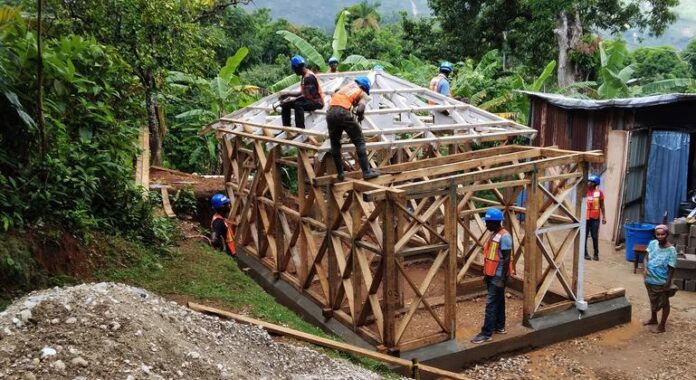
We cannot forget Haiti,” said Lola Castro, speaking from the capital, Port-au-Prince, while also appealing for Jamaica, Cuba and the Dominican Republic.

More than 80 people were killed and roughly six million were affected by the category 5 hurricane – among the most intense in the Atlantic on record.

The senior humanitarian placed particular emphasis on Haiti, which is already grappling with challenges including gang violence, mostly in the capital, and food insecurity. 

Roughly 5.7 million people – over half the population – are going hungry and 1.4 million nationwide are displaced.

Fleeing through rivers of mud

Hurricane Melissa dumped heavy rains on southern Haiti, impacting 1.2 million people.

Ms. Castro was fresh from the town of Petit-Goâve, where the river burst its banks and “people had to escape from their houses in the middle of the night through rivers of mud.”  Twenty-five residents died.

She met “women and men in total distress” who are trying to rebuild their lives after losing their loved ones, homes, livelihoods, crops and cattle.

WFP, alongside other UN agencies, NGOs and the government, were on the ground “from day one” providing food and then cash transfers, which allow people to make their own purchasing decisions.  

Women told her that they will use the cash transfers to buy food, soap and other immediate needs.

“We also talked with a group of youth that are organized, trying to help these communities to restart their lives,” she continued.

“And what they ask is, ‘Please don’t forget us. Don’t forget us, because a month-and-a half (ago) we were in all the news, but now we need continued support.’”

Recovery and rehabilitation

The hurricane also caused catastrophic damage in western Jamaica and eastern Cuba, and WFP has reached more than 725,000 people across the four countries.  

“We are trying now to really work on recovery and rehabilitation through a number of tools,” Ms. Castro said, such as school feeding programmes and supporting government efforts to boost social protection through registering everyone who has been affected by the disaster. 

“But what is very clear in Haiti and in the whole region is that we need to invest much more, as we have done this time, on anticipatory action.”

Advance preparation critical

WFP undertook a lot of work around emergency preparedness before the hurricane hit. 

These measures included sending messages advising Haitians of the impending storm, reaching some 3.5 million nationwide, and distributing advance cash transfers to more than 50,000 people.  Teams in Cuba also moved food aid from the east of the island to the west. 

“But we need to do much more of that,” she said.  “We really need also to ensure that our simulations and preparedness mechanisms are ready.”

Building community resilience

Ms. Castro highlighted examples such as microinsurance payments, which enable smallholder farmers in Haiti – who provide food used in WFP’s “homegrown” school meals programmes – to keep on producing.

“These are new mechanisms and tools that we need to do much more in the region, in the Caribbean, because we know every year there will be hurricanes or earthquakes, like we saw last year in Cuba,” she said.

We really need to work harder to build the resilience of these populations that are permanently affected so that food insecurity doesn’t become a trend but is reduced, with the communities working for themselves and building their own resilience.”

WFP is seeking $83 million to reach 1.3 million people across the Caribbean affected by Hurricane Melissa. and roughly half the funding has been received. 

Source link

Afghanistan’s crisis deepens as human rights recede and aid funding falls

0
Afghanistan’s crisis deepens as human rights recede and aid funding falls

Briefing the Security Council, Georgette Gagnon, Deputy Special Representative of the Secretary-General for Afghanistan, and Tom Fletcher, the UN Emergency Relief Coordinator, said nearly half the population will need protection and humanitarian assistance in 2026.

Women and girls remain “systematically excluded” from almost all aspects of public life, Ms. Gagnon said, as the ban on secondary and higher education for girls has now entered its fourth year, depriving the country of future doctors, teachers and leaders.

Media freedom is increasingly restricted. Journalists face intimidation, detention and censorship, reducing the space for public debate and public participation,” she added.

Afghans – both women and men – also face daily intrusions under the de facto authorities’ law on the “propagation of virtue and prevention of vice,” she added, describing a pattern of systematic interference in private life.

Humanitarian needs surging

At the same time, humanitarian needs are surging. Mr. Fletcher said that nearly 22 million people will need assistance next year, with Afghanistan now ranking among the world’s largest humanitarian crises.

For the first time in four years, the number of people facing hunger has gone up,” he warned. Some 17.4 million Afghans are now food insecure, while massive funding cuts have left the response “stretched to breaking point.”

More than 300 nutrition delivery points have closed, leaving 1.1 million children without lifesaving nutrition, while 1.7 million face the risk of death without treatment. The health system is also buckling: 422 health facilities were closed in 2025, cutting three million people off from lifesaving care.

© UNHCR/Oxygen Empire Media Production

The year 2025 has seen a marked increase in refugee returnees to Afghanistan. Pictured here, a scene at the Islam Qala border crossing between Afghanistan and Iran.

Refugees returning to hardship

Adding to the strain, Afghanistan has seen record refugee returns, with over 2.6 million Afghans returning in 2025 alone, bringing the two-year total to more than four million. Most arrive with few possessions and are absorbed into already impoverished communities.

“Women and children made up 60 per cent of all returns this year,” Mr. Fletcher noted – returning to a country where women are barred from education, work and, in some cases, healthcare.

Economic pressures are worsening despite modest growth. While GDP is expected to rise by 4.5 per cent, per capita income will fall by about four per cent due to population growth, according to World Bank figures cited by Ms. Gagnon.

Rural livelihoods have also been devastated by the third year of the opium cultivation ban. Although welcomed internationally, UN agencies report a 48 per cent drop in rural incomes, with more support needed for alternative livelihoods.

Aid delivery crippled

While security conditions appear calmer than in past decades, tensions with Pakistan are rising amid cross-border exchanges linked to militant activity. At the same time, the closure of key border posts for two months has hurt trade and civilian life on both sides.

Meanwhile, women’s participation in humanitarian work remains under direct assault. Since September, female national UN staff have been barred from accessing UN premises nationwide, a restriction Mr. Fletcher called “unacceptable” and warned was crippling aid delivery.

There can be no effective humanitarian response without women,” he said. “Afghanistan needs them.

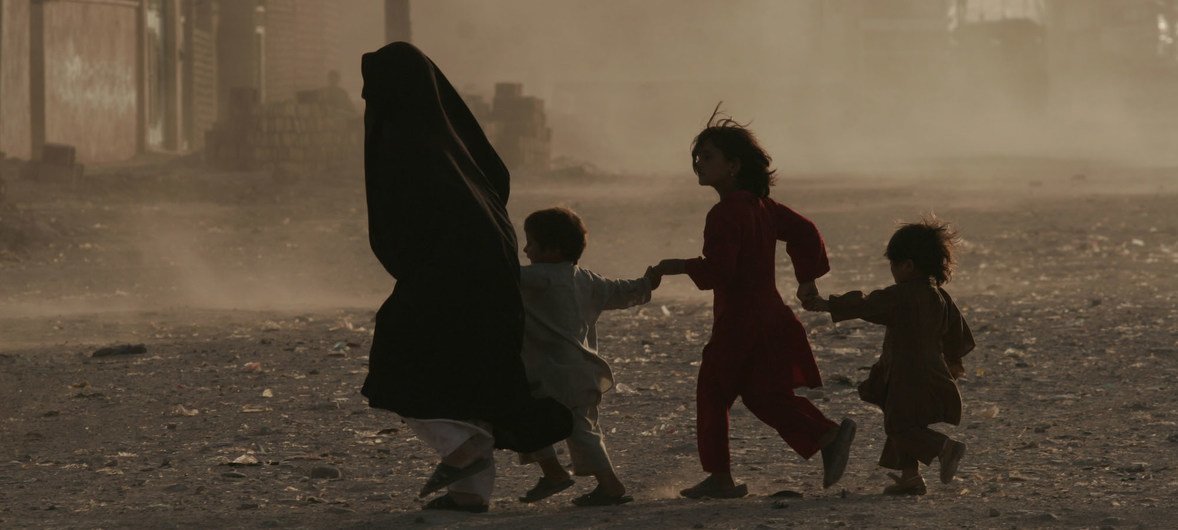
A family runs across a dusty street in Herat, Afghanistan.

A family runs across a dusty street in Herat, Afghanistan.

Rights increasingly out of reach

The UN Assistance Mission in Afghanistan (UNAMA) also warned that rights in the country remain “out of reach for too many,” especially for women and girls. Involuntary returns are also placing journalists, former officials and civil society figures at heightened risk of reprisals.

Human rights are not optional. They are the everyday essentials that sustain life,” Ms. Gagnon said in a separate UNAMA statement. “For Afghanistan, ensuring women and girls can learn, work, and participate fully is indispensable to recovery.”

Call for international support

Despite severe constraints, the UN continues to deliver aid. More than $40 million in emergency funding has been released in recent months to respond to earthquakes, drought and mass returns.

But Mr. Fletcher warned that underfunding is now costing lives.

As we look to 2026, we risk a further contraction of lifesaving help at a time when food insecurity, health needs a strain on basic services and protection risks are all rising,” he said.

He stressed that without urgent attention of and support from the international community, the crisis would only worsen.

Source link

UN warns of ‘regional conflagration’ as DR Congo violence uproots 500,000

0
UN warns of ‘regional conflagration’ as DR Congo violence uproots 500,000

The UN’s Deputy Spokesperson said Secretary-General António Guterres was “deeply alarmed” by the surge in attacks across South Kivu, where what’s officially known as the Alliance Fleuve Congo/Mouvement du 23 mars (AFC/M23) has advanced into several towns since 2 December.

The UN and Security Council have repeatedly described the majority-Tutsi M23 militia as backed by Rwanda but Kigali has consistently denied providing support.

“The Secretary-General underscores that this escalation risks seriously undermining efforts to achieve a sustainable resolution of the crisis and increases the risk of a broader regional conflagration,” Farhan Haq said in a statement.

Dozens of civilian deaths and many more injuries have also been reported in Kamanyola, Luvungi, Katogota and Uvira triggered mass displacement and caused civilian casualties.

Mr. Guterres called for an “immediate and unconditional cessation of hostilities,” urging all parties to honour commitments made under the peace accords signed by the leaders of DRC and Rwanda in Washington on 4 December and the Doha Framework Agreement reached in November.

He added the UN remains “fully mobilised” to support lifesaving assistance and ongoing diplomacy, stressing that “the risk of regional conflagration is real, and the need for de-escalation is urgent.”

Dramatic escalation

The UN aid coordination office (OCHA) said new assessments indicate that more than 500,000 people have been displaced in just over a week, a dramatic rise from earlier estimates.

While some families have returned to areas where fighting has momentarily subsided, most remain in overcrowded sites where the risk of cholera, mpox and other disease outbreaks is rapidly rising.

In the key town of Uvira – reportedly overrun by AFC/M23 fighters on Wednesday – the situation was described as relatively calm on Thursday, though sporadic gunfire continued in several neighbourhoods.

Radio Okapi, operated by the UN peacekeeping mission MONUSCO, reported that the city’s streets were deserted, the border crossing with Burundi closed, and residents sheltering indoors amid fear and uncertainty.

Myrline Sanogo Mathieu from the UN World Food Programme (WFP) describes the situation in eastern DR Congo.

Hospitals ‘struggling to cope’

Hospitals are struggling to cope. Uvira’s main referral hospital is receiving a steady influx of wounded patients, including more than 60 people transferred after Ruzizi Hospital ceased operations due to insecurity.

On Wednesday, an explosion in Uvira’s Kimanga neighbourhood reportedly killed two civilians and injured three others.

More than 27,000 people have fled into Tanganyika Province, which borders South Kivu, since 8 December, arriving in Kisongo, Kabimba and along the shores of Lake Tanganyika.

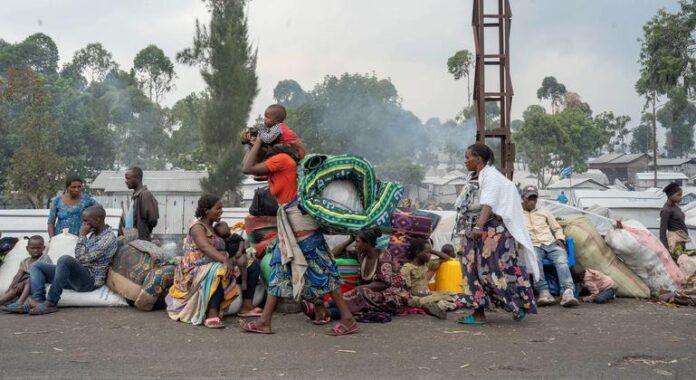
Previous waves of fighting in eastern DR Congo has driven thousands of refugees into neighbouring Burundi. Pictured here, displaced families arrive at Rugombo transit site in Cibitoke Province. (file photo)

Regional spillover fears

The violence has also driven people across DRC’s borders – an estimated 50,000 people have crossed into Burundi, where conditions at makeshift sites remain “very precarious,” according to OCHA.

Many refugees – mostly women and children – are exhausted, injured and in urgent need of shelter, food, water, sanitation and protection services.

Additional arrivals have also been reported in Rwanda, where the UN refugee agency, UNHCR, is supporting registration, health and nutrition services, hot meals and child protection assistance at the Nyarushishi Transit Centre.

A year of escalating conflict

The latest surge comes after one of the most volatile years in eastern DRC in recent memory.

Fighting between the Congolese armed forces, local militias and M23-aligned fighters intensified sharply earlier this year, culminating in the fall of Goma in January and repeated waves of displacement across North and South Kivu.

UN Special Envoy for the Great Lakes Region Huang Xia said the newest escalation “seriously undermines prospects for a durable settlement” and risks igniting broader regional tensions.

He urged all armed actors to step back from confrontation and facilitate rapid, unhindered humanitarian access.

Source link

Social media: Age-related bans won’t keep kids safe, UNICEF warns

0
Social media: Age-related bans won’t keep kids safe, UNICEF warns

After months of anticipation and debate over the government’s controversial move, under 16s woke up to find themselves locked out of popular platforms such as TikTok, Instagram and YouTube, according to media reports.

The ban aims to protect young people from online abuse such as cyberbullying, exploitation and exposure to harmful content, all of which are detrimental to their mental health and well-being.

Bans could backfire

As other governments contemplate similar moves, the UN Children’s Fund (UNICEF) cautions that age-related restrictions alone won’t keep children safe. 

“While UNICEF welcomes the growing commitment to children’s online safety, social media bans come with their own risks, and they may even backfire,” the agency said in a statement. 

For many children, particularly those who are isolated or marginalised, social media is a lifeline for learning, connection, play and self-expression, UNICEF explained. 

Moreover, many will still access social media – for example, through workarounds, shared devices, or use of less regulated platforms – which will only make it harder to protect them.

Protection and respect for human rights

Age restrictions must be part of a broader approach that protects children from harm, respects their rights to privacy and participation, and avoids pushing them into unregulated, less safe spaces,” the statement said.

“Regulation should not be a substitute for platforms investing in child safety. Laws introducing age restrictions are not an alternative to companies improving platform design and content moderation.”

The UN human rights chief also weighed in during his end-of-year press conference in Geneva.

“We know how difficult it is for societies to grapple with the issue of how to keep children safe online,” Volker Türk said in response to a journalist’s question.

“We have had the social media platforms launched now quite a few years ago, but I don’t think at the stage when they were launched that a human rights due impact assessment was actually done.”

Make the internet safe

UNICEF urges governments, regulators and tech companies to work together with children and families to build a digital space that is safe, inclusive and respects children’s rights.

Authorities must ensure that age-related laws and regulations do not replace companies’ obligations to invest in safer platform design and effective content moderation.

Furthermore, social media products must be re-designed, putting child safety and well-being at the centre, while regulators must have systemic measures to effectively prevent and mitigate online harm.

 Support for parents

Other recommendations include helping parents and caregivers to improve their digital literacy.

“They have a crucial role but currently are being asked to do the impossible to protect their children online: monitor platforms they didn’t design, police algorithms they can’t see, and manage dozens of apps around the clock,” UNICEF said.

The UN rights chief noted that countries are trying to keep up with technological developments, and Australia is not alone in its response.  The state of California in the US has a similar law to shield minors online, while the European Union is debating draft legislation.

It’s very important to keep monitoring what works, what doesn’t work,” said Mr. Türk.

“But it is also very clear from a human rights perspective that the best interest of the child has to be taken into account in all of this, including the protection and safety concerns that children face.” 

Source link