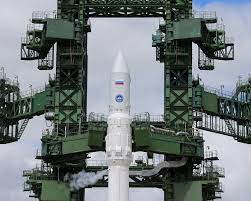
The military satellite Cosmos 2555, launched on April 29 with the Angara-1.2 launch vehicle, could burn up in the atmosphere as early as June. Information about this appeared in the Telegram channel Alpha Centauri Cosmos.
Vitaly Egorov, an expert and promoter of astronautics, told The Insider that if there is no serious start to the engine, the satellite will cease to exist by mid-June. In 15 days, the satellite has made only one short-term correction of its orbit – on May 6. Since then, its orbit has been declining. Egorov notes that the data on the position of the Cosmos 2555 satellite (as well as on any other) is available to anyone, as it is monitored by the US military system NORAD. “Scientists have already plotted the movement from the launch to the present day. It can be seen that in about 10-12 days it has lost 30 km of altitude and from an average height of about 290 km has descended to a height of 260 km, which at such altitudes is quite a significant loss. And indeed, if this continues for another 2-3 weeks, then the satellite will inevitably enter the dense layers of the atmosphere and descend into orbit. The graph shows that there have been several attempts to change the orbit. There may have been 3 or 4 engine starts, but they were very weak and did not significantly affect the orbit. Therefore, in the near future, if there is no major engine start and orbit change, then probably by mid-June, the satellite will cease to exist. Maybe even earlier, “Egorov said. On April 29, Interfax reported, citing the Ministry of Defense, that a light Angara-1.2 launch vehicle had been launched from the Plesetsk spaceport in the Arkhangelsk region.
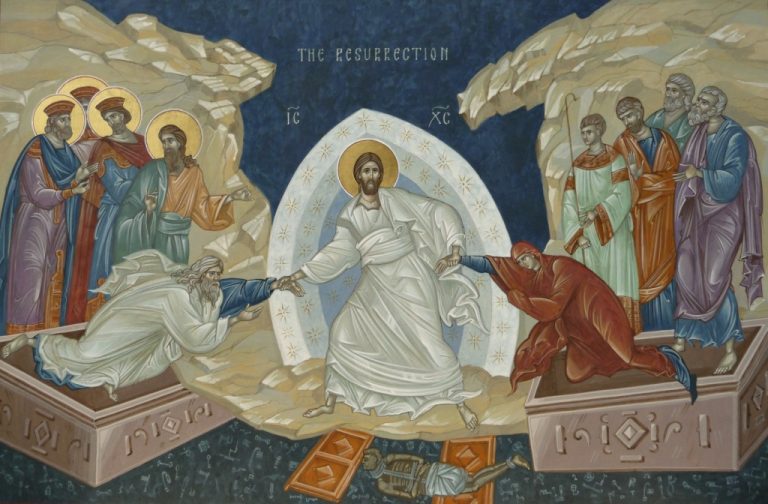
For the unbelieving consciousness, the idea of resurrection is absurd. From this point of view, the faith of Christians is even more absurd. The case of the speech of St. Paul the Apostle in Athens is indicative – the center of the then world philosophical and intellectual thought. His speech ends the moment he speaks of the resurrection from the dead. Some of the listeners leave, others laugh at him, and some stay and believe him (Acts 17:34). In many ways, the event described corresponds to the attitude of the people in the modern world. With its belief in the resurrection, Christianity is radically different from all other religious systems. The goal of the Christian life is not salvation per se, but union with God through love. The main obstacle to this union with Him is death. It is the main obstacle that needs to be overcome. And according to the Christian faith, this can only happen with divine help.
The Christian faith in the resurrection from the dead is radically different from the belief in immortality. Immortality, understood in various pagan systems, is generally accepted as immortality of the soul, ie of a part of man – of its component, which is separated from the material, from dark matter, and goes to the realm of light. Christianity is radically changing the paradigm. It preaches something unthinkable – complete recovery of man, physical and spiritual. Because of this faith, he became hated by the pagan world. The reason is that it does not deny this world, does not treat it with contempt, but does not worship it. On the contrary, he accepts it, views it as a creation of God, which, however, is subject to transformation, liberation from sin – ie, confession of a mistake made at the dawn of human history. The classical pagan world preaches something else – an escape from this world and, accordingly, hatred of matter, which, according to him, stops man on his way to God. For him, matter is evil, a dungeon that holds the soul. For Christianity, the problem is not in matter, but in the spirit that has distanced itself from God and sunk into matter, distorted its purpose. Due to man’s sin, matter in the world created for him also suffers damage. According to the Christian faith, through the resurrection not only the soul is restored, but also the matter, the whole man, ie nothing of it is lost, does not perish. Therefore, there is nothing superfluous in man. Otherwise, it would be absurd to assume that God created man in such a way that something must fall away from him afterwards.
In the Old Testament, the expectation of the resurrection is conveyed indirectly. There the main idea was the belief in one God, as a counterbalance to pagan polytheism. As a result, the resurrection was avoided, which was especially popular in the cults of the pagan world and led to temptation. But the prophets clearly testify that the resurrection of man is something that will happen and defeat death. The text of Prov. Hosea: “I will redeem them from the power of hell, I will deliver them from death. Where is your sting, death? Where is your victory, hell? ”2. The life of the Old Testament man depends on two main factors: exclusively and only from God, on the one hand, and on the other, as a consequence of the first – the community, the people, the ancestral origin. Therefore, the well-being of man is determined entirely by the well-being of the people, by life here and now – the well-being of the individual is predominant on earth. The land has a special role for the Israelite; even today it is politically important, but also eschatological in importance3.
In the attitude of the Old Testament man to life, to its meaning and significance, the book is very indicative. Job. Job’s trial ends only with his faithfulness to God. He remains faithful to the end, despite all the suffering. The book concludes with God restoring to him twice what he had before the trial (42:10). He died “old and full of life” (17). However, there is no ultimate, eschatological optimism in this book. It anchors man on earth, does not give him extreme hope. It does not solve the question of meaning, it only postpones it. The real solution comes later. It is in the resurrection.
This was first foreshadowed by the prophets4, and was gradually expressed through revelations in visions and various images. However, the prophetic view and vision of the resurrection is not understood by all. Subsequently, the idea of it was rejected in certain religious and intellectual circles of society. In this spiritual and ideological environment in the so-called inter-Testament age, two currents are formed regarding the belief in the resurrection of the dead5. On the one hand are the Pharisees who accept the resurrection and God’s judgment, and on the other are the Sadducees who deny the resurrection and even enter into a dispute with Jesus Christ (Mark 12: 18-27).
The very preaching of Jesus Christ is categorical about the resurrection. The Savior rebuked the Sadducees, much of the spiritual and intellectual elite of Jewish society at the time, for misunderstanding the Scriptures. He refers to Moses, ie the law according to which God is the God of the fathers Abraham, Isaac and Jacob. “But he is not the God of the dead, but of the living: for all live unto him” (Luke 20:38). In refutation of their unbelief, the Savior again uses an argument from Scripture. He quotes Ps. 109: 1 where the Messiah is called the son of David (Luke 20: 41-44). Apparently here Jesus Christ categorically states that death is not absolute, that it is only temporary and does not affect man as a whole. According to St. Cyril of Alexandria, Jesus Christ showed the Sadducees that they were especially illiterate because they did not accept the words of their main authority, Moses, who was clearly familiar with the resurrection from the dead. “To whom will He be God, according to their arguments, if they have ceased to live? He is the God of the living. ”6
The Gospel directly testifies to how difficult it was to accept the idea of the resurrection from the dead. Although Jesus Christ told His disciples that He would be killed and resurrected, their faith was weak. It is weak even after the transfiguration of Peter, James, and John. They enter directly into another spiritual reality, participate in theophany (Luke 9: 34-35), but still cannot accept this truth. Most obviously, these moments occur after the very resurrection of Jesus Christ. The words of the passengers about Emmaus are indicative. The women have already brought the news of His resurrection, but they doubt, do not believe the testimonies and those who saw the empty tomb (Luke 24: 23-24). The Savior has to explain the Scriptures to them, and yet they do not believe. Only after the blessing and breaking of the bread (Holy Eucharist) do they recognize Him. All the while, Jesus Christ insists before them that what is happening is the fulfillment of Scripture. That is, the hidden reproach is that they do not rely on Scripture, but on their own understandings. So that they would not hesitate, He took special action: “Then opened he their minds to understand the scriptures, and said unto them, Thus it is written, and thus Christ must suffer and rise again from the dead on the third day” (45-46).
Unbelief in the resurrection shows how much man has sunk into dependence on the definitions of the external, sensory world. The example of St. Thomas the Apostle is illustrative. He is looking for external, empirical evidence: to see the scars from the nails and to put his finger in the wounds from them, to put his palm in the wound from the spear. Until he did so, he said, “I will not believe” (John 20:25). Despite all these encounters with the risen Christ, the lives of the disciples did not change visibly. They are still not clear about what happened and what is going to happen. They fish (21: 3 nat.), Take care of everyday things. Clearly, in order to establish faith in the resurrection — despite the evidence Jesus Christ gives for Himself forty days after His resurrection — and for the radical change it brings to man, something else needs to happen. This is the historic appearance of the Church on the day of Pentecost. Then, with the descent of the Holy Spirit upon the disciples, this radical change occurs. Their spiritual gaze opens and they begin to understand the Old Testament scriptures. The leading role is taken by St. Peter the Apostle and he, already enlightened by St. Spirit mind, begins to explain the Old Testament prophecies and their relationship to what is happening now. He refers them to Jesus Christ because they testify to the victory over death (Acts 2:27). The apostle directly declares, “Then God raised up Jesus, of whom we are all witnesses.”
After the descent of the Holy Spirit on Pentecost, when the spiritual eyes of all believers are opened, many of the events related to Jesus Christ, and especially the question of His resurrection, become clear to the heart and mind. Such are they later for all baptized, believing Orthodox Christians, conscious members of the Orthodox Church. For the Orthodox consciousness, the resurrection is what gives meaning and gives the right answer to the question of the Savior’s sacrifice. Without the resurrection, it would be meaningless. As Prof. Totyu Koev notes: “The Resurrection of Christ is a unique, unrepeatable case in the whole of human history. In him and through him the Golgotha sacrifice is affirmed and fully accepted. Without the resurrection, the death on the cross is meaningless, just as the resurrection without the cross is meaningless ”7.
This truth was hard to grasp among the newly converted Jews and Gentiles. Evidently among the newcomers to the Church in Corinth, and perhaps among the believers close to the apostles, there were hesitations about the resurrection of Jesus Christ. Then the app lights up. Paul puts before them the question of the resurrection from the dead radically: “If Christ has not been raised, then our preaching is in vain, and your faith is in vain” (1 Cor. 15:14). That is, all the efforts he, the apostles, and their followers make are in vain. And not only that, but they would be in self-deception, or worse, they would be frauds. But the truth is clear: “Christ rose from the dead and became the beginning of the dead.” If there is no resurrection, the very coming of Jesus Christ into the world is meaningless.
The meaning is clear: the resurrection from the dead is a new beginning for man. Through him, the last enemy was defeated – death (26). Without faith in the resurrection, the Christian faith itself becomes meaningless. It is absurd! In his second epistle to the Corinthians, the apostle reassures them, “We know that he who raised up the Lord Jesus will raise us up through Jesus” (2 Cor. 4:14).
It was difficult for the Hellenic consciousness to accept the resurrection as a reality. For him, death and resurrection are above all inherent in pagan gods, but not in man. Confirmation of this idea is found elsewhere, again in a Hellenic environment. Before the believers in Thessaloniki, the apostle again insisted, “If we believe that Jesus died and rose again, even so them also which sleep in Jesus will God bring with him” (1 Thess. 4:14). The resurrection is a victory over death, it gives hope to every person to make sense of his life and, fighting his sins, to avoid despair and despondency, but to believe in life. This is the promise of the very Life of Jesus Christ: “I live and you will live” (John 14:19). The resurrection of Christ is the pinnacle, the culmination of the Christian faith. It intersects, summarizes and centers all questions and answers related to it.
What has been traced so far shows how the Holy Scriptures begin with the story of the creation and catastrophe of the Fall, the consequence of which is death. In its content it is nothing but a testimony to this gigantic battle that is being fought in heaven and earth precisely to destroy this last enemy – death. The center of this battle is the fact of its destruction in the person of Jesus Christ, and how this will happen for each person individually and for the world as a whole is testified by the last book of Scripture – vol. Revelation. In it, the history of the world, past and future, unfold as in a fast-paced film. It is the most optimistic ending in world history known to mankind. This eschatological optimism solves the question of meaning – it is in the resurrection of man in his entirety and his existence with God. Then the lost access to the tree of life will be restored. The tree will be in the middle of the main street of the new Jerusalem. According to bl. Jerome symbolizes the Holy Scriptures:
the fruits are its meaning, and the leaves are the words. However, only the words, as the Jews read them, are meaningless. But “even if one understands the Scriptures only as history, he acquires something useful for his soul.” The river that flows through the city is God’s Revelation, which contains the truth and brings grace to the inhabitants of the city. According to Bishop Andrew of Caesarea, the tree of life is Jesus Christ himself. The fruits of the tree are the believers in Christ who spread the faith during the twelve months, symbolizing the apostles. They point to the uninterrupted knowledge of God that believers receive. “The Tree of Life bears twelve fruits, namely, the Apostolic Council, which shares in Him Who is the true Tree of Life, Who, through His participation in the flesh, has enabled us to share His divinity.”
The bride of Christ, the Church, awaits the coming of Christ. She calls: “Come! Come! And he that heareth, let him say, Come. And he that is thirsty, let him come, and he that will, let him take of the water of life freely ”(Rev. 22:17). St. John himself concludes the book with the common hope of all Christians: “Amen, yes, come, Lord Jesus!” (20). The faith of the Church is focused on the Resurrection, and therefore it is its brightest holiday. It begins in history, is experienced constantly, transcending space and time, and is projected into the eschatology. However, its influence is constant and unchangeable for the believing Orthodox Christian, as evidenced by many of the texts of the resurrection service. They invite us to rejoice in the Resurrection:
“This is the chosen and holy day,
The first day of the week, king and lord,
Holiday and celebrations:
In him let us bless Christ forever ”10.
However, the joy of the Resurrection is always shared. It overcomes all selfishness and forgives every person who has sinned against us. Otherwise, the joy of the Resurrection is impossible. The worship service of the holiday invites us again:
“It is the day of resurrection,
Let’s shine on the holiday
And hug each other.
To those who hate us, let us say: brothers!
And forgive them all for their resurrection. ”11
In conclusion, it can be said that the Resurrection in its deepest sense leads to the restoration of man’s fullness, of his wholeness. Jesus Christ comes to “transform” man through His resurrection. In Greek, Sōtēr (Savior) means “Healer”. The miracles of healings that have such a remarkable place in the Gospels symbolically foreshadow man’s final “healing.” The true wholeness, the indivisible, incorruptible body, man acquires only in the bodily resurrected Lord, in the “body of the resurrection.” Therefore, the resurrection is directly related to the complete recovery and salvation of man from sin and death.
Welcoming the Savior is the greatest hope of the believing Christian – the final solution to the problem of evil and death. That is why Christianity is the most optimistic religion.
Excerpt from the publication “Between Faith and Reason”, Sofia, Omofor, 2020
Notes:
1 Cults associated with the Sun, with the cycle of nature, where the personified deities of nature die and are reborn as Tammuz e.g.
2 Biblical critique, based on linguistic and literary analysis, questions these Old Testament testimonies. She raises the question of the clear acceptance of the idea of resurrection from the dead only in the book. Daniel (12: 2), which is believed to have been written at a very late stage in the time of Antiochus IV Epiphanes (215-164 BC).
3 On the subject, see: The Promised Land in Biblical-Historical and Archaeological Context. In: Cultural texts of the past – carriers of symbols and ideas. Book I. Texts of history, history of texts. Proceedings of the Jubilee International Scientific Conference in honor of the 60th anniversary of Prof. D.Sc. Kazimir Popkonstantinov, Veliko Tarnovo, October 29-31, 2003. Sofia: University Publishing House “St. Kliment Ohridski », 2005, pp. 76-92.
4 Spiritual and intuitive sense of realities that are not subject to rational analysis.
5 Cf. Popmarinov D. Biblical theology. Protection of the Mother of God Foundation, Sofia, 2018, p. 316 nat.
6 Cyril of Alexandria, Commentary on Luke, Homily 136. ACCS, NT, v. 3, p. 296
7 Koev, T. Resurrection and life. DK, kn. 4, 1991. https://web.archive.org/web/20200814074122/https://bg-patriarshia.bg/reflections.php?id=393
8 Jerome, Homilies on the Psalms 1 (Ps. 1). ACCS, NT, v. 12, p. 356.
9 Andrew of Caesarea, Commentary on the Apocalypse, 22.2., ACCS, NT, v. 12, p. 358.
10 Irmos of the eighth song from the Easter canon of St. John of Damascus. Cit. By: The Incarnate God. Festive catechism. Protection of the Mother of God Foundation, Sofia, 2007, p. 331.
11 The hymn from the ninth song of the Easter verse, ch. 5 of the Easter canon of St. John of Damascus. Cit. By: The Incarnate One, p. 336.
12 Ivliev, archim. January The Man in the Holy Scriptures (exegetical approach).
https://web.archive.org/web/20161015032437/https://azbyka.ru:80/ivliev/chelovek_v_svyaschennom_pisanii-all.shtml to 25.05.2020
The topic of European integration of our southwestern neighbor was among those discussed at the talks with Mark Rutte
The future of Northern Macedonia must be in the European family, there are no two opinions on this issue.
This was stated by Prime Minister Kiril Petkov after the meeting with his Dutch counterpart Mark Rutte, held at the Council of Ministers.
The topic of the European integration of our southwestern neighbor was among those discussed at the talks, Petkov said.
“Now it is a matter of concrete constructive steps to go this way together. This is not a function of a calendar or expectations, this is a function of the common work we have to do together. When we do, our government will bring the issue into Bulgarian. Parliament and I hope that in the near future we will be able to advance and the European future of Northern Macedonia will become a fact, “said Kiril Petkov.
The Bulgarian Prime Minister announced that he and Rutte also talked about the accession of our country to the Schengen area.
According to Kiril Petkov, fulfilling the strongest task of the Bulgarian government – to eliminate corruption and increase the level of Bulgarian institutions – is the safest way to Schengen.
“Mark assured me that this is the way. It is not a matter of political statements, but to do our job,” said the Bulgarian Prime Minister.
On the topic of energy, he once again confirmed that Bulgaria will want to be part of the exceptions in connection with the European embargo on Russian oil.
Kiril Petkov expressed gratitude to his Dutch counterpart for the cooperation in the military field, including the Dutch fighters involved in the protection of Bulgarian airspace.
We must prepare in the best way for Europe after the war, after the Russian aggression in Ukraine, said the Prime Minister of the Netherlands Mark Rutte after the meeting of the Council of Ministers.
“The Netherlands is helping Bulgaria with F-35 fighters and it is important to be side by side, because the threat from Russia is not only a threat to Bulgaria or Romania, we must deal with it together, at European Union level and together with NATO. “, said Mark Rutte. We are all together, united, because divided we will be defeated, said the Prime Minister of the Netherlands.
He assured Petkov that Bulgaria has friends everywhere in Europe and congratulated him on the stated desire of the new government to fight corruption and modernize the country.
The two prime ministers also expressed a desire to work on a number of joint initiatives and projects related to agriculture, the IT sector, artificial intelligence and the green economy.
The Minister of Foreign Affairs of Bulgaria Teodora Genchovska confirmed that the pressure on our country for the soon start of the negotiations with Skopje for accession to the EU continues.
“There is pressure, and it continues now, but our position is clear – we expect Northern Macedonia to start implementing the treaty and ensure the inclusion of Bulgarians in the preamble to their country’s constitution,” she told Bulgarian journalists in Brussels. Council of the EU.
From the very beginning, the whole process is based on the merits of Northern Macedonia, in no way tied to dates, she added in response to a question on whether progress can be expected in June. On the part of Northern Macedonia, clear concrete steps must be taken to ensure that the Treaty of Friendship, Good Neighborliness and Cooperation will begin to be implemented and will continue to be implemented, the minister said. We expect concrete actions, said Genchovska.
According to the Minister, the inclusion of the Bulgarian minority in the constitution of Northern Macedonia would not be enough to set a date for the start of negotiations with the EU. The other track is the treaty – it is internationally recognized, which means that Skopje must respect the rule of law and this is part of the Copenhagen criteria, Genchovska explained.
According to her, the upcoming visit of the European Commissioner for Enlargement and Neighborhood Policy Oliver Warhey this week does not create additional pressure. We will continue to explain what our position is, what we expect from the negotiation process and what guarantees we want to be included in the negotiating framework, said Genchovska.
She added that Bulgaria’s official position is one. There are representatives of the cabinet and various institutions who, I hope, have already understood that there is no way for Bulgaria to have two foreign policies. If there is any progress on how our relations with Northern Macedonia will develop in the future, all this will go through a decision of the National Assembly, the minister said.
Demonstrating clear signs of stress can make people more attractive and encourage others to treat them more positively. It is possible that in the process of evolution Homo sapiens even specifically developed the ability to demonstrate the external manifestations of his psycho-emotional state to others in order to receive additional support
Such findings were made by British researchers from the University of Nottingham Trent and the University of Portsmouth, who published an article on the subject in the journal Evolution and Human Behavior. A corresponding press release was published on the website of the University of Portsmouth.
Researchers have studied the paradox of stressful behavior, in which humans, like other primates, often show external signs of stress “to their own detriment,” such as scratching, biting nails, fluttering and touching their face or hair. to others that they are in an inadequate condition. It turned out that outside observers not only manage to determine quite accurately when someone is stressed, but also react more positively to people who show more signs of stressful behavior. As part of the study, participants in the experiment were videotaped while performing work that they had to prepare as soon as possible. The videos were shown to other volunteers who had to assess how tense they thought the person in the video was. The participants in the experiment, who reported that they were seriously worried during the task, were perceived by the outside world as experiencing the greatest stress. The results also showed that people are usually able to determine when others are stressed because of their own behavior. Interestingly, the subjects who were identified as experiencing the most stress during the task evoked the most sympathy from others, which the experimenters said provided a key to understanding how empathy works and why people have evolved to demonstrate to others these signals.
Homo sapiens, unlike many other animals, shows a great tendency to cooperate with their peers, and perhaps that is why behavior that informs others of their own weakness has succeeded in such a great development.
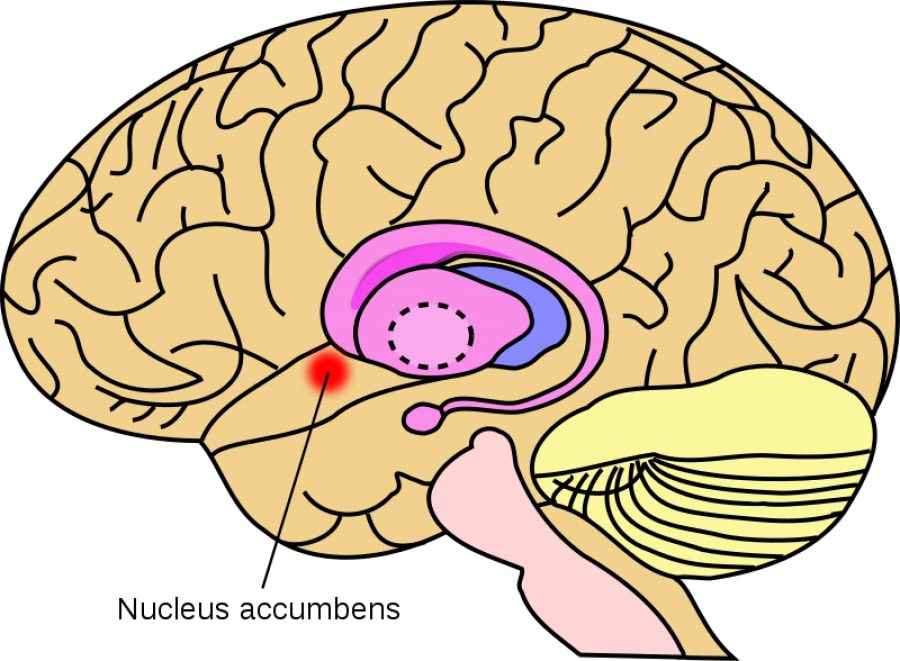
Image: The adjacent nucleus (nucleus accumbens). John Henkel, Leevanjackson / CC BY-SA 4.0
The “center of love” in the human brain has been discovered by Japanese scientists – it is located in the adjacent nucleus (nucleus accumbens), an important part of the reward system. It is this area of pleasure and addiction that becomes active when men look at photos of their loved ones, no matter how attractive they are. Now we need to understand exactly how attachment is formed and how the work of the adjacent core changes over time.
Romantic relationships are an important aspect of life. Earlier research has shown that interest in attractive people activates certain areas of the brain, including the adjacent nucleus. Researchers at Kyoto University have studied the role of the adjacent nucleus in the formation of emotional attachment. They set out the details in an article in the journal Psychological Science. The adjacent nucleus is a group of neurons that play an important role in the reward system of the brain, the formation of addictions, pleasure, laughter, fear, aggression. Receiving information from the prefrontal cortex, amygdala and hippocampus, the adjacent nucleus analyzes emotional and sensory data and forms a response to stimuli.
“Since childhood, I have been interested in the mystery of close interpersonal relationships: why and how do people build long-term relationships with loved ones? – says Ruhei Ueda, one of the authors of the study. – In graduate school I got acquainted with the methods of neuroimaging, which can tell us what is happening in our brain. I realized that providing empirical evidence on these issues would be a difficult but exciting job for me. ” The study involved 46 heterosexual men aged 20 to 29 who have permanent romantic relationships. The researchers used functional magnetic resonance imaging to record their brain activity while performing a series of mental tasks. With a correct answer, some participants were shown the photo of their happy partner, and others – a stranger, also with a benevolent expression on his face.
In the first group, researchers found unique activity in the adjacent nucleus, which appeared in anticipation of the “approving” photo of the beloved. The result did not depend on the attractiveness of the woman. “Intimate romantic relationships play an important role in most people’s lives,” said Ueda. – Our research provides empirical data revealing the neural mechanisms that underlie the maintenance of the connection: the center of pleasure and dependence in the brain, the adjacent nucleus, encodes the partner in a specific way different from strangers. We believe that unique neural perceptions of the partner may be related to established romantic relationships. ” of time.
“Selective preference for a particular person can be observed in the first meetings, which can encourage us to start a relationship,” explains Ueda. – Little is still known about the exact neural mechanisms that underlie this process. In addition, numerous psychological studies have shown that the quality of relationships, such as devotion or satisfaction with them, changes dynamically over time, which must be reflected in the work of the brain. Earlier, experts from the Netherlands found that nascent sympathy is influenced by the synchronization of heart rhythm and sweating of the palms. The researchers invited 142 single heterosexual men and women between the ages of 18 and 38 to four-minute blind meetings in special booths. Participants were separated from each other by a barrier that descended for a few seconds, allowing them to make a first impression. In addition, participants received special glasses that monitor eye movements, heart rate monitors and devices to control sweating of the palms. During the communication, the volunteers had to rate the attractiveness of the interlocutor several times on a scale from 0 to 9.
Couples who considered each other attractive and would like to see each other again had a synchronization of certain indicators. Their pulse began to accelerate and decelerate at the same time, and the sweating of the palms, measured by the skin’s electrical resistance, increased and decreased at the same time. The mechanism underlying physiological synchronicity is still unclear, the researchers note. But perhaps when people like someone, they unconsciously pay attention to micro-expressions, such as dilated pupils or redness, and the body reacts by repeating these features.
Poor hygiene, cynical compliments and a lack of noticeable interest are the main characteristics that repel a potential partner in flirting, Greek psychologists have found. At the same time, in most cases, women are more critical of a potential partner – probably such selectivity is explained by the greater contribution of women to future family relationships and raising children. For men, the most important are the parameters related to the appearance of the partner. Older people are more strict with potential partners – obviously because they are more picky about preferences and are more interested in long-term relationships. Flirting is crucial to attracting a partner, but many people have difficulty with him. Psychologists from the University of Nicosia in Cyprus have decided to find out what exactly repulses people in potential flirting partners. The researchers described the results in an article in the journal Personality and Individual Differences.
“Research shows that many people (maybe every second) have difficulty flirting,” says lead author Prof. Menelaos Apostolu. “Understanding what exactly leads to failure will allow people to improve their skills in this area.” The participants in the first part of the study were 212 women and men with an average age of 32-35 years. Slightly more than a third of them were single, as many were in a relationship, and about a quarter were married. Participants had to consider the following scenario: they are lonely and someone comes to them and starts flirting. Volunteers had to name those traits of the flirt that could repel them. The main such traits were vulgar and rude communication, external unattractiveness, attempts at excessive cohesion, stupidity, narcissism, lack of sense of humor, stinginess, poor hygiene, cynical compliments. In total, the researchers identified 69 characteristics and their variants that could spoil the first impression. The second part of the study involved 734 volunteers with an average age of 28-32 years, of whom 42% were single, 40% in a relationship and 12% were married. They had to imagine the same situation as the participants in the first study, but this time to choose repulsive features from the list compiled from its results. Here, the anti-rating of flirting was led by cynicism, lack of hygiene and lack of interest – when, for example, a potential partner in the communication process looked in search of other acquaintances. Differences of opinion, vulgar vocabulary and stupidity were also important. Stinginess, ugly and unsightly appearance, violation of physical boundaries turned out to be a little less unpleasant, but still quite important.
The role is played not so much by the features themselves, but by what they can indicate, the authors of the work explain. “Cynicism, vulgar language, narcissism, breaking borders, lack of sense of humor are associated with negative personality traits, including lack of empathy, aggression and malice, low self-esteem,” they wrote. – Poor hygiene can indicate negative personality traits, as well as hidden psychopathology. In addition, people value intelligence in the partner, which leads to the appearance of points “Lack of intelligence”. This may partly explain the emergence of the point “Lack of sense of humor”, as humor is also associated with the intellect. “In addition, people want the potential partner to be interested only in them, to be like them, to look good and is ready to share resources. Researchers suggest that some traits will be more important for women and others for men. However, women were more demanding in almost all respects. “One of the reasons is that women make most of the mandatory parental investments related to raising children, so they are at greater risk than men if they make the wrong choice of partner,” the authors write. “Accordingly, in the process of evolution, women have become more selective and less risk-averse than men.”
Men’s requirements turned out to be higher than those of women only in terms of appearance. Older people also had higher requirements. Probably the reason is that young people are more focused on gaining experience in relationships with different partners, while over the years people become more inclined to a serious relationship and better understand what they want. “People can flirt more effectively if they work on their approach, avoiding unpleasant and sexist comments, inappropriate touch and not flirting with more than one person at a time,” the researchers said. “The results also show that personal hygiene and vocabulary expansion are other ways to improve flirting skills.” The data are collected on the basis of self-reporting, so they can somewhat distort the real picture, say the authors of the work.
Thus, participants who have no experience in a relationship may not be completely accurate in assessing which of the factors may be unpleasant to them.
In addition, the participants in the study were only Greeks – and attitudes toward certain manifestations of flirting may vary by culture. For example, touch and other physical contact may be perceived in some places as more outrageous, in others as less outrageous. According to scientists, the study should be repeated with residents of other countries to understand how cultural aspects can affect the success of flirting.
The general view of Cleopatra, presented in an ancient Roman text and popularized in modern media, is that of a temptress
Cleopatra VII (69 – 30 BC) was the queen of the Ptolemaic kingdom of Egypt and its last acting ruler.
Known for her love affairs with Mark Antony and Julius Caesar, Cleopatra is often described as a seductress, forged her position in the beds of powerful men.
Cleopatra, however, was a powerful ruler, but historical accounts have discredited her, downplayed her success, and greatly exaggerated her indiscretion. The general view of Cleopatra, presented in an ancient Roman text and popularized in the modern media, is that of a temptress who uses her sexual talents to gain political advantage.
What these ancient tales fail to mention is that she was in fact one of the greatest intellectuals of her time. She was trained by leading scholars from the Hellenistic world and studied at the Museum Training Center in Alexandria, where the famous Library of Alexandria was located. There she studied geography, history, astronomy, philosophy, international diplomacy, mathematics, alchemy, medicine, zoology and economics.
Cleopatra is the only member of her dynasty who speaks ancient Egyptian and reads hieroglyphs. She also knew ancient Greek and the languages of the Parthians, Jews, Medes, Three-Year-Olds, Syrians, Ethiopians and Arabs.
It is known that Cleopatra VII wrote several works related to herbs and cosmetology. Unfortunately, all her books were lost in the fire of 391 AD, when the Great Library of Alexandria was destroyed. The famous doctor Galen studied her works and managed to rewrite several recipes created by her. One of the medicines he also offers to his patients is a special cream that helps men get their hair back.
Its influence on science and medicine has been well known since the first centuries of Christianity.
After the death of Cleopatra, Egypt became a province of the Roman Empire.
According to Maggie Mulquin, it can be destructive
Ironically, the pursuit of happiness is often stressful rather than satisfying. There are many individual reasons for the suicides of young athletes that we are witnessing. But we need to raise the question of how society can help prevent these tragedies. There is no doubt that our culture disappoints young people, and one of the important dimensions of this failure is our insistence on promoting happiness as a measure of a successful life.
This is what psychologist Maggie Mulquin wrote in her analysis for NBC.
Focus on happiness
it can lead to a propensity for perfectionism, as people try to maintain something that is actually a short-lived and elusive emotion, instead of approaching life in a way that creates resilience during inevitable ups and downs, she notes.
As the poet Robert Frost said: “Happiness compensates with height what it lacks in length.” The pressure to present to the world only the best of ourselves can prevent us from connecting with others who might see our shortcomings if we allow them to come closer. To be condemned or, even worse, to be repulsed if we present to the world something less than happy and orderly creates a fragile foundation for self-confidence.
We are constantly bombarded by advertisements and posts on social networks that suggest that happiness is at your fingertips – in fact, it is just a click away. We are told that we can change the furniture in our living room and our state of mind in an instant. This supposed decision makes our appetite for quick decisions stronger, and the failure we experience when a quick solution does not work is perceived as a personal shortcoming, because it is supposed to be so easy to get, explains the psychologist. .
According to Maggie Mulquin, the pressure that people feel to be happy, or at least look happy, can also be devastating to build a strong sense of self-worth.
Reducing happiness to something ostentatious
Is was reduces our ability to express the full range of emotions, which increases stress as we close parts of ourselves.
We live in a world of Hallmark cards, where every event seems to be reduced to a single emotion (all birthdays should be happy!), So people learn to hide their inner emotions instead of expressing them. trigger a downward spiral of emotions and increase the likelihood of depression and anxiety, “she commented.
Instead of promoting happiness as an elixir of life, our society should deepen conversations and explore how people can find satisfaction, the psychologist recommends.
In psychology, the state of satisfaction usually refers to being at peace with yourself. It does not carry the stigma of satisfaction with less, as the word is commonly used. In a psychological sense, being happy means being in harmony with yourself. Unlike happiness, the state of satisfaction is long-lasting and provides a solid foundation for mental health. Discovering what makes us feel satisfied and striving for it helps us protect ourselves from stress in its many manifestations, the expert said.
People who feel connected to a goal, passion, or other person have a stronger sense of well-being. This is a more lasting state of mind than ordinary moments of happiness. Establishing a deep connection with something or someone strengthens self-confidence. This is the seed of determination that can help someone get out of bed in the morning, even when they feel depressed. For those who do not feel satisfaction, their longing makes them vulnerable to quick decisions and despair, to the constant pursuit of the next blow of happiness.
Promoting a sense of satisfaction, not happiness as a goal to measure a satisfying life, must begin early. Usually under “happiness” people imagine a list of achievements, not a state of mind. Many patients struggle with the burden of disappointing their parents by not finding the “happiness” their parents wanted for them.
The misconception that the antidote to stress is happiness
It also reinforces the misconception that only an individual’s inability to cope with it leads to mental illness. Social messages prescribe what happiness looks like – from certain body types to six-figure salaries. Despite all the evidence to the contrary, economic and social structures continue to spread the dangerous myth that individual change, unlike social change, is the solution to the problem of unhappiness.
There are more feelings in the world than happy and sad. As a society, we must encourage and support people to express a wider and more nuanced set of feelings than the current one allows.
There will be no progress in overcoming the mental health crisis if adaptation depends solely on individuals, instead of advocating for change in society.
It is a big step in this direction
to get off the train of happiness and start promoting the value of being happy. Satisfaction comes from a life measured with satisfaction, in a community that wants to know people as they are, not just when they are happy.
After 30 years of presence: McDonald’s leaves Russia
The American fast food chain closed, albeit temporarily, all its establishments in March, after the beginning of the Russian invasion of Ukraine
McDonald’s has announced that it has started procedures for its complete exit from the Russian market, where it has been present for 30 years, and will continue to pay its employees until a buyer is found, probably within a week, world agencies reported. The company stressed that it wants to make sure that they will be appointed by the new owner.
The American fast food chain closed, albeit temporarily, all its establishments in March, after the beginning of the Russian invasion of Ukraine.
“The humanitarian crisis caused by the war in Ukraine, as well as the increasingly unpredictable conditions for doing business, have led McDonald’s to conclude that it can no longer remain the owner of its activities in Russia,” the statement said. the company. The chain’s Russian activities will be sold to a local investor, the fast food giant said.
Leaving Russia is expected to affect the group’s finances as an extraordinary expense of 1.2 to 1.4 billion dollars (1.15 – 1.34 billion euros).
McDonald’s plans to resume operations in Russia under a new brand in mid-June, retaining jobs, most suppliers, the restaurant chain and its menus, a company source told TASS. More than 90 percent of these suppliers are Russian, the source said.
The process of selling the Russian business to McDonald’s includes 850 restaurants with 62,000 employees, according to the Associated Press.
“At the same time, we have a commitment to our global community and we must adhere to our values,” said President and CEO Chris Kempczynski in a statement. “And our commitment to our values means we can no longer let our arches shine there,” he added.
As it tries to sell its restaurants, McDonald’s plans to begin removing its golden arches and other symbols with the company’s name. She notes that she will keep her trademarks in Russia.
The first McDonald’s was opened in Moscow more than 30 years ago, shortly after the fall of the Berlin Wall. It was a strong symbol of the easing of tensions since the Cold War between the United States and the Soviet Union.
Risk of monkeypox transmission in the United Kingdom is minimal following a confirmed case of the rare and sometimes fatal animal-bourne disease, the World Health Organization (WHO) said on Monday. On 7 May, UK health authorities notified WHO of the confirmed case in an individual who had recently returned to the country from Nigeria.
Monkeypox is a viral disease that occurs primarily in tropical rainforest areas of Central and West Africa. It is occasionally exported to other regions.
The monkeypox virus is mostly transmitted to people from wild animals such as rodents and primates, though human-to-human transmission also occurs.
The disease typically presents with fever, rash and swollen lymph nodes.
Contact with live and dead animals – for example through hunting and consumption of wild game or bush meat – are known risk factors. UN News/Omar Musni
The Palace of Westminster and central London, as seen from across the River Thames.
Extensive contact tracing
WHO said the case travelled to Nigeria in late April, staying in Lagos and Delta states, and developed a rash on 29 April.
They returned to the UK on 4 May and went to a hospital that same day. As monkeypox was suspected, they were immediately isolated.
Extensive contact tracing has identified exposed persons in the community, the healthcare setting, and on the international flight. So far, none has reported compatible symptoms.
“Since the case was immediately isolated and contact tracing was performed, the risk of onward transmission related to this case in the United Kingdom is minimal. However, as the source of infection in Nigeria is not known, there remains a risk of ongoing transmission in this country,” the UN agency said.
No travel or trade restrictions
Nigerian authorities were informed about the case on 7 May.
The individual did not report contact with anyone with a rash illness, or known monkeypox, in Nigeria. Details of travel and contacts within the country have also been shared for follow up as necessary.
WHO currently does not recommend any restriction for travel to, and trade with, Nigeria or the UK, based on available information at this time.
More about monkeypox
The monkeypox virus belongs to the orthopoxvirus family, which includes smallpox.
It can be transmitted by contact and droplet exposure, and the incubation period is usually from six to 13 days but can range from 5 to 21 days.
Symptoms can be mild or severe, and usually resolve spontaneously within 14 to 21 days. However, lesions can be very itchy or painful.
There have been seven cases of monkeypox previously reported in the UK, all of which were related to a travel history to or from Nigeria.
Two separate cases were also reported in the United States last year, also imported from Nigeria.
Since September 2017, the West African country has continued to report cases of the disease, with 558 suspected cases up to 30 April of this year.
The figure includes 241 confirmed cases, including eight deaths from the disease.