During archaeological excavations, scientists unearthed the secret tomb of an ancient Egyptian general who led an army of foreign mercenaries.
Archaeologists were disappointed to find that the sarcophagus had been opened and the Wahbire-merry-Neith mummy had been seized.
Newsweek wrote about it (story was provided to Newsweek by Zenger News).
The Egyptian general Wahbire-merry-Neith was responsible for recruiting soldiers from Asia Minor and the Aegean islands. The burial dates back to the beginning of the 5th century BC and was excavated by the Czech Institute of Egyptology at Charles University in Prague.
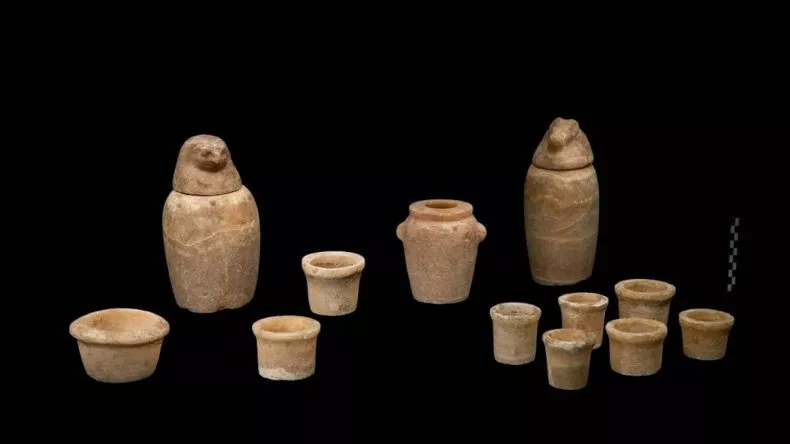
Inside the tomb, a team of scientists discovered the largest embalming complex in Egypt, where there were 370 ceramic jugs with materials used to mummify the commander.
Wahibre-Mary-Knight was buried in a huge two-tiered square tomb. The main shaft is 6 m deep and measures approximately 14 m by 14 m across. The second shaft was dug lower and had a rectangular shape, with dimensions of 16.5 m by 3.3 m.
Let us remind you that an amateur archaeologist using a metal detector found a dagger belonging to an ancient Roman warrior in the south-east of Switzerland. Then professional archaeologists immediately discovered hundreds of artifacts in the region.
Photo: Canopic jars and ceremonial cups were found in the tomb of an ancient Egyptian commander of foreign soldiers named Wahbire-merry-Neith that was uncovered by a Czech archaeological mission from Charles University in Abusir near Saqqara, Egypt.EGYPTIAN MINISTRY OF TOURISM AND ANTIQUITIES/ZENGER
A team of European scientists, led by French archaeologist François Desset, has managed to decipher one of the great mysteries: linear Elamite script – a little-known writing system used in present-day Iran, writes Smithsonian Magazine.
The claim is hotly disputed by the researchers’ colleagues, but if true, then it could shed light on a little-known society that flourished between ancient Mesopotamia and the Indus Valley at the dawn of civilization. An analysis recently published in the journal Zeitschrift für Assyriologie und vorderasiatische Archäologie may also rewrite the evolution of writing itself. To decipher the reading of the characters that make up the linear Elamite script, experts used recently studied inscriptions from a set of ancient silver vases. “This is one of the great archaeological discoveries of recent decades. It is based on the identification and phonetic reading of the kings’ names,” said archaeologist Massimo Vidale of the University of Padua.
In 2015 Desset gained access to a private London collection of unusual silver vases with many inscriptions in both cuneiform and linear Elamite script. They were excavated in the 1920s and sold to Western traders, so their provenance and authenticity have been questioned. But analysis of the vessels found them to be ancient rather than modern forgeries. As for their origin, Desset believes they were in a royal cemetery hundreds of kilometers southeast of Susa, dated to around 2000 BC. – right around the time when the linear Elamite script was in use. According to the study, the silver vases represent the oldest and most complete examples of Elamite royal inscriptions in cuneiform. They belonged to different rulers of two dynasties. Stone with linear Elamite inscriptions from the Louvre collection.
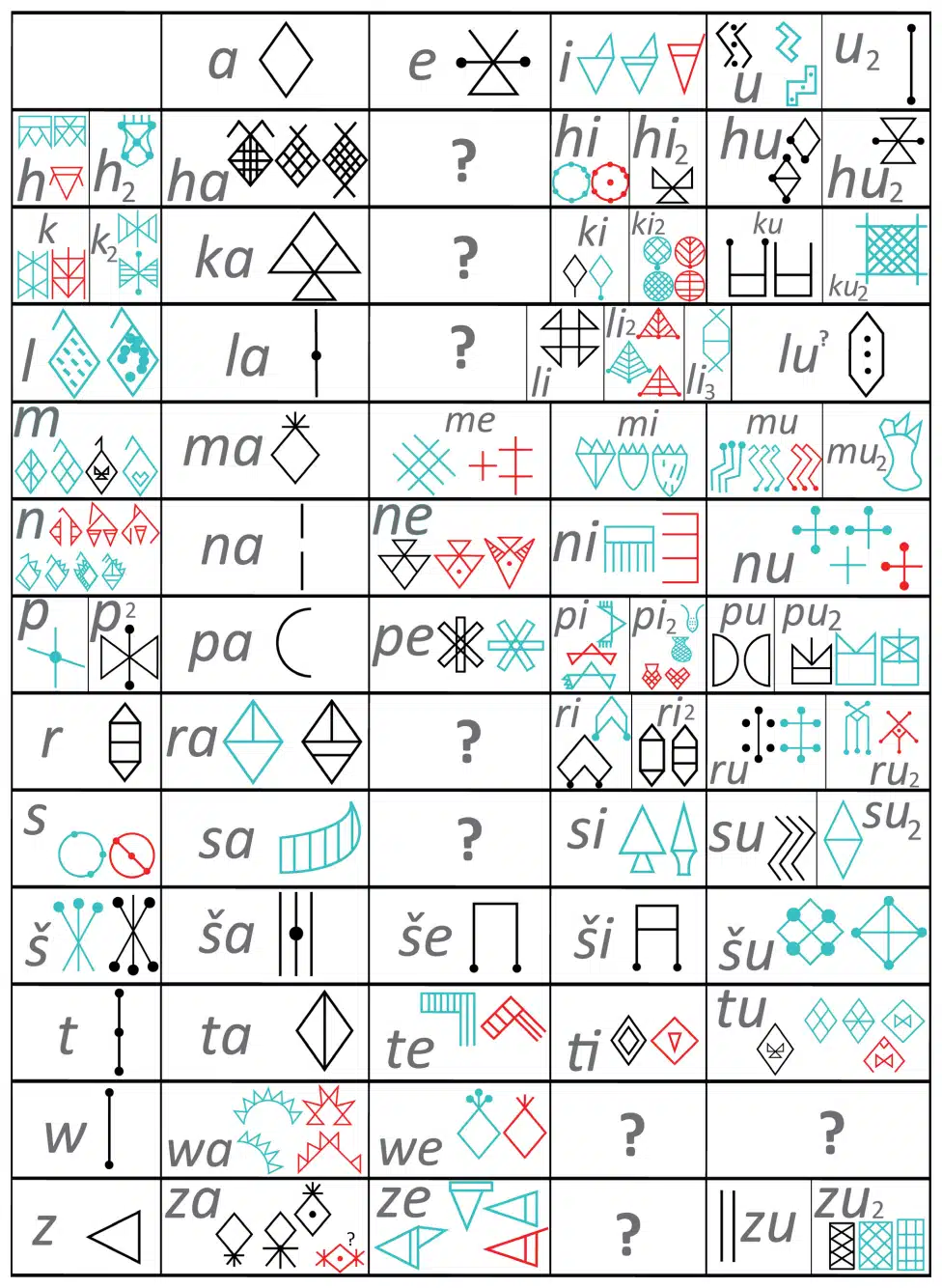
According to Desset, the juxtaposition of the inscriptions on the vessels was very useful in deciphering the linear Elamite script. Some names written in cuneiform can now be compared to symbols in the linear Elamite script, including the names of famous Elamite kings such as Shilhaha. By following the repeated signs, Desset was able to understand the meaning of the letter, consisting of a set of geometric figures. He also translated verbs like “give” and “make”. After subsequent analysis, Desset and his team claimed to be able to read 72 characters. “Although complete decipherment is not yet possible mainly due to the limited number of inscriptions, we are on the right track,” the authors of the study conclude. The hard work of translating individual texts continues. Part of the problem is that the Elamite language, which has been spoken in the region for more than 3,000 years, has no known cognates, making it difficult to determine what sounds the signs might represent.
The speakers of Elamite inhabited southern and southwestern Iran – Khuzestan, as in ancient Persian the name of Elam was Hujiyā, and Fars (as it is possible that it was also spread in other areas of the Iranian plateau before the 3rd millennium BC).
In the III millennium BC, a number of Elamite city-states are known from Sumero-Akkadian sources: Shushen (Shushun, Susa), Anshan (Anchan, today Tepe-Malyan near Shiraz in Fars), Simashki, Adamdun and others.
In the II millennium BC an important constituent of Elam were Shushen and Anchan. After the accession of Elam to the Achaemenid Empire in the middle of the 6th century BC, the Elamite language maintained its leading position for another two centuries, gradually giving way to Farsi.
Photo: Grid of the 72 deciphered alpha-syllabic signs on which the transliteration system of Linear Elamite is based. The most common graphic variants are shown for each sign. Blue signs are attested in southwestern Iran, red ones in southeastern Iran. Black signs are common to both areas. F. Desset
Bulgaria stops accepting documents for tourist visas for citizens of Russia, RIA Novosti reported, citing the Association of Tour Operators of Russia (ATOR). The measure applies to both tourists and property owners in Bulgaria.
“According to the tour operators, the Bulgarian consulate in Moscow has notified them of the temporary suspension of accepting documents for tourist visas, as well as for visas for property owners, ‘in view of the emergency situation that has arisen,'” says the announcement of our diplomatic representation.
Our consulate in Moscow explained to the Russians that the reason for the suspension of visas was the declaration on August 5 of 14 employees of the diplomatic missions and consular services of Bulgaria in Russia as persona non grata.
“This step on the part of the Russian side is a response to the decision of the Bulgarian authorities to expel 70 Russian diplomats and technical staff of the Russian diplomatic departments, including the Russian consuls general in Varna and Ruse,” commented ATOR.
The association also specified that due to a lack of employees, the consular service of the Russian Embassy in Bulgaria and the Consulate General in Varna have partially suspended their work. In addition, the Consulate General of Russia in Ruse has suspended operations. The Consulate General of Bulgaria in Yekaterinburg is also temporarily closed.
The consular service of Bulgaria has indefinitely suspended the acceptance of documents for tourist visas and visas for property owners. The decision is positioned as temporary, Russian media reports.
According to tour operators, the Bulgarian consulate in Moscow has notified them of the temporary suspension of accepting documents for tourist visas and visas for property owners “due to the current emergency situation”. The Consulate General of Bulgaria in Yekaterinburg is temporarily closed.
The occasion is the announcement today of the announcement of 14 employees of the Bulgarian diplomatic missions and consular services as persona non grata. This step by the Russian side is a response to the decision of the Bulgarian authorities to expel from the country 70 Russian diplomats and technical employees of the Russian diplomatic departments, including the Russian consuls general in Varna and Ruse.
The Russian consular services in Varna partially suspended their work, and the Russian consulate in Ruse stopped working.
The Bulgarian visa centers in Moscow, Yekaterinburg and St. Petersburg (including the regional visa centers) due to “technical reasons” do not accept applications with payment of consular fee from March 25. However, Russians could obtain visas for tourist trips to Bulgaria from the consulates general of Bulgaria in these three cities.
It is this option that has now been discontinued.
Even without a Bulgarian visa, Russians can travel to Bulgaria – this is possible if they hold a multiple-entry Schengen visa or a multiple-entry national visa of Croatia, Romania or Cyprus. Bulgaria and these countries recognize the visas of third countries on the basis of agreements.
The association notes that it is not known how long the pause in the visa process will last. “Sources of the ATOR newspaper report that the Bulgarian side will look for opportunities to renew the issuance of visas in Russia,” Ator adds.
Earlier today, the Russian Foreign Ministry notified Bulgarian Ambassador Atanas Krastin about Moscow’s response to the restrictions on the work of Russian diplomatic institutions in Bulgaria. 14 employees of the embassy and consular services of Bulgaria in Russia have been declared “persona non grata”. Previously, Sofia announced that it imposed similar measures against 70 employees of Russian institutions abroad, to whom the Bulgarian authorities attribute work for the special services under the guise of diplomatic activity.
Over 2 million visitors a year pass through the dark rooms of one of Pompeii’s brothels. No, this is not a joke, but reality. Although in this case it is not at all a question of consuming the carnal pleasures usually offered in such a place, but of pure history.
Yes, there were about 25 such establishments in Pompeii. For comparison, in Rome at the same time there were about 50. But let’s not forget that one was a city of a million people, and the other with a population of about 20,000 people, which raises the question – why were there so many brothels in Pompeii? The answer is that it was a port city. At that time, sailing at sea was far from an easy job, out of 10 ships, 8-9 returned, and every returned alive sailor wanted to “catch up”. In addition, numerous merchants from all over the world flocked to the city and had to be “served”. However, this figure does not include all the other establishments where wine was offered. The usual practice was to “serve” meat on their second floor.
Today, the most famous brothel in Pompeii is difficult to get into. This is so that the exposed frescoes on it can be preserved and for this reason no more than 10 people are allowed to stay in its premises at the same time. But believe me, the wait is worth it.
Nothing new under the sun
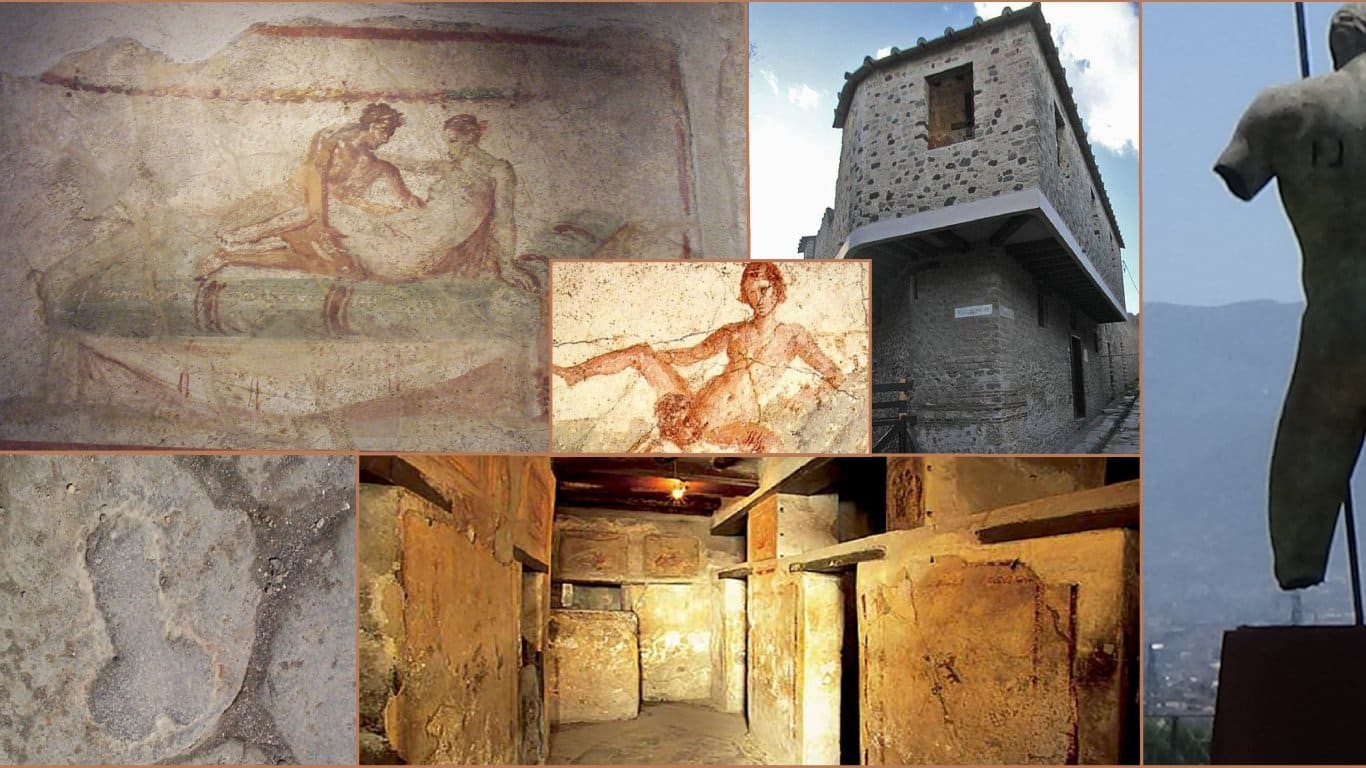
The Lupanarium – that’s what brothels were called in ancient Rome, is located near the theater and the baths. This is not accidental, everyone would explain about the proximity to the bathroom, but for the second, we just have to guess that at that time there was no television with news channels and those for adults, instead these “programs” went right in the theater. And as for the name lupanarium, it comes from the Latin word for she-wolf, lupa. This is what the Romans called prostitutes, likening them to predators, just as today in Bulgarian we would say that a woman is a tigress in bed. Our language has changed the animal but retained the embedded characteristics. And one more touch, forget about what was written in “Messalina” or the scenes in “Caligula”. At that time they were also discreet, for this reason the front door of the lupanarium is on the corner between two small streets. To get an idea just imagine a man walking 10 meters ahead of you down a small street and at the corner with the other turn. In a minute you will also take this direction, but when you do, there will be no one in front of you, the person is simply lost to the surrounding world. Discreet, right?
One would wonder, how did a foreigner learn where this little loophole was, as well as the other 24? Well, yes, in the pre-internet era there were other ways to get such information. In this case, if you were in ancient Rome, you just had to stare at your feet. Just as today there is a special road sign, such as the one with the crossed spoon and fork and arrow, so at that time there was a phallus carved into the road. The direction it pointed indicated where to go. A similar phallus painted or carved into the stones on the facade of a given building showed that this was the sought-after place.
To discover the lupanarium today, simply pick up a map from the museum’s ticket office. She will tell you that it is an 18 object in a 7 region.
And what is in the lupanarium in Pompeii? And today everything is almost intact. Small rooms with brick beds where the priestesses received their clients. They probably had soft mats on them. The murals are interesting. In terms of content, they are frank pornography. It is not clear whether they served simply as decoration or as a kind of catalog of services offered, but they are extremely well preserved.
The cost of living in the ancient world
The graffiti left by customers is also interesting. Here you will need help from either a tour guide or the historical reference books to understand what they are referring to. And then, as now, graffiti provided valuable information. From those found in the lupanarium, one can understand what kind of profession prostitution was in ancient Rome. From the inscriptions on the walls of the Pompeian lupanarium, it is clear that for an ordinary session per client they took 2 aces, the same as 2 glasses of good wine or 1 loaf of bread. Unsurprisingly, another graffiti suggests that the price varied according to the client’s desire and the “priestess’s” streak. “Atiche asked me for 16 aces, and the gifted Fortunata for 23 aces,” another customer angrily wrote on the wall. It is very much fantasized whether it is a question of the fact that the prostitutes had made a name for themselves and were in a position that allowed them to set such large financial conditions, or whether their client saw himself as annoying and in order to refuse him they asked him for this money, and maybe he the customer was very perverted too… But the content extracted from the graffiti shows purely mathematically that the high prices were the exception, since the base price of 2 aces is mentioned in 16 of the 28 graffiti giving information about the price of the services offered. Another scribbler has immortalized “the fair Greek Eutychis” and “the sucker Lachis.” This suggests that the girls were mostly from the Eastern provinces, as is the reality today.
Between the lines
Something that is not written in the guidebooks, but has been the subject of study by historians. Based on these prices and information about life in ancient Rome, analysts conclude that the rulers of the empire tried to keep supply high so that prices were low and everyone, even a slave, could afford them. After all, their goal was to fulfill their slogan “Bread and Spectacles” with content. And they probably did.
If there are even more curious people, how the ancients protected themselves from sexually transmitted diseases, they can look in the work of Julius Rosenbaum from 1839 “The Plagues of Desire in Antiquity”. Based on written information, he generalizes that the most widespread sexually transmitted disease was genital herpes. The most common modern diseases such as gonorrhea and syphilis were almost non-existent. His data is also confirmed by studies of the found skeletons of that time. And this means that in the ancient world they observed exceptional hygiene.
Few facts about Pompeii
In any reference book you will read that ancient Pompeii was beset by two interconnected disasters – a major earthquake in 63 AD, which greatly affected the city, and the second – the historic eruption of Vesuvius in 79 AD, which buried it for centuries. The city began to rise again from the ashes after 1748, when the first excavations took place. Today it is one of the largest open-air museums and almost all of it has been revealed.
(Un)solicited advice
Definitely worth a visit no matter what season of the year. The first thing to know is that this is not a short tour – you will actually be entering a city of 20,000 people, which means allowing at least 4 hours for a tour. Usually those who want to visit it stay in Naples, and from there there are enough travel options – both train (direction Naples-Salerno) and bus, just look and decide what you like. Next, comfortable shoes – ladies, forget about heels, you’ll be walking on an old Roman road made of stone slabs with 20cm ruts carved from the old vehicles, so a pair of stilts will do a better job as long as you know how they are used (this is a wink with a sense of humor). Outside of this joke, even if you go in rainy weather, don’t worry, the ancient Romans knew how to make roads, they did a wonderful job there, they placed the stones in such a way that in the rain and barefoot, your feet will still they will stay dry. But this does not exclude carrying an umbrella – both in the rain and in the sun, it will be most useful to you, there are almost no natural shadows in Pompeii, so it is simply a mandatory attribute. It’s a good idea to have a hat, sunscreen and a water bottle. Don’t worry about carrying the smallest one, and the ancients thought of it – the old public fountains in the city have been restored and you can always fill up with water from them. In fact, this is typical of all of southern Italy to this day. And one more important tip, at the entrance ask for a map, without it you are guaranteed to get lost. In the age of the Internet, it’s available there too, but a paper card won’t drain your phone battery.
It’s a good idea to have food with you, although make no mistake, in Pompeii itself you won’t be allowed to eat as you please. That on the one hand, but on the other hand, when you’re done with the tour, you’re guaranteed to be starving. There are 2 pizzerias near the exit, but they are always crowded and, as expected, more expensive, but still affordable.
After all that has been written, do not stress, but be calm – the comfort of visitors to Pompeii has been thought through very precisely. There is a medical center inside, I have already written about the water, smokers, beware, you will not be allowed to smoke anywhere, on the map, and in places with the corresponding symbols, smoking areas are indicated. Again on the food front, there is a kiosk inside that offers a quick breakfast.
What else in Pompeii
Pompeii was an extremely important city for ancient Rome. If one was the center, the other had the exact location – on the coast of the sea, which means that what entered Rome first landed in the bay around Naples, where Pompeii is also. Yes, Vesuvius was his curse, but it was also his blessing – and to this day, he bestows the entire valley with extremely fertile soil. In fact, even now the bay is connected to Rome in a straight line, via the SS7 highway, which follows the route of the old road. In fact, it is extremely picturesque – slightly cramped for the large vehicles that today move along it, but it is lined with centuries-old pine trees, which for tens of kilometers cast a shadow on it and protect it.
Entering Pompeii, one of the first things that will greet visitors is the theater. There are actually two there, plus the arena. The moneylender’s house is extremely well preserved, in which you can see rich decoration, even surviving stone furniture. Today, the garden has also been restored. Of course the forum, the temples of Venus and Jupiter. The house of entertainment is curious, where interesting bronze statues have been found.
Vesuvius
And if you want to make your experience 100 percent, go to Vesuvius. You will read many things on the web how to get there. The most convenient and cheapest is with some buses departing from Piazza Porta Marina Inferiore. Tickets are collected from the driver. They will take you almost to the crater itself for €3.50. Attention – at the top you will be asked for a ticket, which can only be bought online and 2 days in advance. Second, those who are afraid of heights should simply not go up. Be aware that the journey from Pompeii to Vesuvius is about an hour, but on the other hand, if you want the same cheap company to return you, their last vehicle is at 17.30. Last but not least, know where you are going. It’s a volcano, from where the bus will drop you off to the rim of the crater is 500 meters.
Tourists going on holiday in Spain should be aware of a new law that will leave them toasty in the hottest season.
Madrid has passed a new law which means that shops, offices and accommodation will no longer be able to set their air conditioning systems to temperatures lower than 27 degrees Celsius in the summer.
The act is part of a package of energy-saving measures, which also prevents people from running their air conditioners to more than 19 degrees in winter, the Mirror reports.
Tourists should bear this in mind as temperatures on the sunny side are expected to reach an unbearable 42 degrees. A code orange was declared in nine Spanish provinces for “intense heat”.
Salamanca, Ávila, Toledo, Seville, Córdoba, Jaén and Ourense have also issued a severe weather warning, along with Cáceres and Badajoz, which are part of Extremadura.
Temperatures in Extremadura are not expected to drop below 39 degrees until Monday. Andalusia, Madrid and the Basque region and Aragon are in yellow code.
Spanish Prime Minister Pedro Sánchez called last week for ties to be avoided as much as possible as a measure to save energy, reports TASS.
Although the prime minister did not specify how exactly this step would help save energy, he apparently meant that in hot weather indoors, a person feels more comfortable without a tie, which helps to save on air conditioners.
“I’m not wearing a tie,” Sanchez told reporters.
“This means that we can all save energy as well. I have asked ministers and all civil servants, and I would also like to appeal to the private sector, if they have not already done so, not to wear ties when it is not necessary,” he explained he.
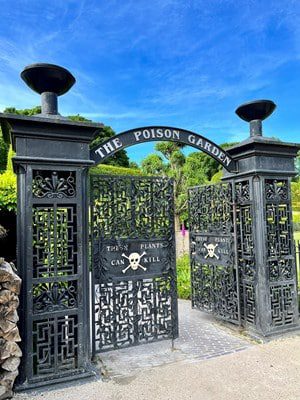
A skull and crossbones sign welcomes visitors to Alnwick Gardens, they are only allowed to look but if life is dear they must not smell, touch and taste
800,000 tourists flock to Alnwick Castle in the north of Great Britain every year. Called the Versailles of the North, it attracts like a magnet not only because of its harsh and mystical beauty, but also because in its huge park it hides something irresistible for every lover of a good crime read – the deadliest garden in Europe, also known as the garden of poisons.
Just a few kilometers north of Newcastle, late 11th and early 12th century Alnwick is familiar to many from television and film because
the imposing fortress is featured in the footage of the series “Downton Manor”, as well as in two of the films about the boy wizard – “Harry Potter and the Philosopher’s Stone” and “Harry Potter and the Chamber of Secrets”.
Behind an imposing black metal fence that greets visitors with the words ‘These plants kill’, eloquently illustrated with a skull and crossbones, the poison garden is home to over 100 species from around the world that are alluringly beautiful but deadly dangerous. Jane Percy, who in 1995 became the Duchess of Northumberland after her husband inherited the title and the castle, was the author of the unusual idea. The new owner asks her to take care of the park, which until then is just a forest with neatly arranged rows of trees.
In 1996, Percy engaged Jacques Wirtz, a Belgian landscape architect credited with the renovation of the Tuileries Gardens and the Elysée Palace in Paris. He created the plans for a garden of 3,000 roses, a “snake garden” with turtle-shaped bushes, a bamboo maze, and the famous poison plant garden.
In the beginning, the duchess wanted to make a special place for medicinal herbs, but after visiting the botanical garden in Padua of the Medici family – one of the most famous poisoners of the second half of the 15th century, the idea came to her “for something really completely different”, she says she in front of “Smithsonian” magazine.
“If you decide to build something, especially a tourist attraction, you have to make it truly unique – adds the aristocrat. – One of the things I hate the most is the standardization of everything. So I thought I should do something completely unusual.”
By carefully selecting the deadly species, apart from the mandatory requirement that they can thrive on British soil,
Jane Percy insisted that each root tell its own interesting story. After all, the garden opened its doors in 2004. Thus, in it, tourists can not only see what the green killers look like, but also learn the legends and historical facts that brought them sinister fame.
“What’s amazing about toxic species is that they’re common and common in nature, but people don’t know them and don’t realize what can happen to them sometimes just by touching them,” added the Duchess. Visitors were surprised to learn, for example, that the oleander, found in many gardens, is highly poisonous.
Behind the black fence, visitors must be especially careful as they navigate through hedges of highly toxic laurel, belladonna and hemlock – swallowed by Socrates to be put to death, as well as bushes of castor, a single seed of which leads to complete rejection of all organs. Not to mention the beautiful brugmansia, or angel’s trumpet, which is the Duchess’s favorite flower.
“It is an amazing aphrodisiac that subsequently takes you to the afterlife. During the Victorian era, women would leave one of the angel’s trumpet flowers in the middle of the card table. They put their glasses under the bell, tapped it lightly so that a little bit of pollen fell into the drink. The effect was like LSD,” says Lady Percy.
Next to the strong ogres, there is also a square of drugs, where opium, cannabis, coca, hallucinogenic mushrooms grow. They are grown with a special permit so that visitors of the youngest generation can be explained their harm and the dangers they pose.
There are free guided tours of the gardens every 10-15 minutes, and the entrance ticket is €30 for adults and €12.50 for children over 5. From the end of March to the end of October, they are open until 6pm.
Gardeners who care for all these species wear special protective clothing and gloves and are required to observe a number of precautions. Guests can only look, but are absolutely forbidden to touch, smell or, God forbid, taste. The most dangerous poisons are enclosed in cages, and there is also 24/7 surveillance with cameras.
However, a few years ago an incident occurred. Youngsters managed to snatch a few oleander leaves as a souvenir. A few minutes later, the driver and passengers fall asleep under the influence of the toxic fumes from the leaves and cause a crash.
In addition to the poisonous gardens, Alnwick Castle is also known for a sinister legend. According to legends, in the Middle Ages, an ugly creature similar to vampires roamed it, because it sucked blood and spread diseases. It tormented the local people for years before they managed to kill it and bury it in the dungeons of the fortress.
PHOTO: A skull and bones sign on the black garden fence warns of the dangers lurking / Pixabay
At the beginning of September, Ecumenical Patriarch Bartholomew I, Archbishop Hieronymus of Athens and Metropolitan Epiphanius (Dumenko) of Kyiv, head of the Autocephalous Orthodox Church of Ukraine, will celebrate together the feast of the Council of the Saints of Thasos.
A pilgrimage to Kavala and Thassos will take place from 3 to 6 September 2022 on the occasion of the first official celebration of the Assembly of the Saints of Thassos and will include church and cultural events.
The local Metropolitan of Philippi, Naples and Thassos Stefan has sent an invitation to participate to the three superiors through St. Synod of the Greek Church in February of this year. The Ecumenical Patriarch and the Archbishop of Athens have accepted the invitation, and it is expected that the Kiev Metropolitan Epiphanius will do the same.
The President of Greece, Katerina Sakellaropoulou, has been invited to honor the celebrations on the island with her presence.
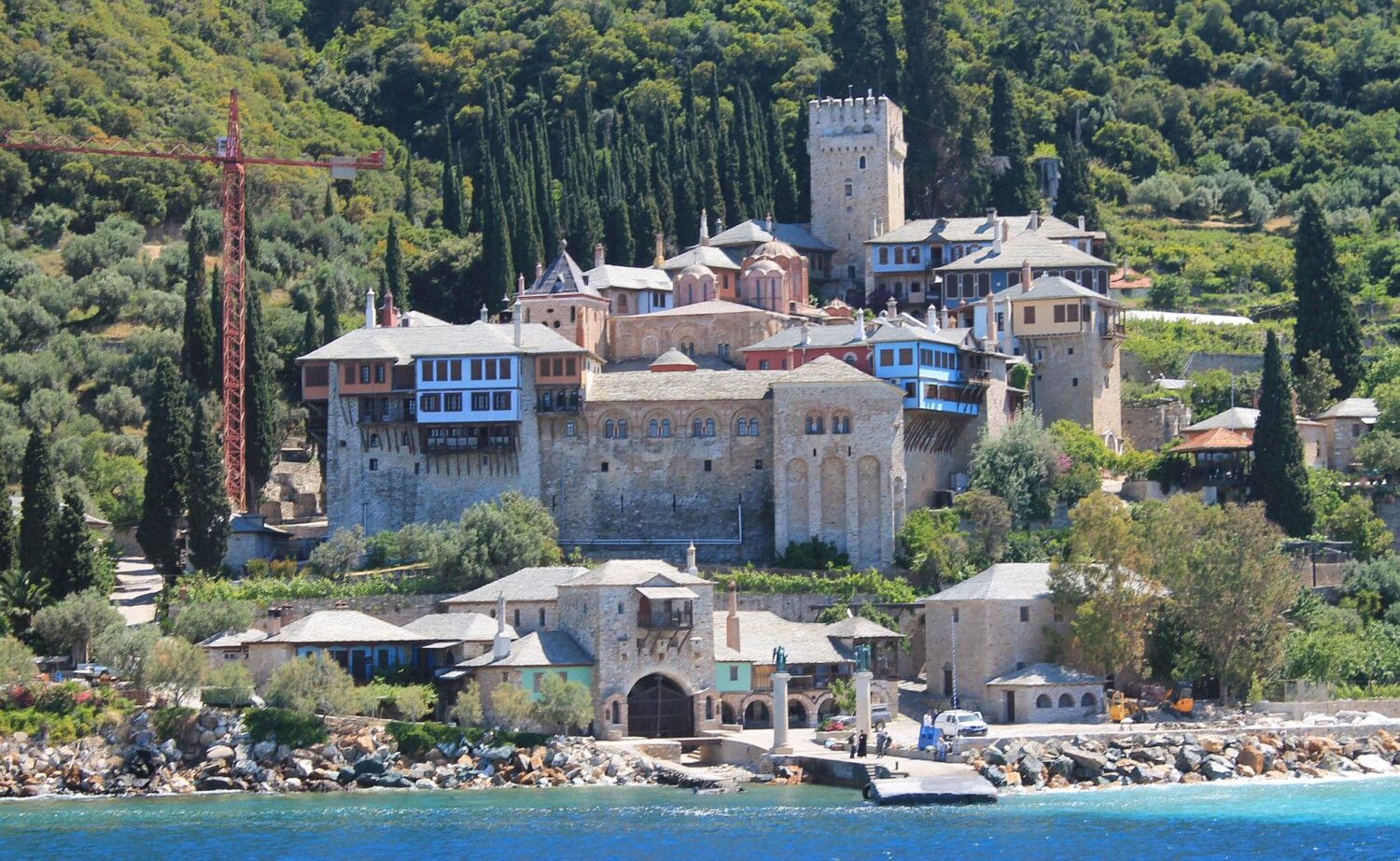
A huge fire broke out between two monasteries at the monastic state of Mount Athos in Greece.
One of the most valuable monasteries of Athos – the Docheiariou monastery (Greek: Μονή Δοχειαρίου) , which has a very valuable library with hundreds of manuscripts and books, as well as wall paintings and icons by ancient masters, is threatened.
A large-scale operation is underway to extinguish the fire, in which three helicopters, three planes and 33 firefighters are involved.
The goal is to stop the fiery element before it reaches the walls of the monastery.
The fire broke out in cultivated land next to the monastery cloister and engulfed a dense forest that is in close proximity to the monastery.
There is no danger for the monks, as well as for the visitors of the Holy Mountain, reports the Civil Defense.
Being present across European countries and in direct contact in the streets, markets, any kind of shops, associations, schools, administrations, and agencies, with the youth, parents and the populations at large gives the right and objective data on how the European population perceives and behave facing the drug problem.
This extents from:
-the young lady who was smoking with friends a “joint” of cannabis for ten years before she realised that her behaviour was slowly changing,
-the desperate old mother whose son is going to the shooting room instead of the rehabilitation centre,
-the father who at the info-stand, in front of his teenage daughter, testified that driving after a party with friends, he had been tested drug positive by the police, lost his driving license and then realised his wrong-doing and hardly stopped the drug use,
-the monitor of a driving school who had students under drug influence, to be less stressed,
-school professors are happy to have access to educational materials on drugs to enlighten their students,
-an hospital nurse in favour of drug prevention actions instead of this “harm reduction”,
-school professors asking for lectures on drugs to their students and enjoying their positive feedback,
-this former cocaine user who explained the hell he had to go through before getting out of the addiction and how good he feels now,
-and many more… about the harmful effects and dreadful results of drug use, in accordance with these words from Ron Hubbard in the sixties:
“Research demonstrates that the single most destructive element present in our current culture is drugs”.
THE OCCURENCES
All these people have a common viewpoint regarding drug use: they did not know when they started how harming the drugs could be and that they were never told about the dwindling spiral they were engaging into, “otherwise they will never start in the first place”. And alcohol is part of the picture, starting with the adolescents and the binge-drinkings !
ground cannabis on clear plastic bag
This is in the middle of the last century, popularised by the Beat Generation, the Hippie movement and artists that started the rock culture of drug experimentation such as with the Beatles (Day Tripper-1965, Lucy in the Sky with Diamonds-LSD-1967); Jimmy Hendrix (Purple Haze-Cannabis-1970); J.J. Cale (Cocaine-1976); Eric Clapton the guitar legend addicted to heroin in the 1970, the movie actors as Marilyn Monroe (died in 1962 at age 36 of an overdose), Judy Garland in 1969, and Bruce Lee in 1973, etc., also writers as William Burroughs (Junkie-1953, heroin), Aldous Huxley (The Doors of Perception-1954, mescaline), Jack Kerouac, a Beat writer (On The Road-1957, benzedrine), Hunter S. Thompson (Fear and Loathing-1972, all drugs), Stephen King, Paulo Coelho…, that the recreational use of drugs became the symbol of the youth rebellion, uprising, protest and social upheaval, and of political dissent. And since then, drug use has drastically increased, pervading all society levels.
Today, in the 2022 Drug Report of the European Monitoring Center for Drugs and Drug Addiction (EMCDDA), the Director summarised the drug trends by: “Everywhere, Everything, Everyone”. Indeed, health, education, the justice system, social welfare, economy, political system, governments, and communities are concerned by the drug problem, and in its wake are found: war, corruption, crime, misery, and lost lives.
In addition, within the EU (European Union), EMCDDA reports that drug problems interfere with and complicate the resolution of other vital issues such as homelessness, the management of psychiatric disorders and self-harm (suicide), the reduction of youth criminality, the exploitation of vulnerable people meanwhile greater levels of violence and corruption are observed.
EUROPEAN STATISTICS
Across the EU the EMCDDA (Report 2022) estimated that some 83.4 million or 29% of the people aged 15 to 64 have used illicit drugs in the last year, compared to the 284 million people worldwide (UNODC Report 2022).
In Europe:
the cannabis is the most widely used by 22.2 million people (584 tonnes of resin and 155 tonnes of herbal were seized in 2020 );
then the stimulants with 3.5 million of cocaine users (213 tonnes were seized in 2020). An increased use of crack cocaine is noted in Belgium, Ireland, Spain, France, Italy, Portugal and Germany. In 2021, the highest loads of crack cocaine residues in the waste waters of 13 European cities were found in Amsterdam (Netherlands) and Antwerp (Belgium);
2.6 million of people are MDMA (ecstasy) users;
2 million for amphetamines, and,
1 million of heroin or opioid users. Opioids account for the greater harm in the illicit drug use and are present in 74% of the fatal overdoses reported.
Is noted that people with drug problems use a range of illicit substances, medicinal products and other non-controlled psychoactive substances.
During the COVID-19 measures and restrictions, the European illicit drug market reacted fast with a rapid bounce back in drug supply and use, returning to a business-as-usual model.
As a result, it is estimated that some 6 500 overdose deaths (mean age of 41 years) occurred in the extended European Union in 2020. They are due to polydrug toxicity, illicit opioids and medicines (such as benzodiazepines, methadone, buprenorphine, oxycodone, fentanyl) and alcohol. There are also signs of increased harm among young people with the use of hallucinogenic and dissociative drugs such as ketamine, GBL (industrial solvent, addictive) and GHB (a powerful sedative) both known as “rape drugs” and the nitrous oxide (N2O-the laughing gas can become a neurotoxic with repeated uses).
Facing drugs, the young people are the most vulnerable. They are exposed to drugs earlier than ever due to their easy availability, the aggressive promotions, the multiplication of shops and dealers, the innovations in the digital illicit drug market and above all the lack of factual data, information and education on the subject ! This is crystal clear when talking across Europe with youth, students and even parents, themselves eager to know more on the harming effects of drugs, to be able having facts to dialogue efficiently with their young children and educate them preventively on this subject.
WHAT TO KNOW ABOUT DRUGS?
First, we need to keep in mind that the natural drugs found either in plants or small animals are secondary metabolites, poisons, whose only function is to protect them against predators -including humans!- thus ensuring the survival of the species.
Then, all the psychoactive drugs/substances are fat-soluble (liposoluble). The human brain is a well blood-irrigated organ which contains nearly 60% of lipids (dry weight). This explains that the psychoactive drugs are able to cross fast the hemato-encephalic barrier and interfere with the release/reuptake of the neurotransmitter dopamine (DA) in the neurons of the nucleus accumbens (NAc) part of the complex “reward and pleasure system” in the mesolimbic area of the brain. The NAc is also involved in the reinforcement functions (Bassareo and Di Chiara, 1999) for food search and incentive motivation at the origin of the addiction problem by self-administration. So, any substance that modifies the DA release/reuptake is a candidate for abuse.
The main characteristics of a drug as a psychoactive substance, besides the toxicity and dependence, are the alteration of perceptions, the capacity to think, memory and of the state of consciousness. This last point (alteration) is not valid for tobacco smoking. Note however that in Europe, 9 out of 10 lung cancers are caused by tobacco leading to the European Commission’s Beating Cancer Plan (June 2022).
FACING THE DRUG PROBLEM
To regulate the development and the availability of the drug, the International Drug Control Conventions of 1961, 1971 and 1988, and the Convention on the Rights of the Child (1989), were ratified. The protection of the populations in the EU is subjected to the European Social Charter (1961 & 1996), the Charter of Fundamental Rights (2000/C 364/01) and for the youth to the European Charter of the Rights of the Child ( 1979, Rec.874 – 17.4 b).
Despite these Conventions and Charters, despite the Europol, South Eeast Law Enforcement Center, Frontex, Customs, and other agencies, drugs are circulating in full illegality.
The active pro-drug legalisation organisations are omitting to learn from the catastrophic health results after marijuana legalisation in countries as States of Colorado and Washington (2012), Massachusetts (2013) in USA, Uruguay (2013) and in Canada (2018) with now 21% of addicted. This is a good business for pharmaceutical firms and the mental health sector.
“Alcohol and nicotine provide poor models for legalisation. The tax revenues reaped from these drugs are dwarfed by their social and health costs. The same is true for marijuana and any other illegal drug” comments the Institute for Behavior and Health (USA).
Too many European politicians/governments are under the powerful lobbying of organisations and firms with vested interests in the production and/or sale of drugs (or precursors). Indeed, they never consider the subsequent costs generated by illegal drug and alcohol abuse.
Only for hospital-based treatment in then 21 EU member states, this was estimated according to a 2014 study (Lievens D. et al) to be 7.6 BILLION euros.
But there are also expenditures for harm reduction, shooting rooms with doctors, nurses and supplies, berthings, more accidents in the workplaces, on the road (25% by drivers under alcohol influence and 15% for other drugs), misdemeanours and crimes, school droppings, various related illnesses, to say a few. And all these of course supported by the taxpayers!
A positive point from the European Commission is the implementation of the new EU Drugs Strategy 2020-2025 with: “… the aims to ensure a high level of health promotion, social stability and security and contribute to awareness raising” as well as for the 2021-2030 EU Strategy on Road Safety concerning all illegal psychoactive substances, including alcohol.
NEVER EVER GIVE UP!
Today, when the THC (psychoactive substance) of the cannabis resin reaches 21% and in the herbal 11%, prevention is more than ever needed to help to avoid the early initiation of drug use with the linked health and mental disorders and the further reaches to other drugs.
“Care starts with evidence-based prevention and addressing perceptions and misperceptions of risk, including by taking a hard look at the message our societies are sending to young people.” said the UNODC Executive Director in the World Drug Report 2022.
Photo by Blaz Erzetic
The key point is to preventively raise the awareness of the youth and parents on what drugs are and do. “It is ignorance that blinds and misleads us. Open your eyes, O miserable mortals!” said Leonardo da Vinci (1452-1519).
And this starts at school at an early age until ideally the twenties with an age-adapted education on the drug subject included in school curricula. And as “It Takes a whole village to educate a child” (an old African proverb), this education must also involve the families, all the community leaders, official organisations and authorities, and youth associations, with the care and economic support of the States, and with no one left behind.
“By closing schools, you will open prisons,” said the writer-humanist Victor Hugo, let’s do the opposite!
Educate and Inform
Educate and inform: this is what, as like-minded associations, the Foundation for a Drug-Free Europe and its hundred of Say No To Drugs associations and groups, with the support of the Foundation for a Drug-Free World, are doing across Europe with their prevention campaign named “The Truth About Drugs”.
The drug problem is not a fatality and the “war on drugs” is not yet lost! “The only thing necessary for evil to triumph is for good people to do nothing,” said Edmund Burke (1729-1797).
As reported by the Baháʼí Community in Brussels (BIC), the “quiet campaign to strangle the Baháʼí community is now taking a more overt violent turn, reminiscent of the earlier days of the Revolution in Iran”.
On July 31, according to this religious minority, “there were raids on the homes or businesses of 52 Baháʼís across Iran and the detention of 13 individuals including three former members of the long-disbanded, seven-member, informal leadership group of the Baháʼís of Iran. Each of the seven, including the three detained on July 31, already served a ten-year prison sentence beginning in 2008”.
Sina Varaei, Policy Officer of the BIC in Brussels, told The European Times that on August 2, “the Iranian government escalated the persecution by targeting the village of Roshankooh in Mazandaran province, where a large number of Baháʼís live. Approximately 200 Iranian government officials sealed off the village and used heavy earthmoving equipment to demolish homes of Baháʼís”.
Developments retaking from June
In June, 44 Baháʼís were arrested, arraigned, sentenced, or imprisoned. This total included 26 people in the city of Shiraz who, as reported by Varaei “were sentenced to a combined 85 years in prison for, according to the authorities, ‘causing intellectual and ideological insecurity in Muslim society’. The Baháʼís had, in fact, been gathering in Shiraz as part of their efforts to address local community needs and to assess the severity of the region’s water crisis. More than twenty Baháʼís in 4 cities, Shiraz, Tehran, Bojnourd, and Yazd, were arrested, jailed, or subjected to home searches during the first three weeks of July 2022″.
“In isolation, these actions over the last two months are troubling enough” sentences Brussels activist. “However, when one combines them with system-wide actions taken in the last 18-24 months, including the endorsement by appellate courts of real property confiscations from anyone who is a Baháʼí, the significant expansion of state-sponsored hate propaganda to over 950 articles and videos (from roughly 22 per month in 2010-2011) posted on the internet or broadcast per month, and the enactment of amendments to Articles 499 and 500 of the Iranian Penal Code, which effectively criminalize any activity in support of any unrecognized religious minority, one sees an emergent pattern that strongly suggests a deliberate, systematic effort to substantially increase the persecution of the Baháʼís of Iran”.