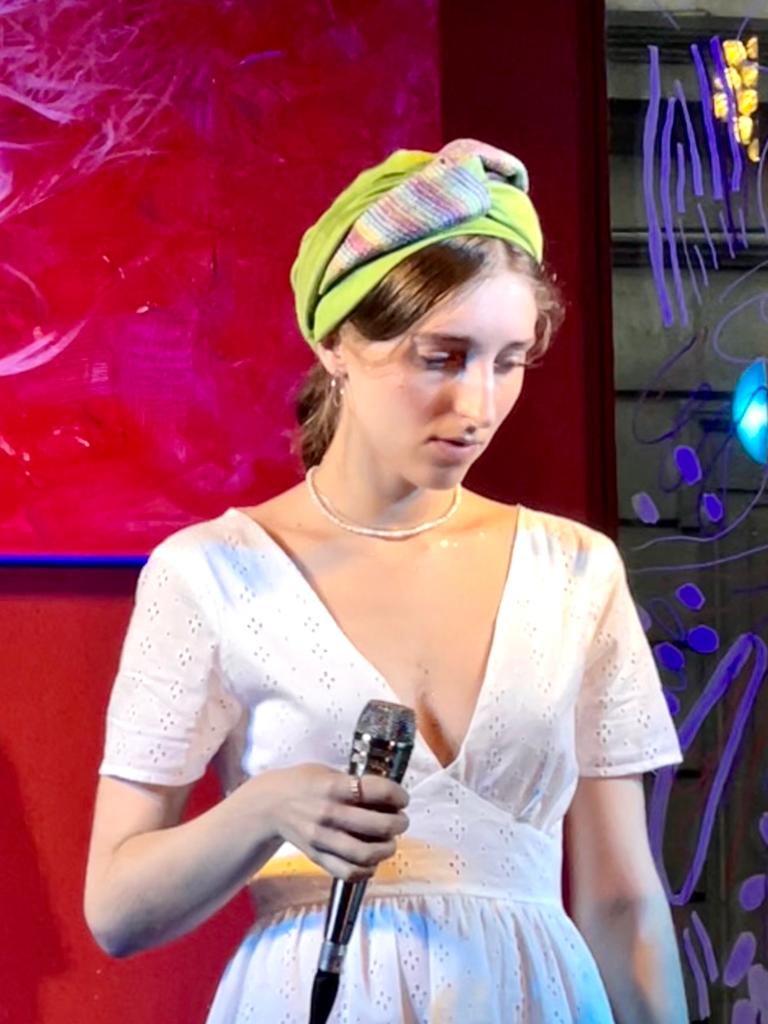
I am usually not a big fan of sweet-voiced folky female songs. But this lady, man! Siv Jakobsen, a Norwegian faery with a melancholic gaze who sings like an angel which came on earth to help, but who encountered some issue with her mission, and fell in pain with humanity.
Her song Most of the Time is one of these songs that you start listening without hoping anything, and then you kind of dream it all along, and get back to the beginning to travel again. Her voice is sweet but does not cloy. Even what could be perceived as a mixing flaw, some recording mouth sounds when she pronounces a “t” or a “d”, becomes part of the charm and you figure out by yourself that she made it on purpose, to let you know that you are in the room with her, whispering in your ear.
Is it dream pop or indie folk, who cares? But I’d say indie dream folk. Can’t say I understood the deep meaning of the lyrics. But again, you wouldn’t care less – of course you might get it better than me – and it’s enough to understand each sentence separately and make it your own, in a romantic dream or a passionate trip to the faery world of love.
Siv is not new in the industry. She already recorded 4 albums and has a fair number of international fans around. So, it’s likely that you already know her. But if you don’t, please remedy your ignorance:
Vienna (Austria), 20 July 2022 — The global production of cocaine has reached record levels, amounting to 1,982 tons as of 2020. Trafficking routes are determined by production and consumption locations, and Brazil sits in the path for cocaine trafficking from South America to Africa and Europe.
COVID-related measures appear to have impacted the internal consolidation, redistribution and management of cocaine stocks within the country.
COVID-19 and its impact on the cocaine supply chain in and around Brazil is the subject of the fourth in the series of ‘Cocaine Insights’, released today by the United Nations Office on Drugs and Crime (UNODC) and the Centre of Excellence for Illicit Drug Supply Reduction in Brazil (CoE).
The publication points out important changes in drug trafficking and organized crime patterns through the new contexts of the pandemic, in relation to the regional and transatlantic chain of production and distribution of cocaine.
It finds that COVID-19 affected law enforcement activities, disrupted the activity of organized crime groups, impacted cocaine and cannabis flows and induced changes in trafficking modalities, amongst other impacts on the cocaine trade in Brazil and the region.
COVID-19 lockdown measures in Brazil allowed law enforcement to dedicate more resources to drug interdiction. Thus, seizures of cocaine and cannabis both increased sharply in number. The report also details how cannabis supply expanded across Brazil while the impact on cocaine varied across federal units, despite an overall decline in the quantities seized. Cocaine seizures data from the country suggests that, following the onset of COVID-19, western provinces saw a rising trend of cocaine while a falling trend can be observed in the eastern provinces, as flows from seaports out of the country declined.
Cocaine Insights 4 shows that COVID-related measures brought about difficulties for organized crime groups to move imported cocaine internally towards exit ports and areas of consumption. The difficulties in cross-border transportation of cocaine likely led to a surge in clandestine flights and thus to a surge in flows into western border states.
A drop in cocaine seizures at Brazilian seaports occurred in parallel with declines in cocaine seized in destination countries, such as those in Western and Central Europe, in consignments known to have departed from Brazil. The disruption in flows from Brazil appears to have been temporary, though.
Cocaine Insights 4 also paints a picture of COVID accelerating already existing trends in cocaine trafficking. COVID forced law enforcement agencies in Brazil to adapt and hampered some police activities, yet conversely prompted lockdown measures that facilitated drug interdiction on roads. Along with this, the report details how cannabis availability expanded across Brazil after the onset of COVID-19, driven by big increases in flows from Paraguay.
Cocaine Insights 4 also highlights how criminal organizations continue to be more specialized and increasingly use new technologies. This complex scenario reinforces the need to continue strengthening international cooperation to address transnational organized crime in an articulate way, focusing on people and comprehensively considering economic and social aspects.
Further information
The series ‘Cocaine Insights,’ developed by UNODC in the framework of the CRIMJUST programme and in cooperation with partners and stakeholders at national, regional, and international levels, delivers in an accessible and informative format the latest knowledge and trends on issues related to cocaine markets: the illicit cocaine trade, its impact, and the outlook for the future. This publication is the result of a collaboration between UNODC and the CoE. The CoE is a partnership between UNODC, the National Secretariat for Drug Policies and Assets Management of the Ministry of Justice and Public Security, and the United Nations Development Program in Brazil.
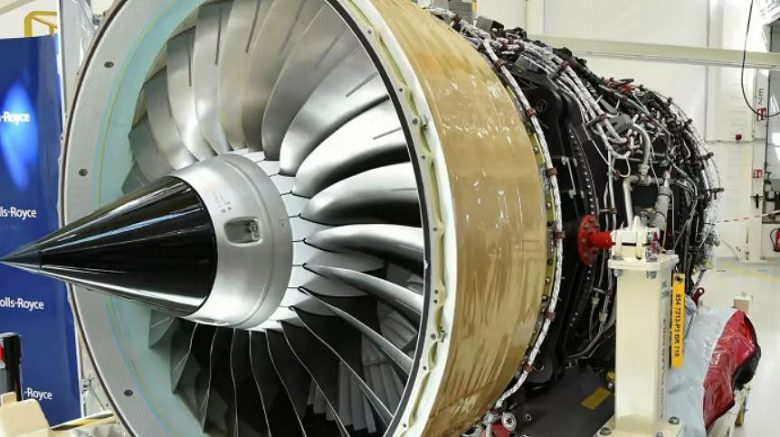
According to the Financial Times, Rolls-Royce plans to begin ground testing of two aircraft engines of its own production using hydrogen fuel. The first test will take place this year in the UK using the AE 2100 turboprop engine. Civil and military aircraft are equipped with such engines. A second test will take place later in the US with a Pearl 15 jet engine.
Rolls-Royce director of aerospace technology Alan Newby said in a statement that the tests “will allow early detection of some problems in the hydrogen combustion process.” The decision to conduct full flight tests will be made within the next two years.
So far, the company has been focusing instead of hydrogen on sustainable aviation fuel (SAF), which can significantly reduce aviation emissions in the short term. The first ever flight of an ATR 72-600 powered by SAF took place in Sweden in June.
Rolls-Royce has taken the decision to test hydrogen fuel at a time when the aviation industry is being criticized for excessive air pollution from modern aircraft. The number of flights and the level of emissions in 2022 increased after the removal of covid restrictions. According to forecasts by the consulting company IBA, carbon dioxide emissions will be 36% higher than last year, and by 2023 will be equal to pre-pandemic levels.
In this regard, the views of many industrial companies associated with the aviation industry are directed towards hydrogen engines. For example, Airbus aims to develop the world’s first zero-emission commercial aircraft by 2035. The company even presented three design projects for environmentally friendly aircraft as part of the ZEROe concept.
When we think of spiders, we most often picture webs of cobwebs that they use to capture their prey. Now, new research published in Ecology and Evolution reveals another surprising way a spider uses its thread—one species in Madagascar has been observed sewing leaves together to create a trap in which it traps a frog.
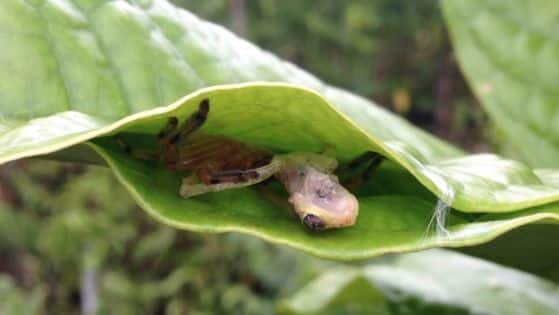
The unusual sight was an accidental discovery made by a team of researchers conducting ecological studies in Madagascar. One morning, after completing a bird count in Ambodiala, they spotted a spider (Sparassidae, Damastes sp.) feeding on a frog. Invertebrates preying on vertebrates is not unheard of, but the researchers believe their report is one of only two to describe such predation in Madagascar.
The same type of spider has also been spotted on three other occasions, mostly in vanilla plantations across the region. Most interestingly, all the spiders have been spotted either near or inside a hiding place of leaves “stitched” with thread. The shelters are partially open on one side, making them look like cool hiding places for the frogs, warmed by the Madagascar sun, who have no idea that a spider is lurking inside.
The first spider found eating a frog retreats back into its leafy hiding place as researchers approach to take a photo. The remaining spiders are either near or still in similar leaf shelters. They do not seem to show a preference for certain tree species, as the leaves of various trees have been used in the crafts of creating such hiding places. What connects them, however, is that they are all “stitched” to each other with the silk thread of the spiders.
“When temperatures rise, frogs seek shade and hide away from the ground, which spiders provide in the form of shelter,” the authors wrote in their paper. “Frogs may select the seemingly protected traps in an attempt to hide from other predators, such as birds that scan the vegetation for prey … We hypothesize that amphibians may not only be opportunistic, indiscriminate or accidental prey, but rather purposefully exploited food source of spiders Damastes sp.”
The researchers acknowledge the study’s limitations, as only one observation was made of a spider feeding on a frog. They also note that large prey such as a frog are more easily spotted by the human eye and should not be taken as evidence that this is a common behavior. However, the behavior of spiders that “sewing” leaves to create shelter is impressive.
Photo: Seemingly peaceful cool shelters turn out to be a trap for some animals. Photo: Thio R Fulgence et al (2020), Ecology and Evolution
Source: IFLScience – Madagascan Spider Observed Sewing Leaves Together To Create Tempting Trap For Frogs
EU Today publisher hosts ‘Sensi Independence’: 2 days of Ukrainian art & jazz in the heart of Brussels
Anna Kozachenko steals hearts at Maison Sensi
UK publisher Gary Cartwright hosted two concerts by Ukrainian vocalists Anastasia Kudriavchenko and Anna Kozachenko at Maison Sensi arthouse in Brussels.
I cannot express enough my gratitude for the way friends & colleagues stepped up to support this project. This shows the level of love and support there is in Belgium for the Ukrainian victims of war.” — Gary Cartwright
BRUSSELS, BELGIUM, July 24, 2022 /EINPresswire.com/ — On July 21-22 at the prestigious Brussels art house and private restaurant Maison Sensi in Brussels, two spectacular concerts, hosted by EU Today publisher Gary Cartwright, featuring Ukrainian vocalists Anastasia Kudriavchenko and Anna Kozachenko, who on consecutive evenings thrilled and delighted specially invited international audiences of diplomats, journalists, musicians and others.Proceedings were opened on the first night by Belgian Senator Mark Demesmaeker, a long time supporter of Ukraine.
In August 2015, then a Member of the European Parliament, Senator Demesmaeker was awarded, by then President Petro Poroshenko, Ukraine’s Order of Merit, taking into account his “significant personal contribution to supporting Ukraine on its reform path and while resisting the Russian aggression.”
Both artistes, following Putin’s unprovoked and vicious attack on Ukrainian sovereign territory in February of this year, left the country as refugees, and are now resident in Belgium: Anna in Brussels, and Anastasia in Antwerp.
The organiser of the two day event, Gary Cartwright said: “working with Simon Saverys, Luciano Laudon, and the team from Maison Sensi, we wanted to give these wonderful performers a chance to share their incredible talents with us, and to show them that while they are here with us they are appreciated and valued.”
He continued: “when they return to Ukraine, as they want to do so much, we want them to take away some great memories.”
The concerts were organised under the banner ‘Sensi Independence,’ July 21st being Belgian independence day, and also in recognition of the fact that Ukraine is fighting now to keep its own independence.
Anastasia, who performs as Nask Taylor, hails originally from Crimea, and is a singer, songwriter, and music producer. She has a Bachelor’s degree in music and vocals, has participated in the Voice of Ukraine talent show, and prior to arriving in Belgium she has performed in Canada and the USA.
“She has many things to say: with her irrepressible energy and drive, combined with primordial rhythms and modern synthesised sounds.Her electronic ethnic music boldly interweaves acoustic and electronic sound, distinctive harmonies and eclectic incorporation of various vocal performances.”
Her latest single, Arra Rah was released on June 20th. Anna, from Odesa, was born into a family of classical musicians. Her acquaintance with jazz began when she became administrator of the Peron No 7 jazz club in her home city.
Having moved to Kyiv, in February 2019 she first performed on stage as a member of the jazz project How Deep Is The Ocean, led by pianist and composer Oleksiy Bogolyubov.
In February 2021 she recorded her first single Bridges in the Ukrainian language, and in August of the same year became a resident of the Art Jazz School, three months later joining the freejazz project FREEBETREE led by trumpeter and composer Yasha Tsvetynski and double bassist and composer Kristina Kirik.
As well as the two concerts, Maison Sensi is also currently hosting an exhibition by Alexander Kudriavchenko, and wife Irene (who works under the name of Irene Ku).
The pair have also recently escaped from war-torn Ukraine with their family under dangerous conditions, having spent some weeks in a bomb shelter under a school in Kyiv, before they could be evacuated first to Lviv and then on to safety in Antwerp. Alexander has the distinction of of having been exhibited in the Louvre in Paris, arguably the most important art museum in Europe.
“The paintings of Alexander Kudriavchenko attract audiences not only with their perfect display of skills but also with their harmonious combination of dynamic anxiety and internal silence. His work abounds with colour, motion and challenge, and yet these aspects seem unattainable, set in a meditative state in the inner recesses of the mind,” said Markiyan Filevych, Iconart Gallery, Lviv.
Irene, an artist, illustrator and designer says of her work “Most of all I love to draw people, studying their inner world, relationship to life, relationship to the surrounding space…. Once, while drawing flamenco dancers with a simple marker, I realised that there is no more lively and driving matter than a line. You can observe the rock paintings of Altamira, or Rembrandt’s painting, or the canvases of Basquiat or Cy Twombly — everywhere we see that artists resort to the line as the main tool of the image. It creates form, and it also destroys it. So I paint portraits of people, experimenting with marker lines, trying to tame the chaos they create.”
In addition to EU Today and Maison Sensi, the art expo and concerts received generous support from:
In addition to EU Today and Maison Sensi, the art expo and concerts received generous support from:
With less than eight years remaining to limit global warming to 1.5 degrees Celsius, the President of the UN General Assembly convened a ‘Moment for Nature’ debate on Tuesday to examine the interconnected environmental threats hampering efforts to achieve sustainable development.
The day-long event is being held to assess recent decisions on the global environment agenda and to present solutions to common bottlenecks, such as the gaps between commitments and actions, as well as the need for wider mobilization.
“We know that we have backed ourselves into a corner with our recklessness. We know that this will only get worse, and quickly, as we continue to delay the actions that are needed,” said Mr. Shahid.
Endless possibilities
Despite the immense challenges facing the world, he was adamant that humanity can effect change, as witnessed by the development of technologies that were once inconceivable.
“I myself remember a time when the power of renewable energies was viewed as far too weak and expensive to make a difference,” he said. “Today, fleets of vehicles and countless homes run on renewables. Entire cities and countries aspire to be run on renewable energies. The possibilities are endless.”
Global ‘triple crisis’
UN Secretary-General António Guterres welcomed the meeting, where participants are reviewing information from major UN conferences issues such as climate, desertification and biodiversity; the state of the oceans, and sustainable transportation, food systems, and energy.
It comes as countries are facing what he called a “triple crisis” of climate disruption, biodiversity loss and pollution.
“Our ways of life – based on producing, consuming, discarding and polluting – have brought us to this dire state of affairs,” the UN chief said in video message.
“But, since human activities are at the root of this planetary emergency, that means we also hold the key to the solutions. Now is the time to transform our relationship with nature and chart a new path.”
Climate Visuals Countdown/Raphael Pouget
A women’s cooperative in southern Mauritania is using solar energy to operate the borehole that supplies water to the market garden.
Take action now
The UN Deputy Secretary-General, Amina Mohammed, outlined areas where governments can take action, including in transforming how we view and value nature.
“We must strengthen nature’s capacity to protect us from hazards and extreme events. This means accelerating implementation of national restoration policies, programmes and plans for marine and terrestrial ecosystems while creating new jobs, tackling poverty and improving sustainable development,” she said.
Countries also need to “close the biodiversity finance gap” by 2030, she added, which currently stands at some $700 billion per year. This can be done through repurposing and re-directing the $500 billion per year for “harmful subsidies” towards more biodiversity-positive activities.
Change our ways
The President of the UN’s Economic and Social Council (ECOSOC), Collen V. Kelapile, underscored the urgency to act on the “mounting scientific evidence” on climate change. The world is at the brink of a precipice, he warned.
“We should either do everything we can to change our consumption and production patterns and make transformative change to nature-sensitive economic growth, nature-based solutions to rebuild our societies after COVID and preserve our environment,” he said.
“Or we can get further deeper into the abyss of continuous calamities, until we destroy the entire humankind.”
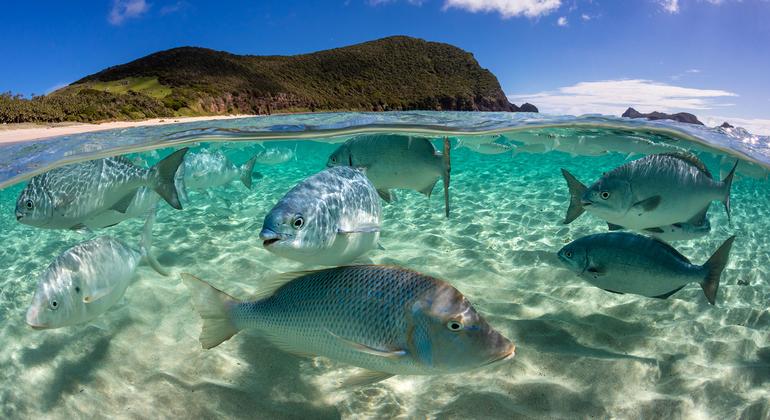
A school of fish swim in the Pacific Ocean in Australia.
‘Massive political lift for nature’
The review under discussion at the meeting was conducted by the UN Environment Programme (UNEP), whose chief, Inger Anderson, catalogued the numerous outcomes from global gatherings over the past year, such as the COP27 climate conference in Glasgow, and the fifth UN Environment Assembly held in Nairobi.
“But we have not yet reached that moment for nature – the moment when we truly find common ground for nature and deliver on the many commitments and pledges that have been made,” she said in a video message.
This December, countries will gather in Montréal to conclude the Global Biodiversity Framework, a new set of goals for nature over the next decade. Ms. Andersen said it must result in “a massive political lift for nature”, as well as adequate resource mobilization.
She also urged countries to adopt a General Assembly resolution on the universal human right to a clean, healthy and sustainable environment.
“What Member States are deliberating on is the very foundation of human life because the environment sustains humanity and indeed the other rights we enjoy,” she said.
The chances of seeing unprecedented temperatures of 40 degree Celsius (40°C) or more in the UK could be up to 10 times more likely in the current climate than under a “natural climate unaffected by human influence,” the World Meteorological Organization (WMO) declared on Monday.
In a statement, the WMO noted that the UK’s Met Office has, for the first time, issued a “Red Warning” for exceptional heat, and forecast temperatures reaching 40 degrees Celsius (104 Fahrenheit) on Monday and Tuesday.
For the first time temperatures of 40°C have been forecast in the UK and UK MetOffice has issued the first ever Red warning for exceptional #heatwave. In Portugal and Spain, temperatures have reached highs around 46 degrees Celsius. Details here👇https://t.co/S4R5we1xsD… pic.twitter.com/HK4EwESAc9
— World Meteorological Organization (@WMO) July 18, 2022
The current record high temperature in the UK is 38.7 degrees Celsius, which was reached just three years ago.
‘Widespread impacts on people and infrastructure’
“Nights are also likely to be exceptionally warm, especially in urban areas”, said Met Office Chief Meteorologist Paul Gundersen. “This is likely to lead to widespread impacts on people and infrastructure. Therefore, it is important people plan for the heat and consider changing their routines. This level of heat can have adverse health effects”.
The heatwave is also acting as a lid, trapping atmospheric pollutants, including particulate matter, resulting in a degradation of air quality and adverse health effects, particularly to vulnerable people, explained Lorenzo Labrador, Scientific Officer at WMO’s Global Atmosphere Watch Programme.
“Likewise, the abundant sunshine, high concentrations of certain atmospheric pollutants and stable atmosphere is conducive to episodes of ozone formation near the surface, which has detrimental effects on people and plants,” he continued.
Dr Nikos Christidis, climate attribution scientist at the Met Office, added that a recent study has found that the likelihood of extremely hot days in the UK has been increasing and will continue to do so during the course of the century.
“Climate change has already influenced the likelihood of temperature extremes in the UK”, said Dr. Christidis. “The likelihood of exceeding 40 degrees Celsius anywhere in the UK in a given year has also been rapidly increasing, and, even with current pledges on emissions reductions, such extremes could be taking place every 15 years in the climate of 2100”.
Extreme heat events do occur within natural climate variation due to changes in global weather patterns. However, the WMO points out that the increase in the frequency, duration, and intensity of these events over recent decades is clearly linked to the observed warming of the planet and can be attributed to human activity.
Wildfire havoc in southern Europe
News of the exceptional highs expected in the northern European country broke amid huge wildfires across the southwest of the continent, which have caused hundreds of deaths, and seen thousands of people evacuated from their homes.
In Portugal, temperatures have reached highs up to around 46°C, and red warnings are in effect for much of the country, as hot conditions increase the risk of wildfires.
More than 13,000 hectares of land were on fire in the French Gironde region, and 15 of France’s 96 departments were listed on Red alert and 51 on Orange alert, with residents of those areas urged to be vigilant. The heatwave in western France is expected to peak on Monday, with temperatures climbing above 40 degrees Celsius.
‘Half of humanity in the danger zone’: UN chief
In his video message to a high-level climate event in Germany on Monday, UN chief António Guterres warned that “half of humanity is in the danger zone,” facing floods, drought, extreme storms, and wildfires.
Addressing ministers from 40 nations in the city of Petersberg, Mr. Guterres said that the 2015 Paris Agreement target of limiting global warming to 1.5 degrees Celsius, was already on life support coming out of COP26 last November, and its “pulse has weakened further”.
“Nations continue to play the blame game instead of taking responsibility for our collective future”, declared the Secretary-General, calling on countries to rebuild trust, and come together.
During today’s Agriculture and Fisheries Council in Brussels, ministers agreed on a set of conclusions for the further development of sustainable aquaculture in the EU.
Ministers welcomed the strategic guidelines for a more sustainable, resilient and competitive EU aquaculture for the period 2021 to 2030 proposed by the European Commission. They also underlined the importance of giving the appropriate high priority to the sector. The Council voiced its support for the development of new freshwater and marine aquaculture methods with low environmental impact and emphasized the need to ensure the provision of nutritious, healthy and safe food and to reduce the EU’s high dependence on imports of fishery and aquaculture products, therefore contributing to food security.
Today, we managed to agree on the main direction for further development of the aquaculture in the EU. It is a fast growing and also diverse sector, producing both marine and freshwater species. I truly believe aquaculture plays an important role in strengthening our food security, but also in contributing to our goals set in the European Green Deal, Farm to Fork and EU biodiversity strategy. Highlighting the main challenges and threats can help us to increase the competitiveness and resilience of the aquaculture sector in the EU.
Zdeněk Nekula, Czech Minister of Agriculture
In this context, ministers pointed out the need for intensive cooperation between all relevant stakeholders in order to implement aquaculture guidelines, as well as the need to always take into account the specificities of each type of aquaculture system, both marine and freshwater. Ministers further noted the necessity to dispose of the used water in accordance with applicable law and the fact that the emission of certain amounts of nutrients into the water cannot be entirely avoided. They called on the Commission to improve coherence between the objective of a growing sustainable aquaculture sector in the EU and the EU environmental legislation.
Ministers also noted with concern the growing populations of predators, in particular protected species such as cormorants and otters, which have become a considerable challenge for aquaculture operators, causing significant damages to many businesses. As such, they urged the Commission to identify effective and efficient EU-wide management measures to prevent and reduce the damage caused by these predators. They also underlined the importance of disease management, in which animal welfare and research play a key role.
Finally, ministers stated that further steps in increasing the environmental performance of EU aquaculture include the growth of organic aquaculture, as envisaged in the Farm to Fork Strategy and the Action Plan for the Development of Organic Production. As such, they invited the Commission to consider proposing an amendment to the regulation on organic production and labelling of organic products, which currently only allows the certification of shellfish and fish farming as organic under very strict conditions. Some freshwater, marine and other aquaculture systems achieve higher environmental performance, but there is currently no EU level scheme to label or certify sustainable products and no conditions are set to favour these types of aquaculture. Ministers therefore invited the Commission to propose the establishment of a transparent EU system for recognising and rewarding producers for aquaculture management that is environmentally friendly or enables additional ecosystem services, to motivate producers and ensure a long-term support scheme for these activities. They also recommended increasing consumer awareness of all the benefits of aquaculture.
That’s a first single like we’d love to hear more often. I just ran into it at random, browsing Spotify looking for some good new stuff, and I’ve been surprised.
First, Mike Pasarella has a pleasant and plain voice, which he masters pretty well. The track is evolving from an acoustic ballad to a more grunge arrangement with a crunchy guitar in the back and a rock vintage and loud drum accompanying the evolution of the song. And in terms of evolution, the song is rich and diverse. There is a great deal of composition in it, with fluent changes which resonate with old progressive rock tracks, and keep you interested all along.
Our fellow singer is Dutch and says he lives “between The Hague, Rotterdam and Paris”. He also says that whilst having been engaged in music since his younger age, he only recently found the recording studio. I guess he means that he finally decided to go public and share his talent. And that’s definitely a good thing!
The track is well-produced, well mixed (I have no idea if he did it himself or has other fellows around him) and the arrangement, whilst not gushing, makes the job.
Future will tell us if he also has the needed resilience to make a carrier and stand out as a productive singer / songwriter, but if that is the case, I am sure he will encounter success and his public.
That is a REALLY good first single which deserves your attention.