Wednesday, March 25, 2026
Home Blog Page 97

Cold, displaced and in darkness, Ukrainian civilians brace for another winter of war |

0
Cold, displaced and in darkness, Ukrainian civilians brace for another winter of war |

Ongoing strikes on energy infrastructure have left entire communities uncertain whether they will have heat, electricity and clean water in the months ahead, while fresh displacement continues along active frontlines.

Humanitarian agencies warn that this winter could be one of the most difficult yet, as intensified bombardment, worsening access constraints and growing funding gaps threaten to leave hundreds of thousands without adequate support.  

At the same time, the psychological toll of nearly five years of conflict is becoming ever more visible across the country.

In an in-depth interview on Monday with Nargiz Shekinskaya of UN News, Matthias Schmale, the UN Resident and Humanitarian Coordinator in Ukraine, describes the mounting winter risks, the deepening vulnerability of civilians, the funding shortfall facing the relief response and the resilience he continues to witness every day, in communities living under fire.

He started by describing the humanitarian situation and the most pressing concerns.

This interview has been edited for length and clarity

UN Resident and Humanitarian Coordinator Matthias Schmale (second from the right) meets residents of Kharkiv city.

Matthias Schmale: There are several key concerns. First, the ongoing military strikes continue to have a direct and deadly impact on civilians. Just last night, four civilians were killed in Dnipro and dozens were injured. This kind of impact is constant.

Second, the attacks are severely damaging energy generation and distribution infrastructure. With cold temperatures already setting in, we are particularly worried about people’s ability to keep warm and have access to safe drinking water.

If this destruction continues and if the winter is as cold as forecast, our biggest nightmare is thousands of people stuck in high-rise buildings without electricity, heating or water. Managing that scenario would be extremely difficult.

UN News: Can we safely say this winter will be different from what we already experienced?

Mr. Schmale: Yes, we fear it might be. There is a cumulative effect now, as we move into the fourth year of this war. This is not only visible in physical destruction, but also in psychological terms. I see this during my travels across the country – people are becoming increasingly tired and weary, and more uncertain about their future.

What also makes this winter different is the scale of recent infrastructure damage. Last year, repairs were progressing relatively well and the winter was milder than expected.  

This year, the level of destruction has been significantly higher and forecasts suggest a colder winter. That combination makes this winter potentially much more difficult.
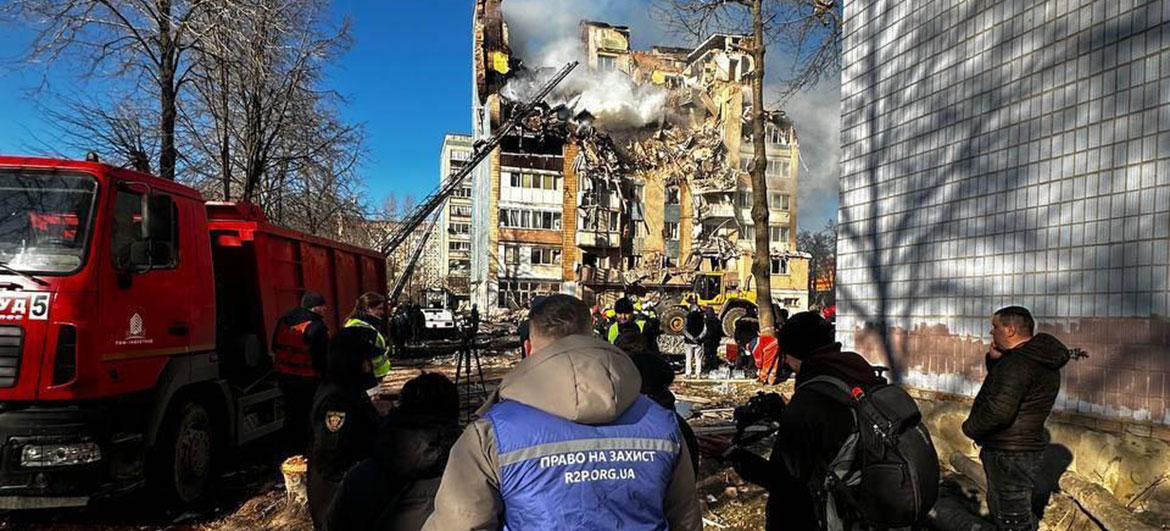
Humanitarians and first responders assisting families in the aftermath of overnight attacks in Ternopil in western Ukraine.

Humanitarians and first responders assisting families in the aftermath of overnight attacks in Ternopil in western Ukraine.

UN News: Which population groups are most vulnerable right now?

Mr. Schmale: One group is low-income people living in high-rise apartment buildings in cities, especially in poorly constructed housing. They are particularly exposed if electricity and heating fail.

Another highly vulnerable group is people living close to the frontline. We estimate at least half a million people live within zero to 20 kilometers of the front. Many are older people and those with limited mobility.

A third group includes the most vulnerable among the internally displaced people (IDPs). Many have been displaced for several years now. Some have found solutions with family, jobs or rental housing, but many remain in precarious conditions and continue to need support.

UN News: The number of displaced people keeps growing as evacuations continue from frontline communities.

Mr. Schmale: We see displacement in waves rather than a steady increase. There was a significant wave in August, and we are seeing new movements again now.  

I recently visited Donetsk region, and the governor told me fewer than 200,000 people are left in the government-controlled part of the oblast. He fears that at least half of them may leave this winter.

The number of IDPs is not rising at the same dramatic pace as in 2022, but it is steadily increasing.
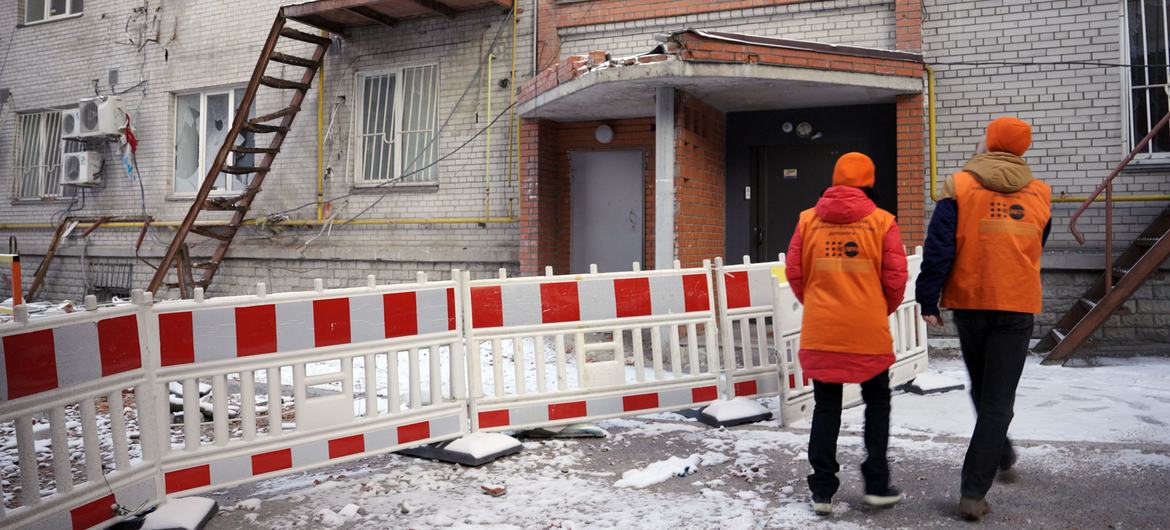
UN mobile psychosocial support teams travel across Ukraine, including to the frontlines, offering immediate emergency interventions as well as access to longer-term assistance.

UN mobile psychosocial support teams travel across Ukraine, including to the frontlines, offering immediate emergency interventions as well as access to longer-term assistance.

UN News: Why do so many people still stay in such dangerous areas?

Mr. Schmale: I ask this question often, and the answers reflect a mix of factors. For some, it is deep attachment to their land and home – their families have lived there for generations.

Others simply lack alternatives. Some people did move to safer areas but could not find housing or jobs. They told me they preferred to return home where they at least do not have to pay rent, even though it is more dangerous.

There is also a strong sense of endurance and defiance. Some say, “We have survived four years; we will survive another year.” Others believe they must stay to honor those who have lost their lives defending the country. It is a combination of emotional, economic and psychological factors.

UN News: How does winter affect humanitarian operations on the ground?

Mr. Schmale: Winter makes everything more hazardous. Road conditions deteriorate with snow and ice, and many frontline convoys delivering food, water, hygiene items and heating supplies face greater risks.

Another major challenge is the constantly shifting frontline. Russian advances in certain areas, even if not decisive, have made access impossible for some communities. The World Food Programme (WFP) estimates that at least 50,000 people they previously reached can no longer be accessed because of fighting. This severely constrains our ability to deliver life-saving aid.
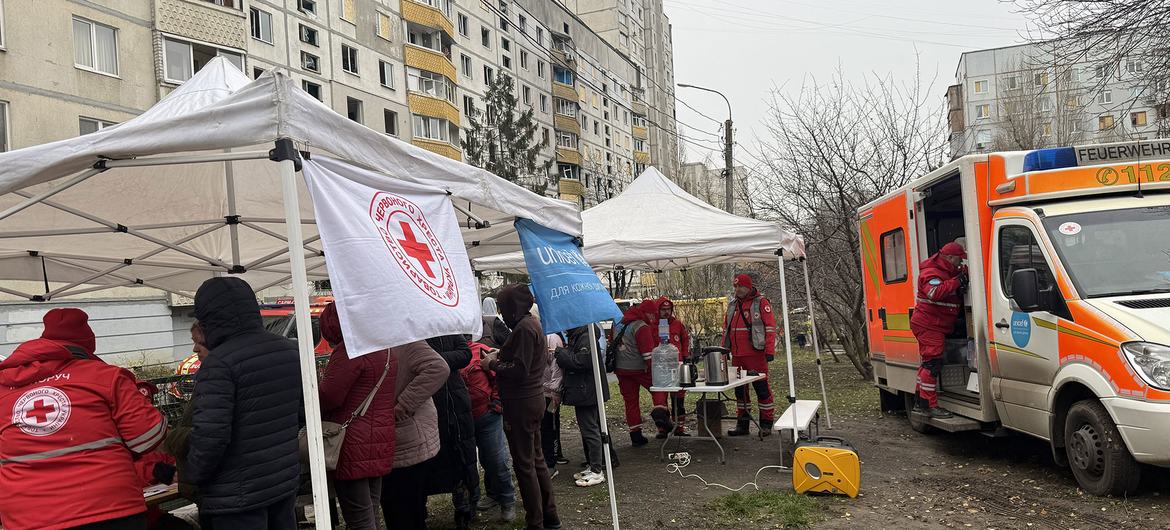
Humanitarian organizations support people affected by the conflict in Ukraine.

Humanitarian organizations support people affected by the conflict in Ukraine.

UN News: How important is cooperation with local authorities?

Mr. Schmale: It is absolutely essential. Ukraine is not a failed state. It remains a functioning state that continues to deliver services under extraordinarily difficult circumstances.

I have seen functioning health centers close to the frontline, and further away markets are fully operational. The government, including local authorities, remains primarily responsible for the safety and well-being of its citizens.  

Our role as the UN and humanitarian community is to work in a complementary way – identifying what the authorities can still provide and where we must step in to reach the most vulnerable. We work closely with the government and with more than 400 NGOs, many of them Ukrainian, to ensure our assistance fills the most critical gaps.

Our winter plan aims to reach 1.7 million people – mainly those living close to the frontline and in rural areas.

UN News: Let’s talk about the winter humanitarian plan. What are the key figures and how well is it funded?

Mr. Schmale: Our winter plan aims to reach 1.7 million people – mainly those living close to the frontline and in rural areas. This does not include all vulnerable urban residents, particularly those in high-rise buildings.

We provide cash assistance so people can purchase heating supplies such as wood, gas or electricity. We also provide warm clothing and essential non-food items.

The winter appeal is about 65 per cent funded. We requested $278 million. We have been able to do a lot with what we received, but funding gaps mean many people are still waiting for assistance, particularly cash and solid fuel for heating. We continue to appeal to the international community to fully fund the response so we can reach everyone in need.

A destroyed building in Ukraine's Kharkiv region. (file photo)

A destroyed building in Ukraine’s Kharkiv region. (file photo)

UN News: Is there a plan B if additional funding does not arrive?

Mr. Schmale: For the people themselves, plan B is to move. If they do not receive support from us, the government, the Ukrainian Red Cross or others, they may relocate to other parts of the country in search of heating and clean water – or even leave the country.

If we reach the nightmare scenario of people stuck in high-rise buildings without utilities, population movement will be inevitable. Our ability to prevent that depends entirely on funding.

UN News: What is your message to the Ukrainian people and to the international community?

Mr. Schmale: To the Ukrainian people: as long as we have the means, we are determined to stay and deliver. That is the UN’s responsibility – to stay and support civilians through thick and thin.

To the international community: thank you for the generosity shown so far. It has allowed us to help countless people survive harsh winters and summers of war. But the war is not over. We must not normalize what is happening in Ukraine as it enters its fifth year. I appeal especially to governments to continue funding this vital humanitarian work.

There are countless stories that show both the strength of the Ukrainian people and the heavy psychological toll of war.

UN News: You travel extensively across the country. Is there a story that particularly stayed with you?

Mr. Schmale: There are countless stories that show both the strength of the Ukrainian people and the heavy psychological toll of war.

A few weeks ago in Kharkiv, I spent an entire morning underground with about 100 students, because public events must take place in shelters. During the discussion, I received messages that a kindergarten nearby had been bombed. After the meeting, I went to the site. The kindergarten had been hit three times. Thankfully, no children were hurt.

There I met a woman who works as a humanitarian. She had dropped her children at that very kindergarten that morning, was called to collect them after the bombing, brought them to safety – and then returned hours later to help with cleanup. That level of resilience is extraordinary.

Another experience was in Kherson, a city under constant bombardment. Above ground it felt desolate, with destruction everywhere. But underground, I visited a modern maternity ward where new life was being delivered safely. The contrast between war and hope was striking.

And in Mykolaiv, I met an older man who stayed in his home during occupation. He proudly showed me how he and his wife rebuilt their house and vegetable garden.

Then he told me his brother was killed in 2022, and he completely broke down. In one moment, you see resilience; in the next, immense grief. That contrast defines Ukraine today.

Source link

Memory Chip Shortage Threatens AI Boom, Prices Double

0
Memory Chip Shortage Threatens AI Boom, Prices Double


Artificial intelligence companies and consumer electronics manufacturers are locked in a sudden battle for memory chips as global shortages push prices to extreme levels and threaten to derail the technology boom.

Computer memory module. Image credit: Lenharth Systems via Stocksnap, CC0 Public Domain

Key Takeaways:

  • Memory chip prices have more than doubled since February in some segments, with suppliers running critically low on inventory
  • Tech giants Microsoft, Google, and ByteDance are rushing to secure supplies while smartphone makers warn of 20-30% price increases
  • The shortage affects everything from USB drives to advanced AI data center chips, with experts warning of macroeconomic consequences

Japanese electronics retailers are now rationing hard-disk drives. Chinese smartphone manufacturers are preparing customers for price hikes. Meanwhile, major technology companies are desperately courting memory-chip manufacturers Micron, Samsung Electronics, and SK Hynix for guaranteed allocations, three industry insiders report.

The crisis spans every memory category—from basic flash chips in USB drives and smartphones to sophisticated high-bandwidth memory that powers AI processors in data centers. Market research firm TrendForce reports prices in certain segments have soared by over 100% since February, attracting speculators who believe the rally will continue.

The ripple effects extend far beyond Silicon Valley. Economists and industry leaders warn that prolonged shortages could hamper AI-driven productivity improvements and postpone hundreds of billions in digital infrastructure investments. This adds unwelcome inflationary pressure as governments struggle to control rising costs and manage U.S. tariff policies.

“The memory shortage has now graduated from a component-level concern to a macroeconomic risk,” said Sanchit Vir Gogia, CEO of Greyhound Research, a technology advisory firm. The AI build-out “is colliding with a supply chain that cannot meet its physical requirements.”

A Reuters investigation involving nearly 40 interviews—including 17 chipmaker and distributor executives—reveals how the industry’s race to satisfy demand for advanced semiconductors has created a paradox. Chipmakers cannot manufacture sufficient high-end semiconductors for AI applications, yet their pivot away from traditional memory products is strangling supply to smartphones, personal computers, and consumer electronics. Several companies are now rushing to reverse course.

Tech firms are engaged in a global scramble, with price increases hitting electronics retailers and component suppliers across China and Japan. Dynamic random-access memory (DRAM) suppliers saw average inventory plummet from 13-17 weeks in late 2024 to just two-four weeks by October, according to TrendForce data. July inventories had stood at three-eight weeks.

This squeeze arrives as investors debate whether massive AI infrastructure spending has created a bubble. Analysts predict only the largest, financially robust companies will survive the price escalation.

One memory-chip executive mentioned that the shortage will postpone future data-center construction. New production facilities require at least two years to build, but manufacturers hesitate to overbuild, fearing idle capacity if demand suddenly collapses.

Samsung and SK Hynix have announced new capacity investments without specifying how production will divide between HBM and conventional memory. SK Hynix has informed analysts the memory deficit will persist through late 2027, Citi noted in November.

“These days, we’re receiving requests for memory supplies from so many companies that we’re worried about how we’ll be able to handle all of them. If we fail to supply them, they could face a situation where they can’t do business at all,” Chey Tae-won, chairman of SK Hynix parent SK Group, said at an industry forum in Seoul last month.

OpenAI signed preliminary agreements with Samsung and SK Hynix in October for its Stargate project, which demands up to 900,000 wafers monthly by 2029—approximately double current global HBM production, Chey revealed.

Samsung confirmed it monitors market conditions but declined to discuss pricing or customer relationships. SK Hynix stated it’s expanding production capacity to address increased memory demand.

Desperation Drives Negotiations

After ChatGPT’s November 2022 launch sparked the generative AI explosion, a worldwide rush to construct AI data centers prompted memory manufacturers to redirect production toward HBM, used in Nvidia’s high-performance AI processors.

Pressure from Chinese competitors manufacturing lower-tier DRAM, particularly ChangXin Memory Technologies, accelerated Samsung and SK Hynix’s transition to higher-profit products. The South Korean companies control two-thirds of the DRAM market.

Samsung notified customers in May 2024 of plans to cease production of one DDR4 chip variant—an older generation used in PCs and servers—by year-end. The company has since reversed this decision and will continue production, two sources confirmed. Micron announced in June it would stop shipping DDR4 and LPDDR4—a smartphone variant—within six to nine months.

ChangXin discontinued most DDR4 production as well, one source said.

This transition, however, coincided with a traditional data center and PC replacement cycle, plus unexpectedly strong smartphone sales—all dependent on conventional chips.

Looking back, “one could say the industry was caught off-guard,” said Dan Hutcheson, senior research fellow at TechInsights.

Samsung increased server memory chip prices by up to 60% last month. Nvidia CEO Jensen Huang, who announced partnerships and shared fried chicken with Samsung Electronics Chairman Jay Y. Lee during an October visit to South Korea, acknowledged the price surge as significant while noting Nvidia had secured substantial supply.

Google, Amazon, Microsoft, and Meta requested open-ended orders from Micron in October, telling the manufacturer they’ll accept whatever quantities it can deliver regardless of price, two people briefed on discussions said.

China’s Alibaba, ByteDance, and Tencent are pressing suppliers hard, sending executives to Samsung and SK Hynix in October and November to advocate for allocation.

“Everyone is begging for supply,” one said.

The Chinese companies didn’t respond to questions about the chip crunch. Nvidia, Meta, Amazon, and OpenAI didn’t reply to comment requests.

SK Hynix announced in October that all chips are sold out for 2026, while Samsung secured customers for next year’s HBM chip production. Both companies are expanding capacity for AI demand, but new conventional chip facilities won’t launch until 2027 or 2028.

Micron, Samsung, and SK Hynix shares have climbed this year on chip demand. Micron forecast first-quarter revenue above market expectations in September, while Samsung reported its largest quarterly profit in over three years in October.

Consultancy Counterpoint Research expects advanced and legacy memory prices to climb 30% through the fourth quarter and potentially another 20% in early 2026.

Smartphone Prices Set to Jump

Chinese smartphone makers Xiaomi and Realme have warned of potential price increases.

Francis Wong, Realme India’s chief marketing officer, told the dramatic memory cost increases were “unprecedented since the advent of smartphones” and could force handset price increases of 20% to 30% by June.

“Some manufacturers might save costs on imaging cameras, some on processors, and some on batteries,” he said. “But the cost of storage is something all manufacturers must completely absorb; there’s no way to transfer it.”

Xiaomi says it would counter higher memory costs through price increases and selling more premium phones, with other business units helping absorb the impact.

Taiwanese laptop manufacturer ASUS stated in November it maintains approximately four months of inventory, including memory components, and will adjust pricing as necessary.

Winbond, a Taiwanese chipmaker controlling roughly 1% of the DRAM market, was among the first to announce capacity expansion. Its board approved a plan in October to dramatically increase capital expenditure to $1.1 billion.

“Many customers have been coming to us saying, ‘I really need your help,’ and one even asked for a six-year long-term agreement,” Winbond’s President Pei-Ming Chen said.

Speculators Enter the Market

In Tokyo’s Akihabara electronics district, stores are limiting memory product purchases to prevent hoarding. A sign at PC shop Ark states that since November 1, customers can buy a maximum of eight items total across hard-disk drives, solid-state drives, and system memory.

Employees at five shops reported shortages have driven prices sharply upward in recent weeks. Some stores show one-third of products sold out.

Products like 32-gigabyte DDR5 memory—favored by gamers—now cost over 47,000 yen, up from approximately 17,000 yen in mid-October. Premium 128-gigabyte kits have more than doubled to around 180,000 yen.

Price increases are pushing customers toward the secondhand market—benefiting entrepreneurs like Roman Yamashita, owner of iCON in Akihabara, who reports his used PC parts business is thriving.

Eva Wu, a sales manager at component trader Polaris Mobility in Shenzhen, said prices fluctuate so rapidly that distributors now issue broker-style quotes expiring daily—sometimes hourly—versus monthly before the crisis.

A Beijing DDR4 seller stockpiled 20,000 units anticipating further increases.

Some 6,000 miles away in California, Paul Coronado said monthly sales at Caramon, his company selling recycled low-end memory chips from decommissioned data-center servers, have surged since September. Nearly all products now go to Hong Kong-based intermediaries reselling to Chinese clients.

“We were doing about $500,000 a month,” he said. “Now it’s $800,000 to $900,000.”


Written by Alius Noreika


Source link

Talking disability: International day of persons with disabilities

0
Talking disability: International day of persons with disabilities

Around 87 million people in the EU have some form of disability. On International day of persons with disabilities, we speak to Donata Lerda, who lives with tetraplegia. She tells us how she lives with her condition and what she would like to see change for persons with disabilities.

Source link

World News in Brief: Global economy ‘on the brink’, ending slavery, Latin America jobs update

0
World News in Brief: Global economy ‘on the brink’, ending slavery, Latin America jobs update

Shifts in financial markets now move global trade almost as strongly as actual economic activity, shaping prospects for developing countries in particular.

“Trade is not just a chain of suppliers. It is also a chain of credit lines, payment systems, currency markets and capital flows,” said Rebeca Grynspan, UNCTAD Secretary-General.

Developing economies face mounting pressures

Developing economies are growing faster than advanced ones, but high borrowing costs, financial market volatility, and climate risks are limiting their ability to invest and sustain growth, the report highlights.  

Climate vulnerability adds to financial pressures. Countries repeatedly exposed to extreme weather now pay an estimated 20 billion dollars more each year in interest because lenders perceive them as riskier, according to UNCTAD.  

Dollar dominance  

At the same time, the United States dollar remains central to global finance, even as some diversification takes place.  

Its share of cross-border payments through the SWIFT electronic transfer system has risen sharply – from 39 per cent to about 50 per cent in five years – and the United States continues to dominate global stock and bond markets.  

While this can bring some stability during financial shocks, it also means developing countries are ever more exposed to US financial cycles that they have little power to shape, UNCTAD said.

Global modern slavery rises to 50 million

“Slavery is a horror from the history books – and a relentless contemporary crisis.”, said Secretary-General António Guterres as the UN commemorated the International Day for the Abolition of Slavery, marked annually on 2 December.

More than 15 million men, women, and children were captured, chained, and forced into slavery across oceans the UN chief said; Many lost their lives during the harrowing journey.

Today, an estimated 50 million people are trapped in contemporary forms of slavery, many of them women and children.  

This day is devoted to raising awareness and mobilising action to end slavery and its modern manifestations, including human trafficking, sexual exploitation, child labour, forced marriage, and the recruitment of children into armed conflict.

Millions of workers exploited worldwide

Forced labour generates an estimated $236 billion in annual global profits, representing wages effectively stolen from workers, particularly affecting those already struggling to support their families, according to the UN.

“Contemporary forms of slavery are perpetuated by crime rings that prey on people struggling to cope with extreme poverty, discrimination or environmental degradation – and by traffickers who exploit people fleeing armed conflict or migrating in search of safety and opportunity. It robs people of their rights, and their humanity,” said Secretary-General António Guterres.

No region is exempt from the problem, with Asia and the Pacific having the highest number (15.1 million), followed by Europe and Central Asia (4.1 million), Africa (3.8 million), the Americas (3.6 million) and the Arab States (0.9 million).  

80 per cent of agricultural jobs in Latin America operate in the informal sector

More than 80 per cent of agricultural employment in Latin America continues to operate under informal labour arrangements – where workers lack formal protection and social security.  

Women, youth and older persons in rural areas continue to be disproportionately affected according to a new report by the International Labour Organization (ILO) and the Food and Agriculture Organization of the United Nations (FAO).  

The report reveals that 86.4 per cent of women work in informal jobs, compared to 78 per cent of men.

The informal sector also accounts for 46 per cent of all child labour in the region, while more than half of the workforce has low levels of education.  

Slow progress

While some progress has been made in Latin America, between 2019 and 2023, nearly half of all young workers in the sector — along with the vast majority of women — continue to be employed informally, the UN agencies noted.  

The ILO and FAO continue to work with governments, employers, and workers to design and implement integrated policies aimed at transforming the agricultural sector into a genuine engine of decent employment, food security, and sustainability across the region.  

Source link

Council and Parliament strike a deal on rules to phase out Russian gas imports for an energy secure and independent Europe

0
Council and Parliament strike a deal on rules to phase out Russian gas imports for an energy secure and independent Europe

The Council and the European Parliament reached a provisional deal on the REPowerEU regulation to gradually phase out Russian gas imports, with the aim of ending any dependency on Russian gas and strengthening the EU’s energy security.

Source link

World news in brief: Global economy ‘on the brink’, ending slavery and employment update in Latin America

0

Changes in financial markets now influence global trade almost as strongly as real economic activity, shaping the prospects of developing countries in particular.

“Trade is not just a chain of suppliers. It is also a chain of credit lines, payment systems, currency markets and capital flows,” said Rebeca Grynspan, UNCTAD Secretary General.

Developing economies face growing pressures

Developing economies are growing faster than advanced economies, but high borrowing costs, financial market volatility and climate risks limit their ability to invest and support growth, the report said.

Climate vulnerability adds to financial pressures. Countries repeatedly exposed to extreme weather now pay about $20 billion more each year in interest because lenders perceive them as riskier, according to UNCTAD.

Dollar dominance

At the same time, the US dollar remains central to global finance, even if some diversification is underway.

Its share of cross-border payments via the SWIFT electronic transfer system has increased sharply – from 39 percent to around 50 percent in five years – and the United States continues to dominate global stock and bond markets.

While this may provide some stability in the event of financial shocks, it also means developing countries are increasingly exposed to US financial cycles that they have little power to shape, UNCTAD said.

Modern slavery worldwide rises to 50 million

“Slavery is a horror from the history books – and an unrelenting contemporary crisis,” said Secretary-General António Guterres as the UN commemorated the International Day for the Abolition of Slaverymarked every year on December 2.

More than 15 million men, women and children captured, chained and enslaved across oceans, UN chief says; Many lost their lives during this arduous journey.

Today, an estimated 50 million people are trapped in contemporary forms of slavery, many of them women and children.

This day is dedicated to raising awareness and mobilizing to end slavery and its modern manifestations, including human trafficking, sexual exploitation, child labor, forced marriage and the recruitment of children into armed conflict.

Millions of exploited workers around the world

According to the UN, forced labor generates an estimated $236 billion in annual profits globally, representing wages effectively stolen from workers, particularly affecting those already struggling to provide for their families.

“Contemporary forms of slavery are perpetuated by criminal networks that prey on people struggling to cope with extreme poverty, discrimination or environmental degradation – and by traffickers who exploit people fleeing armed conflict or migrating in search of safety and opportunity. This deprives people of their rights and their humanity,” said Secretary-General António Guterres.

No region is immune to this problem, with Asia and the Pacific having the highest figure (15.1 million), followed by Europe and Central Asia (4.1 million), Africa (3.8 million), the Americas (3.6 million) and the Arab States (0.9 million).

80 percent of agricultural jobs in Latin America operate in the informal sector

More than 80 percent of agricultural jobs in Latin America continue to operate under informal employment contracts – where workers lack formal protection and social security.

Women, young people and older people in rural areas continue to be disproportionately affected, according to a new report from the International Labor Organization (ILO) and the Food and Agriculture Organization of the United Nations (FAO).

The report reveals that 86.4 percent of women are in informal jobs, compared to 78 percent of men.

The informal sector also accounts for 46 percent of all child labor in the region, while more than half of the workforce has a low level of education.

Slow progress

Although some progress has been made in Latin America, between 2019 and 2023, almost half of all young workers in the sector – as well as the vast majority of women – continue to be employed informally, UN agencies noted.

The ILO and FAO continue to work with governments, employers and workers to design and implement integrated policies aimed at transforming the agricultural sector into a real engine of decent employment, food security and sustainability across the region.

Originally published at Almouwatin.com

Mozambique: “Civilians were killed, some were even beheaded”

0

THE agency reports that nearly 100,000 people have been displaced in the past two weeks alone, following intensifying attacks on villages and a rapid spread of violence in previously safe districts.

Speaking from Erati, a conflict-ridden region in northern Mozambique, Xavier Creach expressed concern over the attacks and his failure to respond adequately.

“These simultaneous attacks in several districts generate an enormous challenge for humanitarian actors who must increase emergency interventions in different areas of the country,” he said.

Unfortunately, we lack resources“, he added.

Houses burned, villages attacked

The violence, which began in 2017 in the country’s northernmost province, Cabo Delgado, has already displaced more than 1.3 million people.

According to the United Nations refugee agency, it has spread beyond the province and into Nampula this year, threatening communities that had previously hosted displaced families.

Those who reached safety say they fled in fear as armed groups stormed their villages – often at night – burning homes, attacking civilians and forcing their families to flee without their belongings or documents.

“Civilians were killed, some were even beheaded,” Mr Creach said. “People had to flee at night in the most chaotic way. »

The sudden influx of displaced people into Nampula province is putting pressure on already fragile host communities, which also face insecurity. Schools, churches and open spaces are filled with newly arrived families.

Short on resources

This is the fourth massive influx that northern Mozambique has faced in recent months, Mr. Creach said.

“The response is insufficient,” he said. “People need help. They need food, shelter, water, support and they arrive traumatized.»

UNHCR $38.2 million will be needed in 2026 to meet growing needs in northern Mozambique. This comes at a deeply worrying time, when funding for 2025 stands at only 50 percent of the required amount.

Mr. Creach said that on Tuesday morning, agency staff saw people returning to very dangerous areas – not to restart their lives, but due to lack of response and overcrowded shelters.

They felt they could no longer stay and had no choice but to return..”

Originally published at Almouwatin.com

Iraq: end of the UN mission, with a commitment of continued support

0

The Special Representative of the Secretary-General for Iraq, Mohammed Al Hassan, made a final briefing to members of the United Nations Assistance Mission in Iraq (MANUI) is preparing to conclude his term on December 31 after more than two decades of service.

“Today, indeed, is a great day for the international community and the United Nations to witness the honorable and dignified closure of a UN mission,” he said.

Victory and sacrifice

UNAMI was established by the Council in 2003. At the time, the country “was grappling with the effects of decades of dictatorship, regional wars, internal conflicts, foreign occupation and Daesh terror,” he recalled.

“The path to peace, security and stability has been long and difficult. However, with the support of the international community, Iraq emerged victorious, but at the cost of countless sacrifices,” he said.

He took the opportunity to honor the memory of all those who have lost their lives since the start of UNAMI operations, including the 22 UN personnel killed in the Canal Hotel bombing in August 2003 – one of the darkest days in the organization’s history.

Hard-earned gains

Mr Al Hassan said he and his predecessors had been struck by the resilience and determination of Iraq and its people as they worked to build a more secure and prosperous future.

“From adopting a new Constitution to strengthening and consolidating democracy through 13 successful electoral processes, Iraq has been able to gradually consolidate hard-won gains, against all odds,” he said.

Last month, Iraq held its sixth parliamentary elections and the process was marked by a notable increase in the turnout of registered voters, to 56 percent. The vote was also one of the freest, most orderly and most credible polls ever held to date.

He commended the Iraqi people, the Independent High Electoral Commission and UNAMI, which provided electoral assistance.

“I can hardly think of a more fitting final chapter to UNAMI’s activities than the scenes I and my team witnessed at polling stations across the country, as Iraqis from diverse backgrounds lined up in orderly lines, eager to vote,” he said.

“While I express confidence that Iraq will continue to build on this strong electoral base, I fervently hope that a new government will be formed without delay. »

He also noted that the formation of a new government in the semi-autonomous Kurdistan region “remains on hold” after more than a year of lengthy negotiations.

Internal displacements, repatriations from Syria

Furthermore, although Iraq has overcome successive conflicts on the path to stability, the lasting effects have given rise to urgent and persistent humanitarian needs. Around a million people remain internally displaced, including more than 100,000, the majority Yazidis from Sinjar.

The minority community has endured immense suffering at the hands of the terrorist group Daesh, also known as ISIL, and its members still live in internally displaced persons camps.

Mr. Hassan highlighted Iraq’s commendable leadership in launching a concerted effort earlier this year to accelerate the repatriation of nationals from northeast Syria.

Tens of thousands of people from various countries with suspected or real links to Daesh remain detained in camps across the region.

He said that to date, approximately 20,800 people have returned to Iraq.

“As returns continue, with the latest taking place yesterday, it remains essential that adequate resources are dedicated to ensuring dignified and sustainable reintegration, including reliable access to basic services, livelihoods and community-level support,” he said.

Human rights challenges

The envoy also congratulated Iraq on its election as a UN member. Human Rights Councilwhich, he said, comes with a corresponding responsibility to uphold the highest standards in the promotion and protection of human rights.

In this regard, he highlighted the many challenges that remain to be addressed, “in particular to guarantee the full protection and exercise of the rights of minorities, women and young people, and to continue to defend freedom of expression as a cornerstone of open public dialogue in a strong democratic society.”

Concluding his speech, Mr. Hassan affirmed that “the departure of UNAMI does not mark the end of the Iraq-UN partnership. Rather, it represents the beginning of a new chapter rooted in Iraq’s leadership over its own future.”

The United Nations will continue to support Iraq in building on its hard-won gains, providing technical expertise, advice and support, he said.

“I wish to reaffirm my full confidence in the resilience of the Iraqi people and in the determination of their leaders to meet all the challenges that lie ahead, as they have done so commendably over the past 20 years,” he added.

“I call on them to strive to build bridges of trust and friendship, promote common interests with all neighboring countries and regain the glory of Iraq as the cradle of civilization.”

Originally published at Almouwatin.com

Millions of jobs at risk in Asia-Pacific as AI adoption rises in rich countries

0

Just like industrialization in the 19th If the century “divides the world between the rich few and the poor,” the AI ​​revolution could do the same.

Countries that invest in skills, computing power and strong governance systems will benefit, others risk being left far behind.“, warned Philip Schellekens, chief economist of the United Nations Development Program for the Asia-Pacific region.

In a new reportThe agency stressed that women and young adults face the greatest threat from AI in the workplace, with broader improvements in health, education and income potentially being left behind.

In the meantime, the tech giant is expected to inject nearly $1 trillion in economic gains over the next decade in Asia alone, the data indicates.

The UN agency said that while China, Singapore and South Korea have invested heavily in – and benefited from – AI, entry-level workers in many South Asian countries face “significant exposure” to changes already underway, including automation.

“Limited infrastructure, skills, computing power and governance capacity limit the potential benefits of AI while amplifying the risksincluding job displacement, data exclusion, and indirect impacts such as increasing global demand for energy and water due to AI-intensive systems. » UNDP said.

Job protection

To avoid a looming jobs shortage, UNDP is urging governments to think about the ethics of AI before deploying it further – and to ensure this is done as inclusively as possible.

“AI is racing and many countries are still at the starting line,” said Kanni Wignaraja, UN Assistant Secretary-General and UNDP Regional Director for Asia and the Pacific.

“The experience of Asia and the Pacific highlights how quickly gaps can emerge between those who shape AI and those who are shaped by it. »

Basic needs to be met

For countries like Cambodia, Papua New Guinea and Vietnam, the priority is not so much developing AI as using existing, relatively simple voice tools that frontline health workers and farmers can use, even when the internet is down.

The Asia-Pacific region is home to more than 55% of the world’s population, placing it at the center of the AI ​​transition.

According to UNDP, the region is home to more than half of the world’s AI users and is rapidly expanding its innovation footprint; China alone holds nearly 70% of global AI patentswhile six countries host more than 3,100 newly funded AI companies.

“AI could increase annual GDP growth in the region by around two percentage points and increase productivity by up to 5 percent in sectors such as health and finance,” the UN agency said in its report. report.

He notes that Afghanistan’s average income is 200 times lower than Singapore’s, which partly explains why the use of AI is now concentrated in the hands of so few wealthy countries.

“We are not starting from a level playing field in this region,” Mr. Schellekens said… It is the most unequal region in the world.

Originally published at Almouwatin.com

‘Decisive action’ needed to end Israel-Palestine stalemate

0
‘Decisive action’ needed to end Israel-Palestine stalemate

Annalena Baerbock was speaking at an Assembly plenary meeting where countries debated a resolution that affirms the UN’s responsibility for the question of Palestine.

“For 78 years the Palestinian people have been denied their inalienable rights – in particular, their right to self-determination,” she said.

“Now, it is high time that we take decisive action to end this decades-long stalemate.”

Gaza war, West Bank violence

Ms. Baerbock said the atrocities committed by Hamas on 7 October 2023 “set off one of the darkest chapters in this conflict.”

She described the immense devastation and suffering in Gaza after two years of war, with thousands killed, countless more injured, communities starving, civilian infrastructure ruined and almost the entire population displaced.

Hostages have been released and reunited with their loved ones, while other families are mourning over bodies that have been returned.

Although the horrors of Gaza have dominated the news, she warned that settlement expansion, demolitions and increased settler violence in the West Bank continue to undermine the prospects for a sovereign, independent, contiguous and viable Palestinian State.

Two sovereign States

“All that has happened in the last two years has all underlined what we have known since decades. The Israeli–Palestinian conflict cannot be resolved through illegal occupation, de jure or de facto annexation, forced displacement, recurrent terror or permanent war,” she said.

“Israelis and Palestinians will only live in lasting peace, security, and dignity when they live side by side in two sovereign and independent states, with mutually recognized borders and full regional integration.”

This is outlined in the New York Declaration, endorsed by many Member States, and UN Security Council Resolution 2803 (2025), which endorsed the ‘Comprehensive Plan to End the Conflict in Gaza’ put forward by the United States.

“We see unfortunately again on a daily basis that these are only words on paper if we do not deliver,” she said.

Ceasefire and humanitarian aid

“We need to ensure that the ceasefire is consolidated and becomes a permanent end to hostilities,” she added, noting that at least 67 children have been killed since the fragile truce began.

Ms. Baerbock also stressed the need to ensure that aid is delivered throughout the Gaza Strip safely and unhindered, and in full accordance with international humanitarian law and humanitarian principles.

This includes delivery through the UN Palestine refugee agency, UNRWA.

She noted that “as outlined in the advisory opinion of the International Court of Justice on the obligations of Israel…allowing UNRWA to fulfil its mandate and continue operations there is not merely a gesture of goodwill, it is a legal obligation.” 

Ms. Baerbock said that “the quest for peace, stability and justice in the Middle East needs our United Nations” – and for the General Assembly to play a meaningful role.

Right to self-determination 

“It requires every Member State to walk the talk: to engage in this process, to uphold the United Nations Charter, to adhere to international law, and the promise this institution made to all the people of the world 80 years ago,” she continued.

“Let us recall once more: self-determination, and the right to live in one’s own state in peace, security, and dignity, free from war, occupation and violence, is not a privilege to be earned, but a right to be upheld.” 

Source link