Eurovision winners donate nearly $ 1 million to Ukraine’s army. The Ukrainian band Kalush Orchestra sold its prize at auction and managed to raise $ 900,000.
The funds will be used to buy military drones to help Ukrainian forces, which have been defending their country from Russian invasion for four months now.
Hundreds of Ukrainian supporters gathered outside the Brandenburg Gate in Berlin on Sunday for a charity event again featuring the winners.
The funds will go to medical supplies and treatment of the wounded during the war.
Religious Freedom & Business Institute has released their annual index measuring the commitment of corporations to religious inclusion in the workplace. The latest index covers all U.S. Fortune 500 companies, while last year’s covered only the 200 largest corporations.
The report is compiled from information published by the companies on their diversity and inclusion initiatives and faith-and-belief employee resource groups. In addition to the external assessment, employees were surveyed asking questions ranging from what chaplaincy services are offered within the organization to whether the company makes donations to faith-based organizations commensurate with those made by their employees.
Tyson Foods stands out with their chaplaincy program, having 100 chaplains available to support their staff, available at all times of the day or night every day of the year and encompassing Muslim and many Christian traditions. The corporate commitment states: “At Tyson Foods, we celebrate the diversity of our team members, customers, stakeholders and consumers and are proud to have built a culture where everyone is valued for their unique backgrounds, experience, thoughts and talents. We also welcome respectful religious expressions and are proud to be a faith-friendly workplace – because our team members’ beliefs matter. Tyson’s chaplaincy program makes dedicated chaplains from a wide array of faiths and religions available at our plants and facilities to listen, offer support, and talk to team members about daily life.”
Equinix, an Internet connection and data center company, supports a program where they will make donations matching their employees’ donations to faith-based and religious organizations up to $1,000 per employee annually. In 2021, their employees donated $42,000 to 71 different religious organizations. Dell similarly has a nonprofit giving program which matches staff donations up to $10,000 annually.
The Religious Freedom & Business Foundation began creating this annual report in 2020. The foundation is dedicated to educating the business community on the benefits of faith and religious freedom to the workplace and the economy.
This can be a valuable source of water for the future colony
The moon is again interesting for humanity and it is preparing for new missions next to it, including building a permanent base there. To this end, the use of available resources will be very important.
The availability of water is a big advantage, and according to a new study by the University of Colorado Boulder, there may be large deposits of ice under the surface of the moon. They are most likely created by ancient volcanoes.
The moon does not currently have active volcanoes, but there were in the early years. Scientists have made a computer model that simulated the processes at that time. He shows that the volcanoes probably generated a large amount of water vapor, which returned to the surface and froze. Over time, they were covered in dust and debris.
According to scientists, it is possible that 5-10 meters below the surface there are huge and thick ice reserves. The study supports the idea of older developments that there may be much more ice on the moon than previously thought. This is especially possible in depressions, craters and other shady places where there is not much sunlight.
This is where possible ice deposits must be sought first. Similar missions are already being prepared, including with the VIPER spacecraft. There is also an open competition for development for digging and extracting ice from lunar reserves. Only a real on-site inspection can confirm whether the scientists’ conclusions are correct.
At 25, Alexandr Wang is the youngest self-made billionaire in the world
As a child, Alex Wang was so good at math that he competed in national math and programming competitions in the United States.
At 25, he is the youngest self-made billionaire in the world, and his company uses artificial intelligence to analyze the damage done by Russian bombs to Ukraine.
Scale AI, a six-year-old San Francisco-based Wang-based company, has already signed three $ 110 million contracts to help the U.S. military develop artificial intelligence.
Scale AI, a San Francisco-based startup that specializes in helping companies label and curate data for artificial intelligence applications.
Scale AI technology works much faster than humans in satellite image analysis and has applications other than for military purposes. According to Forbes, more than 300 companies, such as Flexport and General Motors, use this technology to extract information from data such as self-driving cars or millions of documents.
“Every industry has huge amounts of data in their hands. Our goal is to help them unleash the potential of that data and boost their AI business,” Wang told Forbes.
The son of two physicists working on U.S. military weapons projects, he founded his company when he was 19 years old.
“I told my parents it was going to be something I was going to do in the summer,” he said, as he was studying at the Massachusetts Institute of Technology at the time. “Obviously I never went back to university.”
After a $ 325 million funding round, Scale AI is valued at $ 7.3 billion. Wang, who owns 15% of the company, has a fortune of $ 1 billion.
“Bulgarian politicians, like ordinary citizens, see Macedonians as ethnic Bulgarians, or at least believe we were until the end of World War II,” said the RNM president.
“According to Bulgarian explanations, they want to imitate Greek behavior towards Northern Macedonia in recent decades, introducing conditions for our entry into the EU to protect their national interests,” Northern Macedonian President Stevo Pendarovski was quoted as saying by MIA on May 26th.
In an interview with Euronews, Pendarovski said it was necessary to talk about the real arguments and criteria the country has met in order to join the Union, rather than discussing events from the 19th or 20th century.
“Bulgarian demands are much more contradictory than Greek ones. Why? Because the Greeks have never questioned our ethnic origin. They have never said ‘you are not Macedonian.’ “Macedonian, you can do it. If some people in Greece today say they are Macedonians, they have the right to do so. Bulgaria disputes the identity of Macedonians and that is the big problem,” Pendarovski said.
According to him, Bulgaria expresses the position of Bulgarian society as a result of the long-standing position of Bulgarian politicians and historians dating back to communist times.
“After the Second World War, especially in the 1950s and 1960s, Macedonia was talked about as a fictional nation created by Tito’s decree. So I really think that Bulgarian politicians, as well as ordinary citizens, are watching of Macedonians as ethnic Bulgarians, or at least believe that we were so until the end of World War II. They also consider the Macedonian language, which is known and recognized worldwide, as a dialect of Bulgarian, “said Stevo Pendarovski in an interview with Euronews.
President Pendarovski added that he saw a significant change in Bulgaria’s behavior. Despite all the events on the European continent with the Russian invasion of Ukraine and all geopolitical motives that call into question the concept of a united Europe, Pendarovski said Bulgaria’s position is still firm ahead of Brussels’ decision, expected by the end of June.
According to him, the chances of Northern Macedonia to start membership talks with the EU after 17 years of candidate status are below 50 per cent.
Regarding the inclusion of the Bulgarian minority in the constitution of the Republic of Northern Macedonia, Pendarovski says this is one of the few things that unites the ruling party and the opposition.
“This is one of the topics on which all parties in parliament are unanimous. Why not include Bulgarians in our constitution? But we want this to be bound by a deadline, we want a guarantee that this is the last request from Bulgaria for the Bulgarian minority. Bulgarians living in northern Macedonia, otherwise every month or every year we will have to continue to persuade our citizens to change something, be it our constitution, laws or anything else, we can do it, but where is the guarantee that this is the last Bulgarian request on this topic? “, said the head of state of Northern Macedonia.
Asked about the secession of Albania at the start of negotiations with the EU, Pendarovski said it would be perfectly normal for Tirana to put the interests of its citizens first if it met all the conditions and there is still no green light from Bulgaria.
The Economic and Monetary Affairs and Budgets committees call for recovery funding to be tied to respect for the rule of law, and for ensuring maximum return on investment.
The report, adopted by MEPs with 73 votes to 10 against and 13 abstentions, is intended to influence the Commission’s upcoming review of the implementation of the Recovery and Resilience Facility (RRF) expected by 31 July 2022.
Protecting the EU’s finances and values
MEPs want the Commission to ensure a strong auditing and monitoring mechanism for RRF expenditure, implementation and data management. This would, MEPs say, prevent misuse, double funding or the overlapping of objectives with other EU funding programmes.
The report adopted today underlines the importance of compliance with the rule of law and with Article 2 TFEU as prerequisites for accessing RRF funding, and that the EU’s rule of law conditionality mechanism is fully applicable to the RRF. MEPs expect the Commission to refrain from approving the draft national plans of Poland and Hungary as long as concerns about the observance of the rule of law, judicial independence, and the anti-fraud measures, conflicts of interest, and corruption persist.
The rule of law and the sound financial management of EU funds need continuous evaluation throughout the lifecycle of the RRF and it should be possible to halt or recover already-disbursed funds in case of non-compliance.
Transparency
MEPs reiterate the importance of the Recovery and Resilience Scoreboard in providing basic information for citizens on the overall progress in the implementation of national plans. They expect continuous monitoring of the implementation of the RRF’s six pillars, as well as the 37% target for green spending and 20% for digital issues. They recall that member states should collect and ensure access of data on beneficial owner(s) of the recipient of the funds and beneficiaries of the programme.
Strategic autonomy, war in the Ukraine and social investment
The RRF investments in the green transition and digital transformation should contribute to increase EU strategic autonomy and independence, in particular to reduce its dependency on imported fossil fuels. However, MEPs call for more cross-border projects, such as the improvement of the interconnection of European gas and electricity energy networks and the full synchronisation of power grids. They stress the role of the RRF in the rollout of REPowerEU and say the loans available under the RRF could be used to supplement these projects and advance investment in the EU’s energy transition, contributing significantly to EU energy sovereignty.
They also encourage member states to use the full potential of the RRF, including loans, to counter the effects of current and future challenges – in areas like SMEs, health care, measures to support Ukrainian refugees, and aiding local and regional administration in using funding effectively.
Finally, MEPs believe that based on the example of the RRF, as part of the NextGenerationEU, the strong added value of a common EU response that can be mobilised quickly to cope with crises and new challenges could inspire future initiatives and mechanisms in the EU.
Video games for climate action with special features, pop-ups, and real-life tree-planting opportunities embedded within beloved classics like PAC-MAN or Angry Birds, the gaming industry is working with the United Nations to engage audiences like never before and inspire a new wave of climate action.
Sometime before the COVID-19 pandemic, Cassie Flynn was heading to work on a rush-hour packed New York City subway train.
As the Strategic Advisor on Climate Change for the UN Development Programme (UNDP), she often used the monotony of the commute to think of innovative ways to get ordinary people involved in the climate fight, and on this day, she noticed everyone around her busy doing something on their phones.
“I was a bit cheeky, and I started looking at what people were doing and I kind of peeked over this woman’s shoulder and saw she was playing Angry Birds, and then I looked over and this other guy was playing Candy Crush. All of these people were playing games on their phones,” she recalled while speaking to UN News.
A lightbulb went off, and Ms. Flynn thought: “What if we could meet people there?”
“You know how in [some] games they have these 30-second ads that pop up? What if we could use that? Instead of it being an advertisement for another game or something else, what if this is where we could talk to people about climate change?”
And that’s exactly what she and her team at UNDP did.
UNDP – The mobile game Mission 1.5 by UNDP and partners allows users to vote on climate solutions and actions they wat to see happen
Influencing global policy by playing a mobile game
Ms. Flynn’s momentous subway ride gave birth to UNDP’s Mission 1.5 mobile game, which allows people to learn about the climate crisis and at the same time communicate to governments about solutions that could be put in place to tackle it – all while they’re exploring virtual universes.
“More people play videogames on their phones than they [listen to] music and [watch] videos combined, it’s just massive,” says the expert.
Thanks to an inter-agency effort and a partnership with a gaming company, UNDP’s game – which challenges users to make the right decisions to keep the world on the path to limit global warming to 1.5 degrees –went online at the beginning of 2020.
“Fast forward [to today], we have about 6 million people that have played the game so far in 58 countries, with a 50 per cent completion rate. So, when people start it, they really play it, which is something that we’re really excited about,” Ms. Flynn adds.
But it goes beyond educating the users on climate solutions in 17 languages; the game asks them to cast a vote about which strategies, in their opinion, would be more successful to tackle the crisis.
These answers have become the source for what is now known as the ‘People’s climate vote,’ the largest survey of public opinion on climate change ever conducted.
“We took data from about 50 countries, and we were able to use the samples to cover over half of the world’s population in terms of their thinking on how they should solve the climate crisis,” Ms. Flynn explains.
That information has now been shared and discussed by parliamentarians all over the world and during major international meetings, such as the recent G20 summit and the latest UN Climate Conference, COP26. The results were even included in the latest series of reports issued by the UN Intergovernmental Panel on Climate Change (IPCC), which are very influential for intergovernmental negotiations.
Unsplash/Onur Binay- A young man plays famous mobile game Crash Bandicoot on his smartphone.
Reaching new populations: The Playing for the Planet Alliance
Mission 1.5’s success is only the tip of the iceberg if we think about the reach of today’s video gaming industry, which stretches beyond our smartphones onto the screens of at least 3 billion people in the world – or 1 in every 3 people in the planet.
“The video gaming industry is probably the most powerful medium in the world in terms of attention, reach and engagement,” says Sam Barratt, UN Environment’s Chief of Education, Youth & Advocacy.
Mr. Barratt is the Co-Founder of the first-of-its-kind group of private video game sector organizations that have made commitments to help protect people and the planet, with the support of the United Nations.
Launched during the pivotal 2019 UN Climate Action Summit, the Playing for the Planet Alliance has made headlines in recent years for including commitments from some of the major names in the gaming industry, such as Microsoft, Sony and Ubisoft, as well as dozens of other well-known videogame studios.
Mr. Barrat was inspired by watching his son spend time exploring, playing, and socializing on these platforms, and seeing how the games created incentives to keep the players engaged.
“[It was] an industry that hadn’t really thought about what difference it could make”, he explains to UN News.
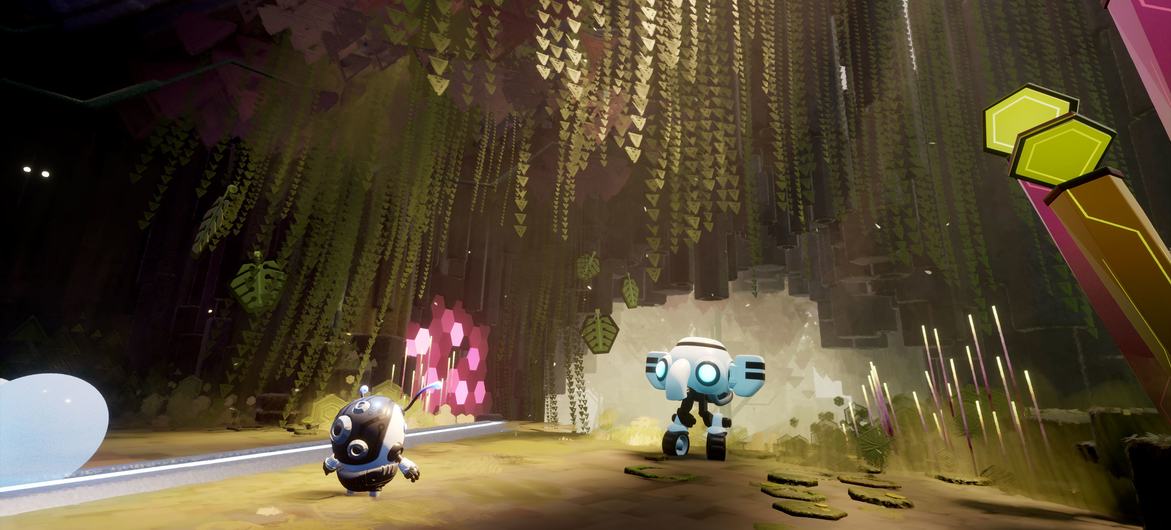
Courtesy: SIE – Snapshot of the game “Dreams” by Media Molecule and Sony which is participating in the Green Jam 2021
Less carbon footprint, more action
The alliance aims to work with these companies on two fronts: First, reducing the carbon footprint of their industries; and second, harnessing the power of their platforms to include messages or steps they might take related to climate action.
“We’ve built a really strong community of practice on this agenda. We’ve doubled in size – for now, at least over 40 studios – with more coming on board. The way I see our role [as United Nations] is that we’re facilitating leadership, we’re here to help the industry… but in the end, it’s a voluntary initiative where the kind of leadership that they show is determined by them,” Mr. Barrat explains.
Playing for the Planet also does a yearly ‘Green Game Jam’, which is an opportunity for videogame studios to get extra creative and integrate green activations within their popular games or create new ones.
This means including environmentally themed features and messages, educating users and inviting them to donate or to participate in UN conservation and restoration campaigns.
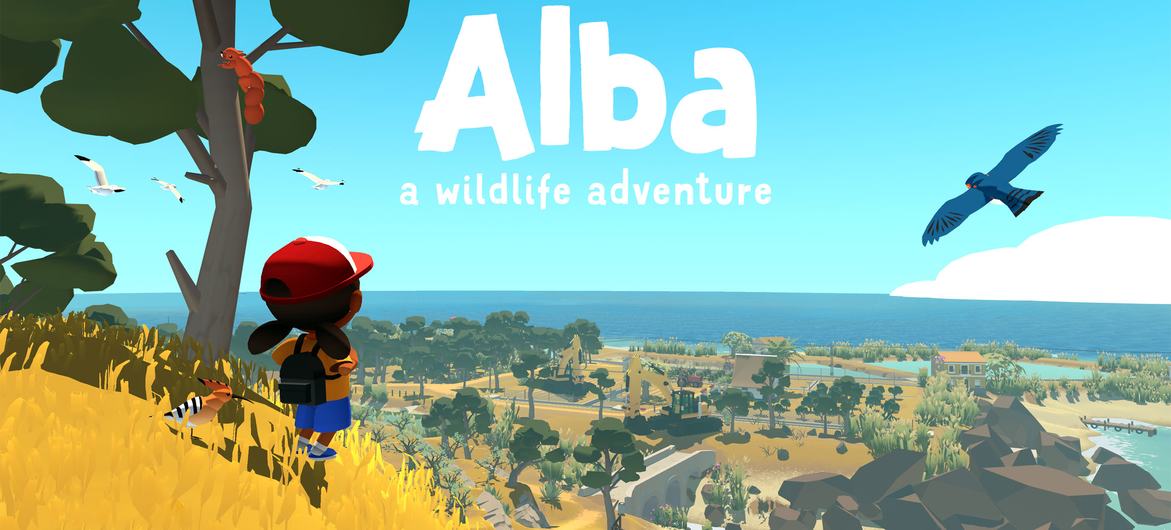
Courtesy: Ustwo Games – Cover of the game Alba, which teaches users about sustainability.
It’s not all fun and games
Over the past two years there has already been an array of cool initiatives and games that have made a difference outside of the screens.
For instance, different activations in games during the Jams have contributed to the planting of over 266,000 trees, with this number likely to increase.
Another remarkable example is the popular video game Alba: A Wildlife Adventure by the English studio Ustwo, which is a member of the Alliance.
The game features a girl protagonist who tries to prevent the construction of a resort on a beautiful Mediterranean Island. It teaches the importance of conservation and restoration to PlayStation, Xbox, Nintendo Switch, PC and iOS users, while devoting some of the proceeds from every download to support tree-planting as a strategy to reduce greenhouse gases in the atmosphere.
Alba has so far led to a remarkable 1million trees planted and 3 habitats restored, with this number set to grow.
During the last Green Game Jam in 2021, UN Environment invited participant studios to support campaigns such as Play4Forests, a petition to demand action from world leaders in protecting forests; and GlowingGlowing Gone, to accelerate ocean protection and climate action.
Studios with a combined reach of 1 billion players participated in the 2021 Jam, and they were able to engage 130 million players around the world with some 60,000 pledges signed for the UN campaigns, and $800,000 in donations to different charities working with environmental causes.
And of course, it was also fun. Just to give you a few examples:
PAC-MAN players were able to play a forest-themed ‘Adventure Mode’ with six stages, an album filled with collectibles and a skin [a download which changes the appearance of characters in the game] as the reward for the event completion.
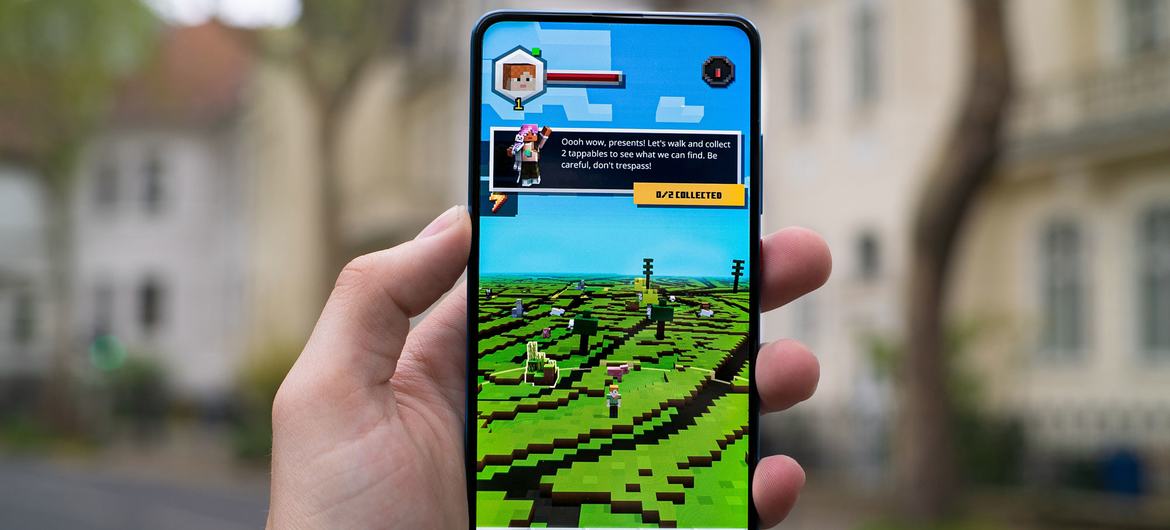
Minecraft, a 3-D computer game where players can build anything, added an additional lesson plan on ‘Radical Recycling’ to player maps, and therefore was able to make a $100,000 donation to The Nature Conservancy.
Pokémon Go created the first-of-its-kind avatar item to give players a new way to voice their support for sustainability efforts.
Angry Birds fans were able to collect a special Mariner Hat Set for participating in a Sea Adventure, and the campaign reached over 280,000 people.
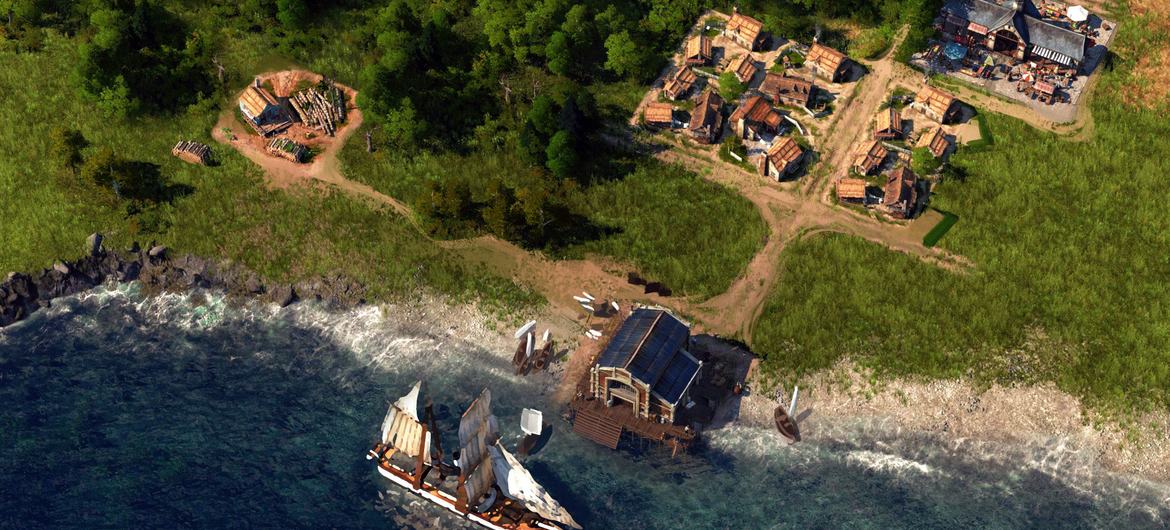
Meanwhile, for Anno 1800, a city-building real-time strategy video game, PC players usually grow settlements and create massive production chains in a world with infinite resources. This time, they learned how, in the real world, their decisions affect the environment and could end up destroying it.
Players start out on an untouched island with a small population and are required to create a sustainable city. If they don’t keep in mind the downsides of population growth and find measures to counter them, the island’s ecosystem and the city will ultimately collapse.
For example, building monocultures depletes island fertility, over-fishing destroys food supplies for future generations, and deforestation leads to deserted islands.
Courtesy: Ubisoft – Settlement in the PC game Anno 1800 supporting the Play4Forest UN campaign.
Decarbonizing the industry
Speaking about change in the real world, according to the latest report of the Playing for the Planet Alliance, 60 per cent of its members are now committed to becoming net zero or carbon negative by 2030 at the latest.
“So, we do know that for many gaming companies, most of the carbon is produced through games that play on devices. Mainly through mobile and all through other parts of that scope. But we still don’t have a full picture. We are working this year to get the whole industry to come up with a methodology so they can understand how they can recall that carbon impact,” Alliance co-founder Sam Barrat, explains.
He adds that while gaming seems to have a lesser carbon footprint when compared with other leisure activities, it all depends on how long users play and what media they use for it.
“When you’re playing on a CD ROM and playing that game a lot, the carbon consequence of its life cycle approach is less than streaming lots of small games,” Mr. Barrat says, highlighting that the Alliance is working together to figure out ways to measure their emissions better.
Unsplash/Mika Baumeister – A young person holds a cell phone with the game Minecraft Earth.
Big companies are already starting to take the lead
Last year, Microsoft conducted a report that details the amount of energy in Watt-hours that mobile devices use while playing mobile video games in a 30-minute period of gameplay.
The previous study that was being used for calculation was from 2012, so this new dataset will allow companies to make more accurate calculations of gamers’ energy use through mobile gaming.
Meanwhile, Sony created a carbon footprint tool on the carbon impacts of the gaming sector and made substantial improvements in the energy efficiency of their Play Station 4 and 5 consoles.
“We also recognize the impact we have on climate change as an industry – and we are taking steps to address it… We’ve achieved an estimated avoided energy use for PS4 and PS5 consoles of 57.4 TWh [Terawatt-hour] and 0.8 TWh respectively from energy efficiency improvements we’ve made to date, such as efficient chipsets, power supplies, and low power rest mode,” Ross Townsend, Sony PlayStation Corporate Communication Manager, tells UN News.
He adds that for this year’s Earth Day, Sony Interactive Entertainment invested in high-quality projects and was able to offset carbon emissions equivalent to 100 million hours of average console electricity during gameplay.
Gameloft, a giant mobile game developer, has also made moves to reduce its carbon footprint.
“We have the ambitious project to become Net Zero Carbon with a long-term work consisting in focusing on Scopes 1 [direct greenhouse emissions associated with fuel combustion] & 2 [Indirect emissions associated with electricity, steam, cooling etc.] and by reducing our energy and electricity footprint by 80 per cent and onboarding our providers in our decarbonization’s journey,” emphasizes Stephanie Cazaux-Moutou, Gameloft Communications Manager.
Videogames being the biggest entertainment industry, the impact is real: there is a room to lead rather than follow
Since 2019, the company is also reducing its business travel and compensating the remaining emissions.
Other Alliance members are also working on a new protocol to reduce the use of plastics within the industry to be launched sometime in 2022.
“Three quarters of the consumers around the world expect brands to be actively involved in solving social and environmental changes. Videogames being the biggest entertainment industry, the impact is real: there is a room to lead rather than follow,” adds Ms. Cazaux-Moutou.
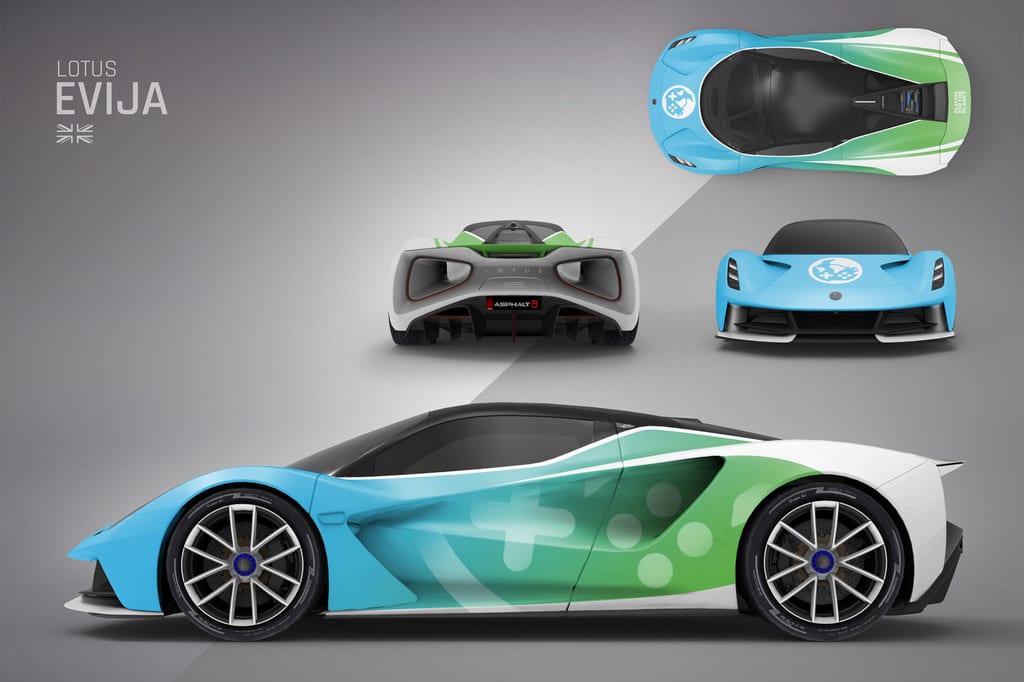
Gameloft/Lotus – The racing electric car Lotus Evija as it appears in the green activation of videogame Asphalt 9.
Into the Future
The 2022 Green Game Jam has included the participation of over 50 studios that have been launching their activations since April, and has a focus on ‘Food, Forests and Our Future’.
Gameloft, for example, integrated into Asphalt 9, a key racing game, the opportunity for players to drive stunning electric cars, including the luxurious Lotus Evija, and race for the planet.
“Gaming is no longer solely for younger generations. Considering the adverse impact climate change will have on communities across the globe, it is important to educate, inspire and engage as many people as possible,” highlights Mr. Townsend from Sony, which is also participating in the latest Jam with their game “Dreams”, inviting users to create Sustainable Farming community games, and planting up to 130,000 real world trees.
Competing videogame companies working and learning together, and collaborating with each other, might have been hard to imagine a few years ago, but today, it is a reality.
Because the truth is, if we don’t come together to end the climate crisis, no one is going to be a winner.
“There’s a real opportunity here to use this for good and to help ignite conversations around some of the world’s challenges that people may want to be engaged with and talk about, but haven’t had the opportunity… I think through video games and through the gaming industry, we can reach entirely new populations and help to engage people in new ways that we haven’t been able to before,” highlights UNDP’s Cassie Flynn.
In 2022, Mission 1.5 will launch a new series of questions to include in the game, while the Alliance will be holding several events, including a virtual climate march and a Green Game Jam student edition.
“I think this medium has got unprecedented agency and influence in the world, and it’s very young and to some extent maybe misunderstood… we’ve got no choice but to work with this industry because their kind of ability to influence behaviour is potentially exponential,” concludes Mr. Barret.
G7 Foreign Ministers’ Statement on the Launch of an Intercontinental Ballistic Missile by the North Korea
The text of the following statement was released by the G7 foreign ministers of Canada, France, Germany, Italy, Japan, the United Kingdom, and the United States of America, and the High Representative of the European Union.
We, the G7 Foreign Ministers of Canada, France, Germany, Italy, Japan, the United Kingdom, and the United States of America, and the High Representative of the European Union, condemn in the strongest terms the test of yet another Intercontinental Ballistic Missile (ICBM) conducted on May 25, 2022, by the Democratic People’s Republic of Korea (DPRK). Like a number of ballistic missile launches the DPRK has conducted since the beginning of 2022, this act constitutes a further blatant violation of relevant UN Security Council resolutions and undermines international peace and security as well as the global non-proliferation regime.
We are very concerned by the unprecedented series of ballistic missile tests with increasingly versatile systems across all ranges, building on ballistic missile tests conducted in 2021. Together with the evidence of ongoing nuclear activities, these acts underscore the DPRK’s determination to advance and diversify its nuclear capabilities. These reckless actions flagrantly breach the DPRK’s obligations under relevant UN Security Council resolutions, which the Security Council most recently reaffirmed in resolution 2397 (2017). They also pose a danger and unpredictable risk to international civil aviation and maritime navigation in the region.
We, the G7 Foreign Ministers and the High Representative of the European Union, reiterate our urgent call on the DPRK to abandon its weapons of mass destruction and ballistic missile programs in a complete, verifiable and irreversible manner and to fully comply with all legal obligations arising from the relevant Security Council resolutions.
We deeply regret that the Security Council has failed to adopt the draft resolution aimed at condemning the series of recent ballistic missile launches by the DPRK and strengthening measures against it despite support from 13 members. We urge all UN Member States, especially Security Council members, to join us in condemning the DPRK´s behavior and reaffirm its obligation to abandon its weapons of mass destruction and ballistic missile programs. These acts demand a united response by the international community, including a united stance and further significant measures by the UN Security Council.
We reiterate our call on the DPRK to engage in diplomacy toward denuclearization and accept the repeated offers of dialogue put forward by the United States, the Republic of Korea and Japan. By diverting its resources into weapons of mass destruction and ballistic missile programs the DPRK further aggravates the already dire humanitarian situation in the DPRK. We urge the DPRK to facilitate access for international humanitarian organizations and for independent assessment of humanitarian needs such as food and medicines as soon as possible.
We also call on all States to fully and effectively implement all relevant Security Council resolutions, and to address the risk of weapons of mass destruction proliferation from the DPRK as an urgent priority.
The G7 remain committed to working with all relevant partners towards the goal of peace and stability on the Korean Peninsula and to upholding the rules-based international order.
Bulgaria: Prime Minister Kiril Petkov and President Rumen Radev are planning a recent visit to Paris to approve a proposal by French President Emmanuel Macron to lift the veto on northern Macedonia’s European integration. This was stated by BGNES, which refers to sources from various political formations that participated in the last Coalition Council on May 27. The meeting was attended by Prime Minister Kiril Petkov, Deputy Prime Minister Asen Vassilev, Deputy Foreign Minister Velislava Petrova, Ivan Chenchev and Georgi Svilenski (BSP), Grozdan Karadjov and Stanislav Balabanov (ITN), Atanas Atanasov and Vladislav Panev (DB). There is still no official statement on the subject from government officials. Petkov himself commented on the topic in the sense that negotiations are underway at the level of diplomats, but that whatever is agreed between them, the decisive word is the Bulgarian parliament and it will become clear: Petkov for future joint meeting with Macron and Radev for membership in the North Macedonia in the EU: I can’t confirm According to BGNES, the coalition partners have agreed not to comment officially on the veto case for Northern Macedonia in the next two weeks.
The Bulgarian government and Radev have already held talks with the French presidency of the Council of the EU. Macron has promised to include all Bulgarian demands in the negotiating framework and to be the guarantor of their implementation. On May 18, the Elysee Palace issued an official statement on the talks, noting that the Prime Minister of Northern Macedonia, Dimitar Kovachevski, also took part. Macron is committed to fostering dialogue between the two countries and has backed the European perspective of the Western Balkans. “This practically means that we trust Macron completely, but at the same time we run the risk of falling into a decade-long dispute, because each of the member states will be able to block any decision. It will be an endless dispute, and we do not want Turkish option, “one Coalition Council participant told the agency. Bulgaria’s position on lifting the veto for the start of negotiations for Skopje’s EU membership states that the rights of the Bulgarian minority be guaranteed in the Constitution of our western neighbor. A few days ago, Prime Minister Petkov asked President Rumen Radev to convene a National Security Advisory Council (NSAC) on Northern Macedonia, but Radev saw no reason to convene it. He wants “guarantees from the PCM that will lead to irreversible results”.
According to another participant in the May 27 meeting in Macron’s plan, “there are proposals that are not clear and it is not at all certain that the European Commission can give guarantees for their implementation in the future.” The participants in the coalition council were very impressed by the information that “President Radev had a very positive conversation with Macron.” “It’s so transparent. Radev himself said the day after the council: ‘I can congratulate President Macron on his vision and courage to seek an adequate solution to find a way out of this situation and to uphold truth and justice,'” said a Coalition Council member. .
However, one of the participants in the government meeting reacted with “disregard” to the opinion of Bulgarians on the issue of Skopje’s European integration. “Whatever we offer will pass, because Bulgarians do not understand this issue,” he said. “Probably for this reason, tens of thousands of levs have been set aside for a sociological agency to process the population on this issue in the next two weeks,” he added. The lifting of the veto was also necessary due to Ukraine’s desire to start EU accession negotiations. It will be a very bad signal if Ukraine receives an invitation and the RNM and Albania continue to wait, and for that reason the French Presidency is in a hurry with the proposal. According to one of the participants in the Coalition Council, Macron’s plan must be ready before the implementation of Coreper – the Committee of Permanent Representatives of the governments of the EU member states. It is the main preparatory body of the Council of the EU. Prior to its discussion by Coreper, Macron’s plan had to be approved by the Bulgarian Foreign Ministry. It is expected that our delegation in Paris will include a representative of the Ministry of Foreign Affairs. During the talks, neither the issue of the rights of Bulgarians in Northern Macedonia nor the main point of the 2017 Neighborhood Agreement – the common history of the two countries – were discussed in depth. According to BGNES, the first official comments on the topic should come after the proposed text is announced and supported by the Ministry of Foreign Affairs. At the moment, the coalition partners claim that “there are no retreats on the issue of RNM and the national interests of our country will be protected.” Petkov has already stated several times that the issue is so important that there is no way to make a single decision and defined as speculation the thesis that he himself had agreed to lift the veto.
During the meeting it was agreed that any different opinion and position on this issue of politicians, scientists, historians, journalists to be “attacked as quickly as possible and with severe political accusations.” The National Security Advisory Council requested by the Prime Minister Kiril Petkov to the President on the topic of Skopje will be convened after the visit to France. The Prime Minister himself has personally committed himself to holding it. After the meeting of the CIS with Radev – BSP will convene the National Council, which will give a mandate to Cornelia Ninova to support the proposed text. The other parties, which are part of the government coalition, will call on their deputies to “vote in good conscience or call on them to support the only possible solution”. In this way, the current position of our country will be changed, and Prime Minister Kiril Petkov will fulfill his promise that everything will be approved by the National Assembly. “Bulgaria much more than the RSM itself – not to mention France, which was the first to block the RSM – wants the authorities in Skopje to start EU membership talks. The solution is possible and can be found very quickly, as long as there is minimal will on the part “It is enough to look diagonally at the transcripts of the latest talks between the delegations of the two foreign ministries. The behavior of one of them is bordering on arrogance,” said another member of the Coalition Council. “There must be a solution and it is possible. But look at the messages of local politicians, President Pendarovski, the opposition, participants in the government. They openly say that their membership in the EU is a distant prospect. There is more anti-European behavior and propaganda. only in Belarus and Russia, “the BGNES source said. Although the Prime Minister of Northern Macedonia, Dimitar Kovachevski, said weeks ago that Skopje is putting the guarantees for the Bulgarian minority at a high level and working on the issue, Stevo Pendarovski’s rhetoric is quite different. According to him, the current situation on the Bulgarian political scene is such that it is difficult to reach an agreement. Lastly, he called the “illusion” of northern Macedonia joining the EU in the foreseeable future.
10 simple tips to help you overcome any difficulty while avoiding stress
Sometimes there are tasks in our life that require urgent solutions. As a rule, the more urgently the problem needs to be overcome, the more disturbing sensations accompany it, driving people of a nervous warehouse into stress.
People have been studying the science of quickly and painlessly managing problems for years – in colleges, universities and in special courses. This skill is required from managers and in general from any person – each of us one way or another falls responsible for a certain work process. And we still bypass the problems in our personal lives, which rattle the nerves more strongly, because they involve feelings that are little subject to plan and logic.
When a problem looms on the horizon, we first of all experience an acute desire to avoid it, to push it somewhere, to merge it into a dustbin for trouble. Next comes the obsession with someone who can save, help, or at least take on some of the stress. We begin to look for “help from the audience”: call friends, parents, involve colleagues in conversations “on the topic”, google similar tasks that have already been solved by someone.
Responsibility for words and actions is the most difficult part of decision making. Usually we crave advice to take this burden off our own shoulders. It is easier to advise others than to decide for yourself, and this is the main reason why we love consultations – it creates the illusion that others are more savvy in the matter. But, no matter how seductive the theory of magical advice, the final decision will have to be made independently.
The good news is that problem solving literally prolongs your life because it streamlines your life and helps you avoid stress. Employers are willing to pay more to those who have mastered this difficult science, and your own business is easier if you have methods to deal with emerging obstacles in your arsenal.
You can start right now – by learning ten simple steps that will help solve a problem of any complexity:
1. Bet On Positive
The first thing to do when faced with a problem is to start with a positive outlook. Do not give in to uncertainty, it always contributes to development. Look at the problem as an opportunity to learn new things and test your abilities. Yes, it’s hard to keep a smile under the pressure of a deadline, but having a positive attitude makes things wonderfully easier.
2. Ask Questions
Remember the moments from your school and student years, when the teacher states something incomprehensible, everyone is perplexed, but no one asks questions, not wanting to seem stupider than others? Forget about children’s complexes. Before you solve a problem, you must understand it, and if you don’t understand something, feel free to ask until you get a clear picture. Do not be shy. There are no stupid questions, there are those that have not yet been answered.
3. Think Outside
When faced with a problem, don’t jump to conclusions. The usual approach may not work for specific situations. Give yourself time to think, weigh, understand, discuss what exactly is going on before answering. Any task has more than one way to solve it, and perhaps the most non-standard one will be more appropriate and more effective than the obvious ones.
4. Look at the Root
Sometimes the problem you’re trying to solve may just be a symptom or part of a larger problem that needs to be rewinded before it even begins. It is a difficult path, but a quality result follows a thorough and prompt investigation into the “what”, “where”, “why”, “when”, “how” and “who”. Draw the situation up and down, hang the wall in the manner of detective films, draw diagrams and arrows, create lists and plans. Having revealed the problem in its entirety, you will be able to determine the right course of action.
5. Break Up
A handy technique for solving complex problems is breaking down into parts, which involves multiplying smaller segments until each part is understandable for successful execution. By breaking down the problem into parts, it is easier to see the symptoms, tools, and methods for follow-up.
6. Think Logically
Given the complexity of the problem, having an effective plan that specifies, step by step, what needs to be done and when, is critical. The plan is not only good for reminding the deadlines of each stage, but also as a communication tool for the characters involved in the task.
7. Look for Similarities
The appearance of difficulty leads to a natural question: does the problem have the same initial data over which you happened to win? Often the complexities disguise themselves in context, while at the root the problem duplicates the past. This is even more useful when combined with tip #5: when the content of a task is broken down into parts, it is easier to find that you have already gone through some of them and now you know what to do.
8. Control Your Emotions
Emotions and stress undermine the ability to think clearly – do not let them cloud your mind. Try to maintain rational thinking and consciously manage actions. If you find yourself too emotionally charged, take a break to calm down, for example, allow yourself five minutes of privacy with light jazz on your headphones. And do not forget about measured breathing: pranayama is our everything.
9. Represent Success
It is similar to visualization, where the result is a motivating factor, and the trajectory to it is variable at your discretion. The solution to the problem is transition from one state to another, similar to navigation using a map: you can trace the path from the starting point to the place you want to go, or start from the destination and go back. You are free to choose where to unwind this difficult ball – start where you feel confident.
10. Be Realistic
One of the key risks: to value the solution more than the accompanying information. By relying on superficial evidence, you run the risk of missing the gaps that are revealed by testing, testing, and exploring different points of view. You must be honest and objective, while reserving the right to make mistakes. No matter how tight the deadline is, for the sake of the expected result, you can retreat and restart all the previous steps again. Like you, problem solvers have the ability to evolve and improve – if you’re not successful, start over.