The Council adopted today restrictive measures, within the framework of the existing sanctions, on two more individuals for their role in undermining or threatening the territorial integrity, sovereignty and independence of Ukraine and for benefitting from Russian decision-makers responsible for the illegal annexation of Crimea or the destabilisation of eastern Ukraine.
The persons designated today are the following businessmen:
Serhiy Vitaliyovich Kurchenko, a Ukrainian national, who among other actions, took control of several large metallurgical, chemical and energy plants in the separatist-held areas with support from pro-Russia separatists. Moreover, Serhiy Kurchenko strengthened the independent power supplies of the Crimean peninsula. He also owns the largest oil depot on the Crimean Peninsula.
Yevgeniy Viktorovich Prigozhin is a prominent Russian businessman with close ties to President Putin and the Russian Ministry of Defence. He is the founder and unofficial head of the Wagner Group, a Russia-based unincorporated military entity, responsible for the deployment of Wagner Group mercenaries in Ukraine. Some of his companies have been benefitting from large public contracts with the Russian Ministry of Defence following the illegal annexation of Crimea by Russia and occupation of eastern Ukraine by Russia-backed separatists.
The European Union does not recognise the illegal annexation of Crimea and of the city of Sevastopol by the Russian Federation and continues to condemn the Russian violation of international law. Moreover, the EU remains unwavering in its support for the territorial integrity, sovereignty and independence of Ukraine.
EU restrictive measures regarding the undermining of the territorial integrity of Ukraine now apply to a total of 1093 persons and 80 entities. Those designated persons and entities are subject to an asset freeze – including a prohibition on making funds available to them – and, additionally, those persons are subject to a travel ban, which prevents them from entering or transiting through the EU.
Russia’s war of aggression against Ukraine grossly violates international law and is causing massive loss of life and injury to civilians. Russia is directing attacks against the civilian population and is targeting civilian objects, including hospitals, medical facilities, schools and shelters. These war crimes must stop immediately. Those responsible, and their accomplices, will be held to account in accordance with international law. The siege of Mariupol and other Ukrainian cities, and the denial of humanitarian access by Russian military forces are unacceptable. Russian forces must immediately provide for safe pathways to other parts of Ukraine, as well as humanitarian aid to be delivered to Mariupol and other besieged cities.
The European Council demands that Russia immediately stop its military aggression in the territory of Ukraine, immediately and unconditionally withdraw all forces and military equipment from the entire territory of Ukraine, and fully respect Ukraine’s territorial integrity, sovereignty and independence within its internationally recognised borders.
The relevant legal acts, including more details of the persons concerned, will be published in the Official Journal.
Over the past two months, Ukraine has seen “suffering, devastation, and destruction on a massive scale”, the UN Crisis Coordinator for the country told journalists on Thursday, and echoed the Secretary-General in saying, “we must stop the bloodshed and destruction”.
“At least 15.7 million people in Ukraine are now in urgent need of humanitarian assistance and protection…over five million people fled Ukraine to seek safety in other countries and another 7.1 million have been internally displaced across the country,” said Assistant Secretary-General Amin Awad during a press conference in Lviv, west Ukraine.
“This represents more than 25 per cent of the entire population of Ukraine”.
Mass-scale devastation
Since the war started, civilian infrastructure has taken a huge hit with more than 136 health facilities and an average of 22 schools a day coming under attack.
Moreover, damaged water systems have left six million people without regular access.
“The world is shocked by what is happening in Ukraine,” said Mr. Awad, calling “deeply disturbing” the treatment of war prisoners and that the fate of civilians in Mariupol remains unknown.
Meanwhile, people living in occupied Kherson are short on food and medicines; Mykolaiv has been without water for seven days; and the devastation of urban centres and civilian infrastructure across the oblasts – especially in Donetska, Luhanska, Khakvska, Kyivska and Chernivska – have disrupted critical services for millions, including water and health care.
First-hand accounts
The UN Crisis Coordinator described first-hand, his account of the devastation.
“I have met with people who had to carry the bodies of their family members and neighbours from the streets of Bucha and Irpin to be buried in gardens or mass graves. I cannot begin to imagine their suffering”.
He reminded that attacking noncombatants or civilian infrastructure is “a clear violation of international humanitarian law,” calling for it to stop and for civilians to be protected and allowed safe passage.
Humanitarians, returnees
At the same time, humanitarians face tremendous challenges that often prevent them from delivering assistance to areas where people are in desperate need.
“I appeal for safe and unhindered access for humanitarian assistance,” said the UN official.
Mr. Awad also pointed out that some of the over 12 million people who have been displaced are now returning home.
“As United Nations, and together with our humanitarian and development partners, we must be ready to support their durable solution from the start”.
He underscored the Secretary-General’s call for a humanitarian pause and the need to “put aside divisions and focus on converging interests to end this senseless war”.
New funds allocated
The Humanitarian Coordinator for Ukraine, Osnat Lubrani, informed the media that the UN humanitarian office, OCHA, has released to aid organizations an additional $50 million on top of the $158 million already provided for life-saving operations.
This included nearly $98 million from the Ukraine Humanitarian Fund (UHF), the largest allotment since it was established in 2019, and $60 million from the Central Emergency Response Fund (CERF).
Amidst mounting allegations of rape, she said that part of the money would be directed to prevent any form of gender-based violence and to support survivors.
“Thanks to the timely support of our donors, these funds will allow us to reach millions of people – mainly in the most affected oblasts in the east of the country –with the support they need to survive and face probably one of the biggest challenges of their lives,” Ms. Lubrani said.
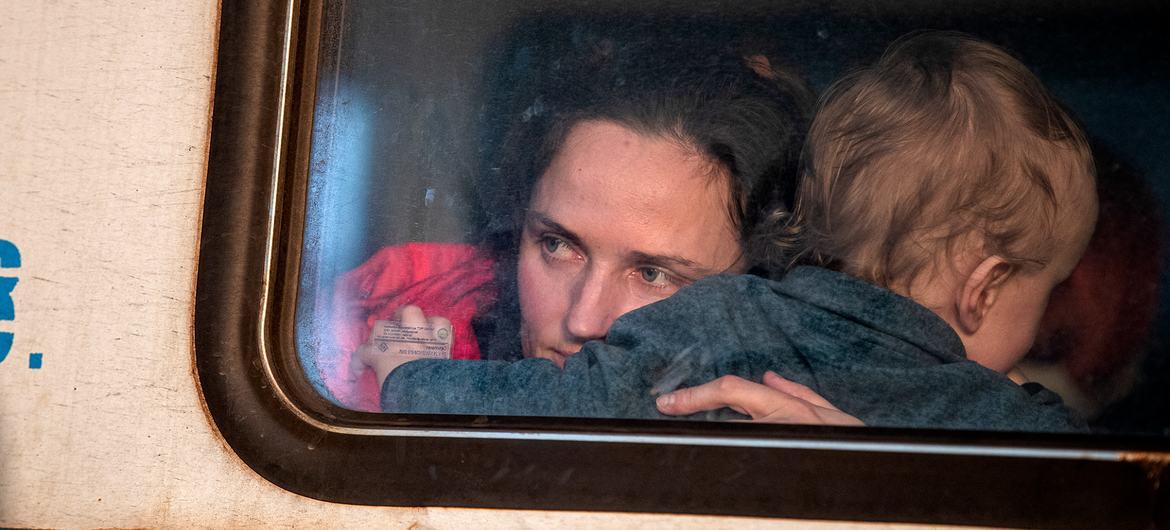
People fleeing the heavily bombed city of Mykolaiv pass through Lviv, western Ukraine, en route to Poland.
Consequences of war
Nearly two months of intense and escalating hostilities in Ukraine continue to have horrific repercussions for civilians and caused a grave humanitarian crisis.
“Aid workers from local and international NGOs and UN agencies have worked day and night to scale up our response to assist more than 3.3 million people. This is alongside the incredible work done by volunteers across the country,” explained Ms. Lubrani, adding that just yesterday the UN managed to deliver nine trucks of relief items to the city of Chernihiv.
The Humanitarian Coordinator also gave examples of how over 145,000 people in non-Government-controlled areas of Luhanska oblast are receiving protection services, and those in transit areas of Lviv have received hygiene kits as they moved in search of safety, thanks to the UHF’s implementing partners.
Challenges abound
Despite these critical efforts and invaluable assistance, much more is required to meet the growing needs of Ukrainians.
“It is remarkable how the humanitarian community here managed, in a few weeks, to expand from delivering assistance in two areas of eastern Ukraine to now operating across all 24 oblasts,” acknowledged Ms. Lubnrani.
“However, we are still not able or have been prevented from reaching areas where people are in dire need of assistance, including Mariupol and Kherson”.
Launching on Earth Day – 22 April – Hove based social enterprise, It’s OurPlanet Too has created a new eco subscription box for children – A TOOL KIT FOR ECO HEROES. Designed to connect children with our precious planet and help empower parents to start conversations with their children about the environment. The tool kits are 100% sustainable and plastic-free and provide a fun and exciting eco-led gift, that educates and gives back.
Each themed tool kit will deliver fun activities, news and information to encourage children to think about how what we do affects our environment, from tiny seedlings to huge trees and the animals that rely on them.
Inside their launch tool kit (themed ‘Our World Is Changing’), you will find over four hours of activities, a recipe, an eco heroes manifesto poster, a reward chart and much more.
Knowing that many parents don’t feel equipped to speak to their children about environmental concerns, an easy crib sheet is included in each tool kit. The aim is to empower parents to start those conversations and make it easier to include their children on the journey to greener living.
The tool kits are 100% sustainable and plastic-free and printed locally, many of the tasks utilise materials already found in the home or even in the recycling box! The contents support the national curriculum and have been developed in consultation with a primary headteacher.
At It’s Our Planet Too, their vision is for every child to believe that they have the power to protect our planet. With the need to tackle climate change, improve climate literacy and weave sustainable practices into all we do, there has never been a more crucial time to inspire and educate our children about environmental issues.
The tool kits will be available to purchase from their website from mid-April. Prices start at£9.50 for an individual tool kit, discounted subscriptions are available for 3, 6 and 12 months.
As a social venture, they are committed to giving back. They do this by educating little ones(and their families) to make positive changes towards a greener future, whilst supporting charities. They pledge to give a minimum of 50% of their profits to good causes.
For images, please click here. Samples are available.
Press release distributed by Pressat on behalf of It’s Our Planet too, on Thursday 21 April, 2022. For more information subscribe and follow https://pressat.co.uk/
Patriarch Kirill should be prosecuted by the International Criminal Court (ICC), says the NGO HRWF in a detailed report
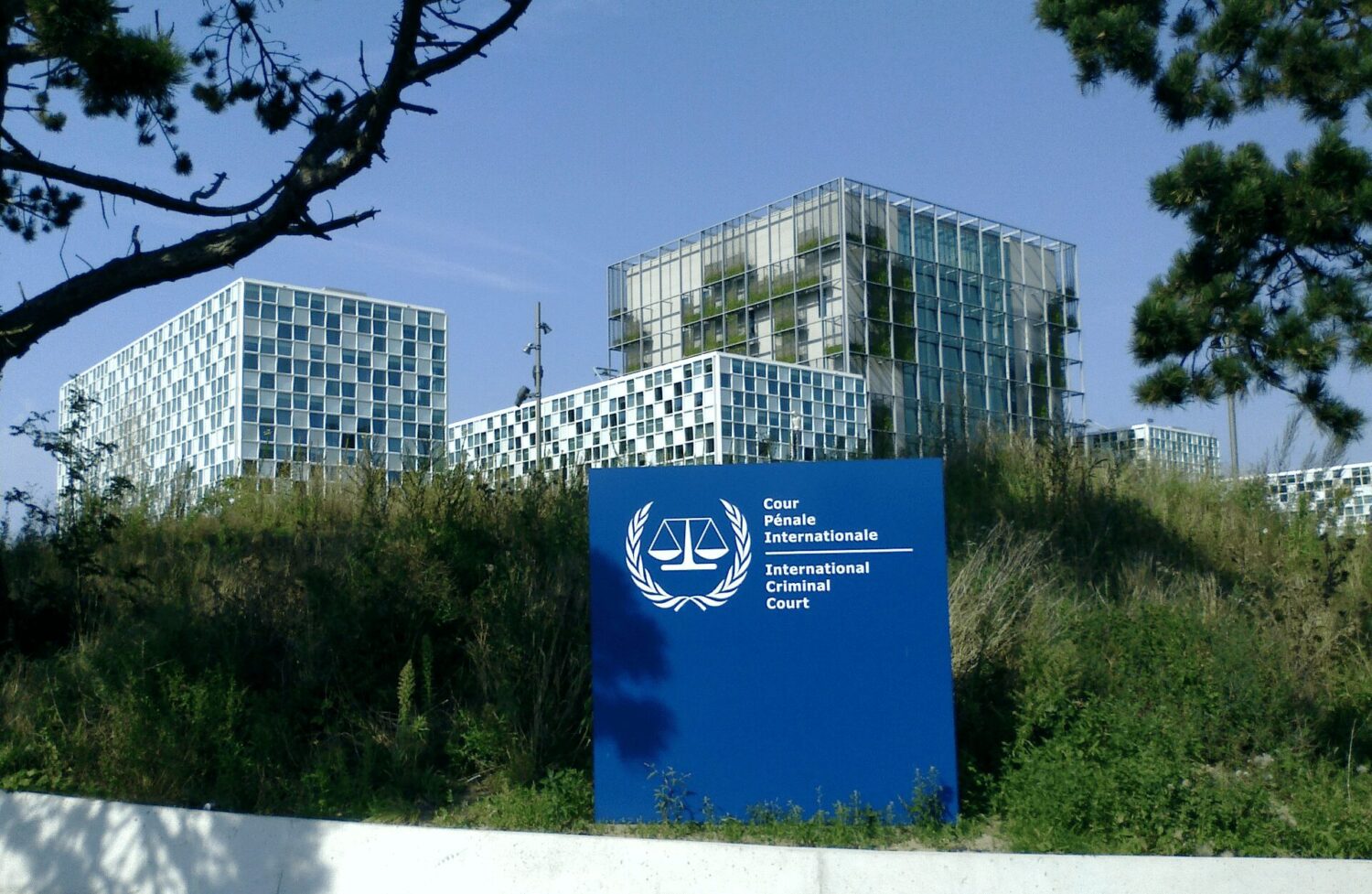
HRWF’s (Human Rights Without Frontiers) contribution calls for the investigation by the International Criminal Court on the potential criminal liability of the Primate of the Russian Orthodox Church for aiding and abetting the commission of war crimes and crimes against humanity.
The NGO responsible for the report, HRWF, was founded by its director Willy Fautré and worked with the human rights specialized attorney Patricia Duval.
Patriarch Kirill of the Russian Orthodox Church and Russian President Vladimir Putin. The Russian Orthodox Church has often been accused of serving the interests of the State. Photo: NovayaGazeta.ru
Human Rights Without Frontiers, a Brussels-based NGO, appeals to the Prosecutor of the International Criminal Court, Karim A. A. Khan QC, to hold personally accountable and prosecute Vladimir Mikhaïlovitch Goundiaïev, known as Patriarch Kirill of Moscow and All Russia, for:
for inspiring, inciting, justifying, aiding and abetting war crimes (Art. 8 of the Rome Statute) and crimes against humanity (Art. 7) perpetrated and being perpetrated by the Russian armed forces in Ukraine.”
According to Fautre and Duval, the International Criminal Court (ICC) is currently “busy documenting and evidencing war crimes and crimes against humanity committed in Ukraine, and identifying the perpetrators to be held accountable for the said crimes. The prosecution of Patriarch Kirill falls within Article 25 of the Rome Statute – Individual criminal responsibility”
The article mentioned by HRWF provides:
In accordance with this Statute, a person shall be criminally responsible and liable for punishment for a crime within the jurisdiction of the Court if that person: (…) (c) For the purpose of facilitating the commission of such a crime, aids, abets or otherwise assists in its commission or its attempted commission, including providing the means for its commission;
On 7 April 2002, the European Parliament adopted aResolution about “the increasing repression in Russia, including the case of Alexei Navalny,” in which it condemned the role of Moscow Patriarch Kirill in Russia’s war against Ukraine.:
“Condemns the role of Moscow Patriarch Kirill, head of the Russian Orthodox Church, in providing theological cover for Russia’s aggression against Ukraine; praises the courage of the 300 priests of the Russian Orthodox Church who signed a letter condemning the aggression and expressed their grief over the ordeal of the Ukrainian people, calling for an end to the war.”[i]
You can read the full complaint and documentation on the web of HRWF, which concludes welcoming “the opening of an investigation on possible crimes committed in Ukraine under the Rome Statute” and also welcoming “the investigation to identify the perpetrators, including possibly going up the command chain to President Vladimir Putin” among other conclusions.
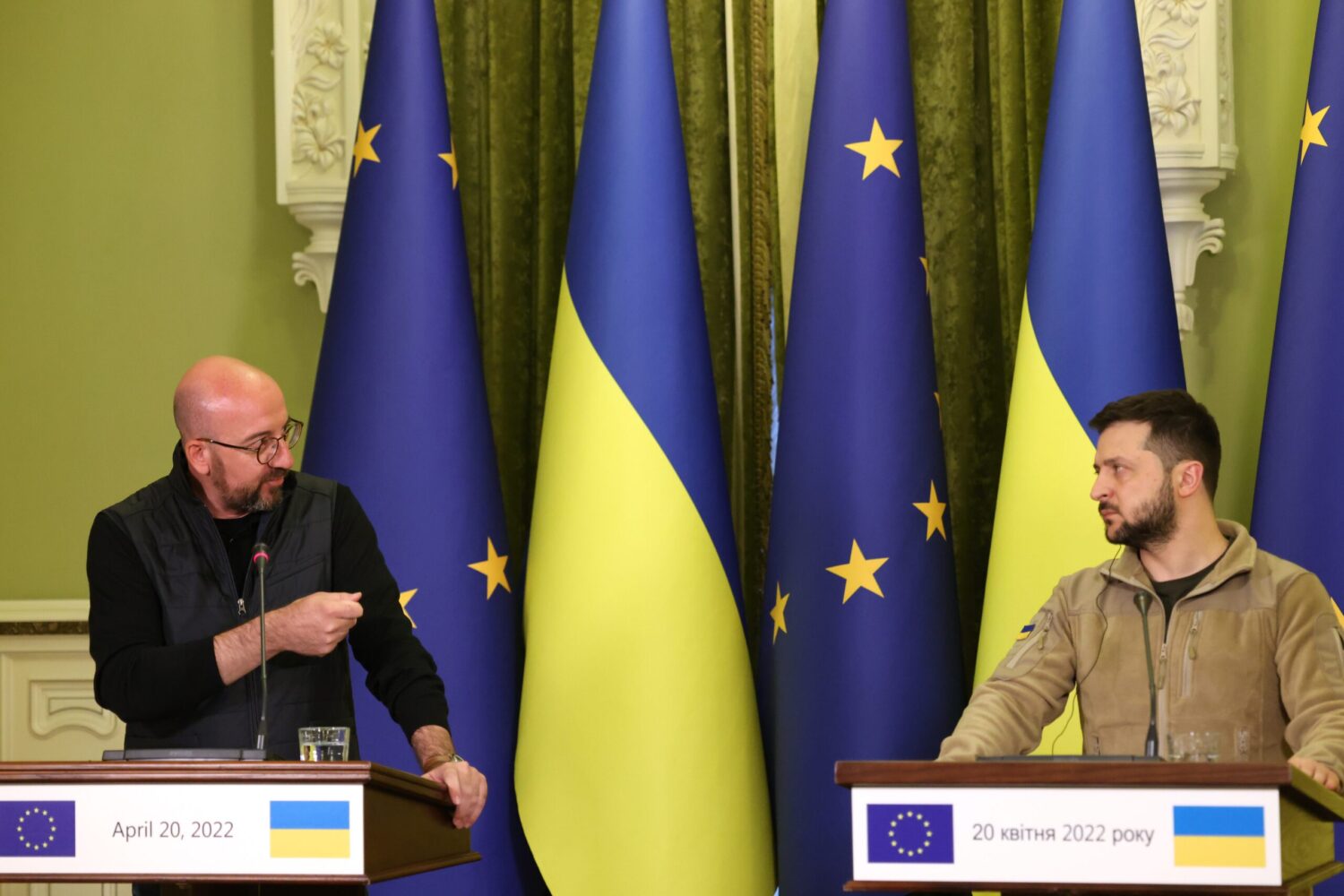
Copyright: European Union : From left to right: Charles MICHEL (President of the European Council, EUROPEAN COUNCIL), Volodymyr ZELENSKYY (President of Ukraine, Ukraine)
Remarks by President Charles Michel at the press conference following his meeting with President Volodymyr Zelenskyy in Kyiv
Last year, I had the occasion to come to Ukraine three times. And exactly one year ago, in March last year, we went together to the Donbas. And there, I said “Russia is not a mediator”. I said “Russia is party to the conflict”. And the situation today is showing that I was right.
This morning, I went to Borodyanka to witness with my own eyes the situation on the ground. I met the people. There are no words to explain what I feel, not as President of the European Council, but as a father, as a human being. These are atrocities. These are war crimes. They must be punished. It will be punished. They must pay for what they have done there, and in many other cities and other locations in Ukraine.
Right now, like you, I think of the people, the soldiers, but also the civilians in the Donbas, in Mariupol and in other cities who are fighting for their lives, who are fighting for the sovereignty of Ukraine. And I know very well, they are fighting for our European values, for freedom, for democratic principles.
We are determined to do everything we can to support Ukraine because we want victory for Ukraine. And that is why we will use all the possible tools in our hands. Of course, financial support is very important. We had the opportunity to go into more detail with the President, and that is why we decided a few weeks ago, after a phone call, to launch this trust fund in solidarity with Ukraine. In the coming days, on May 5th, will be the starting point of this trust fund, with an international donors’ conference. We will organise this together with Poland, with Sweden and with the support of the European Commission, all the member states, and with the support of many international actors.
We are also working closely with international organisations like the IMF, the World Bank and others to make sure that we can mobilise funds in support, so Ukraine can pay the social expenditures that are needed in the short term, in the mid-term, and in the long term. It is also very important to start as soon as possible the programme of rebuilding the country. I can assure you that the EU will be on your side to rebuild your country.
Today we discussed very strategic and interesting ideas, very operational and concrete ideas to accelerate the process. I am optimistic that in the following days and weeks, we will clarify the exact nature of the support that we will be able to provide. And in order to succeed, we will also discuss the rebuilding of the country and the investments needed in infrastructure and in different fields.
The second important topic is military support. For the first time in history, the EU has decided to provide lethal military equipment. It was a decision taken two days after the start of the war. I remember very well, I will never forget it. Because you, Volodymyr Zelenskyy, you called me on Saturday, two days after the start of the war, and you asked me to coordinate the effort to start providing military equipment. And we succeeded in convincing the European Union member states in a few hours to provide military equipment. We decided a first tranche of 500 million euros. And now we have a total of 1.5 billion euros of military equipment, and day after day in close consultation with you, we are trying to convince member states to add bilateral support to make sure that what we provide is what you need. We discussed very precisely your needs and how we are able to make sure that we can provide with the EU’s member states and other partners the means that are needed to fight and to win this war.
The third point is political support. And I would like to say here that, of course, I understand, and I show full respect for the free and democratic decision taken by the government of Ukraine. When you decided to apply to be an EU member, we tasked the Commission immediately, only in a few days. Usually, it takes eight months for the Commission to publish an opinion. We are in close contact on the substance. We will have the opinion of the Commission by the end of June. Then it will be my responsibility to assess when I can put this point on the agenda of the European Council and the Council, to make sure that we have the political discussion to make progress on this.
But I want to share with you that I feel a very strong support to make sure that we can provide concrete support to Ukraine in your choice to follow the EU path for your future. And I am convinced that what you are demonstrating day to day, this demonstration that you are totally committed to democratic principles, to freedoms, and that you don’t only fight for the future of the children of Ukraine, we know that you fight for the European fundamental principles and values.
We are also determined to provide humanitarian support. We are determined to provide support to make sure that international justice and justice will prevail, because there is no peace without justice. That is why it is very important to collect the evidence and to support all the actors who are working in this important field.
Finally, we discussed the sanctions because we see that we must put pressure on the regime, on the Kremlin. We have decided many concrete measures. This is not enough, and it’s why we are constantly working to increase the pressure. Again today, we went into more detail and identified some additional elements for us to put proposals on the table of the Council and to be able to maintain the maximum pressure on Russia.
Finally, one last word. Dear Volodymyr, we met for the first time about three or four years ago, and this was the starting point of a personal relationship based on trust and confidence. I want to tell you that I am, and we are extremely impressed by your personal leadership. Your personal leadership is also showing the bravery and courage of the people of Ukraine. You are not alone. We are with you. And we will do everything possible to support you and to make sure that Ukraine will win the war. Thank you.
UN Spokesperson Stéphane Dujarric said Mr. Guterres has asked President Vladimir Putin to receive him in Moscow and President Volodymyr Zelenskyy to receive him in Kyiv.
The letters were handed over to the countries’ UN Missions in New York on Tuesday.
Urgent steps towards peace
“The Secretary-General said, at this time of great peril and consequence, he would like to discuss urgent steps to bring about peace in Ukraine and the future of multilateralism based on the Charter of the United Nations and international law,” said Mr. Dujarric.
“He noted that both Ukraine and the Russian Federation are founding members of the United Nations and have always been strong supporters of this Organization.”
The announcement came a day after the UN chief called for a humanitarian pause in Ukraine ahead of Orthodox Christian Easter this weekend.
Support for humanitarian pause
The UN Crisis Coordinator for Ukraine, Amin Awad, has underlined the Secretary-General’s appeal amid the mounting humanitarian crisis in the country and the intensifying Russian offensive in the east.
The four-day pause would allow for safe passage of civilians willing to leave conflict areas, he said, and the safe delivery of urgent humanitarian aid to people in the hardest hit areas of Mariupol, Kherson, Donetsk and Luhansk.
“During this week – which marks a rare calendar alignment of the three of the most sacred religious holidays of Christian Orthodox Easter, Jewish Passover and the Muslim holy month of Ramadan – it is the time to focus on converging interests and set aside our differences,” said Mr. Awad.
Casualties continue to mount in the war in Ukraine, which began on 24 February. There were 5,121 civilian casualties in the country as of Tuesday, including 2,224 deaths, according to the latest update from the UN human rights office, OHCR.
As Mr. Awad stated: “The loss of life and severe trauma caused by attacks on hospitals, schools and places of refuge is utterly shocking, as is the devastation of critical civilian infrastructure in the country.”
The Ukraine conflict has generated the largest and fastest displacement in recent years.
Some 12 million people have been forced to flee their homes, with more than five million crossing the border into neighbouring countries and beyond.
Many of those left behind do not have access to water or electricity, while another 12 million are affected by economic hardship and a decline in services.
In eastern Ukraine, some 1.4 million people are without access to running water, including in the besieged port city of Mariupol. Millions more have only limited access to water and electricity.
Amplified ramifications
Additionally, some 136 attacks on health care facilities have been recorded since the start of the war, representing nearly 70 per cent of worldwide attacks on health so far this year.
Growing insecurity, including due to contamination with explosive devices, is a significant obstacle to accessing hard to reach areas in the east.
“This terrible toll on civilians must come to an end,” said Mr. Awad, warning that the war’s devastating impact could affect Ukraine for generations.
“The immediate impact of this senseless war is the gravest here in Ukraine but it could have global ramifications, putting 1.7 billion people worldwide at risk of poverty, hunger and destitution”.
Supporting women and girls
Since the start of the war, the UN and partners have ramped up relief operations to reach people affected by the conflict.
Women and children comprise the majority of the displaced, whether inside or outside the country’s borders.
The head of the UN Population Fund (UNFPA), which supports reproductive health care in more than 150 nations, stressed that the needs of women and girls must be prioritized.
“Women do not stop getting pregnant or giving birth during conflict, and their access to lifesaving health services is literally under attack in Ukraine,” said Dr. Natalia Kanem, the UNFPA Executive Director.
Boosting life-saving services
UNFPA is coordinating and bolstering life-saving sexual and reproductive health services, as well as protection and response services for survivors of physical and sexual violence.
So far, more than 13 metric tonnes of reproductive health supplies have been delivered to seven hospitals in three cities in Ukraine.
Another 27 tonnes of critical supplies, medicines and equipment that have arrived in the country will be distributed to maternity hospitals in in war-torn Chernihiv, Sumy, Kherson, Mykolaiv and four more cities to meet the needs of 1.5 million people.
Another 41 metric tonnes of reproductive health supplies are expected, and UNFPA is also distributing dignity kits that contain sanitary pads and other essential items.
With reports of rape and human rights violations increasing, the agency is supporting 30 shelters, crisis rooms and daily care centres for displaced women and survivors of violence.
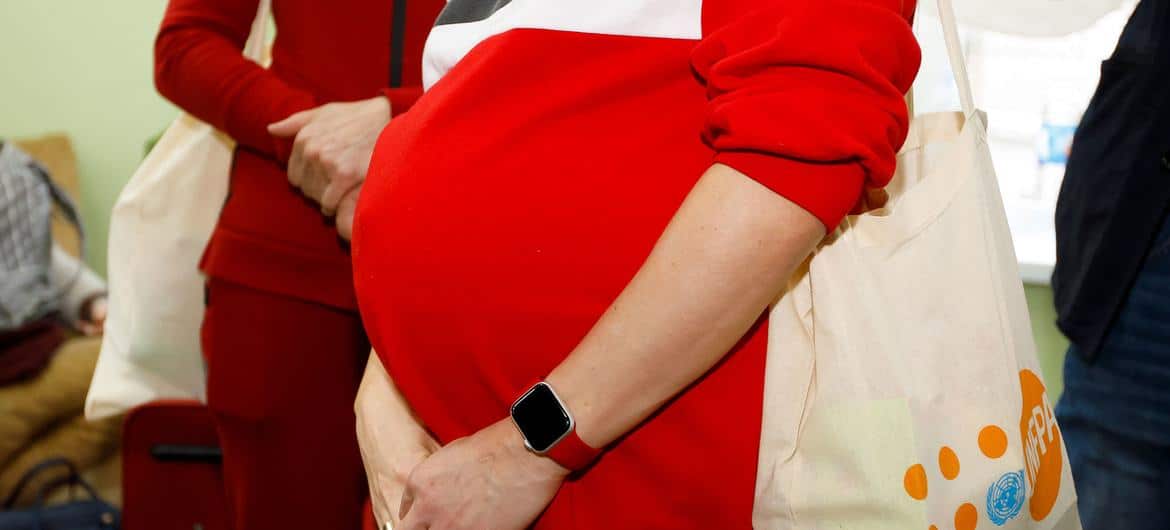
A heavily pregnant Ukranian woman who left Odessa with her mother and young son receives a dignity kit at a placement centre in Moldova’s capital city, Chișinău.
More action needed
Mobile teams will be dispatched to 12 regions across Ukraine in the next two weeks to provide psychosocial support to women experiencing trauma or violence.
Although UNFPA is working closely with the government and other partners, much more needs to be done, said Jaime Nadal Roil, the agency’s Representative in Ukraine.
“We need to reach many more people, including survivors of gender-based violence. We are appealing for increased support to respond to this growing humanitarian crisis,” he said.
Providing safe spaces
More than 100,000 Ukrainian refugees have found shelter in Moldova.
UNFPA recently signed an agreement with the National Health Insurance Country to provide refugees with comprehensive sexual and reproductive health care. This includes critical maternal health services such as life-saving caesarean sections.
Additionally, 10 tonnes of reproductive health supplies have been delivered to Moldova, including for the management of obstetric emergencies.
UNFPA-supported service centres across Moldova also are being expanded with “Orange Safe Spaces” to provide family planning and counseling and referrals for refugees.
As part of the $1.7 billion UN-led appeal for Ukraine, UNFPA is seeking $65.6 for its operations there and in neighbouring countries.
Despite war, COVID-19 and the climate crisis, all of which compound the other challenges facing young people today, the UN chief lauded youth for raising their voices and mobilizing for a better future.
“Young people are…leading the way in the fight against climate change, standing up for racial justice and gender equality…holding leaders to account…[and] are at the forefront of our efforts to secure a more inclusive, peaceful, and prosperous future for all,” Secretary-General António Guterres said on the second of a two-day forum on youth.
We have no time to lose – UN chief
Under the theme Youth 2030: Achieving the SDGs, he delivered a recorded video message to the Economic and Social Council (ECOSOC)’s annual Youth Forum encouraging young people to “keep pushing; to keep mobilizing; and to keep bringing your ideas to the table”.
“We have no time to lose”.
More must be done
Through its Youth Strategy, the UN is committed to working, for and with young people.
Mr. Guterres thanked Jayathma Wickramanayake, his Youth Envoy, along with UN entities and country teams as well as youth organizations and Member States for working to ensure that “our actions are guided by the perspectives and energy of young people”.
“But we can and we must do more,” he underscored, reminding that the UN Our Common Agenda report proposes a series of recommendations to strengthen and deepen solidarity with youth and future generations while building more networked, inclusive and effective multilateralism.
Education summit
The UN chief informed the meeting of an upcoming summit on Transforming Education that will convene in September.
He encouraged the participants “full and active engagement” in mobilizing political ambition, action, solutions and solidarity to transform education.
The summit will take stock of efforts to recover pandemic-related learning losses, reimagine education systems for the future, and revitalize national and global efforts to achieve the fourth Sustainable Development Goal (SDG 4) for inclusive and equitable quality education and lifelong learning opportunities for all.
Upgrading youth engagement
Another update the Secretary-General shared was the creation of a new UN Youth Office that will “upgrade engagement” with young people across the Organization’s work.
“Meaningful, diverse, and effective youth participation – inside the United Nations and far beyond – is essential to advancing human rights, addressing the climate crisis and achieving the Sustainable Development Goals,” he concluded.
‘Rescue’ the planet
The Youth Envoy thanked the thousands of young people around the world who “were leading our conversations every step of the way” throughout the Youth Forum – despite facing countless challenges and disproportionate impacts amidst the COVID-19 pandemic.
“There is no need to sugar coat it – we live in a world abundant with crises and emergencies,” said Ms. Wickramanayake.
In addition, the world remains off-track in achieving the SDGs by 2030, she stressed, calling for efforts to “rescue” both the Goals and the planet.
“We have heard time and time again…the constant demands of young people to change the oppressive systems and structures that weigh us down, that increase inequalities and trap us in a cycle of violence,” she said.
Stressing that many ideas, visions and solutions were put forward over the last two days, the Youth Envoy urged participants not to simply “pat ourselves on the back and move on” but instead to harness the moment, act and hold leaders accountable.
Youth bridge
Sharifah Shakirah, Founder and Director of the Rohingya Women Development Network, said that the 2030 Agenda was launched to end poverty and set the path to peace, prosperity and equality for all on a healthy planet.
However, “today, we live in two different worlds”, she said, noting that in one, privileged people are protected by their countries, and in the other – exemplified by where she was born – children are forced to flee violence and persecution.
Describing young people as the bridge between both worlds, she pointed out that, even before the onset of the COVID-19 pandemic, one in five youth globally suffered from limited access to education, and one in four faced conflict.
Now, in the context of the pandemic, “young people are maintaining open communication with their communities”, including by creating grassroots organizations and providing assistance to others on the ground.
UN partners
Those sentiments were echoed by a range of UN officials, who praised the countless young people that contributed to both the Forum and COVID-19 recovery efforts at every level.
Liu Zhenmin, Under-Secretary-General for Economic and Social Affairs (DESA), welcomed the active contributions of young people, which personify the UN’s goal of “leaving no one behind.”
Meaningful engagement with youth is at the core of DESA’s work, including in climate change action and financing for development, he said, adding that his department it is always exploring new ways to engage with young people such as through its UN Youth Delegates programme.
Youth volunteers in Jordan are supporting their communities during the COVID-19 crisis.
Taking the wheel
“You have rightly demanded to be in the driver’s seat in devising the recovery efforts and a seat at the table when decisions are taken that would impact your own future,” said ECOSOC President Collen Vixen Kelapile.
After two challenging years of lockdowns, quarantines, social distancing, treatment inequities, and the loss of livelihoods for millions, he noted that young people have shared their visions of how to get back on track to accelerate the implementation of the SDGs.
Emphasizing that the pandemic affected young people most, Mr. Kelapile said it also revealed how their leadership, resourcefulness and dedication can turn major crises into opportunities for a fairer, more inclusive and more equitable future.
Against that backdrop, he added that “there is no shortage of good will, commitment and desire to act among you” and pledged the UN’s solidarity going forward.
Pristina and Belgrade must engage more actively in dialogue facilitated by the European Union (EU), the head of the UN Interim Administration Mission in Kosovo (UNMIK) told the Security Council on Wednesday. “While this process has led to meaningful results on various practical matters, a comprehensive normalization of relations between the two sides so far continues to be elusive,” said Caroline Ziadeh in her first biannual address as the UN Special Representative.
“Reconciliation and addressing grievances of the past should reinforce the pursuit of important strategic objectives,” she added.
Resilience crucial
Acknowledging the ongoing situation in Ukraine and its continued impact on European security and economy, Ms. Ziadeh reiterated that the resilience of democratic institutions throughout the Balkans is a crucial factor in maintaining a secure and democratic Europe.
However, shocks to Kosovo’s economy were building up well before the onset of the conflict, she said, noting the impact of the COVID-19 pandemic.
“In this context, finding practical modes of economic co-operation between Belgrade, Pristina and all neighbours in the region assumes greater urgency”.
Serbian elections
Her call for cooperation came on the heels of the Serbian general elections.
The UNMIK chief lauded the peaceful logistical exercise – supported by both sides – enabling 19,000 eligible voters to cast their ballots in special polling stations in Serbia.
Regrettably, however, a solution to facilitate voter participation in Kosovo could not be achieved.
Refuse impunity
Following the recent reports of attacks targeting Kosovo Police, Ms. Ziadeh urged collaborative condemnation and swift action to bring perpetrators to justice.
She also encouraged Pristina and Belgrade to seek a permanent solution to the issues regarding vehicle license plates and energy.
During these complex times, the Special Representative called upon leaders to be judicious in their actions and political rhetoric.
UNMIK’s legacy of support
The senior UN official clarified that UNMIK’s role is neither an obstacle nor a vehicle for the outcome preferred by one side or the other side.
Rather, she explained, the Mission continues its legacy of institutional support, working in synergy with the UN family of agencies, funds, and programmes to ensure conditions for a peaceful and normal life for all inhabitants of Kosovo.
“UNMIK remains the locus of relevant knowledge, experience, and subject area expertise…supporting an active civil society, promoting new tools to help Kosovo reinforce the rule of law, contributing to the empowerment of women and youth, providing expertise and support”.
Photo credit JW.org - Photo: near the building of the Supreme Court of the Russian Federation. April 2017
JW World Headquarters (20.04.2022) – April 20, 2022 will mark five years since Russia’s Supreme Court criminalized the activity of Jehovah’s Witnesses, liquidated some 400 of their legal entities, and confiscated their houses of worship. Russian authorities have since jailed over 320 Witnesses, with over 80 still in prison.
The systematic persecution has escalated over the past year as prison sentences exponentially increased in frequency and in term length. Several Witnesses have also been tortured or severely beaten either while being interrogated or in prison.
Jarrod Lopes, spokesman for Jehovah’s Witnesses, states:
“It’s well-documented that Jehovah’s Witnesses endured decades of Soviet persecution. Ignoring this history, Russian authorities have inhumanely beaten, tortured, and imprisoned peaceful Jehovah’s Witnesses in a failed attempt to break their faith and eliminate them. Long after the Soviet regime fell, Jehovah’s Witnesses have continued to thrive and they will likewise outlive the current Russian administration.”
Below are the latest statistics as well as some quotes from international experts that you will find helpful if you chose to report on the anniversary of the ban.
April 20, 2017: Judge Ivanenko of Russia’s Supreme Court announces decision to shut down the legal entities of Jehovah’s Witnesses in Russia and Crimea
2017 Russian Supreme Court Ruling
· The April 20, 2022, Supreme Court ruling, albeit grossly unjust, simply liquidated all of the Witnesses’ legal entities, Local Religious Organizations (LROs), in Russia and Crimea, declaring them “extremist”. During the 2017 Supreme Court hearing, the Russian government claimed that individual Witnesses would be free to practice their faith. However, the government’s claim of allowing freedom to worship has been inconsistent with its actions.
· 1741 homes of Jehovah’s Witnesses have been raided, almost one per day
o 27 homes raided since February 24th Ukraine invasion
· 620 JWs involved in 289 criminal cases
o This includes 16 JWs in Crimea, 4 of whom are in prison (some after conviction have been transferred to prisons inside of Russia). All have been charged under prevailing Russian law
o Oldest involved in a criminal case is 87.5-year-old Yelena Zayschuk, she is 1 of 6 in their 80’s; there are 34 in their 70’s
· Over 450 added to Russia’s federal Rosfinmonitoring list of extremists and terrorists
o Many are placed on the list even before being criminally charged or tried—see Forum18
Beatings and Torture
For example:
· February 2019, Surgut, seven men tortured—suffocated, stripped naked, doused with water, and given electric shocks to their genitals—Link to confirmed report. Video interviews
· February 2020, Chita, one man beaten, choked, and given electric shocks to his stomach and leg—link to report
· February 2020, Orenburg, five men severely beaten in prison, with one man being hospitalized for broken rib and damaged kidney—link to report
· October 2021, Irkutsk, one man beaten while his wife screamed for them to stop, another was tortured—stripped naked, lifted and suspended off the ground by his arms behind his back, attempted to force a glass bottle in anus area—link to report. Video interviews
As if torturing a man and making him writhe in pain isn’t savage enough, many Russian officers will also resort to inhumanely threatening to have his wife raped.
· Why and how successful is it?
o Most often, Russian law enforcement officers have beaten or tortured Jehovah’s Witnesses to force them to divulge information about fellow believers and or bully them into giving up their faith. The overwhelming majority of men withstood the torture and never complied, even with the smallest demands for information. That’s why in most of the criminal cases, the authorities have resorted to planting a mole to infiltrate the congregation and leak the names, contact information, and worship activities of local Witnesses.
What Experts Are Saying
Natalia Prilutskaya, Russia researcher at Amnesty International, call on Russia to:
“to immediately and unconditionally release all Jehovah’s Witnesses arbitrarily deprived of freedom for their faith and to drop criminal charges against all peaceful believers. Those who have been subjected to criminal prosecution, torture and other ill-treatment, unlawful searchers of their properties, who have lost their jobs, must receive adequate compensation and have their rights restored.”
The world should have started paying more attention to prosecution of Jehovah’s Witnesses in Russia already five years ago. Arbitrary prosecution of peaceful believers on spurious charges of “extremism” was and is a litmus test of the lack of freedom in Russia and of the Russian government’s intentions to quash any dissent, anything that they see as a threat to their official narratives. While the world was watching repressions against dissenters being unleashed within Russia, its government was also quietly preparing to promote their world view with tanks and missiles on the territory of the neighboring country, Ukraine. Were there a stronger international reaction to persecutions inside Russia, including to persecution of Jehovah’s Witnesses, the world could have been in a much better place today now. To prevent further escalation, it is important to expose and rigorously respond to human rights violations being committed in Russia. Restoring justice for one of the persecuted communities – Jehovah’s Witnesses – is one of the steps on the long road to restoring human rights and freedom in Russia and ensuring that no more international crisis, like the aggression against Ukraine, could be conceived in the Kremlin.”
Sir Andrew Wood, former British Ambassador to Russia (1995-2000), states:
“It follows that the punishment of peaceful believers on the grounds of their certification as extremists by the Russian Supreme Court in effect by demand of Russia’s current president is arbitrary and unjust. Their arrest, ill treatment, and confinement are a breach of elementary human rights together with the infringement of the freedom of all souls to seek their path to the truths of religion as best they may. The targeting of particularly vulnerable people of whatever gender or age adds to the injustice.”
“The people of Russia and those beyond them share an interest in the country’s future rule under the conditions of natural law. That is essential to its future beneficial evolution. The peaceful pursuit of religion is an essential element of that aspiration, whether in times of war like the present or in less dangerous circumstances. It therefore deserves our support as we hope and work for a better future.”
Dr. Emily Baran, expert on Russia and Soviet history, states:
“The history of Jehovah’s Witnesses, both in Russia and worldwide, makes clear that persecution will not have its intended purpose of eliminating this faith community. What persecution does is isolate Witnesses, subject them to cruel and senseless harassment, violence, and loss of freedom, and make their daily lives full of uncertainty. The Witnesses have demonstrated adaptability before, including in the Soviet period, and will continue to find ways to practice their faith even in these difficult conditions. Russian Witnesses will adapt because they have to, because they feel their faith requires it of them, and because repeated persecution has given them the skills to do so effectively.
More comments by the experts above can be downloaded here.
Russia Exporting Weaponization of Anti-Extremism Legislation
· Russia has been seeking ways to export its anti-extremism legislation, along with how to weaponize it
o May 2020, Putin signed a “Decree of the President of the Russian Federation”—“On Adopting a Strategy to Counteract Extremism in the Russian Federation Until 2025”
§ Section 32 on pg. 16, clearly outlines the President’s goals, in the field of international cooperation:
§ Strengthening the position of the Russian Federation in international organizations whose activity is aimed at counteracting extremism;
§ Promoting in bilateral and multilateral formats Russian initiatives in counteracting extremist activities, including over the Internet;
§ Signing agreements with foreign states aimed at solving problems in the realm of counteracting extremism;
§ Exchanging best practices in counteracting extremism, including cooperating together to develop international legal documents;
o Moscow-based rights advocate Sova Center published a report in 2020 confirming that
“Russian extremist legislation has been and remains the model anti-extremist legislation for Central Asian countries, despite the fact that, in recent years, it has been repeatedly criticized at the international level by UN High Commissioner for Human Rights Michelle Bachelet, the UN Human Rights Committee, the UN Committee on the Elimination of Racial Discrimination, the Venice Commission, the European Commission against Racism and Intolerance of the Council of Europe, and other structures
MEPs support a common charger for portable electronic devices, reducing e-waste and making the use of different mobile phones, tablets and digital cameras more convenient.
On Wednesday the Internal Market and Consumer Protection Committee adopted its position on the revised Radio Equipment Directive with 43 votes in favour (2 against).
The new rules would make sure consumers no longer need a new charger and cable every time they purchase a new device, and can use one charger for all of their small and medium-sized electronic gadgets. Mobile phones, tablets, digital cameras, headphones and headsets, handheld videogame consoles and portable speakers, rechargeable via a wired cable, would have to be equipped with a USB Type-C port, regardless of the manufacturer. Exemptions would apply only for devices that are too small to have a USB Type-C port, such as smart watches, health trackers, and some sports equipment.
This revision is part of a broader EU effort to address product sustainability, in particular of electronics on the EU market, and to reduce electronic waste.
Clear information on charging
MEPs also want to see clear information and labelling on new devices about charging options, as well as whether a product includes a charger. This would, they say, help to avoid confusion and ease purchasing decisions for consumers that often own several different devices and do not always need additional chargers.
With the growing usage of wireless charging, MEPs want the European Commission to present a strategy by the end of 2026 that allows for minimum interoperability of any new charging solutions. The goal is to avoid a new fragmentation in the market, to continue to reduce environmental waste, ensure consumer convenience and avoid so-called “lock-in” effects created by proprietary charging solutions.
Quote
Rapporteur Alex Agius Saliba (MT, S&D) said: “With half a billion chargers for portable devices shipped in Europe each year, generating 11,000 to 13,000 tonnes of e-waste, a single charger for mobile phones and other small and medium electronic devices would benefit everyone. It will help the environment, further help the re-use of old electronics, save money, and reduce unnecessary costs and inconvenience for both businesses and consumers. We are proposing a truly comprehensive policy intervention, building on the Commission’s proposal by calling for the interoperability of wireless charging technologies by 2026 and improving information given to consumers with dedicated labels. We are also expanding the proposal’s scope by adding more products, such as laptops, that will need to comply with the new rules.”
Next steps
Once Parliament as a whole has approved this draft negotiating position at the May plenary session, MEPs will be ready to start talks with EU governments on the final shape of the legislation.