Four Christian organisations are strongly condemning the advance of the Russian military into Ukraine and the assault that began on the night of 24 February 2022. They call for Russian troops to be brought back to Russia and an immediate end to the conflict. “Peace must prevail,” they insist.
The Conference of European Churches (CEC), the Lutheran World Federation (LWF), the World Communion of Reformed Churches (WCRC), and the World Methodist Council (WMC) are calling for prayers of peace for the people of Ukraine and the region.
They have issued an invitation to an online prayer service on Ash Wednesday, 2 March at 17.00 (CET). The service will bring together Christians from Ukraine and other parts of the world, seeking peace and an end to the ongoing conflict.
“This is a time for churches in Europe and globally to form a strong alliance of solidarity with people who fear the impact of war in Ukraine. This is a time to gather in prayer for people who possess the power to make decisions that will save lives and make peace possible,” said CEC General Secretary Dr Jørgen Skov Sørensen.
“Jesus calls us to be messengers of hope who work for peace. As Christian churches we therefore call for an immediate de-escalation of this conflict, so that the lives, human rights, and dignity of people in Ukraine are protected,” said LWF General Secretary Rev. Anne Burghardt.
“As the Scriptures encourage us to turn away from evil and do good, to seek peace and pursue it (1 Peter 3:11), we consider such an unprovoked attack as evil, and strive to do all we can to stand against it—while also preparing to assist those impacted by it,” said the WCRC Collegial General Secretariat, composed of Hanns Lessing, Philip Peacock, and Phil Tanis.
“Despite what is happening in Ukraine I still believe that the international community can make a difference as we collectively work for peace in the region,” said WMC General Secretary Rev. Dr Ivan Abrahams WMC General World Methodist Council.
In the call to prayer for the people of Ukraine and the region, the four Christian organisations note the military assault threatens the lives of Ukrainians, as well as peace throughout Europe and beyond. “The crisis is urgent and requires the attention and solidarity of the global Christian community.”
CEC is a fellowship of 114 churches from Orthodox, Protestant and Anglican traditions from across Europe, and together with its ecumenical partners represents over 380 million European citizens. The LWF brings together 148 Lutheran churches representing over 77 million Christians across the globe. The WCRC is comprised of 100 million Christians in Congregational, Presbyterian, Reformed, United, Uniting and Waldensian churches. The WMC encompasses 80 member churches on six continents.
To the surprise of everyone, the Russian president took to the television at dawn to announce a “military operation” in Ukraine against military sites. and called on Ukrainian soldiers “to lay down their arms”.
“We will strive to achieve a demilitarization and denazification of Ukraine,” said Vladimir Putin. “We do not have in our plans an occupation of Ukrainian territories, we do not intend to impose anything by force on anyone,” he assured, calling on the Ukrainian military “to lay down their arms.” He promised “consequences that you have never known before” to those “who would try to interfere”.
Several explosions first sounded in the east of the country, Ukrainian border guards reported that Russian ground forces had entered the country, including from the annexed Crimea as well as from the north, at the Belarusian border, from the northeast and from the east, at the Russian border. The Ukrainian foreign minister said a “full-scale invasion” was underway.
Shortly after the statements of the Russian president, powerful explosions were heard in Kiev, Odessa, and eastern Ukraine. In the capital, at least two explosions were heard in the city center. Bomb warning sirens also sounded in the center of Kiev and in Lviv, in the west of the country.
The President of Belarus, Alexander Lukashenko, said Thursday that the army of his country, an ally of Moscow, did not participate in the invasion of Ukraine launched in the morning by Russia.
Russia says it has destroyed Ukrainian air bases and air defenses, after numerous missile strikes. Ukraine, which has closed its airspace, says it has been subjected to “intensive bombing” across its territory, according to its commander-in-chief.
U.S. President Joe Biden denounced an “unwarranted attack.” “The world will hold Russia to account,” he promised. Nato chief Jens Stoltenberg condemned a “reckless and unprovoked attack” by Russia. And at the UN, Ukraine called on Russia to “stop the war”.
The ambassadors of NATO member countries will meet urgently Thursday morning in Brussels.
I am deeply worried by the latest reports of escalating military actions of the Russian Federation in Ukraine, opening up the alarming scenario of an armed conflict causing horrific human suffering, death and destruction. Today, peace on the whole European continent and beyond is facing a serious threat.
COMECE President Cardinal Jean-Claude Hollerich SJ. (Credit: CNS photo/Paul Haring)
On behalf of the Bishops of COMECE, I wish to reiterate our fraternal closeness and solidarity with the people and institutions of Ukraine.
Sharing Pope Francis’ feelings of anguish and concern, we appeal to Russian authorities to refrain from further hostile actions that would inflict even more suffering and disregard the principles of international law. War is a grave affront to human dignity and it has no place in our continent.
Therefore, we urgently ask the international community, including the European Union, not to cease seeking a peaceful solution to this crisis through diplomatic dialogue. We call on the European leaders gathering today for a special meeting of the European Council to show unity and endorse measures promoting de-escalation and confidence-building, while avoiding any steps that could potentially reinforce the violent conflict.
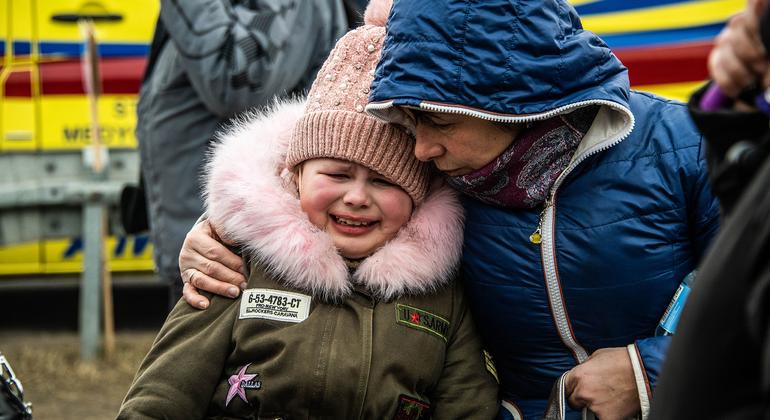
In the light of the emerging humanitarian situation provoked by the on-going hostilities, we appeal to European societies and governments to welcome refugees fleeing their homeland in Ukraine from war and violence and looking for international protection. It is our vocation, our responsibility and our duty to welcome and protect them as brothers and sisters.
Joining Pope Francis, we pray to Our Lady, the Queen of Peace, that the Lord may enlighten those bearing political responsibility to “examine their consciences seriously before God, who is the God of peace and not of war; who is the Father of all, not just of some, who wants us to be brothers and not enemies”.
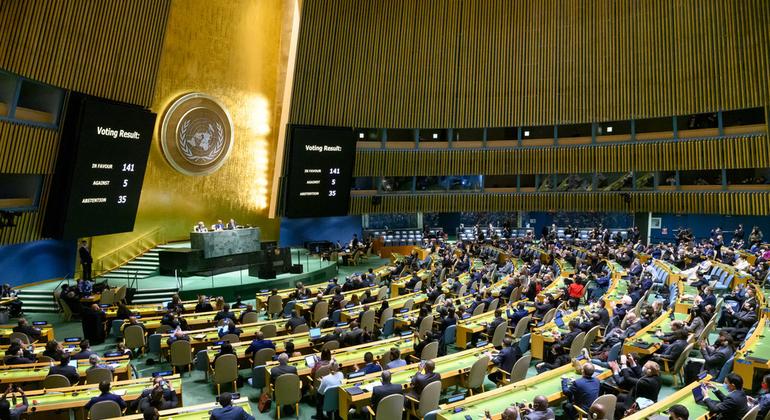
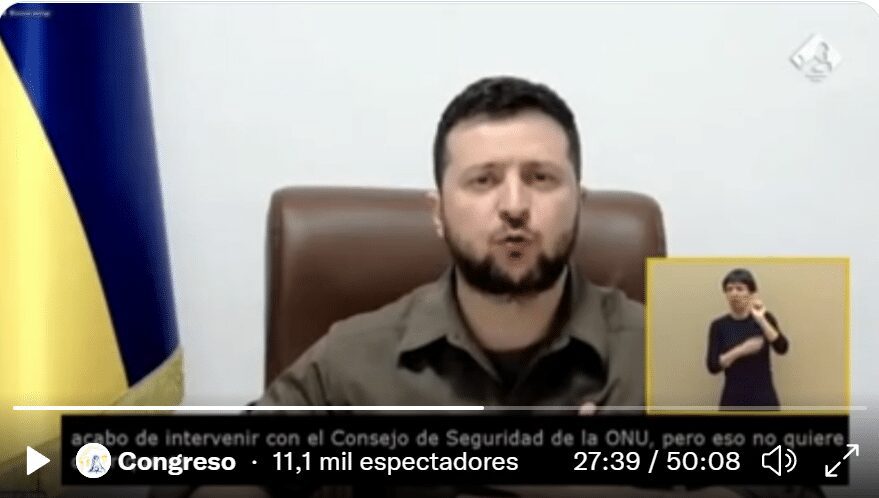
Hours after diplomats took the floor at the General Assembly to deplore Russia’s actions toward Ukraine and appeal for diplomacy, Mr. Guterres said that instead of repeating what he’d already stated, his political chief would update the Council on “a number of events” that took place during the day.
But before handing the microphone to her, he drew attention to rumours that were circulating that an offensive against Ukraine was imminent.
As the meeting continued, President Putin announced a special military operation in the Donbas and asked Ukrainian troops to put down their arms.
Guterres ‘saddest moment’
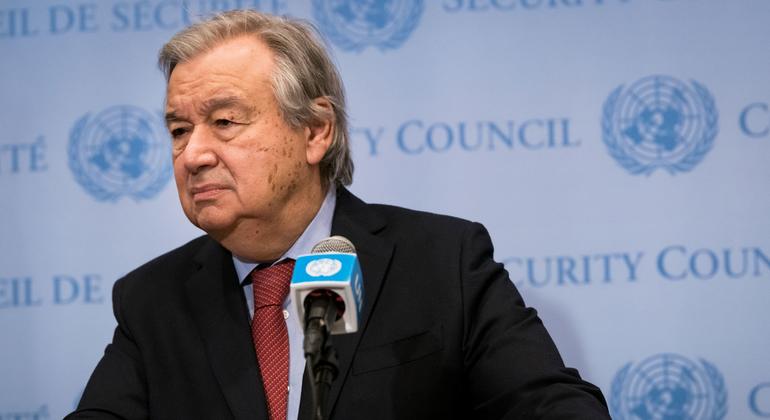
Speaking to journalists after the session ended, he called what happened the “saddest moment” in his tenure as UN Secretary-General.
In light of this development, the UN chief said, “I must change my address and say: In the name of humanity bring your troops back to Russia. In the name of humanity to not start in what may be the most devastating war since the start of the century.”
Events unfolding
Under-Secretary-General for political and peacebuilding Rosemary A. DiCarlo told the Council that earlier today, the “so-called authorities of the Donetsk and Luhansk Peoples Republics” requested military assistance from Russia.
Meanwhile, the Ukrainian authorities declared a nationwide state of emergency and announced other related defence and security measures, including the mobilization of reservists.
“Throughout the day we have seen disturbing reports of continued heavy shelling across the contact line and civilian and military casualties…the repeated targeting of civilian infrastructure…[and] an ongoing large-scale military build-up and military columns moving towards Ukraine,” she said.
Under the present circumstances, I must change my appeal:
President Putin, in the name of humanity, bring your troops back to Russia.
This conflict must stop now.
— António Guterres (@antonioguterres) February 24, 2022
Moreover, Russia has also reportedly shut airspace to civilian aircraft near the border with Ukraine.
“The United Nations cannot verify any of these reports, but if these developments were confirmed, they would greatly aggravate an already extremely dangerous situation,” she said.
The Ukrainian authorities are also reporting a new large-scale cyber-attack targeting several State and financial institutions.
Staying and delivering
UN staff remain on the ground to provide humanitarian assistance to the people of Ukraine, Ms. DiCarlo said, adding, “we are committed to staying and delivering”.
“All parties must ensure the safety and security. Respect for international humanitarian law and international human rights law is also paramount”, she stated.
While the world cannot predict what will happen in the coming hours and days ahead, Ms. DiCarlo said that “what is clear is the unacceptably high cost – in human suffering and destruction – of an escalation,” concluded the senior UN official.
‘Perilous moment’
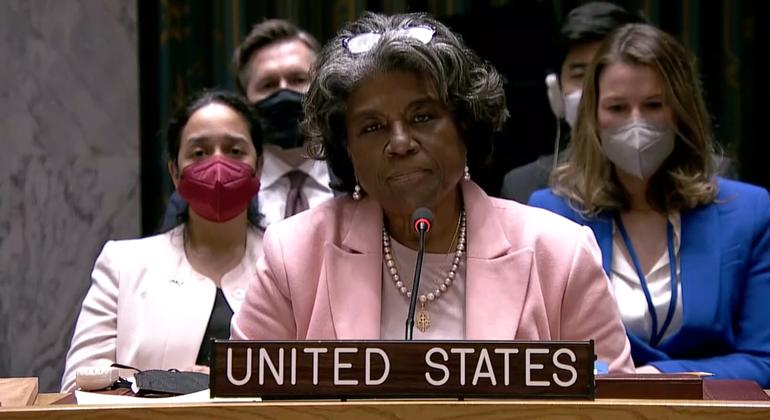
US Ambassador Linda Thomas-Greenfield said that the meeting was being held tonight because, along with Ukraine, we believe that a full-scale further invasion is imminent.
She pointed to the Russians closing airspace, moving troops into Donbas and moving forces into combat-ready positions.
“This is a perilous moment and we’re here for one reason, and one reason only: to ask Russia to stop. Return to your borders. Send your troops, your tanks, and your planes back to their barracks and hangars. And send your diplomats to the negotiating table. Back away from the brink, before it is too late.”
Ms. Thomas-Greenfield reminded that Russia called previous predictions “hysterical”, saying that we were lying and were supplying the world with misinformation.
“But what we said would happen has come to pass, for all the world to see,” the US Ambassador spelled out. “We must confront this threat head-on”.
‘Unjustifiable blow’ to peace
French Ambassador Nicolas de Rivière said that Russia is on the verge of provoking chaos in Ukraine and striking “an unjustifiable blow to peace and security in the heart of Europe”.
He said that President Putin had been planning this assault for months and had consistently and patiently undermined Ukraine’s sovereignty and territorial integrity.
“Throughout all this, Ukraine had shown remarkable restraint, including restraining from violence,” Mr. de Rivière said.
He reminded that European allies and the United States had consistently expressed commitment to work together with Russia to seek a diplomatic solution and “the international community had made its united voice heard earlier today in the General Assembly, calling for respect for territorial integrity and sovereignty.
In the face of all this, the French Ambassador said that “if Russia confirms that its choice is war it will have to take all the responsibility and pay the price.”
‘A gun to Ukraine’s head’
UK Ambassador Dame Barbara Woodward noted that for months, Russia has been holding “a gun to Ukraine’s head”.
Members of the Security Council, General Assembly, and the Secretary-General himself had been calling for an end to Russia’s aggression.
“The world is calling for peace, but Russia is not listening,” she said.
As such, the United Kingdom, she said, will not compromise its commitment to Ukraine’s sovereignty and territorial integrity.
“We will not compromise our commitment to the purposes and principles of the UN Charter…most of all the founding principle that we live together as good neighbors,” concluded Ms. Woodward.
Root of the crisis
Russian Ambassador Vasily Alekseevich Nebenzya, who is serving as the President of the Council for February, said that after listening to the statements tonight and in recent days, it was difficult to explain intensification of shelling by the Ukrainian regime of civilians by in Donetsk and Luhansk.
All the speeches and speakers seemed not to care for those people “who are living in basements. They seemed not to care about the refugees are fleeing to Russia,” he said, as if “those four million people simply don’t exist.”
“We tried yesterday and the day before to explain the logic by which Russia recognized the regions in the Donbas, but you just didn’t want to hear it; then or now. The people of the Donbas have been living in fear for the past eight years under Ukraine’s shelling and aggressions,” he said.
The Russian Ambassador stated that “the root of today’s crisis around Ukraine is Ukraine itself, which has for years been undermining the Minsk Agreements and calls for de-escalation”.
He went on to say that he had just learned that President Putin had declared a special military operation in the region, but that was all he knew and would need more time to gather specific information.
“I will keep you appraised of the situation,” he said and added that “occupation of Ukraine is not in our plan, our plan is to protect the people from the genocide perpetrated by the regime in Kyiv.”
Too late for de-escalation
Ukrainian Ambassador Sergiy Kyslytsya said that most of his statement was “useless now” after the Russian Ambassador had stated openly from the floor of the Council that the President Putin had “declared war on my country”.
He welcomed the intention of some Council members to submit a resolution condemning the aggression against Ukraine, saying “there is no purgatory for war criminals. They go straight to hell.”
Mr. Kyslytsya asked the Russian Ambassador to clarify whether Ukraine was being bombed “at this very moment.”
“It’s too late to speak about de-escalation. Too late. The Russian President declared a war. Should I play the video of your President? You declared a war. It’s responsibility of this body to stop the war”, Mr. Kyslytsya said, directing his comments to Russian Ambassador Nebenzya.
Considering this “delectation of war” the Ukrainian Ambassador said that the Russian Federation should “relinquish the responsibilities of Council President and transfer them on to a responsible member of the Council who respected the Charter.”
Moreover, he continued, the Security Council should pause the session to consider all resolutions and recommendations to stop the war.
“I call on every one of you to do everything possible to stop the war,” he concluded.
Before the end of the meeting, several members of the Council took the floor a second time to condemn President Putin’s announcement of Russia’s so-called “special military operation” in areas of eastern Ukraine.
Tourism flows around the world are expected to return to pre-pandemic levels no earlier than 2024, the United Nations World Tourism Organization said.
The highly contagious version of Omicron, albeit a mild one, will “disrupt recovery” in early 2022, after a 4 per cent increase over 2020 last year, according to the UN’s Madrid-based World Tourism Barometer.
Revenues from tourism in 2020 decreased by 72% compared to the previous year – which ended with the outbreak of the coronavirus pandemic.
“The pace of recovery remains slow and uneven across regions of the world due to varying degrees of mobility restrictions, vaccination rates and travelers’ confidence,” the agency said in a statement.
In Europe and North and South America, tourists increased by 19% and 17% respectively last year compared to 2020.
However, in the Middle East, they fell by 24% in 2021, while in the Asia-Pacific region they were 65% below 2020 levels and 94% below pre-pandemic levels.
The statement said tourism experts “see slightly better prospects” for this year after the turmoil in the first months due to the Omicron wave.
How Graphene Affects Electronics, Medicine, and Green Energy
In the world of science, graphene has made a whole revolution: more than 50 thousand patents with this material have been registered in the world, more than 50% of them belong to China. It is used in almost all areas to improve the properties of the material. Hi-Tech understands how graphene is taking over our lives and changing the future.
Graphene is used in electronics, water purification, medicine, and even solar panels.
What is graphene and what are its properties?
Graphene is a substance made of pure carbon, which is made in the form of sheets that are one atom thick. Graphene is 200 times stronger than steel, and it’s also flexible like rubber. In addition, it efficiently conducts electricity and heat.
Graphene is not a natural substance. Physicists theoretically described its properties as early as the 1960s, but it was not until 2004 that it was obtained for the first time. At the time graphene was created, its production methods were very expensive, but researchers manage to keep costs down. Therefore, graphene is going to be used in a large number of areas: in medicine, electronics for the production of computer technology and others.
The double bond between carbon atoms, combined with the thin atomic thickness, explains the special properties of graphene. Its ability to efficiently conduct electricity and heat is thought to be due to its small and strong carbon bonds.
Graphene is a substance made of pure carbon, which is made in the form of sheets that are one atom thick. Graphene is 200 times stronger than steel, and it’s also flexible like rubber. In addition, it efficiently conducts electricity and heat.
What is the advantage of graphene?
Graphene can be used as a raw material for the production of a wide range of products. The main advantages of the material are that it has a high conductivity – 200 times more than silicon, conducts heat efficiently and is thin enough to be considered a two-dimensional material.
Graphene is transparent, strong, light, flexible, and yet retains conductivity.
Is graphene dangerous to health?
It depends on how it is produced. Today, high-quality graphene is used in bioelectronics, which was obtained using chemical vapor deposition. In this case, the material cannot be toxic, since it does not interact with cells.
The researchers also conducted work in which they grew cells on graphene and on ordinary glass. It turned out that they grew much more actively on graphene, due to its biocompatibility.
Where is graphene already being used?
Graphene is widely used in electronics. Physicists at MIT have created a graphene-based superconductor that works even in strong magnetic fields. This discovery is going to be used to create super-powerful MRI systems and quantum computers that are ideally protected from interference.
Graphene can also be used instead of indium, a rare element used in touch devices. Researchers have created an OLED device out of graphene and found that it works just as efficiently as analogs made with indium tin oxide.
Researchers at MIT have made ultra-thin material out of white graphene to optimally store memory. The developers note that the device works stably even after a while. It is noted that the thickness of the material is several nanometers.
A team of US scientists has created a hardware security device out of graphene. The developers note that due to the physical and electrical properties of graphene, the device has become more energy efficient and protected from AI attacks.
Graphene is widely used in electronics. MIT physicists have created a graphene-based superconductor that works even in strong magnetic fields.
Where will we use graphene in the future?
• The medicine
In the chapter on toxicity, we already mentioned that graphene is biocompatible, so one of the potential areas for its use is medicine. Researchers say graphene could help diagnose and treat cancer. It is planned to create a chip with graphene to make devices more sensitive.
So far, it is impossible to say exactly when graphene bioelectronics will be widely used. Researchers are already testing neurodevices, biosensors and other projects in laboratories.
• Solar panels
Another promising area for the use of graphene is the production of green energy. For example, an international group of scientists is developing hybrid two-dimensional structures with graphene and quantum dots. They want to create a structure with controlled optical and photoelectric properties. It is planned to be used for solar panels. Engineers want to get a device that will work more efficiently than analogues.
• Water desalination
Other MIT researchers have shown that graphene oxide foam can be used to filter uranium in drinking water. As a result, filtered water has passed EPA standards. The filtration lasted several hours. It is noted that the foam can be reused.
• Smart clothes
Scientists from the US have made clothing from graphene oxide: it can protect the wearer from insects. According to the researchers, mosquitoes cannot sting through the resulting material. The fact is that the proboscis of insects cannot pass even the thinnest layer of graphene, and the material does not transmit chemical signals by which mosquitoes determine the victim.
Another promising area for the use of graphene is the production of green energy.
So far, the production of graphene is still an expensive process, and complex electronic devices with the addition of this material are made by hand. Also, its production has not yet been established, so graphene is used pointwise in various fields.
Scientists have studied the EEG of a dying brain for the first time in the world: it belonged to an 87-year-old patient with epilepsy.
Researchers from Canada, the US, China and Estonia studied how the dying brain behaves: the data was obtained by chance during the recording of a continuous electroencephalogram (EEG). During this, the patient suddenly had a heart attack, which led to death.
The result was a 15-minute recording, which recorded the activity of a dying brain. The authors focused on studying 30 seconds of this activity in two periods: when the heart continued to beat and had already stopped.
It is noted that during this period, the activity of the gamma rhythm was increased – these are brain waves that are activated during dreams or meditation. They suggested that at the time of death the patient recalled important events from his life.
By generating memory-seeking oscillations, the brain can recall last memories of important life events right before death. It could change our ideas about when life ends. – Ajmal Zemmar, lead author of the study
The authors note that so far there is not enough data to draw global conclusions about brain activity. However, scientists suggest that they have evidence of the ability of the brain to coordinate activity even after blood stops circulating through it.
Now scientists have a reason to study near-death and post-mortem experiences: before they did not become the object of serious scientific work.
“The Most Divine One is incomprehensible: for the verses of the bookless, fishermen are wise, suffocating with a word, and from the deep night, withdrawing people are countless, by the brilliance of the Spirit.” (From the third ode of the second canon of the Matins of Pentecost)
Any text has many features in the choice of words, in the construction of phrases, in its very content; features of the text – a manifestation of the characteristics of the personality of the writer.
Since ancient times, the saints have been telling us how the words of Scripture reveal the character of the spirit of the writer. Yes, st. Irenaeus of Lyons, interpreting the expression about the unbelievers – “whose minds of this world God has blinded” (2 Cor. 4, 4), says that in order to understand the meaning, one must take into account the way of expression characteristic of Paul: it spirit, makes movements in words”[1]. But at the same time, “man asks, and the Spirit answers.”
However, it would be hasty to conclude from this that we can explain any feature of the text of Scripture at our will by the properties of the personality of the clergyman. After all, on the other hand, everything that is contained in Scripture is the words of the Spirit. This is expressed with particular force by St. Theodore the Studite, when addressing the monastic scribes:
“Be strong scribes, laboring in calligraphy, for you are the inscribers of the laws of God and the scribes of the words of the Spirit, passing books not only to the present, but also to subsequent generations”[2].
Before starting a discussion of patristic thoughts about the inspiration of Scripture, we would like to make an aside remark. The development of historical thought is sometimes a challenge for a Christian. When the prevailing scientific hypotheses become incompatible with the telling of the Sacred History, there is a great temptation to “make something up”. A typical example in this regard is provided by the recent paper of the Pontifical Biblical Commission “Inspiration and Truth of the Holy Scriptures” (2014). About the biblical story about the return of the Jews to the land of Palestine, it says that “in fact, in a real war, the walls of the city do not collapse at the sound of trumpets (Josh. 6, 20)” and that this and similar passages of Scripture “should be considered as a kind of parable, which brings characters with symbolic meaning onto the stage”[3].
Can an Orthodox adhere to such a point of view? The Church has not, to our knowledge, made any recent determinations about the text of Scripture; however, we have at our disposal the authoritative message of the Eastern Patriarchs of 1723, whose text was also approved by the Russian Synod. There we read the following:
“We believe that Divine and Holy Scripture is inspired by God; therefore, we must believe it unquestioningly, and, moreover, not in our own way, but precisely as the Catholic Church has explained and betrayed it. <…> Since the Culprit of both is the same Holy Spirit, it makes no difference whether one learns from the Scriptures or from the Universal Church. A person who speaks for himself can sin, deceive and be deceived; but the Universal Church, since she has never spoken and does not speak from herself, but from the Spirit of God (Which she has unceasingly and will have as her Teacher until eternity), cannot in any way sin, nor deceive, nor be deceived; but, like Divine Scripture, it is infallible and has everlasting importance”[4].
If we agree with this, then it is not so easy to take the point of view of the Pontifical Biblical Commission. Indeed, in order to declare the historical narratives of Scripture to be parables and allegories, one must find interpretations of the holy fathers, and not just talking about the symbolic meaning of this text, but declaring it a parable – that is, a symbolic, but in reality, history that did not take place. Only then can such an interpretation be considered “transmitted” by the Church with at least some degree of meaningfulness.
For the same reason, the hopes of some jurisdictionally Orthodox writers to avoid conflict with the prevailing scientific notions by emphasizing the human elements of Scripture are also futile. Any attempt to declare Scripture erroneous at least in one particular place, as it seems to us, will not pass through the “sieve” of patristic interpretations.
Any attempt to declare Scripture erroneous at least in one particular place will not pass through the “sieve” of patristic interpretations.
Before proceeding to the exposition of the patristic testimonies, let us briefly say what we will try to substantiate.
1. Not only dogmatic and moral passages of Scripture are infallible, but even individual “unessential” verses are the work of the Holy Spirit, and not just human authors.
2. Scripture is inspired not only at the level of general meaning, but also of textual expression.
3. The manner of expression and the way of conveying thoughts in Scripture is not only the work of the clergyman; The Holy Spirit gives the gift of wisdom and eloquence, which is poured throughout the text of Scripture.
4. Even individual words and prepositions of Scripture are not without the care of the Holy Spirit.
Today, unfortunately, one can often hear that these positions are “fundamentalist”, almost Protestant. But, as we shall see below, they have their basis in the Holy Tradition of the Church.
Single iota
If we assume that only a certain universal non-verbal sense of Scripture is inspired by God, expressed exclusively by human efforts in different languages, then we should expect that the holy fathers will not resort to such interpretations, the very existence of which depends on the language of Scripture.
But in fact, such interpretations, although not frequent, are quite common in patristic writings.
St. Maximus the Confessor, explaining the expression about two birds sold for an assarium, writes that “an assarium is ten nummi, the number ten means the letter iota, and this letter is the first in the name of our Lord Jesus Christ”[5].
The number 10 is indeed represented by the Greek letter iota and the Hebrew letter iodine. But already in Latin, “I” means a unit (and, by the way, St. Maximus is one of the few Eastern saints who was strongly associated with the Latin West, still Orthodox in those centuries); translate the interpretation of prp. Maxim in Latin (as well as in English, say) is impossible with the preservation of meaning: you have to explain to the reader what is at stake.
In the same way, St. Basil the Great, in order to reveal the meaning of the Scripture narrative about the creation of the world, turned to the Syriac language, as closer to Hebrew[6]. Moreover, he writes that “the Syrian language is more expressive and, by affinity with Hebrew, comes somewhat closer to the meaning of Scripture.”
This is indicative. As you can see, St. Basil did not consider the meaning of Scripture to be something invariant, existing regardless of language and forms of expression, but connected the meaning of Scripture with how it is revealed in a particular word.
Blessed Augustine writes about translations of Scripture into Latin:
“The reader must either strive to understand the languages from which Scripture is transcribed into Latin, or must have more literal translations”[7].
At the same time, the saint was well aware that, from the point of view of taste and style, literal translations look inelegant, but he considered them preferable – “because they can show the reader the correctness or error of their not so much words as thoughts, which were kept in translations.”
However, the literal translation is not a panacea. For excessive literalism in translation, which destroys the clarity of the text, the translation of Akila by St. Epiphanius of Cyprus[8], who prefers the translation of 70 interpreters.
It should also be noted that even the centuries-old liturgical use of one or another translation did not stop the holy interpreters from clarifying the meaning of the meaning of Scripture from the original text. Yes, St. Theophan the Recluse corrected the understanding of the Slavic Apostle in Greek[9], and schmch. Hilarion (Troitsky) resorted to the analysis of the Hebrew text[10], extracting meaning from the coincidence of Hebrew words in those passages of Scripture where different ones are used in the Greek text (“among 70 interpreters”).
We would like to emphasize that recognizing the existence of some basic, referential text of Scripture does not mean recognizing the priority of the current Hebrew text (Masoretic edition) of the Old Testament over the Greek translation of 70 interpreters. It only means that the words of Scripture should be considered in their entirety of meaning, including the additional meanings of the original text (in St. Basil) and sometimes even the lettering of names (in St. Maximus) – and that one should not reduce the many-sided full meaning of Scripture to one only the general idea of what was written.
The words of Scripture must be considered in their entirety, including the additional meanings of the original text.
The fact that the Holy Spirit generally takes care of the words of Scripture, as it seems to us, is clear from the most ancient tradition about the translation of the Old Testament from Hebrew into Greek. Excellent storytelling ssmch. Irenaeus of Lyons about 70 interpreters deserves to be quoted in full:
“Wishing to test them separately and fearing that by mutual agreement they would not hide the truth contained in the scriptures through the translation, he separated them from each other and ordered everyone to translate the same scripture; he did the same with regard to all (other) books. When they gathered together at Ptolemy and compared their translations, God was glorified and the writings were recognized as truly Divine, because they all read the same thing in the same words and with the same names from beginning to end, so that the Gentiles present realized that the Scriptures were translated by the inspiration of God. And there is nothing surprising in the fact that God did it. He, who, when during the captivity of the people by Nebuchadnezzar the Scriptures were damaged and after 70 years the Jews returned to their country, after, in the time of Artharxerxes, the Persian king, inspired Ezra, a priest from the tribe of Levi, to restore all the words of the former prophets and renew to the people the statute of Moses.
When thus the Scriptures were translated with such fidelity and with God’s grace, and when from them God prepared and formed our faith in His Son, preserving for us the Scriptures intact in Egypt … “[11].
Thus, it seems clear that, on the one hand, God has care about the individual words of the Scriptures, on the other hand, that the translation of the seventy was inspired in a very special way.
With deep expressiveness, St. John Chrysostom in one of his sermons. Its idea is visible even from the title – “That should not leave without attention neither time nor even a single letter of the Divine Scriptures”; St. John says this:
“It was not in vain that I said this and spread about it not without reason, but because there are treacherous people who, having taken the Divine books in their hands and seeing the count of time or the enumeration of names, immediately leave them and say to those who reproach them: there are only names here, and there is nothing useful. What are you saying? God speaks, and you dare to say that there is nothing useful in what has been said? If you see only one simple inscription, then tell me, will you not stop at it with attention and begin to explore the wealth contained in it? But what do I say about times, names and inscriptions? See what power the addition of a single letter has, and stop neglecting whole names. Our Patriarch Abraham (indeed, he belongs to us rather than to the Jews) was first called Abram, which in translation means: “stranger”; and then, being renamed Abraham, he became the “father of all nations”; the addition of one letter gave the righteous man such an advantage. Just as kings give golden tables to their governors as a sign of power, so God then gave this letter to the righteous as a sign of honor.
This does not only apply to names. So, the 318 people with whom Abraham went out to opponents are also interpreted symbolically: the lettering of 318 (τίη) in Greek begins with the letter “tau”, which forms a cross, and the subsequent iota and eta represent the name of the Lord Jesus (Ἰησοῦς). The remarkable unity of ancient and modern interpreters here shows the right. John of Kronstadt, referring in this matter to Clement of Alexandria[13].
Blessed Jerome also speaks of the meaning of the very letters of Scripture:
“Individual words, syllables and points in the Holy Scriptures are full of meaning, therefore we are more likely to be reproached for word production and word combination than for damaging the meaning”[14].
St. Jerome is quite consistent in his theory that texts should be translated according to their meaning. However, Holy Scripture has many more levels of meaning than human texts; because St. Jerome retains meaning, even by making his speech ugly, but retaining the “words, syllables” – perhaps we would say “morphemes” – and the “points” of Scripture, because they are also full of meaning.
However, if this is the task facing the translator of Scripture, then when using it, it is quite possible to take only the right part, the right level of meaning, and quote it paraphrastically, if it is appropriate. It seems to us that this is exactly what we are talking about when, in his letter to Pammachius about the best way to translate, Blessed Jerome writes that one should not translate literally[15].
After that, Blessed Jerome cites a number of places in the New Testament, where the texts of the Old are retold paraphrastically or allegorically, – in general, not by direct quotation. By this Blessed Jerome defends his translation of the letter of St. Epiphanius of Cyprus, produced by him not literally, but in meaning.
This Jerome idea, unfortunately, is often interpreted quite falsely – in the sense that Blessed Jerome did not at all attach weight to the words of Holy Scripture, if the thought is restrained. Meanwhile, the saint wants to say that when only a general meaning is needed, there is no need to quote the text word for word, a paraphrase is enough. However, Jerome does not in any way claim that in Scripture only this general meaning exists, or that under other circumstances a literal translation cannot be required. In the same letter (!) Jerome says:
“For I not only confess, but also freely declare that in translation from Greek, except for Holy Scripture, in which the arrangement of words is a mystery, I convey not word for word, but thought for thought.”
It should be noted, by the way, that among the opponents of St. Jerome, who insisted on a literal translation even of the letters of St. Epiphanius, there was at least one saint – St. Melania Roman, who is mentioned by Jerome himself as one of the instigators of controversy.
A modern scholar thus sums up the position of Blessed Jerome regarding the inspiration of Scripture:
“The Presbyter of Bethlehem regards all the books of the Bible as “one Book” (unus liber), a single creation of the Holy Spirit, since they are all written by the same Holy Spirit. Like many other early exegetes, he saw the inspired writers of the Bible as instruments (quasi organum) through which the Holy Spirit spoke and acted. Having received Him, the prophets and apostles spoke “on behalf of God.” The whole Bible was written “under the dictation (dictante) of the Holy Spirit”, and therefore in it “even individual words, syllables, lines, dots are filled with meaning”. God Himself teaches through His Scripture, therefore it has indisputable Divine authority; it is always true and cannot contradict itself; if we meet in it two opposite statements, then, as Blazh believes. Jerome, one should consider that both of them are true, and look for the possibility to get it right.”[16]
Even suggestions are worth considering
With such an opinion about the letters of Holy Scripture, the Fathers, of course, even more decisively begin to interpret individual words, including prepositions and demonstrative pronouns.
So, for example, St. Basil discussed with the Eunomians the question of why Scripture uses the expression “in the Spirit” more often than “with the Spirit.” The very chapter of his work on this is called “On the fact that Scripture uses the syllable ‟v” instead of the syllable ‟s”, and also that the syllable ‟i” is equivalent to the syllable ‟s” [17].
It is curious that at the same time, in order to discuss the text of the Apostle Paul, St. Basil draws on examples from the Psalms. Thus, the stylistic unity of Scripture at the level of prepositions seems self-evident and does not need to be proved to the saint: that is, if the preposition “in” elevates to a greater height than “with” in the Old Testament, then the same can be expected in the New. It seems that such stylistic unity cannot be attributed to the commonality of the artistic vision of the priests, but rather to the unity of the Spirit who spoke through the apostles and prophets.
Also curious is the general remark of St. Vasily on the topic of research into which he entered: “to disassemble even the syllables themselves does not mean moving away from the goal.”
Dmitry Leonardov, analyzing the sermons of St. John Chrysostom, notes: “In the works of Chrysostom there are many places where the divine inspiration of particular words of the biblical text is affirmed”[18], and we are talking not only about significant words, but also about introductory conjunctions such as the word “when”. True, the author of the study draws a somewhat unusual conclusion from these words. Leonardov writes:
“We must also not forget that Chrysostom recognizes the difference in the degrees of inspiration of St. writers. In accordance with these degrees, the volume of the actual human work of St. writer in compiling this or that St. books”,
And
“he insists only on the deep meaning in the Bible of every word, syllable and letter, but not at all on their extraordinary, supernatural origin.”
Can we agree with this conclusion? Let’s take a closer look at what St. John Chrysostom.
Just before the words: “Look what power the addition of a single letter has, and stop neglecting whole names,” the saint warns menacingly:
“God speaks, and you dare to say that there is nothing useful in what has been said?”
And the very view that in every word, syllable and letter of Scripture “the sea of Divine thought is poured”, but this happened “naturally” (if not due to “supernatural origin”), seems very strange. In fact, an attempt to attribute St. John, the idea of the greater and lesser Divinity of the Scriptures cannot in any way be considered successful, since St. John repeatedly says the opposite. For example:
“Let us therefore not neglect those thoughts of the Scriptures, which are considered unimportant, because they too are from the grace of the Spirit; the grace of the Spirit is never small and meager, but great, amazing and worthy of the bounty of the Giver. <…> And this, i.e., that it was not only said, but set out in writing and transmitted through the epistle to all future generations, is not the work of Paul, but the grace of the Spirit ”[19].
The very idea that Scripture, even in individual words, is the work of the Omniscient Spirit dates back to the very early days of Christianity and, apparently, is of apostolic origin. Yes, ssmch. Irenaeus of Lyon writes that the Evangelist Matthew could have said, “The birth of Jesus was like this,” but the Spirit said, “The birth of Christ was like that”[20].
Blessed Jerome[21] has a similarly high opinion of the choice of words in the Book of the Prophet Ezekiel, calling attention to “the elegance of Holy Scripture.”
“The Grace of Scripture”
The blessed one, being a translator, was aware of the stylistic difference between different priests. However, he attributed the apparent rudeness of speech found in Scripture, first of all, to the need to adapt to the language of the listeners: “due to deliberate adaptation to the edification of the common people”, but at the same time with the preservation of meaning for the “scientists”[22].
Above, we have already seen the review of schmch. Irenaeus on the peculiarities of the letter of the Apostle Paul. However, the same schmch. Irenaeus puts up a decisive barrier when discussing the suggestion that, at the content level, the text of Scripture may contain an adaptation to the thinking of the listeners: only the most empty sophists can argue that “the Lord and the Apostles did not conduct the work of teaching according to the truth, but hypocritically and adapting to the acceptability of each ”, in fact, “The apostles sent to find the lost, to provide insight to those who have not seen and to heal the sick, of course, spoke to them not according to their real opinion, but according to the revelation of the Truth”[23].
The beauty of the word of Scripture has a supernatural foundation, pouring out from Him Who creates great minds.
Blessed Augustine, by the way, in some cases found it possible to support barbarisms in the translation of Scripture, rather than obscure its meaning[24]. At the same time, Blessed Augustine does not at all doubt the eloquence of Scripture, and the beauty of the word of Scripture has a supernatural basis, pouring out from Him Who creates great minds, and concludes:
“For this reason, I boldly recognize our canonical Writers and Teachers not only as wise, but also eloquent in relation to such a kind of oratory, which was completely befitting of persons inspired by God.”
The fact that the beauty of the words of Scripture is based on Divine grace, although the authors do not make beauty an end in itself, unlike human sages, is also written by St. John Chrysostom: Scripture “in itself has divine grace, which imparts splendor and beauty to its words”[25].
It was left to St. Photius of Constantinople, one of the most educated people of his era. In his letter to George, Metropolitan of Nicomedia, St. Photius draws attention to the elegance and beauty of what Paul said, and emphasizes that it is not about the content (“teaching and faith”), but about the rhetorical ability of the apostle (“strength and power of speech”)[26].
St. Photius contrasts the purity of Paul’s words with the indistinctness of Plato’s turns, noticing also the amazing combination of greatness with the clarity of Paul’s speech. It should also be noted that St. Photius does not attribute these abilities to Paul himself because of his education or intellectual level. On the contrary, he notes that all the apostles were simple and ignorant people, “more mute than the fish they caught” – but God showed them lacking “nothing of the wisdom of man.”
St. Photius insists that the Apostle Paul possessed all varieties of verbal skill, and, despite the ignorance of his language, this was the result of “Divine power perfected in weakness”, its “moderate outflow” (apparently, St. Photius implies that Divine power is more obvious in the very the content of the messages than in the form – but also in the form), the fruit not of studies, but of supernatural inspiration:
Thus, the style of the epistles of the great Paul, embodying all varieties of verbal skill and colored with appropriate and suitable figures, in the eyes of prudent people is worthy to take the place of a type, and a model, and an object for imitation, and it is unjust to attribute to it the imitation of others. After all, it is not easy to find whom he repeated, because Paul’s speeches are not the fruit of studies, but of supernatural inspiration, a wealth of wisdom, a pure and transparent source of truth, flowing with saving pleasure. This is a kind of small reflection of a formidable lightning from above, beating from the apostolic lips, this is a kind of moderate outflow of Divine power accomplished in weakness, irrigating the whole world, this is an indisputable evidence of grace acting in clay vessels (oh, terrible and extraordinary mysteries!), wisdom pouring from the unlearned language, from uneducated lips – the measure of eloquence, from ignorant lips – rhetorical art.
Holy Scripture is not only eloquent in itself, but also becomes the basis of truly church rhetoric.
The fact that Scripture, even in relation to the manner of speech, takes the place of “a model and an object for imitation” reminds one of the rights. John of Kronstadt, noting that Holy Scripture is not only eloquent in itself, but also becomes the basis of truly church rhetoric:
“Holy Scripture is a shining light in the dark place of this world. How many it enlightened! How many people borrowed the power of their word from him! All the great preachers of the Church, all the creators of spiritual creations, in which we find so much delight, so much loftiness and beauty of the word, were formed by the Holy Scriptures”[27].
In all of the above, we deliberately did not touch on the question of how the writer of the inspired text is recorded, or on the degree of clarity of prophetic revelations and types for the prophet himself. It seems to us that the acuteness of the issue of the specific mechanics of receiving an inspired text will be removed if we agree that, according to the teachings of the holy fathers, the text of Scripture was unmistakable, full of meaning in every word and full of eloquence, which, if it was stylistically adapted to the listeners, remained – and still remains! – unquestionably faithful to the revealed truth.
Author: Stanislav Minkov, December 9, 2021, pravoslavie.ru
Notes:
[1] Irenaeus of Lyon, Hieromartyr. Refutation and refutation of false knowledge (Against heresies). Book 3. Chapter VII. An answer to an objection borrowed from St. Paul.
[2] Theodore the Studite, Rev. T.V.
[3] “Inspiration and Truth of Holy Scripture”
[4] Epistle of the Patriarchs of the Eastern Catholic Church (1723).
[5] St. Maximus various questions and selections from various chapters of perplexities.
[6] Basil the Great, saint. Conversations on the Six Days.
[7] Augustine the Blessed. Christian Science or Foundations of Hermeneutics and Church Eloquence.
[8] Creations of St. Epiphanius, Bishop of Cyprus. T. I-VI.
[9] Theophan the hermit, saint. About our duty to adhere to the translation of 70 interpreters.
[10] Hilarion Troitsky, Hieromartyr. Holy Scripture and the Church.
[11] Irenaeus of Lyon, Hieromartyr. Refutation and refutation of false knowledge (Against heresies).
[12] St. John Chrysostom. Conversation 2. To the words of the prophet Isaiah “in the year of the death of the king …”.
[13] Holy Righteous John of Kronstadt. Commentary on the Gospel of Matthew.
[14] Jerome the Blessed of Stridon, Rev. The doctrine of the inspiration of Holy Scripture.
[15] Jerome the Blessed of Stridon, Rev. Letter to Pammachius about the best method of translation.
[16] Redkova Irina Sergeevna. The image of the city in Western European exegesis of the XII century.
[17] Basil the Great, saint. About the Holy Spirit.
[18] Leonardov D.S. The teaching of St. John Chrysostom on the inspiration of the Bible.
[19] St. John Chrysostom. Conversations about statues.
[20] Irenaeus of Lyon, Hieromartyr. Refutation and refutation of false knowledge (Against heresies).
[21] Jerome the Blessed of Stridon, Rev. The doctrine of the inspiration of Holy Scripture.
[22] Ibid.
[23] Irenaeus of Lyon, Hieromartyr. Refutation and refutation of false knowledge (Against heresies).
[24] Augustine the Blessed. Christian Science or Foundations of Hermeneutics and Church Eloquence.
[25] St. John Chrysostom. Creations. Volume IV. Book 1. Conversation 37.
[26] Saint Photius, Patriarch of Constantinople. Commentary on the Gospel of John.
[27] Holy Righteous John of Kronstadt. A diary. Volume I. Book 2.
Photo: The Petersburg Codex (lat. Codex Petropolitanus; symbol: Π or 041) is an uncial manuscript of the 9th century in Greek containing the text of the four Gospels, on 350 parchment sheets (14.5 x 10.5 cm). The manuscript got its name from the place of its storage. The text on the sheet is arranged in one column with 21 lines in a column. The manuscript contains several lacunae (Matt 3:12-4:18; 19:12-20:3; John 8:6-39), totaling 77 verses. In the Gospel of Mark, the text of the manuscript reflects the Byzantine type of text, repeatedly similar to the text of the Codex Alexandrinus. The manuscript is assigned to the V category of Aland. The manuscript was found by Tischendorf in the east and brought back in 1859[2]. Currently, the manuscript is kept in the National Library of Russia (Gr. 34), in St. Petersburg.
Rumors have surfaced on social media that the military wanted to assassinate Central African President Fosten-Arcange Tuadera, whose convoy was to pass through the same place where they were.
UN Secretary-General Antonio Guterres said yesterday that the four soldiers of the French Foreign Legion detained in the Central African Republic (CAR), including a Bulgarian, should be released immediately, AFP reported.
The four soldiers have French, Italian, Romanian and Bulgarian citizenship, respectively, and are part of the UN mission in the CAR. “These members of the UN mission in the CAR enjoy the privileges and immunities accorded to them in the interest of the UN,” Guterres said, stressing that the UN-CAR procedure should be followed in the event of a conflict. suspicion of wrongdoing was not observed.
In a statement, the UN Secretary-General called on the CAR government to fulfill all its obligations under international law and to release servicemen immediately and unconditionally.
Earlier this week, the French General Staff expressed optimism that the soldiers would be released soon. The CAR authorities launched an investigation into the detention of the soldiers yesterday.
The four servicemen were arrested at Bangui airport while escorting a French general with senior positions in the UN mission in the CAR.
The incident comes in the context of France’s deteriorating relations with its former colony and a fierce war for Russia’s influence, which France accuses of an anti-French campaign in the country.
There have been rumors on social media that the military wanted to assassinate Central African President Fosten-Arkanj Tuadera, whose convoy was to pass through the same place as they were.
Many asked me to tell about the Sacrament of Holy Confession and a little about what the Church is, what Orthodoxy is. Before talking about confession, we must first talk about Orthodoxy, about the Church.
What is Orthodoxy?
Orthodoxy is not a branch of philosophy, history, folk tradition, sociology, but a branch of medicine
We need to know that Orthodoxy is an exact medical science, the purpose of which is the healing of the soul and the achievement of eternal bliss, the acquisition of paradise, deification. Thus, Orthodoxy is not a religion in the sense in which the word is understood today. It is not a branch of philosophy, not a branch of history, not a branch of folk tradition, not a branch of meditation, not a branch of sociology, not a branch of psychology, if you like, but a branch of medicine. And therefore, many parallels can be drawn between the medicine of the body and the medicine of the soul. And this true medicine of the soul, as we said, is Orthodoxy, and not psychology.
Orthodoxy vs psychology
Psychology arose over time due to the fact that society moved away from Orthodoxy, and a Western person needed to find an emergency way out of this situation. Then it was announced that, supposedly, in the current desperate situation, we would create a science that would deal with the problems of the soul (after all, psychology is called the science of the soul). Because everyone, of course, was aware that our soul has problems, it is sick.
Orthodoxy is a therapeutic science
So, as we said, Orthodoxy is a therapeutic science, the science of healing the soul, and the Church is the guardian of this therapeutic science, which is applied in the Church in the cooperation of man with God.
What we need to know is that a person cannot heal himself. Why? Because a person by himself does not know what he needs to achieve, since the main consequence of spiritual illnesses is a violation of the vision of the mind, a clouding of the mind. And in order for a person to know what he needs to achieve and how he can be healed, he must have a bright mind and worldview of a deified person.
Man is healed in the Church
But since we are all fallen people, all the sons of Adam, and thus all have moved away from the burnt man, we no longer know what to strive for and how to be healed. For this reason, God created His Church, in which, with the help of people who are united with Him, He heals the rest, us who submit, following this therapeutic method, this recipe for healing the human person.
So, brethren, the commandments of God are not an appeal from a superior to a subordinate. The commandments of God are the appeal of the Physician and the Father to His most beloved children who are sick.
Church Therapists
Those through whom this therapeutic method of healing the human personality is primarily applied are priests and people who have come close to God. On the one hand, priests, from an institutional point of view, and on the other hand, in the aspect of grace, are people of holy life, possessing grace, that is, those to whom this science of healing human souls was revealed directly by God.
Priests, by virtue of their ordination, can carry out this healing primarily through the sacraments of the Church, as well as through spiritual nourishment, while people of holy life heal souls with the power of grace, with those spiritual gifts that they have acquired, and those knowledge that they have accumulated.
You need to look for a confessor (therapist)
We ourselves need to look for a therapist who can heal our spiritual illnesses – a confessor
So, it is very important to know that we ourselves need to look for a therapist, we need to look for a doctor of our soul who can heal our spiritual illnesses. As in the treatment of the body, we are looking for a doctor who is suitable, with an appropriate specialty for the treatment of our bodily diseases, so in the treatment of the soul, we must look for a therapist suitable for us, and this is the confessor we need to find.
The Grace of the Permission of Sins
We said that, from an institutional point of view, spiritual fathers have this grace from God to knit and loosen, that is, to heal us, and now let’s look at this in the aspect of grace and say that it is very important to meet with a confessor often. Just as we have a family doctor who observes or should observe us constantly, and it is necessary that he regularly sees our analyzes, so the spiritual doctor must see our spiritual evolution over time.
Maintaining a close relationship with the spiritual father
Therefore, it is very good for the confessor to be nearby. Of course, it is best when he is close geographically, that is, so that we can go to him, maintain personal relations with him, but today this can also be done using various technological means.
And yet, I emphasize it again, it is best to communicate face to face. If this is not possible due to time, pandemic, distance, it will be very good to communicate in modern ways. In any case, it is very important to try so that contact with the confessor does not become rare.
Holy Fathers and Confession
You should know that many saints – St. John of the Ladder, St. Paisius Velichkovsky, not to mention Theodore the Studite (and such is the tradition of the Holy Fathers even to this day, up to St. Joseph the Hesychast) – spoke about the need for daily confession. And in the monasteries, this elite spiritual milieu, they confessed every day.
Saint Athanasius of Athos, revered as the patriarch of the Holy Mountain, did not have an outstanding theological education, left no writings behind him, and during his lifetime did not perform an abundance of extraordinary miracles. But what distinguished Saint Athanasius of Athos (for this reason he is called the Patriarch of the Holy Mountain) was, firstly, that he served as a personal example for the monks, was always among the disciples, and, secondly, that he confessed to everyone every day.
Gracious power and institutional power of the confessor
And despite the fact that he was a simple monk, that is, he possessed only grace-filled power, he also did not have institutional power, since he was not a priest, he did not allow the monks to reveal their thoughts to anyone else but himself.
Of course, this is not practiced in the world, but it happens in the monastic environment. And Saint Joseph the Hesychast was not a priest either, he was a simple monk, but by virtue of his spiritual gifts he listened to the thoughts of others and corrected them every day.
If in the case of St. Joseph the Hesychast this was relatively easy, since he had only a few disciples, then in the case of St. Athanasius, it was about 120-150 monks. And in order to listen to everyone every day, one had to have a phenomenal preparation, colossal both on the part of the saint and on the part of the disciples, who, accustomed to confessing every day, spoke briefly, to the point: so, so, so and so.
Confession: how often?
In the world, of course, it is difficult to confess every day. We do not require this, but once a week or, in the rarest case, once every two weeks, in extreme cases, once a month. But not 4 times a year, brethren! This is very, very rare. This is no longer spiritual progress, not therapeutics. Thus, we are left without spiritual nourishment almost all year round, and nothing good can come of this.
We need to have constant spiritual contact with the confessor and most of all try not to lose contact with him, so that sins do not accumulate in us, so that we do not forget something, so that nothing torments us, does not burden us, does not overshadow. If we rarely confess, then besides the fact that we can forget something, we will also have to tell a lot of everything at once. And thus we will tire our spiritual father, and we will tire ourselves, and we will annoy those who stand behind us, who are also waiting for their turn to confess.
How to confess?
In confession we must be brief and to the point
In confession, brethren, we must be brief and to the point. Let’s not start with, say, “I was born in 1900 in such and such a year in the autumn,” and set forth my entire biography, the history of my entire life. Don’t, brethren, don’t need unnecessary details. Details are not needed at all, because in this way we lose time and ourselves get lost in trifles. In addition to everything, especially when it comes to carnal sins, we do not give details, because we can lead the confessor himself into temptation, because he is also a person, right? Therefore, we will speak briefly and clearly.
You can even write down for yourself on a piece of paper point by point: “What I did bad” (1, 2, 3, 4, 5), “What I did good” (1, 2, 3, 4, 5). This is useful if the confessor is really experienced. And we will also say what we think we have done good, so that the confessor can tell us: “Yes, this is really good, strengthen this, but drop this,” so that he knows, so that he has a holistic view of our life , our spiritual path.
Advice and confession
At confession, of course, we can ask for advice, and it’s good to ask for worldly advice, but let’s just beware of intruding into purely professional spheres. That is, brethren, we do not ask the confessor what car to buy, what name to give to the company, and so on. I’m telling you because I know there have been misunderstandings because of this. If we have an idea of the confessor’s life experience and expertise in a certain area, we can ask him a question related to this area. But this does not mean that we are already bound by spiritual law if the confessor tells us to buy a car X, Y or Z.
For example, throughout the Holy Mountain, the most common car is the Toyota Hilux. But if someone is told to buy a Toyota Hilux, this does not mean that he was commanded to buy a Toyota Hilux on Mount Athos. We just dealt with it, it is a very good car, but we are not associated with this company.
We will distinguish between the spiritual and everyday aspects of life
In spiritual problems, the priority is given to the confessor. And in family problems, the spouse (wife) prevails
Do you understand? So one thing is the spiritual side, and the other is the everyday side of life. Because serious dramas can arise in the family due to the fact that, they say, “the confessor told me to do this.”
Here you have to be very careful! In spiritual problems, the priority is given to the confessor. And in family problems, the husband (wife) prevails. So find a common language with each other. There is no monastery there. There has never been a rite of initiation into the laity, like the rite of ordination into monasticism, as a result of which the laity would have given all their freedom into the hands of a confessor.
Confessor of the laity
The great difference between laymen and monks is that laymen can confess to whatever confessor they want. And if the laity see that they have a problem that their family confessor does not solve, they can go to another abba, a more experienced spiritual father, even without the blessing of their confessor.
As in the case of doctors, when we have some serious problem – a problem with the stomach, eyes, etc. – and the family doctor cannot solve it, we, of course, go to an orthopedist, an otolaryngologist, a gastroenterologist, that is, a specialist doctor. But this does not mean that we leave our family doctor or that we need to take the family doctor’s blessing in order to go to the appropriate specialist doctor.
Abba and confession
The same is true in the spiritual life. So when we see that the confessor cannot solve some of our problems, we go and ask another priest: “Father, what should I do with this problem?”.
And, again, if we see that the family doctor, that is, the family confessor, does not solve any of our problems in time, and especially if he drives us to despair, then there is a huge problem here. We need to change our confessor, find ourselves another therapist who would inspire us, push us forward and, with the help of God, heal our passions in a timely manner.
What and how to confess?
As for the passions, it is very important, brethren, since it is also connected with time that we do not confess every thought that comes to our mind. Of course, that would be great, but as we said, this is impossible, especially in the world, for a number of reasons: lack of time and so on. Brethren, we confess those sins that are stubbornly repeated, those thoughts that importunately come to us. They must be confessed.
Suppose now I am standing on the opposite slope of Athos, where there is a valley a few hundred meters down. And if I hear that down there, someone scolds me, I do not attach any importance to this, I move on. If I see him come out here on the road and hear him scolding me, I will take a glimpse of what is going on in that direction. If I see that he is coming towards me and throwing himself at me, then I need to call the police, I need to tell about it.
And I will tell my confessor about this when the thought comes to me, will fight me and I will not be able to overcome it. We do not retell the whole lot of thoughts and chaotic movements of the mind. We open those thoughts that persist. I didn’t say it. Barsanuphius the Great said this.
So, we must be very attentive to what we confess, details are not needed here, and you yourself do not remember the details, especially when it comes to carnal sins, because they defile the mind if you remember them in detail.
Don’t be ashamed to confess!
As for these fleshly sins, and others too, brethren, do not be ashamed to confess! It is very important! And here I am referring primarily to the fair sex. Can you tell me how much I’ve heard? I’ve heard enough. Listened to everything! So you won’t surprise anyone. Well, okay, now I don’t know exactly where you planted the bomb, who you killed and so on, but, brethren, believe me: you will not surprise anyone!
The confessor will not look at you in any way. After all, usually there are, especially among ladies, such fears: “Oh, how will he look at me after that?” Yes, he will not look at you!
Personal Repentance and Attracting the Grace of God
The confessor will be touched by your repentance – that’s what will happen, and the grace of God will enlighten him to tell you a word from God.
Confession is a highly spiritual act, during which the confessor is enlightened by grace
Because confession is not a process of informing someone. Confession is an eminently spiritual act, during which the confessor is enlightened by grace, which you attract to yourself and to him by your repentance, renunciation of sin, rejection of sin, and then he, impressed by this and touched by this, full of love, the grace of God, which is love for you, will tell you from God what to do.
You will not tell anyone anything new, as we said. So, let it not be a problem for you, they say, “what will happen when he hears what I did?”. You didn’t do anything. Well, well, you did something, and it became your pain, your bleeding wound, your problem, but, brethren, from Adam to this day there is nothing new under the sun. So this is very, very important.
Fasting and confession
Preparation for confession. Brethren, there is no need for fasting! Because because of this, serious dramas were obtained. People came here, to the Holy Mountain, and wanted to confess, they had huge problems, but since they forgot to fast, they never confessed.
However, the post is not needed. You must know that a person can confess at absolutely any time of the day or night, and he must be ready to open his heart at any moment, and the priest must open the door for him at absolutely any moment. Of course, we will not abuse this now and will not show up at 12 o’clock at night to the priest, we will not knock on his door and behave impudently and heartlessly, forgive me!
When to confess?
But we can go to confession at any moment. And, besides, the only preparation that would be good to do, and even that is not necessary, is to pray briefly before confession: “Lord, help me so that he will tell me a word from God, and so that I express what I have on soul.” In short, there is not much to say. And secondly, for people of a certain nature, especially if we have to tell the confessor about a lot, it would be good to write it down on a piece of paper in advance so as not to come to the confessor and there, like a fish on land, draw only one “aaaa”, right ? After all, time is wasted and tension is created in the queue.
So, if someone wants to record a confession, that’s good, he can record it on his mobile phone, and anywhere, absolutely no problem. Point by point, so as not to get confused in the details and, most importantly, not to forget anything!
Let’s confess only for ourselves!
The main effect of confession is resurrection, deliverance from the tyranny of sin, the tyranny of death.
Because in the end we will leave confession with a heavy soul, while the main effect of confession, you should know this, is resurrection, it is liberation from the tyranny of sin, the tyranny of death. But this, of course, if we confess our own, and not other people’s sins. Because it often happens at confession that we come and say, we start very humbly and spiritually, and then: “I lost my temper because X did this to me, he is a pig and a bastard,” and so on. And in reality it turns out that I say what he did, but I do not say what I did, you understand?
One must be very careful not to confess the deeds of others. If necessary, we will describe the context very briefly, but we will not give a name, but will focus on ourselves, our problems, because then how will the priest read the permissive prayer? He reads a prayer for permission from the sins of you, and not of the person whose deeds we confessed.
The meaning of penance
Brothers, do not be afraid of penance! Well, in the world you have a different problem: you are looking for good confessors, but you need to know that at least in traditional monasteries, with the best confessors, those who are familiar with the tradition of the Church know that penance is not a prerequisite for the forgiveness of sins.
Sins are forgiven exactly at the moment when the priest lays his hand on the head of the confessor and reads the well-known permissive prayer: “… and I, unworthy priest …” At this moment, all sins are forgiven, and if a person dies in the next second, then he will go to heaven .
If penance is given, then so that the person does not fall again. Do you understand? Thus, penance is pain, labor, commensurate with the pleasure that was experienced at the moment of committing a sin, so that a person would no longer fall.
Pleasure and proportionate pain
Since sin is primarily a sinful pleasure, for this reason pain proportionate to it is given. So that balance is restored and a person is freed from slavery to sin. Therefore, in the case of carnal sins, sins associated with numerous pleasures, confessors are very experienced and give serious penances in order to wrest the corresponding person from the corresponding tyranny.
God is forgiving
Don’t think God won’t forgive you! God will forgive you everything! If only we wanted to be forgiven
And again: don’t think that God won’t forgive you! God will forgive you everything! If only we wanted to be forgiven.
If we were embraced, and we sit in these embraces with our sins and do not want to throw them out, do not want to renounce them, do not want to confess them, then God, also out of love for us, says:
“Listen, brother, if that’s what you want, then what should I do with you? I respect your freedom of choice, because I love you completely, even if it is your torment.
And then, at this moment, when a person sits in the arms of God with his sins and, worse, does not confess them, because he is ashamed, because he does not want to, and so on (“And how will the confessor look at me?” And others pretexts) – at this moment a person is tormented so much, writhes so much, until he is completely wrinkled, and then he loses his freedom and moves towards hell.
Confession is the condition of salvation
So, for this reason, confession is the main thing in the salvation of a person, and for this reason, on the other hand, psychology cannot resolve a person from sins, since psychology does not possess the grace of God.
We cannot help ourselves (through psychology) because the solution is above us.
Psychology is just, excuse me, a discussion… Yes, there is some unloading going on there, but it still remains at the human level. And besides, psychology is not a sacrament. Psychology does not imply Holy Communion.
If psychologists cooperate with confessors and after a person has unloaded himself a little with a psychologist, they send him to a confessor – this is acceptable and good. But psychology alone cannot heal a person, and we see that the entire West, full of psychology to the brim, is also full of nervous diseases.
Because this is in no way, in no way impossible, because a person needs God, needs the uncreated, needs love, and people – we ourselves in our environment – cannot solve our own equation, we cannot help ourselves, because the solution is above us.
conclusions
So, here is what can be said briefly about confession and attitude to psychology. And so we need to know that it is very important to go to confession and confess regularly, at least once a month, and preferably once a week. And in monasteries one can achieve daily confession.
In addition to the fact that a person is unloaded during confession, and in addition to the fact that grace descends on him, he also receives a spiritual word from a confessor. And this grace that descends on him gives him the strength to follow the spiritual word that comes from the mentor, and so the person gradually gets out. And that’s how we heal! And not pills, brethren, let’s throw pills!
May God bless us!
Author: Monk Theologos (Kadar), Source: Mount Athos cell (O Chilie Athonită), February 22, 2022.