In Germany, the archaeologists of the city of Augsburg have discovered end of last year the largest hoard of Roman coins ever discovered in Bavaria. It consists of coins about 1900 years old.
According to The History Blog, a treasure of approximately 5,600 silver denarii from the 1st and 2nd centuries AD was discovered in the Oberhausen area, the oldest part of the city. Archaeologists have examined a plot of land allocated for residential development there.
The most ancient coins in the hoard date from the period of the reign of the emperor Nero, that is, the middle of the 1st century. The most recent are from the reign of Emperor Septimius Severus (193-211 AD). Experts note that the treasure was found near the site of one of the first Roman bases in the region. By the way, the coins were scattered over a large area, but the ancient “container” for their storage could not be found.
“We assume that the treasure was hidden outside the city of Augusta Vindelikum, near the Via Claudia camp, around the beginning of the 3rd century,” says Sebastian Gairkhos, head of the archeology department of the city of Augsburg. the time of the rise of water in the river Vertakh. So the coins were scattered in the river gravel over a certain area. “
According to the expert, at the beginning of the 3rd century, an ordinary Roman soldier earned from 375 to 500 denarii, that is, the found treasure is equivalent to about 11-15 annual salaries of such a warrior. In addition to coins, archaeologists have also discovered hundreds of various Roman artifacts – weapons, tools, jewelry, dishes, vessels and much more.
People who were born between 1997 and 2012 are called Gen Z, or “digital natives” – they have been using phones, tablets and computers since birth. This also affects how they learn and perceive information. Anna Kobets, methodologist of the online school for tutors “Teach. Home”, explains how the buzzers learn.
Gen Z features: lifelong learning, fast information processing and self-education
Buzzers are often said to focus only on reading short posts and watching short videos on TikTok. Because of this, they are considered superficial, unable to analyze information and solve problems that require concentration. But this is a mistake – the buzzers quickly get used to the high speed of life, the flow of information and are able to adapt. This speaks of the sharpness of thinking, the ability to instantly switch from one task to another. In addition, they can process more information in a shorter time and not experience psychological discomfort.
Chats, social networks, instant messengers have taught buzzers to communicate quickly – the fact that a person instantly receives an answer to his question. Fast communication is reflected in the study as well – for example, a student wants to immediately find out the result of a test or get an explanation of incorrectly solved problems.
Already in adolescence, people of generation Z have a broad understanding of the world around them, they know what hard skills and soft skills are, and they start thinking early about their place in life and how to make money. They strive for new knowledge, strive to go beyond the general educational program – they are looking for practical application of knowledge in online courses, narrowly focused intensives, even on YouTube and TikTok.
For buzzers, learning is a multifaceted, continuous process, they are close to the concept of lifelong learning (“education throughout life”). For Z kids, there is no fundamental difference between online and offline education.
Zoomers thrive where you need to rely on their strengths, they tend to make decisions on their own, even if this requires studying a large amount of information or conducting a whole research. At the same time, it is much more comfortable for them to exist in a format where they can fully show others and independently evaluate their contribution. But, despite their independence, Zoomers value interaction and cooperation, they are team players and work more efficiently in small groups.
Gen Z’s main motivation is internal, not external. For them, interest in the subject is important – good grades or any other type of reward for them fades into the background. Zoomers learn because they enjoy the learning process. The fact that knowledge will be useful to them in the future, or the importance that parents attach to it, is less significant factor. This is evidenced by research data – zoomers are not interested in a passive role in the classroom, they strive to be maximally involved in the learning process, because this way they learn the material better and feel their significance.
It is important for a zoomer to be aware of what he is doing and why. In the first place for him are the immediate prospects, since the world is constantly changing and, first of all, he needs knowledge to solve problems here and now.
New approaches to learning: games, interactivity and visual
Teenagers spend most of their time on gadgets and perceive the Internet as a place where they can find any information. It is quite logical to interact with representatives of Generation Z through the means of communication and in the ways that are familiar and understandable to them.
New technologies are already being used in additional education – platforms create educational programs adapted for computers, phones and tablets. The methodology of the courses allows you to give students quick feedback and automatically check homework. This allows you to instantly see the result of the exercise and analyze mistakes. As a rule, online courses for buzzers are interactive, so they are convenient and familiar to them.
For Gen Z, virtual gaming is an integral part of life from an early age. They start playing the simplest games on a smartphone or tablet before they learn to write and read. At the same time, games for them are not only a hobby, but also a way of knowing the world around them and one of the ways of socialization.
Gamification of education is the creation of a special methodology that helps explain the lesson material to the student in a playful, interactive form. According to the studies of Uchi.Doma, thanks to the emotional presentation of the material and its clarity, the buzzer assimilates information better, and the lesson is more effective. This is the concept of active learning, when a student turns from an outside observer into a participant in the process.
Children perceive gamified lessons and homework as an interesting and easy process, not hard work. It is difficult to force modern adolescents to do their homework or study additional material in subjects just because it is “necessary”. It is important for them that the task is interesting, and the game elements are well suited to turn a complex or routine task into an exciting process.
Gamification also allows you to actively use visual images in the format of a game, as well as video or audio, illustrations and diagrams – all this is remembered much better by the zoomers.
Examples of gamification of the educational process
– Bonuses in the form of badges, statuses for completing certain topics, performing tests. Collecting is inherent in children’s nature, so getting the next trophy will motivate the child to continue to study well.
– Separation of difficult topics into mini-lessons with limited access by the type of levels in the game, which open as you progress through the tasks.
– Using time frames. Ability to complete practice exercises only on certain days of the week.
– Chat creation. Many people enjoy playing classic games because of communication with like-minded people, so chat for students in the messenger is also a good idea, there they can discuss educational issues with each other and teachers.
– Using elements of the four-door method. The training course consists of several blocks: a library, which contains all the theoretical material; a playground, which is needed to master certain topics that a student can go through an unlimited number of times; “Cafes” are places where students can discuss learning and share the results of completed assignments and games.
How Buzzers Will Learn: Soft Skills, Emotional Intelligence, and Teacher Abolition
In the new information age, a new economic paradigm has come, the main commodity of which is knowledge. Generation Z will exist in a “knowledge economy” where they will be used to create tangible and intangible values. For a zoomer, a teacher ceases to be a unique carrier of information, since there are hundreds of ways to obtain it now. At the same time, the teacher begins to play a more important role – helping in the understanding of information and its application in practice.
Generation Z students perform much better when presented with an environment that combines verbal, visual, interactive components, an environment that provides opportunities, including for a wide practical experience, allowing them to instantly apply the knowledge gained.
Future teachers will play a significant role in developing the creative and social potential of their students. A large role in the educational process will be assigned to the so-called soft skills – communication building skills, emotional intelligence, creativity and creativity.
There will be a shift towards multidisciplinarity, which will lead to more active interaction between various scientific knowledge and will also become a logical continuation of the concept of longlife learning.
Generation Z grew up in a different time – the development of the digital world affects their life goals, interests, ways of perceiving information. Therefore, different approaches are needed to interact with buzzers and prepare them for adulthood. In this article, we have given only a few examples of solutions, but, of course, the list should and will be replenished, only those who are able to adapt to new circumstances can achieve success in such a rapidly changing world.
After killing hamsters over COVID: Hong Kong warns conservationists not to interfere
Authorities “strongly encouraged” anyone who bought a small mammal after December 22 – just before Christmas – to bring the animal for euthanasia
The Hong Kong government today insisted that animal rights activists not stop the massacre of hundreds of small mammals, which began after the discovery of COVID-19 in hamsters, AFP reported.
Following the example of neighboring mainland China, the territory follows the “zero COVID” strategy. The appearance of each new case causes intensive search for contact persons, local quarantines and mass testing.
The extermination of nearly 2,000 small animals, mostly hamsters, but also chinchillas, rabbits and guinea pigs, was ordered by authorities as a “precautionary measure” after positive tests for COVID in a pet store.
Authorities “strongly encouraged” anyone who bought a small mammal after December 22, just before Christmas, to bring the animal for euthanasia.
The hamsters with positive tests for COVID-19 seem to have been imported from abroad.
The decision to kill these mammals outraged animal rights activists. Some gathered in front of a government-run hamster collection center to dissuade their owners from deciding to hand them over to the authorities.
The Ministry of Agriculture demanded in a statement that the actions of the protesters be stopped immediately and specified that the police were informed about the obstacles they created. So far, there are no sanctions for pet owners who refuse to part with their hamsters. However, health authorities have assured that Hong Kong has the legal means to oblige them. They warned that there was an “increased risk” of animals transmitting the virus to humans after new cases of COVID-19 related to other local pet stores were discovered.
“The risk remains low, but we are constantly monitoring it,” said Maria Van Kerchow of the WHO this week.
A new app developed using research from Princeton University can predict in minutes if someone is infected with COVID-19 based on smartwatch data.
The new generation of diagnostic tools is based on research conducted by Neeraj Jha, professor of electrical and computer engineering at Princeton University. His team is developing artificial intelligence (AI) technology to detect COVID-19 and diagnose and monitor chronic diseases, including depression, bipolar disorder, schizophrenia, diabetes, and sickle cell anemia.
The software integrates the readings from the smartwatch’s sensors – they record heart rate, skin temperature, galvanic skin response, blood pressure and oxygen saturation levels. The user is also asked to fill out a questionnaire about symptoms of COVID-19.
“The hypothesis was that the disease has unique physiological signals that come from our body. This hypothesis seems to have been correct, at least for the few diseases we have considered. So my idea was to see if we could diagnose COVID-19 in this way.” – Neeraj Jha, Professor of Electrical and Computer Engineering at Princeton University
The researchers collected data from 87 people, 30 of whom tested negative for COVID-19 using PCR. Another 30 tested positive and had symptoms, while 27 tested positive but were asymptomatic.
The authors recorded 60 minutes of readings from volunteers from smart watch sensors about heart rate, skin temperature, and galvanic skin response – this is an indicator of the activity of sweat glands. The doctors also measured blood pressure and oxygen saturation separately. After that, the volunteers were given a questionnaire in which it was necessary to indicate whether the participant had shortness of breath, cough, fever, or other characteristic symptoms.
As a result, the team trained a model that was 98.1% accurate for COVID-19. The researchers further validated the method’s effectiveness in a larger field trial in France, the United States, and Algeria.
Once just an obscure island dialect of an African Bantu tongue, Swahili has evolved into Africa’s most internationally recognised language. It is peer to the few languages of the world that boast over 200 million users.
Over the two millennia of Swahili’s growth and adaptation, the moulders of this story – immigrants from inland Africa, traders from Asia, Arab and European occupiers, European and Indian settlers, colonial rulers, and individuals from various postcolonial nations – have used Swahili and adapted it to their own purposes. They have taken it wherever they have gone to the west.
Africa’s Swahili-speaking zone now extends across a full third of the continent from south to north and touches on the opposite coast, encompassing the heart of Africa.
The origins
The historical lands of the Swahili are on East Africa’s Indian Ocean littoral. A 2,500-kilometer chain of coastal towns from Mogadishu, Somalia to Sofala, Mozambique as well as offshore islands as far away as the Comoros and Seychelles.
This coastal region has long served as an international crossroads of trade and human movement. People from all walks of life and from regions as scattered as Indonesia, Persia, the African Great Lakes, the United States and Europe all encountered one another. Hunter-gatherers, pastoralists and farmers mingled with traders and city-dwellers.
Africans devoted to ancestors and the spirits of their lands met Muslims, Hindus, Portuguese Catholics and British Anglicans. Workers (among them slaves, porters and labourers), soldiers, rulers and diplomats were mixed together from ancient days. Anyone who went to the East African littoral could choose to become Swahili, and many did.
African unity
The roll of Swahili enthusiasts and advocates includes notable intellectuals, freedom fighters, civil rights activists, political leaders, scholarly professional societies, entertainers and health workers. Not to mention the usual professional writers, poets, and artists.
Foremost has been Nobel Laureate Wole Soyinka. The Nigerian writer, poet and playwright has since the 1960s repeatedly called for use of Swahili as the transcontinental language for Africa. The African Union (AU), the “united states of Africa” nurtured the same sentiment of continental unity in July 2004 and adopted Swahili as its official language. As Joaquim Chissano (then the president of Mozambique) put this motion on the table, he addressed the AU in the flawless Swahili he had learned in Tanzania, where he was educated while in exile from the Portuguese colony.
The African Union did not adopt Swahili as Africa’s international language by happenstance. Swahili has a much longer history of building bridges among peoples across the continent of Africa and into the diaspora.
The feeling of unity, the insistence that all of Africa is one, just will not disappear. Languages are elemental to everyone’s sense of belonging, of expressing what’s in one’s heart. The AU’s decision was particularly striking given that the populations of its member states speak an estimated two thousand languages (roughly one-third of all human languages), several dozen of them with more than a million speakers.
How did Swahili come to hold so prominent a position among so many groups with their own diverse linguistic histories and traditions?
A liberation language
During the decades leading up to the independence of Kenya, Uganda and Tanzania in the early 1960s, Swahili functioned as an international means of political collaboration. It enabled freedom fighters throughout the region to communicate their common aspirations even though their native languages varied widely.
The rise of Swahili, for some Africans, was a mark of true cultural and personal independence from the colonising Europeans and their languages of control and command. Uniquely among Africa’s independent nations, Tanzania’s government uses Swahili for all official business and, most impressively, in basic education. Indeed, the Swahili word uhuru (freedom), which emerged from this independence struggle, became part of the global lexicon of political empowerment.
The highest political offices in East Africa began using and promoting Swahili soon after independence. Presidents Julius Nyerere of Tanzania (1962–85) and Jomo Kenyatta of Kenya (1964–78) promoted Swahili as integral to the region’s political and economic interests, security and liberation. The political power of language was demonstrated, less happily, by Ugandan dictator Idi Amin (1971–79), who used Swahili for his army and secret police operations during his reign of terror.
Under Nyerere, Tanzania became one of only two African nations ever to declare a native African language as the country’s official mode of communication (the other is Ethiopia, with Amharic). Nyerere personally translated two of William Shakespeare’s plays into Swahili to demonstrate the capacity of Swahili to bear the expressive weight of great literary works.
Socialist overtones
Nyerere even made the term Swahili a referent to Tanzanian citizenship. Later, this label acquired socialist overtones in praising the common men and women of the nation. It stood in stark contrast to Europeans and Western-oriented elite Africans with quickly – and by implication dubiously – amassed wealth.
Ultimately, the term grew even further to encompass the poor of all races, of both African and non-African descent. In my own experience as a lecturer at Stanford University in the 1990s, for instance, several of the students from Kenya and Tanzania referred to the poor white neighbourhood of East Palo Alto, California, as Uswahilini, “Swahili land”. As opposed to Uzunguni, “land of the mzungu (white person)”.
Nyerere considered it prestigious to be called Swahili. With his influence, the term became imbued with sociopolitical connotations of the poor but worthy and even noble. This in turn helped construct a Pan African popular identity independent of the elite-dominated national governments of Africa’s fifty-some nation-states.
Little did I realise then that the Swahili label had been used as a conceptual rallying point for solidarity across the lines of community, competitive towns, and residents of many backgrounds for over a millennium.
Kwanzaa and ujamaa
In 1966, (activist and author) Maulana Ron Karenga associated the black freedom movement with Swahili, choosing Swahili as its official language and creating the Kwanzaa celebration. The term Kwanzaa is derived from the Swahili word ku-anza, meaning “to begin” or “first”. The holiday was intended to celebrate the matunda ya kwanza, “first fruits”. According to Karenga, Kwanzaa symbolises the festivities of ancient African harvests.
A Kwanzaa celebration in Denver, US. Andy Cross/The Denver Post via Getty Images
Celebrants were encouraged to adopt Swahili names and to address one another by Swahili titles of respect. Based on Nyerere’s principle of ujamaa (unity in mutual contributions), Kwanzaa celebrates seven principles or pillars. Unity (umoja), self-determination (kujichagulia), collective work and responsibility (ujima), cooperative economics (ujamaa), shared purpose (nia), individual creativity (kuumba) and faith (imani).
Nyerere also became the icon of “community brotherhood and sisterhood” under the slogan of the Swahili word ujamaa. That word has gained such strong appeal that it has been used as far afield as among Australian Aborigines and African Americans and across the globe from London to Papua New Guinea. Not to mention its ongoing celebration on many US college campuses in the form of dormitories named ujamaa houses.
Today
Today, Swahili is the African language most widely recognised outside the continent. The global presence of Swahili in radio broadcasting and on the internet has no equal among sub-Saharan African languages.
Swahili is broadcast regularly in Burundi, the DRC, Kenya, Liberia, Nigeria, Rwanda, South Africa, Sudan, Swaziland and Tanzania. On the international scene, no other African language can be heard from world news stations as often or as extensively.
At least as far back as Trader Horn (1931), Swahili words and speech have been heard in hundreds of movies and television series, such as Star Trek, Out of Africa, Disney’s The Lion King, and Lara Croft: Tomb Raider. The Lion King featured several Swahili words, the most familiar being the names of characters, including Simba (lion), Rafiki (friend) and Pumbaa (be dazed). Swahili phrases included asante sana (thank you very much) and, of course, that no-problem philosophy known as hakuna matata repeated throughout the movie.
Swahili lacks the numbers of speakers, the wealth, and the political power associated with global languages such as Mandarin, English or Spanish. But Swahili appears to be the only language boasting more than 200 million speakers that has more second-language speakers than native ones.
By immersing themselves in the affairs of a maritime culture at a key commercial gateway, the people who were eventually designated Waswahili (Swahili people) created a niche for themselves. They were important enough in the trade that newcomers had little choice but to speak Swahili as the language of trade and diplomacy. And the Swahili population became more entrenched as successive generations of second-language speakers of Swahili lost their ancestral languages and became bona fide Swahili.
The key to understanding this story is to look deeply at the Swahili people’s response to challenges. At the ways in which they made their fortunes and dealt with misfortunes. And, most important, at how they honed their skills in balancing confrontation and resistance with adaptation and innovation as they interacted with arrivals from other language backgrounds.
Researchers use advanced technology and mice to study dopamine neuron structure, addiction and the brain’s ability to recover.
A late 1980s commercial meant to combat drug addiction used a pair of frying eggs as a metaphor for the effects of drugs on the human brain. While researchers have long understood that there is a connection between drug abuse and adverse changes in the brain, it is only now that they can study, in fine detail, the alterations that actually occur.
Using state-of-the-art technology, researchers from the University of Chicago and Argonne National Laboratory detailed, for the first time, specific changes that occur in the brains of mice exposed to cocaine.
Dopamine axons (light blue) form local swellings, called varicosities, filled with vesicles (yellow spheres) that release dopamine. These swellings can form direct contact points with non-dopamine axons (red) and closely resemble spinules, structures that are believed to modulate neuronal activity. Credit: Image by Gregg Wildenberg, University of Chicago/Argonne National Laboratory
The research provides new insights into the function of key dopamine neuron structures, which are involved in multiple functions, from voluntary movement to behavior. The results turned the page on older questions regarding how dopamine is transmitted, while opening a new chapter on others. Through continued work, the researchers hope to understand how certain types of addictions work and, perhaps, develop targeted treatments.
“It’s not like some molecules are changing here or there. The circuit is rearranging much earlier and with much less exposure to the drug than anybody would have thought.”
— Narayanan ‘Bobby’ Kasthuri, neuroscientist, Argonne/UChicago
In a recent paper published in the journal eLife, the researchers describe how they are building on the burgeoning field of connectomics, the development of highly detailed and accurate 3D maps of every neuron in the brain and their connections.
For their part, the team set out to more clearly identify the process by which dopamine is transmitted across neurons, as they don’t make conventional physical connections, where signals are transferred across synapses.
“Evidence suggests that these neurons dump dopamine into extracellular space, activating nearby neurons that possess dopamine sensing receptors,” says Gregg Wildenberg, a lead investigator on the project. “But connectomics has had little to say about these kinds of circuits because they don’t make typical connections, so we wanted to step into this area to see how it actually worked.”
What, if any, anatomical changes in dopamine circuits are caused by drugs of abuse, like cocaine?
Wildenberg is a staff scientist in the lab of Narayanan “Bobby” Kasthuri, a leading neuroscience researcher at Argonne and an assistant professor at UChicago. One of their motivations for the project was to understand dopamine’s involvement in addiction. What, if any, anatomical changes in dopamine circuits are caused by drugs of abuse, like cocaine?
Obtaining that level of detail required the employment of Argonne’s large volume, three-dimensional serial electron microscope. A high-powered microscope capable of visualizing the smallest details of the brain, it allowed for a more intimate look at the dopamine neurons from a selection of both cocaine sensitized mice and control animals.
Using resources at the University of Chicago, the team collected approximately 2,000 40 nanometer-thick sections (1mm = 1 million nm) from dopamine associated sections of the midbrain and forebrain.
From these samples, the SEM generated a collection of 2D, individual images—totaling over 1.5 terabytes of data. These were digitally reassembled using the visualization cluster, Cooley, at the Argonne Leadership Computing Facility, a DOE Office of Science user facility.
This process creates a 3D volume that allows researchers to identify and trace different anatomical features of the dopamine neurons, which, until recently, had proven something of a challenge.
“The leap of faith in this project was that we would actually be able to detect anatomical changes that might be happening at any point in the brain,” said Kasthuri, a co-investigator on the project. ?“Could we take this microscopic slice of brain and find anything that’s quantitatively different? That is also part of the reason why we chose cocaine, because we thought whatever is happening is probably happening systemically throughout the brain.”
The results determined that, indeed, dopamine neurons don’t make physical connections, except in some rare cases. And the latter may suggest that dopamine neurons are not identical; that a different subclass may exist that is inclined toward making more physical connections.
A connectomic analysis of the brains of mice treated with cocaine shows that dopamine axons undergo two major anatomical remodeling events: 1) axons increase the average number of branches they make (top image), 2) while simultaneously pruning, or removing, existing axons. Credit: Image by Gregg Wildenberg, University of Chicago/Argonne National Laboratory.
In general, they found that small swellings, or varicosities—sites responsible for releasing dopamine—could be classified into four different types based, in part, on the size as well as the amount of neurotransmitter carrying vesicles each varicosity contained.
Some of these swellings, they found, were devoid of any vesicles, leading some critics to charge that they could not be defined as proper release sites. These empty varicosities, they say, likely indicate that there may be other molecular components, in addition to the presence of vesicles, that define dopamine release sites.
“We suggest that it’s possible that these empty varicosities have all the molecular machinery to release dopamine, but it may be that dopamine vesicles are being shuttled actively throughout the axon and we just happened to catch a snapshot in time where some are empty,” said Wildenberg.
The cocaine portion of the study yielded two major changes, both of which focus on axons, the ultrathin cables that project from neurons. Like trees, axons sprout tendrils that branch away toward other axons to deliver signals. After exposing the mice to cocaine, the team found an increase in that branching.
In a totally unexpected result, they also found that about half of the axons they studied formed huge swellings, or bulbs, at various locations along the axon. The nearest correlation to these bulbs appears in developing animals, at junctions where neurons meet muscle. In some cases, an axon retracts, or is pruned, and then swells up into a large bulblike structure.
The team saw signs of both sprouting and retracting, sometimes in the same axon. According to the researchers, the finding represents the first documentation of this behavior happening in the context of a disease model.
“The circuit is rearranging much earlier and with much less exposure to the drug than anybody would have thought.”
— Narayanan “Bobby” Kasthuri, scientist at Argonne and assistant professor at UChicago
“Now we know that there is an anatomical basis to drugs of exposure,” noted Kasthuri. ?“These animals received one or two shots of cocaine and already, after two to three days, we saw widespread anatomical changes.”
“It’s not like some molecules are changing here or there,” he added. ?“The circuit is rearranging much earlier and with much less exposure to the drug than anybody would have thought.”
While the study has helped elucidate questions of form, function and dynamics in the dopamine system, it also presents important new questions related to repeated exposure and addiction, as well as treatment and recovery.
Primarily, can the brain overcome the structural rearrangements introduced by addictive drugs, based upon its plasticity in other areas? Results from this research and accessibility to powerful tools of discovery hold the key to answering these types of questions in the future.
Reference: “Cell type specific labeling and partial connectomes of dopaminergic circuits reveal non-synaptic communication and large-scale axonal remodeling after exposure to cocaine” by Gregg Wildenberg Is a corresponding author, Anastasia Sorokina, Jessica Koranda, Alexis Monical, Chad Heer, Mark Sheffield, Xiaoxi Zhuang, Daniel McGehee and Bobby Kasthuri, 29 December 2022, eLife. DOI: 10.7554/eLife.71981
Other authors on the paper were Anastasia Sorokina, Jessica Koranda, Alexis Monical and Chad Heer, along with Asst. Prof. Mark Sheffield, Prof. Xiaoxi Zhuang and Assoc. Prof. Daniel McGehee.
Funding: McKnight Foundation, National Institutes of Health, National Science Foundation
With the war in Ukraine now in its third week, UN political affairs chief Rosemary DiCarlo warned the Security Council on Friday that direct attacks against civilians and civilian objects are prohibited under international law, and may amount to war crimes.
In a fast-breaking meeting called by Russia to address its claims of United States support for military biological research in Ukraine, Ms. DiCarlo said Russian armed forces are pursuing laying siege to several cities in the south, east and north of the country, with a large concentration reportedly massed along several approaches to the capital, Kyiv.
The situation is particularly alarming in Mariupol, Kharkiv, Sumy and Chernihiv, she said, where shelling of residential areas and civilian infrastructure has resulted in an increasing number of civilians killed and injured.
“The utter devastation being visited on these cities is horrific,” she stressed.
Civilians ‘inexcusably’ targeted
As of 11 March, the UN High Commissioner for Human Rights (OHCHR) recorded 1,546 civilian casualties – including 564 killed and 982 injured – since the start of the Russian invasion.
The real casualty figures are likely “considerably higher”. Most have been caused by explosive weapons with a wide impact area, including heavy artillery, multi-launch rocket systems and air strikes.
Further, she said OHCHR has received credible reports of Russian forces using cluster munitions in populated areas – indiscriminate attacks, which are prohibited under international humanitarian law.
As of 10 March, the World Health Organization (WHO) verified 26 attacks on health facilities, health workers and ambulances, causing 12 deaths and 34 injuries. This includes the bombing of the Mariupol maternity hospital on 9 March, which she condemned.
Ms. Di Carlo went on to describe the targeting of civilians, residential buildings, hospitals, schools and kindergartens as “inexcusable and intolerable”, emphasizing that all alleged violations of international humanitarian law must be investigated, and perpetrators held accountable.
Millions in dire need of aid
Ms. Di Carlo said humanitarian aid is being scaled up in areas where security permits and has reached more than 500,000 people. The UN and partners have developed operational plans to meet humanitarian needs where they are most acute, she said, appealing to donors who pledged over $1.5 billion to the appeal last week, to release the funding quickly.
Evacuations must continue
It is critical to achieve a ceasefire to allow for the safe passage of civilians from besieged areas, she told ambassadors.
On 9 March, more than 51,000 people were reportedly evacuated through five out of six agreed-upon safe passages. These evacuations must continue.
The number of refugees fleeing the violence has reached 2.5 million – all of whom, including third country nationals, need access to safety and protection, in line with the principle of non-refoulement, and without discrimination.
‘Logic of dialogue’ must prevail
“The need for negotiations to stop the war in Ukraine could not be more urgent”, she said, noting that three rounds of talks held thus far between Ukrainian and Russian delegations must be intensified – notably to secure humanitarian and ceasefire arrangements as a matter of priority. “The logic of dialogue and diplomacy must prevail over the logic of war.”
Perhaps most alarming are the risks the violence poses to the global framework for peace and security, she said, adding that: “We must do everything we can to find a solution and put an end to this war; we must do it now.”
Russia biological weapons claim refuted
Today’s meeting comes on the heels of claims by Russian Ministry of Defence Spokesperson Major General Igor Konashenkov on 6 March, his country’s military had uncovered evidence of US-funded military biological programmes in Ukraine, including documents confirming the development of “biological weapons components”.
Addressing those concerns, High Representative for Disarmament Affairs, Izumi Nakamitsu, said the “United Nations is not aware of any biological weapons programmes”.
Nor is it in a position to confirm or deny” reports that public health facilities are in areas impacted by armed conflict, placing the safety of those facilities at risk. She appealed to all parties in the conflict to ensure the safety of all such facilities in Ukraine.
Explaining that the Russian Federation and Ukraine are both States parties to the 1972 Biological Weapons Convention – which prohibits their development, production, acquisition, transfer, stockpiling and use – and that Moscow is a depositary Government, she said biological weapons have been outlawed since the Convention entered into force in 1975.
With 183 States parties to the treaty, biological weapons are “universally seen as being abhorrent and illegitimate,” she stressed.
Assessing compliance: A State responsibility
However, the Convention lacks a multilateral verification mechanism overseen by an independent organization, such as the Organization for the Prohibition of Chemical Weapons (OPCW), meaning that the responsibility of assessing compliance rests with States parties.
The treaty does contain several measures for States to address concerns or suspicions about the activities of their peers, Ms. Nakamitsu said. Under Article V, for example, States parties can consult and cooperate to resolve any problems which may arise. An annual exchange of information has been established, based upon the submission of confidence-building measures.
The Russian Federation and Ukraine both participate annually in the confidence-building measures, and their annual reports are available to all States parties for the purposes of transparency and reassurance.
Complaints procedure
In addition, she said that under Article VI, a State Party which finds that its peer is in breach of its obligations can lodge a complaint with the Security Council. An investigation based on the complaint can then be initiated, if agreed by the Council.
Noting that Article VI has never been activated – and that these provisions have not been regularly used – they are nonetheless internationally agreed procedures available to defuse tensions.
“I would, therefore, encourage the Biological Chemical Weapons States parties to consider making use of the available procedures for consultation and cooperation to resolve these issues,” she said. “Situations such as this demonstrate the need to strengthen the Biological Weapons Convention, to operationalize and institutionalize it.”
Addressing other concerns, she warned that an accident involving the nuclear facilities in Ukraine could have severe consequences for public health and the environment and all steps must be taken to avoid it.
“The possibility of an accident caused by failure to a reactor’s power supply or the inability to provide regular maintenance is growing by the day,” she stressed. The forces in effective control of nuclear power plants in Ukraine must ensure their safe and secure operation.
‘Extreme concern’ over nuclear plants
She expressed extreme concern that four of the International Atomic Energy Agency’s (IAEA) seven pillars for the safe and secure operation of facilities, are reportedly not being implemented at Chernobyl and Zaporizhzhya – Europe’s largest reactor.
“Communications must be fully restored, and operating staff must be allowed to properly carry out their duties and to do so free of undue pressure,” she asserted.
The Council has held three briefings on the situation in Ukraine since the Russian Federation launched its military assault on 24 February, addressing humanitarian needs (28 February and 7 March) and the safety of nuclear sites (4 March).
UN Photo/Evan Schneider – Vassily Nebenzia, Permanent Representative of the Russian Federation to the United Nations, addresses the Security Council meeting on threats to international peace and security.
Russian allegations
Russian Ambassador Vassily Nebenzia said his delegation convened the meeting because during what it still maintains is a “special military operation”, it had discovered a “truly shocking” emergency clean up by “the Kyiv regime” of traces of a biological military operation, with support from the United States Department of Defense.
He said the Russian Ministry of Defence has documents on its website confirming that a network of 30 biological labs across Ukraine – in Odessa, Kyiv, Dniper Kherson and elsewhere – were conducting “very dangerous” experiments to strengthen the pathogenic qualities of the plague, anthrax, cholera and other lethal diseases using synthetic biology.
Some were aimed at spreading infection through migratory birds and bats, while others – funded by the United States – used excto-parasites, like lice and fleas, a particularly reckless endeavour as it would not allow for controlling how a situation could develop.
He said the results were being sent to the military biological centres in the United States, including the Walter Reade Army Institute of Research, the Naval Medical Research Center, and the Biological Warfare Laboratories, at Fort Detrick in Maryland.
“Biological threats know no borders,” he warned. “No region in the world can feel safe”. He accused the United States of blocking a legally binding protocol to create a verification mechanism, leading Moscow to believe that “they have something to hide”. The Russian Federation will not exclude the possibility of invoking the Convention’s Articles V and VI, he said, but for now, it expects to hear responses from the United States.
US accuses Russia of lies, disinformation
To those claims, United States Ambassador Linda Thomas-Greenfield said Moscow called today’s meeting for “the sole purpose of lying and spreading disinformation”.
Last month, she said, United States Secretary of State Antony Blinken, laid out with “tragic accuracy” what Russia would do, warning it would manufacture a pretext for an attack, even cautioning it would fabricate claims of biological or chemical weapons activities to justify its own violent attacks against Ukrainians.
“The Russian Federation is attempting to use the Security Council to legitimize disinformation and deceive people to justify President [Vladimir] Putin’s war of choice against the Ukrainian people,” she said, adding that China too has spread disinformation in support of Russia’s “outrageous” claims.
“I will say this once: Ukraine does not have a biological weapons programme. There are no Ukrainian biological weapons laboratories supported by the United States – not near Russia’s border or anywhere,” she affirmed.
Laying out the facts, she said Ukraine owns and operates its own public health laboratory infrastructure, with facilities that make it possible to detect and diagnose disease like COVID-19, “which benefit us all.” The United States has assisted Ukraine to do this safely, with work undertaken proudly, clearly and in the open.
She accused the Russian Federation of having long maintained a biological weapons programme, with a well-documented history of nerve agent attacks, notably against Russian opposition leader Alexei Navalny and former Russian military intelligence officer Sergei Skripal.
“It continues to shield the [Bashar al] Assad regime in Syria from accountability when the United Nations and OPCW found that it had used chemical weapons repeatedly over the years. Its call for the Council meeting is “potential false flag operation in action,” she said.
China’s concerns
“Biological weapons are weapons of mass destruction,” said China’s Ambassador Zhang Jun. “Any information on bio-military activities should trigger high attention from the international community.”
He noted with concern, credible information released by Moscow, stressing that its concerns should be “properly addressed”. He pressed States parties to implement their Convention obligations, provide clarification and accept multilateral verification.
He also took note of the World Health Organization’s (WHO) press report advising Ukraine to destroy pathogens in its laboratories to prevent spread of infectious diseases, and looked forward to receiving more information in this regard.
He firmly rejected claims against China made by the United States representative. The international community has raised awareness around the US military’s biological activities, with 336 labs around the world. “If the United States believes information is fake, all they can do is to provide relevant data to us so the international community can draw its conclusions on its own”.
UN Photo/Evan Schneider – Sergiy Kyslytsya, Permanent Representative of Ukraine to the United Nations, addresses the Security Council meeting on threats to international peace and security.
Russian aggression ‘threatens us all’ warns Ukraine
Ukraine’s Ambassador Sergiy Kyslytsya directed his comments to “the representative of the aggressor State, who sits in the seat of the Soviet Union” – whose aggressor State status was recognized by General Assembly resolution ES 11/1, adopted overwhelmingly on 2 March at an emergency session.
He quoted Russian Foreign Minister Sergei Lavrov who said on 10 March that “we do not plan to attack other countries; we did not attack Ukraine either”. The Russian Embassy in London then Tweeted that a pregnant woman was “wearing makeup and playing multiple roles of pregnant women in Mariupol.”
He said Kremlin spokesman Dmitry Peskov then told reporters in aftermath of the strike on 9 March that “Russian forces do not fire on civilian targets”, before clarifying later that the Kremlin would “look into the incident because you and I do not have clear information on what happened there”.
On 10 March, Mr. Lavrov claimed without evidence that the attack on the Mariupol hospital was warranted because the building had been seized by Ukrainian armed groups.
“Whatever the gentleman in the Soviet seat may say in reply is most probably useless,” he cautioned.
By calling today’s meeting, the aggressor State has “shot itself in the foot”, he said, as Ukraine runs a health system that is in full compliance with its international obligations.
He underscored that Ukrainians are being killed and cities are being destroyed. People are being buried in mass graves in Ukraine’s cities, for the first time since the Second World War. He urged the world to be “resolute in countering such barbaric actions.”
“Russian aggression threatens us all” he said.
Finally, he read from an open letter penned by 194 Nobel Laureates, who equated Russia’s actions with those of Nazi Germany in 1939 against Poland – using feigned provocation – adding their voices in condemning Russia’s military tactics.
A coalition of nearly 50 faith-based and human rights organizations and professionals, through the informal International Religious Freedom Roundtable, wrote to the Prime Minister of the Republic of Bulgaria, Kiril Petkov urging him to be the first Bulgarian Prime Minister to acknowledge and apologize for the deportation of Macedonian Jews during WWII.
This Friday, March 11, 2022, will mark the 79th anniversary of the tragic deportation of 98% of the Macedonian Jewish population by the pro-Nazi government and armed forces of the then-Kingdom of Bulgaria. To date, no Bulgarian government since 1943 has apologized for the then Kingdom of Bulgaria’s role in this deportation.
“Bulgaria has denied the existence of this deportation from even happening, which is extremely insensitive to the Macedonian Jewish community. Bulgaria should face the facts, once and for all, of what happened during their occupation of Macedonia, granted to them by Nazi Germany,” said UMD President Meto Koloski. “Recognition of past atrocities is essential for human progress and the Macedonian Jewish community deserves this long overdue apology.”
In 1941, the Kingdom of Bulgaria entered into an agreement with Nazi Germany by which Nazi Germany allowed Bulgaria to occupy geographic Macedonia and Thrace and to exploit their natural resources.
In an open letter, published by the European Jewish Congress, to Petkov’s predecessor in December 2020, the Macedonian Jewish community stated:
The current government in the Republic of Bulgaria has a moral obligation to admit the guilt of its predecessor and take responsibility, following the example of many European countries that were on the wrong side during World War II, for the atrocities committed by their predecessors, the pro-Nazi government, against the Jewish population in the occupied territories during World War II.
The Republic of Bulgaria, by repealing the verdicts in 1996 adopted by the People’s Court in 1945 and by removing any reference to the perpetrators of crimes of World War II, is deliberately whitewashing its dark history, and thus distorting the truth about the Holocaust committed by their predecessors against the Jewish population in the occupied territories. This is in complete contradiction with the IHRA definition of Holocaust denial and distortion.
UMD (United Macedonian Diaspora) has been a longtime participant of the IRF Roundtable and thanks all the signatories for their support of this letter.
UNODC launches partnership document countering drugs and crime for the promotion of African development
Vienna (Austria), 11 March 2022 – Last month, UNODC hosted its African Conference on Drugs and Crime, in which some 100 representatives from African civil society discussed effective strategies to tackle crime and drug-related issues and support the implementation of the UNODC Strategic Vision for Africa 2030. The Strategic Vision for Africa states that partnership with civil society is one of the key change enablers in addressing the world drug problem and crime in Africa.
UNODC Executive Director, Ghada Waly, said last year of the initiative: “The Strategic Vision recognizes that Africans are Africa’s most precious resource, and that we can do so much more to empower the continent’s youth, women, and civil society to leverage their potential for innovation and action towards safe and prosperous communities.”
In his concluding remarks to the conference, Slum Child Foundation founder George Ochieng Odalo stressed that civil society plays a key role in helping to implement the international joint commitments that address drugs and crime: “Once we change Africa, we change the world”.
The objective of the African Conference on Drugs and Crime was to elicit a civil society perspective on promoting evidence-based interventions to foster African development, tackle crime and drug-related issues and support the Strategic Vision. Accordingly, the conference produced an outcome document outlining follow-up actions designed to increase collaboration between civil society organisations and improve how international instruments are implemented. The document will be submitted to the 65th Session of the Commission on Narcotic Drugs (CND) and to the 31st Session of the Commission on Crime Prevention and Criminal Justice (CCPCJ).
The conference brought together around 100 African civil society representatives from 21-23 February 2022 in a hybrid format. Participants had the opportunity to discuss crime and drug use prevention among youth in Africa, and issues related to organized crime, cybercrime and illicit trafficking. Represented were the Kenyan National Authority for the Campaign Against Drugs (NACADA) and the Alliance of NGOs on Crime Prevention and Criminal Justice, amongst other organizations.
The conference was organized by the Slum Child Foundation Kenya, the Alliance of NGOs on Crime Prevention and Criminal Justice and the Vienna NGO Committee on Drugs, and supported by UNODC.
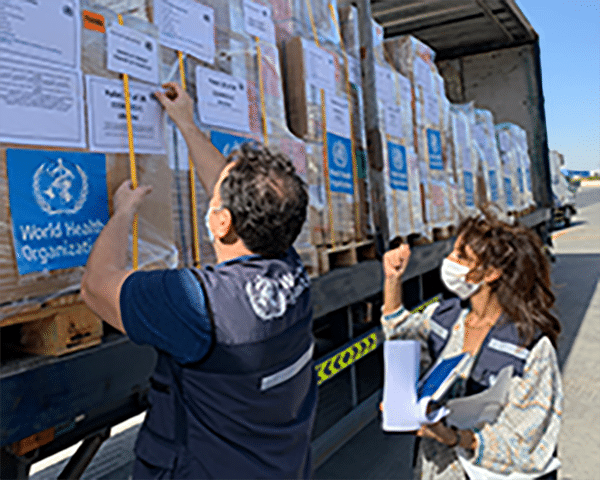
This is not an ordinary cargo, it carries life-saving medical supplies destined for Ukraine.
On Saturday 5 March, just over a week following the escalation of military operations in Ukraine, 3 large lorries carrying 36 tonnes of vital WHO medical supplies crossed the Polish border into Lviv, where they were stored and then distributed to health facilities across Ukraine, including to the capital Kyiv.
The supply chains for medicines, medical supplies and common goods have been severely disrupted in Ukraine, creating urgent need. Many distributors are not operational, and many government and humanitarian stockpiles are inaccessible due to ongoing military operations. Life-saving and essential medicines (such as oxygen and insulin), personal protective equipment, surgical supplies, anaesthetics and safe blood products are reportedly in short supply. WHO has been working with partners to alleviate some of these shortages.
Getting the supplies to Poland
Coordinating the logistics for this shipment and making sure it gets to its destination has been no small feat – taking 5–6 days from dispatch in Dubai to arrival in Lviv.
Robert Blanchard, Team Leader for Emergency Operations explains: “Here at WHO’s global logistics hub, based within Dubai’s International Humanitarian City, medical supplies and equipment are prepositioned, stored, and rapidly dispatched in response to health emergencies all over the world. We are currently working around the clock to send medical supplies to Ukraine. WHO maintains a diverse array of life-saving health commodities, including trauma and emergency surgery supplies that contain items such as essential medicines, sterile surgical instruments, bandages, paracetamol and disinfectants. We also dispatch support equipment such as generators, which are critical for mounting an effective emergency response”.
The supplies arrived in Poland by cargo plane on 3 March, travelling a distance of over 6200 km from the hub in Dubai. The 36 tonnes of medical aid and trauma supplies will meet the urgent needs of 1000 people requiring surgical care and provide medical provisions to help treat 150 000 people.
Making sure the supplies reach those in need
A priority health concern has been the worsening of conflict-related trauma and injuries, which could occur as a result of lack of access to health facilities and life-saving medicines and supplies.
“We have surgical supplies to treat wounds, as well as medicines for all other diseases that do not stop for war. More supplies are expected in the coming days,” commented Flavio Salio, WHO Emergency Medical Teams Network Leader.
Yet, getting these supplies to Ukrainian hospitals remains a problem, as Dr Jarno Habicht, WHO Representative in Ukraine, highlights: “These trauma and medical supplies must reach those who need them the most. For this to happen, we have to ensure safe passage because people’s health needs are increasing every day and every hour”.
Additional shipments planned and on their way
This was the first of multiple shipments planned to support people severely affected by this humanitarian emergency. A second shipment has arrived in Lviv for distribution to other parts of Ukraine, containing cold chain elements, such as fridges, so that vaccines and other medicines can be stored safely. The Dubai-based logistics team is also preparing more health supplies for a third charter flight, which will deliver an additional 40 tonnes of trauma and emergency surgery kits to enable hospitals to continue to treat injured patients and perform operations.
WHO’s continued support to Ukraine and neighbouring countries
WHO has released US$ 5.2 million from its Contingency Fund for Emergencies and will need to raise US$ 45 million for Ukraine and US$ 12.5 million to support neighbouring countries providing refugee care.
Ensuring the health and well-being of all people lies at the core of WHO’s mandate and commitments in all situations. WHO is working closely with its offices in Ukraine and neighbouring countries, through government and other health partners, to rapidly respond to the health emergency triggered by the conflict and to minimize disruptions to the delivery of critical health-care services.