Sunday, September 20, 2026
Home Blog Page 17

The Lakota Way and Eastern Orthodox Christianity (similarities and a few differences in ‘creation spirituality’ and cosmology) [1]

0

By Jamie Moran PRELUDE Wilmer Mesteth, the spiritual leader of the Oglala Lakota [Western Sioux], and I were close friends. We spent hours talking abo…

By Jamie Moran

PRELUDE

Wilmer Mesteth, the spiritual leader of the Oglala Lakota [Western Sioux], and I were close friends. We spent hours talking about the Lakota Way and Christianity. We explored often overlooked similarities. The real split in Christianity is between the Greek East [Orthodoxy] and the Latin-Germanic-English West. Therefore, the real dividing line in Christianity is not Roman Catholic versus Protestant, nor among the myriad groups within Protestantism [Lutheran, Baptist, Pentecostal, Methodist, Fundamentalist-Evangelical etc], nor between Protestantism and Anglicanism [low church versus high church]. An area where all the West and the East differ markedly is cosmology, or ‘creation spirituality.’ In this area, Eastern Orthodoxy and the Lakota Way have parallels. I once said to a Russian bishop, and expected to be rebuked for the remark, that Orthodox Christianity had much Shamanism in its weave. The Orthodox bishop agreed. He said the Shamanic side of Orthodox Christianity was certainly present but few Orthodox noticed it. He reckoned it was a cultural strand older than Homer and may have entered Greece from Thrace to the north-east. He and I reached the conclusion that the Shamanic aspect of Orthodoxy is rooted in ancient Greek Shamanism [predating Plato et al, yet still evident in Plato’s account of the four kinds of ‘divine madness’, and much more evident in the epigrams of Heraclitus]. It is a voice from the past, from the ancestors. The coming of the Messiah does not refute it, rather it is confirmed by adding something new to it.

There is certainly a gap between Lakota Shamanism and Western [Augustinian] Christianity. Not all of Western Christianity is rooted in Augustine of Hippo, and it is changing markedly at the present time. But much of it used to be. This is why Western Christians invading the ‘New’ World regarded Red Indians ‘pagan.’ But “pagan” should be distinguished from “shamanic.” The Indigenous Way of the First Nations is more accurately called Shamanic—especially if the Middle East provides the model of paganism. The Great Mother goddess in incestual congress with her son-lover, for the sake of the fertility of the crops growing in the earth, is nothing like the earlier and primal Shamanism of nomadic hunter-gatherer peoples. The remains of a campfire in a cave have been dated to one million years ago. Aboriginal rock art in Australia dates back to 80,000 years ago. The origin of settled crop growing is debated. Many scholars put it at no earlier than 4000 BC in Mesopotamia. Other scholars put it back earlier, here and there. But give or take 5000 years, settled crop growing is far more recent than nomadic hunting and gathering. It is the settled crop growers who evolved the Great Mother religion in the Near East, and elsewhere. Father Sky is left out. Mother Earth becomes the entire focus. Whether paganism takes an Oedipal turn, or does not, it is the religion of farmers. Shamanism predates the paganism of farmers by millennia. The first peoples — for at least one hundred thousand years and perhaps far longer — were nomadic, not settled, and their Way is rooted in values, activities, energies, symbols, qualities, of what it means to be in constant movement, to own little and not seek to possess the land as ‘private property.’  Their culture has both father and mother, sky and earth, and the many themes of Shamanism [including the primal understanding reached between humans and animals] are not restricted to fertility of nature, but many other spiritual, human, natural, themes, are prominent. Shamanism is complex [and has multiple forms]. Paganism is simple, by contrast. If anyone was ‘pagan’ in the battles for America, it was the invading whites. They espoused Christianity with their words but did not practice it in their actions. This has always been so.

When the Lakota Way is looked at in relation to Eastern Christianity, a contrast remains but the similarities and overlaps crystallize round several themes to do with= Cosmology; the Creator-creation interweaving [panentheism, not pantheism]; the Fall of humanity; the many Jewish meanings of ‘darkness’ [6 in all]; and finally ‘the sacred feminine’= Sophia-Temple-Mary the Mother of God in relation to the Beautiful Wohpe the Star Maiden, the White Buffalo Calf Woman, and the Seven Ceremonies brought by the Calf Woman to the Lakota.   

What differentiates Shamanism as contrasted with Judaism & Christianity is time. Shamanism is focused on the Sacred Beginning. Judaism & Christianity are focused on the Holy End. Paradoxically, the time that differentiates these three traditions also links them in a hidden way. The Mantra of Time=

Shamanism to hold the Sacred Beginning.

Judaism to contest the Existential Middle.

Christianity to win the Eschatological End.

 [1] Four Directions of the Sacred Circle

This is the account I learned on the rez from attending classes at the University in Kyle, and from private conversations with Wilmer Mesteth. Black Elk came was a major influence. This scheme is one among many versions. It is not Red Indian to standardize such things, or to insist on a single fixed dogma for them. Different sub-traditions within the Tradition approach the Sacred Circle differently. It is reminiscent of ‘two rabbis, three opinions.’ Different interpretations respect the ‘mystery’ of sacred and symbolic realities.

In Lakota spirituality, the Sacred Circle [or Medicine Wheel] represents the universe [the whole cosmos, visible and invisible, material and spiritual], and the interconnectedness of all life. It is differentiated into four cardinal points, the Four Directions [or Four Winds who are the sons of the Wind, Tate]. Each direction has a theme, and is guarded by a spirit being, and further symbolized by an animal spirit. The four directions point to the seasons of the year, phases of the day, and stages of human life.  Many other meanings, spiritual, psychological, physical, can be represented by the fourfold circle.

NORTH

Old age

Winter

Night

WEST                                                                              EAST

Adulthood                                                                     Birth-&-Rebirth

Autumn                                                                           Spring

Afternoon-Evening                                                      Dawn

SOUTH

Childhood

Summer

Morning & Mid-Day

 [2] Guardian Spirit Beings

NORTH= Waziya, the White Haired Old Man of the North, also known as the Frost Giant. Waziya is the North Wind, living in a tipi in a remote region of cold, ice and snow. He lives alone. His breath freezes everything. He tests human endurance and presides over the necessary spiritual meaning of life’s losses as we age. To accept losses is a path of wisdom. To resist losses is a path of folly. The winter cold is harsh yet also cleansing. The plant is cut back to reach fuller blossoming. Wazyia guards the entrance to the Star Path where persons go after death. He also plays a role in the very sophisticated Lakota creation story.

EAST= Wanbli, the Eagle. This seems odd, initially, because the East does not seem to have a Spirit Guardian as such, only a spirit animal. However, Wi the Sun, and Anpetu the Day, rule the East gateway directly. Nor is the Eagle just another animal spirit. The Eagle is the chief of the flying, four-legged, crawling, nations. Humans cannot look right into the sun, because of the vast cosmic power it manifests. Thus, the Eagle becomes the messenger of the sun, becoming the visible, approachable mediator of the sun’s immense light. The Eagle flies closest to the Creator.   

SOUTH= Okaga [Itokaga], the South Wind= the warm summer breeze. He is seen as a beautiful young man, compassionate, pleasing, gentle, a master artist and creator. He is the spirit of warmth, physical growth, abundance, in the summer season. Every year Waziya, the bitter old man of the North, tries to kill off Maka, the earth, in an endless winter, but he is opposed by the Guardian Spirit of the South, a loving protector who every summer travels north to melt the snow and push back the Frost Giant of the North, so that the people can live again and thrive. ‘Itokaga’ literally means ‘where the face is made’, suggesting ‘towards the warmth.’ Look towards the warmth. Okaga the South Wind brings rains and warmth that empowers the earth to grow food and celebrate being alive. Thus, he is regarded by the Lakota with reverence as the ultimate spirit of youth and the joy of life. Okaga’s very presence causes joy. He wears garments that signify life, summer, happiness to be alive. He travels with a wooden flute. The music he plays on it is so beautiful that it wakes up the plants, coaxes the flowers to bloom, and moves the birds to sing. He is the music of the rejoicing to come back to life, after a season in death. The Lakota say his person is defined by his generosity toward and love for the earth, Maka. He will not see her despoiled or destroyed. Okaga is the power of the eternal renewal of the earth. Okaga loves and makes beauty. He plays a role in the traditional Lakota girls coming of age ceremony.

WEST= Wakinyan Tanka, the Thunder Being, Wakinyan Oyate, the Thunders. This is the place of the greatest power, says Black Elk. It grants a warrior the power to make live and to destroy. It is also the place of the cup of living waters. It is fire and water, in opposition and in complementarity. Wakinyan Tanka operates through the storm, the zig zag lightning, the shattering thunderclap, high winds and fist sized hail, and flooding rains. After the storm, the earth is refreshed, says Black Elk. The healing rain, mild and delicately tender, comes after the raging storm. The storm has to happen yet it comes and goes, it does not thunder forever. Black Elk says the storm comforts those too beaten down in the world and brings low those riding too high in the world. The Thunder signifies radical changes that befall human life as a fate not chosen, and not escapable by any human manoeuvring. The direction of the West is where all things reach their sunset, the place of endings. The awareness of impending death and the fragility of mortality becomes acute. ‘Nothing lasts forever’.. All things must end. This can hurt the heart desperately. The heart must understand that endings are part of something bigger and more mysterious. The Wakinyans are the patron of warriors. A Cherokee author has said, “a warrior is someone constantly saying goodbye to himself.”

In the beginning of time, the Thunder Being fought an epic battle against Unktehi, an evil serpentine monster lurking in the dark deep of the waters. This giant malevolent being flooded the land to drown animals and humans. The Wakinyans unleashed the lightning and fierce heat. This dried up the floods, burning the monster alive. The jagged formations and peculiar shapes of the Badlands in South Dakota are a reminder of that battle. Wakinyan Tanks is fierce in battle against evil forces. A commentator [who does not want to give his name]=

“The Thunder Beings have been described… as beings without form, with a body which billows and changes form like clouds. They have claws, but no feet; beaks, but no head; wings, but no shoulders; and a voice like thunder, but no throat.

The Wakinyan also live in an anti-clockwise dimension and cannot be understood by ordinary people because they speak backwards. It is said that this is why Heyoka speak and act in an anti-natural manner, as they become relatives of the Wakinyan.

In the Lakota tradition, one of the main purposes of the Wakinyan is to purify the world from all filthy things. They sweep it with wind, wash it with water, or burn it with lightning. They cause all that grows from the ground to flourish …and give nourishment to all things that breath. They enjoy the smell of cedar, and it is said that cedar trees are never struck by lightning. They control water in all it’s forms…”

The Storm in which Yahweh comes to rebuke the high and mighty, bringing them low, and encourage the broken and oppressed, raising them up, is in the same ‘Reversal’ paradox as the Thunder of the West. Yahweh says to humanity, “My Thoughts are not your thoughts, My Ways are not your ways.” What we call worldly wisdom God calls folly, and what we call worldly folly God calls wisdom. The sacred clown, or Heyoka, is a Reversal person. The ultimate Reversal is the Cross of the Messiah Jesus Christ.

In an older tradition, the four guardian spirits are really all sons of Tate, the Wind.

 The north wind Yata, the Cold-Maker, brings the testing challenges and ordeals of life, and the white hairs of old age. The cold of winter brings sleep to the earth, and this sleep frees dreaming. The stories are told on winter nights, deep into the night.

The east wind Wihoha [Yanpa], the Day-Bringer, brings the morning dawn, the sun rising, and the breath of new life. He is the guardian of light, clarity, and the waking world. He works in association with the daytime sun [Aŋpétu Wí] to grant humans wisdom and clear understanding at the start of each new day. Each day we have a new start, a new chance.

The south wind Okaga, the Life-Giver, is the spirit of warmth, growth, and affection. He is locked in a perpetual, seasonal battle against the frost-giant Wazíya. Every spring, Okaġa drives Wazíya back north, bringing the summer heat, green grass, and abundance back to the Great Plains.

The west wind Wiyóhipeyata, the Evening Guardian, rules sunset and the twilight, the ‘in between’ time, the ‘liminal time’ when dark is coming and light going. There is a different spirit being who guards and influences the west, however. The Thunder Being and the Thunders, of the Storm Power. The Storm Power fights evil, and it was the Thunders who defeated a monster dwelling in the Badlands far back in time.

 [3] Spirit Animals of the Four Directions

North= buffalo, Tatanka

East= Eagle, Wanbli

South= Deer, Tahca [Thahca]

West, Bear, Mato

NORTH= Buffalo

The buffalo guards the northern quadrant of the Sacred Circle and gives gifts essential to the survival, morality, and enduring of the people. The yearly migration of the buffalo covered 1000 miles north, and then 1000 miles back south. The buffalo herd does this journey step by step. This teaches humans the patience needed to not fall into ‘prematurity.’ The Lakota are called a ‘buffalo people’, so indebted are they to this animal. Other powers often spoken of as taught by the buffalo should be mentioned.

 [a] Sacrifice and Generosity [Wóčhaŋtognaka]

The buffalo is the ultimate symbol of giving everything for the survival of others. Historically, a buffalo provided the Lakota with food, clothing, shelter, tools, cord. The buffalo teaches humans the gift of true generosity—sharing everything you have so that the community may live.

 [b] Endurance and Fortitude [Wóksape]

While other animals run away from a brutal winter blizzard, the buffalo turns and walks directly into the storm, utilizing its massive shoulders and heavy fur to shield the herd. It brings the gift of mental and spiritual endurance, teaching humans how to face adversity, trauma, and hardship with dignity and courage.

 [c] Gratitude and Respect [Wóohoda]

The buffalo teaches humans to walk upon Mother Earth with respect and gratitude. Because the buffalo gave its life so the Lakota could survive, it reminds the people to never take more than they need, to honour the spirits of what they consume, and to live in accord with nature.

 [d] Sacred Law and Prayer [Wóčhekiya]

It was the White Buffalo Calf Woman who brought the Sacred Pipe [Čhaŋnúŋpa] and the seven sacred ceremonies to the Lakota people. The buffalo brings the gift of sacred law, prayer, and connection to Wakáŋ Táŋka [the Great Mystery].

EAST= Eagle

The eagle’s gifts=

 [a] Highest Vision and Foresight [Wóableza)

Because the eagle flies higher than any other creature, it possesses the gift of vision. It teaches humans to look beyond their immediate, everyday struggles and see the “big picture.” The eagle brings the gift of foresight, helping people understand how their current choices will affect the next seven generations.

 [b] Direct Connection to the Creator

The eagle flies so high into the heavens that it touches the realm of the Great Mystery. It brings the gift of divine communication, acting as the primary carrier of human prayers up to the Creator. Its feathers are considered the most sacred of all objects, functioning as physical conduits for spiritual energy and blessings.

 [c] Truth and Honesty [Wówičakȟe]

The eagle lives in the intense, pure light of the East, where the morning sun rises. It brings the gift of unyielding truth and integrity. It teaches humans to walk with honour, to speak honestly, and to live transparently without deceit or hidden motives. A ‘bad heart’ [with bad motives and bad intentions] always hides in darkness. The light of the east penetrates this darkness and unveils what it hides.

 [d] Courage and Self-Belief [Wówaditaka]

Facing the rising sun each morning, the eagle embodies the courage to start anew and conquer fear. It brings the gift of a strong, noble spirit, helping humans rise above pettiness, jealousy, and doubt, to achieve their spiritual potential.

SOUTH= Deer

The deer guards and brings gifts to the southern quadrant of the Sacred Circle. Deer is feminine gentleness and care that disarms hate and fear. The deer is also youth, in its innocence and vulnerability.

 [a] Gentleness and Compassion [Wačháŋtognaka]

The deer teaches that true strength does not require force, aggression, or violence. Its gentle nature is viewed as a powerful spiritual medicine that can calm anger, heal emotional wounds, and defuse conflict within a community.

 [b] Acute Awareness and Intuition

Because deer are highly alert in and sensitive to their environment, they represent the gift of sharp intuition and spiritual awareness. This is sometimes called ‘watchfulness’ [it can relate to mindfulness, which is why deer relate to Buddhist enlightenment]. Deer teach humans to listen closely to their surroundings, trust their instincts, and remain alert to unseen dangers or negative energies. This allows for swiftness in reacting to threat.

 [c] Grace and Unconditional Love

The deer embodies the grace of the youth stage of life. It brings the gift of unconditional love, reminding people to treat themselves and others with kindness, patience, and soft-heartedness rather than harsh judgment.

 [d] Fertility and the Renewal of Life

Connected to Okaga — the South Wind of warmth and summer — the deer is the gift of growth, abundance, and fertility. It represents the flourishing of new generations and the continuous blossoming of life on Mother Earth.

WEST= Bear

The bear is a paradox on many levels. In war, bear rushes straight in. The Berserker Viking warriors were bear men. Yet the bear showed to humanity all the healing herbs and medicines growing wildly, and thus the bear is closely related to the ‘medicine person’, the shaman, the healer. The Mother bear is unusual in having her babies in a cave in winter. This is a defiance of death= an assertion of life against death.

 [a] Introspection and Inner Wisdom [Wóableza]

The bear teaches the gift of looking inward. Because the bear hibernates in a cave all winter, the Lakota view this as retreating from the noise of the world to look into one’s own soul. It brings the wisdom that comes from quiet reflection and self-knowledge. This is, in more Jewish terms, ‘pondering in the heart.’

 [b] Physical and Spiritual Healing [Pežúta]

The bear is considered the main medicine animal. Because bears dig for roots, herbs, and medicines in the earth, they hold the secrets of natural healing. The bear gives medicine men and healers the spiritual power to cure illnesses and mend wounds.

 [c] Fierce Strength and Protection [Wóitkoze]

While the Deer of the South brings gentleness, the Bear of the West brings raw, physical power and the courage to defend the tribe. The bear fights by ‘going straight in.’ The bear teaches how to stand strong against adversity and protect the vulnerable, especially children and the home.

 [d] Transformation and Rebirth

Emerging from its dark cave every spring, the bear represents the gift of rebirth. It teaches humans how to endure dark, difficult periods of life [the ‘winters’ of existence] and emerge stronger, wiser, and renewed.

There are many different ways to understand ‘walking’ the sacred circle.

A straight-forward way of interpreting the Sacred Circle is to see its four cardinal directions as the four stages of life, childhood and youth, adulthood, old age, and the final liberation of death into life with Wakan Tanka. In this way, the circle is completed.

SOUTH= CHILDHOOD & YOUTH

The morning of life.

Innocence, play, openness.

Empathy toward peers.

A soft hearted, relational foundation crucial before facing the storms and responsibilities of adult life.

WEST= ADULTHOOD & MIDDLE AGE

The mid-day to the afternoon, into the evening of life.

Experience, responsibility, carrying the weight.

Introspection, inner strength through facing flaws and accepting one’s power and its limit, healing from life’s wounds.

Bear the unbearable, in keeping true to one’s road. “Passion is the adult we do not become.”

Stamina to survive, and help others survive, the harsh times.

NORTH= OLD AGE & ELDER

The endurance, and wisdom, of the elder.

Elder guides the younger.

A shield to protect the integrity, culture, spirit, of the community. Keeper of practices, sacred laws, stories, ways, that give the life to the culture, and in the absence of which it dies. Conserving what is good, letting die what is worn out and defunct.

Grandmothers & Grandmothers held in high respect and great affection.

The child and the aged elder are heads and tails of one coin. Both are the most revered in the community.

How we age is key. A person who has not walked the good red road south to north may be elderly, but that does not mean they are an elder. They have not spent their many years living in such a way as to ‘make sacred’ and attain ‘spiritual understanding.’ This makes death much harder. Death can be a welcome transition to the next step.

EAST= THE END OF LIFE & SPIRITUAL TRANSITION

At the very culmination of life, the person reaches the East. As this time approaches, the person detaches from earthly matters, especially those that are petty, and sees life more and more in a spiritual way. The person is ready to soar away, in their dying.

The East is the place where light rises.  While the West guards through fearsome power [Thunder] and the North tests through harsh conditions [Wazíya], the East guards through peace, clarity, and unclouded vision. Thus, its spirits — the misty Yáŋpa and the soaring Waŋblí — function as one. The warm South is the place where the soul exits this life, to go on the Spirit Path, or Ghost Road.

THE CENTRE [Čhaŋgléška]

All directions and inhabitants of the Sacred Circle converge in the Centre.

Wakan Tanka, the Great Mystery, dwells in the Centre, according to Black Elk.

The powers and gifts of a given direction can be sought in a particular time and place, a situation where help is needed.

A given direction can be the patron for a certain walk of life, as the West is for warriors.

When the blue of sky and the green of earth are added to the four, the sacred number 6 emerges. Adding the centre gives the sacred number 7.  Judaism has much to say about ‘4’ and ‘6’ and ‘7.’ The 7 is very important. Both the Lakota and Eastern Orthodox traditions have 7 sacred ceremonies, 7 sacraments. Numbers and the roots of words carry meanings in Judaism. Quality is woven in with Quantity.   

THE CROSSING OF ROADS, VERTICAL & HORIZONTAL

Black Elk speaks of the crossing of the two roads, the good red road running south to north, and the bad black road running west to east.

“The good red road of making sacred and spiritual understanding is crossed by the bad black road of worldly difficulties and war. It is the Great Mystery who has made the two roads cross, and the place where they cross is holy.” There is no unimpeded vertical ascent, from earth straight to heaven. The spiritual road has to accept being crossed by the road of the fallen world. The Crossing of these two roads is paradoxical. The vertical road is wounded by the horizontal reality, yet this is also the way in which the horizontal road is wounded by the vertical road. The two converse roads are brought together, in a dramatic intersection, in the centre of all that is. The greater is brought down low to the lesser, so that the lesser can be raised up to the greater. This is the holiness of the Cross of the Messiah, Jesus Christ. The willingness of the spiritual to suffer the worldly is a stumbling block to moralistic Jews, and folly to metaphysical Greeks.

COMMENT 1

1,The Western ‘mind’ regards nature and the cosmos as made up of, and functioning according to, matter and mechanism. Life is confined to a few organisms on earth, and sentience to even fewer creatures. Westerners, including Christians, misunderstood the Indigenous Vision. For Western Christians, God is a Superior Being, in a world of beings. For Judaism and Eastern Christian, a more apophatic approach is taken. God is not a being like all the others, only more so. This is a Super Mind, a sort of Big Ego in the Sky overlooking, controlling, rewarding and punishing the other, lesser egos. God, as the Biggest Ego, is singular in the way the ego is, a distinct, isolate, being who commands all the other distinct, isolate beings. ‘The angry old man in the sky’ is a wrathful version of this biggest and most formidable ego. The top ‘I am.’ The error of this is basic. God is not the biggest ego in a universe of smaller egos. God is not the ‘I am’ cut off from any ‘Thou’, the ego that says “I am Me, not You.”  The personalness of God is nothing to do with the human ego. Nor is the human personhood [the ‘hypostasis’] anything to do with the human ego, or any kind of egoic existence. God is three persons sharing one nature. The ‘being’ of God is relational, it is the being of Love. The being of Love is communion.  

Even before God reveals the being of Love to humanity, God is first encountered in the awe that recognizes God cannot be comprehended by the human mind, in any of its forms, nous, reason, intellect. God cannot be fitted into created categories of any kind. God transcends being and non-being. Maimonides says God is “incommensurate” when God first finds humanity. We are awe-struck. “Nothing compares to you” can only be sung to God. We must initially approach God through the Way of Apophaticism, the Negative Way. We cannot ascribe anything from our own nature, or the natural world, to God. God exceeds it all.  We can only approach God through the darkness of the clouds of ‘unknowing.’ This is mystical, not visionary. All eyes are shut.

It does not end there. The awe that allows us to respect and feel gratitude toward the Mystery of God becomes the ‘sacred ground’ [the first sacred space= first temple= first church] where God approaches us to reveal more. We cannot know the Essence of God — anything of God qua God is beyond our comprehension — yet God comes down and God reaches out to us. As the sun has many rays, God’s Unitary Essence has Many Energies coming to meet us. These Energies are termed by Jews ‘the names’ of God, and by other traditions as the ‘Qualities, Powers, Gifts’ of God. They communicate God’s Mystery to us and make it possible for us to commune with those Energies. All created matter, space, and time, is capable of receiving the Divine Energies and mediating them, in more tangible and visible forms, to humanity. We partake of the Energies of the Uncreated in the localized Forms & Dynamisms of the Created. God creates the creation so that it is permeable by God, and God can relate to humans through its created structures and created forces. This allows for the Cataphatic approach, the Positive Way, where God takes on created forms that are symbolic with which create a relationship, a dialogue, between the divine and the human. This is an ontology of connection, and communication, and this exchange is personal. It is always the I—Thou meeting of Love, never the clashing of egos, nor just the melting into God, like a drop in the ocean, which is impersonal. When a Lakota person on the Vision Quest receives a vision through an animal, the Great Mystery beyond all affirmation and all negation,  affirms a particular I—Thou relationship with that person, in sending the messenger who reveals a life path for that person, and no other persons. The tendency of all Red Indians to ascribe personal status to animals and other creations of God is a recognition of the way God indwells the universe and makes it into a single organism, living by connection and communication, a personal communion of Love.

God gives the First Nations a wisdom to live by, and care for, the Sacred Beginning.

Hence, the term Wakan Tanka has a double meaning which does not contradict but compliments.

Wakan Tanka has many translations into English. Great Spirit, Great Sacred, Great Holy, Great Mysterious. Tanka is great, and Wakan means what is ‘other’ to anything routine, every day, ordinary, usual, in the normal run of things. It speaks of encounters with the unusual and not in the run of things, the unpatterned and un-patternable, tending toward the incommensurate. My preference is ‘Great Mystery.’ Between the Shamanic Great Mystery and the Jewish God with a partially revealed name — YHWY – that no one knows how to pronounce [“Jehovah” is clearly wrong] and that cannot be spoken or written down [the Hasidic Jews will only write G-d] there is a strong apophatic affinity. If the Great Mystery has revealed nothing about itself to the First Peoples, it has done that so that the focus remains more on the Sacred Beginning of the Creation. It is thus enough to call God ‘the Creator.’ The task that God wants Indigenous Persons to do would only be confused if extra revelations concerning the Mysteriousness of the Ultimate Mystery were added. We are all, in different religious and following different spiritual roads, on a strictly need to know basis with God. We are empowered and gifted what we need for walking that particular road. It is the awe, respect, affection, in which Red Indian peoples relate to the Great Mystery that shows the Great Mystery is the same apophatic reality which the Jews encounter in first becoming aware of the divine. The Lakota and other Plains Tribes call the Great Mystery by the very affectionate and humanly personal name ‘Tunkasila’ – Tȟuŋkášila — which translates to “Grandfather.”

Grandfather, Great Mystery,
all over the world the faces of living ones are alike.

With tenderness they have come up out of the ground.
Look upon your children that they may
face the winds and walk the good road to the
Day of Quiet.

Grandfather Great Spirit,
fill us with the Light.

Give us the strength to understand,
and the eyes to see.

Teach us to walk the soft earth as relatives to all that live.

This prayer is addressed to some’one’, not to some’thing.’ This prayer is inter-personally I—Thou, it is not addressed to some metaphysical abstraction far removed from all that is human. It is not addressed to a maternal womb with the yearning to return to and dissolve in the waters that held the foetus. The womb is a tomb if you stay too long. This is not a prayer of any kind of maternal paganism. Nor is it a prayer of any kind of patriarchal religion. It is precisely the patriarchal religions of Western Christianity [Catholic, Protestant, Episcopalian] who misunderstood Red Indians, and thought them ‘animists’, worshipping the powers and processes of nature ‘rather than’ and ‘instead of’ acknowledging the real God. But the mistake about the Great Mystery who is God is from the Western Christians, and any other path in Judaism, Islam, or any other religion, that is patriarchal. Shamanism worships the same God of radical and ultimate mystery – holiness means ‘otherness’, not wholeness – as do the Jews, and as do the Eastern Orthodox Christians. In the depths of soul and heart, all humans recognize God.

To call the Creator of all worlds Grandfather is to establish a family resemblance between God and humanity ‘made in the image’ of and called to ‘grow to the likeness’ to God. This prayer addresses the Creator as a personhood, singular not multiple, a revered and respected family relation. If God were not personalist in some mystical sense far removed from the fallen ego, there would be no point in praying to him. The prayer asks for help, for mercy, for tenderness, for patience, and for gentleness. Such a helping God is without any doubt relating to humanity in Martin Buber’s I—Thou, not his I—It. There is profound respect but not the fear of punishment, rejection, condemnation, so prevalent in patriarchal distortions of God’s Mystery. What Hebrew calls ‘fear of God’ is better translated as a state of being awe-struck, leading to the thanksgiving of worship. There is in the Lakota prayer not only awe and respect but also trust in God’s love for those asking for help.

All created creatures and things on earth and in the heavens are humanity’s relatives. But better than blood relatives is the phrase spoken at the end of prayers. “All my Relations.” We are related to all that live in relationships of connection and communication, relationships of communion between personal centres, because these relations are all created by Love.

A prayer of ‘a contrite and broken heart’ also exists in the Lakota Way as well as the Jewish Bible.

Truth is coming

It will hurt me.

I rejoice

You can heal me.

The Great Mystery is declared in prayer and ceremonies, more apophatically than cataphatically. More in the awe demonstrated by Silence than in the sound of words, more in the respect manifest in Stillness than in the busy rushing hither and yon. The Red Indians, and First Nations peoples, ‘stand before’ the same Great Mystery of God as do the Jews and the Christians who build on the Jews in their embracing of the Messiah. Awe and respect, yet trust and affection, are mixed in this way of Standing Before the Mystery. You remain yourself, you do not melt. Not matriarchy. You retain your dignity, you do not kow tow. Not patriarchy. You bow head and heart to the Mystery so beyond you, yet you take it on trust that this Mystery created you and loves you, not wanting to see you suffer, but wanting to see you happy. Martin Buber likens this standing before God [literally on your feet, not sitting or laying prone] to walking a narrow ridge with chasms on either side. The Eastern Christian Tradition calls this standing before God ‘Ortho-Doxia.’ Right praise, right worship, right understanding leading to true wisdom. It is Formal and Informal at once. It is not casual— taking the Mystery of God for granted or presuming on it. Nor is it fearful of a remote, austere, unapproachable, Majesty or Lordship. This ‘stand’ respects the Otherness yet leans on ‘for very life’ the friendliness, accessibility, love, of that Mystery. The Mystery and the human share a home= they are linked in an extended cosmic family of relations. This is why the first duty of any Shamanic person is to learn to become a good relative, a good relation, a good kin [Wochangi]. It starts with other persons but extends to all creatures and all things.  The web of creation is an interlocked kinship system. The Mystery is not alien to the human, and to all the creatures and things created by it. The Mystery has ties of kinship, of personal I-Thou dialogue and love with the human. Revelations later in time to the Jews and to the Christians rest on this primal revelation to the primal peoples. The focus in Judaism shifts to time and the fallen world, in ‘tikkun olam’ [repair of the world, repair of time]. This is carried to its climax in the Messiah Jesus Christ. But if we look at in terms of time, then there are three steps – Shamanism, Judaism, Christianity – all of which come from the same God, but each of which is given a different, utterly necessary and crucial, task by that ‘one’ God.

The complex Lakota creation story is where the ‘Western’ and ‘patriarchal’ accusation of polytheism and animism gets going. There are four main spirit beings, four companions of the primary four, and then two additional waves of four spirit beings, to make up all the 16 actors in creating the world humans dwell in. Some commentators call these spirit beings ‘deities.’ A group of gods and goddesses, not a singular ‘God.’ Thus, Wakan Tanka means the totality of the spiritual actors involved in creating. This interpretation simply does not float. Wilmer Mesteth and I discussed it at length and we both rejected it. While some forms of Shamanism really do have gods and goddesses, as is the case of the Greeks or Hindus, most have Spirit and spirits, not gods and goddesses. [The roots of divinity [theos] and spirit [pneuma] are different in Greek.] But might the 16 spirit beings then be spirits, or angels as known in the West? The spirits can ride the wave of the divine powers, so to speak, but spirits as themselves created by the Creator cannot have made the creation by their own efforts. That they help out, augmenting divine activities, is certain. But the 16 spirit beings could not, as only spirits or angels, create the creation. Wakan Tanka does not refer to a collective of ‘spirits’ as if they were God. The spirits, or angels, are creatures– like us, the animals and plants, and all things.  

The opposition between Mono-theism and Poly-theism is academic in the worst sense. Gerald One Feather told me that this logical distinction of Western metaphysics and theology between one static superior being versus a plethora of many deities racing around is false. God is unity in diversity. The 16 actors in the Lakota creation story must be seen through unity in diversity, such that unity implies diversity and vice versa. Gerald One Feather put his point thus= “We walk in One Spirit, but we walk with many spirits.” The One and the Many are complimentary aspects of the same ultimate reality of God. The 16 spirit beings are not “16 deities competing with the one supreme God.”

Black Elk explained to non-Lakota using the analogy of the human body. Just as our hands, feet, heart, eyes, are distinct parts of one person, so the 16 spirit beings can be regarded as the ‘operational powers’ of the Creator God.

The Essence of God is One, but the Energies of God are Many. The 16 benign spirit beings can, in the primal wave of creation, be understood as diverse Divine Energies radiating down, and radiating out, from God, and going to work in the creation. These Divine Energies do not work alone, discretely. They bring spirits of various kinds with them, and these are assigned multiple, different tasks. The Jewish Bible tells us that spirits ‘ride’ the divine energies of God, to get specific jobs done. Psalm 104, 4= “He makes His angels spirits, His ministers a flame of fire.” The elements of nature are not mechanistic= they are shepherded by spiritual intelligences executing the divine will.

But the co-operation goes much farther than that. God creates the immaterial and invisible forms and energies of creatures as capable of co-operating with God, a vessel and a vehicle of Divine Energy. This vessel [soul] and vehicle [heart] is the inner essence of the material and visible forms and energies in their outer crystallization. Thus, the work of creation is shared among the creatures. They too are a wave in the creation work.

The Lakota creation story tells us creation is in four waves. The waves are hierarchal, those coming first are closest to God, or rooted in God, whilst later waves involve spirit beings and spiritual powers. A synergy between spiritual forces and all created happens through the response and initiative of created forces. Everyone has a contribution to the creation! It is the ‘work of many hands.’ The work of creation continues down time. It is a once and for ever event, beginning from nothing prior to it, yet it is an ongoing process as well. This is especially true of water, the mutable element of creation, whose final state is not yet decided.

Thus the 16 spirit beings are symbolic of the Great Mystery’s ‘creative action’ in the cosmos, on earth, in nature, and going into the human world of history. The four waves are four stages of creation, four descents and four outreaches in creating. The creation will forever be imbued, permeated, not so much by some passive presence of God, but by the active presence of God at work in the creation [‘behind the scenes’]. We cannot speak of just God, and the creation, in an Eternal Duality. That is Western. We must realize there is a new ‘third reality’, of God working in the creation, working with the creation, working for the creation. As Abraham Heschel puts it, less ‘God is in history’, and more ‘history is in God.’ “He’s got the whole world in his hands.” The Lakota creation story is telling us that creation is not a dualistic event, but operates through a third thing, a space of relationship, a bridge, actively binding together uncreated and created. Such co-operation has four main actors, four subsidiary companion actors, and two further waves of actors. The ‘third way’ is operating with, as in the interlocking swirls of energy depicted by the Celts in their sacred art.  

The 16 spirit beings of the Lakota creation story are to be understood, then, in a ‘third way’ interpretation. Together, they constitute the totality of the Great Mystery’s action in the cosmos, the totality of the Great Mystery’s work in creating the creation. They are symbols of active process, doings, not personifications of static ‘things’= static beings. This is not transcendence versus immanence. It is transcendence coming down and going out in immanence. This is not pantheism. It is pan-entheism, as scholars nuance it.

2, The First Wave of the Chief Four

The primal goodness= wakan waste

Rock= Inyan

Earth= Maka

Skan= Sky, Motion

Wi= Sun.

Inyan opens a wound in his impregnable nature, and blood spills out. From this blood, everything is created. This is the Hidden Father.

Maka is the earth as receptive to the action of heaven that makes creating possible. This is Sophia.

Skan is the Holy Spirit, he moves all that moves, and his is the vault of sky protecting life on earth.

Wi is the Logos, the Son of the Father yet known in tradition as the ‘Sun’ of Righteousness, and the Eros that fructifies all of the earth, making it bear fruit and blossom.

Creation involves a sacrifice by God. He gives his divine blood to create the earth and everything that exists.  

Maka the Earth is called Grandmother because she nourishes and sustains all life.

The Sky is the Holy Spirit who gives the breath of life to humanity, and all living [as in Genesis]. Skan — Holy Spirit – is the ultimate dynamic and forcefulness of Divine Energy, moving all energies of the creation. Skan is also concerned with justice, just as the Holy Spirit ‘moves’ the heart to seek truth in all action.

 Wi the Sun is the ruler of all the spirits involved with the creation, and he gives light, warmth, and personal power. The Sun – Logos – protects courage in the heart [Daemonic] and constancy of soul [eros]. The Incarnate Logos, the Messiah, is the Sun of Righteousness, and the king of all Messianic Age. His title is, Pantocrator, Master of the Universe.

The Creator looks at the creation when it is brought from nothing, and in the Greek of the Septuagint, he sees the creation is ‘good’, and that also means ‘beautiful.’ The Four Agents of the First Wave of creation are the ‘sacred goodness’ of creation.

3, The Second Wave of the Companions to the Chief Four

Partnerships are needed= the kin, the helpers, of the primary four.  

Hanwi= Moon, companion to the Sun

Tate= Wind, companion to the Sky

Wakinyan Tanka= Thunder, companion to the Rock

Whope= White Buffalo Calf Woman, the Star Maiden, companion to Earth

Hanwi the Moon is helper to the Sun. She rules over the night, the cycles of time [time as circular], tides of the ocean, and governs feminine energy and the supernatural gifts and qualities unique to woman. She is a manifestation of Sophia.

Tate the Wind is helper of Skan the Sky, controlling the seasons, and commanding the paths of ‘walking in a sacred manner.’ Wind is also the Holy Spirit, ‘blowing where it wills’, answerable to no man. The roads of religion, when they are walked not just talked about, are ‘spiritual’ in their movements, steps, leaps. The Holy Spirit is the motor of spiritual journeying and spiritual battle.  Tate is the caretaker at the entrance to the Spirit World.

Wakinyan Tanka the Thunder Being [the Thunders] is the helper of Inyan the Rock. He is the lord of the storms and cleanser of the world from evil. He is the Anger for Truth that God wields to protect the world from take-over by evil forces. The Wrath of God is protective, and directed at the evil spirits, not humanity. ‘After the storm, the healing rains.’ In the Jewish Bible, God acts in the same way= compassion comes after anger, and anger lasts only for a short time. Only God’s love lasts forever.

Whope the Star Maiden embodied in the White Buffalo Calf Woman. She is the spirit of peace, harmony, beauty. [Whope is called ‘the Beautiful One.’] She is a manifestation of Sophia, as the chief mediator in the creation. The White Buffalo Calf Woman brought the sacred pipe to the people and also gave them the seven sacred ceremonies. This is Sophia building her House, the House of Wisdom. The sacred space and sacred rituals are a ‘place’ where Gold is present, and active, in a fuller way. It is the Temple in formation. Sophia’s House is the companion to Maka because it reveals the ultimate goodness and beauty of the Earth. Mother earth and mother church are sisters. Feminine Mysteries cannot be understood by reductive concepts. We should not poke and pry into them, from a motive of idle curiosity, or fear and mistrust, or arrogant conceit.

4, The Third Wave of Creation= Spirits of the Creation

These spirits provide the created, and earthly, counterparts to the supernatural beings and their supernatural powers in the first and second waves of creation.

Tatanka= Buffalo spirit

Mato= Bear spirit

Wani= the Four Winds & Four Directions of the Sacred Circle

Yumni= Whirlwind

The Buffalo is the provider, the Give Away that undergirds human life as its sacrificial rationale. The buffalo hunted by the Red Indians on the plains gave food, clothing, and robust health. They teach that generosity is the foundation of a good life. The buffalo signifies the spiritual alliance between humans and animals [the job of Shamanism at the very beginning was to establish this understanding between human and animal, and keep it in the sacred law].

The Bear is the healer, protecting sacred medicines growing in the earth, and the cave that invites looking within and coming to a mature wisdom about the ups and downs of human existence. The bear is also the fighter who goes straight at the adversary, and thus a patron of warriors and the courage to not hold back, prevaricate, but charge right in. Not a fool, but a bear, rushes in where angels fear to tread. The bear is a protective mother, as well as a protective fighter, having her young in the dead of winter, and protecting them thereafter from all manner of threats, including irascible male bears.

The Four Winds, sons of Tate, are controllers of climate, messengers of the holy, and guardians of the four cardinal points of the Sacred Circle.

The Whirlwind is ‘the little wind’, a spirit of love, play, sport, and a restorative medicine to feminine energy to bring it into balance.

A possible misunderstanding of ‘Divine Energies’ is to think of them on the model of physical energy widely [but not necessarily accurately] conceived in the modern era. Some commentators claim that energy is impersonal, but can be differently characterised by, for instance, war. The energy extends through time and space with this quality. Then humans personify that energy as a ‘war god.’ There is no ‘god’ at the origin of the energy, it is claimed. The energy, in its impersonality, precedes the god, and the god emerges from that energy. In this way, these commentators think they have dispelled the Single God of Judaism. Their tone is often smug. But this line of thinking is wrong, in many respects.

Humans, and other creatures, are not just puppets pulled on the string of impersonal energies filling time and space for no reason. Judaism does not believe in the Angry Old Man in the Sky, a Satanically twisted and distorted image of the Fatherhood of God. The Lakota do not pray to an impersonal energy that they personify as a grandfather. They pray, in reverence and affection, to the Great Mystery who is, out of love, the Grandfather of all humanity. The ‘energy-before-the-god’ interpretation is loveless, as well as impersonal.

Divine Energy has a personal, inter-relational, loving, source, and as it manifests different qualities and different powers in its energetic movement, so these qualities and powers are inherently imbued and shaped by the personalism of God the Creator. The energies with their distinctive natures and forces are neither loveless nor impersonal. They relate and ‘speak’ to us, dialogically. They are actually forms of friendship, alliance, allegiance, kinship.

It is fair to say that in the Far Orient the energy coming down and flowing out, filling all things, is focused on more in its qualities and powers – Chi – than in its personal, loving, source. But it is understood the energies flowing through nature that can empower and heal, inspire and facilitate, human life are ‘meant’ in their ‘benign affect.’ They are gifts, given by some’one’ to some’one.’ Gifts are given as love between persons. All such ‘help’ ultimately comes from heaven in relation to the earth. Everything functions within that sacred parentage of heavenly and earthly. In the Chinese ‘Book of Changes’, the I Ching, heaven is the Creative and earth is the Receptive. This is fatherhood of spirit and motherhood of earth joined in a relationship that is set up by personal love and serves personal love. It is all a family, a network of kinship. All family members live in one House of ‘many mansions.’ God and Sophia create a pairing, a bonding, a love relationship, as the foundation and origin of the entire creative process, as it cascades down like a waterfall, coming down on the four ledges that hold and release the flow.

Wakan Tanks is the Mysterious, non-conceivable, non-imaginable, non-sensory, reality of the origin, the Creator. But Wakan Tanka then becomes God working in the creation, and employing spirits, spiritual powers, qualities, natures, to help further the creation. The creation is originated by the One God, yet the creating is carried through by an entire family, such that everything contributes to the final result, everything has a certain freedom and love, a nascent personhood, and so everything has a stake in creation. God is at work in all things, and communicates through all things, yet all things retain a core and a distinct essence of their own which will never be erased or dissolved. God is not a cosmic soup into which creation melts, nor is God a remote and magisterial Biggest Ego in the Sky, dictating to all the smaller egos on earth. God does not want puppets whose strings he pulls. This is why a state of spirit possession, such as trance, cannot be permanent. It is helpful in enacting a spiritual calling. It is not a model of future bliss.

5, The Fourth Wave of Creation= Multiple ‘Souls’ in Humanity & Nature

These constitute the human soul and its immediate spiritual connections. These connections function as spiritual ‘essences’ and ‘core’ spiritual powers that indwell human beings and all of creation, acting as a direct channel to the divine.

Nagi the ‘Ghost’= the soul’s essential self which survives physical death to go on the Star Path [the Milky Way].

Niya the ‘Breath of Life’= the soul’s vital Life Force, the breath sent by Skan that animates the body with soul, keeping it alive. ‘Ni’ means ‘to live.’ Woniya means Breath of Life. In death, the Niya departs the person and returns to the ancestors.  

Sichúŋ= the spirit animal helper, often encountered on a vision quest, who shields the heart from spiritual evil, and makes it possible for the person to find their heart’s mission in this world. An innate guardian power, destined to give the heart the inspiration and strength needed to answer its calling from God. A personal calling needs a personal helping potency. The sichun is the ‘ton’, the person’s spiritual power or supernatural efficacy.  This is what drives and lifts the heart to its deeds of heroic passion. The ton, or spiritual power, of a sacred being is given to a person along with a spirit name. By giving the seeker a name, the spirit in the vision has ‘officially’ extended a portion of their ton, their particular spirit power, to the person. The name acts as a permanent tether. When the person invokes the name or carries a physical symbol of the spirit [a bear claw, a hawk feather] in a medicine bag, that sicun is activated. The particular attributes of, for instance, bear or hawk envelops the person. If a wolf, then qualities are energized such as loyalty to the community, protecting the roads of people, far ranging stamina in the hunt.

Nagila the ‘Little Ghost’= the little soul in all humans, all creatures, all things, indwelt by the divine. In some commentaries the Little Ghost is regarded a cosmic thread connecting every thread of creation. Thus, the bird, the tree, the stream, each in their own manner, are all sustained by divine presence. A localized presence of the Great Mystery is woven into the very fabric of matter. This raises the question whether the Nagila might also be considered an aspect of providence. All things work together for good, in the love of God.

Every soul has a self, the seat of consciousness, and the golden bridge uniting ‘sea and land’, unconscious and conscious. In more Western, and modern, psychological terms, the Nagi is the soul in its aspect of unique ‘personality’, the specific ‘character’,  the particular inwardness of the soul in a person= their feelings, desires, sensations, rational assessment, imagining, intuitive sensing. The inner soul in its individuality shapes the person’s perspective and demeanour in life. This soul is called the ‘appetitive’ faculty in Eastern Orthodox monasticism because its basic drive is its yearning for Eros.  

In Genesis, the breath of life is breathed directly into the soul of humans by the Holy Spirit [Skan the Sky & Motion]. All living receives a breath of the Holy Spirit, but in a way different to humans. The human soul is given a different consciousness, self-conscious and unself-conscious. The human soul is tasked with a care for the creation in its Wholeness that is like that of God’s concern and love.  In China, Chi, or India, Prana, or in the South Pacific, Mana.  

The sicun is the ‘story’ of the heart in its service to God in this life. This story has specific meanings and purpose, and the spiritual power to enact it in the ‘real world.’ Crazy Horse ‘dreamed of the Thunders’ when confirmed as a warrior. He saw a vision of a horse dancing in a spiritual way not like the way horses move in the physical world. This was his war horse. The vision meant he and his horse would be able to move in a ‘crazy’ manner such that none of his enemies would ever be able to hit him. This proved true. Crazy Horse was never hit by the arrows of the Crow Tribe or the bullets of the American Army. In a scuffle occasioned by a bogus arrest warrant, he was stabbed by an Agency policeman, a fellow Oglala Lakota.

All things, even what the West calls ‘inanimate matter’, is ensouled in some manner. Some mysterious presence of the divine resides in everything, to guarantee its unity with God. It is because of the Nagila that the Lakota can end prayers with, “we are all related” [Mitakuye Oyasin]. All created ‘shares’ the divine in its own nature. What all created have in common is the mystery of divinity. Gazing into everything, we encounter a latent mysteriousness. All created are beautiful and good, coming from God’s hands, yet all created is also strange and mysterious. Its own nature is ‘user friendly’ to the divine.  

 (to be continued)
Source link

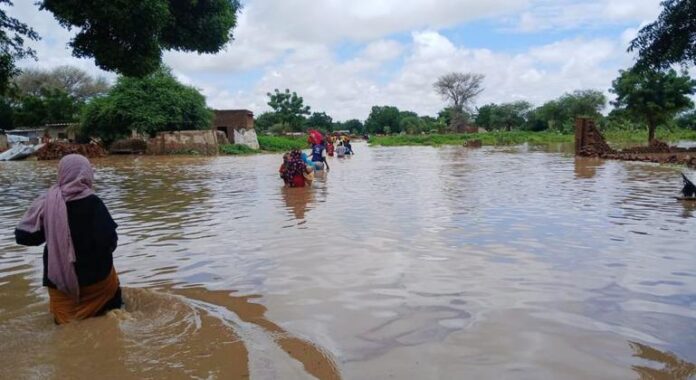
Sudan war: 200,000 newly displaced as fighting and floods intensify

0
Sudan war: 200,000 newly displaced as fighting and floods intensify

In an alert, the agency also warned that relief access has been disrupted further by ongoing delays in global supply chains, particularly through the Red Sea and Strait of Hormuz, adding pressure to an already fragile response.

Across Sudan today, a total of 8.6 million people have fled the war since it began in April 2023. Significant numbers continue to shelter in neighbouring countries, too, as fighting remains active in many areas of the country between the Sudanese Armed Forces and rebel Rapid Support Forces and their allies. 

Meanwhile, repeated attacks on vital infrastructure have stretched families to their limits, IOM Director General Amy Pope stressed. 

The warning signs are impossible to ignore. Across Sudan, families are fleeing violence, losing access to water, electricity, and healthcare, and now facing the added burden of destructive floods,” she said. “Without urgent action to protect civilians and restore essential services, the suffering will deepen.”

Here’s the IOM update in brief:

In North Kordofan state in south-central Sudan, heavy fighting and drone strikes on El Obeid city’s main electrical transformer have triggered prolonged power outages, disrupting water pumping, health facilities and telecommunications. 

Elsewhere in the state, displacement has surged by 25 per cent in Sheikan locality in the past eight months, with more than 200,000 people newly displaced across the wider Kordofan region since late 2025. 

In Blue Nile, clashes in and near Geissan displaced 7,800 people, with some crossing into Ethiopia. Meanwhile, in West Darfur nearly 18,000 people were displaced in the first half of August. 

Heavy rainfall in North Darfur destroyed or damaged nearly 1,350 shelters in Tawila’s sprawling camps last week, displacing more than 1,000 families. Additional flooding in the towns of Kabkabiya and Shangil Tobaya – also in North Darfur – forced dozens of families into temporary shelters.

In the last 72 hours, IOM has delivered 1,750 metric tons of humanitarian supplies, including 17,750 hygiene kits and 850 tents, already directly benefiting 110,750 people in areas where needs are most acute. This will rise to over 400,000 over the coming days. 

© UNICEF/Mohammed Jamal
Young women queue for humanitarian support at a camp for displaced people in Sudan.

Meanwhile, more than 4.5 million people have returned to Sudan in approximately the last 18 months, including significant numbers to Khartoum. Many are returning to areas without water, electricity, healthcare or schools, which have been destroyed. 

IOM is just one of the UN agencies involved in the humanitarian response. Its role is to support those who choose to return and help others who are either stranded or cannot live in areas where the conflict is still active with vital relief. 

“Sudan is one of the world’s largest displacement crises,” said Ms. Pope. “IOM is committed to delivering lifesaving aid, but urgent support is needed to sustain shelter and pipeline operations, before conditions worsen further.” 

Source link

The Council of Europe commissioned study that undermine paradigm shift initiated by the UN CRPD

0

The study on the UN CRPD and the compatibility of the Additional protocol to it. Photo credit: THIX Photo The ongoing discussions on whether or not to adop…

The study on the UN CRPD and the compatibility of the Additional protocol to it. Photo credit: THIX Photo

The ongoing discussions on whether or not to adopt the possible new Additional Protocol to the Oviedo Convention is influenced by a confidential study. The study on the UN CRPD and the compatibility of the Additional protocol to it is a legal opinion formulated in secrecy and kept confidential from the relevant UN bodies and other stakeholders. It isn’t objectively considering the UN CRPD, the authoritative guidance about the provisions of the UN CRPD by the international monitoring body of the convention, and the widespread and uniform interpretation and support it has within the UN system. The author in effect argues that the UN CRPD can be disregarded if one considers the Council of Europe’s pre-CRPD conventions and case law of an article on security and liberty of persons that today is viewed as outdated and discriminatory.

The Ministers’ Deputies Rapporteur Group (GR-H) met for the first time in this final stage of the review of the possible new Additional protocol to the Oviedo convention on the 27 May 2026. The GR-H is preparing the discussions on human rights for the decision-making body of the Council of Europe, the Ministers’ Deputies. The Secretariat prior to this had commissioned what was supposed to be a compatibility study to be done by prof. Andreas Zimmermann at the Potsdam University in Berlin. The idea of the study originated from a Parliamentary Assembly of the Council of Europe (PACE) Opinion that with a unanimous vote had rejected the draft Additional protocol.

Study/legal opinion classified

The study or legal opinion of prof. Zimmermann which is published in the “restricted” classified document GR-H(2026)9 could be described as a positioning document for ongoing Ministers’ Deputies negotiations rather than a full, balanced compatibility assessment.

While the UN CRPD, its General Comments and guidelines and a large number of supporting documents from the World Health Organisation, the UN Human Rights Council, the UN High Commission for Human Rights, the UN Human Rights mechanism, and the UN General Assembly all points towards a unified understanding of human rights in the field of disability and mental health, which is codified and exist in publicly available UN documents, this is not the case with the Council of Europe compatibility study.

The confidential legal analysis or opinion of prof. Zimmermann written for the Council of Europe conclude that the draft Additional Protocol cannot be regarded as being precluded by, or running counter to, the UN CRPD.

A questionable point is why the opinion doesn’t factually consider all required UN documents with the unified UN interpretation of the UN CRPD that it would require to be based on for it to be an actual legal analysis. And secondly why it doesn’t take the spirit with which the paradigm shift on mental health initiated by the UN CRPD was born in to consideration. Avoiding this whether intentional or not it undermines 20 years of work by the UN and civil society groups defending the interests of 100 million people.

Study conducted in secrecy

Prof. Andreas Zimmermann also did not take contact to the body empowered by the UN CRPD itself and the general practice of UN human rights treaty bodies to provide guidance and interpret the Convention: The UN CRPD Committee. The study was conducted in secrecy and it is kept like that to the relevant United Nations bodies and to civil society that in a unison voice has demanded the withdrawal of the draft Additional Protocol.

Even colleagues of Andreas Zimmermann, professors with speciality in bioethics at the Potsdam University were never consulted with and had no clue that the study was being done. This may be explained by the viewpoint expressed by Prof. Zimmermann to the European Times of it being an “independent” study.

Prof. Zimmermann declined to further comment on the study he wrote with reference to it being used in the drafting of a revision of the Additional protocol and negotiating process ongoing at the GR-H.

While it most certainly would have been expected from an actual legal analysis that it is based on all the relevant texts it analyses, it is surprising and even shocking that the author also did not appropriately consider the statements on the Additional protocol issued directly to the Council of Europe by the UN CRPD Committee. The Committee has issued a number of statements and open letters based on its authoritative guidance texts that in clear language lays out that the draft Additional Protocol ignores both the letter and the spirit of the UN CRPD.

UN CRPD Committee statement of January 2026

The UN CRPD Committee even shortly prior to the commissioning of the “compatibility study” issued another statement to the Council of Europe, which still is available on its website.

The UN CRPD Committee in that statement of 15 January 2026 noted that “the draft Additional Protocol, which purports to protect the rights of all persons with “mental disorders” with regard to the use of involuntary detention and involuntary treatment, is in flagrant violation of the human rights of persons with disabilities recognized by the Convention. It is in particular in open contradiction with Article 5 on equality and non-discrimination, Article 12 on the right to equal recognition before the law, Article 14 on the right to liberty and security, Article 15 on freedom from torture and cruel, inhuman or degrading treatment, Article 16 on freedom from exploitation, violence and abuse, Article 17 on the right to physical and mental integrity, Article 19 on the right of persons with disabilities to live independently and participate in community life, and Article 25 on the right to health.”

That UN CRPD statement with an attachment goes in to details on this over eight pages. And as part of these further notes that, “Although explicit reference is made to the Convention in the preamble to the draft Additional Protocol, the provisions are insufficient or conflict with the human rights standards for persons with disabilities enshrined in the Convention and developed by the Committee on the Rights of Persons with Disabilities.”

Paradigm shift on mental health undermined

The paradigm shift on disability and mental health initiated with the CRPD has a broad implication that the opinion of prof. Zimmermann now undermine. The World Health Organization’s Comprehensive Mental Health Action Plan 2013–2030, emphasizes that mental health services, including for persons with disabilities, must be provided in the community and be free from coercion. The 2023 joint WHO-OHCHR “Mental health, human rights and legislation: Guidance and practice” also call for legislative reform to end coercion in mental health services, replace psychiatric institutions with inclusive community support systems, and enshrine free and informed consent as the basis of all mental health-related interventions.

Likewise, governing bodies of the international community have reaffirmed the need to move away from coercion in mental health, such as the United Nations General Assembly in its Resolution A/RES/77/300 (2023) and the Human Rights Council, in its 2026 Resolution 61/18 on mental health and human rights.

Council of Europe warned for a decade

The UN CRPD Committee has been advising the Council of Europe’s bodies dealing with the Additional protocol for more than a decade with repeated communications.

Already in 2015 the UN CRPD Committee informed the bioethics committee (DH-BIO) that was drafting the Additional protocol as part of a public consultation process that “involuntary placement or institutionalization of all persons with disabilities, and particularly of persons with intellectual or psychosocial disabilities, including persons with “mental disorders”, is outlawed in international law by virtue of article 14 of the Convention, and constitutes arbitrary and discriminatory deprivation of liberty of persons with disabilities as it is carried out on the basis of actual or perceived impairment.” The statement by the Committee is in the file of the Additional protocol and available through the website of the Council of Europe.

The UN CRPD Committee further laid out that involuntary institutionalization and involuntary treatment, which are grounded on therapeutic or medical necessity, do not constitute measures for protecting the human rights of persons with disabilities, but “they are an infringement of persons with disabilities’ rights to liberty and security and their right to physical and mental integrity.”

The Committee pointed out that States parties to the Convention have an obligation to require all health and medical professionals (including psychiatric professionals) to obtain the free and informed consent of persons with disabilities prior to any treatment, so that persons with disabilities’ rights, autonomy, will and preferences are duly respected. And that States parties have an obligation not to permit substitute decision-makers to provide consent on behalf of persons with disabilities.

Deep trauma from forced treatment

And the UN CRPD Committee furthermore pointed out that “States parties must also abolish policies, legislative and administrative provisions that allow or perpetrate forced treatment, as it is an ongoing violation found in mental health laws across the globe, despite empirical evidence indicating its lack of effectiveness and the views of people using mental health systems who have experienced deep pain and trauma as a result of forced treatment.”

“Pursuant to article 4.1.d) of the Convention, Member States of the Council of Europe that are parties to the Convention, should refrain from engaging in any act or practice that is inconsistent with the Convention, including by engaging in the negotiation of regional standards that are not in line with the human rights approach to disability enshrined in the Convention,” the UN CRPD Committee stressed.

Commissioner for Human Rights: Legal safeguards inadequate in real world

The Council of Europe’s Commissioner for Human Rights has already declared in 2014, that human rights violations caused in the context of involuntary placements, and more generally in connection with the use of coercion in psychiatry:

“have their roots in outdated legal frameworks, but also assumptions the validity of which are being increasingly challenged. The premise so far has been that involuntary placement of persons with mental health problems was an inevitable necessity, since they present a danger to themselves and others. The focus was very much on designing safeguards and controls, often judicial in nature. Well, very often these safeguards do not work. The case-law of the Strasbourg Court is now full of examples where national procedures have gone terribly wrong, where the person whose life is at stake has entirely lost his say in a process which has essentially been reduced to a dialogue between the judge and the psychiatrist. We need to shift the focus to how coercion can be avoided in the first place, and how the person can best be supported in making healthcare choices.”

The Council of Europe’s Commissioner for Human Rights restated this directly to the Bioethics Committee (DH-BIO) as part of the public consultation process in 2015. He noted that he therefore is “unable to share DH-BIO’s assessment of the main cause of the violation of the human rights and dignity of persons in the context of such coercive practices set out in the letter inviting the Commission to comment, i.e. “legal gaps in certain member states, in particular concerning legal provisions governing measures for involuntary placement and treatment of persons with mental disorders”.

The Commissioner further noted that in his experience, “the larger problem is rather that the legal safeguards prove often inadequate in practice, owing to the shortcomings of existing legal systems and their inherently discriminatory nature. The Commissioner considers that human rights of persons with psychosocial disabilities are routinely violated while respecting the letter of existing legal safeguards, including some that are very similar to those proposed in the draft Additional Protocol.”

And “The Commissioner already pointed to the risk of an explicit conflict between international norms at the global and European levels, owing to the divergence of interpretation between the DH-BIO and the Committee on the Rights of Persons with Disabilities. He considers that such a situation would be detrimental both to the CRPD system, but also to the work of the Council of Europe.”

Source link

Council of Europe: Struggles caused by a minority of countries set back the implementation of international human rights on mental health

0

Council of Europe with Committee of Ministers meeting room to the right. Photo credit: THIX Photo The executive body, the Committee of Ministers, of the Co…

Council of Europe with Committee of Ministers meeting room to the right. Photo credit: THIX Photo

The executive body, the Committee of Ministers, of the Council of Europe is in summer break amid the final review of the controversial possible new Additional protocol to the Convention on human rights and biomedicine (Oviedo Convention). The examination of the draft Additional protocol that aim at regulating involuntary measures in psychiatry has been marked by struggles with widely opposing views. A dozen countries among the Council’s 46 member states have caused further work to amend the draft version. The UN CRPD Committee, civil society groups representing the interest of more than 100 million people and the national human rights institutions in Europe have reiterated strong demands to withdraw the Additional Protocol clarifying it violates international human rights law.

The Committee of Ministers, consisting of the Ministers’ Deputies to the Council of Europe, has been discussing the Additional protocol to the Oviedo convention over the last months. By February 2026 the Ministers’ Deputies, had received all the data requested as part of the examination process on the draft Additional protocol from its subordinate and advisory bodies and thus could start the final review process.

The Parliamentary Assembly in its role as advisory to the Ministers’ Deputies in a unanimous vote in end January 2026 had rejected the draft additional protocol, and suggested that the Committee of Ministers prior to its final examination of the drafted possible new Additional protocol commission a study to determine the compatibility of it with the UN CRPD.

The actual point of the Assembly was to not continue the work on the Additional protocol, and to consider proceeding by means of a more flexible instrument than a protocol, for example a recommendation, and one in full compliance with the UN interpretation of the UN CRPD.

Confidential study commissioned

The Secretariat of the Ministers’ Deputies following this commissioned a legal study to be done by prof. Andreas Zimmerman, from the Potsdam University in Berlin. The legal analysis or opinion of prof. Zimmerman was made available to the members of the Ministers’ Deputies Rapporteur Group, GR-H, on the 5th of May under the internal number GR-H(2026)9. The GR-H is an informal group within the Ministers’ Deputies structures, consisting of the permanent representatives or their deputies.

The analysis of the UN CRPD and the compatibility of the Additional protocol to it is classified as “restricted” and has not been made public to the relevant bodies in the UN nor to civil society. It could be described as a positioning document for ongoing Ministers’ Deputies negotiations rather than a full, balanced compatibility assessment.

The legal analysis or opinion frame what is politically “in play” and while it may not be stated openly it is meant to defend the possibility of a new Additional protocol to the Oviedo Convention, and well justifying how that would not conflict with international human rights law.

The analysis does not appropriately consider all required UN documents on the UN CRPD, specifically the authoritative guidance about the provisions of the UN CRPD by the international monitoring body of the convention (UN CRPD Committee). It also does not appropriately consider the widespread and uniform interpretation and support it has within the UN system issued in numerous Guidances and training material from the WHO, reports of the UN High Commissioner on Human Rights, and Resolutions from the UN Human Rights Council.

Prof. Zimmermann also did not take contact to the body empowered by the convention itself to interpret the UN CRPD: The UN CRPD Committee. The work was even kept secret from the UN Committee. And in contradiction to the interpretation of the relevant UN bodies the legal opinion of prof. Zimmermann conclude that the draft Additional Protocol cannot be regarded as being precluded by, or running counter to, the UN CRPD.

Opposing views lead to new revision

The Ministers’ Deputies Rapporteur Group, GR-H, met on 27 May for the final review of the draft Additional protocol. The views on it were widely opposing. No final decision could be made as the view of the Ministers’ Deputies representative were too diverse and incompatible. One thing however was abundantly clear, the drafted version of the Additional protocol would not be able to be approved as it was.

In view of the so-called compatibility analysis of prof. Zimmermann which argued that the concept of the Additional protocol, that persons in certain circumstances can be involuntary detained in psychiatry, is not incompatible with UN CRPD, three possible options were then considered by the GR-H:

1. Discontinue the process

2. Proceed on a lex lata basis pursuing a reality-based approach, reflecting the continued existence of the involuntary measures and the need to strengthen the strict human rights conditions under which they may be considered as a very last resort subject to the principle of legality, necessity, proportionality and effective procedural safeguards.

3. Develop an instrument pursuing a normative approach with a new draft aimed at prohibition of involuntary measures.

A quarter of the member states dictate the future of all

Representatives of five member states were in favour of option 1 and twelve representatives supported option 2. One member state expressed support for option 3. In other word less than half of the 46 member states’ representatives who has voting rights and who regularly participate in the GR-H meetings voted.

And the result is that the dozen countries, just 26% of the Council’s members, those that either does not consider the authorized interpretation of the UN CRPD or for other reasons hesitate thus could take action with reference to the confidential legal analysis of prof. Zimmermann that provide a justifiable way to disregard the UN interpretation of the UN CRPD and the paradigm shift it initiated. With this they then could dictate the future direction of the Council of Europe, which they envisioned as a revised Additional protocol.

The Secretariat of the Committee of Ministers was instructed to have the revised version of the draft Additional protocol prepared so it could be examined at the following GR-H meeting, scheduled for 7 July.

The revision was to be done by the Steering Committee for Human Rights in the Fields of Biomedicine and health (CDBIO), as the competent body. The predecessor of the CDBIO, the Bioethics Committee (DH-BIO) with largely similar functions and the monitoring of the Oviedo convention, had drafted the original version of the possibly new Additional protocol over a decade-long process.

The revision was to address the preamble and Article 1 only in order to clarify that the Additional protocol itself was not contrary to disability rights, and that the measures described therein were a last resort.

Revision of Additional protocol would still violate the UN CRPD

The request to write a limited revision would not make the Additional protocol compatible with the UN CRPD. The Secretariat, which included the technical assistance provided by Laurence Lwoff, who was the Secretary of the DH-BIO during the entire drafting process of the possible new Additional protocol, was well aware through numerous communications received from the UN that the concept of a Protocol that regulate the use of involuntary measures in psychiatry would never be able to be in line with the text and spirit of the UN CRPD.

That the revision text would state that one should have regards to the UN CRPD when invoking involuntary interventions, even as a measure of “last resort” only would still be fundamentally incompatible with the UN CRPD. To make an assertion to the contrary is not simple ignorance considering the extent and content of the UN CRPD communications provided to the Council of Europe over the years.

The UN CRPD Committee had addressed this matter repeatedly during the drafting process of the Additional protocol and in the course of the subsequent review process. The Committee even issued an eight-page statement as late as in January 2026 addressing the Council of Europe on it. The UN CRPD statement detailed that, “the draft Additional Protocol is fundamentally incompatible with the [UN CRPD] Convention, and in contradiction to this we note repeated assertions to the contrary by the CDBI since 2011.”

And the statement of January 2026 further lays out how “The draft Additional Protocol ignores both the letter and the spirit of the Convention. Although explicit reference is made to the Convention in the preamble to the draft Additional Protocol, the provisions are insufficient or conflict with the human rights standards for persons with disabilities enshrined in the Convention and developed by the Committee on the Rights of Persons with Disabilities.”

Biomedical Committee meeting

The CDBIO met a few days after the GR-H meeting, and on the 2nd June was informed by the Secretariat on the discussions on the Additional protocol held at the Ministers’ Deputies level.

The Secretary of the CDBIO, Laurence Lwoff, told the European Times that the information on the discussion at the level of the Committee of Ministers were only for information purposes. She stressed that the CDBIO was not called upon for anything since the beginning (which dates back to 2011), nor since it submitted the draft Additional protocol to the Committee of Ministers in November 2021. She specified that nothing was sent back to the CDBIO for revision.

Tomáš Doležal, the Chair of the CDBIO in line with this informed the European Times on the 2nd July that the draft Additional protocol sent by the CDBIO to the Ministers’ Deputies “is now at the level of the Committee of Ministers for decision.”

What really happened in that CDBIO meeting may not be important, but it is noted that it caused some upset. Several members understood the briefing to imply more than just data “for your information, because you have drafted this original text that is now to be revised.”

The CDBIO as a committee thus did not get involved with the writing of the revised text for the possible new Additional protocol.

The Secretary of the CDBIO, Laurence Lwoff, did after the CDBIO meeting of June. Having worked on this matter since 2002 as part of the Secretariat of the Bioethics Committee in its various forms she is a prominent advocate for the need of the Additional protocol, holding the belief that it does not violate the UN CRPD. Her involvement in writing the revision text was done as part of the Secretariat formally through the technical procedures related to Council of Europe treaties.

UN CRPD Committee addressed the Committee of Ministers directly

The UN CRPD Committee in view of information that the Ministers’ Deputies still struggled with uncertainties then issued an Open letter to the Committee of Minister prior to its last meeting before the summer break. The UN CRPD Committee urged the Member States of the Council to oppose and withdraw the draft Additional Protocol and to uphold their human rights obligations under the Convention on the Rights of Persons with Disabilities.

The UN CRPD Committee pointed out that the UN CRPD “prohibits involuntary placement and involuntary treatment of persons with disabilities on the basis of disability, without exceptions. Involuntary placement and involuntary treatment, whether as measures of last resort or subject to certain safeguards are still incompatible with the human rights model of disability set out in the UN CRPD, which prohibits coercion in mental health services.”

The draft Additional protocol, the UN CRPD Committee noted, is “inconsistent with the UN CRPD, and its adoption and implementation will render States parties to the UN CRPD, which are Member States to the Council of Europe in breach of their obligations under the Convention on the Rights of Persons with Disabilities.”

The UN CRPD letter was followed up by a unified call by civil society groups across disability and human rights organisations, mental health service providers and the European Network of National Human Rights Institutions (ENNHRI). They demand that the Council of Europe definitively abandon the draft Additional Protocol to the Oviedo Convention on mental health care.

The groups are representing the interest of more than 100 million people in Europe, more than 50 National Human Rights Institutions (NHRIs) – the state-mandated bodies, independent of government, with a broad constitutional or legal mandate to protect and promote human rights at the national level. It also included the European Association of Service Providers for Persons with Disabilities (EASPD) representing over 20,000 services in over 46 different countries. They argued that the Additional protocol would solidify the use of coercion and forced treatment in psychiatry.

How do we proceed in the face of failed system

The Ministers’ Deputies Rapporteur Group, GR-H, met for a second round of discussions on 7th July, now with the revised draft of the Additional protocol, but also with a strong pressure with reiterated calls from the UN CRPD Committee and stakeholders within disability rights, human rights and service providers all opposing the adoption of the revised Additional protocol.

The discussion again was not smooth now with more member states demanding that the UN CRPD should be taken in to consideration for real seemingly with a general consensus in favour of the UN CRPD and civil society.

A few countries still hesitate. The full implementation of the paradigm shift initiated by the UN CRPD is not a short-range process and what do we do right here and now? There are valid concerns, yet, the coercive psychiatric system has failed. Increasingly scientific studies and accounts are evidencing that trauma, harm and even death is caused by involuntary commitment and involuntary treatment and other coercive measures in psychiatry. And there are no therapeutic benefits and a lack of clinical evidence supporting use of coercion and involuntary institutionalization.

The nationwide scientific study undertaken by the internationally renowned Swedish research centre the Karolinska Institute, found that of the 72.275 persons committed in the decade 2010-2020, 2.104 died by suicide – well above any other psychiatric services and 55 times the rate of the general population. This led to the conclusion that there is “an excess suicide risk among involuntary psychiatric care patients compared to other clinical populations”. Another nationwide study from Denmark comparing several years in two decades show that “committed patients, in spite of the commitment, constitute a high-risk group for suicide, also in relation to psychiatric patients in general.” And it was concluded that “Consequently, involuntary measures cannot be used as prevention, even if the suicide risk is high.”

Ministers’ Deputies Rapporteur Group, GR-H, still undecided

The revised Additional protocol text was not agreed upon by the member states at their 7 July meeting. The position is still stalled with opinions that does not allow for a common agreement.

The Chair of GR-H then proposed that the Secretariat encourage a dialogue with representatives of civil society and Representatives of the UN CRPD Committee with the aim of drafting a new text that all delegations may agree upon. This is then to be discussed at the next GR-H meeting on 10 September.

The Secretary of the GR-H however left for summer break without taking any contact to civil society. None of the main civil society groups engaged with the Council of Europe process, the European Disabilities Forum (EDF) and the Mental Health Europe (MHE) were contacted about the revised Additional protocol nor invited for discussion or consultation on it. The Conference of INGOs to the Council of Europe also did not receive anything.

It is now to be seen how the few member states that hesitated will react to the impossibility of continuing the revision process if the UN CRPD and international human rights law have to be actually considered in the spirit they were formulated and as they are interpreted by a unified UN system, something the majority of states in Europe seem to favour.

Source link

Ebola: Motorbike riders carrying the sick may hold key to response boost

0
Ebola: Motorbike riders carrying the sick may hold key to response boost

Key points

  • Ambulance attack highlights dangers facing responders
  • Motorbike riders are key to tracking infections
  • Surveillance and treatment capacity reinforced

“Almost on a daily basis we face some kind of reaction from the communities,” said Dr Thierno Baldé, WHO Incident Manager for the Bundibugyo virus disease in the DRC. “These are difficult situations. People are having their relatives who are sick, who are dying.”

Speaking via video from the outbreak’s epicentre in Bunia, the medic told reporters in Geneva that on Monday, one of the ambulances used in the response was attacked. It was not an isolated incident.

According to local authorities on Monday, the Ebola Bundibugyo outbreak has killed 2,325 people, surpassing the 2,299 deaths recorded in the DRC’s 2018-2020 outbreak, previously the most lethal. The fatality rate has risen to 46 per cent, according to Government data. 

Dr Baldé said that the milestone of 5,000 confirmed cases has been crossed and confirmed that cases have been identified in a sixth province, Bas-Uele

Working day and night

“The situation is quite difficult, but people are working here days and nights trying to control this outbreak,” Dr Baldé insisted. 

We are really recentering all of the operational approach, all of our activities, around the engagement of the communities,” the WHO official said.

Describing the multi-pronged scale-up underway, he said that one of the key targets of the response is the association of motorbike riders, involved in the transport of patients and dead bodies. 

Hand-washing stations and disinfectant have been made available, but the new objective is to recruit them as surveillance and response officers, Dr Baldé said.

The WHO medic explained that the bikers are one of the most affected categories in the population because of their transport duties. Some have lost multiple family members to the virus. 

Because the motorbike riders are a key link in the chain of disease surveillance, they need to “be able to tell us wherever they transport a sick person”, contact the surveillance team and enable the suspected case to be tested, Dr Baldé explained. 

This grassroots engagement is taking place “in a very dignified manner”, Dr Baldé said, “by convincing them, explaining to them…this is for the good of themselves, the good of their family”.

Treatment capacity push

In other response measures, WHO plans to deploy 100 additional expert epidemiologists in health zones. They will be supported by more than 500 community health workers who can pursue contact tracing and identify infected individuals and convince them to seek treatment.

Some 400 beds have been added in facilities in various localities over the past two weeks.

Dr Baldé insisted that an extra push is needed to ensure safe and dignified burials “by engaging those local people who are doing that in the villages and equipping them with chlorine and gloves “to be able to handle these bodies in a very safe manner”.

The WHO official highlighted the localities of Lita and Nizi as examples of progress today, whereas “we were overwhelmed by the number of community deaths about six weeks ago, seven weeks ago”. 

“Today, we are reporting only few cases, few deaths, and those deaths are being safely and dignifiedly, buried at the right time…We have seen a kind of stabilization of the situation where we are capable of intervening as quick as possible,” he concluded. 

The outbreak of Ebola Bundibugyo virus disease, for which there is no vaccine and no approved treatment, was declared by DRC authorities on 15 May.

Experts meet

On Tuesday, the International Health Regulations Emergency Committee met for the second time on the epidemic, which has already been declared a public health emergency of international concern. The panel was expected to advise on the current risk level in its recommendations to countries. 

In his remarks to the panel, WHO Director-General noted that clinical trials are advancing for vaccines and therapeutics specifically to treat Bundibugyo virus.

For the first time, two vaccines designed specifically against Bundibugyo virus have entered human trials; a separate vaccine has shown cross-protection in animal studies and it is being proposed for phase III trial. This is the third of four phases of clinical trials and often precedes approval for a new treatment.

The response still needs faster data sharing, enhanced surveillance, sustained financing, access and security, and stronger cross-border coordination,” Tedros insisted.

Equally, “we must also remember that Ebola is only one threat the people of DRC face, including maternal mortality, diarrheal disease, pneumonia, malaria, cholera and more”, the WHO chief stressed. “Even as we fight to end this epidemic, we cannot allow the response to disrupt access to other essential health services.”

According to WHO’s attacks on healthcare tracker, there have been 18 incidents – including six where people have died – since 1 January, including 14 on facilities, two on medical transport and 26 on health personnel and patients. 

Source link

Apple Leaks Camera AirPods in macOS 26.7 Code

0
Apple Leaks Camera AirPods in macOS 26.7 Code


Camera AirPods surface in Apple’s own code

Apple appears to have leaked its camera-equipped AirPods itself, through a video tucked inside the macOS Tahoe 26.7 release candidate. The earbuds are said to carry a camera that feeds low-resolution imagery to Apple’s long-delayed AI Siri assistant, which then describes what the wearer is looking at through a function called Visual Intelligence. The hardware was first tipped by a Bloomberg reporter in May.

A frame from the new video from Apple in which the new AirPods can be seen.

Key Takeaways

  • A demo video inside the macOS Tahoe 26.7 release candidate shows AirPods feeding a camera view to Siri, which identifies a book and saves it for later.
  • The cameras are not visible in the footage, and the earbuds resemble current AirPods Pro apart from a noticeably thicker stem.
  • Codenamed B790, these appear separate from another camera AirPods project, B798, reportedly planned for 2027.

What the video shows

The clip is short. A man wearing AirPods asks Siri to remember the book he is currently checking out. Siri’s voiceover replies: “With Visual Intelligence, your world becomes saveable. See something you like? Just ask me to save it for later.”

Nothing in the footage reveals the cameras themselves. The earbuds look close to the current AirPods Pro, with a slightly thicker stem as the only clear physical difference.

Other references in the same release candidate point to the setup process for Visual Intelligence on the earbuds, and to a warning that appears when hair covers the AirPods and blocks the sensor’s view.

How the camera would work

This is not a camera in the ordinary sense. Reports indicate the sensors are not intended for taking photographs or recording video. They supply a live low-resolution view of the wearer’s surroundings so the assistant can interpret and answer questions about what is in front of them, hands-free.

The practical difference is meaningful. A wearer would not need to pull out a phone and point it at something to get an answer, which is the friction that has limited visual AI features on handsets so far.

The privacy question

There are concerns, and they are not unreasonable. A low-resolution view of the world is still a view of the world, and anything worn on the head that watches continuously functions as a surveillance device regardless of image quality. That will put some buyers off.

Reports suggest the earbuds may carry some form of indicator showing when the cameras are active. That would be the minimum for a wearable of this kind. The comparison drawn most often is to camera glasses, a category already attracting criminal complaints from digital rights groups in Europe over bystander consent.

What September could bring

The demo’s presence in a release candidate suggests these are close to announcement. Apple’s iPhone 18 event is expected next month, which would be the natural stage.

The B790 models may differ from another camera-equipped AirPods project, codenamed B798, which was expected in 2027 according to a separate report. Some accounts suggest B790 could launch as a new top-tier product positioned above the current AirPods Pro rather than replacing it, though Apple has said nothing.

A wearable category feeling its way forward

The same release candidate reportedly exposed a much wider product pipeline, including identifiers tied to the iPhone 18 Pro and Pro Max, a foldable iPhone, updated MacBook Pro and iMac models, a new home hub with a display and a home security camera. That breadth suggests a substantial hardware refresh over the next two months. It also underlines how thoroughly a routine security update can undo months of secrecy, and the clip circulating publicly within hours left Apple no realistic way to walk it back.

The strategic context is Siri. Apple delayed camera AirPods once already, reportedly waiting until an intelligence-upgraded assistant was ready to justify them, and the company has since moved toward letting users choose which underlying model drives Siri and its writing tools, a shift covered alongside the iOS 27 compatibility split.

Competitors have been building the same bet from the other direction, with eyewear partnerships pairing assistants with cameras rather than starting from audio. There is also a supply question sitting underneath the launch calendar, since component shortages have pushed prices up across the device market, and one account of the leak suggests the standard iPhone 18 could slip toward spring 2027 as a result. That the leak arrived in a build shipped mainly for security fixes is a small irony worth noting.

Written by Vytautas Valinskas


Source link

UAE–Iran: Abu Dhabi Takes a Firm Stand

0

The United Arab Emirates has significantly hardened its position toward Iran following the detection of two ballistic missiles launched from Iranian territ…

The United Arab Emirates has significantly hardened its position toward Iran following the detection of two ballistic missiles launched from Iranian territory. Abu Dhabi has announced the suspension, until further notice, of all trade exchanges and financial transactions with Iran, a decision of considerable political, economic and strategic significance that underlines the UAE’s determination to defend its sovereignty while making full use of its regional and international influence.

An exceptionally firm decision

The United Arab Emirates has taken a major step in its response to the escalating regional tensions by announcing the suspension of all trade exchanges, commercial activities and financial transactions with Iran until further notice, a measure that goes far beyond a conventional diplomatic protest and reflects Abu Dhabi’s determination to impose tangible consequences whenever the country believes its national security and sovereignty are being threatened. According to information published by Gulf News and Sharjah24, Emirati authorities linked the decision to regional escalations threatening regional and international peace and security, while the UAE Ministry of Foreign Affairs reiterated the country’s commitment to international law, the integrity of the international financial system and the highest global standards. More importantly, the announcement demonstrates that Abu Dhabi is prepared to respond to security pressure not only through diplomatic statements but also by mobilising its considerable economic and financial influence, giving the decision particular significance in a region where trade and investment have long been essential instruments of power and stability.

Two ballistic missiles at the heart of the escalation

The announcement comes against the backdrop of a particularly serious military development after the UAE Ministry of Defence confirmed the detection of two ballistic missiles launched from Iran towards the United Arab Emirates, an incident that substantially increases the gravity of the situation and helps explain the firmness of Abu Dhabi’s response. According to Reuters, this was the first officially reported incident of its kind since the May 4 attack on the port of Fujairah, while Emirati authorities said that one projectile fell outside UAE territorial waters and the second landed within them. At the same time, security measures were reinforced and the authorities stressed that the country remained fully prepared to confront threats capable of affecting its security, sovereignty or stability, illustrating the UAE’s determination to maintain control of the situation while avoiding improvisation at a moment of extreme regional volatility.

UAE sovereignty as a red line

Abu Dhabi’s response is based on an increasingly clear principle: the sovereignty and national security of the United Arab Emirates are treated as fundamental interests on which the country is unwilling to compromise, particularly when confronted with a direct security threat. The UAE is therefore moving beyond verbal condemnation by simultaneously using diplomacy, territorial defence, economic influence, international trade and financial networks to demonstrate that actions threatening its fundamental interests can have substantial consequences. This approach also reflects the profound transformation of the Emirates’ role in the Middle East, as the country has developed from a predominantly commercial power into an influential strategic actor capable of shaping diplomatic relationships, investment flows, international commerce and regional balances of power, giving decisions taken in Abu Dhabi an impact extending far beyond the UAE’s own borders.

Economic power becomes a strategic instrument

The suspension of UAE–Iran trade assumes particular significance because of the central position occupied by the Emirates in regional and international economic networks, with Abu Dhabi and Dubai ranking among the Middle East’s most important financial, commercial, aviation, maritime and logistics hubs. Economic relations between Iran and the UAE have historically involved significant trade, re-export activities, financial flows and deeply established commercial networks, meaning that Abu Dhabi’s latest decision should not be interpreted merely as a symbolic gesture but as the deployment of a genuine instrument of economic pressure capable of producing substantial consequences. By suspending trade and financial transactions with Iran, Emirati authorities are demonstrating their willingness to place national security considerations above short-term commercial interests while simultaneously sending Tehran a powerful message that economic relationships cannot indefinitely be separated from questions of sovereignty, security and regional stability.

Abu Dhabi combines strength with strategic restraint

One of the most significant elements of the Emirati response is its attempt to combine firmness with strategic control, as the UAE has chosen an extremely consequential economic and financial measure without automatically turning the confrontation into an open military escalation. This approach gives Abu Dhabi several levels of response and avoids reducing its strategic choices to either inaction or armed confrontation, thereby preserving considerable room for manoeuvre at a time when a single miscalculation could trigger a broader regional crisis. By initially relying on economic, commercial, financial and diplomatic instruments, the Emirates are demonstrating that they possess the ability to exert substantial pressure while retaining control over the pace and intensity of their response, an approach consistent with the country’s broader objective of protecting domestic stability, maintaining international confidence and safeguarding its position as one of the world’s most attractive centres for business, investment and global connectivity.

A message extending far beyond Tehran

The decision taken by the United Arab Emirates is primarily directed at Iran, but its consequences are being watched far beyond Tehran and Abu Dhabi, including by the United States, European capitals, Gulf states and international businesses whose interests depend heavily on stability across the region. The proximity of the Strait of Hormuz, one of the world’s most strategically important maritime passages, gives every new escalation immediate international significance because any disruption can affect energy supplies, maritime transportation, global logistics and financial markets. Reuters reported renewed upward pressure on oil prices amid continuing concerns surrounding Iran and the security of the Strait of Hormuz, illustrating why the confrontation between the UAE and Iran cannot be viewed exclusively as a bilateral dispute and why developments in the Gulf can rapidly produce economic consequences thousands of kilometres beyond the region.

The UAE is asserting its regional influence

Through this decision, Abu Dhabi is demonstrating that threats to Emirati interests can result in significant political and economic consequences, supported by the broad range of instruments of influence the country has developed over recent decades. The United Arab Emirates today combines defence capabilities, institutional stability, diplomatic influence, financial power, international investment, sophisticated infrastructure and a central position within global trade networks, and it is precisely this combination that gives the latest measures against Iran their strategic weight. Suspending commercial exchanges and financial transactions therefore represents much more than an economic sanction: it is a political signal that Abu Dhabi is prepared to use the international influence it has accumulated to protect its national interests and sovereignty while seeking to preserve the stability that has been fundamental to the UAE’s economic success.

A crisis that could reshape regional balances

The central question is now how Tehran will respond to such a consequential measure and whether the economic rupture will contribute to containing tensions or instead mark the beginning of a new phase of confrontation in the Gulf. What is already becoming apparent is that the United Arab Emirates does not intend to rely solely on diplomatic condemnation when it considers its national security to be directly threatened and is prepared to mobilise the full range of instruments available to defend its interests. In a region where strategic balances are evolving rapidly, Abu Dhabi’s decision could therefore become an important precedent by demonstrating how a major regional economic power can use its commercial and financial networks as strategic instruments alongside traditional diplomacy, reinforcing the UAE’s position as a leading Middle Eastern actor while highlighting its determination to remain in control of its response during a crisis in which any serious miscalculation could have consequences extending far beyond the Gulf.

Source link

Colombia earthquake: UN ramps up aid for 100,000 people

0
Colombia earthquake: UN ramps up aid for 100,000 people

Key points

  • UN agencies unroll plans to serve more than 100,000 people in need
  • The earthquake has affected 15 departments and 472 municipalities
  • As of 17 August, 304 deaths, 4,400 injuries and 426 missing people had been reported, with more than 26,500 homes destroyed
  • More than 75,000 students no longer have safe access to their schools with 1,631 educational institutions damaged and 263 either partially or completely collapsed, or deemed at imminent risk

More than 186,000 people have been affected, according to a report by the UN humanitarian aid agency, OCHA.

The World Food Programme (WFP) is seeking $23 million to provide food assistance to 100,000 people over the next three months.

More than 2,000 people received food assistance in Pereira and Quibdó on Sunday alone. WFP plans to expand operations this week using food stocks and its network of field offices and logistics hubs in Cali, Quibdó and Medellín.

Assistance needed for months

WFP said the immediate outpouring of solidarity from communities, businesses and individuals had been extraordinary, but warned that recovery will require sustained support.

“The solidarity shown in the immediate aftermath of the earthquake has been extraordinary,” said Nils Grede, WFP Country Director in Colombia. “But, we know from experience that recovery does not end when the first wave of support subsides.”

He said humanitarian assistance would be essential in the weeks and months ahead.

WFP is adapting its response to local conditions. In remote communities where markets are not functioning and access remains difficult, the agency is prioritising direct food assistance.

In urban areas where markets and basic services are beginning to recover, cash assistance can be scaled up so families can buy the food they need while also supporting local businesses.

Humanitarian access remains difficult in some of the worst-affected areas. Landslides and damage to at least 16 roads and 10 bridges are hampering the movement of relief teams and supplies, particularly in Chocó. The presence of non-State armed groups is also limiting access in some rural areas.

Existing vulnerabilities deepen the crisis

The earthquake struck regions already facing serious humanitarian pressures.

Before the disaster, close to seven million people in Colombia were experiencing moderate or severe food insecurity, according to WFP. In Chocó and Valle del Cauca, two of the hardest-hit areas, close to one in three people were already food insecure.

Conflict and displacement have also affected many communities in these regions, compounding the impact of lost homes, livelihoods and access to essential services.

OCHA says Chocó, Valle del Cauca, Risaralda and Caldas remain priority areas because of the scale of the damage. Urgent needs include food, shelter, safe water, healthcare and education.

What’s the UN doing?

WFP’s operation is part of a broader UN and humanitarian response supporting Government-led relief efforts, with coordination groups covering health, shelter, water and sanitation, food security, protection and education in emergencies in some of the hardest-hit cities, including Quibdó, Pereira, Armenia, Cali and Manizales.

Here are some highlights:

  • In Quibdó, WFP, the UN Children’s Fund (UNICEF) and other partners have provided food assistance to hundreds of families
  • UNICEF and its partners have distributed family hygiene kits, and other humanitarian teams are supporting water and sanitation services in temporary shelters
  • OCHA is supporting humanitarian coordination across several affected departments
  • The UN Development Programme (UNDP) is working with national authorities to use satellite imagery to assess population exposure and damage to buildings and support early recovery
  • WFP has placed four mobile storage units on standby, with additional relief supplies available for deployment from the UN Humanitarian Response Depot it manages in Panama

Post-disaster trafficking risks

The International Organization for Migration (IOM) has warned that displacement, family separation and loss of livelihoods following the earthquake can increase the risk of human trafficking.

The agency said criminal networks may target people in temporary shelters or those seeking help elsewhere with fraudulent offers of jobs, transport, accommodation or assistance.

IOM urged affected communities to rely on official sources of support and avoid handing over identity documents or sensitive personal information to strangers.

Protection teams are also focusing on safe spaces for children and adolescents, family reunification, measures to prevent gender-based violence in shelters, and psychosocial support for affected communities.

Source link

An Open Letter to My Dear Friends in India

0
An Open Letter to My Dear Friends in India

My dear friends in India, I write this letter with affection, respect, and hope. Our friendship has convinced me that the bonds between ordinary Indians an…

My dear friends in India,

I write this letter with affection, respect, and hope. Our friendship has convinced me that the bonds between ordinary Indians and Pakistanis are far stronger than the divisions created by politics, history, and conflict. We share a civilization that stretches back thousands of years. We have inherited common languages, literature, music, cuisine, traditions, and memories. We laugh at the same jokes, cherish similar family values, celebrate poetry, and understand each other’s emotions without translation.

It is precisely because of this shared heritage that I believe the peoples of India and Pakistan deserve a future of permanent peace.

For nearly eight decades, our two nations have remained trapped in cycles of suspicion, hostility, military confrontation, and periodic crises. Every generation has inherited unresolved grievances from the previous one. While history cannot be rewritten, the future certainly can be.

The partition of British India in 1947 was one of the greatest tragedies in modern history. Millions suffered, countless families were displaced, and many innocent lives were lost. Those wounds continue to shape our collective memory. Yet regardless of our different interpretations of why partition occurred, it remains an irreversible historical reality. No nation can prosper by attempting to undo history.

Real statesmanship requires accepting realities while building a better future.

From my perspective, genuine reconciliation requires that both India and Pakistan recognize each other’s permanent legitimacy as sovereign nations. Any dreams, narratives, or political visions that imply reversing partition or questioning each other’s existence only deepen mistrust. Lasting peace demands mutual respect for each other’s sovereignty and national identity.

At the same time, Pakistan must also demonstrate the courage to support a peaceful and democratic future for the people of Kashmir. The aspirations of Kashmiris deserve to be heard without coercion, violence, or domination. Whether one agrees or disagrees with this view, I believe that the wishes and dignity of the people themselves should remain central to any lasting settlement. Neither military confrontation nor perpetual rivalry has brought peace to the region.

History offers many examples where former enemies became trusted partners. European countries fought devastating wars for centuries before choosing cooperation over conflict. Today, they trade, study, innovate, and prosper together. Their success came not from forgetting history but from refusing to remain prisoners of it.

South Asia deserves the same opportunity.

The world around us is changing rapidly. The twenty-first century is witnessing profound geopolitical transformations. The rise of the Global South, the emergence of new centers of economic growth, technological revolutions, climate change, and shifting international alliances all require regional cooperation rather than regional hostility.

Countries that remain consumed by conflict risk being left behind.

India possesses enormous economic potential, technological capability, and global influence. Pakistan occupies a strategic geographic position and has immense human potential. Instead of viewing each other primarily as security threats, our two countries could become partners in creating one of the world’s largest zones of economic cooperation.

Imagine open trade across borders.

Imagine students studying freely in each other’s universities.

Imagine artists, writers, scientists, doctors, engineers, and entrepreneurs collaborating.

Imagine tourists visiting historical sites without fear.

Imagine families separated by partition meeting without endless bureaucratic hurdles.

Imagine billions of dollars spent on weapons being invested instead in schools, hospitals, scientific research, clean energy, railways, water management, and public health.

The greatest beneficiaries would not be governments but ordinary people.

Millions of Indians and Pakistanis continue to struggle with poverty, unemployment, inadequate healthcare, insufficient educational opportunities, and the rising cost of living. These are the real enemies confronting our societies—not each other.

Every rupee diverted from development to perpetual military competition represents a lost opportunity for a child who cannot attend school, a patient who cannot receive treatment, or a young person unable to find meaningful employment.

Peace is therefore not merely a moral aspiration; it is an economic necessity.

It is also a humanitarian necessity.

Pakistan 2 An Open Letter to My Dear Friends in India

As friends, we may disagree about history. We may interpret the past differently. We may honour different national narratives. Yet friendship does not require uniformity of opinion. It requires mutual respect, intellectual honesty, and a willingness to listen.

I do not ask anyone to abandon love for their country. Patriotism and peace are not opposites. One can love one’s nation deeply while also wishing prosperity and security for one’s neighbors.

A good example of people to people relations is that Pakistani officials and local residents warmly greet Sikh pilgrims arriving from India and around the world at the Wagah Border , presenting flowers, showering them with rose petals, and hosting celebrations at holy sites like Nankana Sahib and Gurdwara Panja Sahib.

Indeed, the strongest nations are often those confident enough to pursue reconciliation.

Our generation has a unique responsibility. We can either continue transmitting suspicion to future generations or begin transmitting hope.

The children born today in Karachi, Lahore, Delhi, Mumbai, Srinagar, Kolkata, Islamabad, Chennai, Peshawar, Bengaluru, and countless villages across both countries deserve a future free from fear. They deserve opportunities greater than those available to their parents. They deserve to inherit cooperation instead of conflict.

This vision may appear idealistic.

But history repeatedly reminds us that every lasting peace once seemed impossible until courageous people decided that endless hostility was no longer acceptable.

I dream of the day when India and Pakistan become examples not of perpetual rivalry but of successful reconciliation; when our borders become peaceful rather than militarized; when our economies complement rather than compete destructively; and when our peoples recognize one another not as enemies but as neighbors sharing a common destiny.

Whether one agrees with every proposal I have expressed is less important than embracing the larger principle: peace serves both nations better than perpetual confrontation.

May wisdom prevail over anger.

May dialogue replace suspicion.

May cooperation replace conflict.

And may future generations remember us as those who chose hope over hatred and peace over perpetual division.

With warm regards, friendship, and sincere hope,

A friend who believes that the future of both India and Pakistan lies in peace.

Source link

Dogs recognize smiling faces | The European Times

0

In humans, we describe this feeling as “euphoria” Any dog ​​lover will tell you that their four-legged friend senses your mood and emotions, writes the BBC…

In humans, we describe this feeling as “euphoria”

Any dog ​​lover will tell you that their four-legged friend senses your mood and emotions, writes the BBC.

Now scientists have determined exactly what happens in a dog’s brain when it sees a person – even a complete stranger – smiling or frowning.

The study involved 14 dogs who stood completely still in a brain scanner while they were shown pictures of human faces.

Pictures of happy, smiling faces triggered activity in a specific area of ​​the brain associated with the feeling of reward.

This reward system is the part of the brain that is activated when we experience pleasure and remember pleasant experiences – for example, when we eat delicious food or receive praise.

In humans, we often describe this feeling as the “euphoria” we experience when we win a game or even when we receive a positive comment on social media.

Previous studies on dogs have found that the same area of ​​the brain is activated when dogs anticipate a tasty reward or smell a familiar person.

“It controls our motivation to do things – our desire to act,” says Laura Quaya, one of the lead researchers in the study from the University of Vienna. “So this finding suggests that happy faces, even when they belong to strangers, have positive meaning for dogs.”

Quaya and her colleague Raul Hernandez-Perez continued their study to see how dogs respond to other human emotions. The animals were shown images of people expressing happiness, anger, fear and sadness. However, the brain’s reward system responded only to happy faces.

“Dogs can distinguish positive emotions from all others, but they don’t seem to be able to distinguish different negative emotions from each other,” Hernandez-Perez, also from the University of Vienna, told the BBC.

Illustrative photo: pexels-nikeah-schell-859761-12096679

Source link