
Council agrees on fishing opportunities in the Atlantic and the North Sea for 2026 and for certain stocks for 2027 and 2028, and in the Mediterranean and the Black Seas for 2026.
Syria: Effort to buttress human rights since Assad’s fall, ‘only the beginning of what needs to be done’

OHCHR is calling for more action to end the violence and achieve justice.
“While the interim authorities have taken encouraging steps towards addressing past violations, these steps are only the beginning of what needs to be done,” spokesperson Thameen Al-Kheethan told journalists in Geneva.
Summary executions and arbitrary killing
Since last December, Syria’s interim authorities have established national commissions for transitional justice and missing persons, among other measures.
A draft law on transitional justice has been announced, and trials have begun into deadly violence that occurred in coastal areas in March.
“Yet, we continue to see distressing accounts of summary executions, arbitrary killings and abductions, mainly targeting members of certain communities and individuals accused of affiliation with the former government,” he said.
Minorities affected
Hundreds have been killed over the past year by the security forces and affiliated groups, elements associated with the former government, local armed groups and unidentified armed individuals.
Other reported violations and abuses include sexual violence, arbitrary detentions, destruction of homes, forced evictions, and restrictions on freedoms of expression and peaceful assembly.
Alawite, Druze, Christian and Bedouin communities were mainly affected by the violence, which has been fed by rising hate speech both on and offline.
Incursions by Israeli forces
“The past year has also been marked by repeated Israeli military operations, including incursions, and occupation of additional territory,” Mr. Al-Kheethan added.
OHCHR has received reports of civilian casualties, as well as arrests and home searches.
The spokesperson noted that the integration of former armed groups into Syria’s new security forces has so far happened hastily and without proper human rights vetting.
This is crucial to ensure that perpetrators of serious violations do not enter their ranks and to prevent further violations.
A woman holds the new Syrian flag outside UN Headquarters in New York.
Accountability essential for Syria’s transition
“All violations – past and present – must be independently, thoroughly and transparently investigated, and those responsible held to account,” he said.
The UN High Commissioner for Human Rights, Volker Türk, has called on the authorities to take action to address the root causes of the violations.
He stressed that accountability, justice, peace and security for all Syrians are absolute prerequisites for a successful transition.
One year after Assad’s fall, Syria’s future must be ‘free, sovereign and united’

In a statement on Sunday, António Guterres paid tribute to the “resilience and courage of the Syrian people, who never stopped nurturing hope despite enduring unimaginable hardship.” He described the past year as proof that “meaningful change is possible when Syrians are empowered and supported in driving their own transition.”
“What lies ahead is far more than a political transition; it is the chance to rebuild shattered communities and heal deep divisions,” the UN chief said. “It is an opportunity to forge a nation where every Syrian – regardless of ethnicity, religion, gender or political affiliation – can live securely, equally, and with dignity.”
A year of fragile progress
Since Assad fled Damascus last December, the UN has worked closely with Syrian authorities and civil society to stabilize the country and lay the groundwork for inclusive governance. Efforts have focused on restoring essential services, expanding humanitarian access, and creating pathways for refugees and displaced persons to return.
In another sign of progress and hope, the UN refugee agency reports that more than one million refugees have returned since December 2024, alongside some two million people inside Syria who have gone back to their communities of origin.
Transitional justice initiatives have begun to take shape, while Syrian women have emerged as key voices in shaping new institutions and demanding equality.
Humanitarian needs remain immense, but the past year has seen progress in rebuilding local governance structures and broadening civic participation – steps the UN says are vital for an “inclusive and accountable Syria.”
The UN Independent Commission of Inquiry welcomed these steps, noting that access long denied has finally been granted, and engagement on human rights is underway. It praised the creation of national bodies on transitional justice and the missing, while cautioning that Syria’s transition remains fragile amid continuing insecurity and sporadic violence in several governorates.
The Commission, which was established by the UN Human Rights Council in August 2011 to investigate all alleged violations of international human rights law since March 2011 in Syria, underscored the enduring pain of thousands still forcibly disappeared and warned that cycles of reprisal must end for peace to take root.
“Moving beyond the legacies of 14 years of war will take strength, patience and support,” it said, urging Syrians and the international community to work together so that rights long denied become a reality for all.
Go here for more of our Syria coverage.
Call for global support
In is message, Mr. Guterres urged the international community to “stand firmly behind this Syrian-led, Syrian-owned transition,” stressing that success depends on sustained funding for humanitarian appeals, removing barriers to reconstruction, and promoting economic development.
“On this anniversary, we stand united in purpose – to build a foundation of peace and prosperity and renew our pledge to a free, sovereign, united, and inclusive Syria,” he said.
Ukraine civilians bear brunt of escalating attacks as winter closes in
Speaking in New York on Monday, UN Spokesperson Stéphane Dujarric told journalists the UN humanitarian office, OCHA, was deeply concerned by the scale and spread of the latest attacks.
“In recent days we’ve seen an alarming pattern of intensifying hostilities in frontline areas and persistent attacks on critical civilian infrastructure,” he said.
Nationwide disruption
“These strikes are resulting in more power outages and disruptions to vital services nationwide.”
Between Friday and the early hours of Monday morning, authorities reported more than 100 civilian casualties, including nearly 20 deaths.
Two children were reportedly killed, and several more injured. The worst-hit regions were Sumy, Kharkiv, Donetsk and Zaporizhzhia.
Ukraine’s Energy Ministry confirmed new attacks on critical facilities in at least eight regions across the north, east and south.
The strikes triggered emergency outages and prolonged scheduled power cuts, leaving communities without reliable electricity.
“Apart from electricity, heating and water supplies were also interrupted in Chernihiv, Kremenchuk and other parts of the Chernihiv and Poltava regions,” Mr. Dujarric said.
Health services were also caught in the crossfire. In Kherson City, a World Health Organization (WHO) team reported that an attack on Thursday damaged the water and gas supply to a maternity ward.
Railway station destroyed
Elsewhere, homes and civilian infrastructure suffered extensive damage; in the Kyiv region, an attack destroyed the railway station in Fastiv Town.
Humanitarian teams are stepping up emergency aid and winter assistance, but needs are rising sharply.
“These latest developments raise concerns about the worsening humanitarian situation in Ukraine as colder weather sets in,” Mr Dujarric warned.
During a recent mission to the Sumy and Chernihiv regions, UN staff reported growing demand for generators, fuel and other winter supplies as communities struggle to stay warm and connected.
Iran: Statement by the Spokesperson on the arrest of Narges Mohammadi and other human rights defenders

Iran: Statement by the Spokesperson on the arrest of Narges Mohammadi and other human rights defenders
Sudan: UN strongly condemns deadly drone attack on peacekeeping base in Kordofan
This oil-rich region is located between Sudan and South Sudan and has been contested since their separation in 2011.
Kadugli is the capital of South Kordofan state in Sudan, where violent clashes rage between the Sudanese Armed Forces (SAF) and the paramilitary Rapid Support Forces (RSF), at war for almost three years.
Attacks on peacekeepers are “unjustifiable”
UN Secretary-General António Guterres strongly condemned the “horrific” drone attacks.
He expressed his deepest condolences to the Government and people of Bangladesh, as well as the families of the fallen peacekeepers, and wished a speedy recovery to the injured.
“Attacks targeting UN peacekeepers may constitute war crimes under international law and I remind all parties to the conflict of their obligation to protect UN personnel and civilians,” he said. a declaration.
“Attacks like today in South Kordofan against peacekeepers are unjustifiable. Those responsible must be held to account.”
New call for ceasefire
The Secretary-General expressed solidarity with the thousands of peacekeepers who continue to serve under the UN flag in the most dangerous environments.
“I reiterate my call on the warring parties to agree to an immediate cessation of hostilities and to resume talks to achieve a lasting ceasefire and a comprehensive, inclusive and Sudanese-owned political process,” he said.
Not a target
In a post on social mediathe head of UN peacekeeping operations said he was “shocked by today’s horrific drone attack”.
Jean-Pierre Lacroix stressed that “UN peacekeepers are not a target” and that “this attack may constitute a war crime”.
UNISFA was established in 2011. Its mandate – which was recently extended by one year – includes strengthening the capacity of the Abyei Police Service (APS), monitoring and verifying the redeployment of forces from the region, facilitating the delivery of humanitarian aid and protecting civilians.
Nearly 4,000 soldiers and police officers are participating in the mission, alongside civilian personnel.
Originally published at Almouwatin.com
With skills and determination, Guatemalans embark on a life-changing journey to Germany

Some hold back tears, others offer nervous smiles, each aware that this moment marks the start of a life-changing journey far from home.
“I have never left Guatemala City, let alone my country,” said Billy, one of the participants. “My family is very excited because I will be the first of us to travel abroad.”
Safe route
Their three-month opportunity is part of a pilot project designed to create safe and regular labor migration pathways, supported by the Guatemalan government, the German Embassy in Guatemala, the Technical Training and Productivity Institute and the International Organization for Migration (IOM).
The journey is guided by a sense of purpose shaped by resilience, determination and years of effort. In Germany, this goal will translate into skills, technical knowledge and a commitment to supporting loved ones back home.
Months of training unfolded in a single moment at the gate, where determination overcame nerves.
Workers will train and work as packaging distributors, learning valuable skills, supporting their families and making new connections overseas.
After months of preparation, the moment feels both surreal and hard-won, the result of months of study, evaluation and anticipation.
Ricardo, a 36-year-old Mayan from Alta Verapaz, a region in northern Guatemala known for its rich coffee production, used to get up at 1 a.m. to travel to Guatemala City for the training sessions held as part of the pilot project.
He hopes this new chapter can help him build a more stable future at home.
Oscar, a car mechanic, along with Douglas and John, all said they were undertaking the journey to give their children a safer and better future.
“When I heard the news, I couldn’t believe it,” he said. “I had applied for the program a year earlier and had almost given up hope. Then, all of a sudden, I got a call. I’m going in with pride; I want to show what Guatemalans are made of.”
For many participants, a simple social media post announcing the opportunity was the first step toward something they had never imagined.

Technical training on automotive systems and safety prepared the men for the challenges ahead, strengthening their skills well before boarding the plane.
In the months before their departure, the group took classes to learn skills they believed would stay with them for life – studying engines, maintenance systems and the correct names of car parts.
The group also attended German classes organized by IOM, intercultural sessions and virtual tours of their future workplace.
What they practice abroad will ripple back home, strengthening their communities, inspiring others, and creating small changes across borders.
New opportunities abroad for young talents from Guatemala
For John, enthusiasm was as much linked to discovery as to professional development.
“It’s not just about salary. It’s about something deeper: discovering another country, meeting new people, understanding how they live, their food, their culture, their way of partying. In the end, it’s not about what you earn, but what stays with you long after you leave.”
As the training progressed, a different type of growth took shape. The ten men grew closer through group chats where they shared messages, jokes, questions and small details about their lives.
At the airport, families wave and shout words of encouragement as the group heads toward the gate.
Before entering the departure hall, Oscar ends a video call with his family.
“Does what lies ahead worry me? No, but it certainly excites me,” he said.
Originally published at Almouwatin.com
UN Alliance of Civilizations urges young people to reaffirm peace as global priority

Talk to UN News ahead of the 11th Global Forum of the Alliance, which opens on Sunday in Riyadh, Saudi Arabia, Miguel Ángel Moratinos urged young people around the world to reclaim peace as a global priority.
The future depends on a new generation ready to choose dialogue over division and humanity over hatred, he said.
Miguel Ángel Moratinos, High Representative of the United Nations Alliance of Civilizations (UNAOC), during an interview with the UN media team in Riyadh, Saudi Arabia
A unique role
The Alliance is a leading United Nations platform for intercultural dialogue. As the forum celebrates 20 years since its inception, Mr Moratinos reflected on how the world has changed over the past two decades.
When the Alliance was created in 2005 on the initiative of former UN Secretary-General Kofi Annan, the international order was unipolar.
Today it is multipolar, with emerging powers from the Arab world, Asia, Africa and Latin America demanding to be seen and heard.
The Alliance is in a unique position to bring them and everyone else to the same table, he insisted.
Mr. Moratinos recognizes, however, that the world has become more complex. He sees this as a challenge that requires a deeper commitment to listening, dialogue and understanding.
AI: opportunities and challenges
One of the most pressing issues Mr Moratinos identifies is artificial intelligence – a force he believes will shape the future in profound ways, while warning of the challenges ahead.
“A machine doesn’t care about religion, faith or ethics – but humans do.“, he said. This is why he insists that AI must remain human-centered, guided by human values and human decision-making.
He warned of the risk of people giving up their freedom and responsibilities to machines. If humanity forgets its moral compass, he warned, technology will not correct the situation. For Mr. Moratinos, the Alliance of Civilizations exists precisely to protect values and ethics.
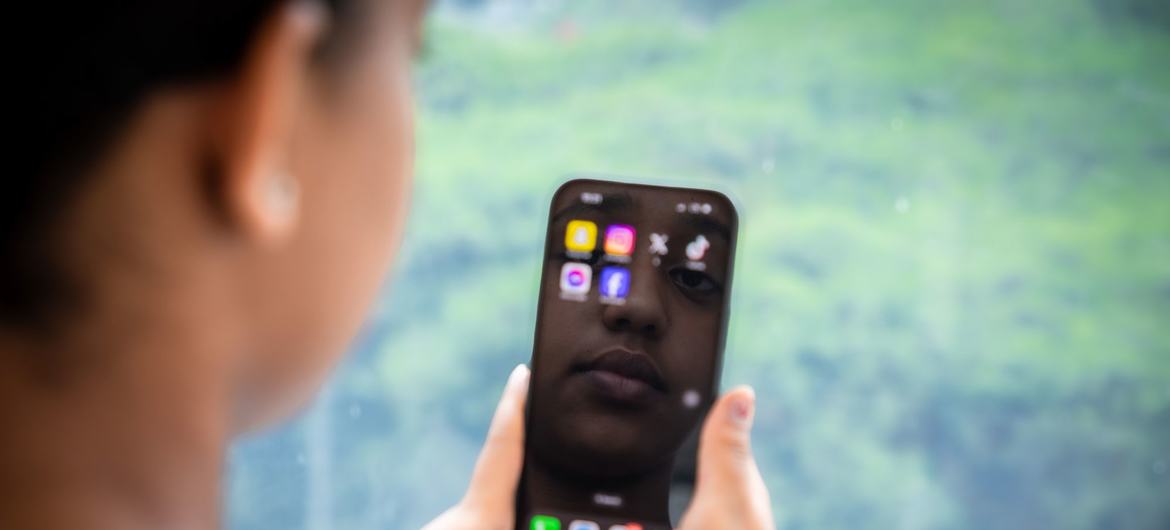
Social media can enable cyberbullying.
“Hate is back and it’s dangerous”
Addressing one of the Alliance’s major concerns, he spoke of the resurgence of hate speech, particularly online.
“Hate is back,“, said Mr. Moratinos. “Hate makes you feel like you have to eliminate your counterpart.”
He warned that hatred begins with words but leads to exclusion, violence and conflict. To combat this phenomenon, the Alliance invests in programs that promote counter-narratives and encourage understanding. And he said young people are at the heart of these efforts.
Today’s young people live “a large part of their lives” in virtual spaces which, he fears, can distance them from real human relationships.
“We need to restore realism to young people” he said, calling for a better balance between the online world and real life – where relationships, cultures and communities truly take shape.
Peace must come first
Mr Moratinos said the world had become consumed by security and, in doing so, had forgotten about peace.
“Everyone is much more concerned about security than peace. » he said. “But there will be no security without peace. »
Saving the planet, he added, makes no sense if humanity continues to self-destruct. He highlighted the heavy human toll of the conflicts in Gaza, Ukraine and Sudan, and insisted that the world must refocus on what really matters: saving humanity.
“Peace with a capital P,“, he said, must be the defining message of the Riyadh forum and the guiding principle for generations to come.
And he believes it’s young people who can make this vision a reality. Only they, he says, can decide that the 21st century will be the last century marked by war.
Originally published at Almouwatin.com
In Baghdad, Guterres hails ‘new chapter’ in Iraq as UN mission draws to a close

MANUI was established in 2003 after the fall of Saddam Hussein and has supported Iraq through the political transition, post-conflict recovery and the horrors of ISIL, also known as Daesh. His term ends on December 31.
Mr. Guterres said the progress made by the Iraqi people in recent years is a source of inspiration.
“We recognize this today, as we close one chapter in the history of the United Nations and Iraq – and open another. »
“A country at peace”
The Secretary-General praised the courage, fortitude and determination of the Iraqi people who have overcome decades of violence, oppression, war, terrorism, sectarianism and foreign interference.
“Against all odds, the Iraqi people have never wavered in their commitment to building a peaceful and inclusive society based on the rule of law and democratic institutions. » he said.
He highlighted milestones achieved over the past two decades, including the drafting of the 2005 Constitution, multiple national elections and the territorial defeat of the terrorist group Daesh, also known as ISIL.
Today, Iraq is “a country at peace with increased security and a clear determination to win the battle for development.”
The role of the United Nations mission
“MANUI “I was humbled and humbled to walk alongside the Iraqi people,” he said, noting that the Mission had advised successive governments and parliaments on judicial and legal reforms, promoted human rights and supported civic space for women, youth and minorities.
Additionally, when Daesh captured large parts of Iraqi territory, UNAMI helped mobilize and coordinate support to protect civilians and millions of displaced people.
The mission worked to promote inclusive political dialogue and national reconciliation. It also helped ensure the safe return of millions of displaced people, including returnees from al-Hol camp in northeast Syria and members of the minority Yazidi community who suffered abuse and violence at the hands of ISIS.
Tribute to the staff
The Secretary-General greeted all UNAMI personnel and paid tribute to the victims of the terrorist attack on the mission’s headquarters on 19 August 2003. The attack killed 22 personnel and injured more than 100.
“It is deeply moving for us to be joined by some of the survivors and families of victims,” he said.
“We honor the memory and legacy of all, including Sérgio Vieira de Mello, the first Special Representative to lead the Mission. »
He also expressed his gratitude to the Mission’s national staff “who have worked year after year to rebuild and strengthen their countries.”
A “lasting partnership”
The Secretary-General concluded his speech by highlighting his meeting that day with Prime Minister Mohammed Shia’ al-Sudani, during which he reaffirmed the UN’s commitment to supporting Iraq as it continues to strengthen its institutions, governance and accountability; improve public services; and diversify the economy.
“I emphasized that even though a mission may end, the United Nations will always accompany the Iraqi people on the path to peace, sustainable development and human rights,” he said.
Mr. Guterres was particularly touched that the government designated a street in Baghdad as “UN Street.” It represents “a powerful symbol of our enduring partnership – a reminder of how far we have come together and how far we still have to go,” he said.
“It is important that the entire international community understands that today a new chapter opens. Relations between Iraq and the United Nations will be normal relations,” he added.
The Secretary-General assured Iraqis that “the United Nations will continue to be with you every step of the way.”
Originally published at Almouwatin.com
‘The system has failed’: Giles Duley’s mission to reframe disability in war

At UN Headquarters in New York, where we met the world-renowned British photographer, writer, chef and NGO founder, staff stopped him after the press conference to thank him for his honesty and for elevating stories too often overlooked.
Giles Duley has dedicated his work as a photographer to document the impacts of war. He himself was severely wounded in Afghanistan and continues to fight on all fronts to heal his own wounds and those of others.
“The process to really truly support people with disabilities in conflict and peacebuilding situations has not even begun,” he told UN News.
“Every day of my life I am out on the frontlines – in war zones and humanitarian crises – and I see people living in terrible situations in homemade tents. I see people unable to access toilets. I see people unable to escape bombardments. I see people trapped in their homes, having to use baths as shelters because they can’t get into underground shelters.”
As Global Advocate, he said, his mission was to honour the responsibility entrusted to him those whose lives he has documented for decades. “When I photograph somebody in a war zone… they always say to me: share this story with the leaders. But the opportunities to do so were never fully realised.”
‘I wanted to be inspired – not to inspire others’
“I did not expect in my three years here for everything to change. What I hoped for was for people to listen – and that’s where I feel I failed, and that’s where I feel the system failed,” he said.
“Too often when I was invited to talk, all people wanted me to do was tell my story. I was asked to inspire people.”
Giles Duley began his career as a music photographer, shooting artists including Mariah Carey, Oasis and Lenny Kravitz. In 2000, his image of Marilyn Manson was listed among the 100 greatest rock photographs of all time. But he later shifted to documentary work. In 2011, while working in Afghanistan, he was severely injured by an IED, losing both legs and an arm. By 2012, he had returned to work.
“I shouldn’t be here to inspire others,” he said. “I want to be inspired by able-bodied people making the effort to truly impact the lives of those living with disability – to truly help them break down the barriers that create change.”
Too often, he warned, people with disabilities are included symbolically, not substantively. “I have been to many conferences where on stage there will be somebody who is a landmine victim or a survivor of sexual violence… and again and again it’s performative. Everybody clapping, everybody saying ‘I’m really inspired’… but how often do those people then get involved in the conversation about true policy change?”
This week, Mr. Duley helped open Forward, NOT Fragmented, a UN exhibition on survivors, deminers and communities affected by explosive ordnance. Several of his photographs are now on display at Headquarters. He shared the stories behind a few of them.
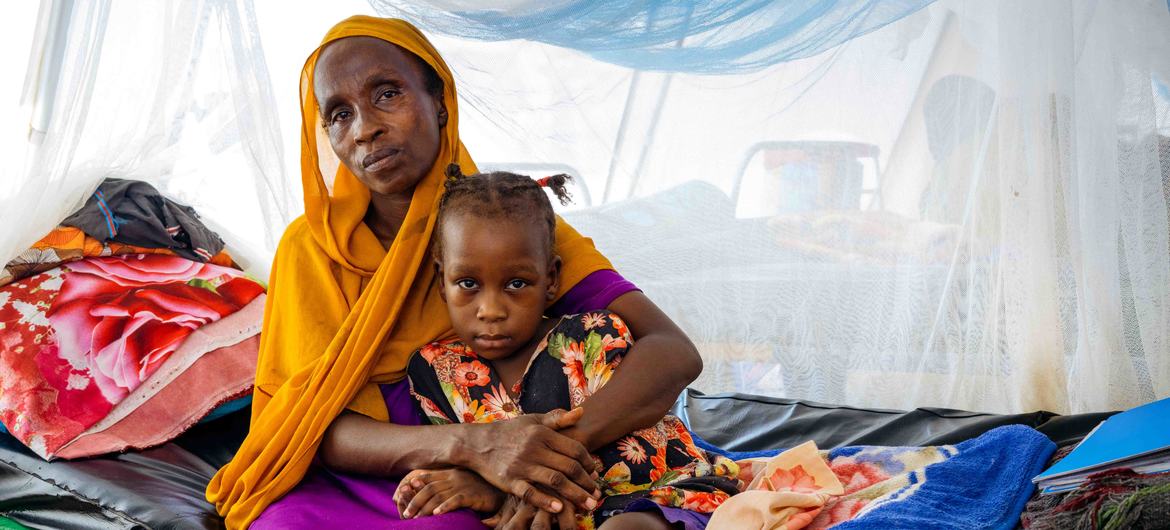
A photo by Giles Duley from Chad.
Chad: crawling to safety
One photograph shows a woman called Nawali, a teacher and activist from a village near the Sudan-Chad border. Disabled by polio as a child, she had built a fiercely independent life. But when her village was attacked, “they smashed her wheelchair, and she literally had to crawl to safety in Chad.”
When Mr. Duley met her in a displacement camp, she was immobile and living in a tent. The woman who had once led a full professional life now had to crawl to the toilets – degrading and dangerous, with risks of assault.
“No agency had provided that wheelchair,” he said. Staff told him she was not registered because “there were no experts to decide who had disabilities.” He added dryly: “Possibly somebody dragging themselves by their hands past them maybe didn’t need an expert.”
Ukraine: ‘We’ve been feeding her sweets’
In eastern Ukraine, he photographed Julia, a young woman with severe cerebral palsy. Early in the full-scale invasion, her parents were detained. Her mother repeatedly pleaded to be released, knowing her daughter could not feed herself.
When the mother finally returned home, soldiers “smiled sarcastically and said: ‘Don’t worry. We’ve been looking after her. We’ve been feeding her sweets.’”
Inside, she found Julia naked on the bed, covered in sweet wrappers. “Her teeth have fallen out. Her hair has fallen out… the stress has made her physically sick,” Mr. Duley said. “This is the reality for people living with disabilities in conflict situations.”

Julia is 32 and has cerebral palsy. When her village in southern Ukraine was occupied by Russian forces, her parents – a teacher and a mayor – were targeted and harassed.
Gaza: A life interrupted
He also spoke of Amro, a boy from Gaza who lost his leg after being shot by a sniper during the 2018–19 border protests. More than 200 Palestinians were killed during the weekly demonstrations.
After surgery and a difficult evacuation, Amro remained inside his family’s apartment for two years. “He didn’t want to go outside… because he felt people would judge him,” Mr. Duley recalled. “He had been forgotten.”
Mr. Duley visited often, cooking with the boy and eventually persuading him to go for coffee along the beach. “Sometimes it’s these very small gestures of kindness and time that can change someone’s life.”
After the 7 October Hamas-led attacks in southern Israel and the subsequent Gaza offensive, he heard from the family one last time: How can we escape? “I don’t know what happened to that family,” he said quietly.
‘Stop seeing the disability first’
Despite decades of advocacy, Mr. Duley said, systemic inaction persists because of stigma and discomfort. After his own injury, “people often wouldn’t even speak to me… A taxi driver might turn up and ask the person behind me where I want to go.”
He has urged media and communications professionals to rethink how they portray disability. “Whenever they interview me, the first thing they want to talk about is what happened to me over 10 years ago. I would not in any other situation ask somebody about their worst experience from a decade ago… I want people to talk about my work.”
People with disabilities, he said, often feel pressure to appear endlessly resilient. In humanitarian zones, he was frequently handed “injury lists” to guide his photography. “Before the person’s name, often it would have a list… they’re an amputee, they have a facial injury… I would rip that sheet up.
“Tell me about the family you meet that always makes you laugh. Tell me about the family that is always feeding you so much that you can’t leave. Tell me about the family that keeps you awake at night. That list will be completely different to the original list.”
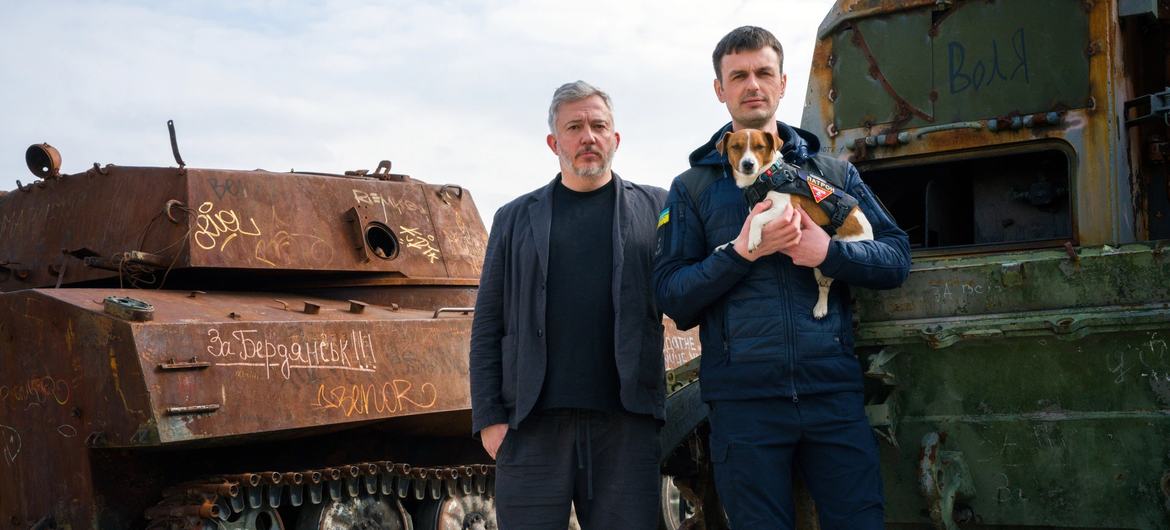
Bomb-sniffing deminer dog Patron and owner Mykhailo “Misha” Iliev, with Giles Duley, UN Global Advocate
Forgotten in crisis
He emphasised that disability is not a monolithic experience. People with mental health conditions and invisible disabilities face distinct risks. And wheelchair accessibility, though vital, is only one part of true inclusion.
Women with disabilities, he said, face “greater challenges as, sadly, women do in most aspects of life”: limited access to toilets, increased stigmatisation. Mothers caring for children with disabilities may not be able to leave home to access aid.
My dream is simply that everybody has the same opportunity that I had
“In crisis, in war, in humanitarian disaster, those people become more vulnerable and often more forgotten,” he said. “It’s simply about understanding their needs – that will enable them to have the same rights.”
Equal opportunities
His final message to world leaders draws on his own recovery. “I had amazing support… and I now live the life I could dream of. I travel, I do the work I’m passionate about, I live independently,” he said. But that, he insisted, “should be the right of everybody with disability: we just need to be seen as somebody that needs a different set of support to enable self-empowerment.
“My dream is simply that everybody has the same opportunity that I had.”
He recalled returning to Afghanistan after his injury, where he photographed a seven-year-old boy who had stepped on a landmine. “I remember looking at him and thinking: why should a boy on his way to school have to go through what I go through every day of my life?
“If my work means that one child…has the opportunities to live in peace or to rebuild their life after war, my life will have meant something.”
