

European Commission Speech Strasbourg, 07 Oct 2025 Our thoughts go out to all those who have lost loved ones, the injured, and the emergency responders. The European Union stands in solidarity with the people of…
Press release – COP30: MEPs want EU climate policy to maintain a high degree of ambition

On Monday evening, the Committee on the Environment, Climate and Food Safety adopted its policy demands for the UN Climate Change Conference COP30.Committee on the Environment, Public Health and Food Safety Source : © European Union, 2025 – EP
In landmark labour case, UN World Court weighs in on right to strike

The case stems from a 2023 request by the Governing Body of the International Labour Organization (ILO), which asked the Court for an advisory opinion on whether the Freedom of Association and Protection of the Right to Organise Convention, 1948 (No. 87) includes the right to strike.
Adopted in the aftermath of World War Two, Convention 87 is a cornerstone of international labour law, guaranteeing workers and employers the right to form and join organizations of their choosing. It does not explicitly mention strikes, but advocates have long interpreted freedom of association to include that right.
ICJ President Yūji Iwasawa began Monday’s proceedings by reading the formal question to the judges, referencing the ILO’s resolution and the Court’s procedural authority. He noted the “tripartite structure of the ILO, which is comprised of representatives of governments, employers and workers.”
A rare request
Tomi Kohiyama, ILO Legal Adviser, recalled that the ILO had not appeared before the ICJ in a consultative capacity since 1932, underscoring the rarity of such requests.
She said the ILO secretariat would not take a position on subject but would assist the Court by clarifying institutional context and interpretative approaches under the Vienna Convention on the Law of Treaties.
“The participation of organisations of employers and workers … is without precedent in the history of your august institution,” she added, referring to the ILO’s tripartite nature.
Three voices of ILO
Founded in 1919, the ILO is unique within the UN system for its tripartite structure, bringing together representatives of governments, employers and workers to set international labour standards.
That balance, however, has sometimes led to deadlock – most notably in 2012, when employer groups challenged whether Conventions No. 87 and 98 recognize a right to strike.
The headquarters building of the International Labour Organization (ILO) in Geneva.
Arguments from labour and business
Paapa Danquah, speaking for the International Trade Union Confederation (ITUC), described strikes as a timeless expression of collective action.
“Strike action has been our vital tool … to improve labour conditions and to defend our human dignities,” he told the court.
He argued that the right to strike is inherently part of freedom of association and thus should be recognized as protected under Convention No. 87.
In contrast, Roberto Suárez Santos, on behalf of the International Organisation of Employers (IOE), asserted that while the right to strike is not objectionable in principle, Convention No. 87 neither explicitly nor implicitly covers the right to strike.
He warned that to read it into the Convention now would impose a prescriptive regime – defining modalities of strike – that could disrupt nuanced national labour systems.
He expressed that the proper path would be consensus within the ILO’s tripartite bodies, not unilateral judicial elevation of standards.
ICJ advisory opinions
Over three days of hearings, 21 countries and organizations are expected to take the stand, with 31 written statements already filed in the ICJ Registry – reflecting global interest in the outcome.
The Court’s advisory opinion, expected in the coming months, will not be legally binding but could profoundly influence international and national labour law.
In the historic work case, the United Nations World Court weighs on the right to strike

The case stems from a request of 2023 by the Administration of the International Labor Organization (Ilo),, requested the court for an advisory opinion on the question of whether the Freedom of association and protection of the right to organize the Convention, 1948 (n ° 87) Includes the right to strike.
Adopted following the Second World War, Convention 87 is the cornerstone of international labor law, guaranteeing workers and employers the right to train and join the organizations of their choice. He does not explicitly mention the strikes, but the defenders have long interpreted the freedom of association to include this right.
Icj President Yūji Iwasawa started the procedure on Monday by reading the official question to the judges, referring to the resolution of the ILO and the procedural authority of the court. He noted the “tripartite structure of the ILO, which is made up of representatives of governments, employers and workers”.
Rare demand
Tomi Kohiyama, ILO legal advisor, recalled that the ILO had not appeared before the ICJ as an advisory basis since 1932, highlighting the scarcity of these requests.
She said the ILO Secretariat would not take a position on the subject but would help the court by clarifying the institutional context and interpretative approaches under the Vienna Convention on the law of treaties.
“The participation of employer and workers’ organizations … is unprecedented in the history of your August institution,” she added, referring to the tripartite nature of the ILO.
Three voices
Founded in 1919, the ILO is unique in the United Nations System for its tripartite structurebringing together representatives of governments,, employers And workers To establish international labor standards.
This balance, however, has sometimes led to an impasse – especially in 2012, when the employers of employers disputed if agreements No. 87 and 98 recognize a right to strike.
The headquarters of the International Labor Organization (ILO) in Geneva.
Labor and business arguments
Paapa Danquah, speaking for the Confederation of the International Syndicate (ItuC), describes strikes as a timeless expression of collective action.
“A strike action was our vital tool … to improve working conditions and defend our human dignities,” he told court.
He argued that the right to strike is intrinsically part of the freedom of association and should therefore be recognized as protected by the Convention No. 87.
On the other hand, Roberto Suárez Santos, on behalf of the International Organization of Employers (IOE), said that even if the right to strike is not reprehensible in principle, the Convention No. 87 does not explicitly or implicit the right to strike.
He warned that to read it in the Convention now imposes a normative regime – defining strike terms – which could disrupt nuanced national work systems.
He expressed that the appropriate path would be a consensus within the tripartite bodies of the ILO, and not a unilateral judicial elevation of the standards.
CIJ advisory opinions
More than three days of hearings, 21 countries and organizations should take a stand, with 31 written declarations already filed in the ICJ register – reflecting world interest in the result.
The courtyard advisory opinionScheduled in the coming months, will not be legally binding but could deeply influence international and national labor law.
Originally published at Almouwatin.com
Gaza: Major UN aid operation ‘ready to go’ if agreement is reached on US peace plan
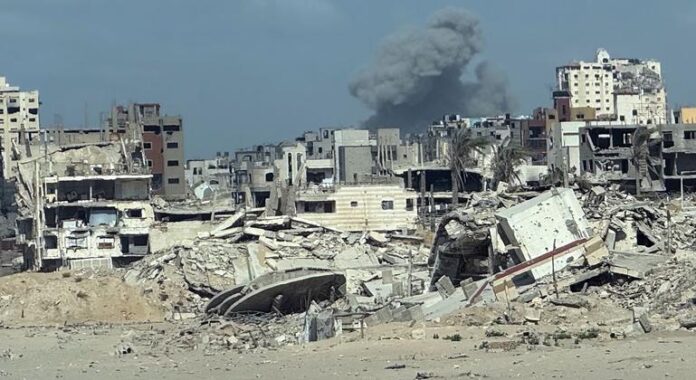
That’s according to UN Spokesperson Stéphane Dujarric, briefing correspondents in New York on Monday as indirect talks got underway in Egypt, which has been mediating negotiations along with Qatar and the United States to end the war between Israel and Hamas.
On Friday, Hamas said it agreed to significant parts of the 20-point US peace proposal, including the release of all Israeli hostages alive and dead, in exchange for Palestinian prisoners.
One of the US proposals is for entry and distribution of aid into Gaza to proceed “without interference from the two parties through the United Nations and its agencies and the Red Crescent.”
Waiting for a green light
Mr. Dujarric said in response to questions that the UN is “ready to go as soon as we get the green light…There are thousands of metric tonnes in the pipeline of goods ready to enter.”
Qatari and Egyptian negotiators are reportedly holding meetings with delegations from both Israel and Hamas in Sharm El-Sheikh late on Monday as hopes rise of a possible end to the conflict which began exactly two years ago with the Hamas-led terror attacks on communities in southern Israel.
Israeli strikes on Gaza have continued despite a call from US President Donald Trump to pause its bombing campaign. Local health authorities reported that 21 Palestinians had been killed on Sunday, with 96 injured.
The UN aid coordination office, OCHA, reports a reduction in air strikes in recent days – but shelling and gunfire have continued.
Emergency funds released
Mr. Dujarric said UN Emergency Relief Coordinator Tom Fletcher had allocated $9 million from the Central Emergency Response Fund (CERF) on Monday to ensure adequate fuel supplies to keep life-saving services running.
“Humanitarian access and movement across the Strip remain challenging,” Mr. Dujarric continued.
“Yesterday, eight missions that required coordination with the Israeli authorities were facilitated, but six other missions were denied, and five had to be cancelled by the organizers.”
Bakeries working flat out
The World Food Programme (WFP) has been able to deliver wheat flour to bakeries this month, which are “currently working up to 22 hours a day and producing some 100,000 bundles of bread daily.”
The UN and humanitarian partners prepared and distributed a total of 885,000 meals through 167 kitchens across Gaza on Saturday. However, only 12 kitchens are operating in the north.
“We and our partners stress the need for unimpeded and sustained access to all parts of Gaza so that aid can reach people, wherever they are,” said the UN Spokesperson.
Displacement sites and shelters in the south are overcrowded, driving some families to stay at garbage dumping sites such as Al Amal, where some 70 tents have been set up over the past few days.
OCHA stressed that UN aid teams and partners continue to do whatever they can to meet people’s urgent needs across the Strip, despite the ongoing violence, limited supplies and restricted access.
Release the hostages to Gaza “unconditionally and immediately”: guterres

“The attackers brutally killed more than 1,250 Israelis and foreign nationals,” he said in a statement.
“More than 250 others have been removed and taken to the Gaza Strip as hostages, including women, children and the elderly. That day, we remember all those who were killed and suffered horrible violence. The horror of this dark day will always be seized in the memories of all of us. “”
Held under deplorable conditions
It is estimated that 48 hostages remain captive. It is believed that some 20 years are alive while 28 are probably died.
Those who still live are detained in deplorable conditions, said the UN chief, who met some of the hostage families and survivors who shared their heartbreaking experiences.
“” I said it over and over again“, He added.
The Gaza Ministry of Health has reported that since October 7, 2023, more than 67,000 Palestinians have been killed and nearly 170,000 injured during the Israel offensive.
“” Put an end to suffering for all. It is a humanitarian disaster on a scale that defies understanding, ”said Mr. Guterres.
He called on all fighters to end the fighting in Gaza, Israel and in the region in the broad sense: “Stop paying civilians with their life and their future”.
‘We have to choose hope’
With indirect talks in progress in Sharm El-Sheikh between the negotiators of Israel and Hamas in order to reach a complete agreement on the Peace Plan of the United States 20 points, the UN chief said it was time to seize the opportunity to end the war.
“” After two years of trauma, we must choose hope – now. The recent proposal by American president Donald J. Trump presents an opportunity that must be seized to put an end to this tragic conflict, “he added.
Hamas said that it would accept parts of the American plan, including the release of all hostages, both alive and deceased. But the problems of total disarmament and the post-war role of the group remain.
The secretary general said that a permanent cease-fire and “a credible political process are essential to prevent other blood effusions and pave the way for peace”, on the basis of international law.
The UN remains unshakable in its commitment to supporting lasting peace, he added.
“Let us honor the memory of all the victims by working for the only way to follow: a just and lasting peace, in which the Israelis, the Palestinians and all the peoples of the region live side by side in terms of security, dignity and mutual respect”, the ” statement concluded.
Originally published at Almouwatin.com
World News in Brief: El Fasher Moving, violations of the rights of Afghanistan, vaccinations of Nigeria children

About 770 people were moved from the capital of the state of Darfur du Nord between October 2 and 4 only, according to the International Organization for Migration (Iom).
They would have asked for a shelter in the gathering sites of the neighboring city of Tawila.
“We call again on the siege of El Fasher, civilians must be protected and those who fled must be offered to a safe passage”, said UN spokesperson Stéphane Dujarric.
El Fasher has been besieged for over a year by rapid support forces (RSF), a paramilitary group that has been fighting against the Sudanese army since April 2023.
250,000 affected: WFP
The world gastronomic program (Wfp) has reached some 250,000 people in the city with transfers in monthly cash since the start of the year.
The United Nations also increased its help and nutrition aid in other parts of the Darfur.
PAM said nearly two million people in the region received food and nutritional assistance in August, especially in areas where famine has been confirmed or where the risk is high.
Human Rights Council investigators to probe Afghanistan violations
The UN Human Rights Council Monday intensified the pressure on the de facto Authorities in Afghanistan for increasingly serious violations of international law taking place there.
In a resolution adopted without vote, the 47 member states of the Council have created a new independent expert investigation body to collect evidence of “most serious” crimes committed in Afghanistan under domination of the Taliban, including against women and girls.
The objective is that the work of new investigators is used in national, regional or international courts or courts, depending on the resolution, which was introduced by Denmark in the name of the European Union and widely welcomed by countries such as the Co-Sponsor Chili, France, Iceland and Mexico.
Japan has also expressed profound concern for repression faced with the Afghan population and stressed that the rights crisis was not a problem that Afghanistan or its neighbors could solve alone.
Nigeria is launching the largest integrated vaccination campaign in its history
As of October 6, Nigeria launched the largest integrated vaccination campaign in its history, as part of its wider efforts to support its “primary health care care strategy under one roof”, which seeks to integrate all primary health care services as part of a unified management structure to improve coordination, efficiency and accessibility.
Aiming to reach more than 106 million children, the initiative is an answer to epidemics during polio, measles and rubella in Nigeria and throughout the Lake Chad basin.
These diseases have serious health risks. The measles is very contagious and potentially fatal, especially in malnutric children, while rubella can cause serious congenital malformations if contracted during pregnancy.
Aim to stop epidemics
In coordination with other African countries thanks to a cross -border national plan, Nigeria aims to stop active epidemics by the end of 2025 and to eliminate the remaining risks by the end of 2026.
Delivered in two phases, the first phase of the target campaign 20 northern states at high risk and Oyo State in the South West.
The second phase, from January 2026, will extend to the remaining southern states – ensuring that each community, including the most remote and badly served areas, is reached.
“The integrated approach of Nigeria gives a strong example to the region.WHO) Regional director for Africa.
Originally published at Almouwatin.com
Darfour: ICC condemns Janjaweed leader in war crimes and crimes against humanity
The historic judgment, rendered Monday in The Hague after a long trial, found him guilty of 27 counts for his role in the attacks against fur, the Masalit and other non -Arab communities between August 2003 and March 2004 in the west of Darfur.
Crimes included murder, rape, persecution, torture and attacks on civilians in the cities of Kodoom, Bindisi, Mukjar and Deleig.
In a 355-page decision, President Joanna Korner and Judges Reine Alapini-Gansou and Althea Violet Alexis-Windsor concluded out of any reasonable doubt that Ali Kushayb ordered, supported and participated in generalized and systematic terrorist attacks This led to mass killings and forced displacement.
Blind killings
The Janjaweed – Armed Arab militias supported by Sudan’s security forces – were part of the Khartoum campaign to crush a rebellion by non -Arab groups in 2003. The villages were shaved, the summary men and women violated what the UN later described as one of the most serious humanitarian crises of the early 21st century.
Among the evidence presented are a testimony describing how Janjaweed fighters “killed the inhabitants of the city without discrimination”, shooting people fleeing for their lives.
Another account recalled an injured father who urged his children to “leave him behind and save himself” as the militia advanced.
Ali Muhammad Ali Abd-Al-Rahman at the opening of his CPI trial. (2020 photo)
A case of many first
Ali Kushayb went to the ICC in 2020 shortly after the fall of the longtime leader in Sudan, Omar Al-Bashir, after having escaped the authorities for more than 12 years.
His conviction will follow and the judgment can be appealed. A repairs phase for victims will also be open.
The conviction marks several stages for international justice: This is the first ICC verdict in the situation of Darfur, the first case returned by the UN Security advice In resolution 1593 (2005) to lead to a conviction and the very first conviction of the ICC for sex -based persecution.
The CPI prosecutor’s office said that he continued to continue other pending mandates to Bashir, former interior minister Ahmad Harun and former Minister Abdel Raheem Hussein – all accused of similar crimes.
Echo of the past
The conviction occurs while the Darfur descends once again into violence in the middle of the War in progress Between the Army of Sudan and the paramilitary forces of rapid support (RSF), which would have been from Janjaweed militias and the former leadership in 2013.
Mass murder reports and ethnically targeted attacks resurfaced in Darfur, making comparisons with horrors two decades ago.
In September only, At least 91 civilians were killed In the besieged capital of El Fasher during a series of strikes by the RSF, involving bombardments and incursions on the ground.
An aerial view of the charred grounds and the structures burned in a village located between the cities of Nyala (capital of the south of Darfur) and El Geneina (capital of Western Darfur). Hundreds of villages have been attacked, looted and destroyed. (Photo 2004)
“Justice will prevail”
Deputy Prosecutor Nazhat Shameem Khan praised the verdict as “a crucial step towards the Darfur Impunity Commission”, adding that he “sends A resounding message to the authors of atrocities in Sudan, past and present, that justice will prevail.“”
She said that the judgment “is a tribute to the bravery of thousands of victims of Darfuri who hoped and fought for justice over the years.”
“A long -standing long repair”
The United Nations High Commissioner for Human Rights, Volker Türk, also praised the decision, calling it “Significant recognition of the enormous suffering endured by the victims of his heinous crimes“And a” first measure of long repair. ” »»
Originally published at Almouwatin.com
Gaza: United Nations Help Operation “Ready To Go” if the agreement is concluded on the American peace plan
It is according to UN spokesperson Stéphane Dujarric, news correspondents in New York on Monday while the indirect talks began in Egypt, who mediated negotiations with Qatar and the United States to end the war between Israel and Hamas.
On Friday, Hamas said that it had accepted important parties of the 20 -point American peace proposal, including the release of all living and dead Israeli hostages, in exchange for Palestinian prisoners.
One of the American proposals is the entry and distribution of aid to Gaza Proceed “without interference of the two parties by the United Nations and its agencies and the Red Crescent”.
While waiting for a green light
Mr. Dujarric declared in response to the questions that the UN is “ready to leave as soon as we get the green light … There are thousands of metric tonnes in the pipeline of goods ready to enter.”
Qatari and Egyptian negotiators would have meetings with delegations from Israel and Hamas to Sharm El-Sheikh on Monday, while the hope of climbing an end of the conflict that started exactly two years ago with the terrorist attacks led by Hamas against the communities of southern Israel.
The Israeli strikes on Gaza continued despite an appeal from US President Donald Trump to suspend his bombing campaign. Local health authorities said 21 Palestinians were killed on Sunday, with 96 injured.
The United Nations Coordination Office, OchhaReturns a reduction in air strikes in recent days – but bombings and gunshots have continued.
Emergency fund released
Mr. Dujarric said that UN UN emergency coordinator Tom Fletcher allocated $ 9 million Central emergency intervention fund (Deer) Monday, to provide adequate fuel supplies to continue the vital services.
“Humanitarian access and movement through the band remain difficult,” continued Mr. Dujarric.
“Yesterday, eight missions which required coordination with the Israeli authorities were facilitated, but six other missions were refused and five had to be canceled by the organizers. »»
Bakeries working flat
The world gastronomic program (Wfp) was able to deliver wheat flour to the bakeries this month, which “is currently working up to 22 hours a day and producing 100,000 bread beams per day. “”
The UN and the humanitarian partners have prepared and distributed a total of 885,000 meals in 167 kitchens across Gaza on Saturday. However, only 12 kitchens operate in the North.
“” We and our partners underline the need for unhindered and supported access to all parties of Gaza so that help can reach people, wherever they“Said the UN spokesperson.
Travel sites and southern shelters are overcrowded, which has prompted some families to stay in waste discharge sites such as Al Amal, where 70 tents have been installed in recent days.
The OCHA stressed that the United Nations teams and partners continue to do everything they can meet the urgent needs of people through the strip, despite the current violence, limited supplies and limited access.
Originally published at Almouwatin.com
Darfur: ICC convicts Janjaweed leader of war crimes and crimes against humanity

The landmark judgment, delivered on Monday in The Hague after a lengthy trial, found him guilty on 27 counts for his role in attacks against the Fur, Masalit and other non-Arab communities between August 2003 and March 2004 in West Darfur.
The crimes included murder, rape, persecution, torture and attacks on civilians in the towns of Kodoom, Bindisi, Mukjar and Deleig.
In a 355-page ruling, Presiding Judge Joanna Korner and Judges Reine Alapini-Gansou and Althea Violet Alexis-Windsor concluded beyond reasonable doubt that Ali Kushayb ordered, supported and participated in widespread and systematic terror attacks that led to mass killings and forced displacement.
Indiscriminate killings
The Janjaweed – Arab militias armed and supported by Sudan’s security forces – were part of Khartoum’s campaign to crush a rebellion by non-Arab groups in 2003. Villages were razed, men summarily executed, and women raped in what the UN later described as one of the gravest humanitarian crises of the early 21st century.
Among the evidence presented was testimony describing how Janjaweed fighters “killed the inhabitants of the town indiscriminately,” firing on people fleeing for their lives.
Another account recalled a wounded father who urged his children to “leave him behind and save themselves” as the militia advanced.
Ali Muhammad Ali Abd-Al-Rahman at the opening of his trial at the ICC. (2020 photo)
A case of many firsts
Ali Kushayb surrendered to the ICC in 2020 shortly after the fall of Sudan’s long-time leader Omar al-Bashir, after evading authorities for over 12 years.
His sentencing will follow, and the judgment can be appealed. A reparations phase for victims will also be opened.
The conviction marks several milestones for international justice: it is the first ICC verdict in the Darfur situation, the first case referred by the UN Security Council in resolution 1593 (2005) to result in conviction, and the first ever ICC conviction for gender-based persecution.
The ICC Prosecutor’s Office said it continues to pursue other outstanding warrants for Bashir, former Interior Minister Ahmad Harun, and ex-Defence Minister Abdel Raheem Hussein – all accused of similar crimes.
Echoes of the past
The conviction comes as Darfur once again descends into violence amid the ongoing war between Sudan’s army and the paramilitary Rapid Support Forces (RSF), which reportedly grew out of the Janjaweed militias and former leadership in 2013.
Reports of mass killings and ethnically targeted attacks have resurfaced in Darfur, drawing comparisons to the horrors of two decades ago.
In September alone, at least 91 civilians were killed in the besieged capital city of El Fasher during a series of strikes by the RSF, involving shelling drones and ground incursions.
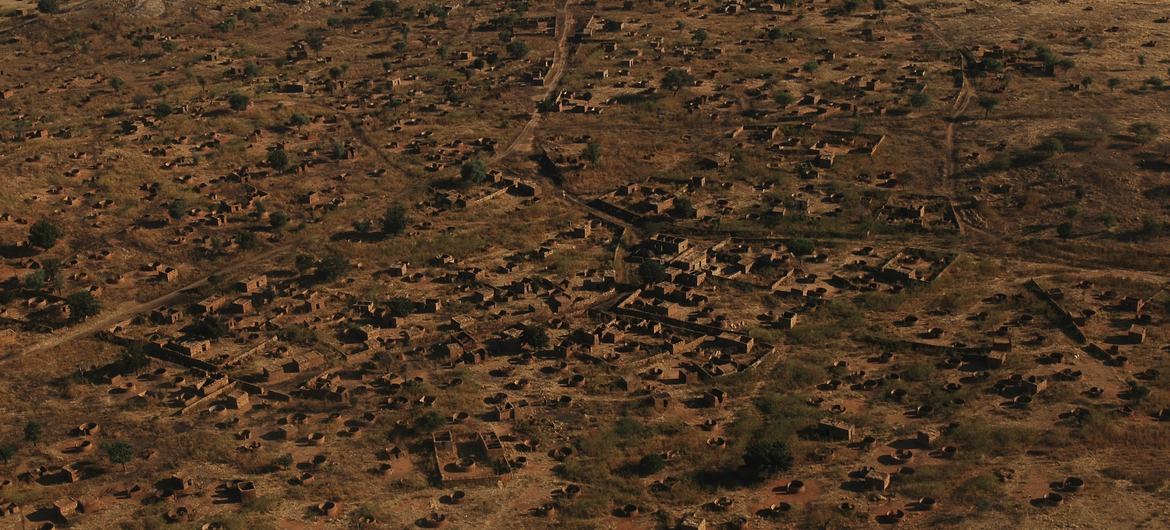
An aerial view of charred terrain and burnt-out structures in a village located between the cities of Nyala (capital of South Darfur) and El Geneina (capital of West Darfur). Hundreds of villages were attacked, looted and destroyed. (2004 photo)
‘Justice will prevail’
Deputy Prosecutor Nazhat Shameem Khan hailed the verdict as “a crucial step toward closing the impunity gap in Darfur,” adding that it “sends a resounding message to perpetrators of atrocities in Sudan, both past and present, that justice will prevail.”
She said the judgment “is a tribute to the bravery of thousands of Darfuri victims who hoped and fought for justice through the years.”
‘A long-overdue redress’
UN High Commissioner for Human Rights Volker Türk also welcomed the decision, calling it “an important acknowledgment of the enormous suffering endured by the victims of his heinous crimes” and a “first measure of long-overdue redress.”
