Wednesday, May 6, 2026
Home Blog Page 521

World News in Brief: Deadly China quake, Killings of Alawites in Syria, executions in Iran, CAR rights defenders, finance and food crises

0
World News in Brief: Deadly China quake, Killings of Alawites in Syria, executions in Iran, CAR rights defenders, finance and food crises

At least 126 people were killed and 188 injured in the 7.1-magnitude quake in Dingri county, a remote region near Mount Everest, according to media reports.  Tremors were reportedly felt in Nepal, Bhutan and parts of northern India.

UN Spokesperson Stéphane Dujarric said the Secretary-General wishes a speedy recovery to those injured and expresses his sincere condolences to the families of the victims.

 The UN is closely monitoring the situation and stands ready to provide support if requested.

UN rights office urges restraint amid reported Alawite killings in Syria

The UN human rights office, OHCHR, has urged restraint in Syria, amid reports that some individuals from the country’s Alawite community and other minority groups have been targeted and killed.  

Speaking in Geneva, OHCHR spokesperson Liz Throssell said that the Office was aware of reports and videos allegedly showing the killing of Alawite men in Homs and other Syrian cities since the overthrow of the Assad regime, which had a decades-long affiliation with Alawism – a branch of Shia Islam:

“We are aware of the reports and obviously our colleagues are working to corroborate. We know that the authorities have issued a statement calling on all to avoid retaliation,” Ms. Throssell added.

International legal obligations

“I think what it is really important is that all parties abide by their obligations under international humanitarian law and international human rights law, and that includes the respect and protection of minorities.”

Taking questions from reporters, Ms. Throssell said that a small UN human rights office team has been deployed to Damascus which had established “initial contacts with the caretaker authorities” headed by Hayat Tahrir Al-Sham leader Ahmed al-Sharaa. 

His forces were principally responsible for the lightning assault that toppled former President Assad on 8 December.

Asked to respond to unconfirmed reports that women were being assaulted because they had been talking to or walking in the street with men who were not relatives, Ms. Throssell insisted that it was “important that the caretaker authorities must act to ensure that security is restored.

She said it was vital “that those accused of committing crimes are held accountable and that women, children and diverse ethnic and religious communities can fully exercise their rights.”

Iran in international spotlight amid sharp rise in executions: OHCHR 

The number of people executed last year in Iran was “alarmingly shocking and high”, the UN human rights office, OHCHR, said on Tuesday.

At least 901 people were reportedly executed there in 2024, including 40 in one week alone in December. More than 853 people were executed in 2023.

Condemning the executions, the UN High Commissioner for Human Rights, Volker Türk, said that he was deeply troubled by this marked increase in use of the death penalty and urged a halt to the practice.

‘Unacceptable risk’

“We oppose the death penalty under all circumstances…It is incompatible with the fundamental right to life and raises the unacceptable risk of executing innocent people,” he added. 

Most of the executions last year were for drug-related offences, but dissidents and people connected to the 2022 protests after the death in police custody of Mahsa Amini, were also put to death. 

The UN rights office said that at least 31 women were reportedly executed in 2024; the majority of these cases involved murder and a significant number of the women sentenced to death were victims of domestic violence, child marriage or forced marriage, with “a number of them …convicted of murdering their husbands”, OHCHR said.

Although data is not provided by the Iranian authorities on executions, the UN rights office cited reliable sources indicating that Iran executed at least 972 people in 2015 – the highest number in recent decades.

© Unsplash/Mahyar Motebassem

An aerial view of Tehran, Iran’s capital city.

Central African Republic: ‘Historic legislation’ to protect rights defenders

The recent adoption of a law increasing protections for human rights defenders in the Central African Republic (CAR) has been welcomed by an independent expert on the human rights situation in the country

“This historic legislation marks a crucial stage in the recognition and protection of organisations and individuals who devote their lives to the defence of fundamental rights and the preservation of their operating space,” Yao Agbetse said in a statement on Tuesday.

The law was adopted by the National Assembly on 27 December, and it is believed to mark a significant development in the democratic evolution of the CAR, advancing the promotion, protection and implementation of human rights in the country. 

‘A step in the right direction’

Highlighting that the legislation is “a step in the right direction”, Mr. Agbetse added that it will safeguard freedom of expression, association, assembly and peaceful demonstration, and protect civic space.  

“It also recognises the contribution of civil society organisations to the country’s development and to the peace process”, the expert said.

The law provides for enhanced protection measures for human rights defenders, including security mechanisms, legal support and guarantees against reprisals. 

These provisions are key to ensure that defenders can continue their vital work without fear of persecution or violence, the independent expert explained. 

Mr. Agbetse said the law was a victory for all those who fight for justice and equality and are committed to a dynamic and participatory democracy.

Special Rapporteurs are not UN staff, do not receive a salary, and serve in their individual capacity, independent of the UN Secretariat or any other organisation.

Yao Agbetse, Independent Expert on the Central African Republic.

UN Photo/Jean Marc Ferré

Yao Agbetse, Independent Expert on the Central African Republic.

2024 financing report: Critical gaps exposed in food crisis funding 

The 2024 Financing Flows and Food Crises report from the Global Network Against Food Crises – which includes the UN Food and Agriculture Organization (FAO) – reveals a troubling disconnection between financial flows and the escalating severity of global hunger.  

While 281 million people experienced acute food insecurity in 2023, humanitarian aid to food sectors declined by 30 per cent compared to 2022. That is despite a long-term trend in assistance which showed a 56 per cent increase since 2016. 

This funding gap is further pronounced in active crises, where humanitarian aid still overpowers development investments. 

Neglected food needs  

While 33 percent of global humanitarian funding targeted food sectors, only three per cent of development assistance was allocated to food-related needs. 

Regions like East Africa bore the brunt of funding reductions, with expenditure dropping by nearly $1.4 billion in 2023. The Middle East and North Africa region also experienced a sharp funding shortfall, with a $1 billion drop below its historical average.  

The report underscores the need for integrated interventions that address both immediate hunger and underlying weaknesses. Investments in agriculture, which supports sustainable livelihoods and resilience were highlighted as key.  

While agriculture has absorbed over 50 per cent of development funding since 2016, structural gaps persist, particularly in rural development and forestry initiatives. Strengthening data systems and improving donor coordination are highlighted as critical to bridging these funding gaps in the future.  

Source link

First Person: Syrian refugee shipwreck survivor vows to help reconstruct shattered country

0
First Person: Syrian refugee shipwreck survivor vows to help reconstruct shattered country

After the Syrian civil war broke out in 2011, Ms. Al Zamel and her family relocated to Egypt. She stayed there with her family for three years but the situation for refugees deteriorated and, in 2014, she and her Syrian fiancé paid smugglers to take them to Europe.

During the journey their boat was rammed by traffickers, causing 500 people to drown, including her fiancé. After four days at sea, she was saved by a merchant vessel, along with two small children she had been holding the whole time (one of them, a nine-month old called Malak, died five hours after they were rescued).

UNICEF/Ashley Gilbertson VII

Many migrants lose their lives crossing the Mediterranean sea in unseaworthy boats (file)

Speaking to UN News, Ms. Al Zamel, currently based in Sweden, recounts the perilous journey from Egypt to Europe and reflects on the ongoing struggle for peace, safety and a better future for Syria, post-Assad.

‘How can they kill 500 people?’

“We made three attempts to leave Egypt by sea. The first two times we failed and, each time, we were imprisoned for 10 days. On the third try, we left from the coast of Alexandria.

The last boat we boarded was in very bad conditions [the migrants were transferred several times to different boats during the journey]. Another ship arrived, with people who looked like pirates, cursing and insulting us. They sank our boat and fled laughing.

To this day, the sound of their laughter is still in my ears, and I can’t forget it. Most of those on board drowned. How could they kill 500 people, including children, women, families and young people?

I had a small flotation device around my waist, and I was afraid because I couldn’t swim. I carried two small girls on my chest for four days. Their family members gave them to me before they drowned. I had to stay awake, without food or water. It was cold and dead bodies were around me. The only light I could see was the stars in the sky. Pain and death surrounded me everywhere.

A lack of options

After I was saved and taken to Europe, I heard that many people, including some who were close to me, wanted to make the same trip. I didn’t agree with this, but I understood their reasons. They are forced to do so because there are no other options.

I had to go through this dangerous journey for my family. I wanted them to live in better and safer conditions. I wanted my younger siblings to study and live safely away from the difficult conditions we experienced in Egypt, where life was difficult, and we did not have many opportunities.

A family gathers at a reception centre in Ar-Raqqa city, Syria.

© UNICEF/Muhannad Aldhaher

A family gathers at a reception centre in Ar-Raqqa city, Syria.

We were able to learn Swedish and I am now studying English. I worked as a teacher’s assistant for six years and my little brother is now about to start his university studies. I have had some very good experiences and worked with good people who love Syrians.

Currently, I participate in conferences with several organizations affiliated with universities, schools or volunteer agencies. I talk about self-motivation and how one must overcome difficulties after going through a difficult ordeal. I talk about Syrian refugees and refugees’ rights.

‘Syrians deserve to live in safety and achieve their dreams’

When I heard the news [of Assad’s fall] it was like a dream for me and the many Syrians who have suffered. I cried my heart out. It was an indescribable feeling, something like a dream.

More than a decade of war has led to widespread destruction across Syria.

© UNOCHA/Ali Haj Suleiman

More than a decade of war has led to widespread destruction across Syria.

I want to speak out about the pain and voices of mothers who lost their children because of Bashar al-Assad’s tyranny. After the liberation, it is necessary to imagine a future full of opportunities, positive changes, peace and security because all Syrians deserve to live in freedom.

Syria needs a lot of help to rebuild and erase the destruction. Whether I remain here, in Sweden, or return, I want to contribute to its reconstruction so that we can all have peace and security.

Syrians deserve to live in safety and achieve their dreams. We all can contribute in some way, to support the community, participate in development projects and raise awareness.”

Source link

First Person: Gaza, where starving people are trapped in a land reduced to rubble

0
First Person: Gaza, where starving people are trapped in a land reduced to rubble

Since the fierce bombardment of Gaza by Israel began in October 2023, in response to a deadly Hamas attack on the country, over 45,000 Palestinians have been killed, and over 100,000 injured.

The vast majority of Gazans, around 90 per cent, are internally displaced, forced to relocate several times to avoid airstrikes and fighting. Meanwhile, they struggle to find food or shelter: hundreds of thousands of homes have been destroyed, and 345,000 people are facing catastrophic levels of food insecurity.

Mr. Dumont shared his vivid reflections on the dire situation in Gaza shortly after his return from a mission to the Occupied Palestinian Territory:

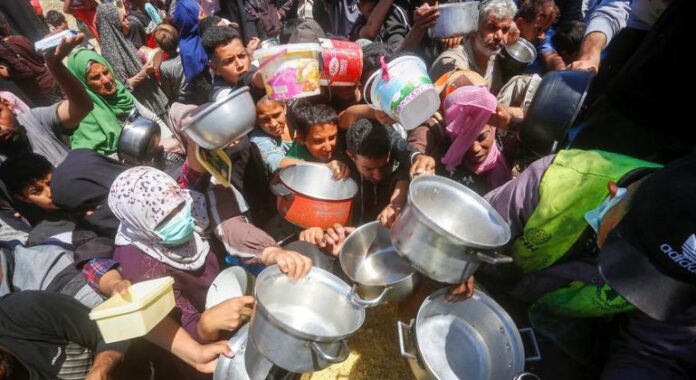
“‘I need food, man’, Abdul Rahmen told me. We were in the southwestern Gazan city of Khan Younis, where men ladled out steaming rice into bowls thrust out by a desperate crowd. One boy was crying, afraid the food, supplied by the World Food Programme (WFP), would run out before his turn.

‘I was ambitious. I had dreams’, Rahmen said, describing expectations as shattered as the buildings around us. ‘But I need food. I can’t buy bread’.

I had arrived in Gaza the day before, making a 10-hour journey from Amman on a bus packed with humanitarian workers. Some of that time was spent waiting at Israel’s Kerem Shalom border crossing into the strip – one of the few available avenues to deliver life-saving humanitarian aid. The 10-day visit, in early December 2024, was my first since before the war broke out nearly 15 months ago.

WFP’s Jonathan Dumont in Gaza, where delivering humanitarian aid is fraught with challenges.

A massive backlog of urgently needed supplies – including boxes of medicine, food and other aid – awaited clearance there, and for the few available trucks and authorized drivers able to navigate destroyed roads, desperate crowds and armed gangs to deliver them.

The size of the US city of Detroit, Gaza today is a mountain of rubble. I’ve gone to many conflict zones this past year – gang-ravaged Haiti, eastern Democratic Republic of the Congo, Sudan’s war-torn capital Khartoum – but Gaza is on a different scale. On one side, waves stroke a Mediterranean beachfront, an illusion of serenity. On the other lies endless destruction, black smoke rising from smouldering buildings.

There’s another difference from many war zones: there’s no way for Gazans to escape the conflict. They are trapped.

And hunger is skyrocketing. More than 90 percent of the population faces “crisis” or worse levels of food insecurity, according to the latest expert findings. More than 300,000 people are likely experiencing catastrophic hunger – the highest level of food insecurity.

A small boy scoops up the last rice grains in his bowl. Hunger is soaring in Gaza and the WFP food allowed to enter is limited.

A small boy scoops up the last rice grains in his bowl. Hunger is soaring in Gaza and the WFP food allowed to enter is limited.

‘People are hungry and angry’

The WFP food allowed to enter the strip can only meet one-third of what we need to reach the hungriest people. Over the months, we’ve been forced to cut rations, and then cut again. In December, we planned to reach 1.1 million people with just 10 days’ worth of food, which includes canned goods, tomato paste, oil and wheat flour.

Besieged North Gaza is the hungriest place. Over the past two months, barely any supplies have been allowed to trickle in.

‘Bread is the most important food for people nowadays, because it’s so cheap,’ baker Ghattas Hakoura told me at a WFP-supported commercial bakery in Gaza City, in the northern part of the strip. Men and women were picking up loaves of pita, costing three shekels, or less than US$1 per packet, in separate, tightly controlled lines.

‘People are hungry and they’re angry,’ Hakoura added. ‘They’ve lost their homes, their jobs, their families. There is no meat, no vegetables – and if we do have vegetables, they are very expensive’.

Nabil Azab (right) stands near the greens his family is tending. Behind are the remains of the apartment building his family still lives in despite the danger.

Nabil Azab (right) stands near the greens his family is tending. Behind are the remains of the apartment building his family still lives in despite the danger.

A 25-kg bag of wheat flour can sell for US$150. In an enclave where farmers once harvested citrus, vegetables and strawberries, I saw small peppers selling at a Gaza City market for US$195 a kilo. Nobody was buying. Nobody could afford them.

Ibrahim al-Balawi, cradling his small daughter, told me she’d never drunk a glass of milk in her life. She’d known nothing but war.

That’s a worry for so many parents in Gaza, a place where you hear the sound of drones and explosions 24/7, coming from the air, land and sea.

‘I want my kids’ future to be similar to any other kid living in any Arab country,’ Hind Hassouna, a mother of four, told me in Khan Younis, after our food distribution there. ‘To live a decent life, wear decent clothes, eat decent food and have a good life. The most important thing is to be free from fear – just like any kid in any Arab country’.

Khan Younis, like many parts of Gaza, has few remaining buildings taller than four stories.

Khan Younis, like many parts of Gaza, has few remaining buildings taller than four stories.

Dead bodies decomposing in the sun

Today, Hassouna’s children walk 1.5 km each way to fetch water. As she spoke in her tent home – which could easily be toppled by wind or flooded by winter rains – they spooned up their small portions of WFP rice. It was possibly their only meal of the day. One little boy slowly cleaned his plate of every last grain, a small smile on his face.

Children are experiencing the worst of the war. As we drove to the food distribution at Khan Younis, I spotted a dead horse amid the rubble. Nearby, a little girl picked through the trash, looking for food.

Later, driving to Gaza City in our armoured vehicle, along the militarized Netzarim corridor dividing the enclave’s north and south, we saw dead bodies scattered to the left and right, decomposing in the sun. A few hundred metres later, a small group of women and children headed in that direction, carrying their belongings. They looked hot and tired.

How will such experiences affect Gaza’s children when they grow up? What will happen to their generation?

Abu Bilal shows his precarious shelter, built under two concrete slabs from his former apartment building.

Abu Bilal shows his precarious shelter, built under two concrete slabs from his former apartment building.

Amid the devastation, Gazans are embracing any semblance of life they can create. In Khan Younis, Abu Bilal dug out his destroyed home and used the rubble to rebuild the walls. Cement slabs from what had been a multistorey apartment building formed a tenuous lean-to. He showed me around his place, complete with a basic toilet and makeshift plastic sink.

‘Dangerous’, he said of his shelter, which could easily collapse during a storm or airstrike.

In what had been a densely populated neighbourhood, Nabil Azab also showed me around the remains of his home. A former taxi driver, he pointed out the twisted carcass of the vehicle that once earned him his livelihood. Like many Gazan families, his has been displaced multiple times, moving from one tent settlement to another.

When an airstrike hit his tent in the southern city of Rafah – injuring him and other family members – that was enough. They, too, cleared out the debris from their partially destroyed home in Khan Younis and moved back in. Their four-storey building, among the few still standing in the area, leans precariously atop a sandy ridge. In the ground below, the family grows lettuce and other greens to help survive. But it’s not enough.

‘I look at my little daughter as she cries asking for food and I feel helpless,’ Azab told me. ‘There’s nothing that I can do for her. Nothing at all.’”

Source link

Al Jazeera ban must be lifted, rights experts urge Palestinian Authority

0
Al Jazeera ban must be lifted, rights experts urge Palestinian Authority

The development comes one week after a court in Ramallah in the occupied West Bank ordered the closure of several Al Jazeera websites. A Palestinian Authority ministerial committee had earlier justified the enforced closure of the media company’s office in the West Bank, accusing it of broadcasting “inciting” material, “misinformation, sedition and interference in Palestinian internal affairs”.

“To shut down a prominent international media outlet and one of the biggest in the region is a disproportionate, unnecessary and severe restriction of freedom of expression and obstructs the right to information of the Palestinian people and regional and global audiences,” the experts said in a statement.

“We are deeply alarmed by this attack on freedom of expression by the Palestinian Authority,” they insisted.

Websites ordered to close

On 1 January 2025, the Palestinian Attorney-General ordered the suspension of Al Jazeera in the Occupied Palestinian territory. The decision prohibits Al Jazeera’s broadcasts and operations including the work of its affiliate journalists, employees and crews.

The suspension followed a letter from the Palestinian Minister of Culture, based on a decision issued by the Tripartite Committee – a specialized ministerial committee that includes the ministries of culture, interior and communications – responsible for licensing ground and satellite radio and television stations.

On 5 January the Magistrate Court of Ramallah ordered the closure of several Al Jazeera websites for four months, including aljazeera.net, aljazeera.net/live, aljazeera360.com and global.ajplus.net on grounds that their published material “threaten national security and incite the commission of crimes”.

We note with serious concern that the decision by the Palestinian Authority to ban Al Jazeera came after the outlet’s critical reporting on the violent crackdown by Palestinian security forces since 5 December 2024 in the Jenin Refugee Camp and across the occupied West Bank. At least eight Palestinians were killed in the violence, including a young female journalist,” the experts said. 

“The decision to ban Al Jazeera on the basis of vague and unsubstantiated allegations amidst escalating violence and human rights violations suggests that the real objective of the Palestinian Authority is to block international scrutiny and silence uncomfortable criticism,” they maintained.

Free and independent

Free and independent media, including the presence of international media, is of vital importance to ensure transparency and accountability for war crimes and crimes against humanity in the Occupied Palestinian Territory.”

In Gaza, Israel has banned all international journalists from reporting inside the enclave since the outbreak of the war in October 2023. Dozens of Palestinian journalists have been killed by Israeli forces while covering the conflict, according to international media organisations, including UN culture agency, UNESCO.

The experts – who are not UN staff and not paid for their work, urged the Palestinian Authority not to follow the example of the Israeli authorities which banned Al Jazeera in Israel and the Occupied [Palestinian] Territory and closed its office in Ramallah last year.

“Without independent reporting, potential human rights abuses and violations of international law may go unreported, creating an environment where impunity thrives,” the experts said.

The experts have raised their concerns about restrictions on freedom of expression and on journalists with the Israeli and Palestinian authorities.            

Source link

Lebanon: Appeal for $371.4 million to boost life-saving support

0
Lebanon: Appeal for $371.4 million to boost life-saving support

Announced at the Grand Serail in Beirut by Deputy Prime Minister Saade el-Shami and UN Humanitarian Coordinator Imran Riza, the appeal extends emergency efforts through March 2025.

It builds on the original Flash Appeal launched in October 2024, following the largest escalation of conflict since the 2006 Lebanon War.

This extension targets immediate relief for the most vulnerable populations – Lebanese citizens, Syrian and Palestinian refugees and migrants – while complementing the Lebanon Response Plan (LRP), which serves as the overarching framework for humanitarian and stabilisation efforts.

Key priorities include food assistance, winterization support, emergency repairs and civilian protection, alongside addressing gaps in healthcare, water and education infrastructure.

A devastating conflict

Despite the severe crises the country has endured over the past 15 years, Mr. Riza described 2024 as one of Lebanon’s darkest years, marked by widespread devastation.

The conflict, which began in October 2023 and intensified over a devastating six-week period from late September to early November 2024, caused over 4,000 deaths, 16,000 injuries and displaced more than one million people.

The destruction of homes, critical infrastructure and essential services further deepened the suffering of those affected.

A month onwards

Despite the cessation of hostilities, over 125,000 people remain displaced and hundreds of thousands attempting to return to their homes are “grieving, struggling and searching for a path forward”, Mr. Riza described.

The Minister of Environment and Coordinator of the Government Emergency Committee, Nasser Yassin explained: “While additional humanitarian assistance is essential, Lebanon’s institutions and public sector also require significant support to prevent the collapse of basic and social services.”

“Similarly, municipalities and local authorities urgently need emergency funding to maintain their operations, given their frontline role and the heavy burden they bear as a result of the war,” he added.

Beyond physical destruction, the psychological impact of the war remains deep, with many people – especially children – suffering from trauma that may persist for years.

The next steps

Mr. Riza called for continued international support to help the country through the winter months and begin recovery. 

Alongside the UN, the Lebanese Government remains committed to leading a coordinated, transparent and accountable response.

Deputy Prime Minister Saade el-Shami explained: “Our aim is to focus together on bridging immediate humanitarian needs with long-term recovery planning, in the most efficient and transparent way.”

Meanwhile, children’s agency UNICEF is providing food and essential items to vulnerable families returning from Syria and facing severe difficulties.

“This is part of several distributions we’re doing in several locations in collaboration with a number of partners such as the Lebanese Red Cross,” said Akhil Iyer, UNICEF Representative in Lebanon.

Sustained funding and resources are essential to stabilise the situation, deliver aid to those in need and enable Lebanon’s recovery from one of the darkest chapters in its modern history. 

Source link

Sudan war becomes more deadly as ethnically motivated attacks rise

0
Sudan war becomes more deadly as ethnically motivated attacks rise

His warning comes in the wake of reports that dozens were brutally killed in ethnically targeted attacks in Al Jazirah state in the southeast, and amid reports of an imminent battle for control of the country’s capital, Khartoum.

The Sudanese Armed Forces (SAF) and a rival military, the Rapid Support Forces (RSF) have been fighting since April 2023 in what Mr. Türk called a “senseless war”.

Desperate situation worsens

As they “battle for control at all costs…direct and ethnically motivated attacks on civilians are becoming increasingly common,” he noted.

“The situation for civilians in Sudan is already desperate, and there is evidence of the commission of war crimes and other atrocity crimes. I fear the situation is now taking a further, even more dangerous turn,” he said.

Attacks on camps

In the last week alone, his office, OHCHR, documented at least 21 deaths in just two attacks on camps in Al Jazirah, located some 40 kilometres from the state capital, Wad Madani.  

However, the actual number of attacks directed at civilians, and of civilians killed, are likely to be higher. 

On 10 January, at least eight civilians were killed in an attack on Taiba Camp, and at least 13 women and one man were abducted. Houses were burnt and livestock, crops and other property looted, while dozens of families were displaced. 

The next day, at least 13 civilians were killed, including two boys, in an assault on Khamsa Camp. 

Authorities promise investigation

The attacks came in the context of the recapture of Wad Madani by the SAF. Reports suggest they were carried out by the Sudan Shield Forces led by Abu Aqla Keikal, a former RSF commander who defected to the other side last October. 

The attacks reportedly targeted the Kanabi, a historically marginalised group comprised mainly of Nuba and other African tribes.

Mr. Türk noted the Sudanese authorities’ assurance that the attacks would be fully investigated and those responsible brought to justice, and that an investigation committee has been established.

“Retaliatory attacks – of shocking brutality – on entire communities based on real or perceived ethnic identity are on the rise, as is hate speech and incitement to violence. This must, urgently, be brought to an end,” he said.

Violence captured on video

OHCHR received three videos that document scenes of violence, including unlawful killings. They were reportedly filmed in Wad Madani, with men in SAF uniforms visibly present.

In the videos, victims were dehumanised and denigrated as “Wassekh” (dirt), “Afan” (mould), “Beheema” (animal) and “Abnaa E-dheif” (bastards), and summary executions were hailed by perpetrators as “Nadhafa” (a cleaning operation). 

Concern for North Darfur

Serious concerns also persist for civilians in North Darfur, where ethnically motivated attacks by the RSF and its allied Arab militias against African ethnic groups, particularly the Zaghawa and the Fur, continue to exact a horrific toll. 

Separately, some 120 civilians were reportedly killed and more than 150 injured in drone attacks in the city of Omdurman, on 13 January, allegedly launched by the SAF on a market in the Ombada Dar es Salam square, an RSF-controlled area.

End the fighting

Mr. Türk reiterated his call for the fighting to end, and for the warring sides to uphold their obligations under international humanitarian law and international human rights law. 

He also warned the proliferation of militia recruitment and mobilization of fighters – largely along ethnic lines – risks unleashing a broader civil war and inter-communal violence.

Appeal to warring sides

The SAF and the RSF are responsible for the actions of groups and individuals fighting on their behalf,” he said. 

He urged them to “take immediate measures to ensure the protection of all civilians, including by taking all feasible measures to avoid or at the very least minimise harm to civilians in the conduct of hostilities.”

Prompt, independent, impartial and transparent investigations into all reports of violations and abuses are crucial, he added. 

Source link

Music Moves Europe Awards 2025: here are the winners

0
Music Moves Europe Awards 2025: here are the winners

The jury selected 5 winners for the Music Moves Europe Awards and the winner of the Grand Jury MME Award. Each year, the jury decides which artists stand out the most among the 15 nominees.

At the same time, fans across the world voted online for their favourite artist, the Public Choice Winner.

These are the winners

The Grand Jury Music Moves Europe (MME) Award 2025 went to

The other winners of the 2025 MME Awards were

  • Kingfishr from Ireland
  • Naomi Sharon from Netherlands
  • Night Tapes from Estonia
  • UCHE YARA from Austria
  • Judeline from Spain

The MME Public Choice Award went to

My warmest congratulations to the winners and nominees of the 2025 edition of the Music Moves Europe Awards. Music breaks barriers and brings people together. It composes the soundtrack of our lives, I am so proud to witness such a variety of sheer talent, bringing the promise of a bright future for the European music scene.

– Said Glenn Micallef, Commissioner for Intergenerational Fairness, Youth, Culture and Sport, who attended the ceremony and handed the Public Choice Award himself.

The public can discover these emerging talents as part of the showcase programme at the Eurosonic Noorderslag festival.

Supporting emerging talents in their international career

The 5 Music Moves Europe Award winners receive €10000 each. 
The winner of the Grand Jury MME Award receives €10000 and a green touring voucher worth €5000. 
The winner of the Public Choice Award also receives €5000.

All 15 nominees [link: /node/3504] are invited for an education programme to get an insight into the music business and to learn from established professionals. Furthermore, they are all invited to perform at ESNS Festival, and in September at Reeperbahn Festival, the co-organiser of the Prize.

About the Music Moves Europe Awards

The Music Moves Europe Awards are co-funded by Creative Europe, the EU funding programme for the culture and audiovisual sectors and are implemented by Eurosonic Noorderslag and Reeperbahn Festival with the support of partners from the music industry.

Source link

Ants Remember Their Enemies and Hold a Grudge

0

Memory shapes behavior throughout the animal kingdom. This is true even for ants, which not only do not forget their enemies, but are also capable of holding a grudge against them, writes Study Finds. Scientists from the University of Freiburg conducted a study in which they noticed that ants are able to form long-term memories of hostile encounters. The insects can even become angry at members of colonies that have previously attacked them.

The study

The study was conducted on black garden ants, which are common in Europe. They live in colonies and often interact with neighboring groups. According to scientists, each anthill has its own unique chemical signature, or odor, that allows the ants to distinguish friend from foe. When confronted with rivals, the insects can open their jaws threateningly, bite or even spray acid to kill competitors.

The Tests

In a series of tests, the scientists exposed individual ants to encounters with insects from other colonies. These encounters lasted just one minute each day for five days. The researchers noticed that the ants were more aggressive toward individuals from colonies they had previously fought with, and less hostile toward insects they had never encountered. The scientists are confident that the ants are capable of forming special memories for their enemies.

The Findings

The more often the same insects meet, the more they fight, the researchers emphasize. In addition, the ants are more likely to attack individuals that live in colonies within their foraging range. “We often have the idea that insects function like programmed robots. “Our study provides new evidence that, on the contrary, ants also learn from their experiences and can harbor malice,” said researcher Dr. Volker Nehring from the Evolutionary Biology and Animal Ecology Group at the University of Freiburg.

Illustrative Photo by Syed Rajeeb: https://www.pexels.com/photo/black-ants-928276/

Baby gorilla found at airport recovers, even gains weight in Istanbul

0

A 5-month-old gorilla was rescued from the cargo hold of a plane and is now recovering at a zoo in Istanbul as wildlife officials consider returning it to its natural habitat. The gorilla was found last month in a crate on a Turkish Airlines flight from Nigeria to Thailand, CBS News reported in January. After a public competition, he was named Zeytin, which means olive, and is recovering.

Zeytin Gains Weight

Weeks after being found at the airport, Zeytin has gained weight and is showing signs of recovery from his traumatic journey.

“When he first came, he was very shy, he would stay where we left him,” said veterinarian Gulfem Esmen. “Now he doesn’t have that shyness. He doesn’t even care much about us. He plays games by himself.”

Of course, what we want and desire is for the baby gorilla … to continue his life in his homeland,” Fahrettin Oulu, Istanbul’s regional director for nature conservation and national parks, said on Sunday.

“The important thing is that an absolutely safe environment is created wherever he goes,” he added.

Illegal trade appears to pass through Istanbul

As Istanbul becomes a major air hub between continents, customs officials are increasingly catching illegally traded animals. In October, 17 young Nile crocodiles and 10 monitor lizards were found in the luggage of an Egyptian passenger at the city’s Sabiha Gokcen Airport.

Illustrative Photo by Andrea Acanfora: https://www.pexels.com/photo/close-up-photo-of-an-infant-gorilla-7268737/

Romanian Church Encourages Organ Donation

0

The Romanian Orthodox Church encourages Christians to donate their organs when it is necessary to save the life of another person. This is clear from a text recently published on the official website of the Romanian Patriarchate.

A living person can donate a part of the liver, bone marrow or a kidney to a terminally ill person. The Church encourages this donation when it is an act of love for the sick person, is not a “subject of transactions”, is carried out voluntarily and with the full mental clarity of the donor, with a clearly expressed written consent. The Church blesses people who can possibly make such sacrifices, but also understands those who cannot do so, respecting the freedom of decision of each person.

Until now, the Church had been involved in the public debate on the use of organs of a deceased person for transplantation. According to the Church’s position, organ donation is an act of self-giving for one’s neighbor and can be encouraged, but excluding the possibility of abuse. “Although it is claimed that donation is an expression of love, it in no way creates a moral obligation to donate; the act of donation is a complete and unquestionable manifestation of free will. Only the donor’s conscious consent reveals his love and spirit of sacrifice, trust and interest in his neighbor.” Consent may be given by relatives, but only after “the law has provided clear rules regarding consent in order to avoid doubts about the sale of organs by relatives.”

Furthermore, in order to prevent abuses, such as are possible when it comes to life-saving and expensive operations, the church’s position states: “Death as the effective cessation of life implies: 1) cardiac arrest; 2) lack of spontaneous breathing; 3) brain death. These three conditions must be fulfilled simultaneously and completely in order to avoid regrettable errors.” And further: “Death as the separation of the soul from the body remains a mystery. No one will be able to say with certainty that this separation coincides with brain death; can coincide with, precede or follow brain death. Being created in the image of God, man is valuable to the extent that his original image is reflected in him. As long as he fulfills the commandment of love and remains in God, who is love, he is a member of the Church of Christ. From this point of view, donating an organ, tissue and even a drop of blood out of love for his neighbor means the self-giving and sacrifice of the whole person in the same mystical Body of Christ, which excludes the view of the human body as a mere means of physically healing someone or as a storehouse for spare organs”.

The Church cannot agree with the transplantation of embryonic tissues, which carries a risk of affecting the health of the fetus, nor with the use of the organs of acephalic or hydrocephalic newborns for transplantation. In the same way, we cannot agree with the tendency for some to become organ donors on condition that they are euthanized.

It also calls for the rejection of “any transactions with human organs and any exploitation of critical situations and vulnerabilities of potential donors (those deprived of mental or physical freedom and other vulnerable social groups)”.

Regarding doctors involved in the transplantation process, it says: “The gift of knowledge and discovery comes from God; man has the responsibility to use this knowledge not against his neighbor and the world, but to maintain the dignified presence of the person in creation and to realize the meaning of existence. In this context, the doctor must be aware that he is an instrument and collaborator of God in eliminating the manifestation of evil in the world as suffering.”

Illustrative photo: Orthodox icon of Virgin Mary The Healer