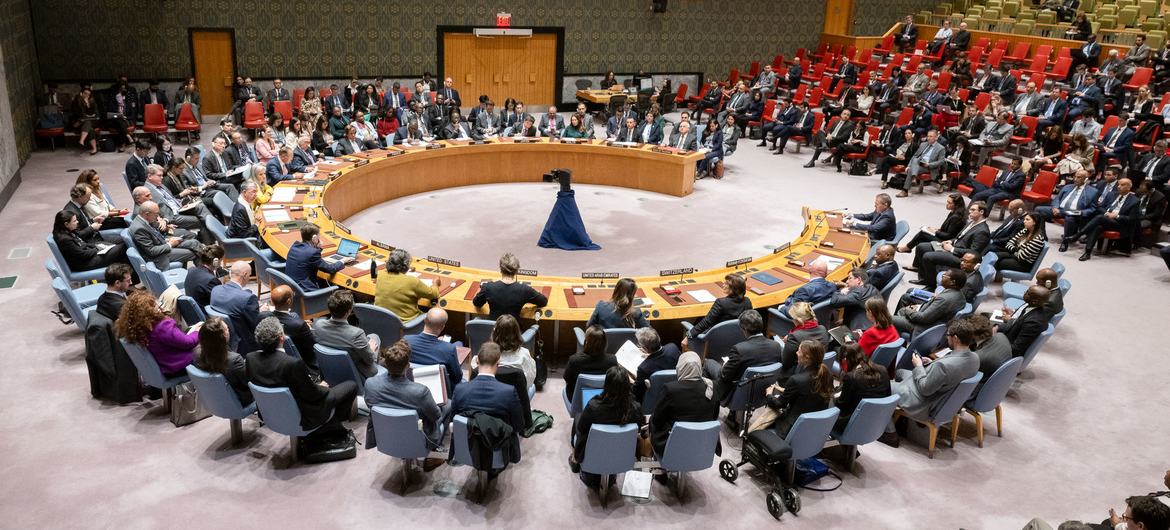
The draft resolution led by Russia received support from five countries (China, Gabon, Mozambique, Russia, and the United Arab Emirates) and opposition from four countries (France, Japan, the United Kingdom, and the United States). Six countries (Albania, Brazil, Ecuador, Ghana, Malta, and Switzerland) chose to abstain from voting.
There was a division among members regarding the absence of a clear condemnation of the extremist group Hamas. It was Hamas that initiated the ongoing escalation of violence by deploying hundreds of fighters to carry out massacres in settlements near the Gaza Strip on 7 October.
For the Council to adopt a resolution, the proposal must receive at least nine votes in favour, with none of its five permanent members opposing or casting a veto.
The initial version of the text had requested a ceasefire for humanitarian purposes, the release of all hostages, access for aid, and the safe evacuation of civilians.
Another version of the resolution, proposed by Brazil, is scheduled for discussion on Tuesday at the Council’s agenda. According to news reports, it proposes humanitarian breaks in the conflict and condemns Hamas and all acts of terrorism against civilians.
Vassily Nebenzia, Permanent Representative of Russia to the UN expressed regret over the Security Council’s failure to adopt the resolution, blaming the “selfish intention of the western bloc.”
During a recent meeting of the United Nations Security Council, the Russian draft resolution to end violence in Gaza was vetoed by Western countries. Russian Ambassador Nebenzia expressed concern over the humanitarian crisis in Gaza and accused those blocking the resolution of doing so for “selfish and political interests”.
However, the US Permanent Representative Linda Thomas-Greenfield argued that the resolution ignored Hamas’ terrorism and therefore could not be supported. She condemned Hamas for their actions, including killing civilians and taking hostages, and stated that the Council should not unfairly shift the blame to Israel.
The Permanent Observer of the Observer State of Palestine to the UN, Riyad Mansour, urged the Security Council to be guided by international law and not to send signals that Palestinian lives do not matter. He noted that what is happening in Gaza is a full-scale assault against innocent civilians. The Permanent Representative of Israel to the UN, Gilad Erdan, called on the Council to designate Hamas as a terrorist organization and to hold it accountable for the situation in Gaza. He also called for the Council to fully support Israel’s right to defend itself and demand the release of all hostages.
The experts were alarmed that hundreds of escapees – the vast majority of whom are women – have been sent back, despite repeated appeals by multiple international human rights bodies. Hundreds more reportedly are in detention awaiting the same fate.
There are long-standing and credible reports that people returned to the DPRK, more commonly known as North Korea, would face serious human rights violations such as torture or cruel, inhuman or degrading treatment and punishment, they said in a statement on Tuesday.
‘Criminals’ and ‘traitors’
The DPRK authorities label citizens “criminals” if they commit “illegal border-crossing”, and “traitors” if any link is found suggesting an “intention to escape to the Republic of Korea”, the official name for South Korea.
“Traitors” receive harsh punishments, including imprisonment without due process, and they may be subjected to enforced disappearance and even execution, the experts warned.
“No one should be returned to a country where they would face the risk of torture, cruel, inhuman or degrading treatment or punishment and other irreparable harm, including the use of the death penalty, and enforced disappearance,” they said.
Respect international law
The rights experts urged China to respect the principle of non-refoulement, which guarantees that no one should be returned to a country where they would face torture, cruel, inhuman or degrading treatment or punishment and other irreparable harm.
They stressed that the principle is guaranteed under international law and must be applied to all individuals at all times, regardless of their migratory status.
The UN experts wrote to Beijing raising concerns over the forcible returns and said they appreciated the official response from the authorities.
They called on China to abide by its international legal obligations and not forcibly repatriate remaining North Korean escapees.
“We welcome the reopening of the border and urge the DPRK to allow UN agencies, other humanitarian organisations and diplomatic missions to return to the country as soon as possible and engage the relevant Special Procedures of the Human Rights Council to review its human rights,” they said.
They also called on the DPRK “to comply with its international legal obligations in respect to all citizens returning to the country, including the absolute prohibition on torture and enforced disappearance, the prohibition of arbitrary detention, and fair trial guarantees.”
Elizabeth Salmón, Special Rapporteur on the situation on human rights in the Democratic People’s Republic of Korea, briefs the Security Council meeting on the situation in the country (file).
They are part of what is known as the Special Procedures of the Council, which is the general name of its independent fact-finding and monitoring mechanisms that address either specific country situations or thematic issues in all parts of the world.
These experts work on a voluntary basis, are independent from any government or organization and serve in their individual capacity.
Interview of Archbishop George of Cyprus (elected on December 24, 2022 and enthroned on January 8, 2023) for “Phileleuteros”, in which he talks about the problems of the Church of Cyprus, the role and responsibility of the Church in society and towards the new generation. He explains what made St. Synod to take a positive decision on the sex education of children at school, criticizes the modern Cypriot processions of relics and holy slippers in churches and answers the teachers of Religion for the cancellation of the non-school day, which in Cyprus was given to students on the name day of the superior of the Church of Cyprus. He also commented on the morning prayer in schools and the problems facing the teaching of Religion.
– How is the new life in the archdiocese going, Your Beatitude?
– The work in the archdiocese is much more than in my former metropolis in Paphos. I encountered problems varying in quantity and quality. With God’s help, everything is overcome. I am aware that the responsibilities are many for the whole Church of Cyprus. I try to be an archbishop whose doors are open to the faithful who want to greet him, ask for a blessing or seek help, to be an archbishop who does not say “no” to those who seek him.
– The positive decision of St. A synod on the sex education of children at school was a pleasant surprise for society. What is it due to?
– I was an educator and a school teacher, I follow the development of society and I know that today, through technology and other means, children are exposed to all this at a very early age. If we don’t say something, it doesn’t mean they don’t know it. They know it, and probably in the wrong way. A responsible leadership will help them stay away from the deviations we don’t want. We have set some conditions – for example, that this training be adapted to the age and receptivity of the children. To be taught by specialists who have certain training and to consider the content of the material with us, but also with the parents.
– Should bishops who do not have children and live celibate have such extreme views on the issue of sexuality and homosexuality?
– It doesn’t matter, there are many unmarried and childless people in society and they have their own opinion on these issues, just like us. We do not live outside society. The fact that the Church requires some people to be celibate in order to hold certain positions (ie the episcopate) does not mean that they are asocial and ignorant of society’s problems. And we have responsibility and knowledge, and we can take positions on these issues.
– The teachers do not agree with the cancellation of the non-school day, which was the archbishop’s name day. What would you tell them?
– Learning time is valuable for all children, not just adults. Having worked in schools, my position is that the archbishop’s name day should not be a non-school day. I would be happy if this day is used for studying. Let the schools not be closed. If the teachers want to go to church in the first period, they can do so, as well as take time in class that day to discuss the role of the Church in the development of our people.
– Religious education and morning prayer in schools in the age of multiculturalism and mixed schools is a divisive issue. What is your position?
– Religion class is not a strict catechism. Depending on the age receptivity of the children, knowledge about other religions is also taught. In the upper grades, children are introduced to the ethical dilemmas that confront them because of technology, science, and bioethical issues. For example, the dilemma: whether they can become organ donors, whether they can trust the in vitro fertilization technology.
Regarding prayer: every living being depends on something that is beyond this world. Even atheists believe in their atheism. That people turn to God and ask for His help is not something that belittles them. And a disciple, when he prays, can receive strength. The problem is created by some who believe that the schools are educating children who are not Orthodox Christians. Let them stand there and pray to their God.
– Holy slippers and holy heads often come to our temples. Doesn’t this go beyond symbolism and the Orthodox religion?
– I’m not in favor of periodically disposing of the relics. I haven’t done it in Paphos either, except twice. Archbishop Macarius only once brought the head of St. Apostle Andrew. However, he never once allowed holy relics to be distributed for commercial purposes for the benefit of the people. I’m against that. When they say that it is the slipper of some saint, and some already speak of it derisively, that is not correct, not least because it is not a shoe that the saint wore. They take a new shoe and place it on the relic to light it. I don’t think this is right and I won’t encourage it. Our faith is spiritual, it should not be subject to abuse.
– What is your attitude towards modern technologies?
– Since I have an education in the field of natural sciences, I try to follow and use technology as much as possible, but I also have an opinion on these issues that pose a danger to people. With so much technology, our judgment and free will are dulled. We follow instructions all the time, and if we hit a dead end, we seek out the expert. This is a result of the excessive information available to us. I support technology, but I am also critical of it. Otherwise, the archdiocese is being modernized digitally. Some European projects are also underway.
– Your Grace, as you said, critical thinking is lost. What is the Church doing to get closer to young people and at the same time protect them from addictions, bad habits and criminal behavior?
– We are in constant contact with parents, teachers and young people. We also have catechism Sunday schools, which are not popular today, they were just an option in the past. There is no free time today. We have church camps where kids detox from their daily habits. We organize meetings on various occasions with the youth, we do not fail to be close to the young generation and convey the messages of Christ.
– The Church in Cyprus and entrepreneurship? Are investments made and how is church property used?
– I found a ready-made project, but it is not a business, but a way to generate income for the social, religious and national activity of the church. To pay the priests, the church has to pay a sum of 4.5 million euros per year. Also there are benefits for needy children, sending patients for treatment abroad, we bear electricity, water and other expenses of poor people. For all these activities we need income which cannot come if we do not use the church property.
– Is today the time of magnificent temples and displays of wealth by the church?
– It is not and never has been, of course. When Judas saw a woman who washed Christ’s feet with precious ointment, and told the Master that it could be sold so that the funds would go to the poor, the Lord rejected the offer. This means that what we do for Christ is not a waste. The fact that we are building bigger temples today is because we have the technology to serve more people. We need temples because it meets the needs of an area. New temples are built where there is a need. This is not money lost. “We must not be the last generation of Greeks in this place.”
– What is your hobby?
– It was always the reading. When I had chemistry exams, my hobby was reading about religion to distract myself, and when I had theology exams, I read chemistry to escape the hustle and bustle of exams. And now I like to read books in the field of chemistry. For example, environmental chemistry.
– Who is your role model in life?
– I lived in a priestly family and I was definitely influenced by my father. Every day we were in the temple morning and evening, we lived according to a religious model and under the shadow of an archbishop. Macarius, who had a strong influence on us. In the national struggles we wanted to follow him, we were fascinated by EOKA (an organization founded by Col. K. Grivas for the accession of Cyprus to Greece, note ed.), we had our heroes, we lived in a real environment at all, not a virtual one like today.
– Has the Church of Cyprus ever been close to schism?
– We have never reached a schism, because our church has the means to prevent one. Let us mention as an example the position of the three metropolitans towards the archbishop Macarius. Then a great council was convened, which solved the problem. And now, if there are different voices and different positions, something better can come out of it. Ultimately, decisions are made either by majority or unanimity. If we come to a major crisis, there is a way to find solutions.
– Has it ever happened that people came to you and told you: take measures for this hierarch, he is doing so-and-so or deviates on some important topic?
– Yes, I meet people personally, I treat their opinion with attention. This is something I do often. I receive alerts and read the newspapers. People are the best criterion. They should send a message to their bishop that they do not accept certain things and demand that they change.
Siobhán Mullally, UN Special Rapporteur on trafficking in persons, said unaccompanied children and children from poor families have reportedly been targeted by the Rapid Support Forces (RSF) militia in the outskirts of the capital Khartoum and elsewhere.
They’ve forcibly recruited women and children especially, she warned.
Girls have also reportedly been abducted from Khartoum to Darfur for sexual exploitation, including sexual slavery.
To date, an estimated 9,000 people have been killed, over 5.6 million driven from their homes in the civil conflict between military Government forces and the RSF, and 25 million people are reliant on aid.
Children ‘easy targets’
“The deteriorating humanitarian situation and lack of access to food and other basic services make children, especially unaccompanied and separated children on the streets, easy targets for recruitment by armed groups,” Ms. Mullally said.
The UN Human Rights Council-appointed expert stressed that recruitment of children by armed groups for any form of exploitation, including in combat roles, is a gross violation of human rights, a serious crime and a violation of international humanitarian law.
Addressing reports that children might be joining armed groups as a means of survival, Ms. Mullally emphasized that the consent of a child – defined as any person below the age of 18 – is legally irrelevant, and it is not necessary to prove the use of force.
Urgent action needed
She also voiced concern over lack of humanitarian access to children.
She called on all parties to the conflict to return to peace talks and reach a comprehensive ceasefire agreement that would allow for the safe delivery of humanitarian assistance and ensure accountability for alleged violations.
“Urgent action is needed to address these pressing concerns and take effective measures to prevent child trafficking and provide effective protection to child victims and children at risk, in particular displaced, unaccompanied and separated children, refugee children and children with disabilities,” Ms. Mullally said.
Independent experts
Special Rapporteurs are appointed by the UN Human Rights Council and form part of what is known as its Special Procedures. The experts are mandated to monitor and report on specific thematic issues or country situations.
They serve in their individual capacity, are not UN staff and do not receive a salary.
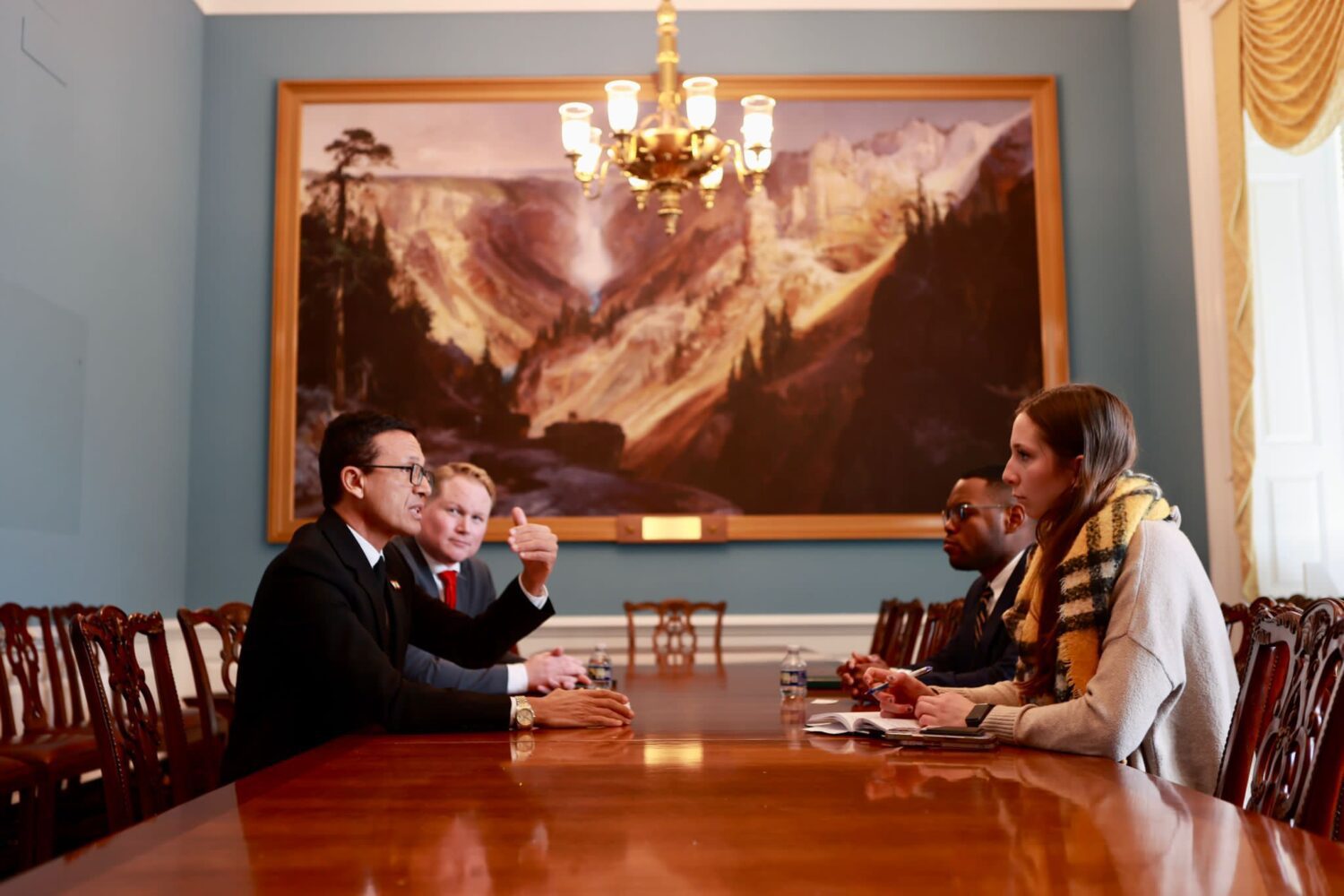
In the midst of the military and political tensions prevailing in the Middle East, the Honorary Chairman of the European Diversity and Dialogue Committee, Omar Harfouche, arrived in the United States of America, specifically to Washington, where he began his meetings in the US Senate.
Harfouch met with members of the US Congress and the Foreign Relations Committee, and the initiator of the Third Lebanese Republic initiative stated that a meeting is now being held in the US Senate and the Foreign Relations Committee will issue a resolution asking the White House to intervene militarily against any party that enters the war on the side of Hamas against Israel, especially Hezbollah.
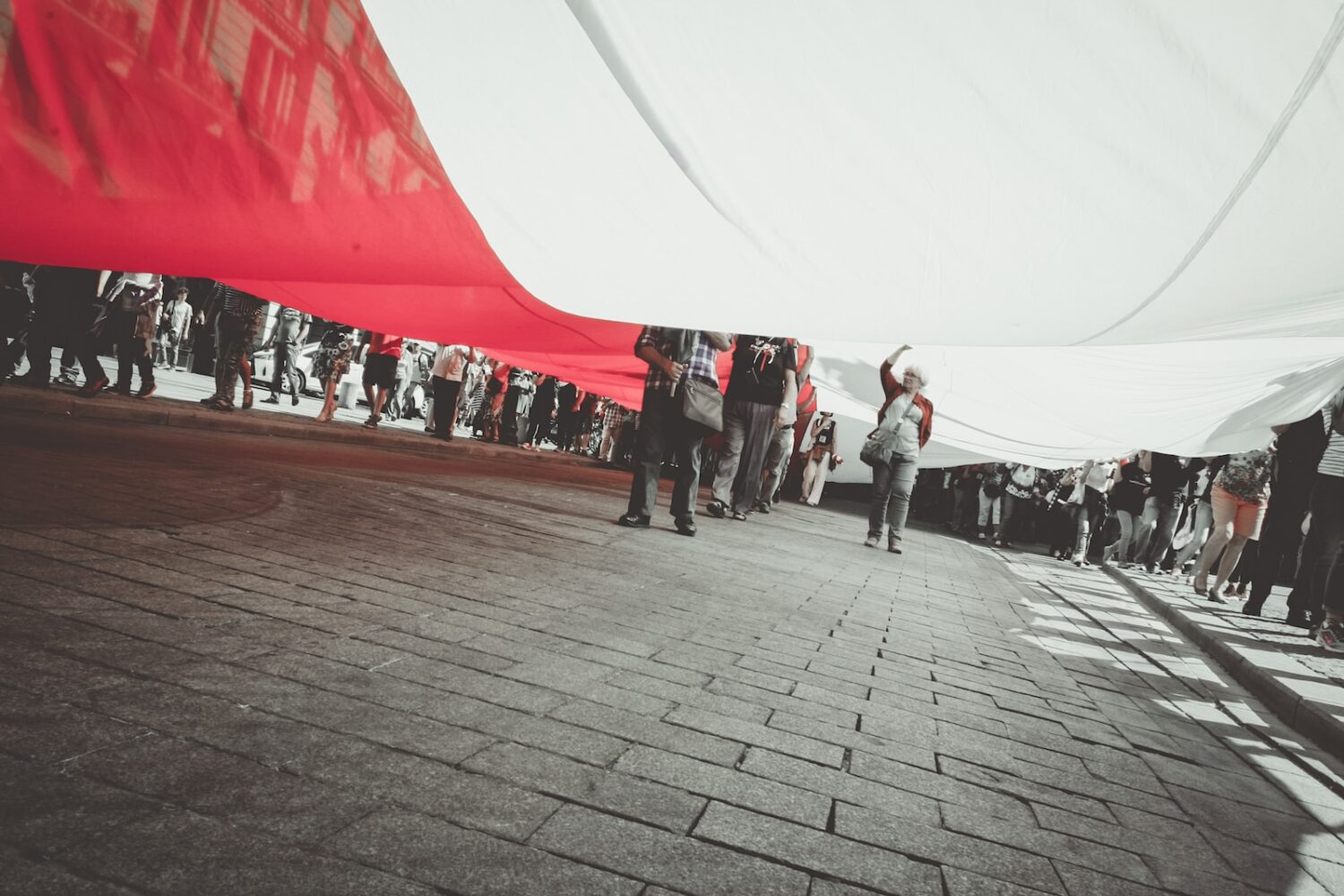
According to an exit poll, the opposition has emerged as the winners of the Polish election. If the vote count validates this outcome, it would signify a significant shift in direction following a fiercely contested election campaign.
WARSAW – The recent general election in Poland suggests that the opposition parties have gained a significant victory, which could bring about a substantial change in the country’s political landscape, as well as have implications for the European Union. The current government, led by the Law and Justice (PiS) party, has been at odds with Brussels for eight years, facing accusations of undermining democratic principles. The opposition’s win could signal a shift in Poland’s relationship with the EU and potentially alter the political dynamics within the bloc.
On Monday afternoon, a final exit poll was published that includes the early vote count. The poll reveals that PiS received 36.1 percent of the support, followed by the centrist Civic Coalition with 31 percent, the center-right Third Way with 14 percent, the Left with 8.6 percent, and the far-right Confederation with 6.8 percent. In the previous year of 2019, PiS had won 43.6 percent of the votes. IPSOS conducted the poll, which was then shared with Poland’s primary television networks.
Despite the Law and Justice party’s initial success in gaining support, their victory can be seen as a hollow one since the three main opposing parties would collectively hold the majority of seats in the 460-member parliament.
According to the exit poll, the voter participation rate was 72.9 percent, setting a new record.
The ruling party utilized the government’s resources to bolster its chances of success, and state media, which is aligned with the ruling party, provided strong support. However, the party faced numerous scandals, including allegations of corruption and the sale of visas for bribes. Additionally, the party’s leadership was marred by eight years of tensions and conflicts with society, including disputes over abortion, the rule of law, grain imports from Ukraine, and strained relations with the EU, which has withheld billions of dollars in funding due to concerns over the rule of law. These factors contributed to a decline in support for the ruling party.
Despite the eleventh-hour introduction of a controversial referendum with multiple loaded questions aimed at discrediting the opposition, the PiS party’s supporters remained unenthusiastic, resulting in an insufficient turnout to legitimize the vote.
It appears that PiS may not win enough seats to have a majority in parliament, even if it teams up with Confederation, which has stated it will not form a coalition with Law and Justice. The remaining three parties have promised to collaborate in order to remove PiS from power.
The final exit poll indicates that Law and Justice is projected to obtain 196 seats, while Civic Coalition is expected to secure 158 seats. Third Way is estimated to win 61 seats, followed by the Left with 30 seats, and Confederation with 15 seats.
The opposition parties, comprising three prominent groups, would hold a combined total of 249 seats in the parliament, while the ruling PiS party and its Confederation ally would have 211 seats.
The tally of votes is anticipated to be concluded and announced by the morning of the following Tuesday.
Surprising Outcome
Jarosław Kazcyński, leader of PiS, considered the outcome a success for his party, but acknowledged the uncertainty regarding its impact on their tenure in government. He expressed hope that they would be able to translate this achievement into another term in office, while also emphasizing their commitment to advancing their agenda, whether they remain in power or move into opposition.
He emphasized that his party is committed to seeing its program through to completion.
The outcome brought great enthusiasm to Donald Tusk, the head of the Civic Coalition.
“I have never been so happy in my life with this supposed second place, Poland won, democracy won. We removed them from power,” said ex-prime minister and European Council president, played a pivotal role in bolstering the opposition’s aspirations upon my reentry into Polish politics in 2021. “We will create a good new democratic government with our partners,” he said, denouncing the past eight years of “evil.”
The opposition pledged to restore and strengthen relations with the European Union.
Robert Biedroń, a prominent figure of the Left, announced that Poland will be rejoining Europe on October 15th.
After the vote count is completed, President Andrzej Duda will be responsible for the next step. He has indicated that it is customary for presidents to select a member from the largest party to be nominated as the prime minister, allowing them the initial opportunity to assemble a government.
Despite the potential partnership with Confederation, Law and Justice (PiS) is unlikely to secure enough seats in parliament to attain a majority, according to Sean Gallup/Getty Images. In such a scenario, the president’s chosen candidate would have two weeks to form a government and seek a parliamentary vote of confidence. If unsuccessful, the parliament would then have the opportunity to nominate a prime minister.
Poland’s recent election was characterized by an exceptionally contentious and divisive campaign season, one that stands out as one of the most acrimonious in the country’s history of democratic politics.
Kaczyński portrayed the opposition as a significant danger to the country’s existence. He alleged that Tusk was colluding with Berlin and Brussels to undermine Poland’s autonomy and allow an influx of migrants from Muslim nations.
The criticism suggests that if PiS is re-elected for a third term, it would solidify their grip on power and steer Poland towards an authoritarian system, similar to Hungary’s, where the government has considerable influence over the judiciary, media, and state-owned enterprises, thereby undermining Poland’s democratic foundations.
“We will be keeping an eye on these elections throughout the night,” Tusk said. “As you know, tens of thousands of people are sitting in the precincts. They are watching, no one will steal these elections from us anymore. We will guard every vote.” Tusk stressed that every vote will be safeguarded, and that the organization will not allow any attempts to manipulate the outcome.
Every effort continues to be made by the United Nations and partners to get aid supplies into Gaza following the Israeli order to evacuate the north of the enclave, the UN’s emergency relief chief said on Monday.
“History is watching,” Emergency Relief Coordinator Martin Griffiths told UN News in Geneva, highlighting the desperate situation facing around one million Gazans uprooted in the last week, after the Israeli military warned of an imminent offensive following the deadly 7 October attacks on Israel by militant group Hamas, which has controlled the Gaza strip since 2006.
“Aid access is our overwhelming priority. And we are in deep discussions hourly with the Israelis, with the Egyptians, with the Gazans about how to do that,” Mr. Griffiths said, adding that he was optimistic about hearing “some good news” soon that a solution could be found to the political impasse which has prevented aid convoys crossing from Egypt’s Rafah into southern Gaza.
The top UN aid official was speaking before heading to the Middle East, “trying to help, working with diplomats from all countries” to secure aid access and de-escalate the tinderbox situation, which UN Secretary-General described on Sunday as being on the “verge of the abyss”.
International responsibility
“It’s all Member States who have obligations…not just those in the region” to defuse the worst Israeli-Palestinian conflagration in decades, Mr. Griffiths continued. “The United States, the United Kingdom, the European Union and the Arab world all have obligations” to ensure that the lives of civilians are protected and the rules of war observed.
“Don’t attack civilian infrastructure, protect civilians when they move,” the UN official insisted. “Make sure they get the aid they need and make sure that there are corridors which allow them some respite from the relentless attacks that are happening upon them.”
Hostage crisis
Among the key issues facing diplomats is securing the release of a reported 199 Israeli hostages, seized during the Hamas raid, the UN emergency relief chief continued.
“This war was started by taking those hostages. Of course, there’s a history between Palestinian people and the Israeli people, and I’m not denying any of that. But that act alone lit a fire, which can only be put out with the release of those hostages.”
Amid ongoing airstrikes in Gaza and concerns over a regional escalation of the conflict – especially on the northern border with Lebanon – Mr. Griffiths reiterated the need for humanity to prevail.
“History is watching to see if the consequences of this war are going to be generationally bad or if there are going to be ways in which swiftly that can be rebuilt, some kind of comity or neighbourliness between those two tragic peoples. …(Those are) the messages I’ll be taking to the region about biased in favour of one or the other, that biased in favour of humanity.”
Toll mounts
Since the start of the war, which has claimed the lives of some 1,300 Israeli citizens and injured 3,200 more, a reported 2,750 people have been killed in Gaza and more than 7,500 wounded.
Fourteen staff from the UN agency for Palestinian refugees, UNWRA, have also been killed. “They were teachers, engineers, guards and psychologists, an engineer and a gynecologist,” Commissioner-General Philippe Lazzarini told journalists on Sunday.
Medical aid to Lebanon
The World Health Organization (WHO) has rushed critical medical supplies to Lebanon in order to be ready to respond to any potential health crisis there.
Two shipments arrived in Beirut on Monday from WHO’s logistics hub in Dubai, and include enough surgical and trauma medicines and supplies to meet the needs of 800 to 1000 injured patients. The Lebanese Ministry of Health is in the process of identifying the referral hospitals that will receive these vital supplies.
Lebanon’s health system has been crippled as a result of an economic crisis, the Beirut port blast that occurred in August 2020, and the additional burden of the Syrian refugee crisis. There are severe shortages of specialized medical doctors and health workers, and medicines and medical equipment.
Since violence escalated between Israel and the occupied Palestinian territory last Saturday, there have also been reports of clashes on the border between Israel and south Lebanon, resulting in casualties among civilians.
Latest updates from UNRWA:
Over one million people – almost half the total population of Gaza – have been displaced. Some 600,000 Internally Displaced Persons (IDPs) are in the Middle Area, Khan Yunis and Rafah, of those, nearly 400,000 are in UNRWA facilities – much exceeding our capacity to assist in any meaningful way, including with space in our shelters, food, water or psychological support.
Despite the Israeli Forces’ evacuation order, an unknown number of IDPs remain in UNRWA schools in Gaza city and the North. UNRWA is no longer able to assist or protect them. Over 160,000 IDPs were sheltering in 57 UNRWA premises.
The number of killed is increasing. There are not enough body-bags for the dead in Gaza.
There is some water available in local shops, but rations are still down to one litre of water per person per day for the UNRWA teams in the Rafah logistics base (to cover drinking and all other needs).
People across Gaza have severely limited access to clean drinking water. As a last resort, people are consuming brackish water from agricultural wells, triggering serious concerns over the spread of waterborne diseases.
After five days, Gaza has had no electricity, pushing vital services, including health, water and sanitation to the brink of collapse.
UNRWA has sent an advance team to Egypt to prepare for the possible opening of a humanitarian corridor to bring humanitarian aid supplies into the Strip.
As of Sunday only eight UNRWA health centres were operational across Gaza providing primary health-care services, with estimated supplies of less than one month.
There are a total of 3,500 hospital beds in Gaza. Evacuation orders apply to 23 hospitals in Gaza and north Gaza, adding up to 2,000 beds.
HAMAS is a terrorist military structure that does not desire the well-being of the Palestinian people, but rather the elimination of the Jewish people, down to the last Jew
I think no one doubts that HAMAS is a terrorist organization. However, the West has lost perspective on a conflict that was not precisely started by the Jews. The facts are clear. One town is attacked by another and has the right to defense, and to the best possible defense, against a terrorist organization that, we must not forget, began by murdering civilians, including women and children.
HAMAS is a terrorist military structure that does not desire the well-being of the Palestinian people, but rather the elimination of the Jewish people, down to the last Jew, no matter how old he or she is. That is the maxim of a totalitarian organization whose only interests are to sow horror and serve the interests of Iran and other deeply ideologized countries with which it is not possible to understand each other.
HAMAS, as a totalitarian organization, is what keeps the Palestinians of the Gaza Strip oppressed, not Israel. In fact, this religious organization is the one that bombed one of the possible exits through the Egyptian border, to hinder the movement of men, women and children who wanted to escape the horror. As a sectarian and totalitarian organization, it uses as human shields thousands of people whom it has asked not to leave the Strip and has made their exit difficult with its permanent actions.
HAMAS, in its madness showing the images of kidnapped children, in the arms of masked terrorists, continues to provoke the Jews. We have arrived, in this absurdity of violence and communicative voracity, to the grotesque spectacle of seeing how images of stabbing, cutting the throat, or shooting in the back of the head are proudly disseminated by those who commit them, as a form of communication. HAMAS’s greatest achievement with its attack on Israel has been to set the Middle East on fire again, without caring one bit about its own people. What was the fault of the hundreds of young people, adolescents murdered mercilessly in the rave for peace in the desert? The hundreds killed by HAMAS in the Kibbutz, where the terrorists entered house by house and killed men, women or children, including babies a week ago, seem to count for no one in the West.
This morning I was listening to a program on Antena 3 (Spain) Public mirror, to a Spanish woman living in the West Bank, married to a Palestinian, Juani Rishmawi spoke of the pain caused by the images of the children who have died under the selective bombing of the Israeli forces and echoed the pain of all of them, for the love that Palestinians feel for their children. However, I have not heard her comment anything about the children that the terrorists keep kidnapped, using them as human shields, or about those who murdered and continue to do so whenever they can. This false morality, this hatred of others, this demonization of the other within Islam is a constant that clouds the rationalization of a conflict entrenched in a Manichean way of understanding religion.
HAMAS is undoubtedly a destructive sect that has held the Gaza Strip hostage. We will be able to establish calls for peace, we will be able to sit down the Jews, Egyptians, Lebanese, Arabs, and talk about peace, about pacts, but we will not be able to sit down the Afghans, Iranians or other radical groups, simply because their way of understanding life is sexist. , misogynistic and above all without conscience. We can talk about human rights in the Gaza Strip, and we see how despite their strategy, the United States and Egypt are trying by all means to build bridges with Israel. The entry of the army has been delayed because the Jews do not want to be atrocious, but as a people, they have historically learned that if they do not defend themselves they will be murdered. What are the gestures that HAMAS has made to try to stop the exodus of its compatriots? Show corpses, show images and boast about being as cruel as DAEHS or ISIS. The reality of the war that we are seeing was clearly described to us in his words, the war correspondent of Radio Nacional de España, Fran Sevilla, when in one of his chronicles he explained: “The videos of the kidnappings and murders of Israelis are being released by HAMAS; those of the bombings of Gaza, by the Israeli Army; and the images of those killed in Gaza, by Palestinian journalists authorized by HAMAS.”
It is the terrorists, with the use of information, who control the flow of what the average viewer sees on their screens. Interested and biased information that the West shows shamelessly, without knowing that it is unwittingly becoming an accomplice of terrorists who only want publicity. It had never happened before that the assassins themselves wanted to show images of their exploits. And this retransmission of images induced by terrorism increases hatred so that this call to lone wolves around the world, begin to commit atrocious actions, such as the murder of a teacher in France.
Until we understand the conflicts that radical Muslim groups are leading us into, until we understand that they do not represent Islam, and until we understand that groups like HAMAS only serve their own interests, there will continue to be atrocities. And to conclude this approach to voracious terrorism, a question is why HAMAS has not returned the kidnapped people and thus prevented the exodus of the inhabitants of the Strip, perhaps because that does not serve their interests?
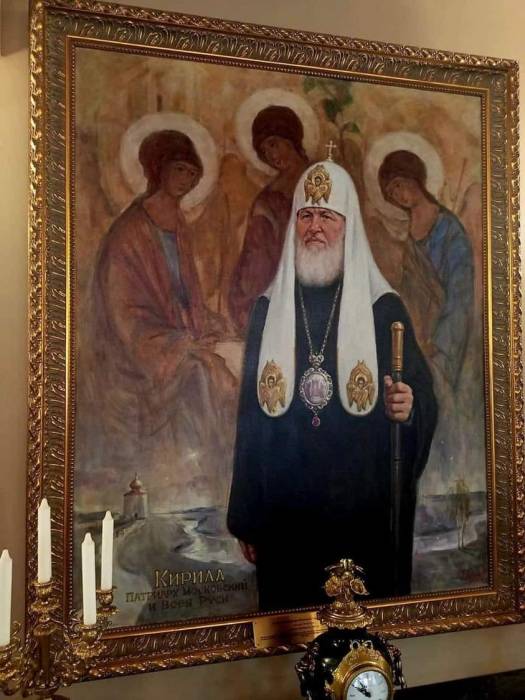
The presence of a painting featuring Patriarch Kirill in the reception hall of the Danilovsky Monastery has sparked controversy among social media users.
After the spokesperson for the Russian Orthodox Church Vladimir Legoida, shared the outcomes of a meeting by the Holy Synod people initially believed that it was a manipulated image intended to tarnish the reputation of the Russian patriarch. However it was later revealed that the painting is a piece and holds a prominent position in the patriarchal residence for everyone to see.
The painting portrays Patriarch Kirill standing against a backdrop of three angels from Andrei Rublevs “Holy Trinity” icon. At his feet lies Holy Rus symbolizing his role as a bridge between heaven and earth—according to the artists interpretation—placed on footing with each member of the Holy Trinity.
While some may view this artwork as kitsch and consider it opportunistic it undeniably conveys a clear message about the prevailing ideology, within the Russian Church at this time. It’s quite surprising that the grandiosity of the image bordering on sacrilege went unnoticed as problematic. Despite this the painting was prominently displayed in the residence potentially evoking a sense of awe and an understanding of Patriarch Kirill significant role in history for all visitors.
The painting sparked discussions on social media platforms with some taking a satirical approach. One comment humorously: “The Patriarch Kirill already deified and became the fourth person of the Trinity during his lifetime. It is clear that the original Trinity is now obsolete and unnecessary.”
According to more serious remarks the intention was to portray Cyril as a patron saint akin to Abraham being the “father of nations.” However traditional iconography rarely emphasizes Abraham in a manner. He is typically portrayed towards the end. Often in the background rather than, at the center of attention compositionally. Furthermore Abraham is depicted serving and entertaining than “revealing” himself amidst angels. His figure also lacks any emphasis through color accents. In this case Cyril is portrayed as being on the level as the Holy Trinity and even surpasses it visually overshadowing the central angel and essentially replacing it in terms of composition.
The artist behind this portrait doesn’t really attribute any significance to the Old Testament theophany (the appearance of God). Their focus is not on God but rather, on highlighting Cyrils greatness. This results in a nonsensical situation where from a meaning standpoint Cyril takes precedence over the Trinity. The fact that the patriarch approved hanging this uninspiring “art product” in his residence suggests that he appreciates this portrayal…
The World Council of Churches released a statement admitting that its months-long efforts to organize Ukraine Round Table had failed.
The attempt by the World Council of Churches (WCC) to bring together around a round table the two Ukrainian Orthodox churches, the Orthodox Church of Ukraine led by Metropolitan Epifany and the Ukrainian Orthodox Church under the leadership of Metropolitan Onufriy, linked to the Patriarchate of Moscow, to a dialogue table has failed.
The organization of the round table has included visits to Russia and Ukraine, but none of the Orthodox churches involved in the conflict has agreed to dialogue with the others. Both Ukrainian churches were categorical in their reluctance to talk.
The WCC statement said: “Unfortunately, despite the efforts we have made over the past months, the practical and political obstacles to the participation of the Ukrainian Orthodox Church (UOC) and the Orthodox Church of Ukraine (OCU) as the main participants in such a dialogue process for now make our plans impossible. We continue to believe that the participation of both the Ukrainian Orthodox Church and the Ukrainian Orthodox Church is an essential basis for the dialogue process we envisage to promote social cohesion among the people of Ukraine on its path as a free and independent nation, and for the broader search of peace in a deeply divided and conflicted world’.
“We pray that God will lead us forward on the path to peace and that circumstances and perspectives will change so that dialogue becomes possible,” the statement concluded.
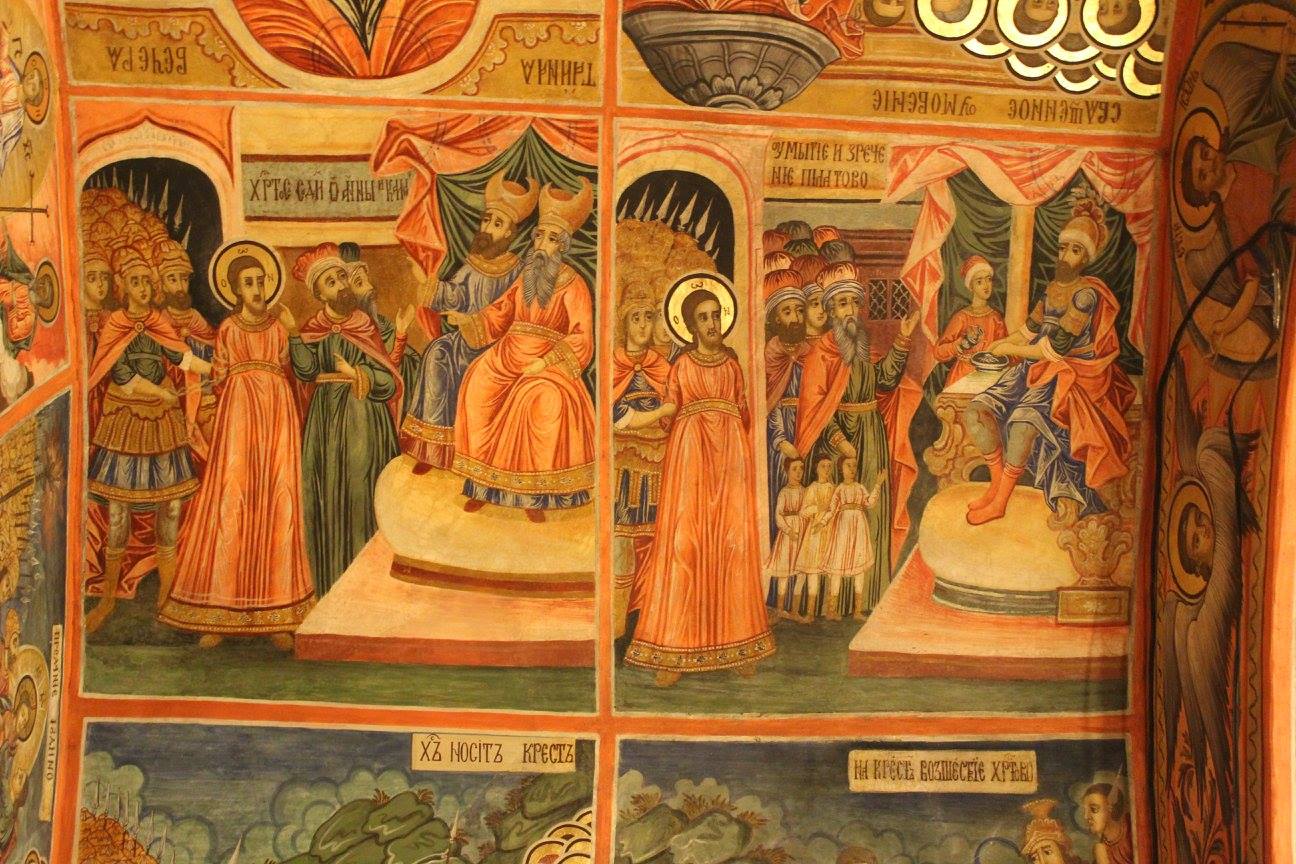
Photo: Pontius Pilatus (fresco by Zahariy Zograf, monastery of Transfiguration, Bulgaria). The frescoes in the church are the work of the notable representative of the Samokov school of painting and date from 1849-1851.