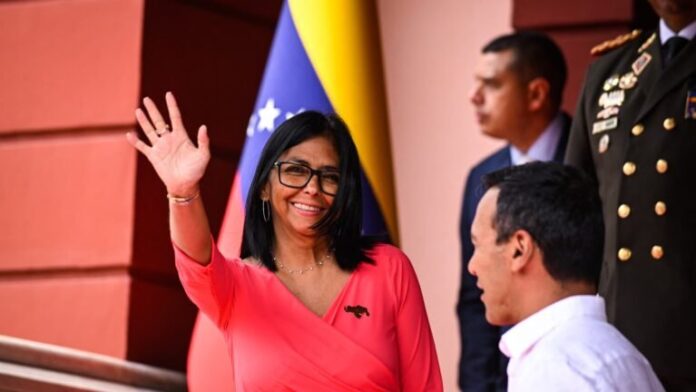
Venezuela’s interim president, Delcy Rodriguez, wore a pin representing her country and including Essequibo, a 160,000 km² oil-rich territory administered by Guyana but whose borders are at the heart of a dispute with Caracas.
Guyana’s President Irfaan Ali complained Tuesday about a brooch worn by Venezuela’s interim President Delcy Rodriguez during two official visits to the Caribbean, depicting his country’s map including Essequibo, a disputed region between the two countries.
This oil-rich territory of 160,000 km² has been administered by Guyana for more than a century but is at the heart of a dispute with Venezuela, the two countries opposing each other over the course of their common border. Repeated calls by deposed President Nicolas Maduro for the annexation of Essequibo have raised fears of armed conflict.
Former vice-president, Delcy Rodriguez, who succeeded Nicolas Maduro after his capture by the American army on January 3, was notably responsible for the Essequibo case before the International Court of Justice (ICJ). During her two official visits abroad this month, first to the island of Grenada and then to Barbados, Delcy Rodriguez wore a gold brooch depicting a map of Venezuela including the Essequibo.
“Ostentatious exhibition of symbols”
Guyana Irfaan Ali considered it “deeply regrettable” that, during these meetings, we could see “the ostentatious exhibition of symbols” affirming Venezuela’s territorial claim to this disputed area.
In a letter sent to the Caribbean Community (Caricom), the Guyanese president believes that neighboring Venezuela cannot claim to normalize, through symbols, maps, legislation, appointments or official exhibitions, an issue that remains to be resolved.
“Using CARICOM meetings to project or promote a territorial claim against a member state risks being interpreted as consent or tolerance. No act, whether deliberate or unintentional, should give the impression that Community platforms can be used to advance claims currently before the International Court of Justice,” he added.
The Maduro government relaunched territorial claims from 2019. In 2023, it organized a referendum on the creation of a new state as part of Venezuela, then in 2025 it chose a governor and deputies for this area, over which Caracas exercises no power. Guyana’s president said in early February that Maduro’s overthrow “does not eliminate or reduce” what he sees as a threat from Caracas to the Essequibo.
Hunger is pushing 56 per cent of South Sudan’s population into high levels of acute food insecurity between April and July 2026, reaching Phase 3 or above on the world’s hunger classification system, the IPC.
Among those projected to face acute food insecurity, 73,300 people are facing catastrophic levels (Phase 5), the most severe level under the internationally-backed alert system. This represents a dramatic increase of 160 per cent from the last estimate.
UN agencies said the crisis is being driven by escalating conflict, mass displacement, economic decline, climate shocks, flooding and below-capacity agricultural production.
Meanwhile, 2.5 million people are in IPC Phase 4 – Emergency level, and 5.3 million are in Crisis (IPC Phase 3).
Lack of services
In Jonglei alone, nearly 300,000 people have been displaced, leaving many communities cut off from humanitarian assistance, while rising food prices, disrupted markets, and weak household purchasing power are further deepening food insecurity.
At the same time, acute malnutrition is being exacerbated by lack of access to health and nutrition services that have been damaged or closed due to conflict.
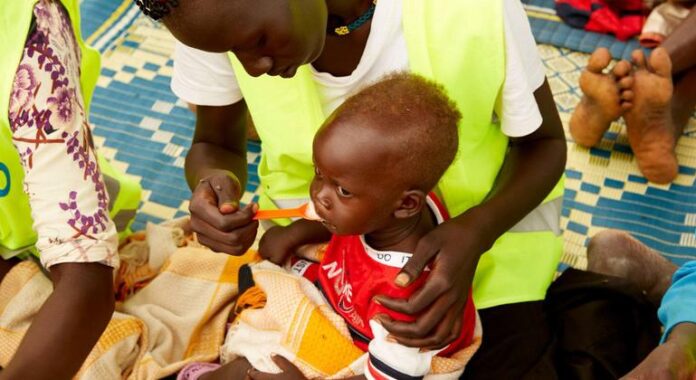
In addition, shortages of supplies and funding have reduced access to life-saving treatment. Disease outbreaks, including cholera, malaria, and measles, are compounding the crisis, particularly among vulnerable and already acutely malnourished children.
Risk of famine
The UN agencies warn of a credible risk of famine in four counties across Upper Nile and Jonglei states.
The IPC projects 11 counties across Upper Nile, Unity, and Jonglei states to face IPC Acute Malnutrition Phase 5 (Extremely Critical) outcomes.
Humanitarian assistance is being scaled up in some areas, but coverage remains uneven, with some communities still inaccessible and receiving little or no support.
“Since the beginning of the year, we have seen a significant increase in conflict in Jonglei and Upper Nile and repeated blockages in our attempts to access people in these areas,” said Ross Smith, WFP’s Director of Emergencies and Preparedness.
“We are now engaged in a critical race against time to expedite and increase our deliveries to remote locations in anticipation of an early rainy season” he added.
Children bearing the burden
For children, the nutritional situation has continued to worsen. The number aged six months to five years facing acute malnutrition has increased by 100,000 cases when compared to six months ago.
Through July this year, 700,000 children are projected to face severe acute malnutrition, the deadliest form. Similarly, 1.2 million pregnant and breastfeeding women are acutely malnourished, placing both mothers and infants at heightened risk.
“Conflict is hitting women and children the hardest. These children are the future of the country, but without urgent support, that future is at risk,” Mr Smith said.
The UN is calling on the international community and governments to act immediately, with critical funds needed to prevent further deterioration and support food assistance, nutrition programmes, clean water and sanitation, and health services.
In terms of trusted hosting, the German SAP has, to date, chosen cloud technologies from Microsoft and Google – but from French joint ventures. After Bleu in March, the publisher signed a partnership with S3NS, owned by Thales and Google.
In this context, SAP Sovereign Cloud will deploy the publisher’s ERP solution (SAP RISE private Cloud Edition) on PREMI3NS, the qualified SecNumCloud offer from S3NS. Availability of the service is announced for the second half of the year.
Data hosted, processed and encrypted in France
For users of the SAP cloud edition, this hosting means data “hosted, processed and encrypted in France, under French jurisdiction.” And who says cloud means, compared to an on-premise ERP, access to the latest functionalities, notably AI.
SAP RISE private Cloud Edition has a first customer: Thales. The majority shareholder of S3NS plans “a transformation of its entire SAP ERP”. In this context, the deployment will be done in “clean core” mode.
The SAP cloud migration project aims to unify key processes, “in the finance, supply chain, production and purchasing sectors.” For the German, this contract is an opportunity to highlight the benefits of its offer for the regulated sectors in France.
Cloud ERP for sensitive customers
Thales also intends to take advantage of this agreement to attract new customers to its trusted cloud. According to him, the partnership with SAP makes it possible to remove the obstacles to the adoption of the cloud in certain sensitive industries.
Public administration, aeronautics and defense, but also operators of essential and vital services are thus targeted by the ERP offer in the SecNumCloud environment. It will of course remain to convince SAP customers to give up on-premises.
These customers will undoubtedly closely follow the outcome of the investigation opened in 2025 by the EU against the publisher. The Commission suspects SAP in particular of requiring the use of its maintenance services for its on-premise ERPs.
30 managed services available and 30 to come
As for S3NS, it has been qualified as SecNumCloud since last December. This valuable label allows it in principle to accelerate its development. The cloud provider claims to date “more than sixty customers”.
Last November, and to complete its private cloud, EDF signed with suppliers Bleu and S3NS. The energy company announced that it would equip itself with a trusted cloud for the “secure and sovereign” storage of its data.
In the race for offers, S3NS announces that it will complete its portfolio comprising 30 managed services “with 30 additional services in the next 12 months”. For this, it can count on the existing GCP. Moreover, Vertex AI services are planned among the new features to come.
وقال دميتري بيسكوف، المتحدث الرسمي باسم الكرملين، إن روسيا لا تنظر في إمكانية الخروج من “أوبك+” داخل التحالف.
وجاء ذلك ردا على سؤال صحفي حول مستقبل العضوية الروسية، حيث قال بيسكوف باختصار: “لا”.
” أوبك+ »، معتبرا أنها تساهم بشكل كبير في تقليل التقلبات في أسواق الطاقة وتحقيق استقرارها. وأضاف أن موسكو تحترم القرار السيادي لدولة الإمارات العربية المتحدة، التي أعلنت مؤخرا انسحابها من « أوبك » و »أوبك+ » اعتبارا
روسيا تؤكد استمرار مشاركتها في “أوبك+” رغم انسحاب الإمارات
أعلن دميتري بيسكوف، المتحدث الرسمي باسم الرئاسة الروسية ” أوبك+ »، نافياً أي تغيير في موقف البلاد داخل التحالف. جاء ذلك رداً على سؤال صحفي حول مستقبل العضوية الروسية، حيث قال بيسكوف باختصار: “لا”.
” أوبك+ »، معتبراً أنها تساهم بشكل كبير في تقليل التقلبات في أسواق الطاقة وتحقيق استقرارها. وأضاف أن موسكو تحترم القرار السيادي لدولة الإمارات العربية المتحدة، التي أعلنت مؤخرا انسحابها من « أوبك » و »أوبك+ » اعتبارا من الأول من مايو، بهدف زيادة إنتاجها النفطي بعيدا عن قيود الحصص المقررة.
يُذكر أن مسؤولين إماراتيين أوضحوا أن الانسحاب يسمح لأبوظبي بتوسعة إنتاجها النفطي دون التقيد بسقوف الإنتاج التي يفرضها التحالف.
المصدر: RT
من الأول من مايو، بهدف زيادة إنتاجها النفطي بعيداً عن قيود الحصص المقررة.
يُذكر أن مسؤولين إماراتيين أوضحوا أن الانسحاب يسمح لأبوظبي بتوسعة إنتاجها النفطي دون التقيد بسقوف الإنتاج التي يفرضها التحالف.
Mike Etienne (James) and D’Johé Kouadio (Nour), in “Dao”, by Alain Gomis. DAY2FESTE
THE “WORLD’S” OPINION – NOT TO BE MISSED
In 1999, the first short film signed by Alain Gomis was entitled Tourbillons, and it is precisely this experience that his latest feature film invites us to, that of a great human tornado which whirls on itself and makes you dizzy. In addition to the reasons for exile linked to his exploration of Afro-descendant diasporas (L’Afrance, 2001; Andalucia, 2008), the 54-year-old Franco-Senegalese filmmaker also demonstrated his taste for ritual, with the funeral farewell tour of Aujourd’hui (2013) or the feverish singing tours of Félicité (2017). Dao, a long film lasting more than three hours, presented at the Berlinale in February, is this time entirely built on two intertwining ceremonies.
The film revolves around Gloria (Katy Correa), “a French woman of African origin, a working mother who lives within a community”, as she describes herself in the introduction. Two decisive events fall upon him. On the one hand, she marries her daughter Nour (D’Johé Kouadio) in the Paris suburbs. A year earlier, she went to a small village in Guinea-Bissau to attend her father’s funeral and perform the sacred rites. Using parallel editing, the film compares the two ceremonies, returning marriage to mourning, and vice versa, in a cycle that transcends space and time. “Dao”, the key term of Taoism, is this “perpetual and circular movement, which flows in all things and unites the world”, as recalled by a highlighted card.
You have 71.26% of this article left to read. The rest is reserved for subscribers.
In a new Child Alert report titled Darfur: 20 Years On, Children Under Threat, UN children’s agency UNICEF warns that while the horrors of 2005 are repeating, the scale of need is now far greater, and international attention is dangerously constrained.
A worsening crisis of violence
The report draws a chilling parallel between the past and the present. Homes, schools, and hospitals are again under fire, but the modern nature of the fighting between rival militaries has become even more lethal.
Over 1,300 children have been killed or maimed in the city – which was held by military Government forces until being overrun by RSF militia after a lengthy siege last October – many by explosive weapons and drones.
Beyond the physical strikes, children face the trauma of abduction, recruitment into armed groups, and sexual violence.
“Twenty years ago, the world united in outrage at the suffering of children in Darfur. Today, a new generation of children is living through horrific violence, hunger and terror,” said Catherine Russell, UNICEF Executive Director.
Across the whole of Sudan, the UN has verified over 5,700 grave violations since the current war began. The trend is accelerating: in the first three months of 2026, child fatalities rose significantly compared with the previous year.
Barriers to lifesaving aid
Despite the collapse of infrastructure and the spread of famine, humanitarian efforts are being strangled by insecurity, bureaucratic hurdles, and a massive funding gap. Many families in North Darfur remain entirely cut off from food and safe water due to prolonged sieges.
While UNICEF and its partners continue to provide mobile health services and malnutrition treatment, the report warns that aid is not reaching those at the greatest risk.
“We cannot allow history to repeat itself,” Ms. Russell urged. “Children in Darfur need protection and sustained humanitarian access. The parties to this conflict must end this brutal war.”
UNICEF is calling for an immediate end to violations against minors and urging international donors to provide flexible funding to support those displaced both within Sudan and across its borders, particularly into overstretched communities in eastern Chad.
In front of the theater where the ABC show “Jimmy Kimmel Live!” » on Hollywood Boulevard, Los Angeles, April 28, 2026. LAUREN JUSTICE/REUTERS
Donald Trump’s attacks on host Jimmy Kimmel reached a new milestone on Tuesday April 28. The US telecoms regulator ordered ABC, which broadcasts Mr Kimmel’s show, to submit a new license application. The democratic opposition denounced an act of censorship.
Melania and Donald Trump have called for the comedian’s departure following a joke they consider a call to violence. The regulator, the FCC, does not justify its decision in the administrative opinion. Requested by Agence France-Presse (AFP), she did not respond immediately.
Contacted by AFP, Disney, ABC’s parent company, confirmed having received the request from the FCC and said it was “confident in the fact that our service records [démontraient] that we have the qualifications for these licenses.” These were initially due to expire between 2028 and 2031 as part of the ordinary process resulting in a renewal request.
After the intrusion of a shooter, since charged with attempted assassination of the president, during the press gala in Washington on Saturday, the first lady, Melania Trump, called for the ouster of Jimmy Kimmel, whose “rhetoric of hatred and violence” she denounced. She was referring to a joke from the host of the late-night talk show “Jimmy Kimmel Live!” » during the program broadcast on Thursday.
During a sequence parodying the White House Correspondents’ Gala, which was held two days later in Washington, Jimmy Kimmel pretended to address Melania Trump, “beaming like a widow in the making”, as he put it.
After Melania Trump, it was her husband who attacked Jimmy Kimmel on Monday, saying that he “should be fired immediately by Disney and ABC” for this “despicable call to violence”.
During his show broadcast later Monday, Jimmy Kimmel did not apologize and explained that this “very nice little joke” was an allusion to the age difference between the presidential spouses and to the often severe appearance of the first lady, but not a call to violence.
An “abuse of power”
In mid-September, ABC temporarily removed Jimmy Kimmel’s show from the air for comments deemed inappropriate by the host following the assassination of ultraconservative influencer Charlie Kirk. This suspension was notably suggested publicly by the president of the FCC, Brendan Carr.
Read also |Article reserved for our subscribers Donald Trump against the media: the written press resists, but the ABC channel suspends host Jimmy Kimmel
Read later
Appointed by Donald Trump, the manager threatened, in March, to deprive certain channels of license which he accused of “distorting” information and “promoting false theories”. To avoid this outcome, he called on them to “correct the situation”, believing that “the general public [avait] lost confidence in traditional media.
The Memorable World
Test your general knowledge with the editorial staff of “Le Monde”
Test your general knowledge with the editorial staff of “Le Monde”
Discover
Newsletter
“In the news”
Every morning, browse the essential news of the day with the latest headlines from “World”
Register
Event
Info lecture halls
In the age of AI and social networks, information is being questioned: at the “Amphis de l’Info” journalists come to meet you.
Discover
The World Application
The Morning of the World
Every morning, find our selection of 20 articles not to be missed
Download the app
Newsletter subscribers
” International “
The essential international news of the week
Register
Event
Info lecture halls
In the age of AI and social networks, information is being questioned: at the “Amphis de l’Info” journalists come to meet you.
Discover
“Remember when they were campaigning for free speech? », Reacted, on X, the elected Democrat in the House of Representatives Greg Landsman, in reference to the Republicans. “Using the FCC to attack political adversaries is an abuse of power and [un acte] incredibly childish,” he continued.
“We cannot tolerate these attacks on the press, the entertainment media or those who express their opinion,” urged his colleague in the House, April McClain Delaney, calling on elected officials to “protest.” »
Stephen Colbert’s ‘Late Show’ removed
In July, the Skydance Media group agreed, at the request of the FCC, to make editorial changes within the CBS channel, often criticized by Donald Trump, to obtain the green light for the acquisition of Paramount Global.
A few days earlier, CBS had announced the removal of a show competing with Jimmy Kimmel’s, Stephen Colbert’s “The Late Show”. The latter had just described as a “good big bribe” the compensation of 16 million dollars paid by Paramount Global, parent company of CBS, to settle proceedings brought by Donald Trump.
In December 2024, ABC had already agreed to settle another dispute also initiated by the Republican billionaire, by paying $15 million.
Brendan Carr “is using his power to silence divergent opinions, on orders from the president,” commented the co-director of the media freedom organization Free Press, Jessica Gonzalez, in a statement.
Also read the editorial of “Le Monde” | “Free speech” under siege in the United States
“I’m a bit of a careless feminist.” Long interview with the voice of Sonic Youth, Kim Gordon, in 1997. From contemporary art studies to the stage, the story of an avant-garde April 28, 1953: birth of Kim Gordon Although named “the godmother of grunge” for her role as co-founder (with her husband, Thurston Moore) of the group […]
Although they had signed a life insurance contract promising them significant returns, savers decided to file a complaint after losing money. Some invested funds may have been misappropriated.
This text corresponds to part of the transcription of the report above. Click on the video to watch it in full.
She wanted to build up savings for her retirement. For this, Bénédicte Scotto from Apollonia took out, in 2011, via an independent broker, life insurance called “Premium Prudent”. “It’s a savings that was presented as safe,” she explains. The documents mention attractive returns of 7.5% annually. And according to her, the broker promised her even more: “We offered a return of at least 20% in the space of a few years.”
But today, not only has she not won anything, but she also says she has lost 5,000 euros out of the 12,000 she had invested. “To have such poor performance and not be able to justify that we had negative performance while, at the same time, the stock market had positive performance, what did they invest our money in so that we had negative returns? “, she asks herself.
His money was in fact managed by an insurer in Luxembourg, FWU. He has since gone bankrupt. We contacted one of the brokers who marketed these life insurance policies in France. Also accused, he defends himself: “The brokerage company ceased all marketing of its products in 2014, on its own initiative, in order to protect savers.” The broker also claims to have alerted the authorities. But 200 savers filed a complaint for fraud.
“Where did the money go?” There is a body of evidence suggesting that the funds invested by these savers could have been misappropriated,” indicates Me Anne Charlotte Mallet, savers’ lawyer. 150,000 life insurance contracts of this type have been signed in France. 34,000 savers would still have recovered nothing.
Testimonials from savers
Association for the Defense of Life Insurance Victims
Savers lawyer Maître Emma Loéty
Savers lawyer Maître Anne-Charlotte Mallet
Written response from the broker Predictis (formerly Arca Patrimoine)
FWU Life (formerly Atlantic Lux) website in liquidation
Communication from the Banque de France (Prudential Supervisory Authority) indicating that FWU Lux is in liquidation
When asked, the legal representative of FWU Lux did not respond.