“The practice of incommunicado detention of members of the political opposition and prominent figures sentenced to lengthy prison terms for voicing dissent increased in 2023,” the 18 Special Rapporteurs and Human Rights Council-appointed Working Group rights’ experts said.
In their statement released by UN rights office OHCHR, they reported that according to the Viasna Human Rights Centre, 1,511 people have been detained on politically motivated charges since widespread protests swept the country in 2020, following the disputed presidential poll in August, which saw millions take to the streets.
Average of 17 arrests daily
The centre has also documented an average of 17 arbitrary arrests and detentions a day.
While Belarusian prisons are notorious for substandard conditions, civil society organisations continue to document the systematic discriminatory placement of persons detained on politically motivated grounds in even harsher conditions than the general prison population, the experts said.
“This arbitrary practice appears to have a systemic character,” the experts said.
The harsh conditions of detention have reportedly had a negative impact on the physical and mental health of the detainees, including dissident video blogger Siarhei Tsikhanouski, activist and campaign strategist Maria Kalesnikava, banker and opposition leader, Viktar Barbaryka, and senior opposition figure and lawyer, Maksim Znak, whose cases have been documented by the experts.
The prisoners were reportedly denied access to timely and appropriate medical examinations and treatment, adequate legal representation and also prevented from contacting their families.
Strategic punishment
“Incommunicado detention – with a risk of enforced disappearance – is indicative of a strategy to punish political opponents and hide evidence of their ill-treatment and torture by law enforcement and prison authorities,” the independent experts said.
They deplored the lack of independent, impartial and thorough investigations into these allegations of inhuman treatment and other human rights violations, as well as the failure to provide effective remedies to detainees and their families.
Independent human rights experts are appointed by the UN Human Rights Council, in Geneva, under its Special Procedures.
They are mandated to monitor and report on specific thematic issues or country situations. They are not UN staff and do not receive a salary for their work.
“Racism and xenophobia continue to spoil our communities, like scars that spoil the fabric of society. The hatred and violence they engender persist, demanding our collective efforts to eradicate racial violence in all its forms,” he told the second session of the Permanent Forum on People of African Descent.
Transforming injustice
Mr. Kőrösi said overcoming this requires recognizing our shared humanity, as the “unacknowledged legacies” of slavery and segregation persist today through
oppressive and racially violent prison systems, inequalities in access to healthcare, and exclusion from the workforce.
“We must do away with these inhumane and shameful inheritances, and we must do it now,” he said, speaking in the General Assembly Hall. “I firmly believe that by reflecting on these painful legacies, we can truly transform the injustices of the past into the freedoms of the future.”
The body will contribute to advancing a UN declaration on the promotion and full respect of the rights of people of African descent, the theme of the current session.
Its establishment crystalized international commitment to accelerate along the path towards full equality and justice for people of African descent everywhere, UN Secretary-General António Guterressaid in a video message to the gathering.
He called for recognizing and repairing longstanding wrongs stemming from centuries of slavery and colonialism.
“We must act with greater urgency to rid our societies of the scourge of racism, and ensure the full political, economic and social inclusion of people of African descent as equal citizens, without discrimination,” he said.
A problem everywhere
The fact that racism knows no borders was made clear by Brazil’s President Luiz Inácio Lula da Silva, who highlighted the constant abuse heaped on Brazilian footballer Vinícius Júnior, who plays for Spanish club Real Madrid.
“The lesson we can draw from these unforgivable episodes is that Vini Jr, a 22-year-old, is capable of standing up to hostile crowds, there is no doubt that we can and must do more to interrupt this dehumanizing circuit of violence,” he said in a video message.
Brazil’s Minister of Racial Equality, Anielle Franco, took to the podium to reinforce President Lula’s call for renewing the International Decade for People of African Descent, with a focus on memory, reparations and justice
“Peace, democracy, international security, the fight against inequalities and the guarantee of human rights will only coexist when centuries of systemic racism – which is characterized by dehumanization, subjugation, trauma, the erasure of our culture and psychological violence – are repaired,” she said, drawing applause from the room.
Musicians perform at the opening of the Second Session of the Permanent Forum on People of African Descent.
Tribute to activists
More than a thousand people are taking part in the Forum, which concludes on Friday. The UN High Commissioner for Human Rights, Volker Türk, paid tribute to the large number of activists and civil society representatives in their ranks.
“Many of you have been vital to the continuing efforts of global anti-racism movements, including protests in 2020 that, among other things, helped to expedite the establishment of the Permanent Forum on People of African Descent,” he said in a video message.
Mr. Türk noted that for far too long, racial discrimination has been treated as a social issue, instead of a severe human rights violation.
“It is urgent that we both hold individuals accountable for acts of racism and racial discrimination, and also consider more profoundly the role of structures and systems of discrimination and oppression that replicate and nurture racial hierarchies,” he said.
“It is vital that the recent diplomatic moves are matched with real action,” said Geir Pedersen, the UN Secretary-General’s Special Envoy for Syria, briefing the Security Council on recent political and humanitarian developments.
A range of diplomatic initiatives have quickened the pace towards finding solutions on, among other things, continuing a direct dialogue with the Government of Syria, including such concerns raised in Security Council resolution 2254 as territorial integrity, and working towards national reconciliation.
In the last month, Moscow hosted a meeting of the foreign ministers of Iran, Russia, Syria, and Türkiye, and Amman held a meeting with counterparts from Egypt, Iraq, Jordan, Saudi Arabia, and Syria.
The League of Arab States adopted related resolutions in Cairo, and an Arab Ministerial Liaison Committee was established to continue the direct dialogue with the Syrian Government. During the same period, the President of Syria participated in the Arab League Summit in Jeddah.
Danger of status quo
“Common attention to these themes and points [of discussions] could present a real opportunity to move forward,” he said, but, he said in his discussions with key ministers involved in seeking a diplomatic solution, he has “made clear that I appreciate the dangers of the status quo both for the Syrian people and for regional and other actors, who want to curb instability”.
If substantive issues begin to be addressed, even if incrementally, this “new dynamic” could create “much-needed momentum”, he said, anticipating his continued engagement with Syrian parties, the Arab, Astana, and Western players, and the Security Council.
“Even minimal progress” in implementing resolution 2254 “will require the confidence and resources of many different players, and serious action”, he said.
Against this backdrop, he said the Syrian people continue to suffer on a massive scale. Syrian refugees had voiced their desire to return, but in 2023, only a small fraction indicated their wish to return in the coming year. Lack of livelhood opportunities, a fragile security situation, and fears of arbitrary detention were among the top reasons why, he said.
As such, confidence-building measures and the political process must be a focus, and “if the Syrian Government were to start to address in a more systematic manner the protection concerns of the displaced working closely with the UN, and if donors were to help the UN to do more to address the concerns all Syrians have about livelihoods”, the reality on the ground could change for all Syrians, bringing about a safer and calmer environment across the country.
Warning of recent reports on the further increase in poverty, he said the cumulative effects of war, drug trafficking, the war in Ukraine, and other drivers, are real concerns.
Currently, violence continues to cause civilian deaths at a time when humanitarian needs “have never been higher”, he said, underlining an urgent need to establish a national ceasefire.
Geir Pedersen (on screen), Special Envoy of the Secretary-General for Syria, briefs members of the UN Security Council on the situation in Syria.
Syria must remain ‘a global priority’
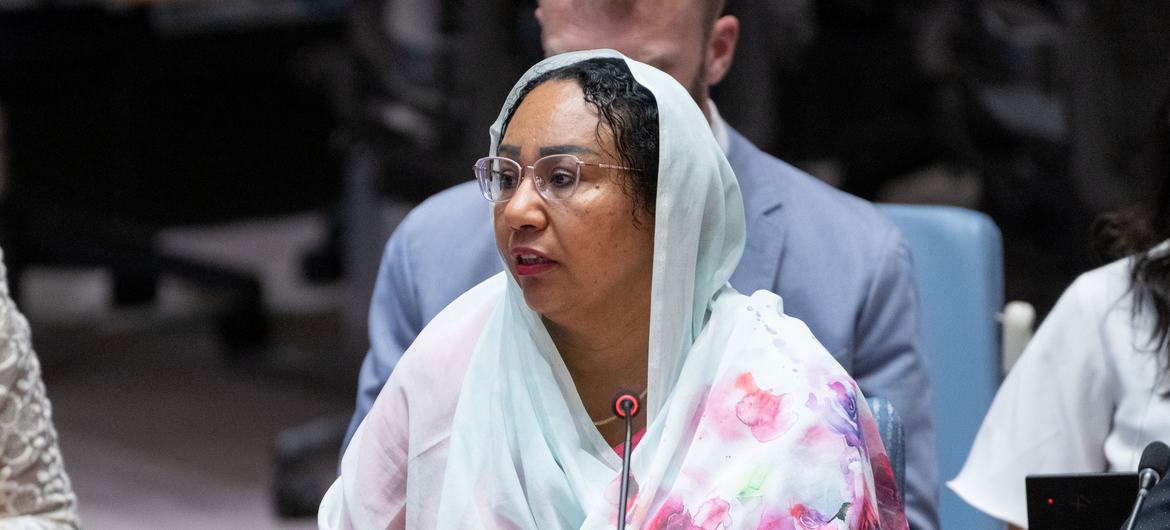
Ghada Eltahir Mudawi, Deputy Director of the Office for the Coordination of Humanitarian Affairs (OCHA), said Syrians need the support of the international community now more than at any time in the past 12 years.
“The humanitarian crisis in Syria must remain a global priority,” she said, outlining the current landscape, where after a dozen years of conflict, “the vast majority of the Syrian population continues to face daily challenges to meet the most basic food, health, and shelter needs.
A staggering 15.3 million people require humanitarian assistance throughout the country, representing nearly 70 per cent of Syria’s population. For the first time in the history of the crisis, people across every sub-district in Syria are experiencing some degree of humanitarian stress, she said, adding that the earthquakes earlier this year compounded this already bleak humanitarian situation, with more than 330,000 people remaining displaced, and thousands more without access to basic services and livelihoods.
Ghada Eltahir Mudawi, Deputy Director of the Office for the Coordination of Humanitarian Affairs (OCHA), briefs the Security Council meeting on the situation in Syria.
‘Matter of life and death’
While the UN and partners continue large-scale efforts to respond to the most urgent humanitarian needs, continued support from donors and this Council will be crucial to address ongoing essential needs, she said, noting that the preliminary Syria Earthquake Recovery Needs Assessment has estimated almost $9 billion in damage and losses, and $14.8 billion in recovery needs over the next three-year period.
A 12-month extension of the Security Council’s authorization of the cross-border mechanism is indispensable, she stressed.
“It is a matter of life and death for millions of people in northwest Syria,” she cautioned.
“The situation in Syria is too fragile, the needs are too great and too many lives are at stake not to ensure sustained humanitarian access via every possible modality, including cross-border and cross-line missions,” she added.
Calling for greater solidarity and urgently increased humanitarian funding to save lives and prevent further suffering, she said that while efforts continue to achieve a lasting political solution, “we must ensure that the urgent needs of women, men and children of Syria – life-saving aid and early recovery – are prioritized and adequately resourced.”
“They are counting on your support to stay the course,” she said.
In other business
In other business this morning, the Security Council considered two draft resolutions, unanimously adopting one that renewed the UN mission in Iraq, UNAMI.
By a vote of 10 in favour, with 5 abstentions (China, Gabon, Ghana, Mozambique, Russia), the Council also adopted a draft resolution renewing the South Sudan sanctions regime, with some members expressing concerns that the measures would have a negative socioeconomic impact on the South Sudanese people.
For more details on the this and other meetings occurring throughout the UN system, visit our dedicated UN Meetings Coverage page.
The latest integrated food security phase classification (IPC) analysis, reported on Sunday that of the total number of affected people, 1.8 million are in an emergency-level phase of need.
This means that households face large food consumption gaps resulting in high acute malnutrition and excess mortality, or are forced to adopt negative coping mechanisms to cover food needs, such as selling off assets or eating seeds instead of planting them, increasing their vulnerability, according to the Food and Agriculture Organization (FAO), one of the report’s global partners.
With 75 per cent of Haiti’s population living in rural areas, urgent measures are needed to save lives and quickly restore the agricultural livelihoods of vulnerable farmers, FAO warned.
Support market gardening
For example, investing $125 in a market-gardening seed package can generate 20 times its value in the production of vegetables, enabling families to have access to food and generate income through the sale of part of the product obtained, according to the agency.
Under the 2023 Humanitarian Response Plan, FAO is appealing for $61.7 million to assist 700,000 people to improve their access to food. Activities will focus on the provision of such agricultural inputs as seeds and fertilizer to increase staple food and vegetable production during the 2023 spring and winter seasons as well as to protect livestock assets, through the provision of poultry and goats alongside vaccines and veterinary treatment.
Hunger ‘hotspots’
Acute food insecurity is set to increase in magnitude and severity in 18 hunger “hotspots” around the world, according to a new FAO and World Food Programme (WFP) report published on Monday.
The report found that many hotspots are facing growing hunger and highlights the worrying multiplier effect that simultaneous and overlapping shocks are having on acute food insecurity. Conflict, climate extremes, and economic shocks continue to drive more and more communities into crisis.
The report warned that Burkina Faso and Mali, Sudan, and Haiti have been elevated to the highest concern levels.
“All hotspots at the highest level have communities facing or projected to face starvation, or are at risk of sliding towards catastrophic conditions, given they have already emergency levels of food insecurity and are facing severe aggravating factors,” WFP said.
“These hotspots require the most urgent attention,” the report warns.
Learn more about what the UN is doing to help the people of Haiti here.
WFP’s Country Director in Sudan, Eddie Rowe, told reporters in Geneva that in a major breakthrough, the agency distributed food assistance to 15,000 people in both Sudanese Armed Forces (SAF) and Rapid Support Forces (RSF) controlled areas of Omdurman, part of the Khartoum metropolitan area, beginning on Saturday.
Speaking from Port Sudan, Mr. Rowe highlighted other recent food distributions, in Wadi Halfa in Northern State to reach 8,000 people fleeing Khartoum and on their way to Egypt, as well as to 4,000 newly displaced people in Port Sudan.
Rapidly scaling up support
In total, WFP has been able to reach 725,000 people across 13 states in the country since it resumed its operations on 3 May, following a pause brought on by the killing of three aid workers at the start of the conflict.
Mr. Rowe said that WFP was rapidly scaling up its support, which they expected to expand depending on progress in negotiations for humanitarian access for all regions, including the Darfurs and Kordofans, strongly impacted by violence and displacement.
Hunger on the rise
In addition to the 16 million Sudanese who were already finding it “very difficult to afford a meal a day” before the fighting started, Mr. Rowe warned that the conflict compounded by the upcoming hunger season, could increase the food insecure population by about 2.5 million people in the coming months.
With the lean season fast approaching, WFP’s plan was to reach 5.9 million people across Sudan over the next six months, he said.
He stressed that WFP needed a total of $730 million to provide required assistance as well as telecommunications and logistics services to the humanitarian community, including all of the UN agencies operating in Sudan.
17,000 tonnes of food lost to looting
He also reiterated the humanitarian community’s call on all parties to the conflict to enable the safe delivery of urgently needed food aid, and deplored that so far, WFP had lost about 17,000 metric tonnes of food to widespread looting across the country, particularly in the Darfurs.
Just two days ago, he said, the agency’s main hub in El Obeid, North Kordofan, came under threat and looting of assets and vehicles was already confirmed.
Some 10,000 people are due to receive food aid in a first distribution in Omdurman, Sudan.
Over 13 million children in need
The UN Children’s Fund (UNICEF) reported that “more children in Sudan today require lifesaving support than ever before”, with 13.6 million children in need of urgent assistance. “That’s more than the entire population of Sweden, of Portugal, of Rwanda,” UNICEF spokesperson James Elder told reporters in Geneva.
According to reports received by UNICEF, hundreds of girls and boys have been killed in the fighting. “While we are unable to confirm these due to the intensity of the violence, we also have reports that thousands of children have been maimed,” Mr. Elder said.
‘Death sentence’
He also pointed out that reports of children killed or injured are only those who had contact with a medical facility, meaning that the reality is “no doubt much worse” and compounded by a lack of access to life-saving services including nutrition, safe water, and healthcare.
Mr. Elder alerted that “all these factors combined, risk becoming a death sentence, especially for the most vulnerable”.
UNICEF called for funding to the tune of $838 million to address the crisis, an increase of $253 million since the current conflict began in April, to reach 10 million children. Mr. Elder stressed that only 5 per cent of the required amount had been received so far, and that without the therapeutic food and vaccines which this money would allow to secure, children would be dying.
Healthcare under attack
The dire situation of healthcare in the country has been aggravated by continuing attacks on medical facilities. From the start of the conflict on 15 till 25 May, the World Health Organization (WHO) verified 45 attacks on healthcare, which led to eight deaths and 18 injuries, the agency’s spokesperson Tarik Jašarević said.
He also cited reports of military occupation of hospitals and medical supplies warehouses, which made it impossible for people in need to access chronic disease medicines or malaria treatment. Mr. Jašarević recalled that attacks on healthcare are a violation of international humanitarian law and must stop.
Keep borders open: Grandi
The UN High Commissioner for Refugees, Filippo Grandi, concluded a three-day visit to Egypt on Tuesday, with an urgent call for support for people fleeing Sudan – and the countries hosting them – insisting that the borders must remain open.
More than 170,000 people have entered Egypt since the conflict started – many through Qoustul, a border crossing that Grandi visited close to the end of his trip. The country hosts around half of the more than 345,000 people who have recently fled Sudan.
Mr. Grandi met newly arrived refugees and Egyptian border officials, to get a sense of the hardships being endured.
Loss ‘on a huge scale’
“I heard harrowing experiences: loss of life and property on a huge scale,” Grandi said. “People spoke of risky and expensive journeys to arrive here to safety. Many families have been torn apart. They are traumatized and urgently need our protection and support.“
The UNHCR chief also held talks with the Egyptian President, Abdel Fattah Al-Sisi, and discussed how best to support refugees and mobilize resources for host countries, not least Egypt.
“I commend Egypt for its long-standing commitment to providing a safe haven to those fleeing violence,” Mr. Grandi said. “The Government, the Egyptian Red Cresent and the people, have been very generous in supporting arrivals. We urgently need to mobilize more resources to help them to maintain this generosity.”
Prior to this conflict, Egypt was already host to a large refugee population of 300,000 people from 55 different nationalities.
After registering with UNHCR, refugees and asylum-seekers have access to a wide range of services including health and education. UNHCR’s emergency cash assistance programme started during the last week.
WMO warned on Tuesday that glaciers and ice sheet melt in Greenland and Antarctica accounts for some 50 per cent of sea level rise, which is accelerating, with disastrous impacts on small island developing states (SIDS) and densely populated coastal areas.
Glacier melt
The average thickness of the world’s glaciers has plummeted by almost 30 metres since 1970.
“The cryosphere issue is a hot topic not just for the Arctic and Antarctic, but it is a global issue,” said WMO Secretary-General Petteri Taalas.
The irreversible changes in the global cryosphere will affect well over a billion people who rely on water from snow and glacier melt, WMO said.
‘Sleeping giant’ of carbon emissions
The agency also called melting Arctic permafrost a “sleeping giant” of greenhouse gases, as it stores twice as much carbon as there is in the atmosphere today.
WMO said it has made this burning issue one of its top priorities and called for better predictions and intensified research, data exchange and investment.
Sea level rise, ice and glaciers are among the climate indicators monitored by WMO and the Intergovernmental Panel on Climate Change (IPCC). The WMO State of the Global Climate 2022 report highlighted the shocking extent of change.
So-called “reference glaciers” which WMO is monitoring in the long-term, experienced an average thickness change of over −1.3 metres between October 2021 and October 2022. This loss is much larger than the average of the last decade, the agency said.
Alpine record
The European Alps smashed records for glacier melt, exacerbated by a winter of little snow: in Switzerland, six per cent of the glacier ice volume was lost between 2021 and 2022 – and one third between 2001 and 2022.
The Greenland Ice Sheet ended with a negative total mass balance for the 26th year in a row.
Sea ice in Antarctica dropped to 1.92 million km2 on February 25, last year – the lowest level on record and almost one million km2 below the long-term mean – measured from 1991 to 2020.
Arctic sea ice in September at the end of the summer melt tied for the 11th lowest monthly minimum ice extent in the satellite record.
The rate of global mean sea level rise has doubled between the first decade of the satellite record, said WMO.
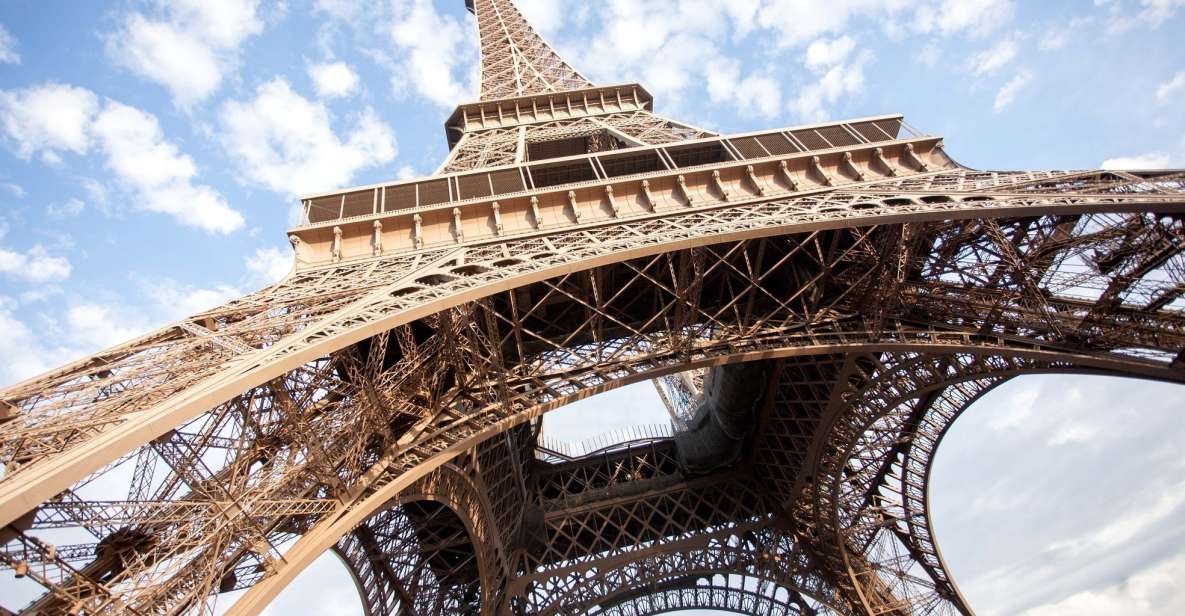
India has the longest railway bridge in the world and the bridges are quite impressive. About 29 meters higher than the Eiffel Tower, the Chenab Bridge stands 359 meters above the Chenab River in the Jammu and Kashmir region of India.
After the decade of citizenship, the power in North India will be open for visitors till the end of December 2023 or January 2024. This was made clear by the announcement of the Ministry. on the railways.
The bridge is 1,315 meters long and is part of a larger project that aims to make the Kashmir valley accessible to the Indian railway network. In addition to the bridge, the project for the railway USВRL also includes the future longest tunnel in the city, writes CNN.
It is believed that the connection of the region of Kashmir with the Indian railway line will give impetus to the industrial and economic development in the region, allowing the railway in Because of all the meteorological conditions between the valley and the eastern part of India, they are called the fifth.
At the moment, the only cyclo-road route connecting the Indian counties of Kashmir with the eastern part of the country is the 300-kilometer magnetic line, which, however, Closed for the winter months and the place of many quests.
That’s all – according to Cyshant Singh, a senior journalist at the Center for Policy Studies in India, he said that the government will also look at “the progress of Kashmir’s integration into India”.
However, it remains to be seen whether the better connection and the railway will be positively received by the locals, considering that “in recent years, Kashmir has been It is supported by the policies promoted by Prime Minister Modi and his leadership, which in fact has led to the death of the nation.” , the eĸcpept comment.
In 2019, India rescinded the order that gave the Indian government part of Kashmir its own laws. The southern and eastern parts of the region are two separate tapestries, which Modi’s goal was to build stability, reduce corruption and give a boost to the economy.
Although the entire railway project was built in 2002, before Modi became the prime minister, the Chenab Bridge is now said to be a prime example of the PM’s commitment to development. that in the city.
In fact, India is investing millions in modernizing its infrastructure. In February, Modi inaugurated the first section of the 1,380-kilometer magnetic cable connecting the capital city of Delhi with the financial center of Mumbai. Only one 250-kilometer section of the magnet palace contains 1.4 million square meters of geological data.
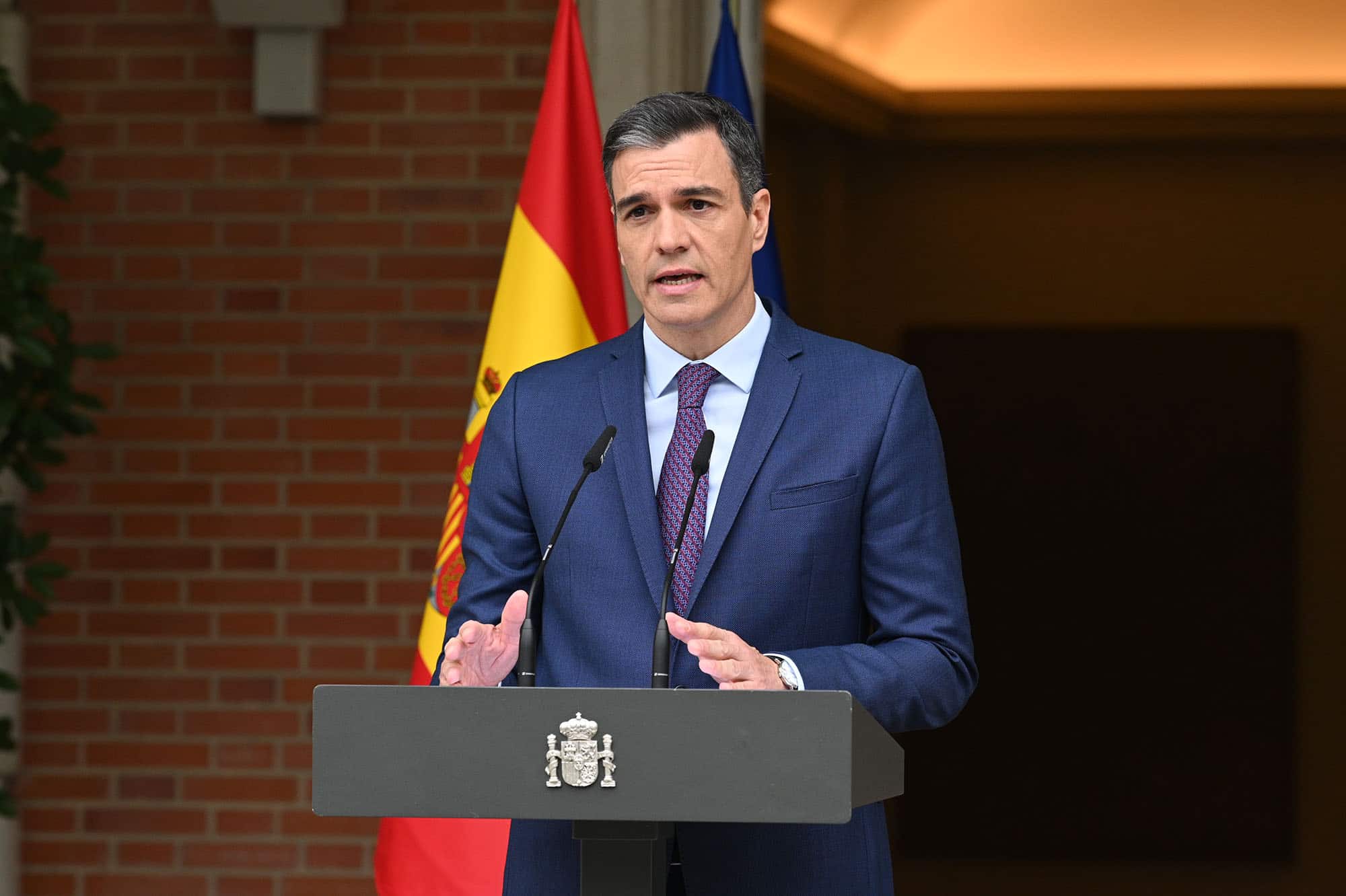
The President of the Government during the appearance in which he announced the call for general elections La Moncloa, Madrid 29.5.2023
According to EL MUNDO, the scale of the defeat and the loss of socialist territorial power have forced the president of the government to “assume the defeat in the first person”. The president summons and forces progressives to decide whether to mobilise to prevent a PP-Vox government, or go massively to the voting date and maintain a socialist government at national level.
Institutional statement by the President of the Spain Government calling for new national elections.
Good morning, I will be brief and I will also try to be very clear.
I have just had a meeting with His Majesty the King, in which I have informed the Head of State of the decision to call a Council of Ministers this very afternoon to dissolve the Cortes and proceed to call general elections, using the prerogative attributed to the President of the Government by the Constitution.
The formal call for the elections will be published tomorrow, Tuesday, in the Official State Gazette, so that the elections will be held on Sunday 23 July, in accordance with the deadlines established by law.
I have taken this decision in view of the results of yesterday’s elections.
The first consequence of these results will be that magnificent regional presidents and socialist mayors will be displaced with impeccable management. And this is despite the fact that many of them have seen their support increase yesterday.
The second consequence will be that many institutions will be administered by new majorities formed by the Popular Party and VOX.
And although yesterday’s votes were municipal and regional in scope, the sense of the vote sends a message that goes beyond that.
And that is why, as President of the Government, and also as Secretary General of the Socialist Party, I take the results personally and I believe it is necessary to respond and submit our democratic mandate to the will of the people.
Spain is on the verge of overcoming a period of crisis resulting from the emergence of Covid-19, and also from the war in Ukraine. We are on a clear path of growth, job creation and social cohesion. And at this point in the legislature, the Government has pushed ahead with the major reforms committed to in the investiture speech, in the government programme and also in our agreement with the European Commission.
Furthermore, our country is about to take on a very important responsibility in this geopolitical context that Europe is experiencing, and that is the rotating Presidency of the Council of the European Union.
All these reasons, I believe, make it advisable to clarify the will of the Spanish people. A clarification of the policies that the Government of the Nation must apply and a clarification of the political forces that must lead this phase.
There is only one infallible method to resolve these doubts. That method is democracy and, therefore, I believe that the best thing is for Spaniards to take the floor, to speak out without delay in order to define the political direction of the country.
Human Rights Without Frontiers (HRWF) calls upon the UN, the EU and the OSCE to ask Turkey to annul a deportation order for 103 Ahmadis Today, a Turkish court has…
Human Rights Without Frontiers (HRWF) calls upon the UN, the EU and the OSCE to ask Turkey to annul a deportation order for 103 Ahmadis
Today, a Turkish court has released a deportation order concerning 103 members of the Ahmadi Religion of Peace and Light from seven countries. Many of them, especially in Iran, will face imprisonment and may be executed if they are sent back to their country of origin.
Human Rights Without Frontiers (HRWF) in Brussels calls upon
the United Nations and in particular the UN Special Rapporteur on Freedom of Religion or Belief, Ms Nazila Ghanea
the European Union and in particular the EU Special Envoy on Freedom of Religion or Belief, Mr Frans Van Daele, as well as the European Parliament’s Intergroup on Freedom of Religion or Belief
the Special Envoys on Freedom of Religion or Belief appointed in the United Kingdom and in a number of EU Member States
the OSCE/ ODIHR
to urge the Turkish authorities to cancel on appeal today’s decision of deportation. The deadline for the appeal is Friday 2 June.
Media outlets all over Europe are raising the issue as an emergency situation as it can be seen in a few of many more articles in
The advocate and spokesperson of the 103 Ahmadis is Hadil Elkhouly. She is the author of the article hereafter and can be joined at the following phone number for interviews: +44 7443 106804
Minority religious members fear death at home for alleged heresy
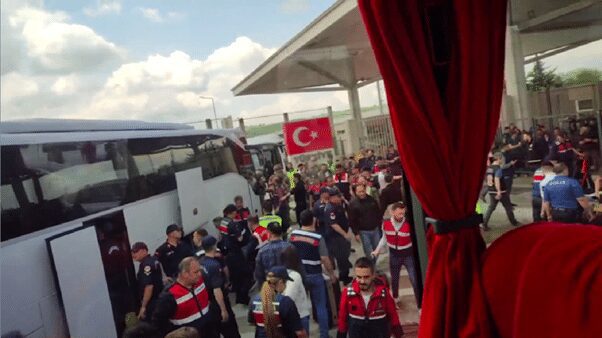
Members of the Ahmadi Religion of Peace and Light. Kapikule border crossing, the gateway between Turkey and Bulgaria on Wednesday, May 24, 2023. Pictures owned by Ahmadi Religion of Peace and Light. Used with permission.
On the May 24, 2023, over 100 members of the Ahmadi Religion of Peace and Light, a persecuted religious minority, were denied entry and faced violent treatment while seeking asylum at the Turkish–Bulgarian border. Women, children, and the elderly were among those targeted by aggression, gunshots, threats, and the confiscation of their possessions.
Among those individuals was Seyed Ali Seyed Mousavi, a 40-year-old real estate agent from Iran. A few years ago, he attended a private wedding where his life took an unexpected turn. Seyed Mousavi found himself at the mercy of undercover police officers who abruptly grabbed him, forced him down, and subjected him to a severe beating. He was left to bleed for 25 minutes before someone finally sought medical assistance.
Seyed Mousavi’s only “crime” was his affiliation with this religious minority, which led to his persecution by the authorities in Iran. The incident forced him to make a difficult decision to leave his homeland behind, abandoning everything he knows in order to preserve his life.
The Ahmadi Religion, not to be confused with the Ahmadiyya Muslim Community, is a religious community that was founded in 1999. It received church status in the USA on 6 June 2019. Today, this religion is practiced in more than 30 countries around the world.It is headed by Abdullah Hashem Aba Al-Sadiq and follows the teachings of Imam Ahmed al-Hassan as its divine guide.
State sponsored persecution
Since its inception in 1999, the Ahmadi Religion minority has been subjected to persecution in numerous nations. Countries including Algeria, Morocco, Egypt, Iran,Iraq, Malaysia, and Turkey have systematically oppressed them, imprisoned, threatened, and even tortured their members. This targeted discrimination is based on a belief that they are heretics.
In June 2022, Amnesty International called for the release of 21 members of the Ahmadi Religion in Algeria who were charged with offenses including “participation in an unauthorized group” and “denigrating Islam.” Three individuals received one year prison sentences, while the remaining were sentenced to six months in prison along with fines.
Similarly, in Iran, in December 2022, a group of 15 followers of the same religion, including minors and women, were detained and transferred to the notorious Evin Prison, where they were coerced to denounce their faith and defame their religion, despite not committing any crimes, nor preaching their faith openly. The charges brought against them were based on their opposition to “Wilayat Al Faqih,” (the guardianship of the Islamic jurist) which grants authority to jurists and scholars who shape and enforce Sharia law in the country. The Iranian authorities even aired a propaganda documentary against the religion on national television.
Ahmadi Religion members have also reported violence and threats by state-sponsored militias in Iraq, leaving them vulnerable and unprotected. These incidents involved armed attacks targeting their homes and vehicles, with assailants openly declaring they are considered apostates deserving death, effectively denying them of any form of protection.
The persecution of this religious minority has escalated significantly following the release of “The Goal of the Wise,” the official gospel of their faith. The scripture was authored by Abdullah Hashem Aba Al-Sadiq, the religious leader who asserted to fulfill the role of the promised Mahdi awaited by Muslims to appear towards the end of times.
Braving the unknown towards freedom
Having gradually traveled to Turkey, over 100 members of the Ahmadi Religion received support from fellow members who had already settled there, fostering a sense of unity through their online connections. Despite the challenges they faced, they persevered in their quest to find a persecution-free home amidst their shared experiences of trauma.
Faced with this dire situation, they turned to the United Nations High Commissioner for Refugees (UNHCR) in Bulgaria, the State Agency for Refugees (SAR), and the Bulgarian Ministry of Foreign Affairs in the hopes of securing a safe haven. Unfortunately, their plea for humanitarian visas was met with disappointment as all avenues proved unfruitful.
In light of their challenging circumstances, the group decided to gather at the official Kapikule border crossing, the gateway between Turkey and Bulgaria on Wednesday, May 24, 2023, to request asylum directly from the Bulgarian Border Police. Their course of action aligns with the provisions set forth in Article 58(4) of the Law on Asylum and Refugees (LAR) which affirms that asylum can be sought by presenting a verbal statement to the border police.
The Border Violence Monitoring Network, along with 28 other organizations, issued an open letter urging the Bulgarian authorities and to the European Border and Coast Guard Agency (Frontex) to fulfill their obligations under European Union law, and international human rights law. These laws include Article 18 of the EU Charter of Fundamental Rights, the 1951 Geneva Convention Relating to the Status of Refugees, and Article 14 of the Universal Declaration of Human Rights.
Their desperate bid for safety was encountered with oppression and violence, as they were forcibly blocked by the Turkish authorities, subjected to beatings with batons, and threatened with gunshots. Now detained, their future remains uncertain. Their greatest fear is to be deported back to their homes, where death might be waiting for them, due to their religious beliefs.
The perilous journey undertaken by this minority group raises crucial questions about the integrity of borders and the commitment of EU member states to uphold human rights. Their struggles serve as a reminder of the need for solidarity to protect basic human rights and preserve the dignity of everyone, regardless of their religious affiliation.
Video by Hadil El-Khouly, Ahmadi Human Rights Coordinator
Members of the Ahmadi Religion of Peace and Light. Kapikule border crossing, the gateway between Turkey and Bulgaria on Wednesday, May 24, 2023. Pictures owned by Ahmadi Religion of Peace and Light. Used with permission.
Human Rights Without Frontiers (HRWF) calls upon the UN, the EU and the OSCE to ask Turkey to annul a deportation order for 103 Ahmadis
Today, a Turkish court has released a deportation order concerning 103 members of the Ahmadi Religion of Peace and Light from seven countries. Many of them, especially in Iran, will face imprisonment and may be executed if they are sent back to their country of origin.
Human Rights Without Frontiers (HRWF) in Brussels calls upon
the United Nations and in particular the UN Special Rapporteur on Freedom of Religion or Belief, Ms Nazila Ghanea
the European Union and in particular the EU Special Envoy on Freedom of Religion or Belief, Mr Frans Van Daele, as well as the European Parliament’s Intergroup on Freedom of Religion or Belief
the Special Envoys on Freedom of Religion or Belief appointed in the United Kingdom and in a number of EU Member States
the OSCE/ ODIHR
to urge the Turkish authorities to cancel on appeal today’s decision of deportation. The deadline for the appeal is Friday 2 June.
Media outlets all over Europe are raising the issue as an emergency situation as it can be seen in a few of many more articles in
The advocate and spokesperson of the 103 Ahmadis is Hadil Elkhouly. She is the author of the article hereafter and can be joined at the following phone number for interviews: +44 7443 106804
Members of the Ahmadi Religion of Peace and Light. Kapikule border crossing, the gateway between Turkey and Bulgaria on Wednesday, May 24, 2023. Pictures owned by Ahmadi Religion of Peace and Light. Used with permission.
On the May 24, 2023, over 100 members of the Ahmadi Religion of Peace and Light, a persecuted religious minority, were denied entry and faced violent treatment while seeking asylum at the Turkish–Bulgarian border. Women, children, and the elderly were among those targeted by aggression, gunshots, threats, and the confiscation of their possessions.
Among those individuals was Seyed Ali Seyed Mousavi, a 40-year-old real estate agent from Iran. A few years ago, he attended a private wedding where his life took an unexpected turn. Seyed Mousavi found himself at the mercy of undercover police officers who abruptly grabbed him, forced him down, and subjected him to a severe beating. He was left to bleed for 25 minutes before someone finally sought medical assistance.
Seyed Mousavi’s only “crime” was his affiliation with this religious minority, which led to his persecution by the authorities in Iran. The incident forced him to make a difficult decision to leave his homeland behind, abandoning everything he knows in order to preserve his life.
The Ahmadi Religion, not to be confused with the Ahmadiyya Muslim Community, is a religious community that was founded in 1999. It received church status in the USA on 6 June 2019. Today, this religion is practiced in more than 30 countries around the world.It is headed by Abdullah Hashem Aba Al-Sadiq and follows the teachings of Imam Ahmed al-Hassan as its divine guide.
State sponsored persecution
Since its inception in 1999, the Ahmadi Religion minority has been subjected to persecution in numerous nations. Countries including Algeria, Morocco, Egypt, Iran,Iraq, Malaysia, and Turkey have systematically oppressed them, imprisoned, threatened, and even tortured their members. This targeted discrimination is based on a belief that they are heretics.
In June 2022, Amnesty International called for the release of 21 members of the Ahmadi Religion in Algeria who were charged with offenses including “participation in an unauthorized group” and “denigrating Islam.” Three individuals received one year prison sentences, while the remaining were sentenced to six months in prison along with fines.
Similarly, in Iran, in December 2022, a group of 15 followers of the same religion, including minors and women, were detained and transferred to the notorious Evin Prison, where they were coerced to denounce their faith and defame their religion, despite not committing any crimes, nor preaching their faith openly. The charges brought against them were based on their opposition to “Wilayat Al Faqih,” (the guardianship of the Islamic jurist) which grants authority to jurists and scholars who shape and enforce Sharia law in the country. The Iranian authorities even aired a propaganda documentary against the religion on national television.
Ahmadi Religion members have also reported violence and threats by state-sponsored militias in Iraq, leaving them vulnerable and unprotected. These incidents involved armed attacks targeting their homes and vehicles, with assailants openly declaring they are considered apostates deserving death, effectively denying them of any form of protection.
The persecution of this religious minority has escalated significantly following the release of “The Goal of the Wise,” the official gospel of their faith. The scripture was authored by Abdullah Hashem Aba Al-Sadiq, the religious leader who asserted to fulfill the role of the promised Mahdi awaited by Muslims to appear towards the end of times.
Braving the unknown towards freedom
Having gradually traveled to Turkey, over 100 members of the Ahmadi Religion received support from fellow members who had already settled there, fostering a sense of unity through their online connections. Despite the challenges they faced, they persevered in their quest to find a persecution-free home amidst their shared experiences of trauma.
Faced with this dire situation, they turned to the United Nations High Commissioner for Refugees (UNHCR) in Bulgaria, the State Agency for Refugees (SAR), and the Bulgarian Ministry of Foreign Affairs in the hopes of securing a safe haven. Unfortunately, their plea for humanitarian visas was met with disappointment as all avenues proved unfruitful.
In light of their challenging circumstances, the group decided to gather at the official Kapikule border crossing, the gateway between Turkey and Bulgaria on Wednesday, May 24, 2023, to request asylum directly from the Bulgarian Border Police. Their course of action aligns with the provisions set forth in Article 58(4) of the Law on Asylum and Refugees (LAR) which affirms that asylum can be sought by presenting a verbal statement to the border police.
The Border Violence Monitoring Network, along with 28 other organizations, issued an open letter urging the Bulgarian authorities and to the European Border and Coast Guard Agency (Frontex) to fulfill their obligations under European Union law, and international human rights law. These laws include Article 18 of the EU Charter of Fundamental Rights, the 1951 Geneva Convention Relating to the Status of Refugees, and Article 14 of the Universal Declaration of Human Rights.
Their desperate bid for safety was encountered with oppression and violence, as they were forcibly blocked by the Turkish authorities, subjected to beatings with batons, and threatened with gunshots. Now detained, their future remains uncertain. Their greatest fear is to be deported back to their homes, where death might be waiting for them, due to their religious beliefs.
The perilous journey undertaken by this minority group raises crucial questions about the integrity of borders and the commitment of EU member states to uphold human rights. Their struggles serve as a reminder of the need for solidarity to protect basic human rights and preserve the dignity of everyone, regardless of their religious affiliation.
Video by Hadil El-Khouly, Ahmadi Human Rights Coordinator