Without its usual starters, PSG largely won against Angers (3-0) on Saturday, during the 31st day of Ligue 1.
Lyon continues its good series. The Rhone club achieved a third consecutive success in the league by beating Auxerre 3-2, Saturday April 25, at Groupama Stadium. Thanks to these three additional points, OL provisionally takes 3rd place in Ligue 1, synonymous with direct qualification for the Champions League, and puts pressure on Lille who can come back up to par if they win against Paris FC on Sunday (5:15 p.m.).
Long held by the 16th in Ligue 1, OL were able to count on Corentin Tolisso to make the difference. Coming into play in the 58th minute when the score was 1-1, the midfielder first gave his team the lead (2-1, 66th) before delivering an assist to Roman Yaremchuck for the break goal (3-1, 71st). Auxerre, which made Lyon falter at the end of the match thanks to a goal from Bryan Okoh (3-2, 88th), conceded, for its part, its 16th setback of the season and remains four points behind Nice, 15th, which faces Marseille on Sunday (8:45 p.m.).
On the first step of the podium, it was a very overhauled PSG which largely won against Angers (3-0) at the Raymond Kopa stadium. After his success against Nantes on Wednesday in a late match (3-0), and three days before the semi-final first leg of the Champions League against Bayern Munich, Luis Enrique decided to leave Ousmane Dembélé, Khvicha Kvaratskhelia, Joao Neves, Nuno Mendes and Désiré Doué on the bench. Absences which did not prevent the Parisians from opening the scoring in the 8th minute through Kang-in Lee.
Senny Mayulu (39th) and Lucas Beraldo (52nd) then worsened the score, during a match marked by the exit at half-time of Achraf Hakimi, affected following a sprint. Reduced to 10 after the red card from Gonçalo Ramos (74th), the Parisians monopolized the ball to finish the match with 10 shots on target compared to just one for Angers. This victory – combined with the draw between Brest and Lens on Friday – allows PSG to consolidate its place as leader of the championship with six points ahead of the Sang et Or three days before the end of the season.
These last few weeks have been particularly trying for Jean Dujardin. Indeed, he lost his lifelong sidekick, Bruno Salomone. This was followed by the disappearance of Nadia Farès following a heart attack last week.
But the actor must keep his head high. It must be said that he is still in full promotion of his latest film, Rays and Shadows. Moreover, Jean Dujardin recently made a notable intervention since he slipped a sentence which was similar to a tackle for Omar Sy.
New acquisition for his haven of peace
During this painful period, Jean Dujardin allows himself moments of disconnection. It must be said that he is the happy owner of a house in Soulac-sur-Mer, called Villa Cabanar. This is available for rental on the Airbnb platform.
This Friday, April 24, the Juste Menuisier Charpentier account shared its new creation which will bring new charm to the home. In fact, the craftsman made him an enormous wooden desk. Moreover, Jean Dujardin seems delighted with his new furniture since he appeared very relaxed and smiling in the photo. A nice boost which was welcomed by Internet users. Moreover, one detail caught their attention: her flip-flops in addition to her chill look.
A home dear to him
This villa is not just a piece of real estate. Jean Dujardin has known her since childhood. “This is the region where my maternal grandfather, who came from the Pyrenees, settled to buy a farm, I still have cousins here… I am full of memories in this region, it constitutes me,” he explained.
Before adding: “It’s not for nothing that I chose to come back to the area; I had a house in Gard for a while, then I came to Soulac because I love this coast so much. I feel good there, peaceful. It’s funny because when we talk about the Médoc, people don’t always know how to locate it, and that’s fine.”
BFM BUSINESS PARTNER – In course no. 362, mental health at work is deciphered by Guillaume d’Ayguesvives, co-founder and CEO of Moka.Care, and Fanny Potier, partner and director at BCG, expert in leadership issues, this Saturday, April 18, in the BFM Stratégie show presented by Frédéric Simottel on BFM Business.
BFM BUSINESS PARTNER – In course no. 363 deciphered by Emmanuel Hembert, global director of the cosmetics sector at Quantis, and Jean-Baptiste Massignon, general director of EcoBeautyScore, this Saturday April 18 in the BFM Stratégie show presented by Frédéric Simottel on BFM Business.
BFM BUSINESS PARTNER – In course no. 361, risk-taking is deciphered by Benjamin Sarda, partner at BCG, and Frédéric Mazzella, founder and president of BlaBlaCar and Dift, this Saturday, March 21, in the BFM Stratégie show presented by Frédéric Simottel on BFM Business.
BFM BUSINESS PARTNER – In course no. 360, technological independence, where companies are becoming increasingly aware that their technological infrastructure has become a real strategic risk, is deciphered by Jean-Christophe Laissy, partner and director at BCG, this Saturday March 21, in the BFM Stratégie show presented by Frédéric Simottel on BFM Business.
BFM BUSINESS PARTNER – This Saturday, February 21, in course no. 359, Johanna Benesty, senior associate director at BCG and Elsy Boglioli, founder and general director of Bio-Up, looked at the health, economic and social issues linked to women’s health, in the BFM Stratégie program presented by Frédéric Simottel on BFM Business. This show was produced in partnership with Boston Consulting Group.
BFM BUSINESS PARTNER – In course no. 358, the results of mergers and acquisitions in 2025 and the prospects in this sector for the year 2026, are deciphered by Sébastien Bard, partner and director at BCG, this Saturday February 21, in the BFM Stratégie show presented by Frédéric Simottel on BFM Business.
BFM BUSINESS PARTNER – In course no. 357, the principles of the Strathena game, and the strategies used by the winners of the summer game, are deciphered by Alexis Lacapelle, founder and director of Interactive 4D, Xavier Fontanet, former president of Essilor, Pierre Dabin, lawyer, and Jules Gastaud, financial engineer, this Sunday, February 15, in the BFM Stratégie show presented by Frédéric Simottel on BFM Business.
BFM BUSINESS PARTNER – In course no. 356, the rise of China in the automotive industry was deciphered by Jacques Léger, industry consulting specialist, author of the book “The tsunami of Chinese electric cars”, and Xavier Fontanet, former president of Essilor, this Saturday January 24, in the BFM Stratégie show presented by Frédéric Simottel on BFM Business.
BFM BUSINESS PARTNER – In course no. 355, the future of TV in the era of streaming is deciphered by Marion Graizon, associate director at BCG, this Saturday, January 17, in the BFM Stratégie show presented by Frédéric Simottel on BFM Business.
The 2026 Global Report on Food Crises, released on Friday by an alliance of UN agencies, the European Union (EU) and partners, finds that 266 million people across 47 countries experienced high levels of acute food insecurity in 2025 – nearly a quarter of the population analysed and almost double the share recorded in 2016.
The report paints a stark picture: hunger is no longer a series of short-term emergencies, but a persistent and increasingly concentrated global challenge.
“Acute food insecurity today is not just widespread – it is also persistent and recurring,” said UN Food and Agriculture Organization (FAO) Director-General Qu Dongyu, warning that the crisis has become structural rather than temporary.
Conflict the primary driver
Conflict remains the primary driver, accounting for more than half of all people facing severe hunger.
Ten countries – Afghanistan, Bangladesh, the Democratic Republic of the Congo, Myanmar, Nigeria, Pakistan, South Sudan, Sudan, Syrian Arab Republic and Yemen – accounted for two-thirds of all people facing high levels of acute hunger.
At the most extreme end, famine was confirmed in 2025 in Gaza and parts of Sudan – the first time since the report began that two separate famines have been recorded in a single year.
“This report is a call to action,” UN Secretary-General António Guterressaid in the foreword, “to summon the political will to rapidly scale up investment in lifesaving aid, and work to end the conflicts that inflict so much suffering on so many.”
The report also highlights a sharp rise in the severity of hunger. More than 39 million people in 32 countries faced emergency levels of food insecurity, while the number of people experiencing catastrophic hunger has increased ninefold since 2016.
Number of people facing high levels of acute food insecurity.
Children bearing the brunt
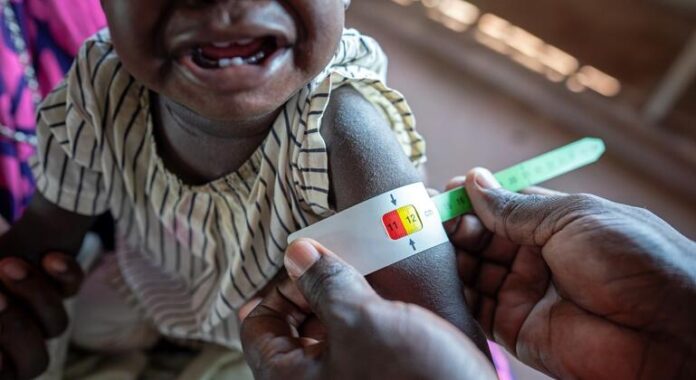
Children are among the most affected. In 2025, 35.5 million children were acutely malnourished, including nearly 10 million suffering from severe acute malnutrition – a life-threatening condition that dramatically increases the risk of death.
“Children with severe wasting are too thin for their height. Their immune systems weakened to the extent that ordinary childhood illnesses can become fatal,” UN Children’s Fund (UNICEF) spokesperson Ricardo Pires warned.
In the worst-affected areas – including Gaza, Myanmar, South Sudan and Sudan – overlapping crises of conflict, disease and limited access to services are driving extreme levels of malnutrition and raising the risk of death.
Displacement compounding the crisis
Forced displacement is compounding the crisis.
More than 85 million people were displaced across food-crisis contexts last year, with displaced populations consistently facing higher levels of hunger than host communities.
“Forced displacement and food insecurity are deeply interconnected, forming a vicious cycle,” said UN High Commissioner for Refugees Barham Salih, warning that humanitarian aid alone is not enough to break the pattern.
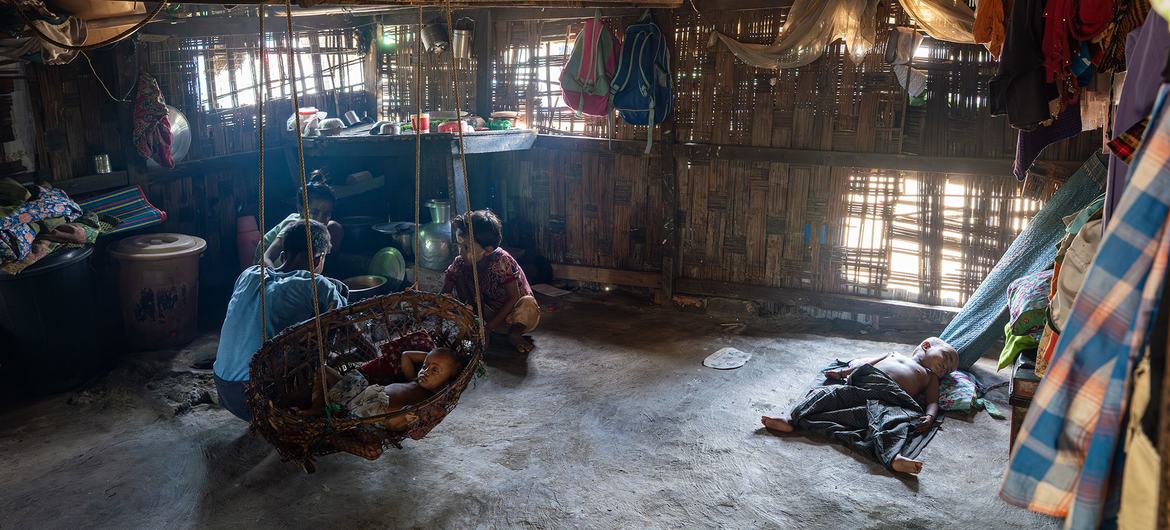
Myanmar is among the countries with very high numbers of people suffering acute food insecurity. Pictured here, a family in an IDP camp in the east of the country.
Collapse in funding
Despite the scale of the crisis, the report warns that funding is moving in the opposite direction.
Humanitarian and development financing for food and nutrition responses has fallen back to levels last seen nearly a decade ago, limiting the ability of governments and aid organizations to respond effectively.
At the same time, data gaps are growing. The number of countries able to produce reliable food security assessments has dropped to its lowest level in a decade, meaning the true scale of hunger may be even greater than current estimates suggest.
Bleak outlook for 2026
Looking ahead, the outlook for 2026 remains bleak. Ongoing conflicts, climate shocks and economic instability are expected to keep food insecurity at critical levels in many countries.
Aid agencies warn that without a shift in approach, the world risks becoming locked into a cycle of deepening crises, with hunger no longer a temporary emergency but an increasingly persistent feature of global instability.
“We must shift from reacting too late to acting early, and from relying solely on food assistance to protecting local food production – because that is how we reduce needs, save lives and build resilience over time,” said FAO Director-General Qu.
The European Union’s greenhouse gas emissions fell a further 3% between 2023 and 2024, bringing the EU’s total emission reductions to 40% below 1990 levels, according to official EU data sent to the United Nations Framework Convention on Climate Change (UNFCCC) and a European Environment Agency (EEA) analysis published today. The EU greenhouse gas inventory was prepared and submitted to the UN body by the EEA on behalf of the EU on 15 April.
Over the last 34 years, the overall decline in EU’s net domestic emissions was driven by a larger share of renewable energy, the use of less carbon intensive fossil fuels, improved energy efficiency, and structural economic changes, according to an EEA briefing analysing the emissions data. Almost all Member States have contributed to the emission reductions.
Key trends and drivers
The largest absolute cuts occurred in electricity and heat production, manufacturing and construction, residential combustion, and iron & steel (including energy-related emissions).
Road transport emissions rose for both passenger and freight modes despite more efficient and electric vehicles, as growth in transport demand outpaced those gains.
Hydrofluorocarbon (HFC) emissions from refrigeration and air conditioning surged from 1990 to 2014 but have declined for ten consecutive years, owing to EU F‑gas phase‑down and recent phase‑out measures.
Forest net removals of carbon have weakened mainly due to aging forests (lower annual increment), increased harvesting and climate impacts.
Energy sector as the main driver of emission reductions
Electricity and heat production, residential and industrial sectors delivered the top three emission reductions.
Emissions from electricity and heat production fell 58% since 1990, reflecting efficiency gains and a shift to lower‑carbon fuels.
Between 1990 and 2024, thermal power station use of solid and liquid fuels fell 68% and 86% respectively, while natural gas use rose 44% (though emissions from gas fell nearly 18% since 2022). Coal consumption in 1990 was more than three times the 2024 level.
Renewables’ share in electricity and heat generation has grown substantially, and CO2 per unit of fossil energy produced has declined.
Large reductions in the residential sector are attributable to better building insulation, improved efficiency and warmer winters, which have lowered space‑heating demand.
Policy contribution
EU and Member State policies drove much of the decline: agricultural and environmental measures from the 1990s, and climate and energy policies since 2005. Notably, this includes the EU Emissions Trading System (ETS) and national measures for sectors outside the ETS.
For more information
Please note: The net domestic emissions reflected by the greenhouse gas inventory do not include emissions from international aviation or navigation. They are therefore not immediately comparable with the scope of the European Climate Law emission reduction target for 2030 (net 55%), as the latter include a share of emissions from international aviation and navigation.
Turning Europe’s circular economy ambitions into reality will depend on making it people-focused — in particular — making sure European Union rules in place work to make it a success for entrepreneurs, business owners, citizens and workers alike, according to two assessments published by the European Environment Agency (EEA) today.
Companies and entrepreneurs that make circularity key to their operations or start-ups — aiming to reduce environmental and climate pressures — encounter significant obstacles when attempting to scale. Related to this is the need to ensure that the jobs created through the circular economy are fair, inclusive and of good quality.
This will be important in the years ahead as Europe’s remanufacturing market alone has the potential to create half a million new jobs by 2030 according to the EU’s Clean Industrial Deal.
The EEA briefings — one which looks at the barriers and enablers to scaling circular business models, and the other at how Europe should ensure a just transition to a circular economy — provide knowledge, supporting the European Commission’s Circular Economy Act which is expected later this year.
People must be at the heart of Europe’s circular economy ambitions. This move to circularity will add to our prosperity and emerging circular businesses need a fair playing field, while workers must benefit from decent jobs, skills development and opportunities. A circular economy is as much about social fairness as it is about economic policy and a tool to protect our environment and climate.
Types of scaling
Growing circular businesses — scaling up, out and deep — remains one of the key challenges.
The widespread adoption and scaling of circular business models in Europe is not yet evident. There are several ways of scaling:
scaling out by reaching more customers and expanding to new markets;
Scaling up by helping change the structures business operate within; and
scaling deep by enabling cultural and behavioural shifts of citizens and costumers.
The briefing argues that these types of scaling are needed if Europe’s circular economy ambitions are to be met and for the EU to meet overarching economic, social, environmental and climate goals.
Way ahead
Most circular business models continue to focus predominantly on waste management and end-of-life product handling. More support is needed to implement and scale also other types of circular business models, such as those that enable extended product lifetimes, or those that promote increased reuse through renting, leasing or sharing on a broader scale that could generate larger impacts.
Similarly more actions must be done to enable emerging circular businesses, including through improved regulation and other policies that promote those business models that adapt circularity and offer a level playing field, promoting technological innovation that lowers costs, promoting financing and insurance that is friendly to circular businesses and promoting social innovation and grassroot projects to help change consumer behaviours.
Fair and just circular jobs
A separate EEA briefing ‘Just transition to a circular economy’ shows how integrating justice into circular economy policies can strengthen environmental and social outcomes. This will be important as a growing circular economy will lead to changes in Europe’s jobs market.
Between 2014 and 2023, the number of jobs linked to the circular economy in the EU-27 grew by 10% to around 4.4 million, according to the EEA briefing. While the circular economy creates new jobs, some are low-paid or insecure, and higher-skilled roles often benefit already advantaged groups, highlighting the need to improve job quality, strengthen skills development and ensure more inclusive access to opportunities.
Circular economy policies are most effective when fairness, inclusion and broad participation are integrated throughout their design and implementation. These elements strengthen social cohesion, economic resilience and public trust, creating the conditions for effective implementation and the delivery of environmental benefits.
More information
The EEA circular economy briefings are the first two in a series of reports the EEA is producing this year ahead of the Commission’s EU Circular Economy Act which aims to accelerate the transition to a more circular economy for Europe.
It aims to establish a Single Market for secondary raw materials, increase the supply of high-quality recycled materials and stimulate demand for these materials in the EU which in turn will help to boost the EU’s economic security, resilience, competitiveness and decarbonisation.
The scaling business models in Europe briefing builds on an underpinning report from the European Topic Centre on Circular Economy and Resource Use.
As the sun set each evening in the Navajo Nation, Colynn Begay used a small battery-powered light to help her five sons finish homework, prepare snacks and get ready for bed. On its brightest setting, the light often lasted only 20 minutes.
“Life is so challenging because I have no electricity,” said Begay, a single mother. “When this light goes out for me, I have no way to see to get my kids ready or prepare their school clothes the night before. Even walking into the kitchen, I cannot see in there, so I would just have to use my phone [light]. And my kids can’t do their homework because we have no light at night. So I usually try to do their homework with them the moment they get back from school.”
Begay’s family lives about 30 minutes outside Chinle, Arizona. Across the Navajo Nation, approximately 14,000 homes lack access to electricity. Like many families, daily life revolved around daylight, including driving to relatives’ homes to charge devices, and traveling an hour round trip each night just to eat out because they had neither a refrigerator nor a stove.
That changed in early March 2026 when her home received a solar power system through a collaboration between Heart of America, a national education nonprofit, and The Church of Jesus Christ of Latter-day Saints.
In recent years, the Church has supported efforts to expand access to electricity and water in remote Navajo Nation communities, working alongside tribal, state and nonprofit collaborators.
Navajo-Solar-Panels
Illuminated only by a small hand-held rechargeable LED light, Colynn Begay looks for a book on the bed at her home on the Navajo Nation tribal lands near Chinle, Arizona, on Wednesday, March 4, 2026.2026 by Intellectual Reserve, Inc. All rights reserved.
Download Photo
Meeting a Foundational Need
Heart of America works with local school districts to identify households with K–12 students that lack electricity. The organization has installed solar systems in hundreds of homes across the Navajo Nation, focusing on educational stability and student well-being.
“The opportunity for us to provide students and their families with electricity and power at home really is a game changer,” said Heart of America President and CEO Jill Heath. “We focus on making sure the student has what he or she needs to succeed — the ability to do homework after the sun sets, the ability to read, to connect with family. However, that’s just the beginning.”
After learning of the need and visiting the area, the Church joined with Heart of America to fund solar installations for another 100 student-family homes. In total, Heart of America has now helped more than 450 such homes across the Navajo Nation. The Church’s support also helps provide portable lighting as well as age‑appropriate educational and enrichment materials for families.
“We were thrilled, we were overjoyed, and started planning immediately,” Heath said. “When this grant came along, and the Church so generously said, ‘We want to help provide more students with electricity and power,’ we knew that this was going to be a great collaboration.”
Power That Changes Daily Life
Each solar kit includes rooftop panels, batteries, lighting, a charge controller, an inverter and a refrigeration unit. Together, the systems provide reliable power for lighting, food storage and essential devices, replacing temporary solutions such as fuel-powered generators and battery lights.
Navajo-Solar-Panels
Mylo Fowler of Heart of America climbs a ladder with a solar panel to be installed on the roof of Colynn Begay’s home on the Navajo Nation tribal lands near Chinle, Arizona, on Thursday, March 5, 2026.2026 by Intellectual Reserve, Inc. All rights reserved.
Download Photo
“We hear stories of students doing better in school because they can do their homework after dark,” said Lian Mah, who has worked on installation teams for several years. “We hear of stories of students who can keep their medicine in the refrigerator now. They don’t have to store it at a neighbor’s house. To keep their food cold, [some families] would literally freeze a gallon of water at a neighbor’s house, bring it over every day, put it in their cooler to try and keep their food cold. And now they have fresh food in their house 24-7 because of this, which is just amazing.”
Eugene Gorman, a father of three in the Red Valley community, said his family relied on generators for years, often spending significant amounts on fuel. He said the solar system will help reduce those costs and ease financial strain.
“This solar will help us a lot,” Gorman said. “We’ll be able to spend money in different places for our kids now instead of just worrying about electricity all the time. We’ll have comfort now. I really appreciate you coming out and doing this for us.”
Installation teams can typically complete a solar setup in about an hour, providing long-term access to electricity and opportunity.
“This is a force multiplier,” Heath said. “It’s elevating opportunities with education, with basic body and mind health, and really enabling multiple generations to thrive.”
Flipping the Switch on Opportunity
For Begay, the impact was immediate.
“My kids get to do their homework [at night],” she said. “We have lights. We get to charge our laptops. We get to charge our phones and tablets. I get to wake up in the morning, turning on the light instead of using my phone. I’m very happy. I’m filled with joy and love. I’m very thankful for all of you.”
Heath said schools have seen improvements in attendance, engagement and academic focus among students whose homes receive electricity.
“The home is where you should feel the most stable, the home is where you should feel the most safe,” Heath said. “You [should] have all the basic needs covered, so that when you do go to school you can focus on learning.”
Once installed, the solar project’s meaning becomes clear, Heath added.
“Once the solar kit is in place, you flip the switch on — but it’s flipping the switch on not just to light but to opportunity,” she said.
In Iran, meanwhile, concerns are growing over a looming shortage of essential medical supplies caused by Israeli-US bombing before the extended ceasefire announcement by President Trump on Wednesday.
“The announcement of a ceasefire early this month was a welcome relief. The reality on the ground, however, is very different,” said Cristhian Cortez Cardoza, Deputy Regional Director for the Middle East and North Africa at UN-partner the International Federation of Red Cross and Red Crescent Societies.
Speaking from Beirut after returning from Tehran, Mr. Cardoza insisted that “a ceasefire does not mean the conflict is over”. The consequences of weeks of “intense conflict” will continue to be felt by Iranian society “for months and years to come”, he said.
Hundreds of Iranian health facilities have been damaged or destroyed, the IFRC official explained, and there is increasing concern about medical access and potential shortages of key services, such as dialysis machines and prosthetic devices, because of destruction to manufacturing.
Because of the war, the IFRC factory that supplies 60 per cent of the country’s dialysis filters only has enough raw materials to continue production for the next three months.
Gaza destruction
The situation remains precarious in Gaza, meanwhile, with more than 1,800 health facilities partially or completely destroyed, according to the UN World Health Organization (WHO).
“It ranges from big hospitals like Al Shifa in Gaza City to smaller primary health care centres, clinics, pharmacies and laboratories,” said the agency’s new representative in the Occupied Palestinian Territories, Dr Reinhilde Van de Weerdt.
Speaking from Jerusalem, Dr Van de Weerdt reported on her first visit to Gaza as the new WHO representative.
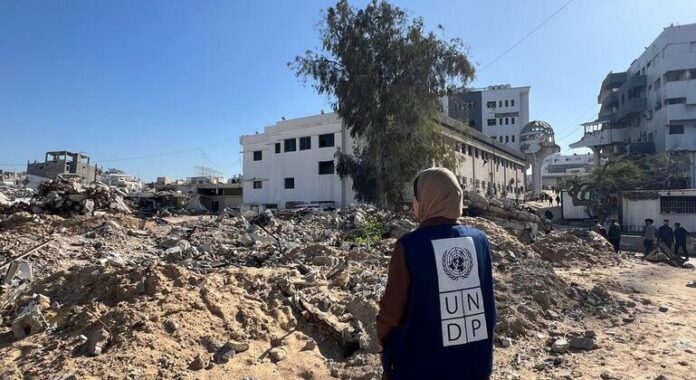
“I just spent my first week in Gaza earlier this month. And really nothing prepares you for the scale of the destruction. You can read the reports, study the numbers, but standing in the street in the middle of endless metres-high piles of rubble is something else entirely.”
Tents, rubble and rats
Across Gaza, most Palestinian families remain displaced, the veteran humanitarian noted. “They live in tents amidst the rubble, dependent on humanitarian assistance for the most basic of their needs. And despite the ceasefire, airstrikes, shelling and gunfire continued.”
In addition to those dangers, more than 17,000 cases of rodent-linked infections have been reported so far this year among Gaza’s displaced and more than 80 per cent of displacement sites report skin infections, such as scabies, lice and bed bugs – “the unfortunate but predictable consequence when people live in a collapsed living environment”, the WHO official said.
“For WHO and the health partners, we need to have a better understanding on the diseases that are affecting the people in Gaza. We therefore need laboratory equipment and supplies to enter Gaza. As many of you know, this equipment and supplies do not enter Gaza, which leaves us blind.”
To address this growing health threat “things need to change”, Dr Van de Weerdt insisted. “Health and healthcare workers need to be protected; essential medicines and supplies must enter Gaza. Bureaucratic processes and access restrictions on these globally recognised essential medicines and supplies must be removed.”
‘Dynamic threat’
Echoing that message, the head of the UN Mine Action Service (UNMAS) in the Occupied Palestinian Territory underscored the ever-present danger from unexploded ordnance across the shattered enclave.
The lethal threat is now “essentially ingrained or embedded in the debris at this point in time,” said Julius Dirk Van Der Walt, Chief of UNMAS, in the OPT.
“We’ve barely scratched the surface in understanding what is the level of contamination that we will be encountering in Gaza,” he continued.
“What we do know is that this will be a dynamic threat…you will have families returning to their homes; a father would maybe walk into the house, find a hand grenade, wanting to move it away from his children.”
The new season of “Mask Singer” kicked off this Friday, April 24, 2026 on TF1. And like every year, spectacular costumes, mysterious performances and improbable investigations were there. But from this first bonus, an elimination has already caused a lot of talk… and especially cringe.
An evening full of surprises… and already an elimination
From 9:10 p.m., host Camille Combal launched the festivities, surrounded by a now well-established quartet of investigators: Kev Adams, Chantal Ladesou, Laurent Ruquier and Michaël Youn.
On stage, the first characters of the season made their entrance: the Owl, the Lawyer, the Russian Dolls, the Chick and even the Cyborg. Ever more impressive costumes, designed to cover their tracks. The evening was punctuated by two duels: the Chick facing the Cyborg, the Owl, the Lawyer and the Russian Dolls.
Sent on hold, the Cyborg finally managed to convince the audience present on set. Result: the Lawyer found himself eliminated in this first episode.
A well-known actress in the costume of the Lawyer
Then comes the long-awaited moment: the unmasking. Under the costume of the Lawyer hid Firmine Richard. A revelation which marked viewers, as the actress is known to the general public.
She notably starred in cult films such as 8 Women, La Première Étoile and Maison de retirement. A popular figure… but whose early elimination was not unanimous.
Angry Internet users
On social networks, and in particular on Twitter (X), reactions were quick to flow. And they are far from being positive.
Many viewers point the finger at a casting considered less impressive than in previous years: “Supposedly the biggest casting in history… it’s off to a good start”, “I’m convinced that under one of the costumes, it’s either my neighbor… or a forgotten celebrity”. A feeling of disappointment seems to set in, with some regretting a lack of big surprises.
Another point of frustration: broadcasting in competition with Beijing Express on M6. Many viewers had to juggle between the two programs, which also caused some frustration.
#PékinExpress because of the stupidity of M6 and its incoherent programming for us viewers, I will have to wait until tomorrow morning to find out the rest of Pekín express…a choice had to be made and mask singer is too tempting!