A new project is launched aiming to help protect and increase the security of places of worship. “The SHRINES project recently established the European network for safety and security management in places of worship.” said one of the partners of the project.
The Network aims to promote awareness and dialogue among managers of places of worship of different religions about the threats they face and the use of technological solutions to better protect these places. According to their staff, it also aims to facilitate the exchange of knowledge, tools and good practices among different stakeholders “involved in managing places of worship (e.g., local municipalities, cultural associations, law enforcement agencies)”.
Project SHRINEs aims at engaging a wider network of organisations and authorities, which they hope it will provide fruitful benefits for the protection of places of worship, including people, historical and cultural sites and heritage.
"This 24-months ISF-funded project aims to enhance the security and safety of places of worship, creating a multidisciplinary network and promoting innovative solutions against current & emerging threats.".
Therefore, SHRINEs has established a European network for safety and security management in places of worship to facilitate the exchange of knowledge, tools, and good practices among different stakeholders involved in managing places of worship.
The network aims to promote awareness and dialogue among managers of places of worship of different religions about the threats they face and the use of technological solutions to better protect these places.
“The protection of places of worship has become crucial as these public spaces continue to represent high-risk areas in the context of criminal activities, man-made attacks, as well as infrastructural incidents and natural disasters. SHRINEs, a project co-funded by the EU, aims to enhance the security and safety of places of worship, while creating an interfaith and multidisciplinary network and promoting innovative solutions against current risks and emerging threats.” says their website.
For millennia, humans have been fascinated by the mysteries of the cosmos. From ancient civilizations such as the Babylonians, Greeks, and Egyptians to modern-day astronomers, the allure of the starry sky has inspired countless quests to unravel the secrets of the universe.
Research by the Atacama Cosmology Telescope collaboration has culminated in a groundbreaking new map of dark matter distributed across a quarter of the entire sky, reaching deep into the cosmos. Findings provide further support to Einstein’s theory of general relativity, which has been the foundation of the standard model of cosmology for more than a century, and offer new methods to demystify dark matter. Image credit: Lucy Reading-Ikkanda/Simons Foundation
Although models explaining the cosmos have been around for centuries, the field of cosmology, in which scientists employ quantitative methods to gain insights into the universe’s evolution and structure, is comparatively nascent. Its foundation was established in the early 20th century with the development of Albert Einstein’s theory of general relativity, which now serves as the basis for the standard model of cosmology.
Now, a set of papers submitted to The Astrophysical Journal by researchers from the Atacama Cosmology Telescope (ACT) collaboration has revealed a groundbreaking new image that shows the most detailed map of matter distributed across a quarter of the entire sky, reaching deep into the cosmos. It confirms Einstein’s theory about how massive structures grow and bend light, with a test that spans the entire age of the universe.
“We’ve made a new mass map using distortions of light left over from the Big Bang,” says Mathew Madhavacheril, lead author of one of the papers and assistant professor in the Department of Physics and Astronomy at the University of Pennsylvania. “Remarkably, it provides measurements that show that both the ‘lumpiness’ of the universe and the rate at which it is growing after 14 billion years of evolution are just what you’d expect from our standard model of cosmology based on Einstein’s theory of gravity.”
The authors note that the lumpiness quality is attributed to the uneven distribution of dark matter throughout the universe and that its growth has remained consistent with earlier predictions. And, despite making up 85% of the universe and influencing its evolution, dark matter has been hard to detect because it doesn’t interact with light or other forms of electromagnetic radiation. As far as we know dark matter only interacts with gravity.
Funded by the National Science Foundation, the ACT was built by Penn and Princeton University and started observations to track down the elusive dark matter in 2007. The more than 160 collaborators who have built and gathered data from ACT, which is situated in the high Chilean Andes, observe light emanating following the dawn of the universe’s formation, the Big Bang—when the universe was only 380,000 years old. Cosmologists often refer to this diffuse light that fills our entire universe as the “baby picture of the universe,” but formally it is known as cosmic microwave background radiation (CMB).
The team tracks how the gravitational pull of large, heavy structures including dark matter warps the CMB on its 14-billion-year journey to us, like how a magnifying glass bends light as it passes through its lens.
“When we proposed this experiment in 2003, we had no idea the full extent of information that could be extracted from our telescope,” says Mark Devlin, the Reese Flower Professor of Astronomy at the Penn and the deputy director of ACT.“We owe this to the cleverness of the theorists, the many people who built new instruments to make our telescope more sensitive and the new analysis techniques our team came up with.”
Penn researchers Gary Bernstein and Bhuvnesh Jain have led research mapping dark matter by using visible light emitted from relatively nearby galaxies as opposed to light from the CMB. “Interestingly, we found matter to be a little less lumpy than the simplest theory predicts,” Jain says “However, Mark and Mathew’s beautiful work on the CMB agrees perfectly with the theory.”
Image credit: Lucy Reading-Ikkanda/Simons Foundation
“The stunning ACT dark matter maps severely narrow down the times and places where the simplest theory could be going wrong,” Bernstein says. “One speculation is that a new feature of gravity or dark energy is appearing just in the last few billion years, after the era ACT is measuring.”
ACT, which operated for 15 years, was decommissioned in September 2022. Nevertheless, more papers presenting results from the final set of observations are expected to be submitted soon, and the Simons Observatory will conduct future observations at the same site, with a new telescope slated to begin operations in 2024. This new instrument will be capable of mapping the sky almost 10 times faster than ACT.
According to the EEA briefing, greenhouse gas emissions from heavy-duty vehicles increased by about 29 % from 1990 to 2019. These vehicles are currently responsible for about a quarter of total road transport emissions in the EU. Moreover, emissions from heavy-duty vehicles have increased every year since 2014, except for the 2020 decline caused by the COVID-19 pandemic.
The EEA analysis shows that the efficiency gains that have been achieved in vehicles and transport operations have been outpaced by the growing demand for freight transport, ultimately leading to continued growth in emissions.
To reduce total emissions from heavy-duty vehicles, improvements in vehicle fuel efficiency need to continue, but further efforts are also necessary. Shifting freight transport from road to rail and passenger transport from cars to buses and coaches offers an important pathway to emissions reductions. Further, reducing the number of trips or their length are important measures to reduce overall emissions, the EEA briefing notes.
The EU Member States have committed to achieving climate neutrality by 2050, and the European Green Deal seeks a 90% reduction in greenhouse gas emissions from transport, compared with 1990 level.
The EEA briefing ‘Soil carbon‘ provides an overview of carbon pools in and greenhouse gas emissions from Europe’s organic and mineral soils, based on 2019 data.
EU Member States reported loss of carbon from organic soils that corresponds to about 108 Megatonnes of carbon dioxide (Mt CO2) emissions in 2019. In the same year, mineral soils removed about 44Mt of CO2 from the atmosphere. The net greenhouse gas emissions from soils, about 64Mt of CO2 equivalent, corresponded to just under 2% of the overall EU net emissions in 2019, or about half of the EU share of emissions from international aviation.
About three quarters of EU organic soils are in just two Member States, Sweden and Finland, the EEA briefing shows. Overall emissions from organic soils are by far highest in Germany, due to the high share of its organic soils under cropland and grassland. The highest carbon losses per hectare originate from peat extraction, mainly in Finland, Ireland, Latvia, Estonia and Germany.
There are mitigation options, such as peatland restauration or agroforestry, to increase the carbon sequestration of soils and decrease carbon losses, which in many cases can also benefit for example biodiversity or water quality. Depending on the soil type, local climate and how the land is managed, however, mitigation actions can increase emissions of other greenhouse gases, such as methane (CH4) and nitrous dioxide (N2O), or have negative consequences on biodiversity or food production.
The EEA briefing also highlights the importance of developing and using scientifically sound methods for estimating the climate impacts of different land management practices, as well as their impact on nature restoration.
Overall, the EU land use, land use change and forestry (LULUCF) sector is a significant carbon sink that removes CO2 from the atmosphere. However, there are large differences between countries because of the size of the country, how the land is used and the type of soils. The EU has committed to reducing its net greenhouse emissions by 55% by 2030, compared with 1990 levels, and become carbon neutral by 2050.
The European Aviation Environmental Report 2022 (published on EASA website) looks at the historic and future scenarios of air traffic and its associated noise and emissions. It also summarises the latest scientific understanding of these impacts before focusing on five main impact mitigation areas (technology and design; sustainable aviation fuels; air traffic management – operations; airports and market-based measures) with recommendations on how to further improve the level of environmental protection.
Welcoming the report as a key instrument to support evidenced-based policy-making, European Commissioner for Transport Adina Vălean commented: “Considerable action has already been taken since the last edition of this report in 2019. This is reflected, for instance, in ever lower CO2 emissions per passenger kilometre and improved noise performance of aircraft. But the report shows scope to go further – with Sustainable Aviation Fuels showing particular potential, in line with our EU policy approach.”
EASA Executive Director Patrick Ky stated: “Safety is a core element of the culture within the aviation sector and this commitment is reflected at all levels to ensure successful and effective business operations. The European Green Deal means that these same principles now need to be applied to the strategic issue of environmental protection, to ensure the long-term viability of the industry. EASA stands ready to play its role in achieving this.”
EEA Executive Director Hans Bruyninckx added: “As a key part of our mobility system, the aviation sector must fully contribute to achieving the Union’s climate and environment goals. Fully reflecting the costs from aviation environmental and climate impacts within market prices and enhancing the consistency of taxation across sectors would provide meaningful incentives to accelerate the transition of the EU transport sector towards sustainability.”
EUROCONTROL Director General Eamonn Brennan stressed: “This important report shows that as an industry we have already made substantial steps to achieve our sustainability goals. We have made major advances on the operational side. However, we now need to urgently move forward on the issue of how we power our aircraft in the most sustainable way possible while moving towards zero emission aircraft in the medium to long term. All of this has a cost, and this must be addressed on a systemic level.”
While the number of flights at EU27+EFTA airports dropped dramatically from 9.3 million in 2019, to respectively 4.12 million and 5.07 million in 2020 and 2021 due to the pandemic, longer-term trends show that the region will be home to some 12.2 million annual flights by 2050, with aircraft CO2 emissions potentially rising to 188 million tonnes, unless environmental protection is further mainstreamed across the sector.
Recognising the multiple European and industry goals that have been established over the last three years, the report highlights the need to independently monitor progress to ensure transparency, accountability, credibility and ultimately establish trust that the measures in place will meet the agreed targets.
About the report
The report is produced by the European Union Aviation Safety Agency (EASA) in accordance with Article 87 of its Basic Regulation 2018/1139, with support from the European Environment Agency and EUROCONTROL, and places aviation in the context of the new European Green Deal as well as European industry’s Destination 2050 initiative and the Toulouse Declaration of reaching carbon neutrality by 2050 in line with the EU economy-wide objective. This joint collaboration, with input from stakeholder groups, ensures the report is a balanced and comprehensive summary on the topic of aviation environmental protection within Europe.
A full overview of key facts can be found in the Executive Summary of the report, alongside recommendations on how to further improve the level of environmental protection.
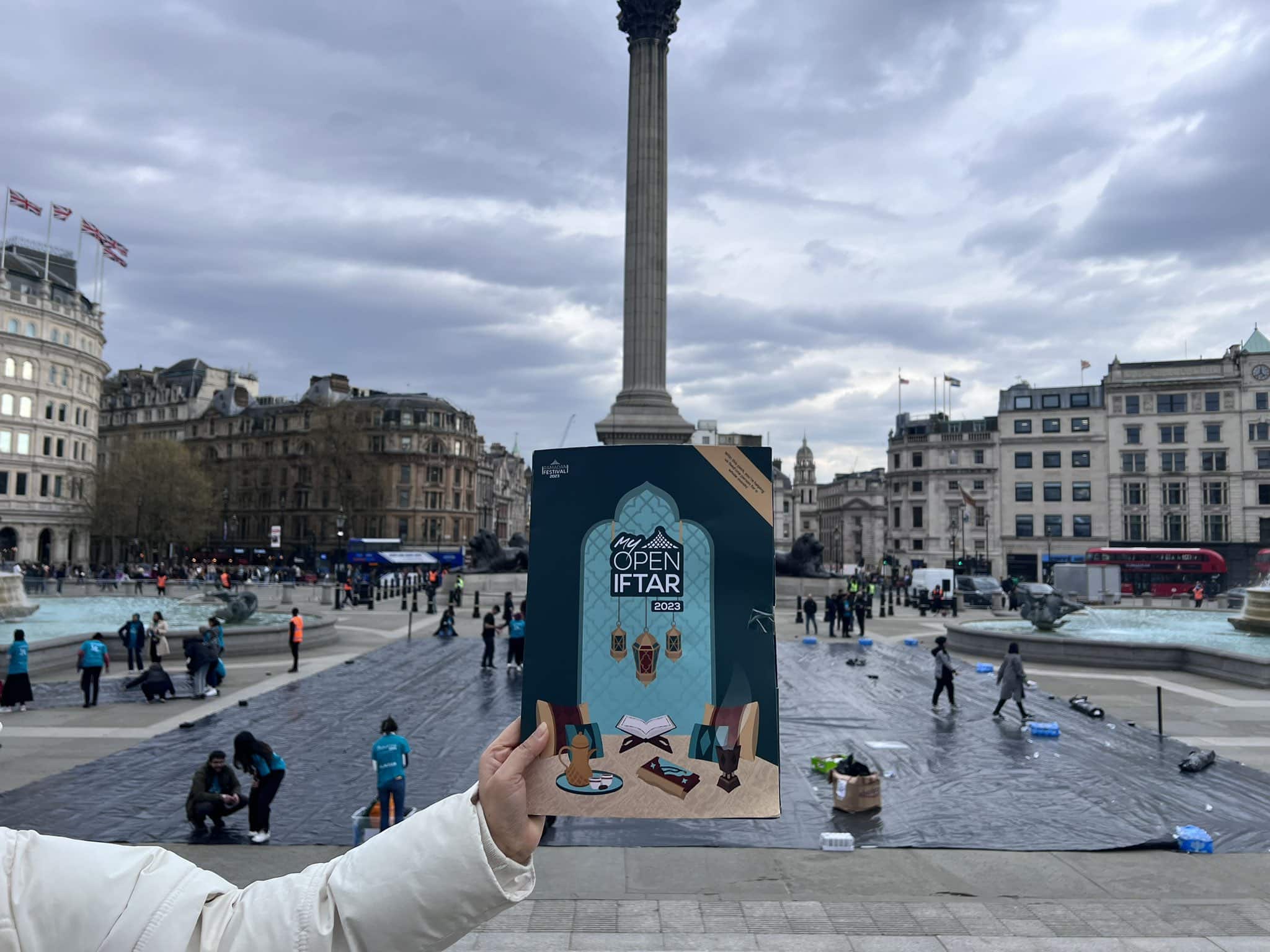
On Thursday a colleague and I were invited to attend Europe’s largest Open Public Iftar in Trafalgar Square by the Aziz Foundation. Thousands of people attended. For those that don’t know, Iftar is the fast-breaking meal at the end of every day during Ramadan, when fasting occurs from dawn to dusk. It’s a spiritual tradition of millions of Muslims around the world and it was shared with anyone, Muslim or not, in Trafalgar Square. It was not only in Trafalgar Square that this happened, but in homes of Muslims around the UK and elsewhere throughout the whole period of Ramadan.
Ramadan is a time for giving and reflection for Muslims. It is a time for self-discipline and to think of those less fortunate (though children, pregnant women, elderly people and those who are ill or travelling are not obliged to fast). It is even good for your health allowing the body to regain a certain equilibrium and similar dietary regimes are advised by many health practitioners today (keto diet, intermittent fasting etc.)
But back to Trafalgar Square. What strikes me is that such an event can happen in London, in the UK, in one of the most iconic places in the city with the approval and agreement of the public authorities. It shows a real welcoming of other faiths into the fabric of British society. God knows (if I may use that expression), and no doubt He does, there is much to be fixed in British society – though one enormous positive is that this festival could happen in a public place celebrated by all who wish to attend.
It says something for the British spirit of understanding and tolerance, that we do not have to be rigid in our approach to religion. That we can welcome all religions and that people of all religions are British. There’s nothing but positive about that.
In contrast, I cannot imagine a Big Iftar being held in Place de la Concorde or, heaven forbid, La Bastille. Shock and horror! “We are being overrun by foreign hoards” would, I imagine, be the gut reaction whilst the intellectual one is that “separation of Church and State requires a strict divide where nothing religious can even fractionally impose in the public space”. For me, whilst I have no problem with the principle of separation of Church and State, I do have a problem with the extreme application of that principle where the non-religious dogma of secularism is imposed on others with a rather equivalent vehement determination that would, in religious terms, be attributed to a fanatic.
I have only to look at some fairly recent French Court decisions that enforced the removal of religious statues on public ground, even when the majority of the townspeople wanted the statue to remain.
To forbid the encroachment of religion into the public space to such a degree is to me just as fanatical as trying to enforce an overpowering religious law on everyone in a society. The non-religion of secularity becomes fascist.
But again, back to Trafalgar Square. I for one was happy, and also very touched, to see a group of ladies in headscarves close to me in a small group saying prayers together as Iftar approached. I saw kindness on their faces and a rather beautiful expectation of their faith.
I was glad that it was arranged for prayer mats to be laid down in the Square so that men could prostrate themselves before their God. I might not be a Muslim, but they are certainly not doing me any harm – to the contrary they helping the world in many ways through their charitable activities – and who am I to say how they should practice their faith? And why should I be bothered? Of course, I am not, though some who are rather more small-minded could find all manner of reasons to grumble.
Last night it was fantastic to come together with Londoners of all backgrounds at Trafalgar Square for the last iftar of Ramadan with @RamadanTent. Their values of charity and hospitality demonstrate why diversity is our city’s greatest strength.
— Mayor of London, Sadiq Khan (@MayorofLondon) April 21, 2023
One of these could be that speakers at the event included the Mayor of Westminster and the Lord Mayor of London – both are Muslims. At that, I hear grumblings again of ‘being taken over’. But they are British and have every right to stand for public office. And the vast majority of their fellow counsellors and political colleagues to who they are accountable are not at all Muslim and from many other faiths and none – so I don’t think that argument holds any water either.
I am glad that we have a vibrant interfaith society in the UK. Of course, there are issues, but what exists is already a vital building block of understanding and inclusivity which speaks well of the UK approach to religion. It also shows in that the new King himself has publicly announced he is Defender of Faith (not the Faith i.e.one faith). We also see other minority religious festivals celebrated in a similar way to the Big Iftar. For example, not so long ago the Hindu festival of Divali, the festival of lights, was also celebrated in Trafalgar Square. Most people are of good faith, religious or not. Look for the nay-sayers where there are problems. They are likely the ones generating conflicts.
New technology improves capability to monitor exact locations in the body.
The idea of journeying inside the human body to solve health problems has been around at least since science fiction popularizations, but the approach to medicine has yet to become real.
Smart pills help diagnose gut disorders. Image credit: Researchers at Caltech
Now, researchers at Caltech have developed what they describe as GPS for smart pills, small enough to travel through the human body and help diagnose ailments. The smart pills can collect health data, record images and even deliver drugs as they pass through the gastrointestinal, or GI, tract.
However, a smart pill must know its location in the body to do its job well. “Wireless localization of smart pills and other tiny devices deep inside the body, with high accuracy, is very challenging,” says electrical engineer Azita Emami. “A low-cost solution could open new avenues in diagnosing and treating common medical conditions.”
Chemical and biomedical engineer Mikhail Shapiro says there are three possible ways to access locations inside the body to see what is going on.
“We can place something inside like a colonoscopy device, cut the body open, or you can swallow a little pill that makes the relevant measurements,” Shapiro says. “I think most people would choose the latter if it provides the performance needed to diagnose and treat them.”
Surgeon wearing a mask during surgery – illustrative photo. Image credit: NCI
Caltech researcher Saransh Sharma developed the smart-pill technology with Emami and Shapiro. It was tested in collaboration with researchers at the Massachusetts Institute of Technology. A paper describing the work appears in the journal Nature Electronics. The research was supported in part by the U.S. National Science Foundation.
The technology has been dubbed iMAG, short for Ingestible Microdevices for Anatomic-mapping of Gastrointestinal-tract. It is not the first implementation of a trackable smart pill, but its creators say it is the most accurate and easiest to follow.
Emami says monitoring digestive tract motility has commonly required a patient to drink multiple “markers” then be X-rayed later to see how far the markers have moved. “That doesn’t show dynamic movement, though,” she says. “What we are doing shows real-time movement, and there is the possibility that we could add drug delivery or sensing to the smart pill.”
Emami says previous attempts at real-time movement tracking of smart pills relied on what is known as radio frequency triangulation; the pill was essentially a radio beacon. Although RF triangulation works, it cannot pinpoint the location of a smart pill with a resolution better than a few centimeters, which is not accurate enough to pinpoint where a pill is sitting in the twists and turns of the intestines. The iMAG pill, however, has the potential to be located with submillimeter accuracy, Emami says.
“For indigenous peoples, the land, the forest, water, is life. We depend on the natural environment, and we care for our surroundings. Managing natural resources is a strong part of our way of life. For example, the way we use rotational farming, avoiding monocultures by planting several different many different types of crops on our farmland.
In indigenous cultures, we look at a woman’s kitchen. If she has a wide variety of native seeds, it means that she is hardworking, and a valuable member of the community! To us, this is a greater indicator of wealth than money.
Naw Ei Ei Min, Executive Council Member of the Asia Indigenous Peoples Pact.
A strong international voice
I started out at the Asia Indigenous Peoples Pact, an organization representing 14 Asian countries, which advocates for indigenous peoples at the General Assembly. I decided to focus on the role that indigenous peoples play in protecting biodiversity.
When it comes to the environment, and issues related to biodiversity, our voices are stronger than ever before at the international level. At the UNFCCC (the UN body responsible for the UN Climate Conferences), there is now a local community and indigenous people platform.
This is a major achievement for indigenous peoples, providing a space for indigenous knowledge and means that we can take part in the decision-making process.
But those changes also need to extend to national, regional and community levels. Real change needs to happen on the ground. The complex way of negotiating international agreements sometimes does not fit with the way we communicate; there still needs to be more equity, in terms of our participation, and giving a voice to those of us who are concerned with climate change.
Climate action and climate justice
If the natural environment is destroyed, then so is our traditional way of life. Indigenous peoples are dealing with the effects of climate change on a daily basis, on the ground, on their lands and in their communities.
We are facing threats from climate change, and also from the continuous exploitation of natural resources. That’s why climate justice is so important. We need take the views of indigenous peoples into account, if we are to find lasting solutions to the crisis.”
Naw Ei Ei Min represents Asia at the UN Permanent Forum on Indigenous Issues. She spoke to UN News during the 22nd session of the Forum, held at UN Headquarters between 17 and 28 April.
The General Assembly designated 22 April as International Mother Earth Day through a resolution adopted in 2009.
The United Nations celebrates this observance through the Harmony with Nature initiative, a platform for global sustainable development that celebrates annually an interactive dialogue on International Mother Earth Day.
Topics include methods for promoting a holistic approach to harmony with nature, and an exchange of national experiences regarding criteria and indicators to measure sustainable development in harmony with nature.
In a parchment on which the work of an early medieval author was written, scientists found a description of a meteoroscope – a unique instrument of an ancient astronomer, which until now was known only from indirect sources.
An article has been published in the journal Archive of History of Exact Sciences, the authors of which examine an 8th-century manuscript discovered in the Abbey of Bobbio in northern Italy. This manuscript contains the Latin text of the “Etymologies” of the early medieval scholar and one of the Church Fathers – Isidore of Seville.
The manuscript was discovered as early as the 19th century, when researching the scriptorium of the abbey. Several hundred manuscripts dating from the Early Middle Ages have been found there. It is believed that this scriptorium is described in Umberto Eco’s novel The Name of the Rose. The collection is now housed in the Ambrosian Library in Milan. The 8th century manuscript is, of course, an extremely valuable historical monument. But the authors of the new work claim that the book is actually even older and more valuable. Examination of the pages has shown that at least some of them are palimpsests. This is what they call manuscripts written on parchment that has already been used. During the Dark Ages, parchment was very expensive and the monks who worked in the scriptorium invented various methods to allow it to be reused.
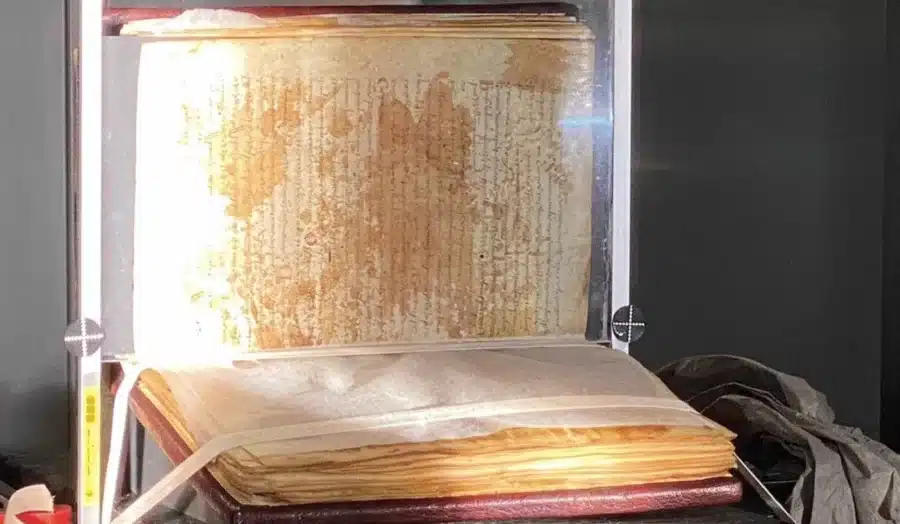
Fifteen palimpsests were found under Isidore of Seville’s text, which had previously been used for three Greek scientific texts: a text with an unknown author on mathematical mechanics and a catoptric (a section on optics) known as the Fragmentum Mathematicum Bobiense (three leaves), Ptolemy’s treatise “Analema” (six leaves) and an astronomical text that was hitherto unidentified and almost completely unread (six leaves). Using multispectral imaging methods, the scientists were able to reveal the hidden ink and examine the text, accompanied by a number of illustrations. They claim that this manuscript belongs to the ancient Roman astronomer Claudius Ptolemy. In addition, the manuscript is unique, there are no other copies.
Ptolemy, who lived in the 2nd century in Roman Egypt (mainly in Alexandria), was one of the most significant scholars of Hellenism and Rome. As an astronomer he had no equal either in his lifetime or for many centuries afterwards. His monograph Almagest (originally titled Syntaxis Mathematica) is an almost complete collection of astronomical knowledge about Greece and the Near East.
Another Roman scholar, Pope of Alexandria (the years of his life are unknown, presumably III-IV century), wrote quite detailed commentaries on the Almagest, from which it is clear that Ptolemy’s work has not reached us in its entirety. For example, Papp mentions the meteoroscope, an ancient instrument designed to determine the distance to celestial bodies, a variant of the armillary sphere. The authors of the new study claim to have found in the palimpsest exactly that part of Ptolemy’s manuscript in which he describes the device of the meteoroscope. This device was a complex assembly of nine metal rings connected in a special way.
According to scientists, it can be used to solve a variety of problems, such as determining the latitude in degrees from the Equator, the exact date of the solstice or equinox, or the apparent position of the planet in the sky. Its diameter was about half a meter. The device of the meteoroscope, the research says, is described in such detail that you can go with this text to a good metal worker and he will assemble the instrument. At the same time, there are practically no recommendations on how to conduct astronomical observations. The latter is very strange for Ptolemy – the rest of his works demonstrate the pedantry of the ancient scientist.
But researchers have no doubts about the authorship: Ptolemy had a very characteristic style and vocabulary. The authors of the work hope to find a continuation of the manuscript in possible palimpsests in other manuscripts from the collection of the Bobbio Abbey scriptorium. The ancient parchment may have been divided into pages and used by several scribes working on different manuscripts.
Photo: A much older text Alexander Jones et al is hidden under a copy of a work by Isidore of Seville.
It is made of a flexible and stretchable polymer containing embedded electronics and medication
Scientists from the California Institute of Technology have developed a “smart” wound dressing that supports tissue regeneration and controls the healing process, reports the site of the educational institution.
In most cases, when someone cuts, scrapes, burns, or gets another wound, the body takes care of itself and heals itself. However, diseases such as diabetes can interfere with the healing process and lead to wounds that do not heal and can become infected and fester.
These chronic wounds are not only debilitating for the people who suffer from them, but also a burden on healthcare systems.
A smart dressing developed by specialists from the California Institute of Technology could make the treatment of such wounds easier, more effective and cheaper.
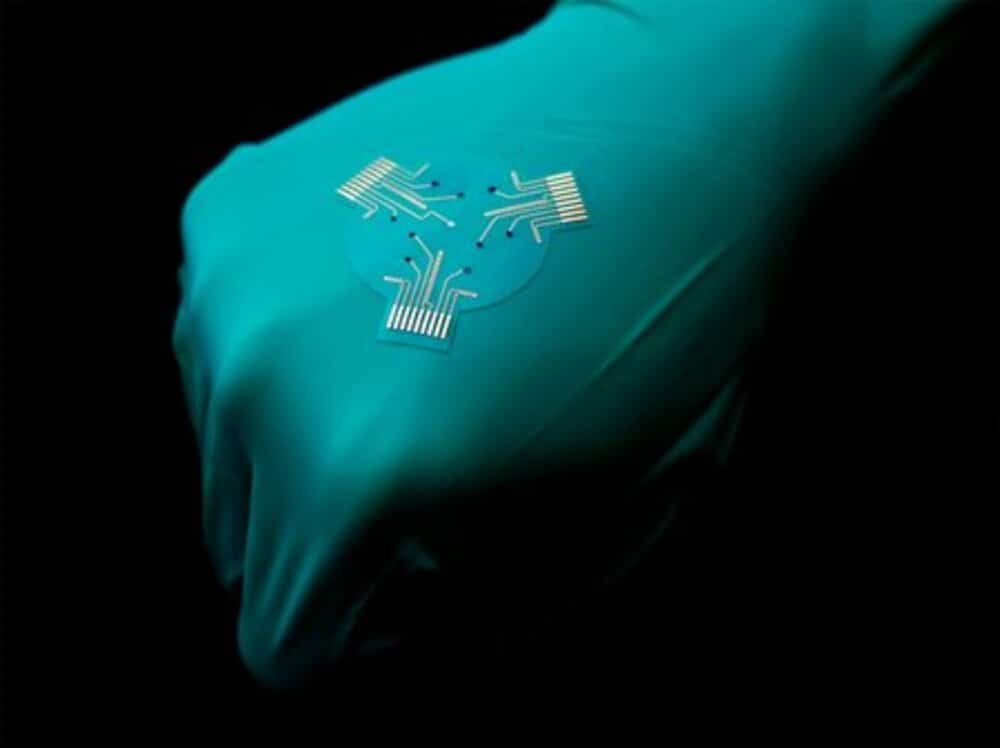
The “smart” bandage is made of a flexible and stretchable polymer containing embedded electronics and medication. Inside it are sensors that monitor the patient’s condition (temperature, inflammation, presence of infection).
The dressing can be connected to a smartphone or computer to transmit real-time data on the condition of the wound. It can also release antibiotics and apply a weak electric field to stimulate its healing.
The developers note that tests with animal models have yielded promising results. Their next goal is to perfect the technology and test the “smart” bandage on humans.